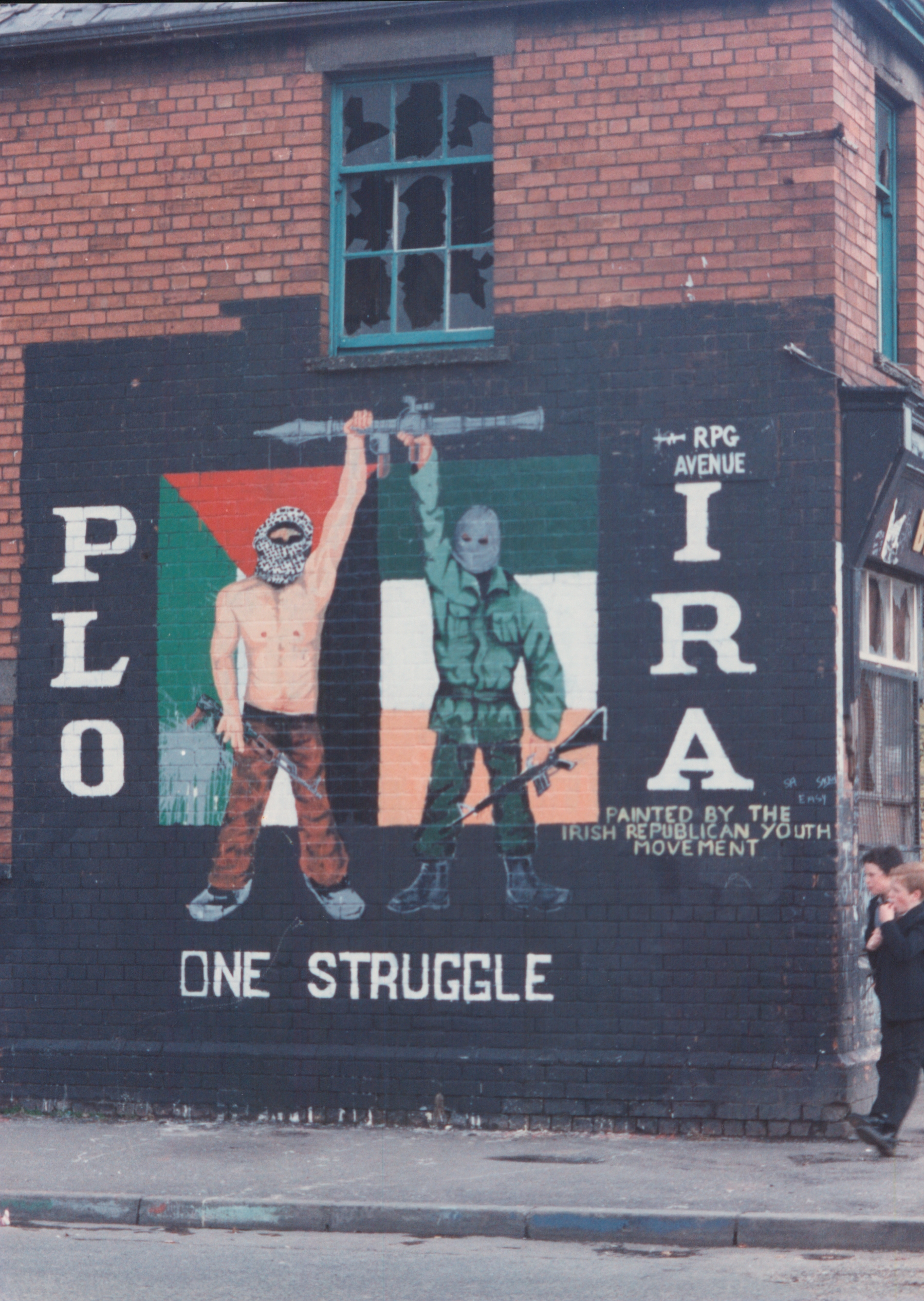
The main panel, of three IRA volunteers with raised weapons, was painted by Sean ‘Conker’ Connolly, presumably based on or inspired by the poster below.
Also on the wall are (below right) a Tricolour and (below left) “Sinn Fein/Gerry Adams” and a small board (at the top) with a raised fist and the slogan “Unity is strength”.
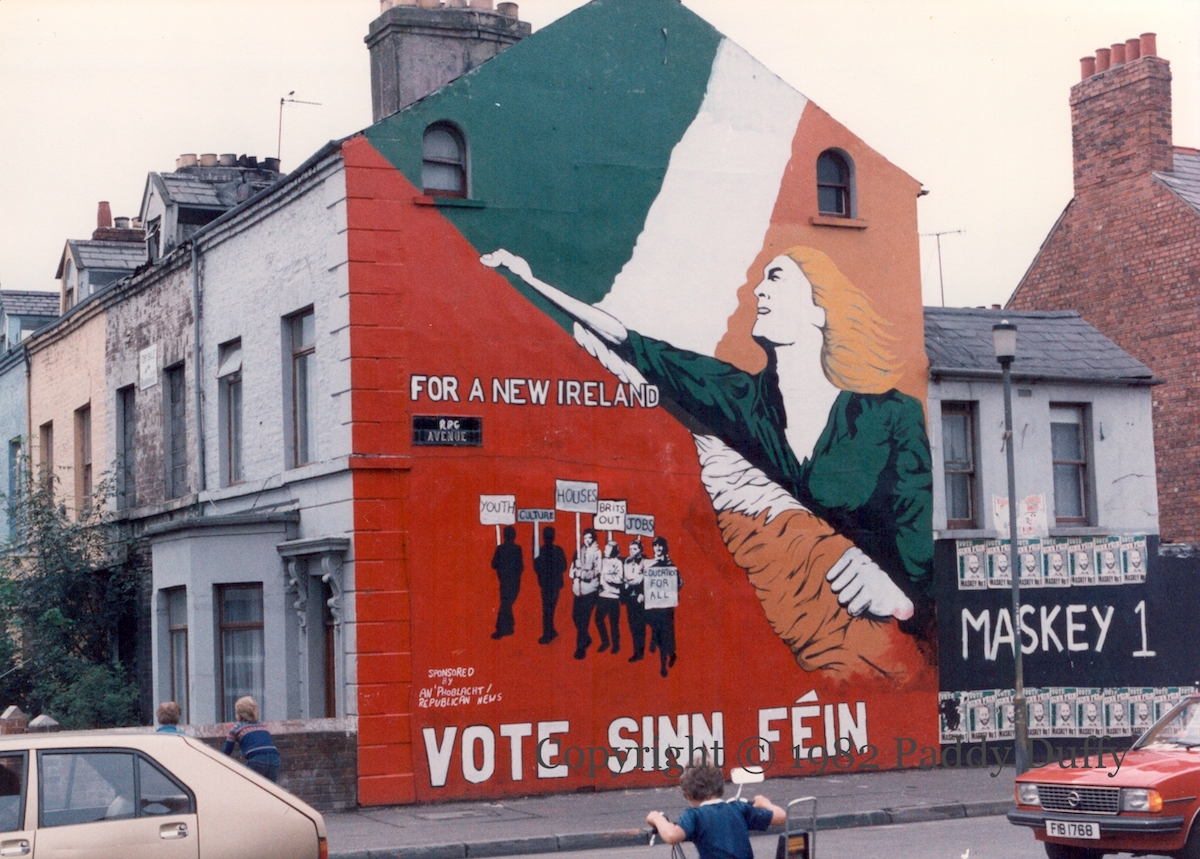
Voting for Sınn Féın is seen as the way to address the social issues named on placards carried by protestors – culture, houses, Brits Out, jobs – in order to bring about “a new Ireland”.
Sınn Féın’s electoral strategy emerged from the 1981 hunger strike, during which Bobby Sands was elected as an MP and Paddy Agnew and Kieran Doherty were elected as TDs. In October of that year, Danny Morrison famously asked at the Ard Fheıs, “Will anyone here object if, with a ballot paper in this hand and an Armalite in the other, we take power in Ireland?”
In 1983, Alex Maskey stood for Belfast City Council in a by-election [after the resignation of … whom? – please get in touch] and was successful (WP) – there are a campaign graffito and posters to the right. Shortly afterward, Gerry Adams stood in the Westminster election and was successful (ARK).
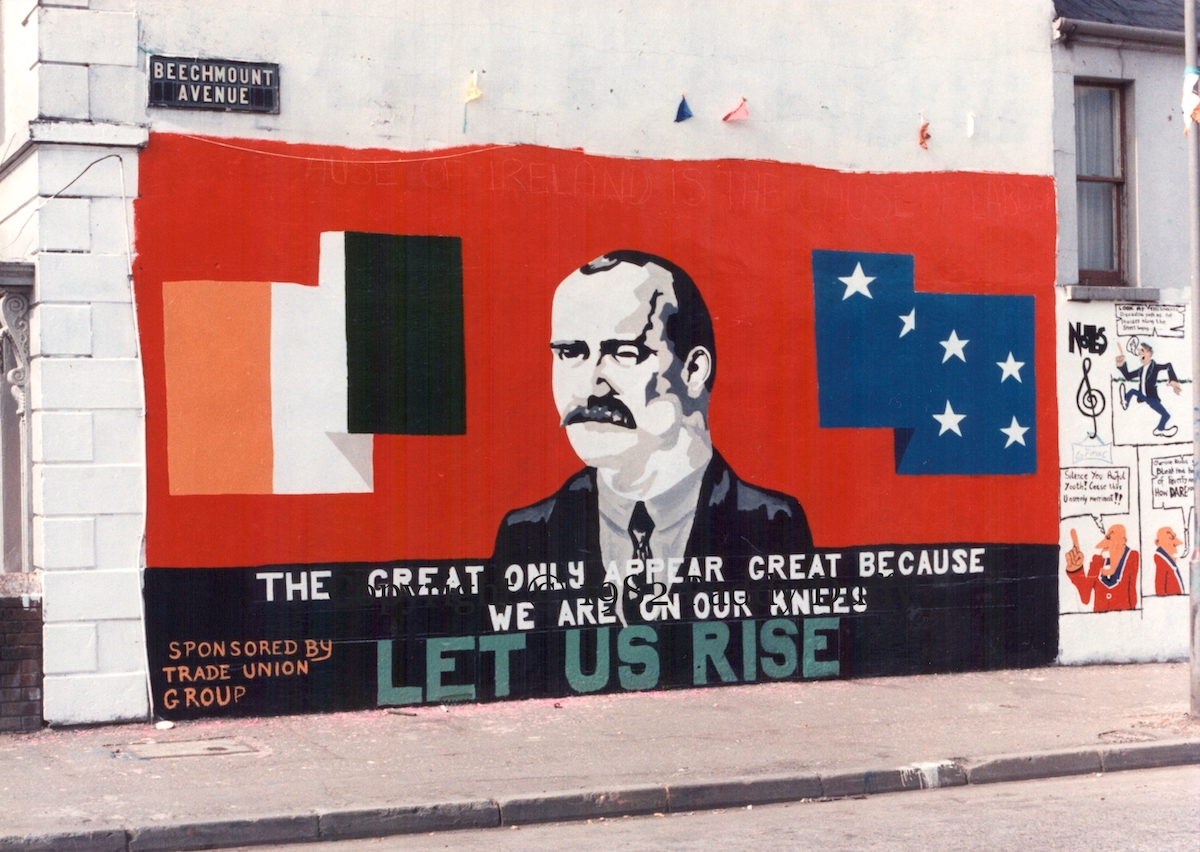
Beechmount/RPG Avenue, Beechmount, west Belfast, replacing James Connolly in Let Us Rise and Cormac’s Notes.
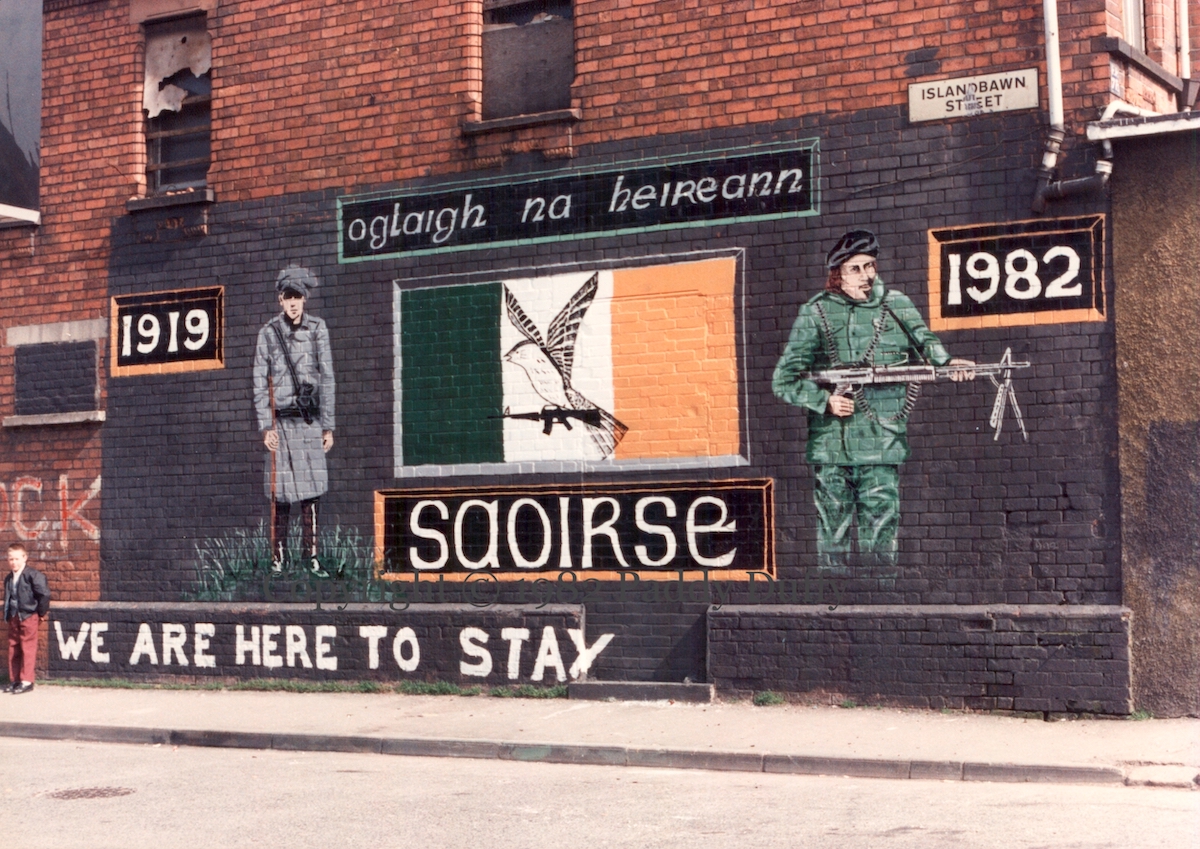
This mural celebrates the IRA (“Óglaigh Na hÉıreann” at the top) from 1919 (the army of the independent Dáıl Éıreann) to the “present” day of 1982. In the centre, a lark flies against a Tricolour, with the word “Saoırse” (“freedom”) beneath.
This is a repainted version of the original, which was one of several murals in Beechmount and the Rock streets that were paint-bombed by “marauding Coldstream Guards” (according to AP/RN of 1982-04-29) – for the damaged mural, see the Peter Moloney Collection. The “1919” date would be changed to “1916”.
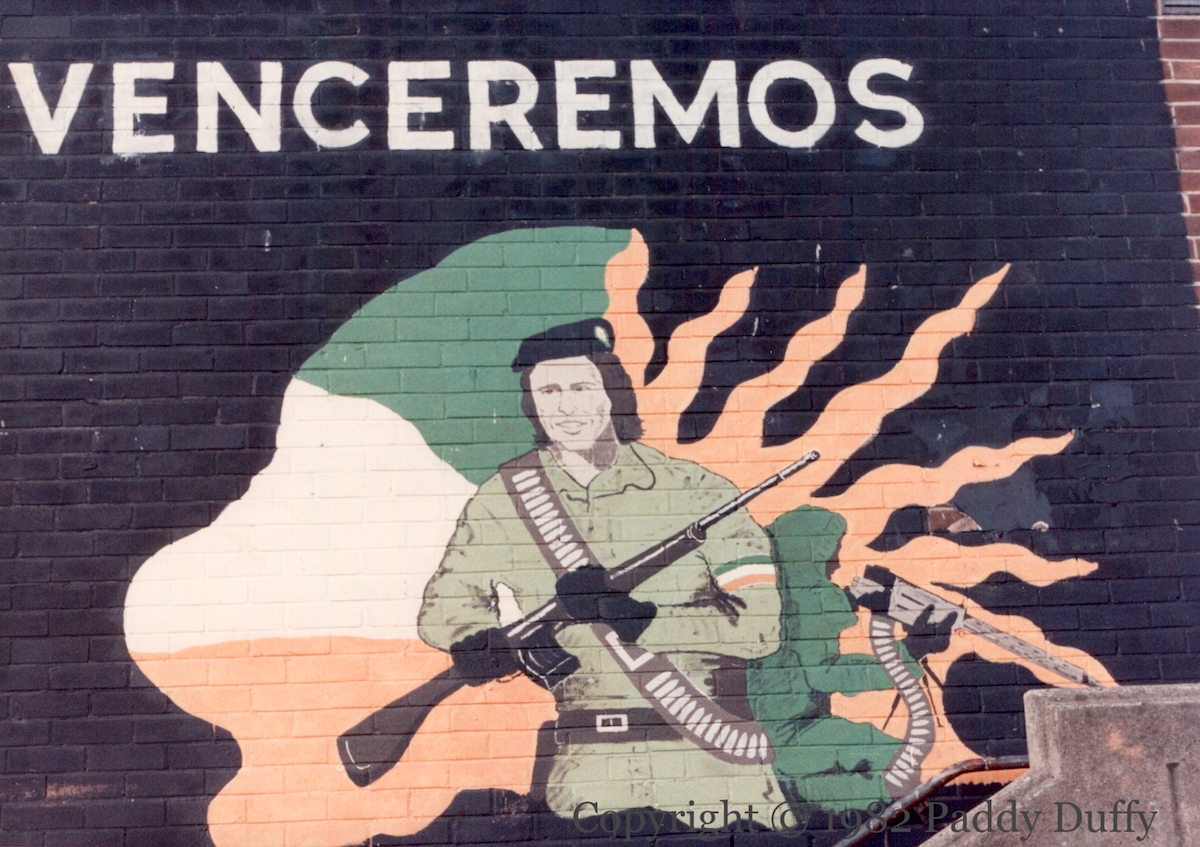
“Venceremos” is a Spanish Civil War slogan meaning “we will win (or: overcome)”, here alongside two Irish revolutionaries armed with a rifle and a machine gun, against a background of the Tricolour and sunburst flags.
Three female activists, one with a rifle, proclaim “Resistance” on the Falls Road, Belfast. The phrase is attributed to Che Guevara. The mural was commissioned by Sınn Féın’s Department Of Women’s Affairs for International Women’s Day, 1982 (March 6th). This is probably a work-in-progress image, as the words “We must grow tough, but without ever losing our tenderness” are missing from the top part of the wall and a signature – “painted by Sınn Féın Youth” – in the bottom left. Compare to the images in the Peter Moloney Collection.
This is the second mural on this wall – the first was a tribute to the first four hunger strikers to die in 1981 (see the Peter Moloney Collection). That mural was only head-high, whereas this one attempts to cover the entire wall, all the way up to the chimney – for the development of CNR muraling at this time, see Visual History 03.
In the shadow of Long Kesh watch-towers, a blanketman draped in an Irish Tricolour is held in the arms of his father, with mother looking on, reminiscent of Michelangelo’s pietà (“pity”) in which Mary holds the body of her dead son after he has been taken down from the cross (and so it also echoes Oliver Sheppard’s statue of Cúchulaınn).
Painted by Con at the top of Donegall Road, west Belfast.
The first names of the ten deceased 1981 hunger-strikers — Bobby, Francis, Patsy, Raymond, Joe, Martin, Kiersn, Tom, Micky, Kevin — appear on a ribbon held by a tricoloured phoenix against a sunburst, flanked by Starry Plough and Tricolour and volunteers firing a final salute.






 Paddy Duffy Collection