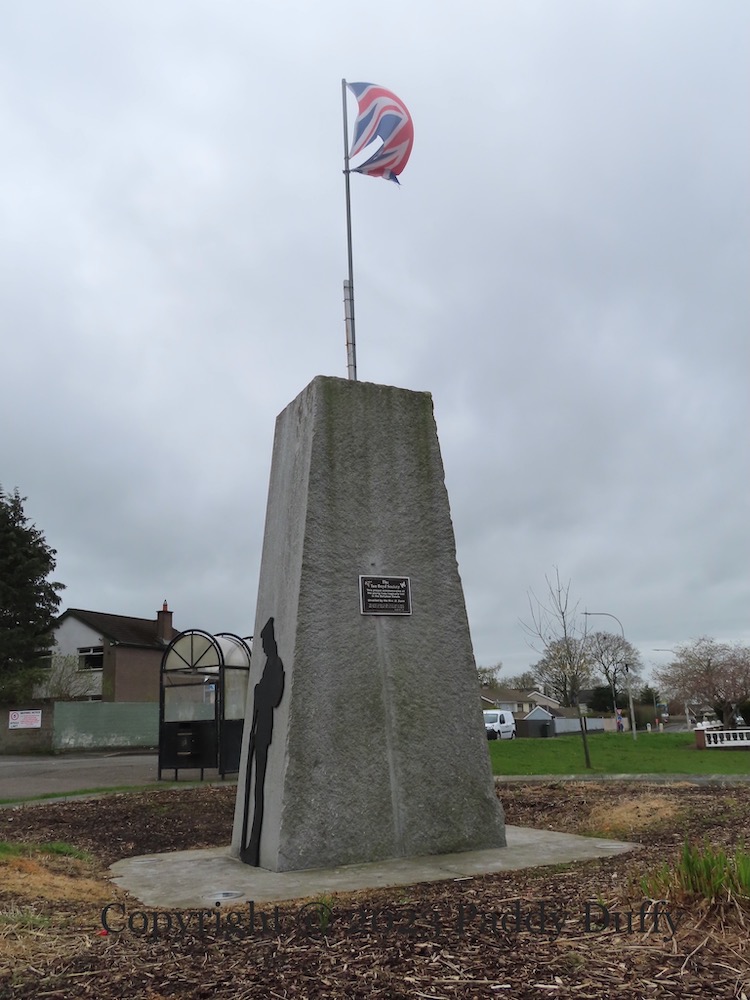
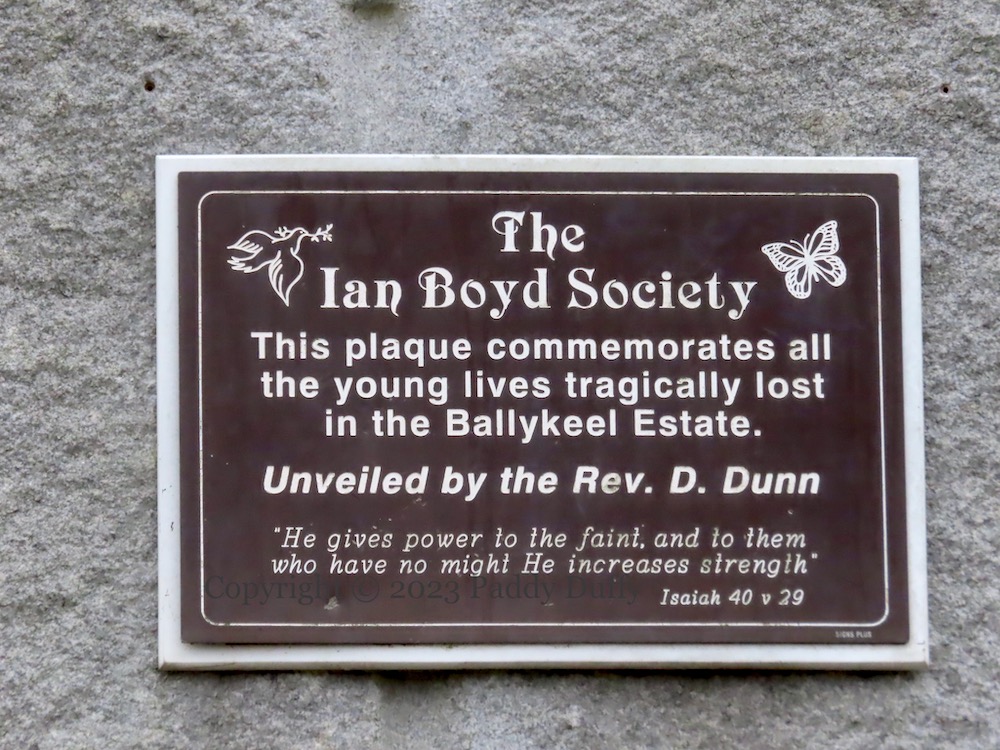
Ballykeel 2 remembers: 1690, VE Day (75th anniversary in 2020 – see also north Belfast | Caw, Londonderry), the Somme 1916, and “all the young lives tragically lost in the Ballykeel estate” (Ian Boyd took his own life in 2006 – anglican.org).
900 people died and half the homes in Belfast were destroyed or damaged in the Belfast Blitz of WWII (WP). in the apex of this mural a Nazi bomber sets buildings alight; in the main panel, people, including a milkman, walk among the bombed-out buildings and play a piano that has been pulled from the rubble.
Painted in 2013 by JMK, in Hogarth Street, Tiger’s Bay, north Belfast
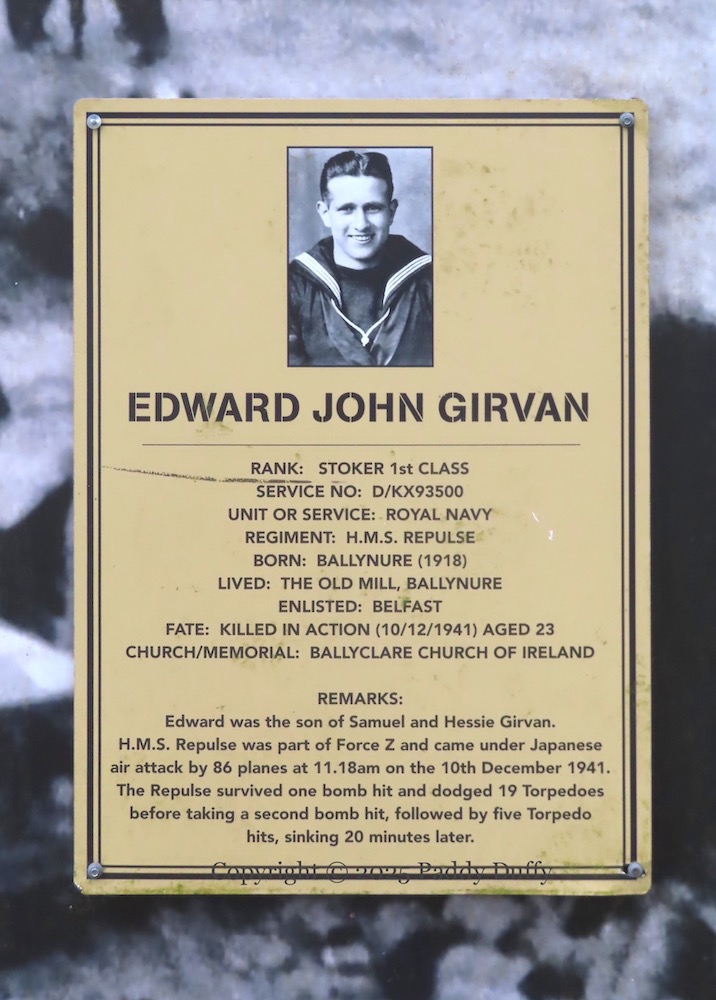
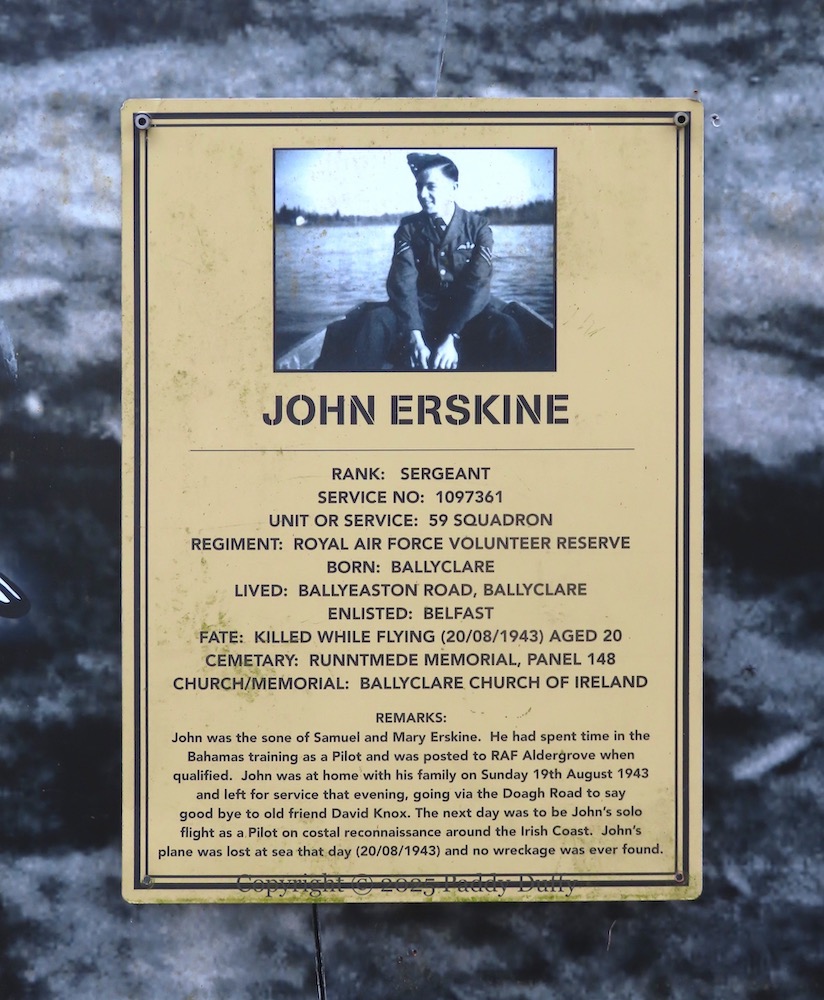
There is now a long board along the front. The two info plaques profile Edward Girvan and John Erskine, whose portraits are also featured in the larger mural, and between them are the emblems of the branches of the British Army: Merchant Navy, Navy, Army, and Air Force.
To the right of and out of frame in the image above, there is a Union Flag painted for the 75th anniversary of VE Day – see Street View.
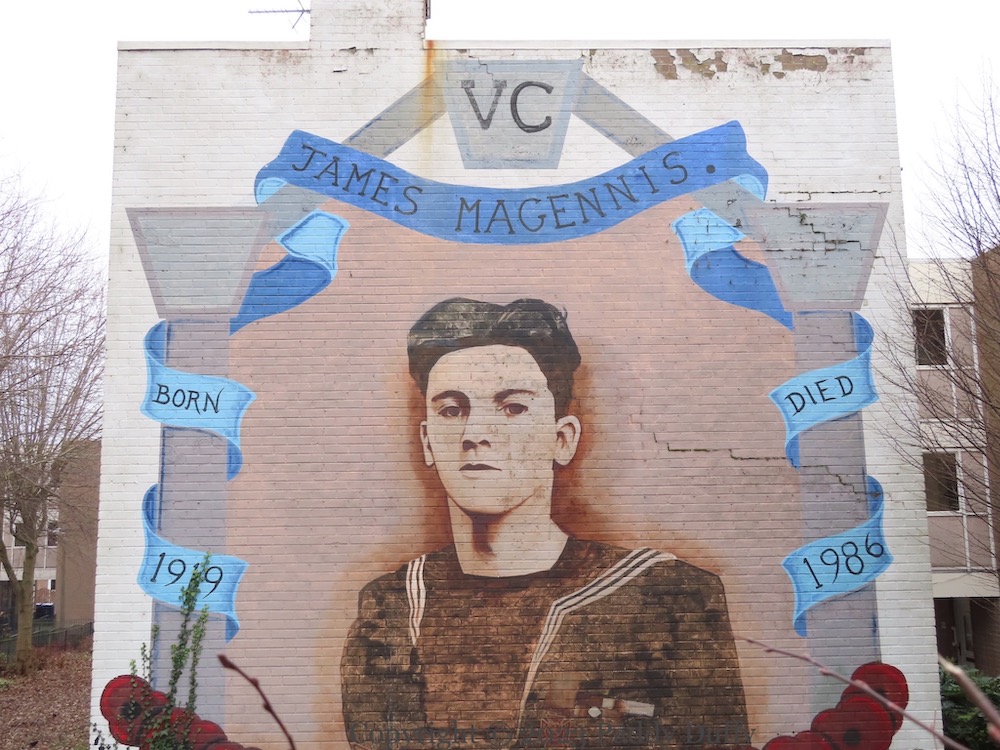
Victoria Cross recipient James Magennis was the only person from Northern Ireland awarded the VC for action during WWII (WP). Although the mural is in loyalist Tullycarnet, Magennis was a Catholic, born in west Belfast, though he later lived in Castlereagh. He was given a reception in 1945 at Belfast city hall.
Four of the 700 NHS staff in the UK to die of Covid during the pandemic have come Northern Ireland, the most recent being dementia specialist Alan Henry in Antrim hospital (Express | BelTel | iTV). In the south, Defence Forces have been deployed to three nursing homes while 6,400 health workers are off sick (Irish Times). The mural above shows a masked nurse and doctor among a field of poppies. It has been added below the three painted boards commemorating Titanic, the Somme, and the WWII Blitz.
On the exterior of the Connswater Community Centre, east Belfast
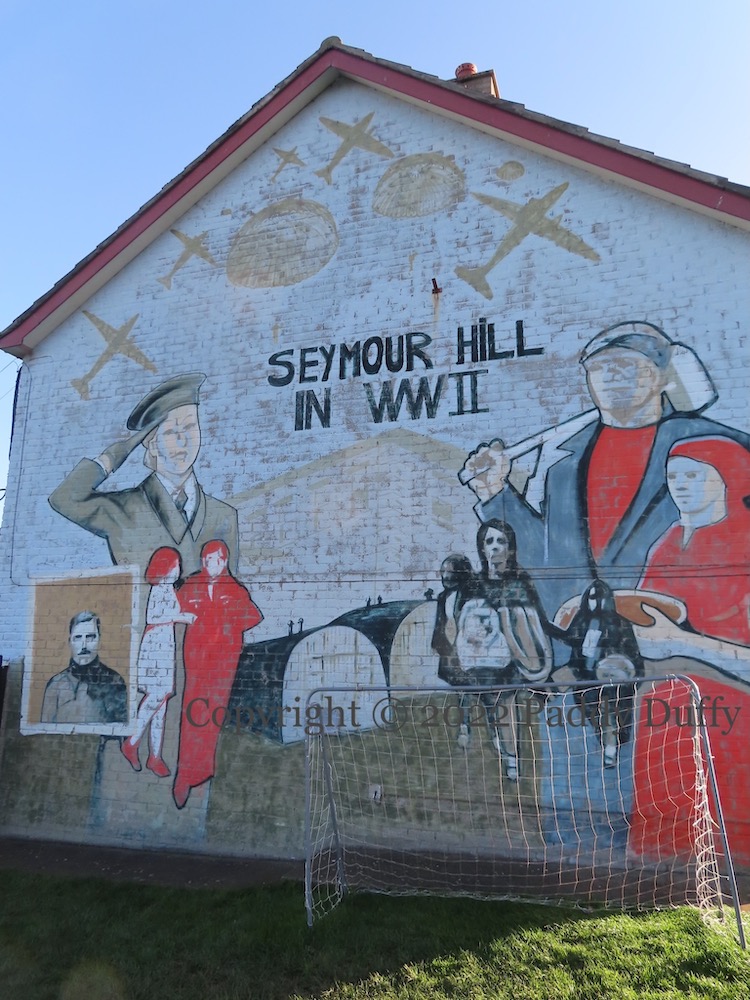
US forces were still segregated racially during WWII; “colored” soldiers (as they were then called) were housed in a camp at Ballybog Road (WW2NI) where Seymour Hill PS now is and just below Seymour Hill House which was used to house evacuees from Belfast after the blitz and which was formerly owned by the Charley family (Lisburn.com | Lord Belmont) – it is now administered by Radius (formerly the BIH Association).
The “framed” portrait on the left is of William “Billy” Harbinson, a member of the Royal Ulster Rifles who was a POW at Colditz (Lisburn.com | WW2NI); the photograph can be seen in the RUR museum.
There used to be a plaque on the wall which read, “This mural was dedicated by Col. Robin Charley on 1st July 2009 to the people from this area who contributed to the to the effort during World War II. Also our American allies who were based here and later contributed to the conflict.”
Painted by Tim McCarthy (“Verz” ig) for the Re-Imaging Programme; it replaced a UDA mural.
This board has a dual purpose. On the one hand, it was part of celebrations marking the 75th anniversary of the Battle Of Britain, which was waged from July to October in 1940. On the other, it is part of an anti-racism project, celebrating in particular the contributions to the Battle made by roughly 145 Polish aviators (WP) and especially the 303 squadron: “The Polish nation – part of us then, part of us now”. The 303 was later stationed in Northern Ireland for a time. (BBC-NI)
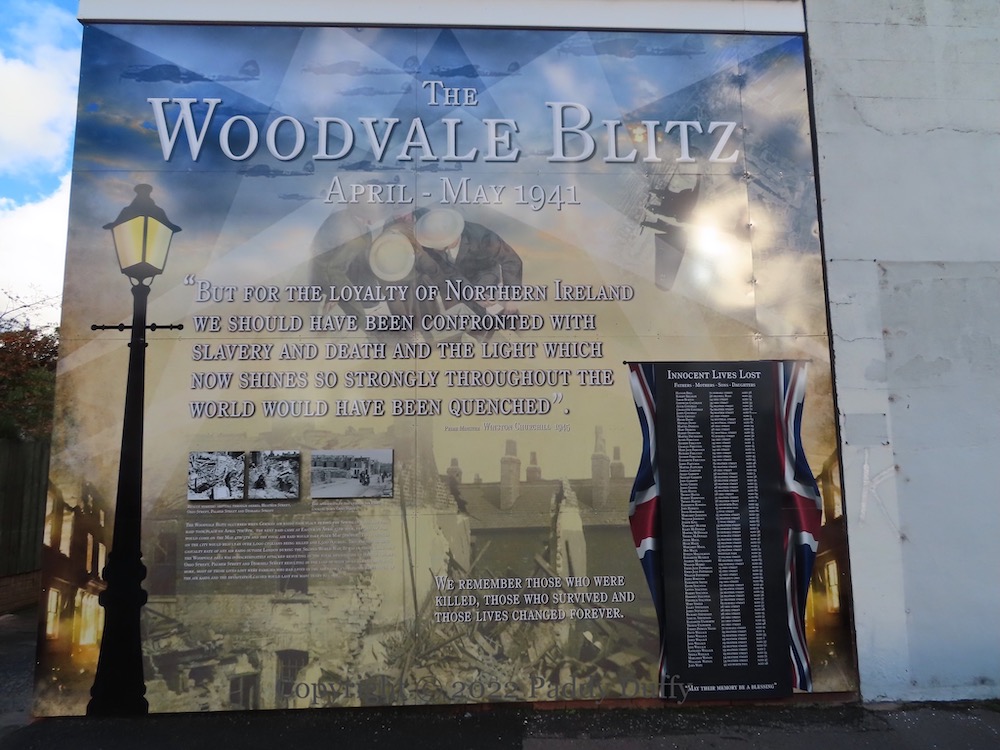
“The Woodvale Blitz occurred when German air raids took place during the spring of 1941. The first raid took place on April 7th/8th, the next raid came at Easter on April 15th/16th, the 3rd air raid would come on the May 4th/5th and the final air raid would take place May 5th/6th. These attacks on the city would result in over 1,000 civilians being killed and 1,5000 injured. This was the highest casualty rate of any air raids outside London during the Second World War. It was in these streets that the Woodvale area was indiscriminately attacked resulting in the total devastation of Heather Street, Ohio Street, Palmer Street and Disraeli Street resulting in the loss of many lives injuring 100’s more, most of those lives lost were families who had lived in the area for generations. The effects of the air raids and the devastation caused would last for many years to come.” The names of 79 victims are given on the right (see close-up below).
“The Woodvale Blitz April-May 1941. ‘But for the loyalty of Northern Ireland we should have been confronted with slavery and death and the light which now shines so strongly throughout the world would have been quenched’ – Prime Minister Winston Churchill 1945. We remember those who were killed, those who survived and those lives changed forever.”
“From Warsaw to Berlin” — Polish airmen in England, in the 300 Mazovian bomber squadron, write a “dedication” on a bomb headed for Germany in August 1941. The plane added as a background is perhaps an Avro Lancaster, while the one in the middle ground (in the wide shot, below) is a Vickers Wellington. According to the information board (shown last, below) “many Polish servicemen remained in Great Britain and Ireland after the [Second World] war, laying the foundations for a large Polish community that now (in Northern Ireland) numbers over 30,000.”
On the side-wall: The Ulster Tower at Thiepval “is dedicated to the glory of God in grateful memory of the officers, non-commissioned officers, and men of the 36th (Ulster) Division and of the sons of Ulster in other forces who laid down their lives in the Great War, and of all their comrades-in-arms who, by divine grace, were spared to testify to their glorious deeds.”
Here are the four boards on Lindsay Street, south Belfast, from east to west.
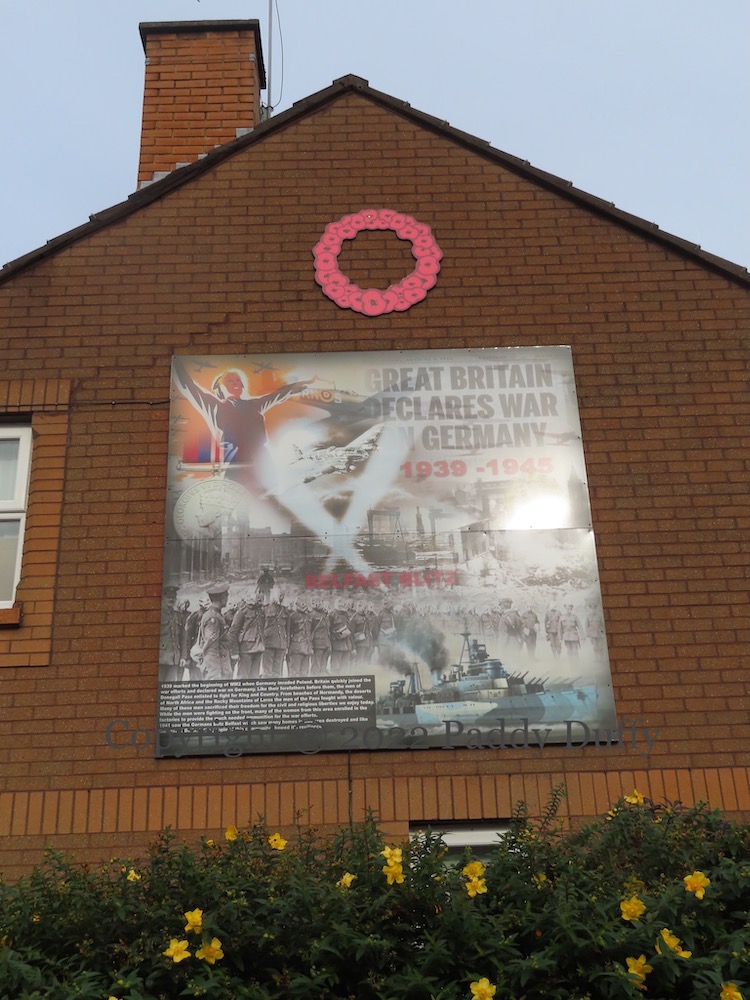
Above: “Great Britain declares war on Germany 1939-1945. 1939 marked the beginning of WW2 when Germany invaded Poland. Britain quickly joined the war efforts and declared war on Germany. Like their forefathers before them, the men of Donegall Pass enlisted to fight for King and Country. From beaches of Normandy, the deserts of North Africa and the Rocky Mountains of Leros the men of the Pass fought with valour. Many of these men sacrificed their freedom for the civil and religious liberties we enjoy today. While the men were fighting on the front, many of the women from this area enrolled in the factories to provide the much needed ammunition for the war efforts. 1941 saw the Germans Blitz Belfast which saw many homes in this area destroyed and like the rest of Belfast, the people of this community shows it’s [sic] resilience.”
“The war is over. Armistice Day 1918. 11th month, 11th day, 11th, hour.” “But in their eyes shall shine the holy glimmers of goodbyes … Their flower the tenderness of patient minds, and each slow dusk a drawing down of blinds.” Lines from Wilfred Owens’ (1893-1918) ‘Anthem For Doomed Youth‘ on a new board in Lindsay Street.
The text at the bottom reads: “The last three months of WWI became known as the hundred days. Realising they were defeated an armistice was signed by the Germans. Germany finally surrendered and WWI ended on November 11th 1918. The terms of the agreement called for the end of fighting along the entire Western Front to begin a precisely 11 am that morning. Records show that the last British soldier killed in WWI was Private George Edwin Allison of the 5th Royal Irish Lancers. He was killed at Mons at 09:30 am, just 90 minutes before the ceasefire.”
Computer-generated board in Lindsay Street showing a map of the northern end of the Western Front and images of soldiers marching, on horseback, and in the trenches: Donegall Pass remembers 1914-1918 – the great sacrifice. Lest we forget. Here are commemorated the many local men who during the Great War of 1914-1918 gave the most that man can give: life itself for God for King and Country.
“It is needful that we knit together as one man, each strengthening the other, and not holding back of counting the cost” – Ulster [Unionist] Council Resolution 1912.” “Ulster’s solemn league and covenant. Ulster Day 28th September 1912.” The Council met on September 23rd and 471,000 people signed the covenant (figures here) on or around the 28th – Ulster Day – led by Sir Edward Carson.










 Paddy Duffy Collection