Warszawiacy Berlinowi

“From Warsaw to Berlin” — Polish airmen in England, in the 300 Mazovian bomber squadron, write a “dedication” on a bomb headed for Germany in August 1941. The plane added as a background is perhaps an Avro Lancaster, while the one in the middle ground (in the wide shot, below) is a Vickers Wellington. According to the information board (shown last, below) “many Polish servicemen remained in Great Britain and Ireland after the [Second World] war, laying the foundations for a large Polish community that now (in Northern Ireland) numbers over 30,000.”

Here is the original image (which has been coloured for the mural).

On the side-wall: The Ulster Tower at Thiepval “is dedicated to the glory of God in grateful memory of the officers, non-commissioned officers, and men of the 36th (Ulster) Division and of the sons of Ulster in other forces who laid down their lives in the Great War, and of all their comrades-in-arms who, by divine grace, were spared to testify to their glorious deeds.”

Click image to enlarge
Copyright © 2022 Paddy Duffy
T01134 T01135 [T01136]

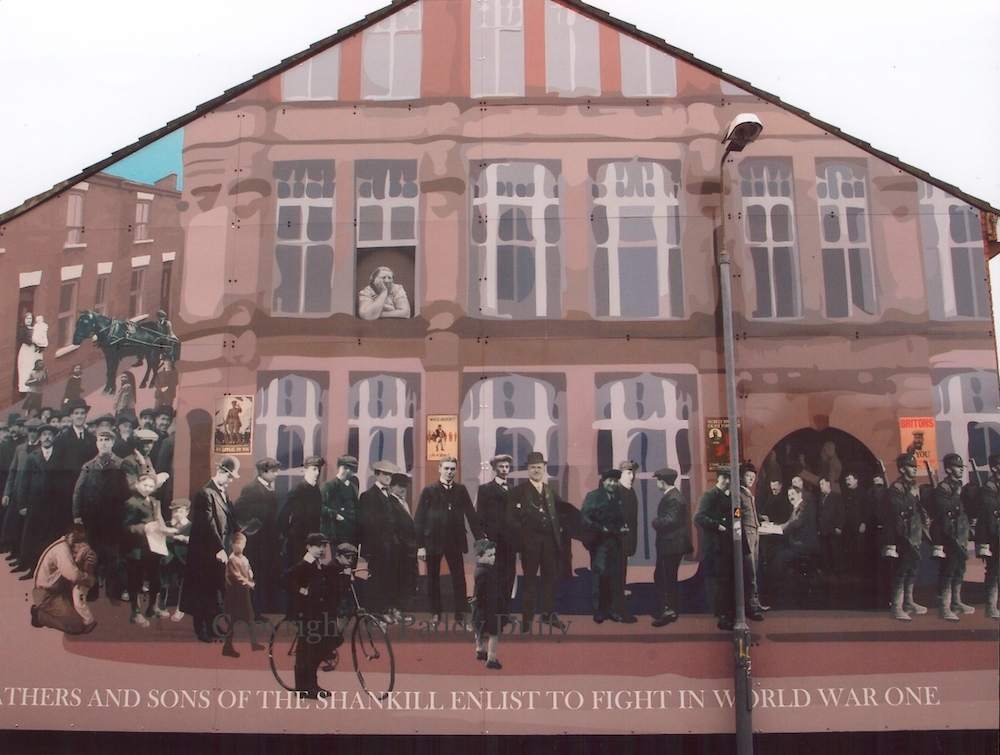
The Great Sacrifice

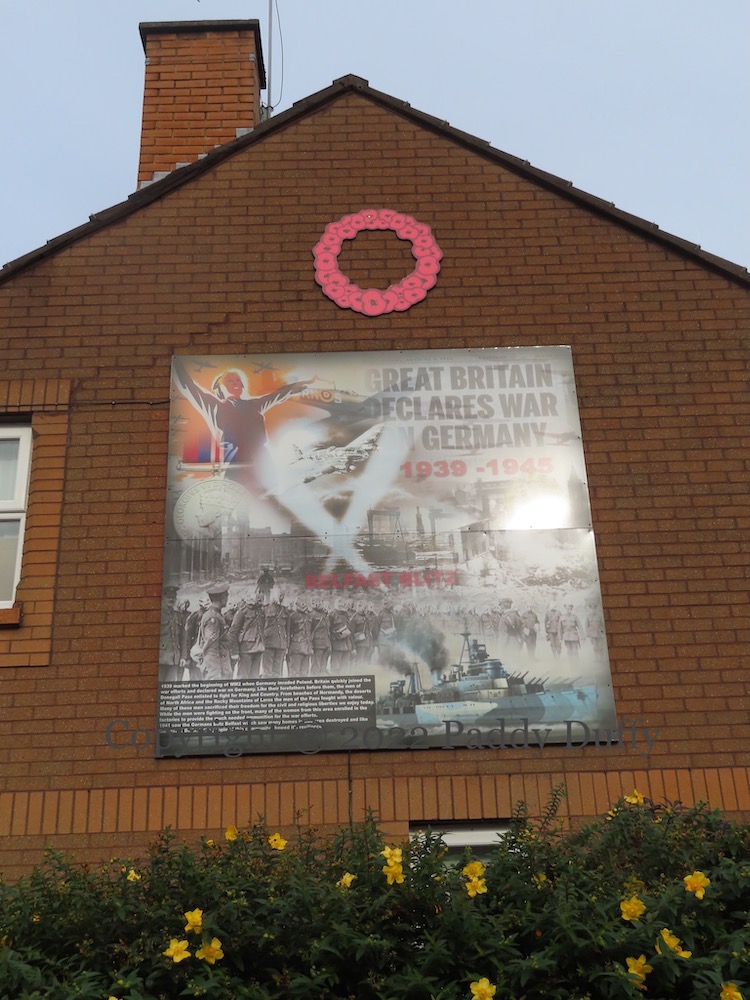
Here are the four boards on Lindsay Street, south Belfast, from east to west.

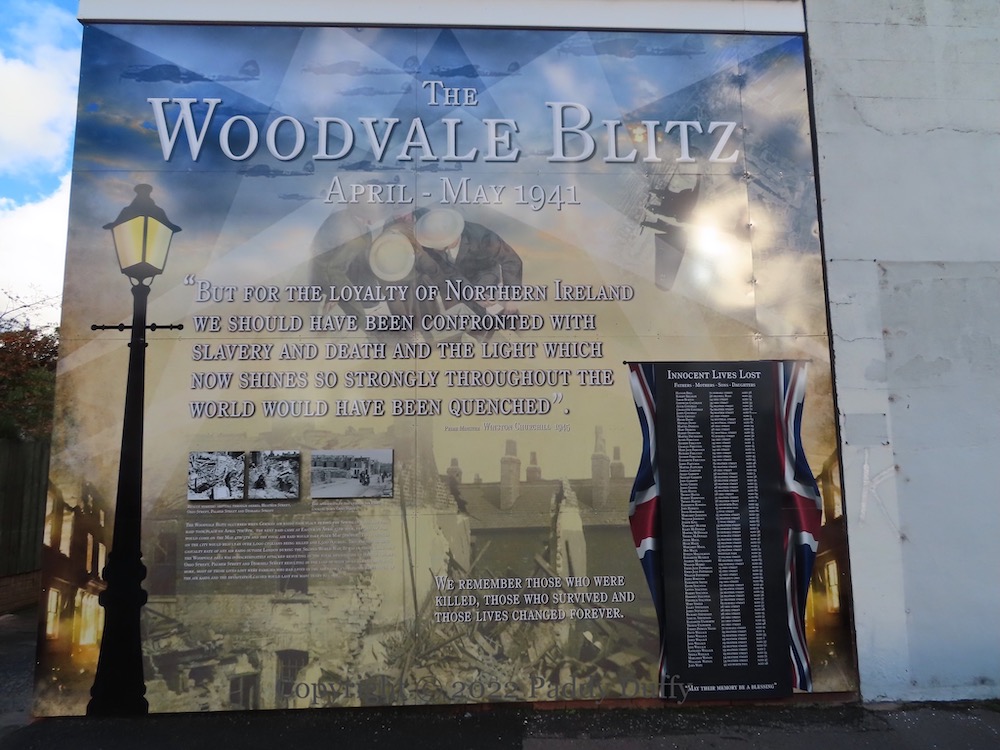
Above: “Great Britain declares war on Germany 1939-1945. 1939 marked the beginning of WW2 when Germany invaded Poland. Britain quickly joined the war efforts and declared war on Germany. Like their forefathers before them, the men of Donegall Pass enlisted to fight for King and Country. From beaches of Normandy, the deserts of North Africa and the Rocky Mountains of Leros the men of the Pass fought with valour. Many of these men sacrificed their freedom for the civil and religious liberties we enjoy today. While the men were fighting on the front, many of the women from this area enrolled in the factories to provide the much needed ammunition for the war efforts. 1941 saw the Germans Blitz Belfast which saw many homes in this area destroyed and like the rest of Belfast, the people of this community shows it’s [sic] resilience.”

“The war is over. Armistice Day 1918. 11th month, 11th day, 11th, hour.” “But in their eyes shall shine the holy glimmers of goodbyes … Their flower the tenderness of patient minds, and each slow dusk a drawing down of blinds.” Lines from Wilfred Owens’ (1893-1918) ‘Anthem For Doomed Youth‘ on a new board in Lindsay Street.

The text at the bottom reads: “The last three months of WWI became known as the hundred days. Realising they were defeated an armistice was signed by the Germans. Germany finally surrendered and WWI ended on November 11th 1918. The terms of the agreement called for the end of fighting along the entire Western Front to begin a precisely 11 am that morning. Records show that the last British soldier killed in WWI was Private George Edwin Allison of the 5th Royal Irish Lancers. He was killed at Mons at 09:30 am, just 90 minutes before the ceasefire.”

Computer-generated board in Lindsay Street showing a map of the northern end of the Western Front and images of soldiers marching, on horseback, and in the trenches: Donegall Pass remembers 1914-1918 – the great sacrifice. Lest we forget. Here are commemorated the many local men who during the Great War of 1914-1918 gave the most that man can give: life itself for God for King and Country.

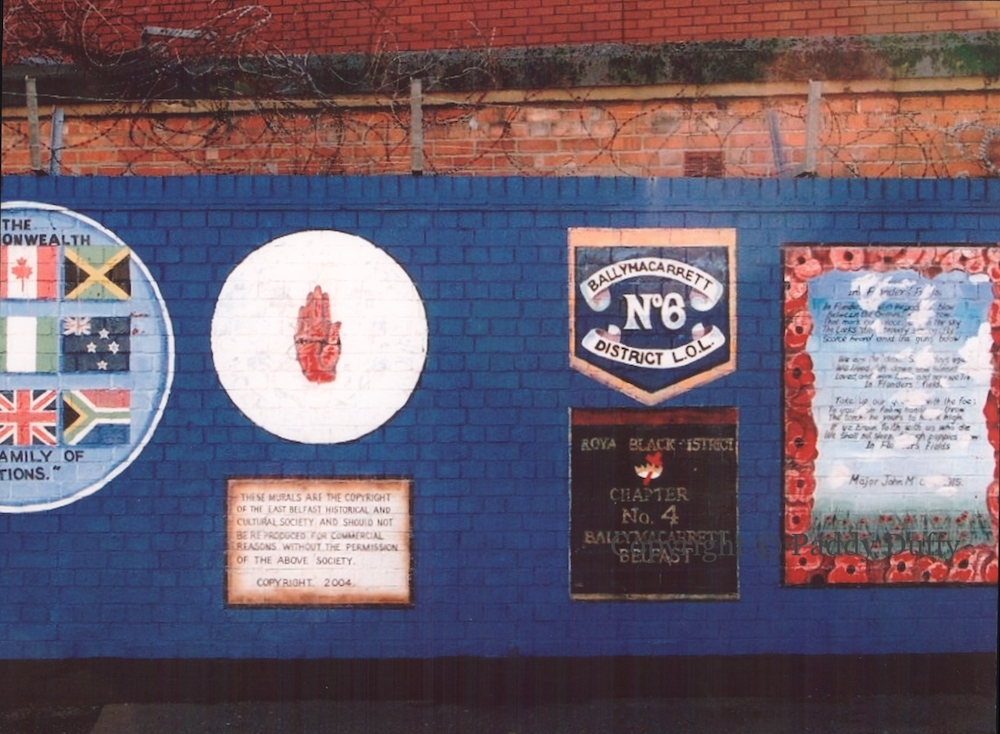
“It is needful that we knit together as one man, each strengthening the other, and not holding back of counting the cost” – Ulster [Unionist] Council Resolution 1912.” “Ulster’s solemn league and covenant. Ulster Day 28th September 1912.” The Council met on September 23rd and 471,000 people signed the covenant (figures here) on or around the 28th – Ulster Day – led by Sir Edward Carson.

Click image to enlarge
Copyright © 2022 Paddy Duffy
T01103 T01104 T01105 T01106

The Silent Unseen

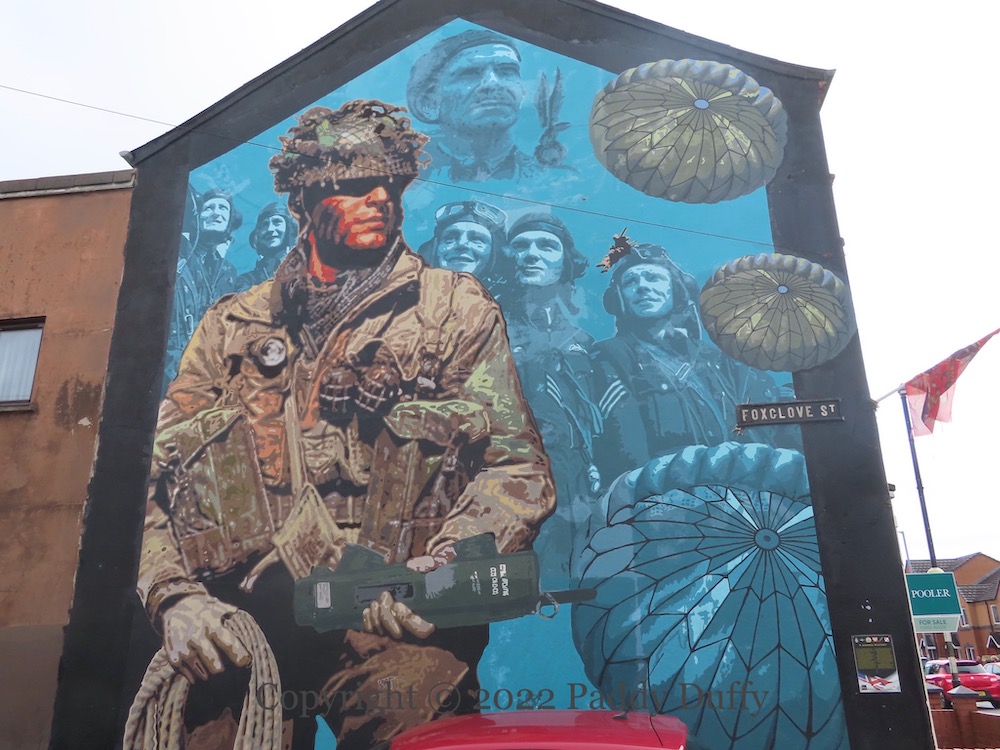
Stanislaw Sosabowski — who appears in the apex of this mural in east Belfast — survived the first World War (fighting for Austria-Hungary), the occupation of Poland in 1939, and escaped from a prisoner-of-war camp before crossing Europe and taking command, in Britain, of the 1st Polish Paras. The unit fought in Operation Market Garden at the Battle Of Arnhem. (WP | Polish Heritage Society for a booklet of text and images)

His memoirs have been published as Freely I Served and interviews about his service were collected for a film called A Debt Of Dishonour (youtube) – the title comes from the fact that Sosabowski was blamed for the failure of the Operation, perhaps as a bargaining tactic in negotiations between Britain, Russia, and Poland.

Across the middle of the mural are airmen from the 303 Polish Squadron, which was celebrated in a Shankill mural: Love Demands Sacrifice. In the foreground is a modern British paratrooper in field gear.

For images of the launch, see WWIIPolesNI.

A post at (the blog) We In Coming Days May Be has a report on the East Belfast electoral constituency. Here is a report on Polish Residents In Belfast from the Belfast Interface Project. Attacks on Poles in east Belfast reached a peak in the first few months of 2014; see previously Romanian Housebreakers Beware and e.g. this Telegraph article. See also: Multiculturalism Is Genocide | Never Actually Existed | Belfast You’re Melting My Head.

Click image to enlarge
Copyright © 2022 Paddy Duffy
T01001 [T01000]

James Magennis

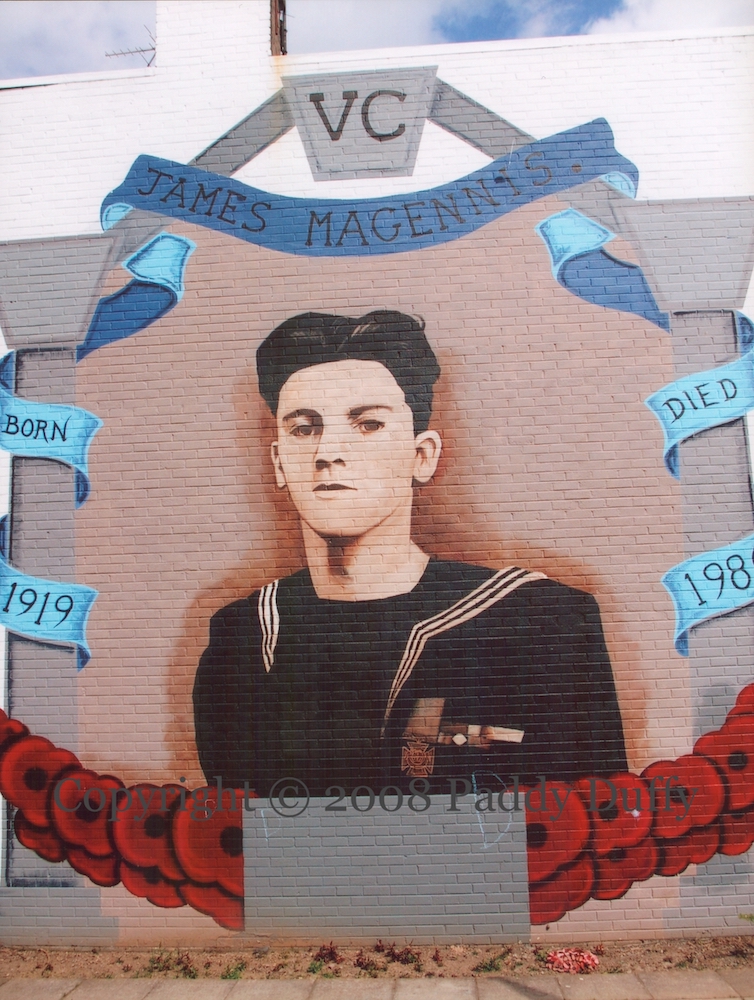
VC (Victoria Cross) recipient James Magennis was the only person from Northern Ireland awarded the VC for action during WWII (WP). Although the mural is in loyalist Tullycarnet, Magennis was a Catholic, born in west Belfast, though he lived for a time in Castlereagh.

The mural takes the place of an Eddie The Trooper mural (see Eddie’s Visual History page). There is a large memorial to Magennis in the grounds of Belfast City Hall.

Painted by Kenny Blair and produced with help from the Tullycarnet Action Group Initiative Trust (TAGIT).

King’s Road, Tullycarnet, Dundonald

Click image to enlarge
Copyright © 2008 Paddy Duffy
T00429