At The Eleventh Hour

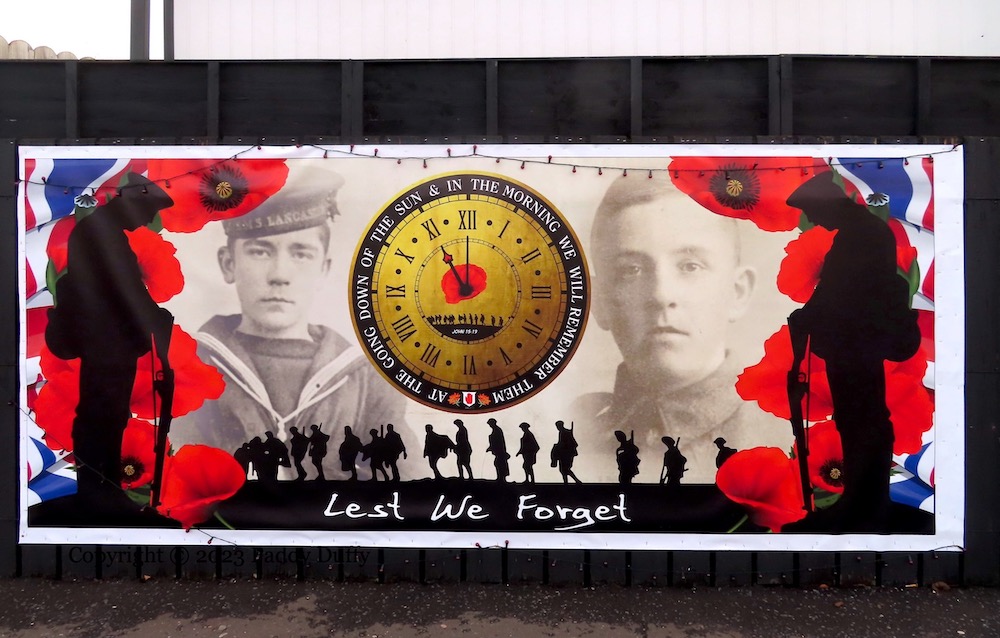
The portrait on the right is probably William McFadzean, familiar from murals such as in the Caw, Londonderry, and in Cregagh, Belfast (though the photo is unknown). The face on the left is John Travers “Jack” Cornwell, “the boy hero of Jutland”, who was awarded the VC for staying at his post as a sight-setter on the HMS Chester (the picture is from an earlier posting, on the HMS Lancaster) when it was hit by German light cruisers on May 31st, 1916. Cornwell died from shrapnel wounds on June 2nd (Mary Evans).

It’s not clear why Cornwell is included here, as he was from, and is buried in, east London, rather than Belfast or Ireland, and does not seem to be associated with the 36th Division. Please get in touch if you can explain his inclusion here. See also: Battle Of Jutland and HMS Caroline.

Dee Street, east Belfast, on the fence seen previously in My God-Given Right To Rule.

Click image to enlarge
Copyright © 2024 Paddy Duffy
T03875 T03876 at the going down of the sun and in the morning we will remember them royal irish rifles lest we forget

Remembrance Sunday

Remembrance Day, formerly known as Armistice Day, commemorates and celebrates the end of hostilities in the first World War on November 11th, 1918. Many ceremonies in the UK take place on the second Sunday of the month, regardless of the date. This practice began in 1945, changing the WWII practice of marking the occasion on the preceding Sunday, to ensure that the holiday did not fall on a work-day (WP).

This large tarp (above) is at the Shore Road memorial garden to the 10th, 36th, and 16th divisions, shown below, along with the nearby Fifes & Drums/Fairhill flute band (Fb)/Pride Of The Shore (Fb) tribute to QEII. The tarp was also seen last year: Remembrance Day.

Click image to enlarge
Copyright © 2023 Paddy Duffy
T03664 [T03662] [T03663]
T03476 [T03477] [T08003]
T03475
2025: T08001 T08002

Kragfargus Cultural Corner

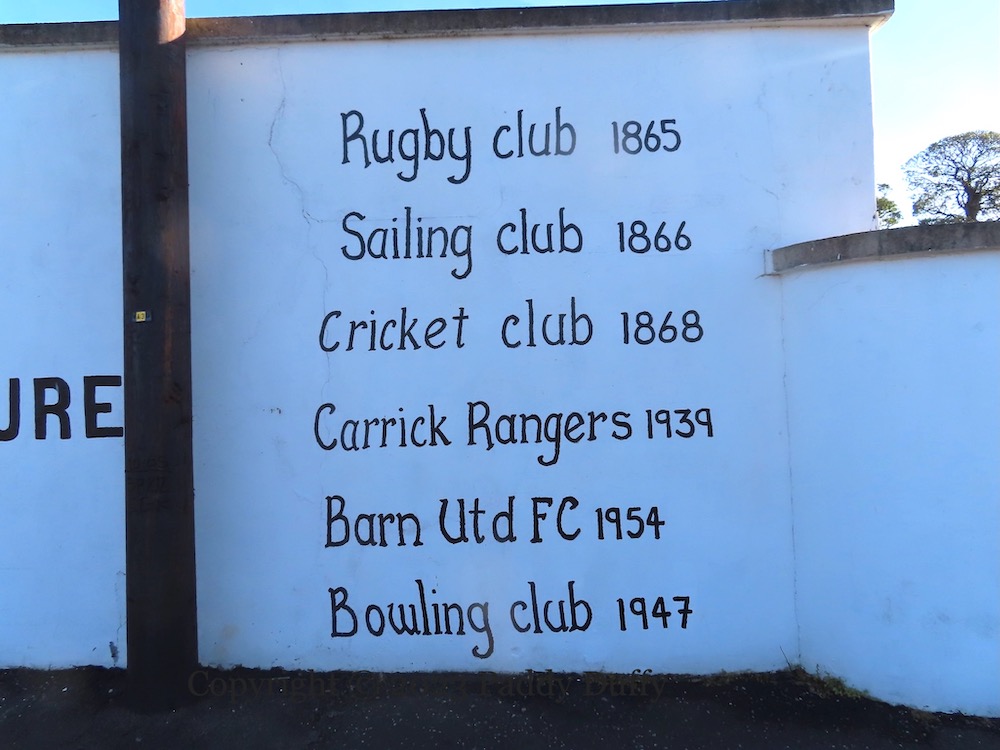
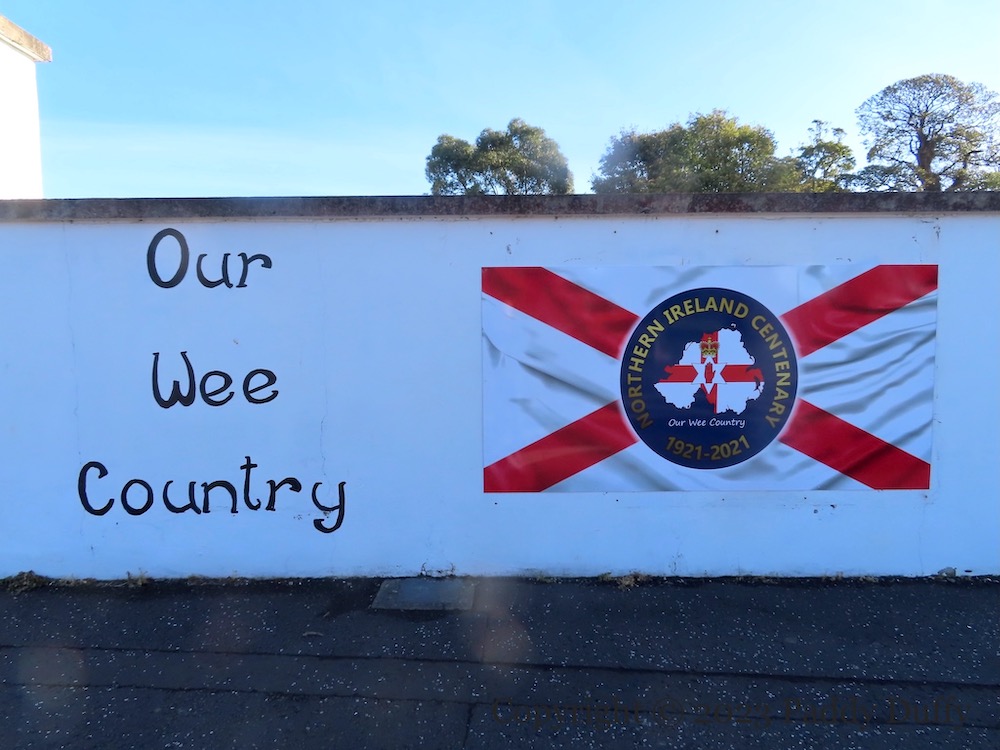
This is the second (at least) iteration of an installation along Taylor’s Avenue, Carrickfergus, showcasing the Ulster-Scots heritage of Carrickfergus and its later contributions to the United Kingdom.

The wall is 60 metres/200 feet in length and can be divided into about ten distinct panels – notes on the different panels are given below, following the order of presentation of images, which show the entire wall moving from left to right.
The original, as seen on Street View, included boards showing the Pretani Isles/British Isles, QEII, and Tom Moore. As seen here, there are now boards to King Charles III, a vintage postage stamp, ‘The Siege Of Carrickfergus’ in 1689, and ‘The Barn Mills Fallen’ of WWI.


Fair Fa’ Ye (or “fair faa ye”) is an (Ulster-)Scots blessing, “fair fall you”, meaning roughly “good luck” (Bloggin Fae The ‘Burn | r/scots | Nelson McCausland).

The stained-glass is called the Dalaradia Window. For images and explanation, see Picts Exiled From Alba.

For Dalaradia, see Kingdom Of The Pretani and the Visual History page on Cú Chulaınn.

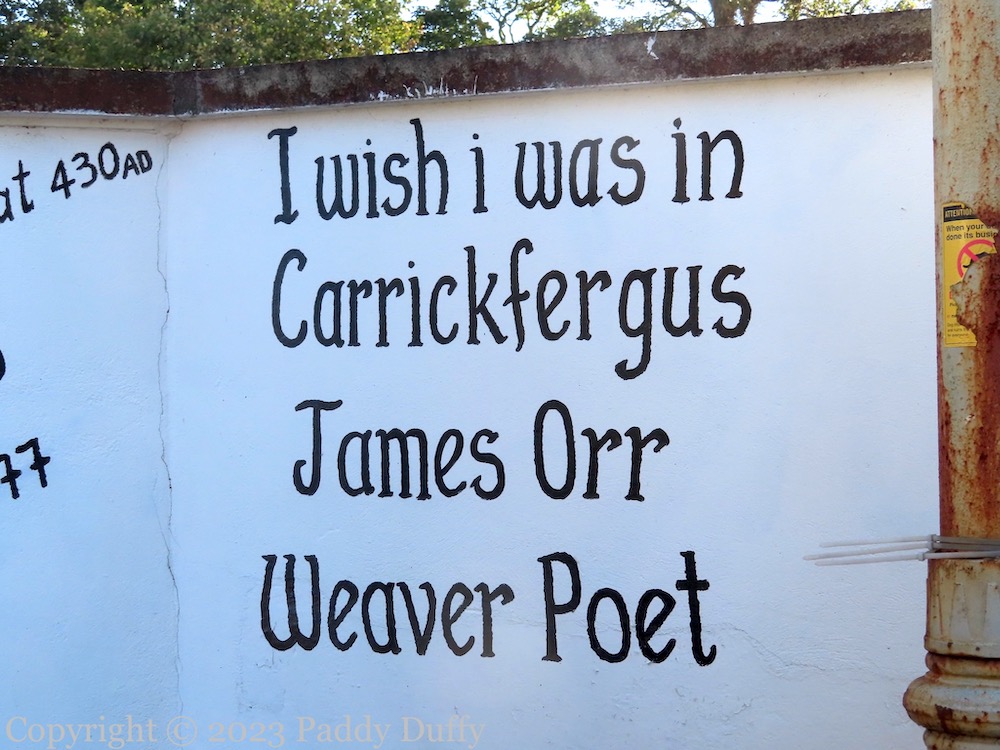
James Orr, the ‘Bard Of Ballycarry’, was a contemporary of Robert Burns and a United Irishman. It does not appear that he wrote a poem with the line “I wish I was in Carrickfergus”.

Daniel Cambridge won his VC for service in the Crimean War (WP) and James Crichton for service in WWI (WP).

CarrickfergusHistory includes “the oldest know map of Carrickfergus” from 1560, employing the spelling “Kragfargus”.

The 2/6 postage stamp featuring Carrickfergus Castle was one of four in a “Castle series” in 1955 (WP).

Click image to enlarge
Copyright © 2023 Paddy Duffy
T03527 T03526 T03525 T03524 T03523 T03521 T03522 T03520c T03519 T03518

A Name That Equals Any In History

“In memory to all who fought and gave their lives.” This is the tribute to the Ulster Division at the Carrickfergus Rangers Supporters’ Club, citing the words of Wilfrid Spender “I am not an Ulsterman but yesterday, the First of July [1916], as I followed their amazing attack, I felt that I would rather be an Ulsterman than anything else in the world.” (For more of Spender’s tribute to the 36th Division, see I Am Not An Ulsterman.)

For the names and information of the nine VC recipients, see Victoria Crosses or Repaying Their Memory.

Also from the Club: Club: a gallery of Rangers’ Managers in We Welcome The Chase | commemorative murals to the UDR in Some Gave All | to the Highland Fusiliers.

Click image to enlarge
Copyright © 2023 Paddy Duffy
T03488 T03490 [T03489] T03487

Armed And Ready Again

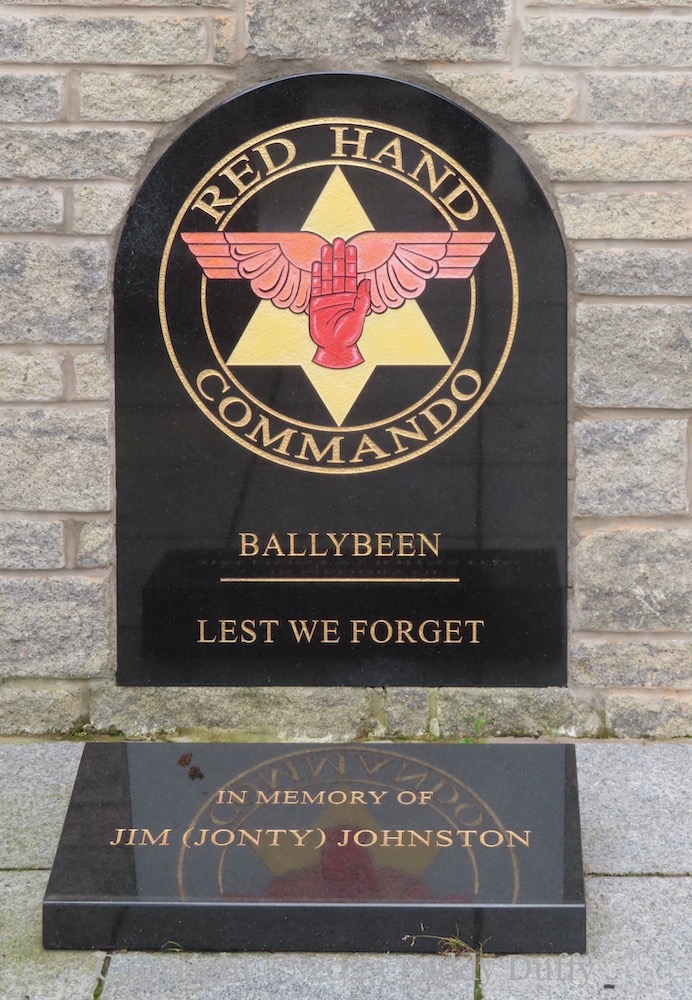
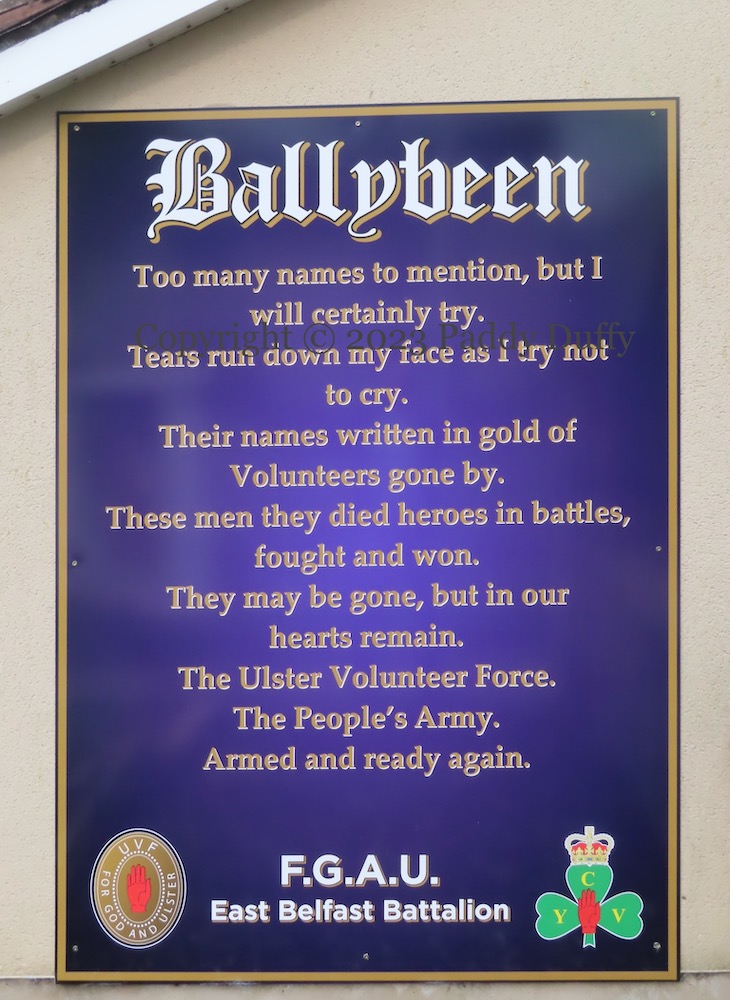
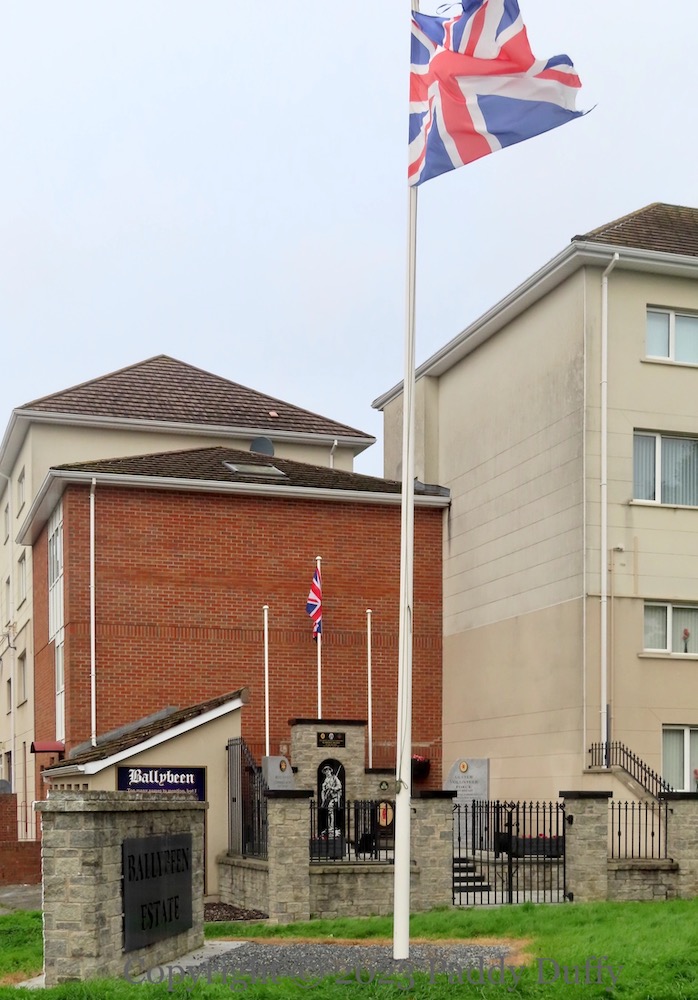
This is the UVF/RHC memorial garden in Ballybeen, with individual plaques to “East Belfast battalion commander” RJ ‘Mickey’ Wilson (died 2022), Jim ‘Jonty’ Johnston (killed in 2003 BelTel), M. Walker, G. McCartney, David Brown. While most of the plaques and stones are to the modern UVF, there are three pieces to the 36th (Ulster) Division.

“Too many names to mention, but I will certainly try./Tears run down my face as I try not to cry./Their names written in gold of Volunteers gone by./These men they died heroes in battles, fought and won./They may be gone, but in our hearts remain./The Ulster Volunteer Force. The People’s Army./Armed and ready again.”

Click to enlarge
Copyright © 2023 Paddy Duffy
T03409
T03407 T03408 [T03409] T03410 T03411 T03412 T03413 T03414
T03406 T03405 T03415

Footsteps Through Our History

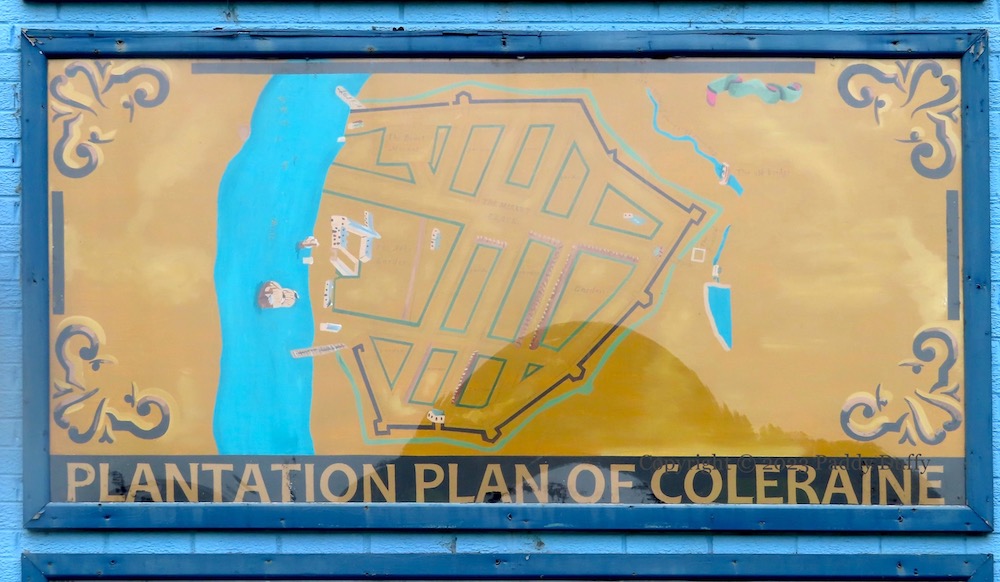
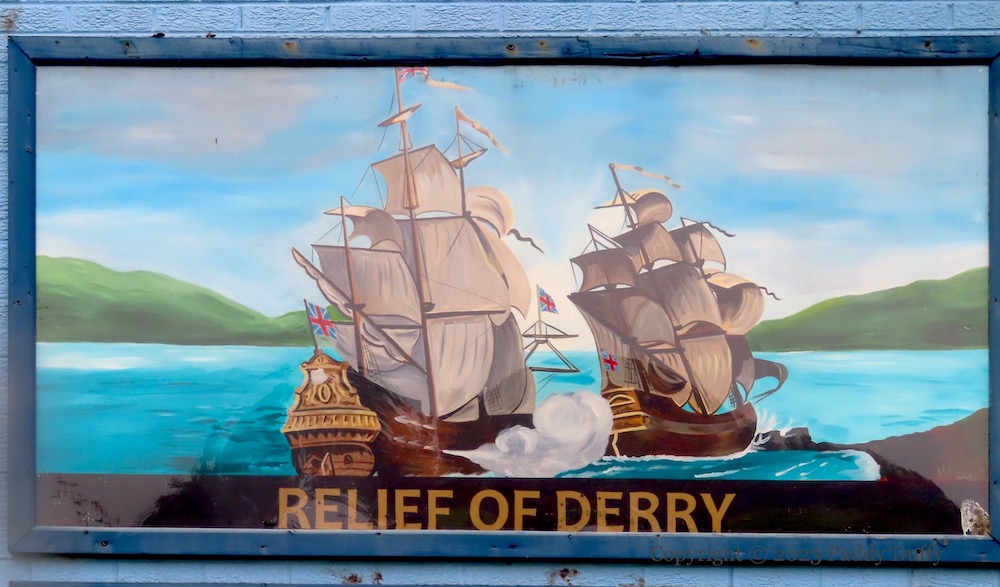
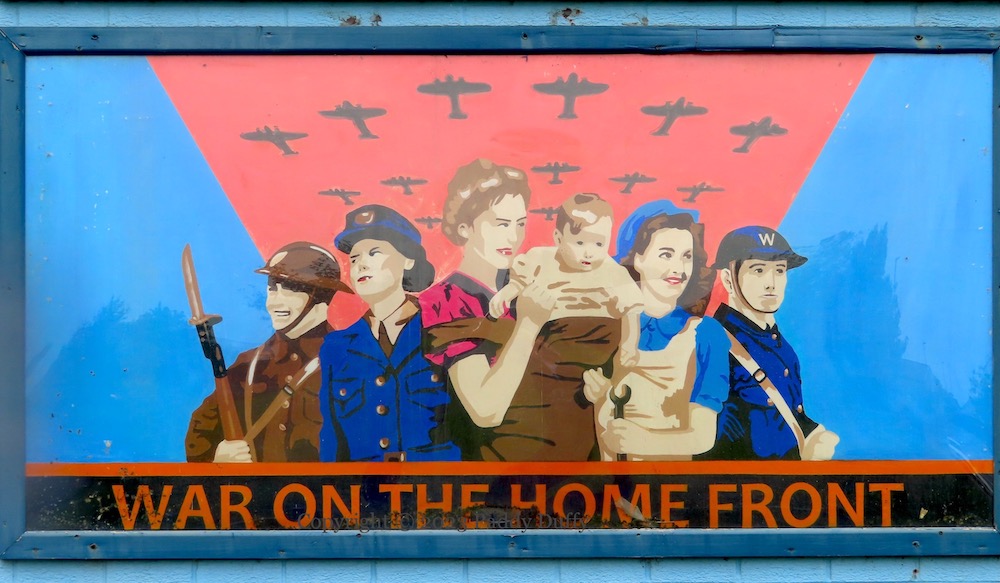
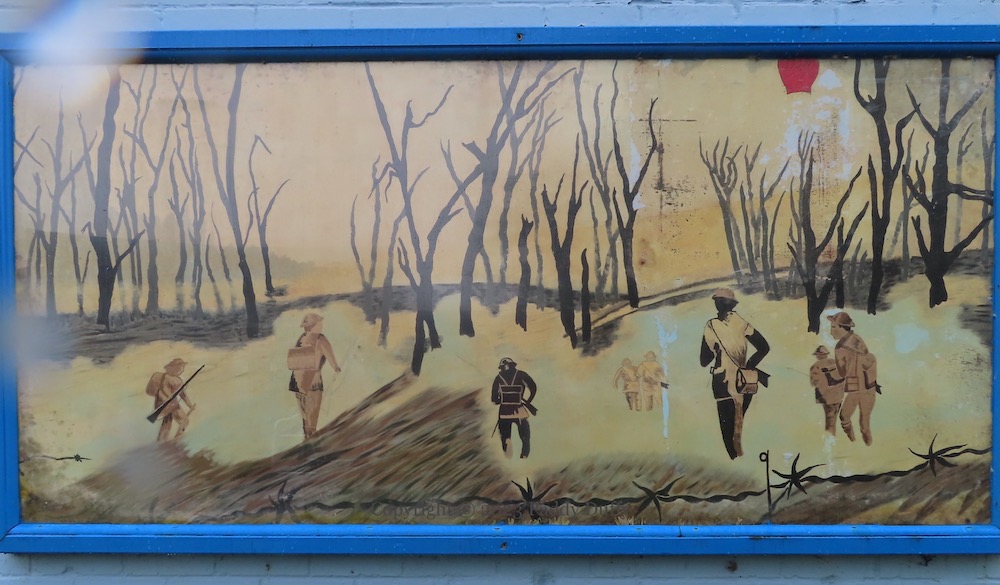
Footsteps through the history of Coleraine, from top to bottom: Martin Luther (c. 1521); John Knox, who led the reformation in Scotland (c. 1560); the plan of Coleraine (c. 1611); the relief of Derry (1689); the Williamite campaign (1690); (and then a jump to) WWI (“Christmas truce, western front”); WWII (“War on the home front”).

These boards replaced a UDA mural in March, 2014 (see Loyalist Ballysally).

Daneshill Road, Coleraine.

Click to enlarge
Copyright © 2023 Paddy Duffy
T03273 T03274
T03275 T03277 T03280
T03276 T03278 T03279

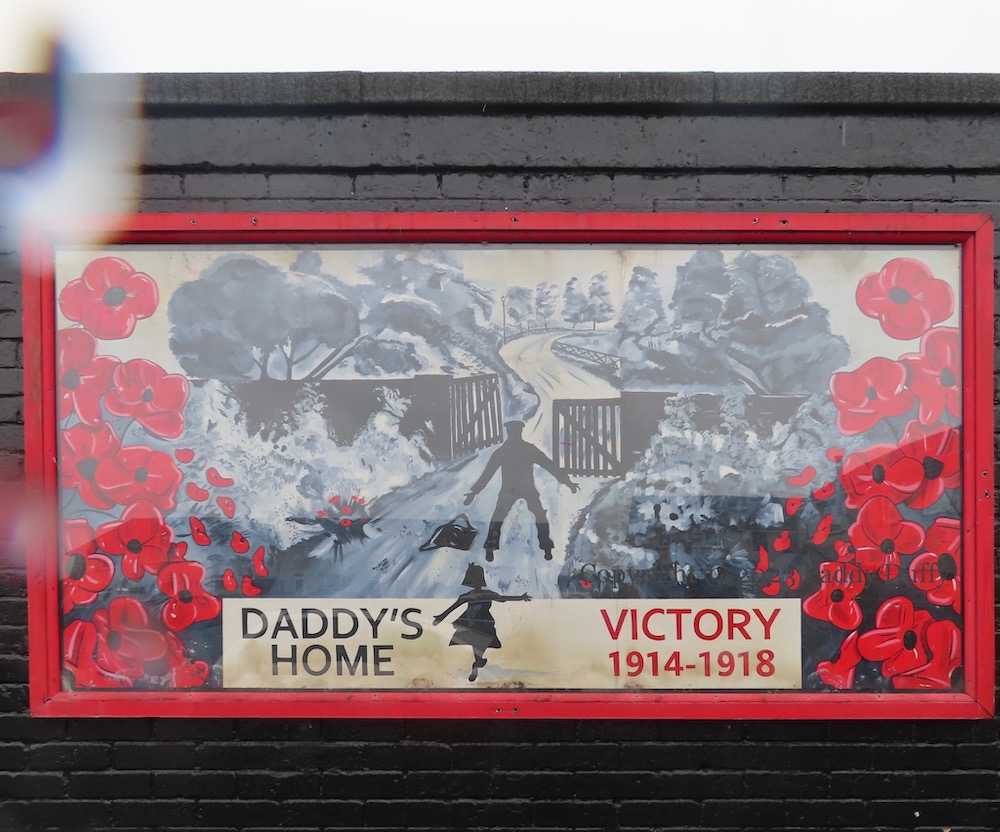
Daddy’s Home

There was previously a mural of the UDA emblem and flags on the substation on the Loughanhill side of Ballysally (Coleraine) (seen in The Hell They Call Highwood) which has now been replaced by the painting of a daughter greeting her father who is returning home after “Victory 1914-1918”. There is also a new version of the painting of the attack on Highwood, as seen below.

The style of the paintings and their frames is the same as the panels in Footsteps Through Our History.

Click image to enlarge
T03282 T03281
Copyright © 2023 Paddy Duffy

The Skins

The Inniskilling Fusiliers were recruited from the four Ulster counties of Fermanagh, Tyrone, Derry, and Donegal. In WWI, battalions also served in the 4th, 29th, and 10th Divisions, as well as the 109 Brigade of the 36th Division. In WWII (represented here by the Spitfire in pursuit of the Messerschmitt) the Fusiliers served in France, India, and Italy. (Ciroca | Long Trail | WP)

(For a broader history, from the Williamite campaign to modern Afghanistan, see Inniskilling.)

This Tyndale mural appears to have be painted without fanfare in 2022.

Click image to enlarge
Copyright © 2023 Paddy Duffy
T03182 [T03183]

The Road To The Somme

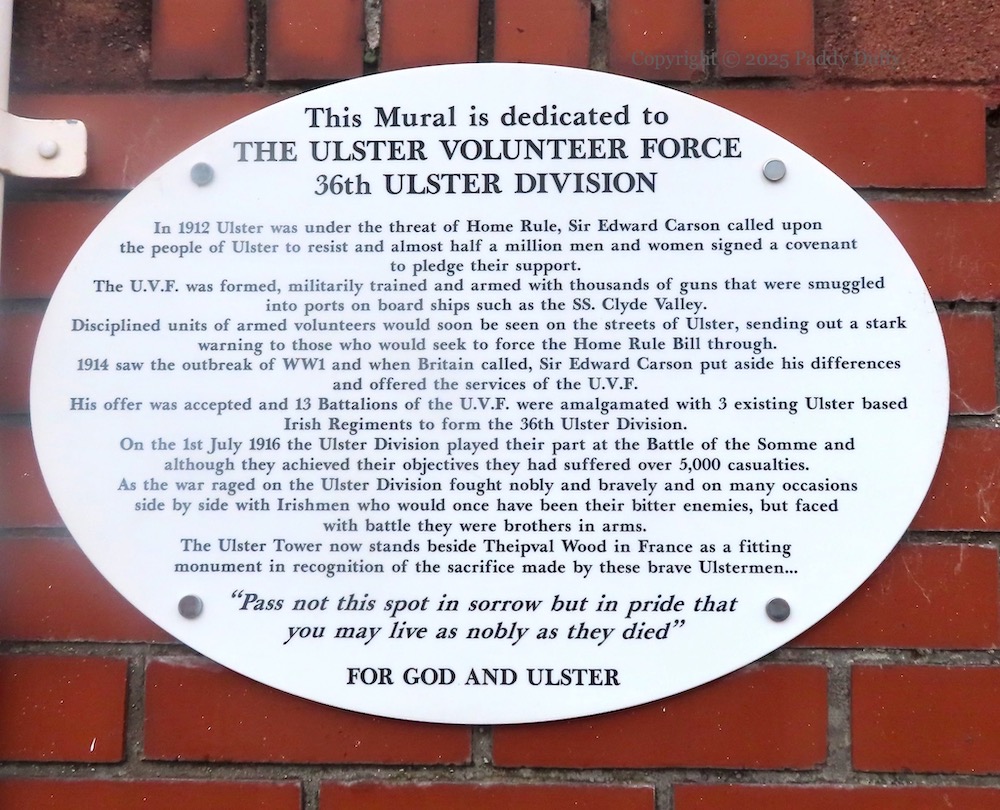
Above is a mural in Carlingford St, east Belfast showing gravestones of two deceased locals: “6322 Private J. Condon, Royal Irish Regiment, 24th May, 1915, age 14” and “10/16015 Rifleman S. Thompson Royal Irish Rifles, 5th October, 1918”. Their gravestones are the end-point of a journey that began with the Covenant and the Ulster Volunteers (illustrated by images of Carson, the Covenant, gun-running, and Volunteers drilling).

To the left is a plaque describing the journey from the Covenant to the Ulster Volunteers to the Somme: “In 1912 Ulster was under the threat of Home Rule, Sir Edward Carson called upon the people of Ulster to resist and almost half a million men and women signed a covenant to pledge their support. The U.V.F. was formed, militarily trained and armed with thousands of guns that were smuggled into ports on board ships such as the SS. Clyde Valley. Disciplined units of armed volunteers would soon be seen on the streets of Ulster, sending out a stark warning to those who would seek to force the Home Rule bill through. 1914 saw the outbreak of WW1 and when Britain called, Sir Edward Carson put aside his differences and offered the services of the U.V.F. His offer was accepted and 13 battalions of the U.V. F. were amalgamated with 3 existing Ulster based Irish regiments to form the on the 36th (Ulster) Division. On the 1st july the Ulster Division played their part at the Battle of the Somme and although they achieved their objectives they had suffered over 5,000 casualties. As the war raged on the Ulster Division fought nobly and bravely and on many occasions side by side with Irishmen who would once have been their bitter enemies, but faced with battle they were brothers in arms. The Ulster Tower now stands beside Theipval [sic] Wood in France as a fitting monument in recognition of the sacrifice made by these brave Ulstermen … “Pass not this spot in sorrow but in pride that you may live as nobly as they died” For God and Ulster”

There is also a side-wall (out of frame to the right) with the words of Captain Wilfrid Spender, describing the first day of the Battle Of The Somme, 1916, but it is in poor condition.

Click image to enlarge
Copyright © 2023/2025 Paddy Duffy
T03171 T07085

Leckagh Remembers The Fallen

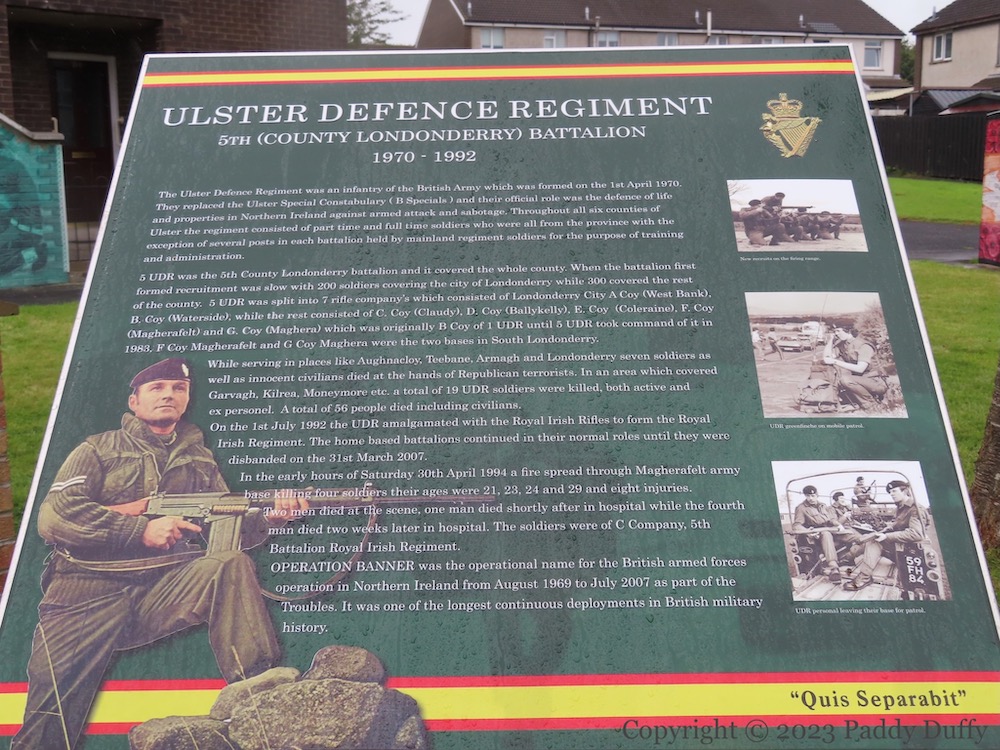
This selection of images from Leckagh Drive, Magherafelt, focuses on the memorials to the dead of WWI (and WWII in the mural above), with an additional board commemorating the UDR 5th (County Londonderry) battalion); there is also a mural and some plaques commemorating (modern-day) UVF volunteers, which will be in tomorrow’s post.

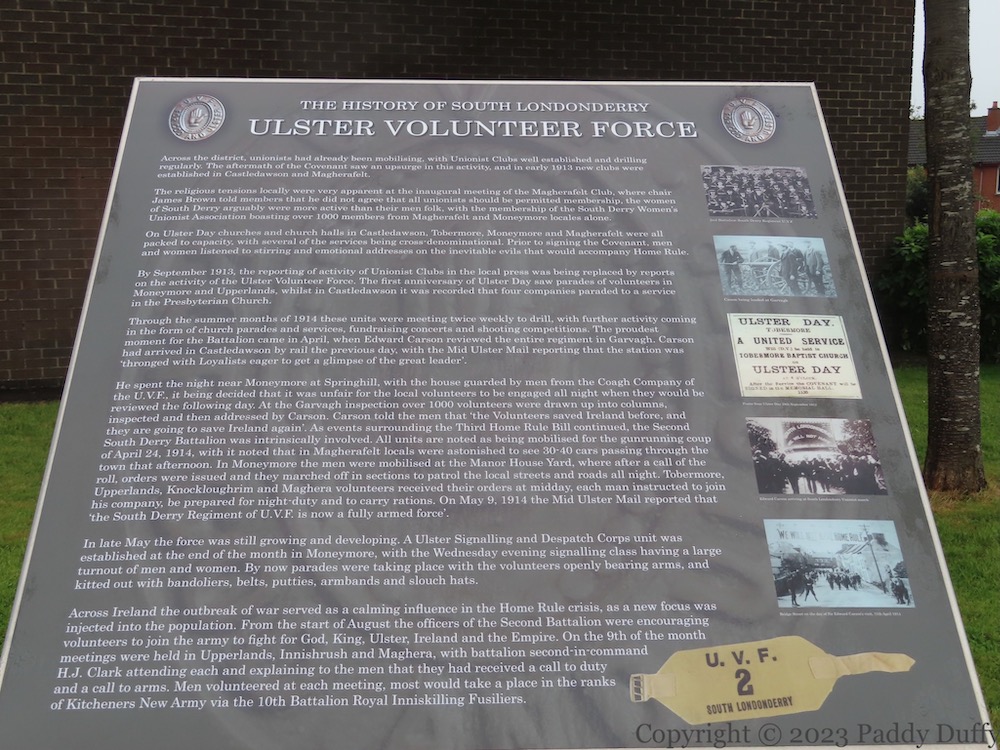
The board shown in the final image provides a history of the South Londonderry volunteers from towns such as Magherafelt, Castledawson, Moneymore, and Tobermore. Edward Carson reviewed the volunteers in April 1914. Later that same month, arms were received from the weapons landed in Larne. In the Great War, the men from the area served in the 10th battalion of the Royal Inniskilling Fusiliers in the 109th brigade of the 36th Division.

Click image to enlarge
Copyright © 2023 Paddy Duffy
T03155
T03142 [T03141]
T03143 T03144 T03146