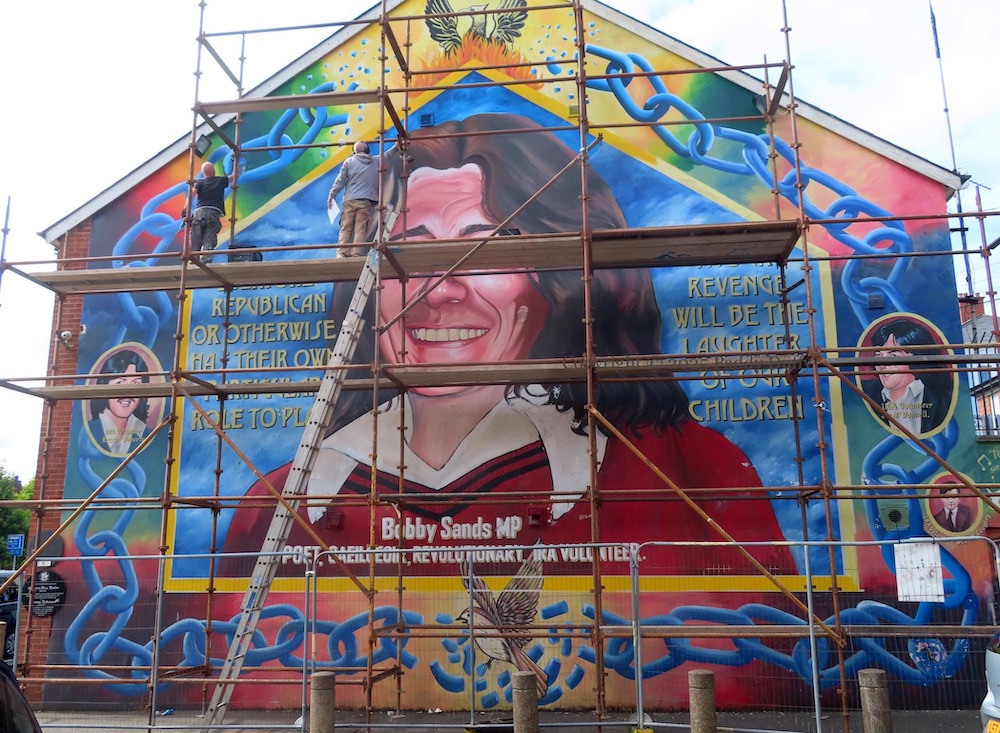
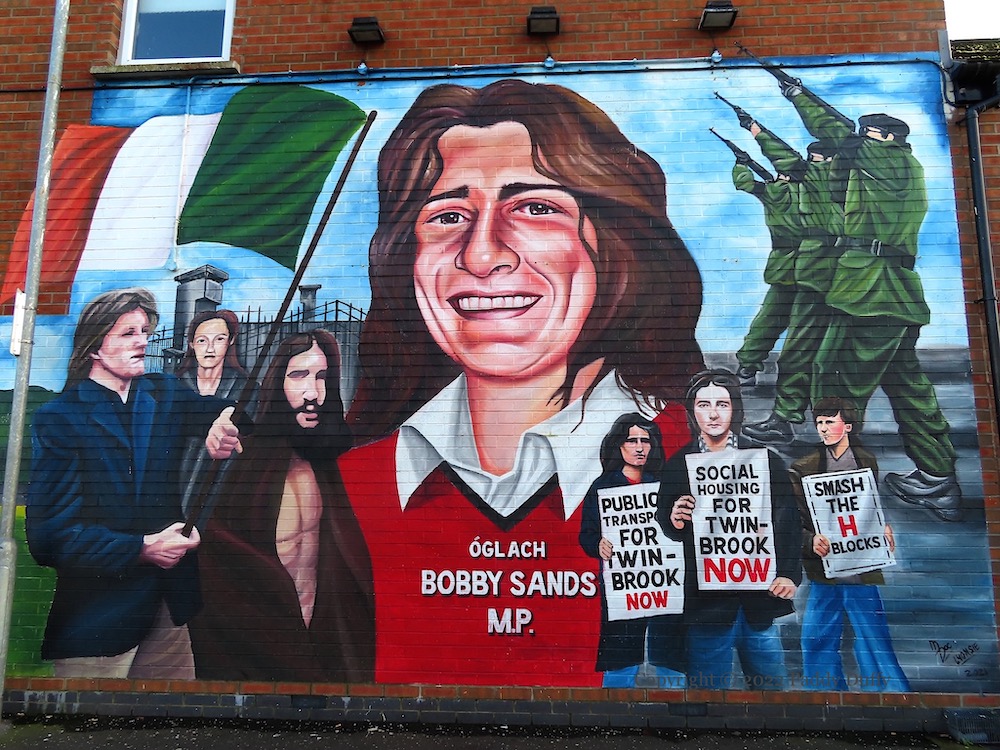
The Bobby Sands mural in Sevastopol Street, on the side of the Sınn Féın offices, is perhaps Belfast’s most famous mural and in general second only to Free Derry Corner in Derry. The main wall of the mural has just been touched up, in time for the march that took place in Belfast on August 24th as part of the national hunger-strike commemoration.
The first mural of Sands was painted on the wall in 1989 and the most recent re-painting prior to this one was in 2015 – see the wall’s Visual History page.
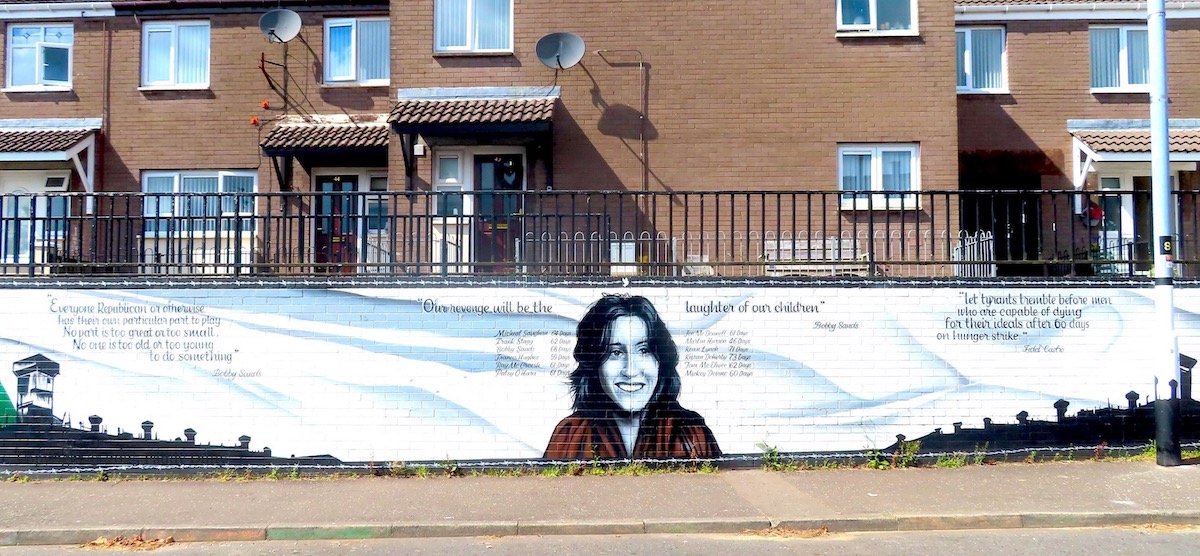
This entry updates Cuımhníonn Doıre from August 2024, in which the central part of the mural, showing Maıréad Farrell (above), was incomplete. In addition to a completed portrait of Farrell there are two quotations from Bobby Sands and one from Fidel Castro (along with a list of the twelve dead hunger-strikers of the Troubles era):
“‘Everyone, Republican or otherwise, has their own particular part to play. No part is too great or too small, no one is too old or too young to do something’ – Bobby Sands” [Diary, March 14th, 1981]
“‘Our revenge will be the laughter of our children’ – Bobby Sands”
“‘Let tyrants tremble before men who are capable of dying for their ideals after 60 days on hunger strike’ – Fidel Castro” [The line comes from Castro’s opening address on September 15th, 1981, to the Inter-Parliamentary Conference (pdf)]
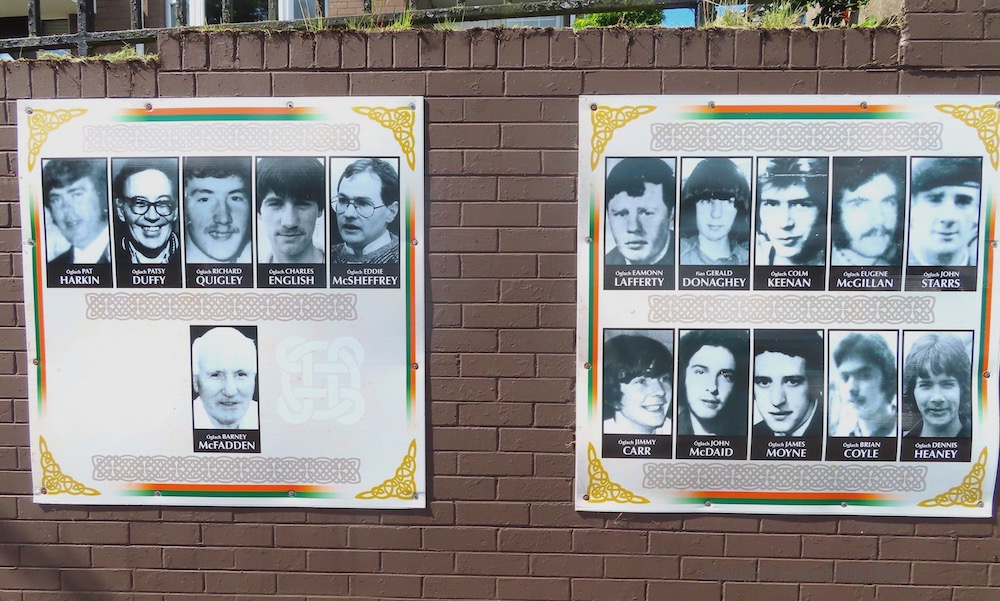
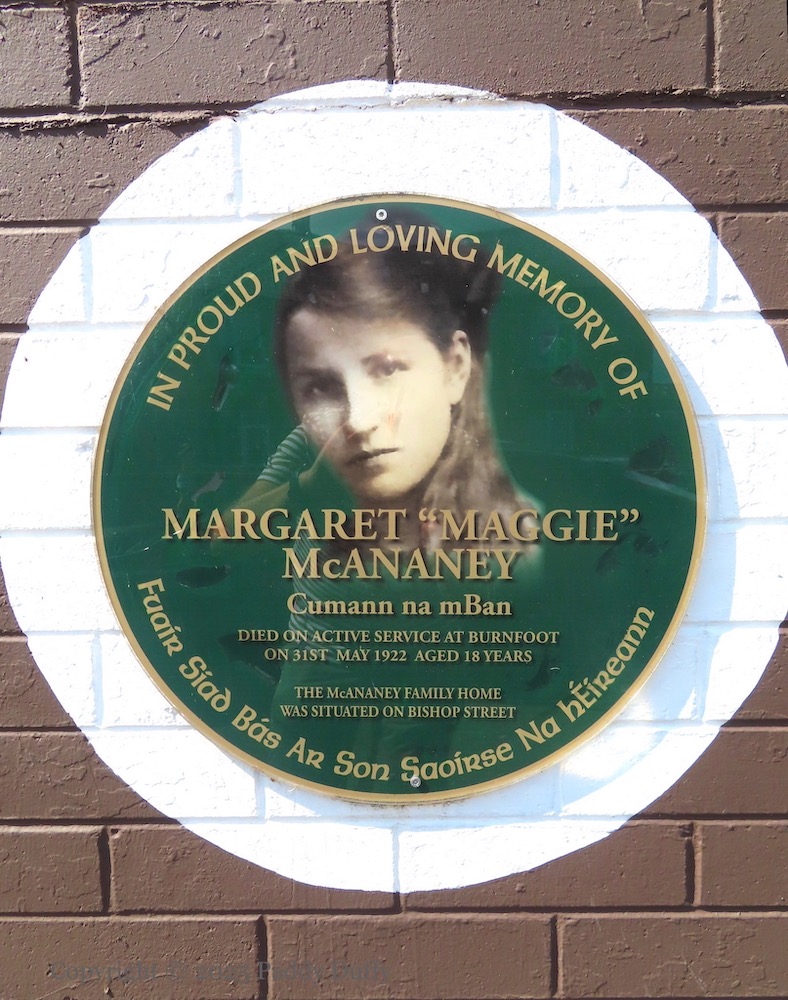
Also included below are an adjacent IRA Derry Brigade roll of honour and a plaque to Maggie McAnaney.
McAnaney died when a gun went off at an IRA checkpoint near Burnfoot, Co. Donegal, a month before the Civil War began (Derry Journal). This is an unusual use of the phrase “active service”, as McAnaney was travelling to a picnic at the time, rather than on exercises or preparing munitions; the phrase would later come to be associated primarily with a premature bomb explosion.
“In proud and loving memory of Margaret “Maggie” McAnaney, Cumann na mBan, died on active service at Burnfoot on 31st May 1922, aged 18 years. The McAnaney family home was situated on Bishop Street. Fuaır sıad bás ar son saoırse na hÉıreann.”
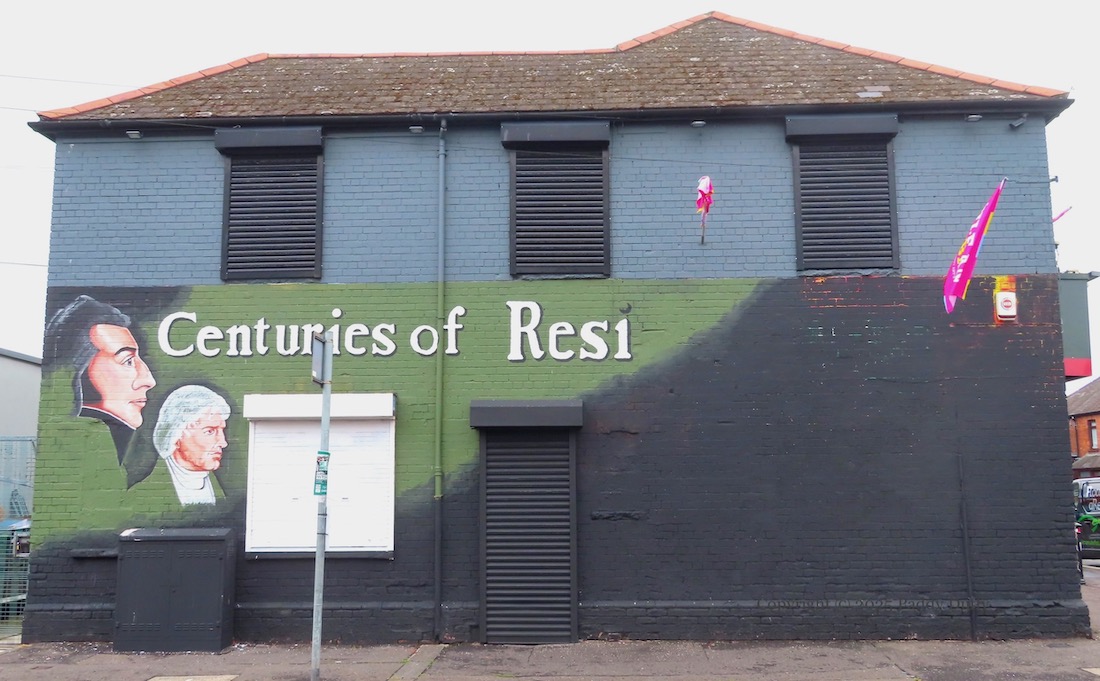
The United Kingdom Of Great Britain And Ireland was created in 1801, a reaction to the 1798 Rebellion, led by (amongst others) Wolfe Tone and Henry Joy McCracken, who were founding members of the Society Of United Irishmen in 1791 in Belfast.
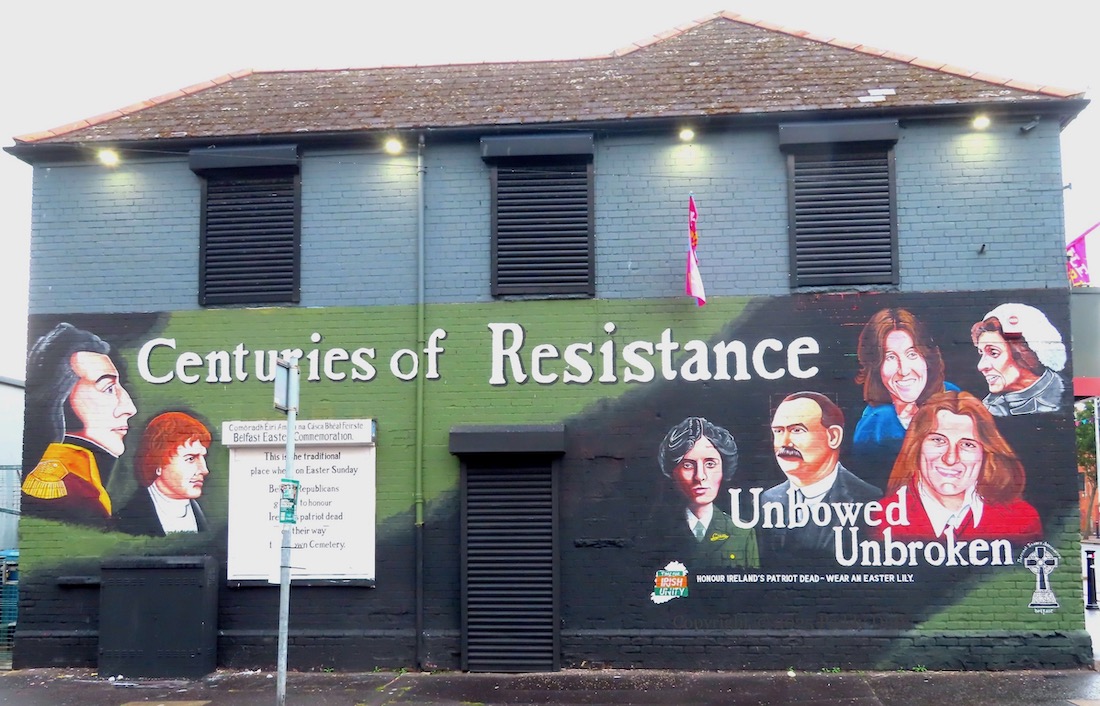
In this mural, Tone and McCracken on the left gaze across the “centuries of resistance” from 1798 to 1916 Rising revolutionaries Countess Markievicz and James Connolly, and beyond to Troubles-era figures Maıréad Farrell, Bobby Sands, and Máıre Drumm.
Around the same time as this mural was painted, a Féıle exhibition called ‘Vibrant Colours, Violent Past’ included A Panorama Of Republicanism which contains dozens of figures but again chooses 1798/Tone, 1916/Connolly, and the Troubles/Martin McGuinness as the pivotal moments and figures.
“Comóradh Éırí Amach Na Cásca Bhéal Feırste/Belfast Easter Commemoration. This is the traditional place where on Easter Sunday Belfast republicans gather to honour Ireland’s patriot dead on their way to Milltown Cemetery.” “Honour Ireland’s patriot dead – wear an Easter lily.” “Unbowed, unbroken.”
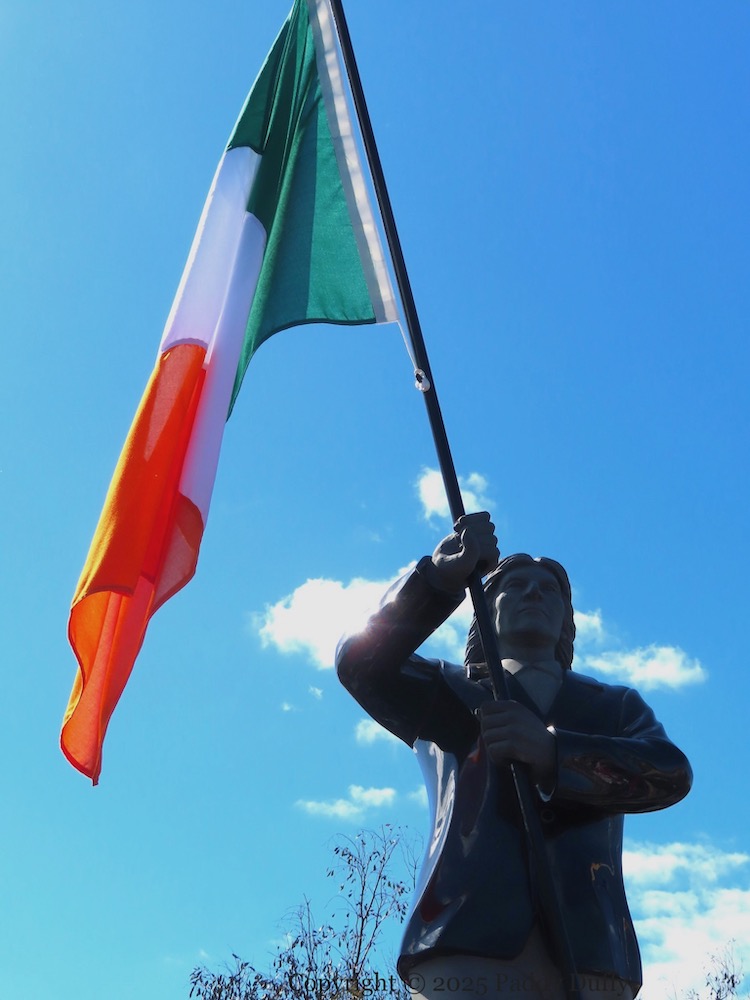
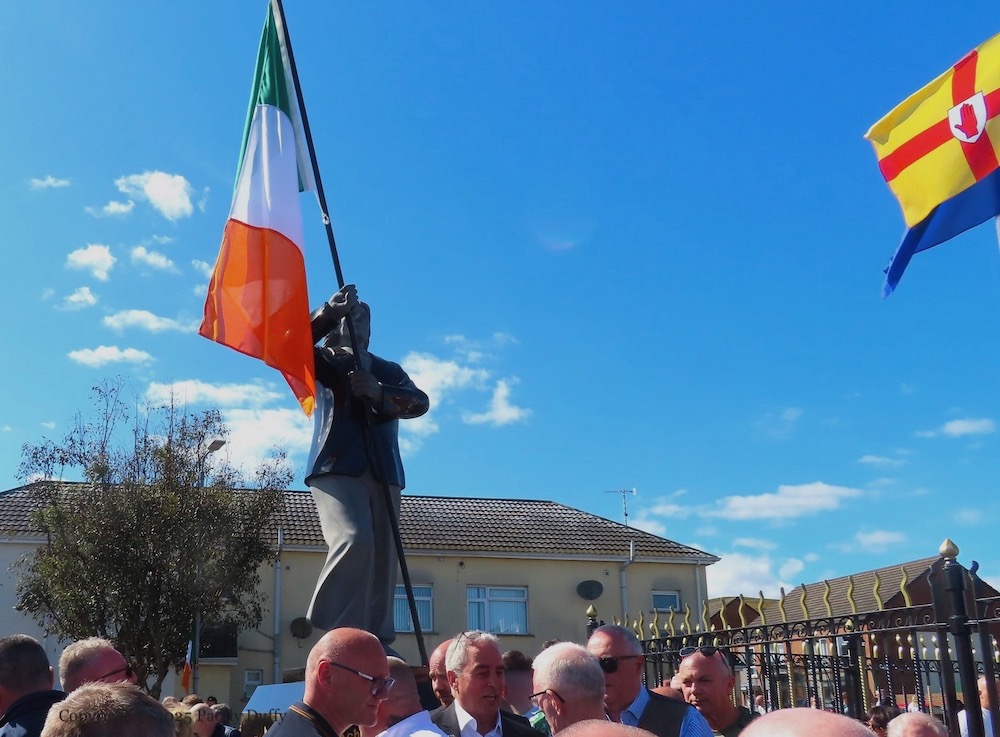
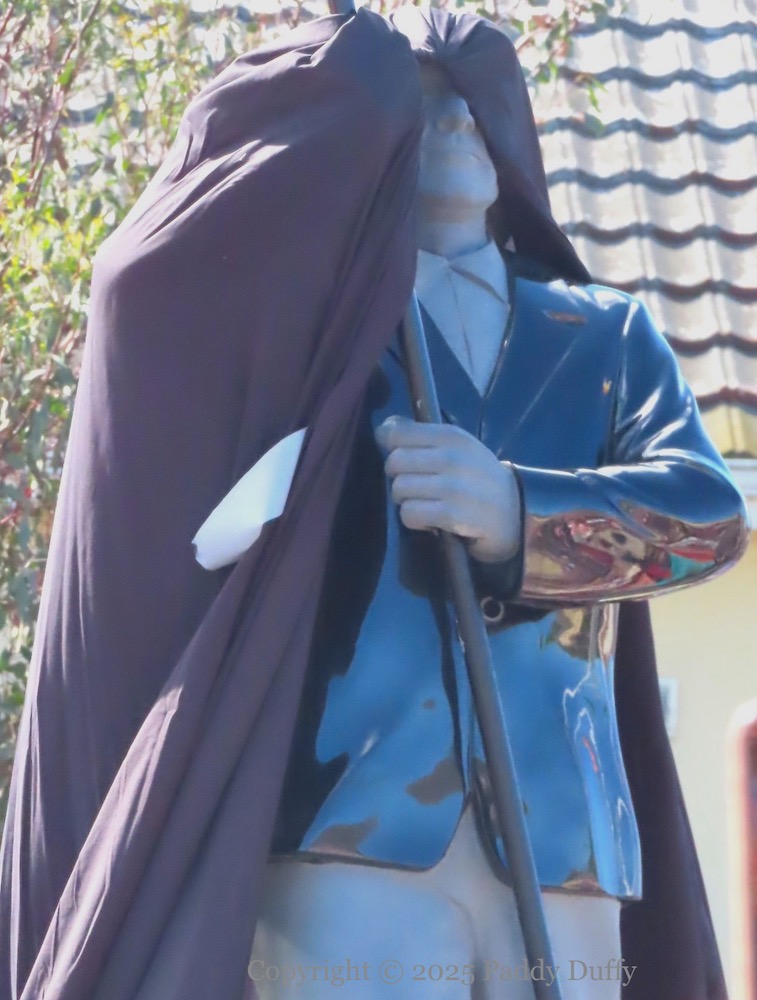
“Óglach Bobby Sands 9th March 1954 – 5th May 1981”. Sands was the first of the ten IRA and INLA prisoners to die in the second hunger strike. For the 44th anniversary of his death, a statue was unveiled in Twinbrook, near the Sands family home and next to the memorial garden in Gardenmore Road (Peter Moloney Collection).
The statue was created by Packy Adams (Belfast Media | Irish News) and appears to be based on the photographs by Gérard Harlay – discovered in 2019 – of Sands carrying a United Irishmen flag in a march that took place a few months before his (final) arrest in 1976 (Bobby Sands Trust). The new statue (which does not have planning permission) has a built-in flag-pole, to which an Irish Tricolour was added for the launch on May 4th.
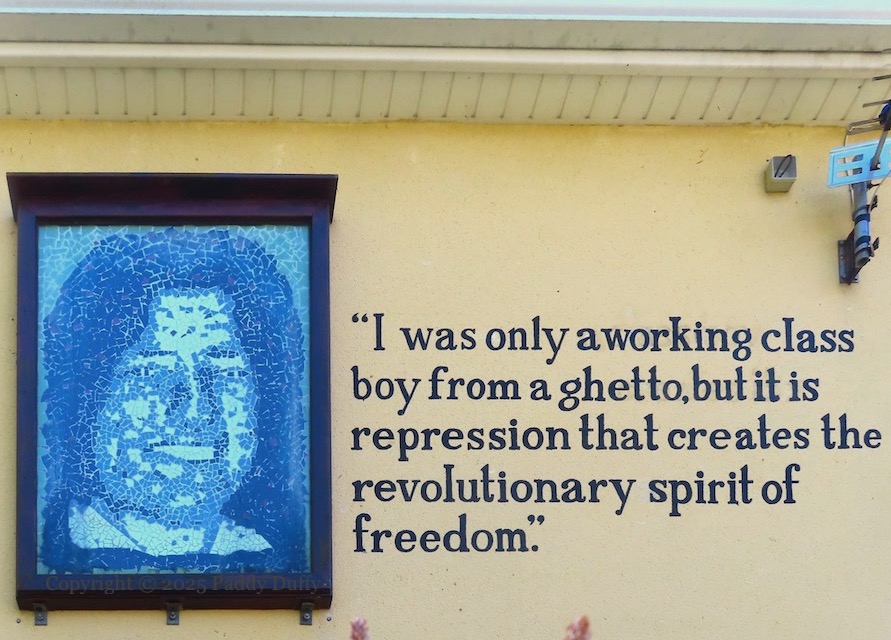
“I was only a working class boy from a [nationalist] ghetto, but it is repression that creates the revolutionary spirit of freedom.” This is a widely-quoted line from Bobby Sands, from an article in Republican News, 16 December, 1978 (page 7 pdf).
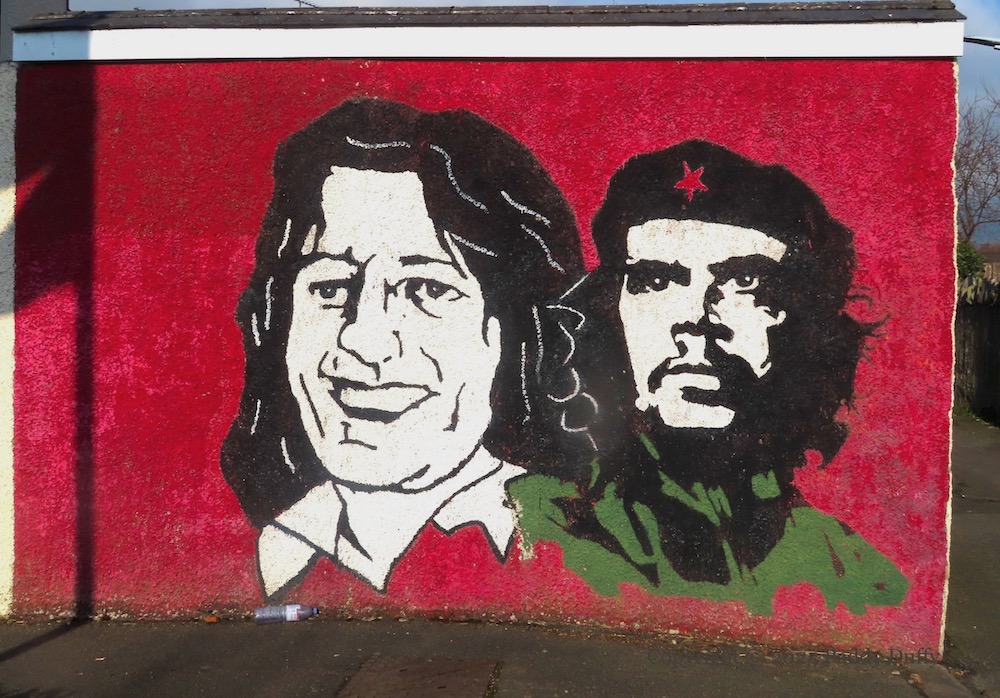
Bobby Sands and Ernesto “Che” Guevara, together in Fountain Street, Strabane. The image of Che is Jim Fitzpatrick’s iconic interpretation of Alberto Korda’s “Guerrillero Heroico” photograph of Che – see the Visual History page on The Influence Of Jim Fitzpatrick.
This mural has been in place since (at least) 2008 – see Bobby & Che in the Peter Moloney Collection.
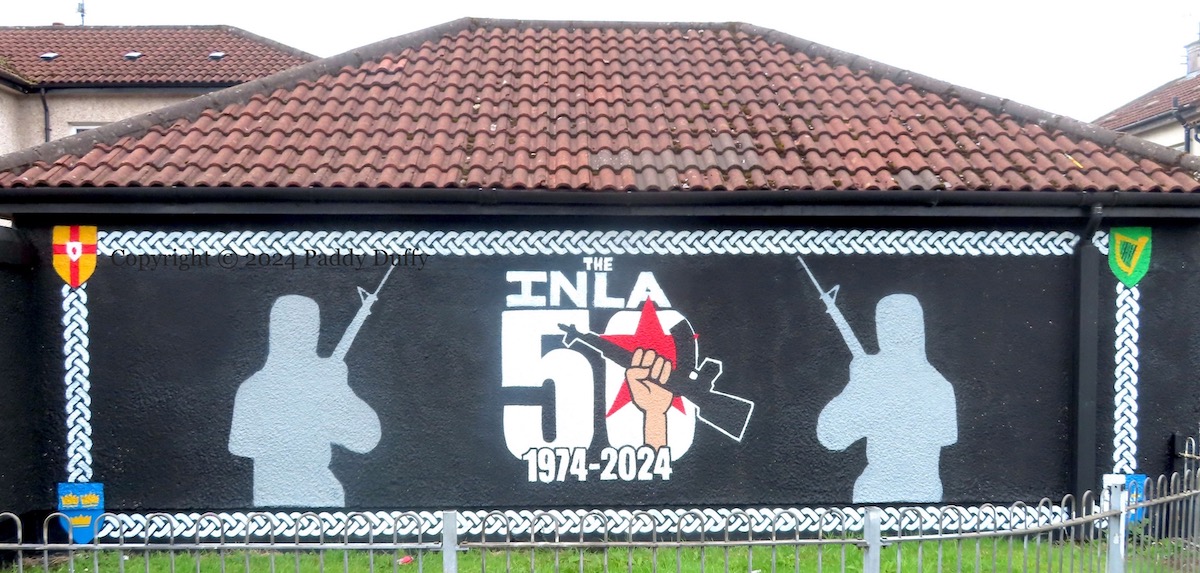
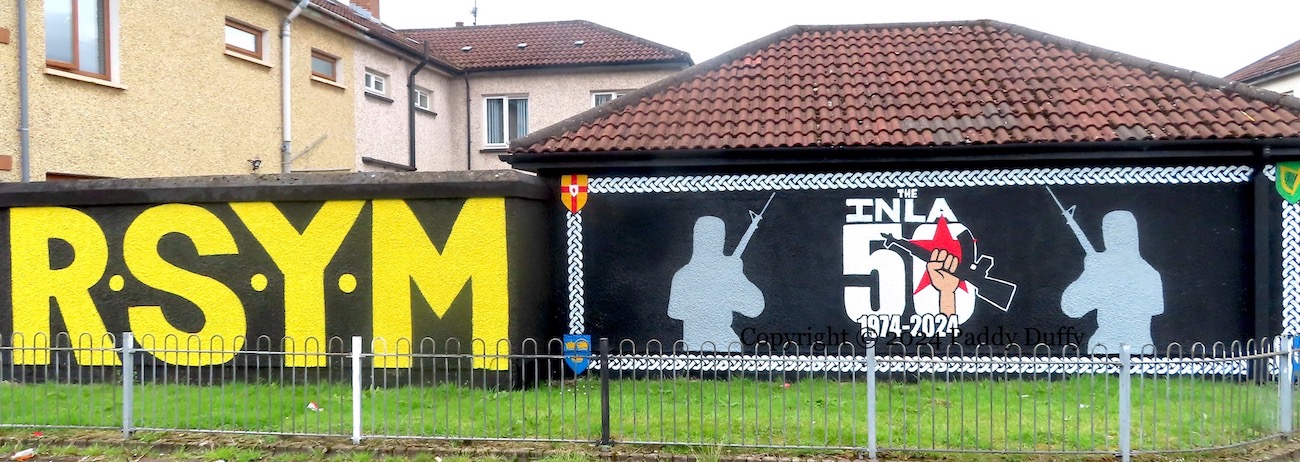
Commemorations of the INLA’s fiftieth anniversary have so far been limited to graffiti – see Saoırse Go Deo in Derry and Let The Fight Go On in Belfast – but here we have two deliberately painted panels in the Bogside (specifically Meenan Square) (one replacing The Way We Were).
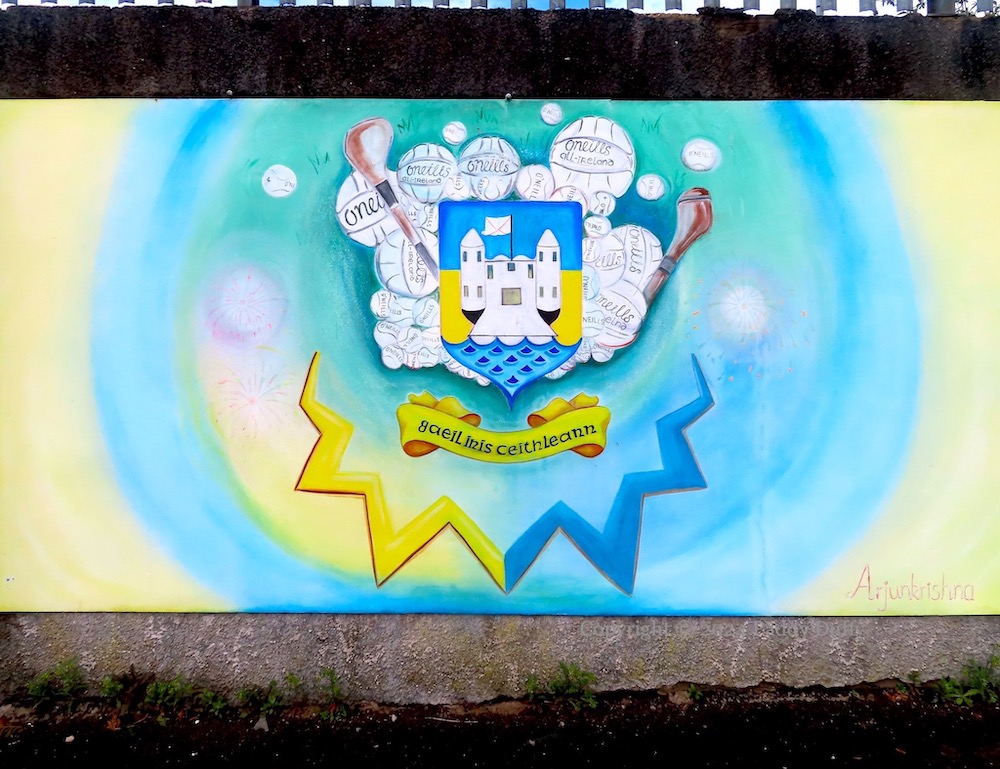
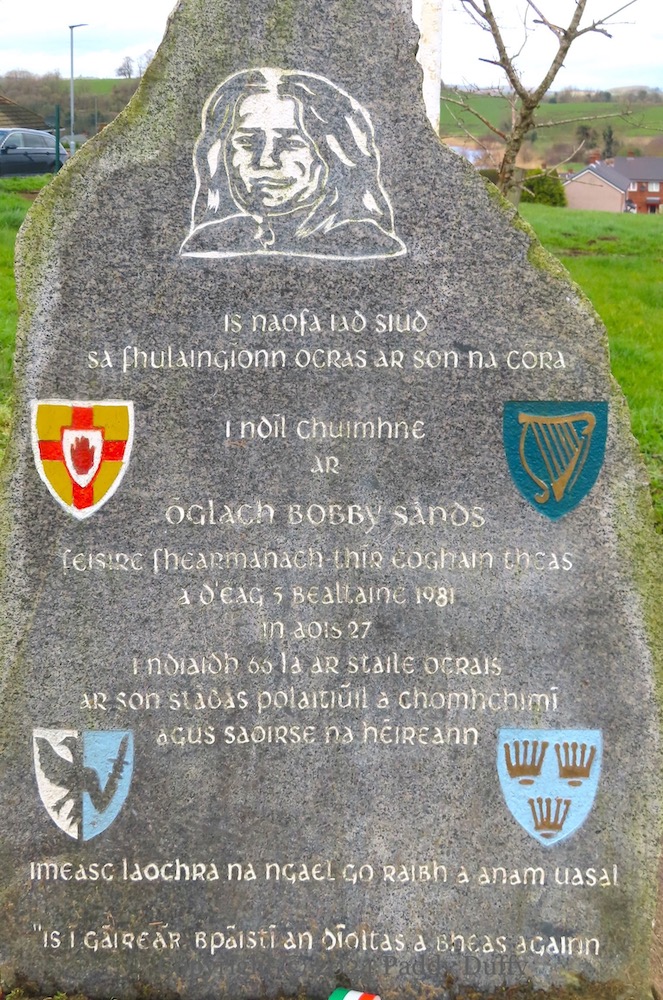
Here are three pieces from the Drumcor Hill area of Enniskillen.
Above, “Enniskillen remembers the hunger strikers” – for the fortieth anniversary of the 1981 strike, against a background of sunburst and starry plough, in Loughview Drive.
Below, the emblem of Gaeıl Inıs Ceıthleann/Enniskillen Gaels (web) on the wall outside their home field of Brewster Park.
Finally, a memorial stone to Bobby Sands in Erne Drive. The inscription on the stone reads, “‘Is naofa ıad sıud sa fhulaıngíonn ocras ar son na córa.’ [= Holy are those who suffer hunger for the sake of justice/”Blessed are those who hunger for justice”] I ndíl [ndıl] chuımnhe ar Óglach Bobby Sands, feısıre [= M.P.] Fhearmanach-Thír Eoghaın Theas, a d’éag 5 Bealtaıne 1981 ın aoıs 27 ı ndıaıdh 66 lá ar staıle [staılc] ocraıs ar son stádas polaıtıúıl a chomhchımí agus saoırse na hÉıreann. I measc laochra na nGael go raıbh a anam uasal. ‘Is í gáıre ár bpáıstí an díoltas a bheas agaınn'”
For an alternative translation of Sands’s quote “Our revenge will be the laughter of our children”, see The Spirit Of Freedom in the Peter Moloney collection.
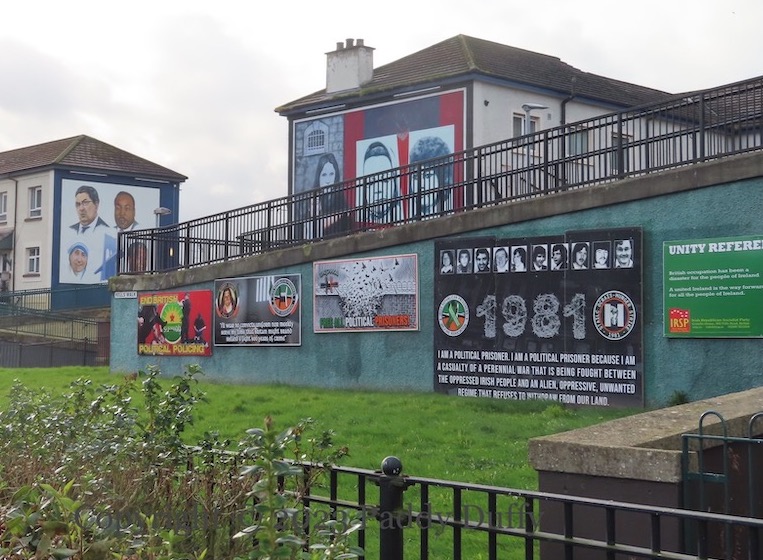
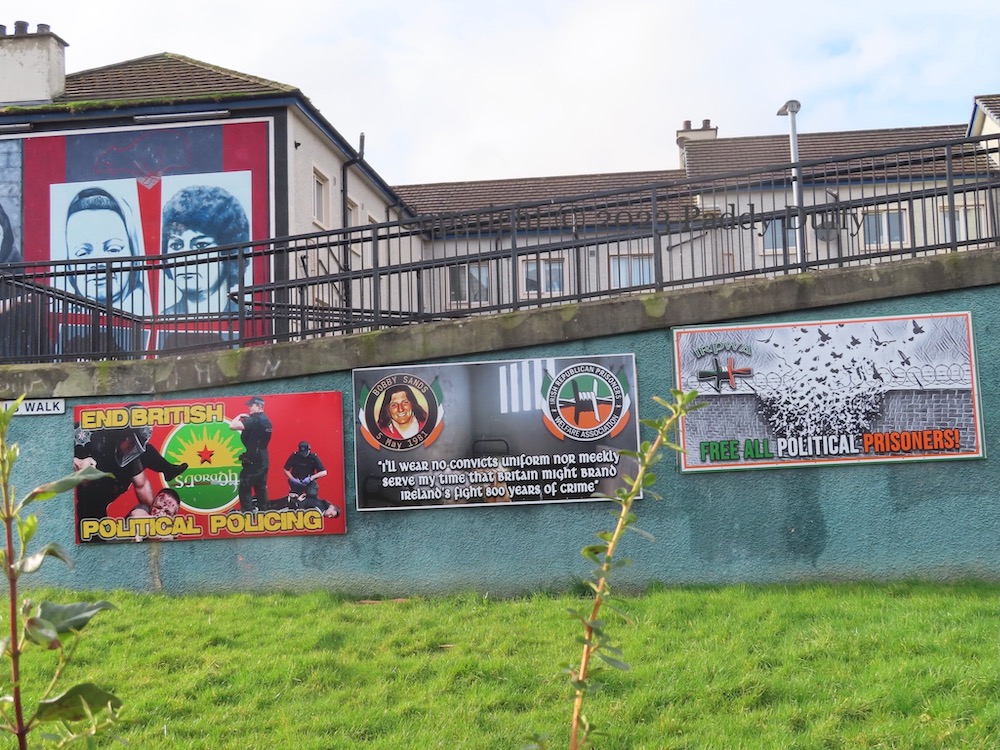
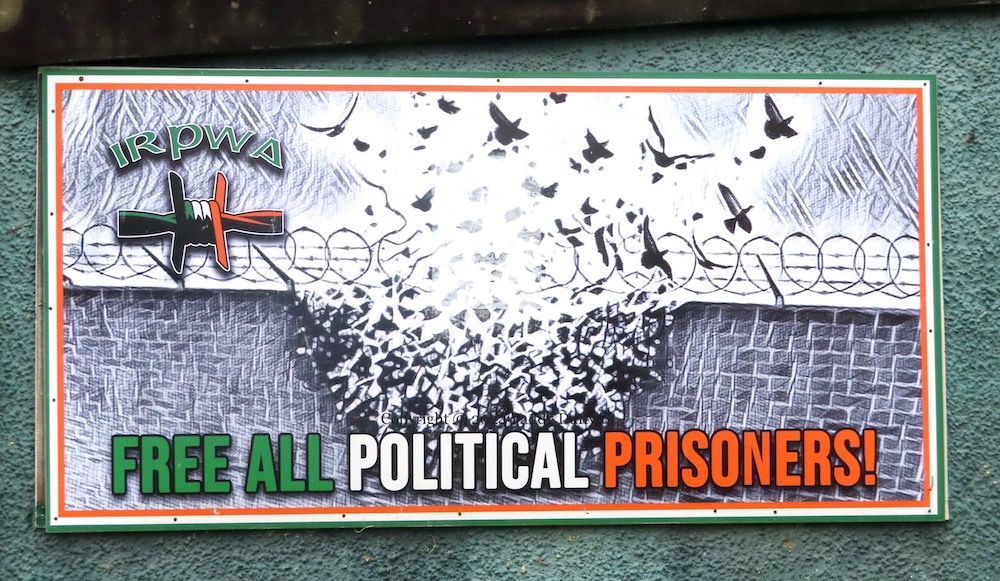
There are six small boards along Rossville Street, Derry.
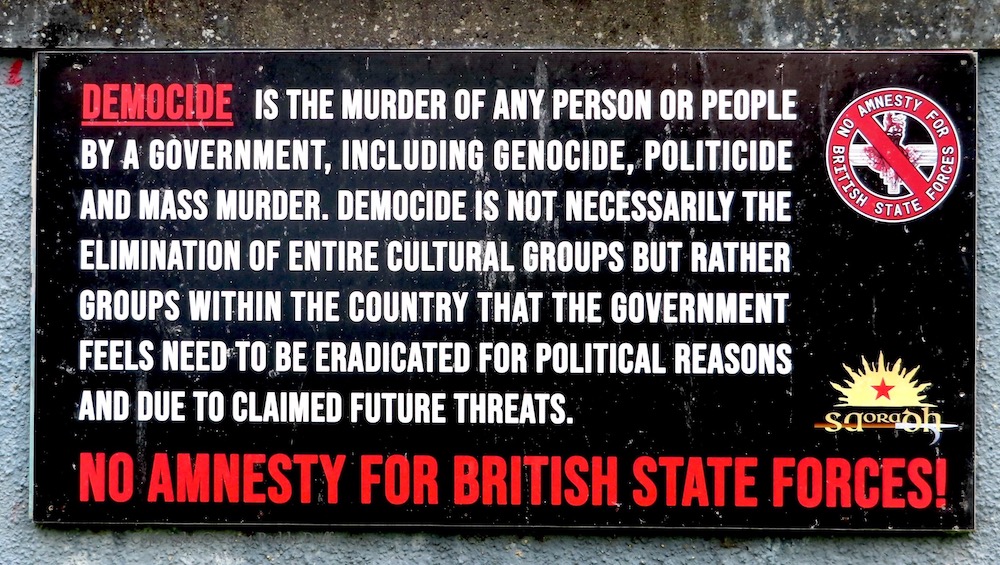
On the end wall (out of sight in the wide shots): “Democide is the murder of any person or people by a government, including genocide, politicide and mass murder. Democide is not necessarily the elimination of entire cultural groups but rather groups within the country that the government feels needs to be eradicated for political reasons and due to claimed future threats. No amnesty for British state forces.”
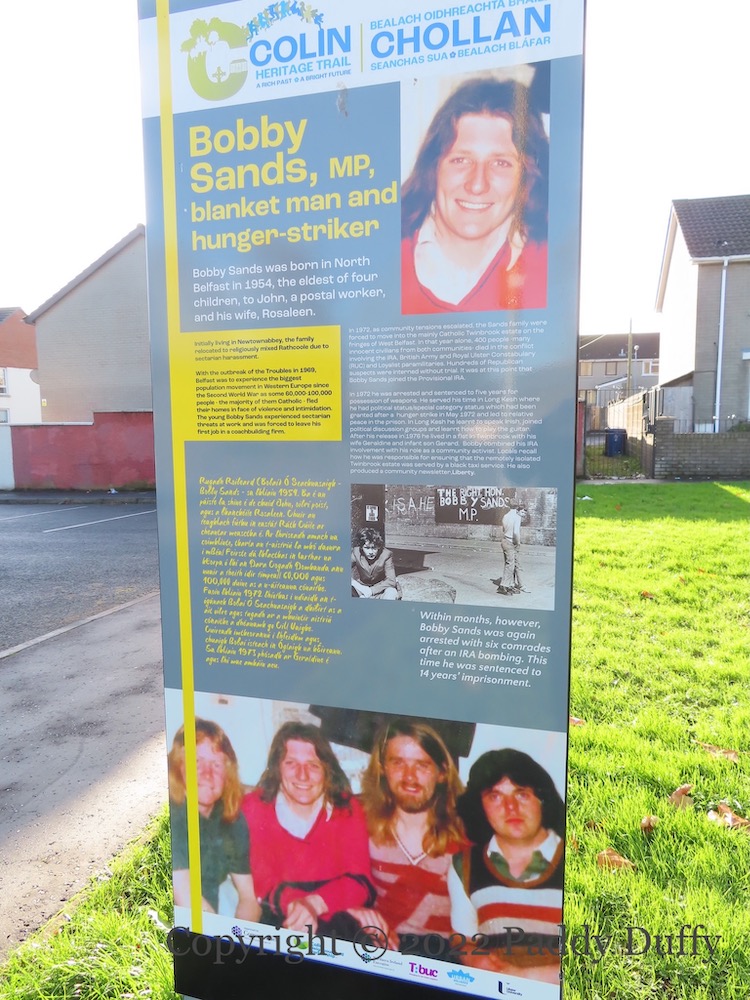
In 2019, images of Bobby Sands before his (second and final) arrest and imprisonment were rediscovered in the collection of French photographer Gérard Harlay. Sands was serving as a flag-bearer in an August 1976 march from the Busy Bee to Dunville Park to protest the withdrawal of political status. (For some of Harlay’s images, see Bobby Sands Trust.) This new mural in his home area of Twinbrook copies one of the images (though presents him as carrying a Tricolour rather than a harp) along with protesters protesting for “Public transport for Twinbrook now” and “Social housing for Twinbrook now”.


















 Paddy Duffy Collection