Chained-together padlocks represent Long Kesh and UDA/UFF prisoners of war (LPOW). The Ulster nationalist flag is on the left. For the four-quadrant shield, see Sans Peur.
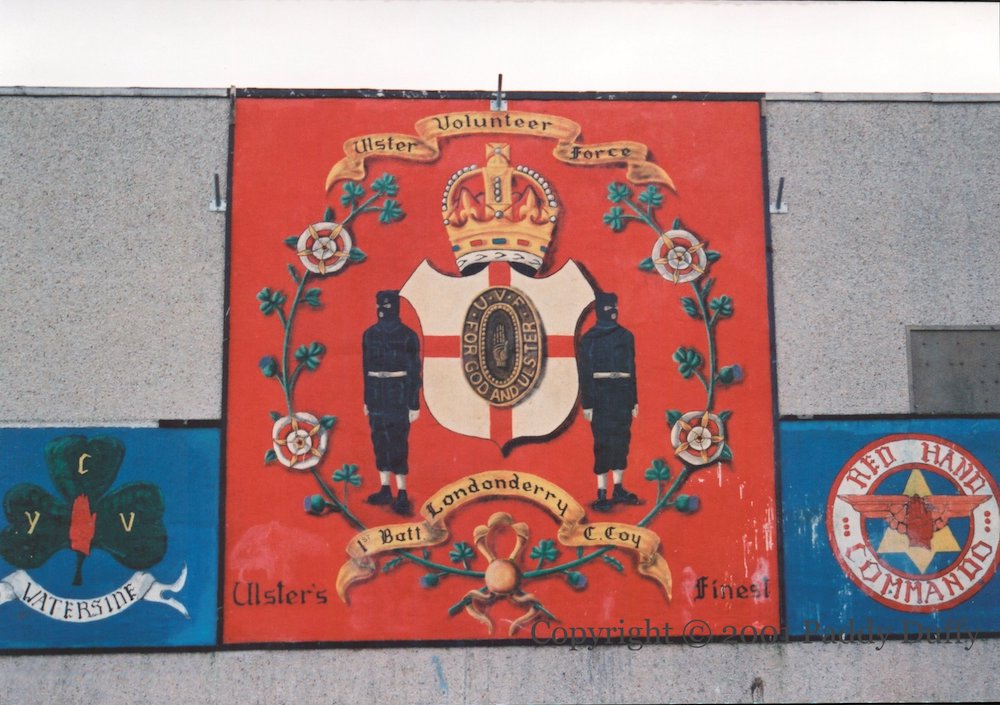
“Ulster’s finest – Londonderry UVF 1st battalion, C company”. Here is a trio of loyalist boards in Dennet Gardens, Londonderry with the insignia of the Young Citizen Volunteers, the Ulster Volunteer Force, and the Red Hand Commandos. The design of a garland of flowers containing a regimental insignia dates to the Ulster Volunteers of 1912; the masked volunteers standing to attention do not.
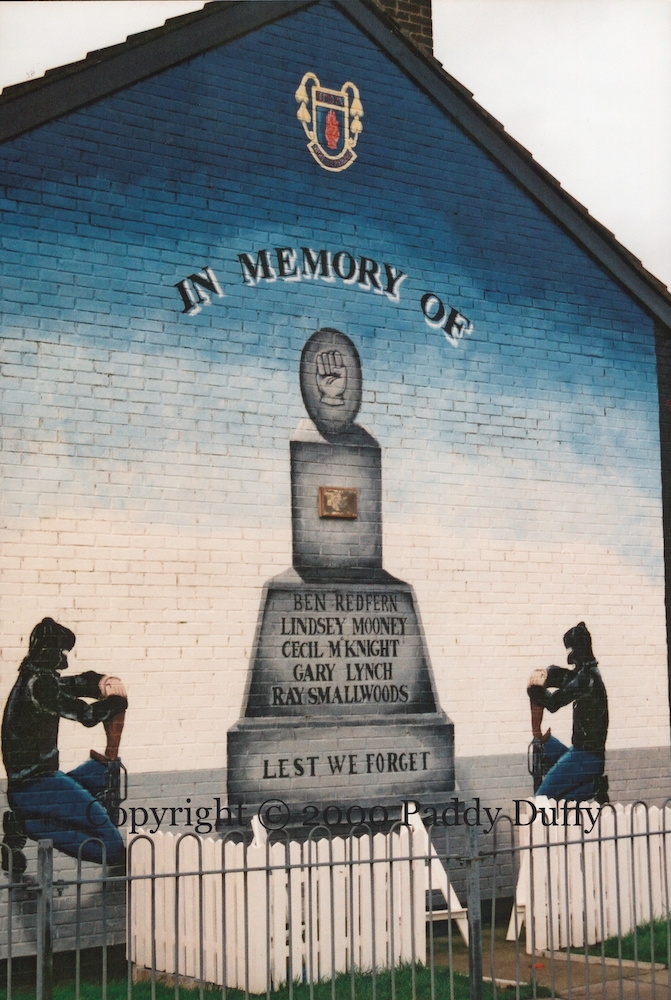
“In memory of Ben Redfern, Lindsay Mooney, Cecil McKnight, Gary Lynch, Ray Smallwoods, William Campbell. Lest we forget.” For Redfern and Lynch, see It’s Still Only Thursday; Smallwoods has a WP page; Campbell died in 2002 in a premature pipe-bomb explosion (Guardian).
Cú Chulaınn (or, as here, Cuchulainn) is usually shown dying, in the pose made famous by Oliver Sheppard in his statue that was installed in the General Post Office in Dublin in 1935. (See the Visual History page about Cú Chulaınn in murals.) Here, however, he is a living warrior (carrying a sword and a shield emblazoned with the crest of Northern Ireland) as an analogue to loyalist paramilitaries and prisoners of war (“LPOW” on the right).
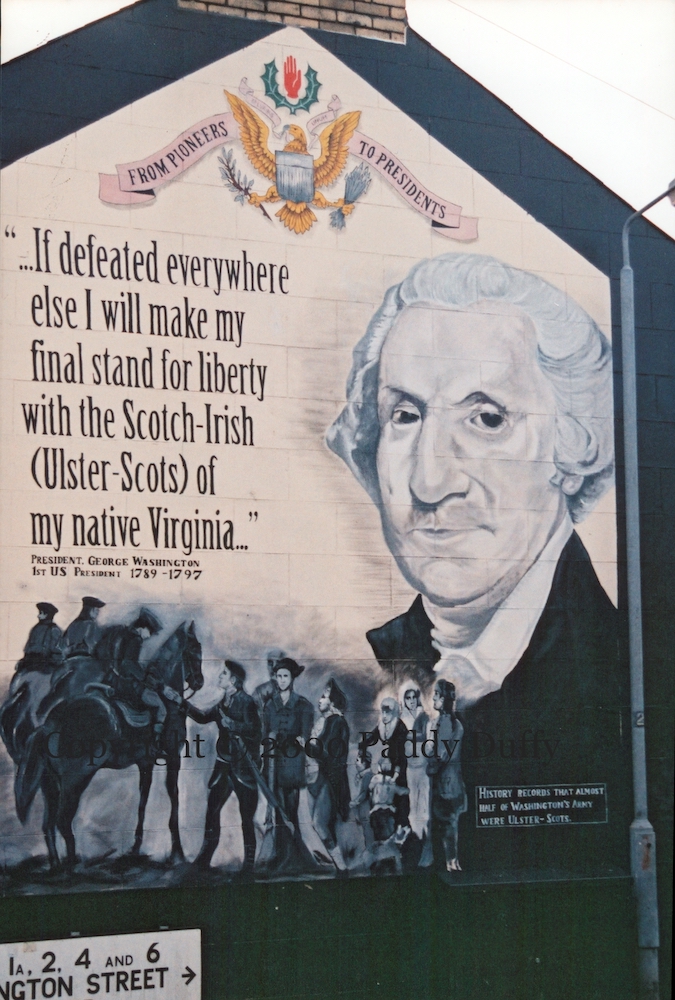
These are two of the first three murals painted in the series “From Pioneers To Presidents”, to Washington and Buchanan, in Ebrington Street Lower and Ebrington Street in the Waterside, Londonderry, along with one to Roosevelt in the Fountain.
George Washington commanded the Continental Army during the revolution and served as the first president of the United States beginning in 1789. His ancestry was English. The quote – “If defeated everywhere else I will make my final stand for liberty with the Scotch-Irish (Ulster-Scots) of my native Virginia” – is undocumented, the closest being this statement from McKinley.
The note in the corner reads “History records that almost half of Washington’s army were Ulster-Scots”; the basis for this claim might be General (Charles?) Lee’s report that “half the rebel Continental Army were from Ireland.” (See Chapter 2 of Bagenal, The American Irish and their Influence on Irish Politics.)
James Buchanan was “15th US president 1857-1861.” Buchanan’s father, also called James, was born in Ramelton, Co Donegal, and was living in Co Tyrone when he emigrated to the United States from Derry in 1783, (one of the “250,000 Ulster-Scots [who] emigrated to America in the 1700s”). James junior was born in 1791, the second of eleven children.
The confusion over the wording of the quote – “My Ulster blood is my most priceless [or simply: a priceless] heritage … [and I can never be too grateful to my grandparents from whom I derived it.]” – is matched by confusion over who said it (Buchanan junior or senior?); the source of the quote is unknown. Likewise we do not know where in Scotland the grandparents might have come from and perhaps the move to Ireland happened much earlier.
Parading This mural demands that Orange Order marches have the consent of local residents in Derry, Garvaghy [Portadown], and lower Ormeau [south Belfast].
Parading was the central on-the-ground issue of the post-Agreement years (BBC). Resistance to Orange Order parades marching through CNR areas was led by local groups: in Derry, by the Bogside Residents’ Group, in Portadown, by the Garvaghy Road Residents’ Coalition, and in lower Ormeau by Lower Ormeau Residents Action Group. In each case, residents were appealing directly to the local lodges and to the police. (The Parades Commission would be established in 1998.)
In 1995, there was a three-day stand-off on the Gavraghy Road that resulted in a silent march without bands (CAIN). The police initially re-routed the 1996 march but reversed the decision at the last minute, citing the threat of loyalist violence, and forced residents off the street in order to accommodate the parade.
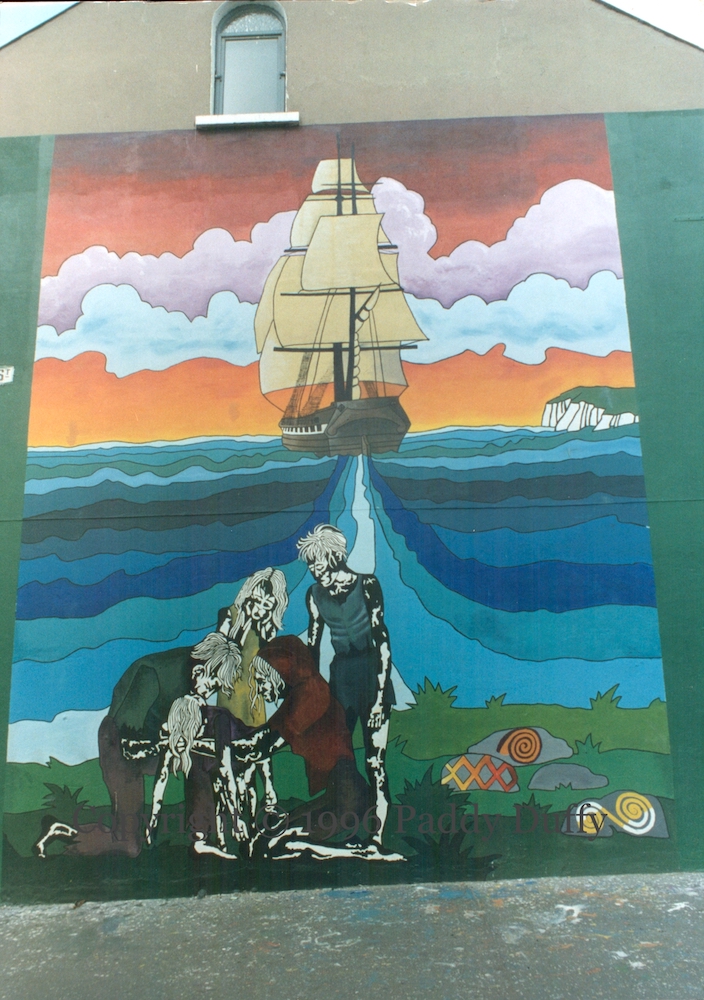
A million, and perhaps as many as 2 million – one in four Irish people – left Ireland between 1845 and 1855, many sailing on so-called “coffin ships” which had mortality rates of 30%. Another million died in the Great Hunger itself (Visual History), in most cases the proximate causes were fever and dysentery (WP | Irish Central).
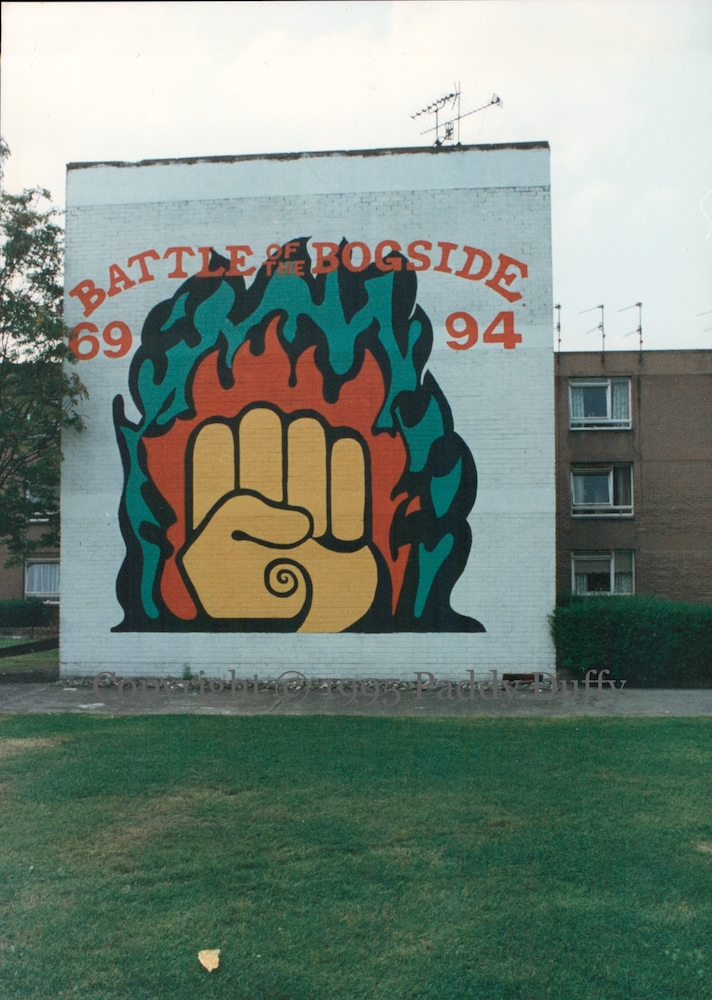
A fist in flames to commemorate the 25th anniversary of the battle of the Bogside, and the beginning of the Troubles, 1969 – 1994. The Battle began on August 12th, 1969, with the declaration of “Free Derry” and exclusion of police. The British Army was deployed on the 14th.