“Years from now they will ask you where you were when your comrades were dying on hungerstrike. Shall you say you were with us or shall you say that you were conforming to the very system that drove us to our deaths[?]” INLA (sign the light-pole as well as the flags and red star in the mural) volunteer Patsy O’Hara, from Derry, joined the hunger strike on the same day as Raymond McCreesh (March 22nd) and died, 61 days later, later in the same day (May 21st, 11:29 p.m.) as him (2:11 a.m.).
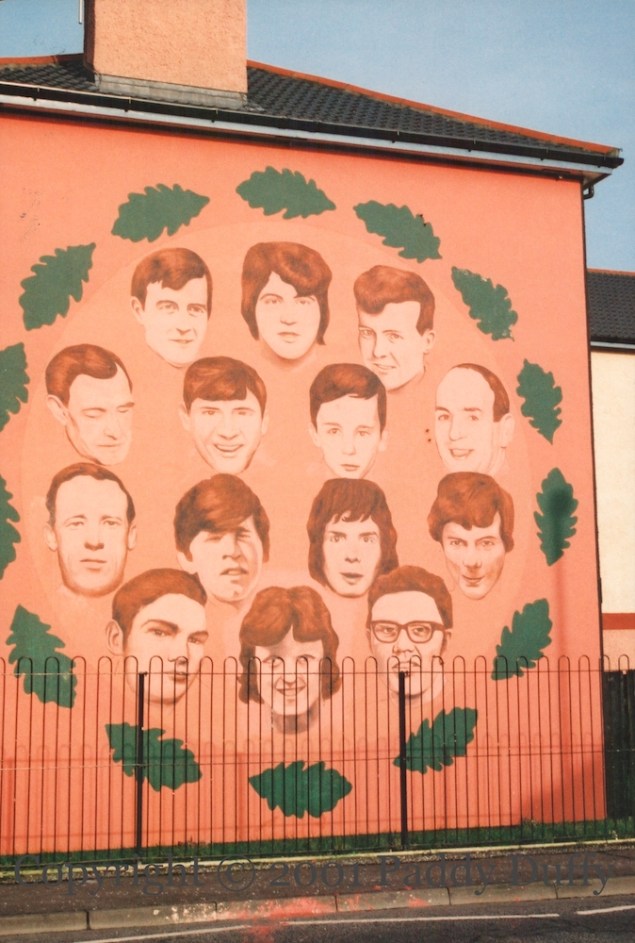
A Christian cross is added to the Bloody Sunday memorial mural in Westland Street, Derry. A version without a cross was seen previously in 1999 and 2004. (The latter gives the names of the victims.) There is an oak leaf – symbol of Derry – for each of the fourteen victims.
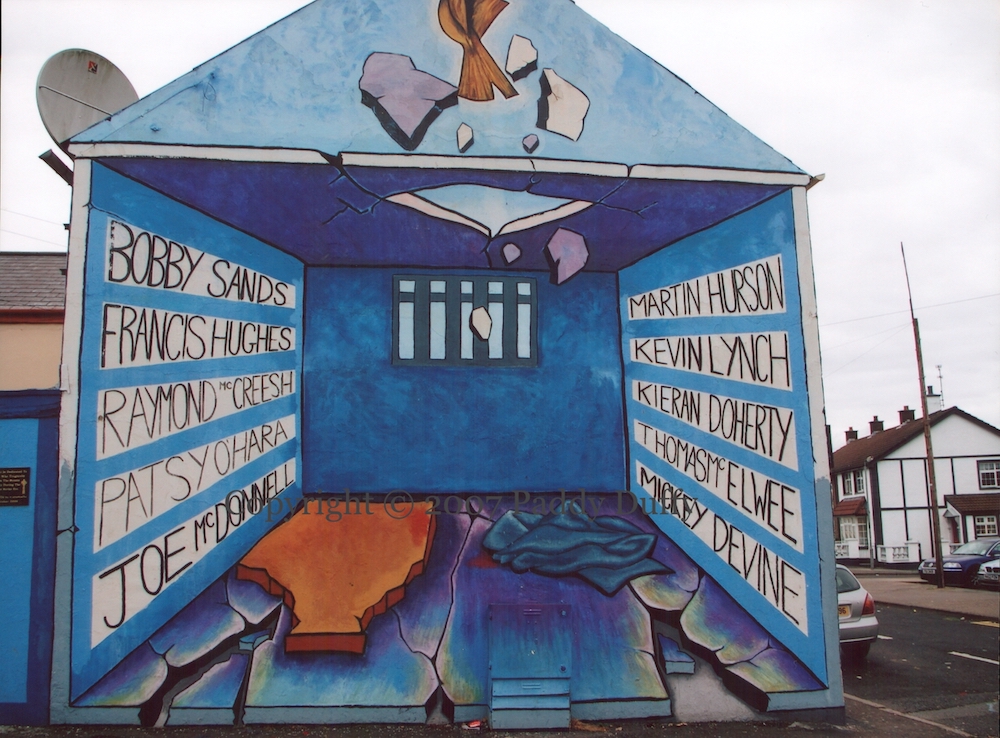
A lark (rather than a dove) bursts through the ceiling of a H-Block cell lined with the names of the ten deceased 1981 hunger strikers. “This mural is dedicated to all those who tragically died on the streets of Derry during the hunger strike era. Suımhneas Dé dá nanamacha. 3rd October 2006.”
These paintings are on boards on the wall around the Cathedral Youth Club in the Fountain.
Above are two boards (on the side) showing the Apprentice Boys crying “No surrender!” and the breaking of the boom that ended the siege. A 2007 entry in the Peter Moloney Collection shows three additional panels to the right, also relating to Londonderry.
“‘My forefathers were … the men who had followed Cromwell and who shared in the defence of Derry, and in the victories of Aughrim and the Boyne.’ – President Theodore Roosevelt, 20th US president, 1901-1904.” The “shutting of the gates” of Derry is represented in the bottom left.
The quote is derived from Volume 1, Chapter 5, of Roosevelt’s The Winning Of The West (available at Project Gutenberg). Roosevelt, however, is describing the forefathers of the Scotch-Irish, rather than his own forefathers, who, as the name suggests, were Dutch.
He writes, “The Presbyterian Irish were themselves already a mixed people. Though mainly descended from Scotch ancestors—who came originally from both lowlands and highlands, from among both the Scotch Saxons and the Scotch Celts—many of them were of English, a few of French Huguenot, and quite a number of true old Milesian Irish extraction. They were the Protestants of the Protestants; they detested and despised the Catholics, whom their ancestors had conquered, and regarded the Episcopalians by whom they themselves had been oppressed, with a more sullen, but scarcely less intense, hatred. They were a truculent and obstinate people, and gloried in the warlike renown of their forefathers, the men who had followed Cromwell, and who had shared in the defence of Derry and in the victories of the Boyne and Aughrim.”
Some sources claim that an ancestor(s) on his mother’s side emigrated from Gleno, Co Antrim in 1729, but this seems to be her great-great-grandfather James, who was a Scot (WP) and appears to have emigrated directly from Scotland, specifically Baldernock, in 1728 or 1729 (WikiTree | Friends Of Bulloch). The search for a connection continues, according to Irish Central.
This mural is one (and perhaps the first to be painted) in the series “From pioneers to presidents”. For more such murals, see the Visual History page about Ulster-Scots murals.
This board on the back of Free Derry Corner (Visual History) commemorates the thirtieth anniversary of the second hunger strike and the ten strikers who died.
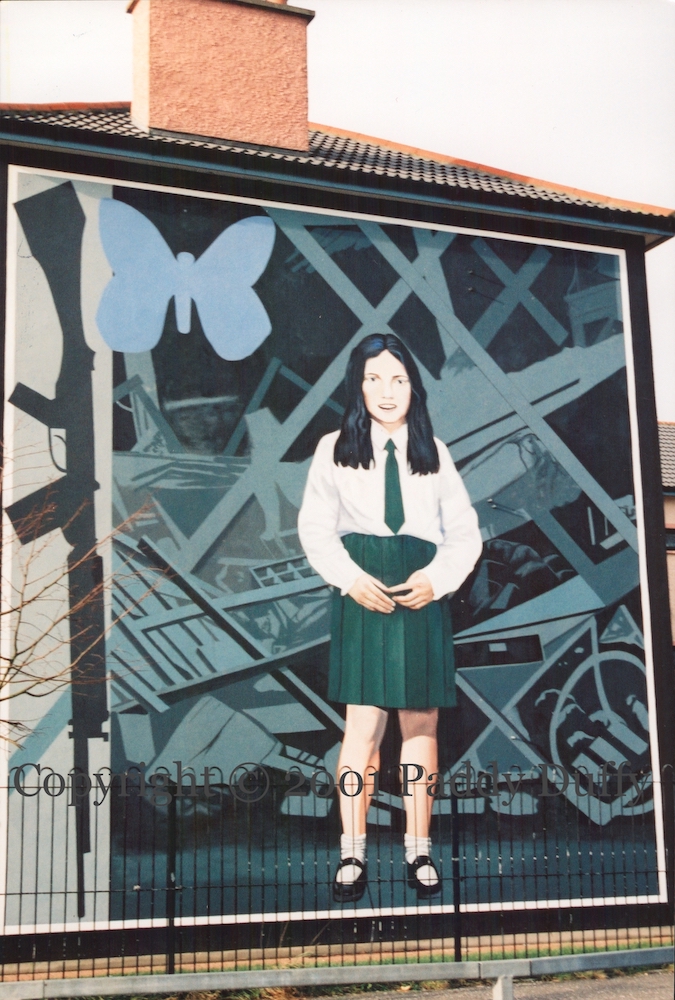
The subject for the fifth mural by The Bogside Artists (Visual History) is Annette McGavigan, the first child to be killed by British forces in the Troubles, in 1971 (WP).
The fourth mural by the Bogside Artists (Visual History) shows the faces of the fourteen people who died on or as a result of Bloody Sunday, January 30th, 1972, shot by the “gun-happy louts” (as described by the Belfast UDA; Vanguard also called for their removal – see the entry for Robert McKinnie in Lost Lives) of the 1st Parachute Regiment; 15 more people were injured.
By row, the victims portrayed are: Michael McDaid, John Young, Paddy Doherty John Johnston (d. June 16th), Hugh Gilmour, Gerry Donaghy, Barney McGuigan Gerry McKinney, William Nash, Kevin McElhinney, Jackie Duddy Jim Wray, Michael Kelly, William McKinney
The portraits are presented within a circle of oak leaves – symbol of Derry – one for each person.
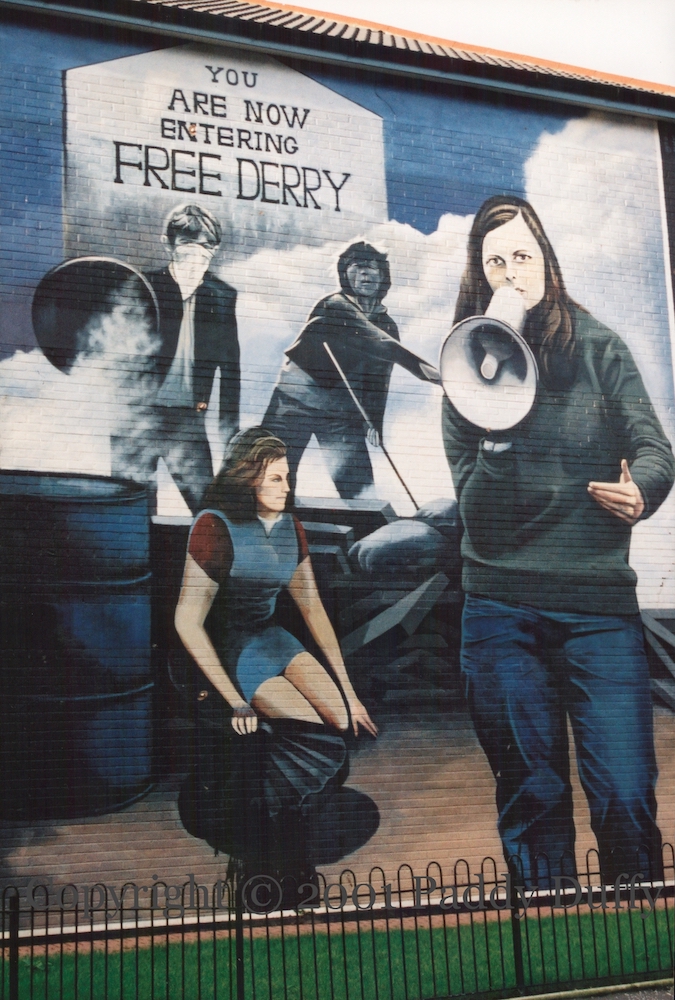
The second mural by the Bogside Artists (after The Petrol Bomber – Visual History) also depicts the battle of the Bogside and features Bernadette Devlin (later McAliskey). Devlin was elected to the British parliament in 1969 at age 21 and was imprisoned in December for her role in the August uprising. The mural reproduces a classic photograph showing Devlin with a megaphone in front of protesters and Free Derry Corner. It replaces another ‘Battle of the Bogside’ mural. The Bogside Artists explain the mural and its history in this short video.
The sixth mural from the Bogside Artists commemorates the 1980 hunger strikes, first in Long Kesh and subsequently in Armagh Women’s Prison. The main figure is Raymond McCartney; the female figure is perhaps Mary Doyle (the other two female strikers were Maıréad Farrell and Maıréad Nugent).