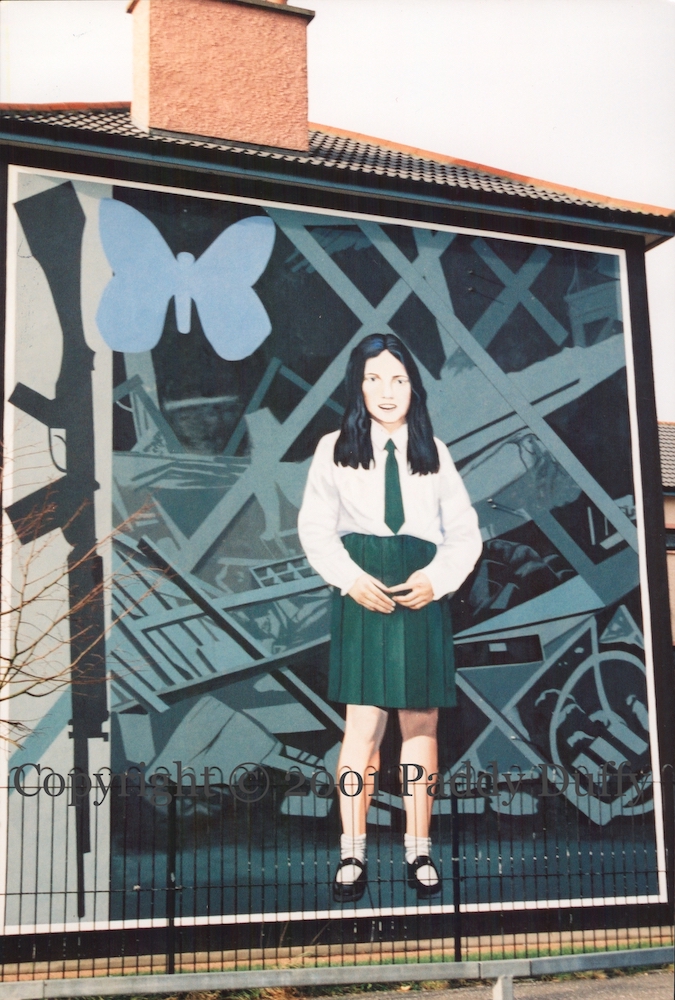
The subject for the fifth mural by The Bogside Artists (Visual History) is Annette McGavigan, the first child to be killed by British forces in the Troubles, in 1971 (WP).
Lecky Road, Derry
Click image to enlarge
Copyright © 2001 Paddy Duffy
T00358
The subject for the fifth mural by The Bogside Artists (Visual History) is Annette McGavigan, the first child to be killed by British forces in the Troubles, in 1971 (WP).
Lecky Road, Derry
Click image to enlarge
Copyright © 2001 Paddy Duffy
T00358
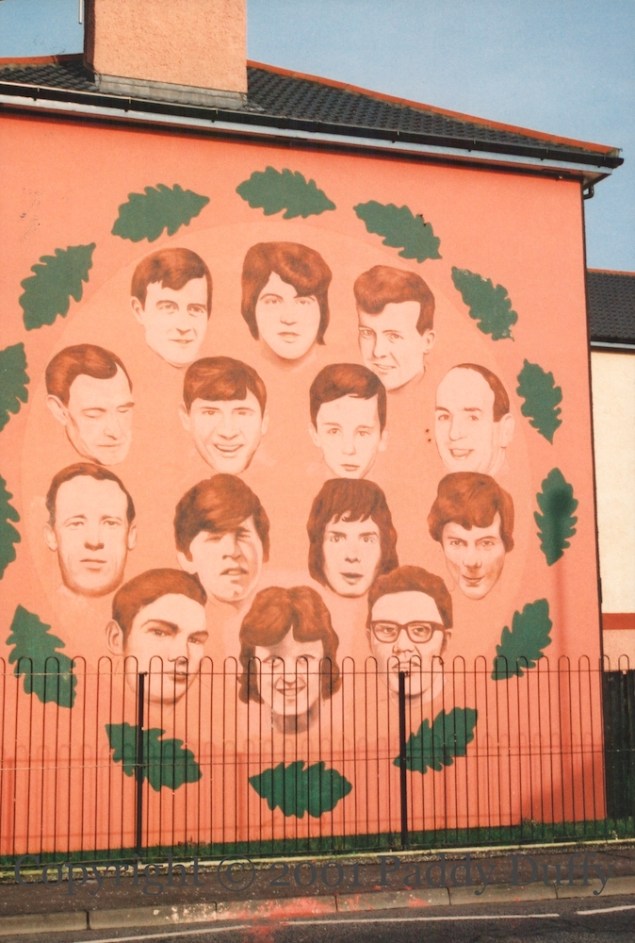
The fourth mural by the Bogside Artists (Visual History) shows the faces of the fourteen people who died on or as a result of Bloody Sunday, January 30th, 1972, shot by the “gun-happy louts” (as described by the Belfast UDA; Vanguard also called for their removal – see the entry for Robert McKinnie in Lost Lives) of the 1st Parachute Regiment; 15 more people were injured.
By row, the victims portrayed are:
Michael McDaid, John Young, Paddy Doherty
John Johnston (d. June 16th), Hugh Gilmour, Gerry Donaghy, Barney McGuigan
Gerry McKinney, William Nash, Kevin McElhinney, Jackie Duddy
Jim Wray, Michael Kelly, William McKinney
The portraits are presented within a circle of oak leaves – symbol of Derry – one for each person.
Westland Street, Bogside, Derry
Click image to enlarge
Copyright © 2001 Paddy Duffy
T00357
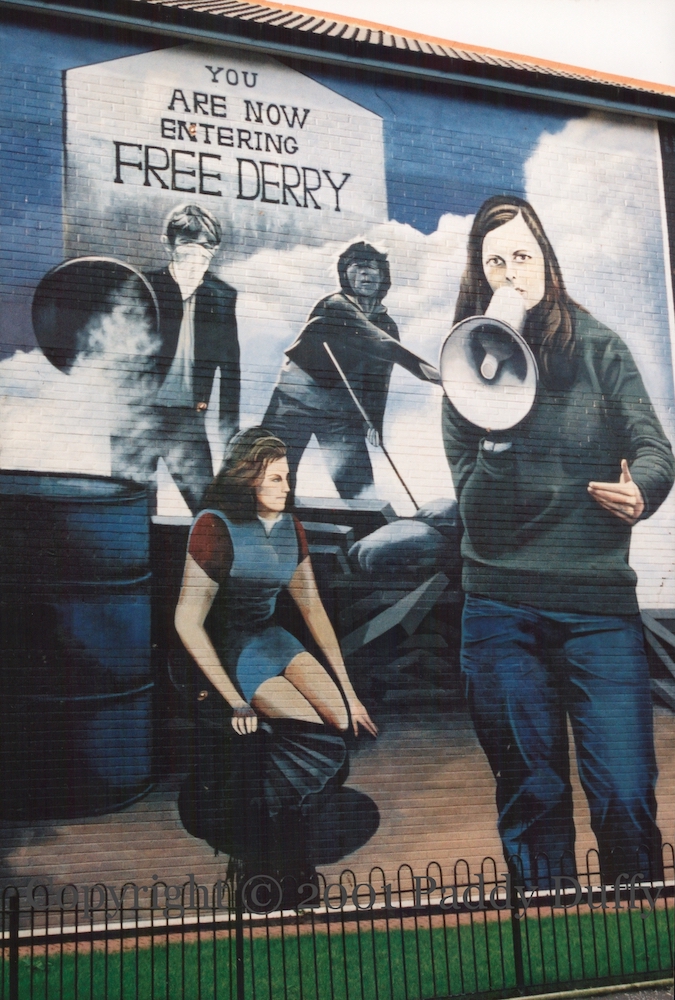
The second mural by the Bogside Artists (after The Petrol Bomber – Visual History) also depicts the battle of the Bogside and features Bernadette Devlin (later McAliskey). Devlin was elected to the British parliament in 1969 at age 21 and was imprisoned in December for her role in the August uprising. The mural reproduces a classic photograph showing Devlin with a megaphone in front of protesters and Free Derry Corner. It replaces another ‘Battle of the Bogside’ mural. The Bogside Artists explain the mural and its history in this short video.
Lecky Road, Derry
Click image to enlarge
Copyright © 2001 Paddy Duffy
T00355

The sixth mural from the Bogside Artists commemorates the 1980 hunger strikes, first in Long Kesh and subsequently in Armagh Women’s Prison. The main figure is Raymond McCartney; the female figure is perhaps Mary Doyle (the other two female strikers were Maıréad Farrell and Maıréad Nugent).
Rossville St, Derry
Click image to enlarge
Copyright © 2001 Paddy Duffy
T00356

Chained-together padlocks represent Long Kesh and UDA/UFF prisoners of war (LPOW). The Ulster nationalist flag is on the left. For the four-quadrant shield, see Sans Peur.
Ebrington Terrace, Waterside, Londonderry
Click image to enlarge
Copyright © 2001 Paddy Duffy (no date given)
T00336
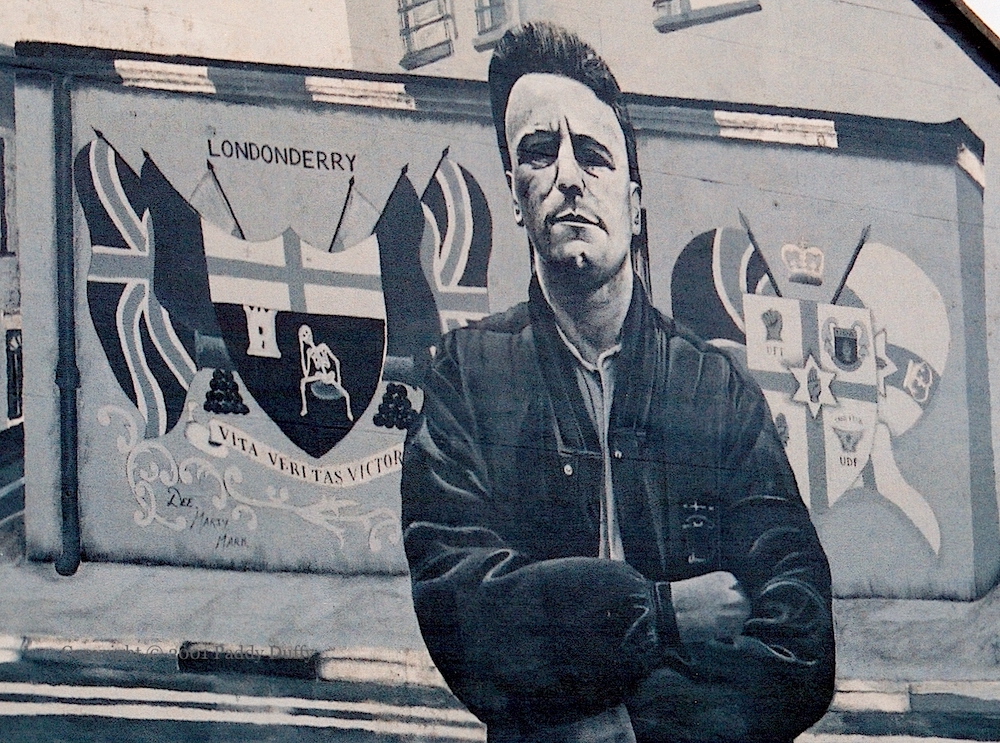
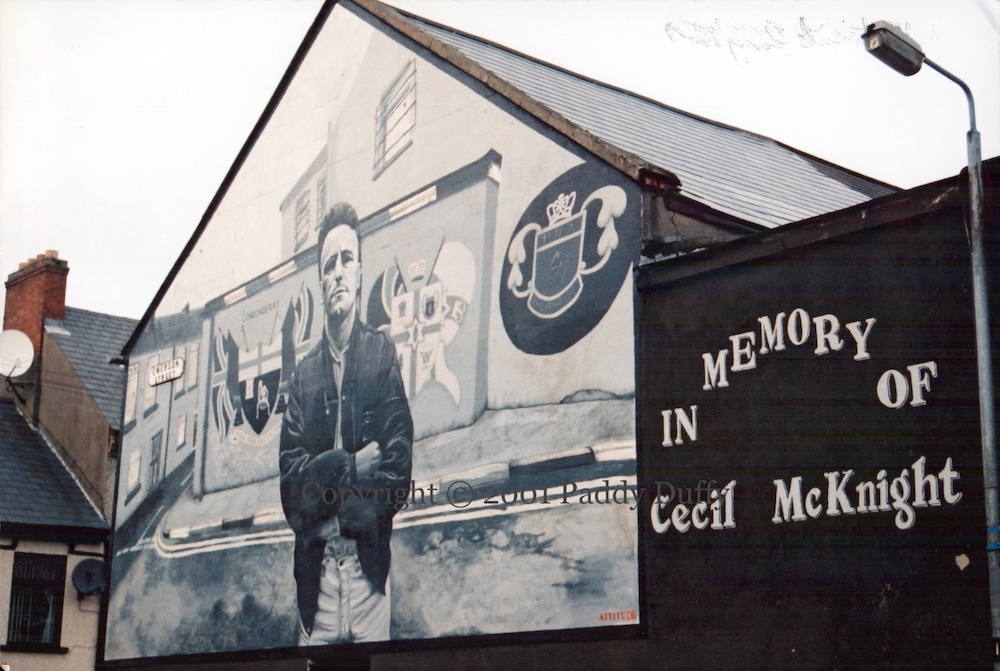
Cecil McKnight was a UDA/UFF volunteer, Orange Order member, and chairman of the UDP (Ulster Democratic Party) when he was shot dead at his home in Melrose Terrace by the IRA on June 29th, 1991. He is shown standing in front of a mural in the adjacent Ebrington Terrace circa 1990.
Emerson Street, Waterside, Londonderry
Click image to enlarge
Copyright © 2001 Paddy Duffy
T00333 T00331
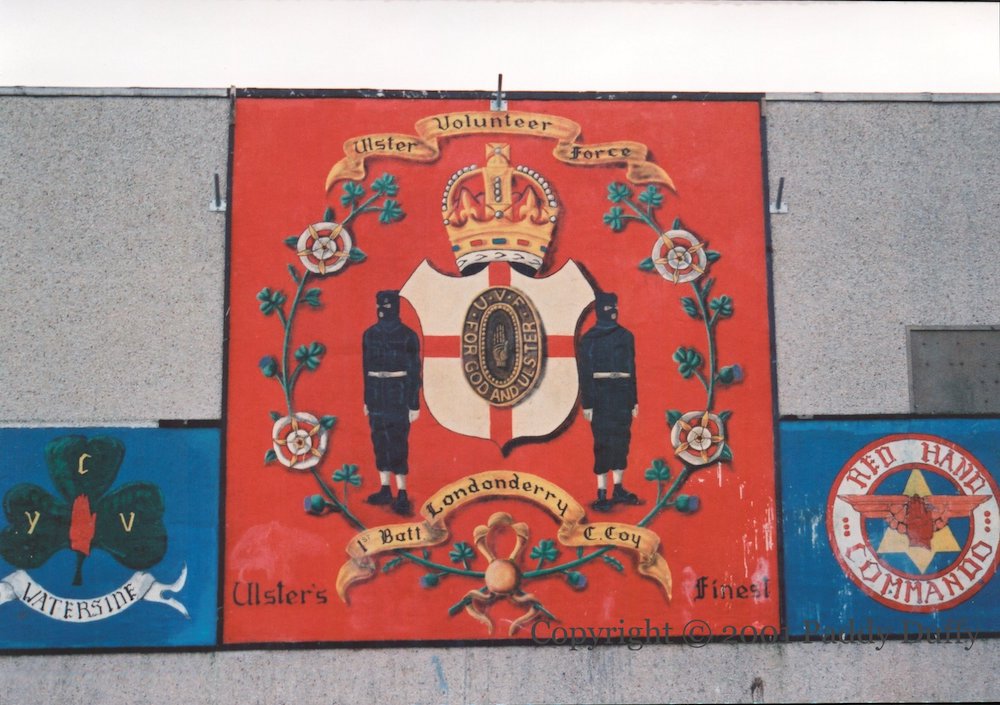
“Ulster’s finest – Londonderry UVF 1st battalion, C company”. Here is a trio of loyalist boards in Dennet Gardens, Londonderry with the insignia of the Young Citizen Volunteers, the Ulster Volunteer Force, and the Red Hand Commandos. The design of a garland of flowers containing a regimental insignia dates to the Ulster Volunteers of 1912; the masked volunteers standing to attention do not.
Dennet Gardens, Londonderry
Click image to enlarge
Copyright © 2001 Paddy Duffy
T00330
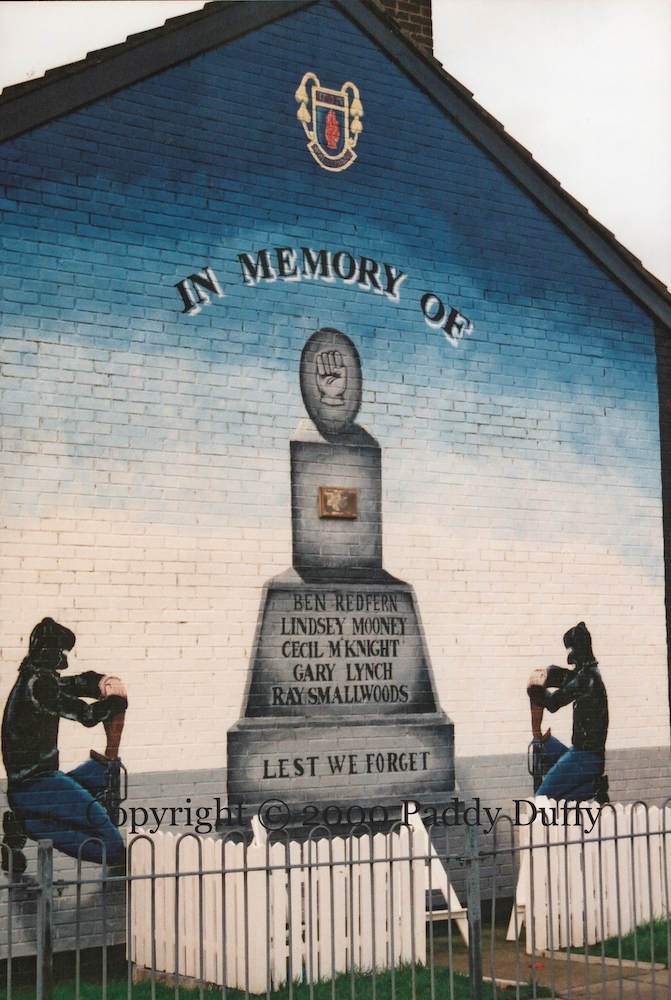
“In memory of Ben Redfern, Lindsay Mooney, Cecil McKnight, Gary Lynch, Ray Smallwoods, William Campbell. Lest we forget.” For Redfern and Lynch, see It’s Still Only Thursday; Smallwoods has a WP page; Campbell died in 2002 in a premature pipe-bomb explosion (Guardian).
Lincoln Court, Londonderry
Click image to enlarge
Copyright © 2000 Paddy Duffy (no date given)
T01195

Cú Chulaınn (or, as here, Cuchulainn) is usually shown dying, in the pose made famous by Oliver Sheppard in his statue that was installed in the General Post Office in Dublin in 1935. (See the Visual History page about Cú Chulaınn in murals.) Here, however, he is a living warrior (carrying a sword and a shield emblazoned with the crest of Northern Ireland) as an analogue to loyalist paramilitaries and prisoners of war (“LPOW” on the right).
Lincoln Court, Londonderry
Click image to enlarge
Copyright © 2000 Paddy Duffy (no date given)
T01194
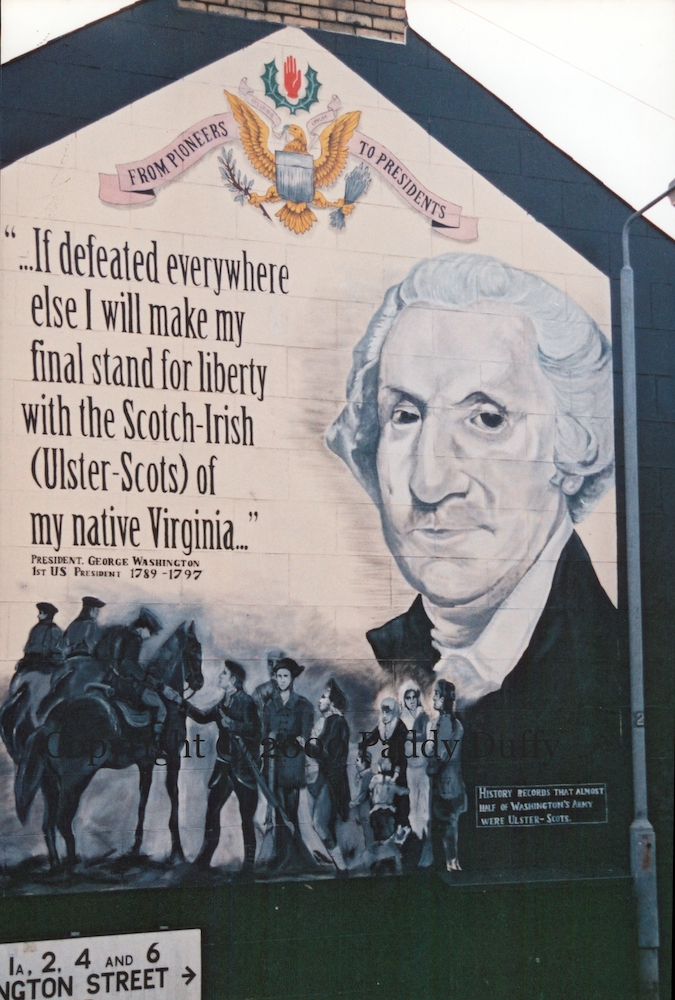
These are two of the first three murals painted in the series “From Pioneers To Presidents”, to Washington and Buchanan, in Ebrington Street Lower and Ebrington Street in the Waterside, Londonderry, along with one to Roosevelt in the Fountain.
George Washington commanded the Continental Army during the revolution and served as the first president of the United States beginning in 1789. His ancestry was English. The quote – “If defeated everywhere else I will make my final stand for liberty with the Scotch-Irish (Ulster-Scots) of my native Virginia” – is undocumented, the closest being this statement from McKinley.
The note in the corner reads “History records that almost half of Washington’s army were Ulster-Scots”; the basis for this claim might be General (Charles?) Lee’s report that “half the rebel Continental Army were from Ireland.” (See Chapter 2 of Bagenal, The American Irish and their Influence on Irish Politics.)
James Buchanan was “15th US president 1857-1861.” Buchanan’s father, also called James, was born in Ramelton, Co Donegal, and was living in Co Tyrone when he emigrated to the United States from Derry in 1783, (one of the “250,000 Ulster-Scots [who] emigrated to America in the 1700s”). James junior was born in 1791, the second of eleven children.
The confusion over the wording of the quote – “My Ulster blood is my most priceless [or simply: a priceless] heritage … [and I can never be too grateful to my grandparents from whom I derived it.]” – is matched by confusion over who said it (Buchanan junior or senior?); the source of the quote is unknown. Likewise we do not know where in Scotland the grandparents might have come from and perhaps the move to Ireland happened much earlier.
See also the Visual History page on Ulster-Scots murals.
Buchanan was also painted on the Shankill in west Belfast.

Click image to enlarge
Copyright © 2000 Paddy Duffy (no date given)
T01192 T01193
 Paddy Duffy Collection