It Is New Strung And Shall Be Heard

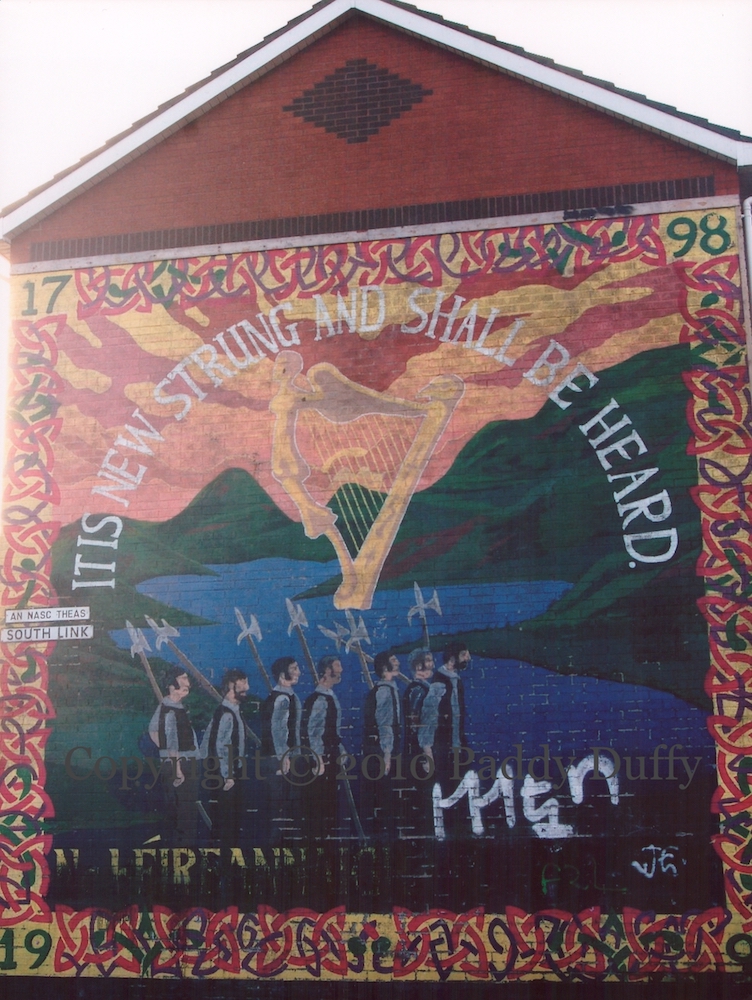
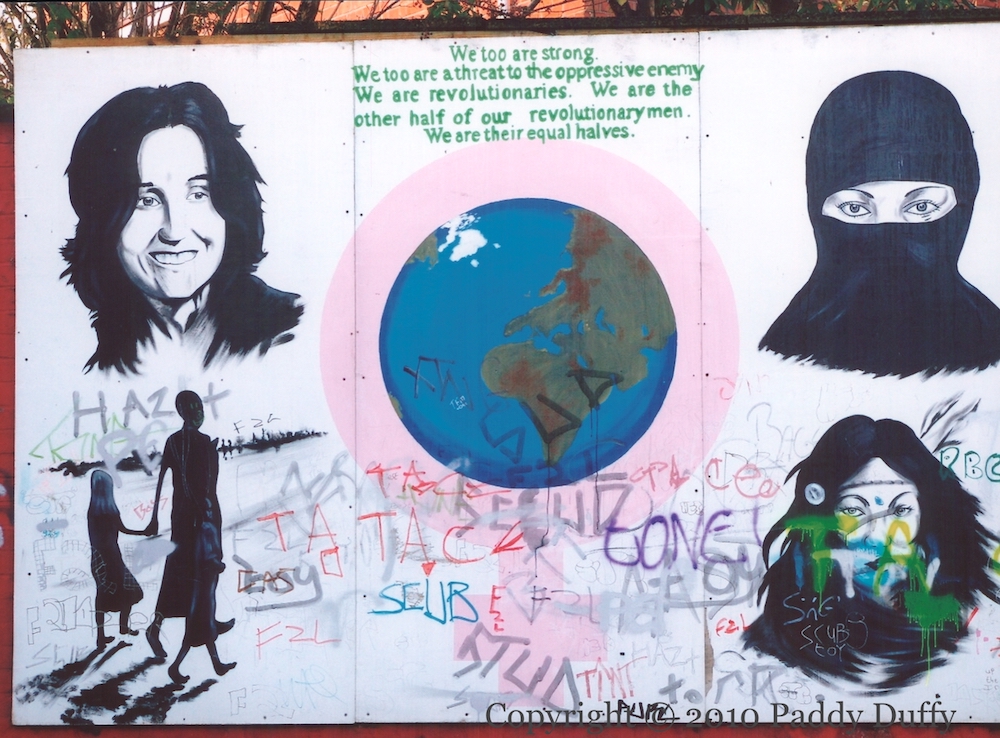
Andrea Redmond painted this mural in Andersonstown for the 200th anniversary of the 1798 rebellion by Na hÉıreannaıgh Aontaıthe (the United Irishmen), who used a harp – specifically a Maid Of Erin harp – as their emblem. To the right, out of shot, are the words Liberté, Égalité, Fraternité.

The mural is in decent shape despite being twelve years old, except for the graffiti at the bottom. The graffiti on the two boards to the side is more obscuring.

The first is devoted to the role of women in global struggles: “We too are strong. We too are a threat to the oppressive enemy. We are revolutionaries. We are the other half of our revolutionary men. We are their equal halves.” The IRA’s Maıréad Farrell is in the top left.

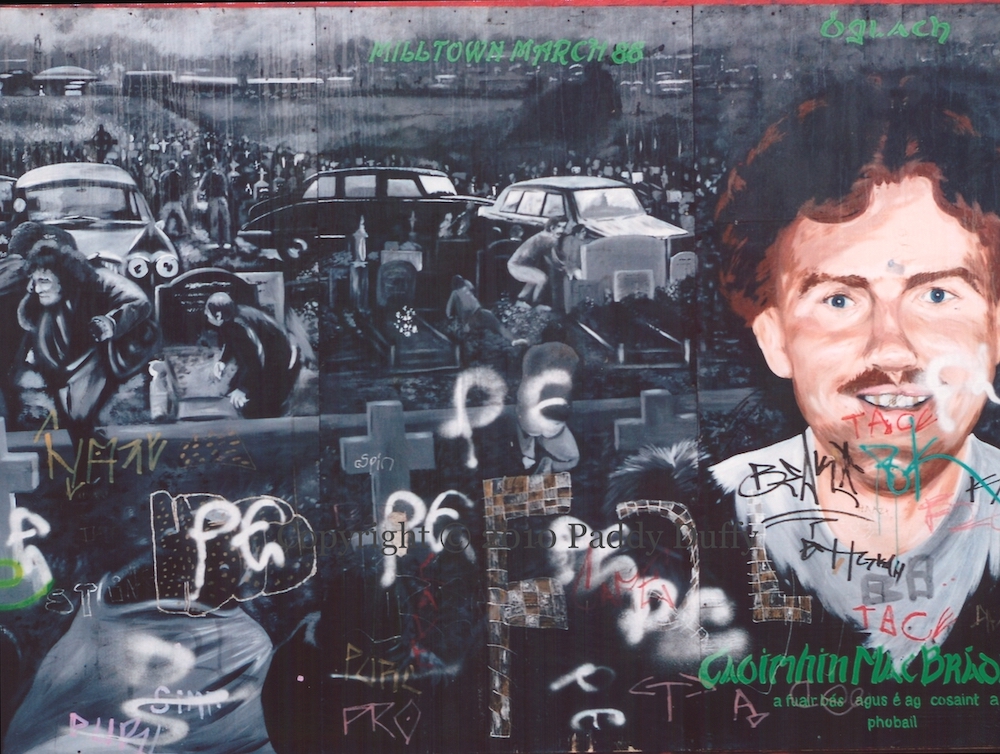
The second commemorates “Óglach Coımhín Mac Brádaıgh a fuaır bás agus é ag cosaınt a phobaıl.” [Volunteer Coımhín Mac Brádaıgh, who died while defending his people.] Mac Brádaıgh was killed pursuing loyalist gunman Michael Stone, who was attacking the funeral of the Gibraltar 3 (including Farrel), in Milltown Cemetery, on March 16th, 1988.

South Link, Andersonstown, west Belfast
Click image to enlarge
Copyright © 2010 Paddy Duffy
T00531 T00533 T00534 [T00535]
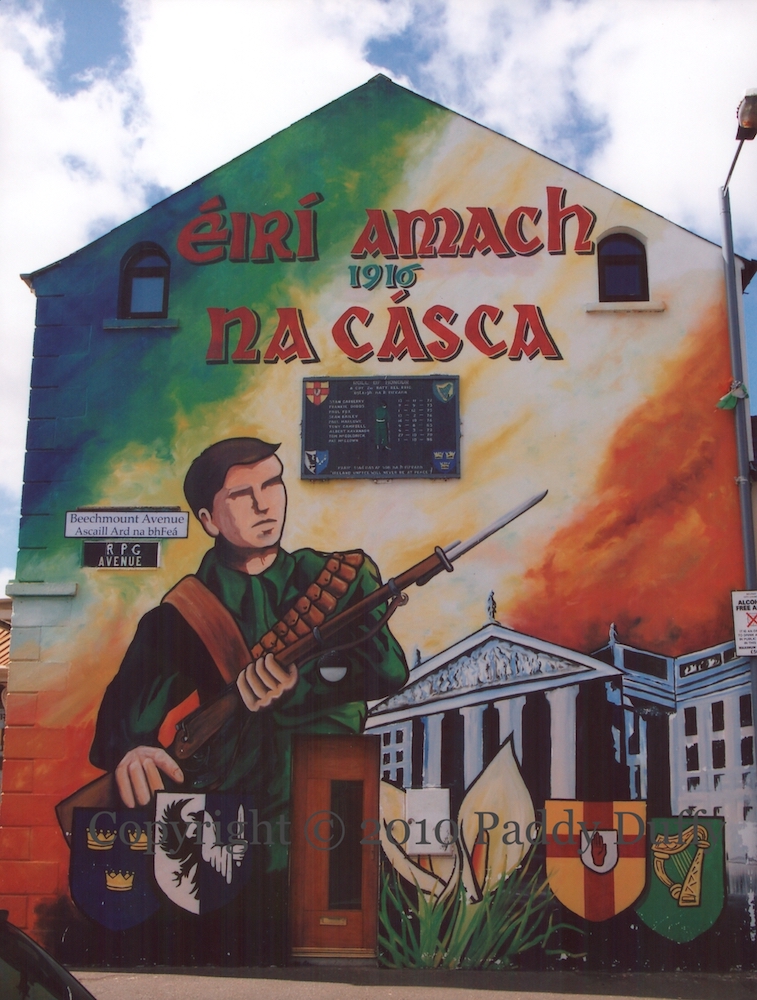
Éırí Amach Na Casca

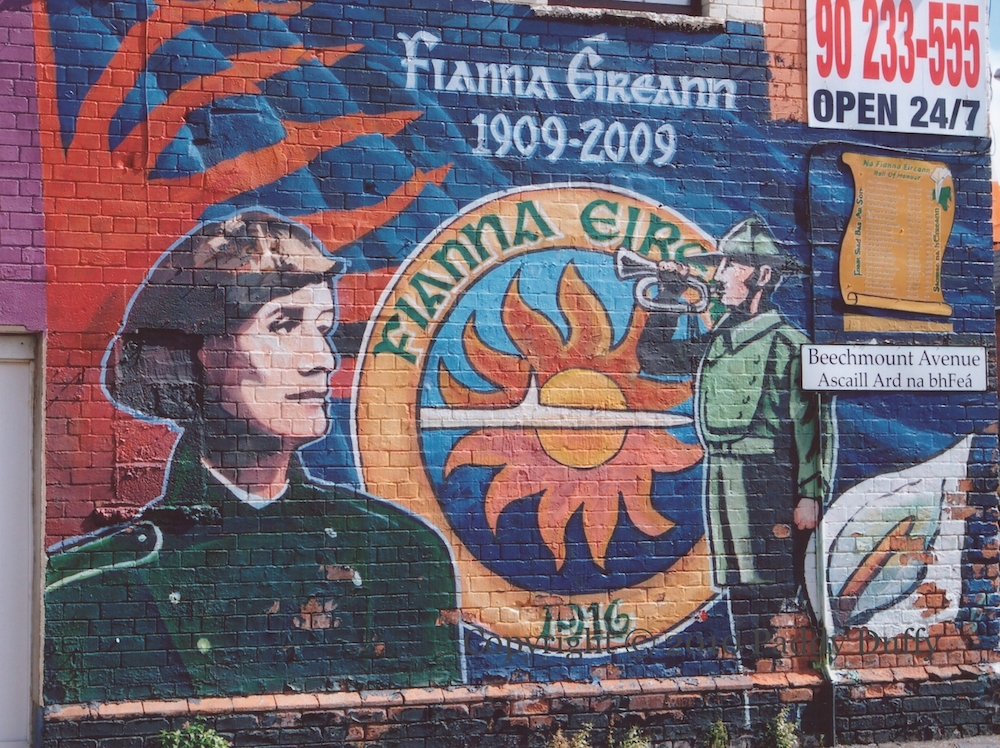
The Éırí Amach Na Cásca 1916 [Easter Rising 1916] mural is repainted (by DD and Seany McVeigh) due to the new doorway. Compare to the previous version. (See also the IRA plaque.)

Beechmount Avenue/Ascaıll Ard Na bhFeá/RPG Avenue, Beechmount, west Belfast

Click image to enlarge
Copyright © 2010 Paddy Duffy
T00525

Fır Na Pluıde

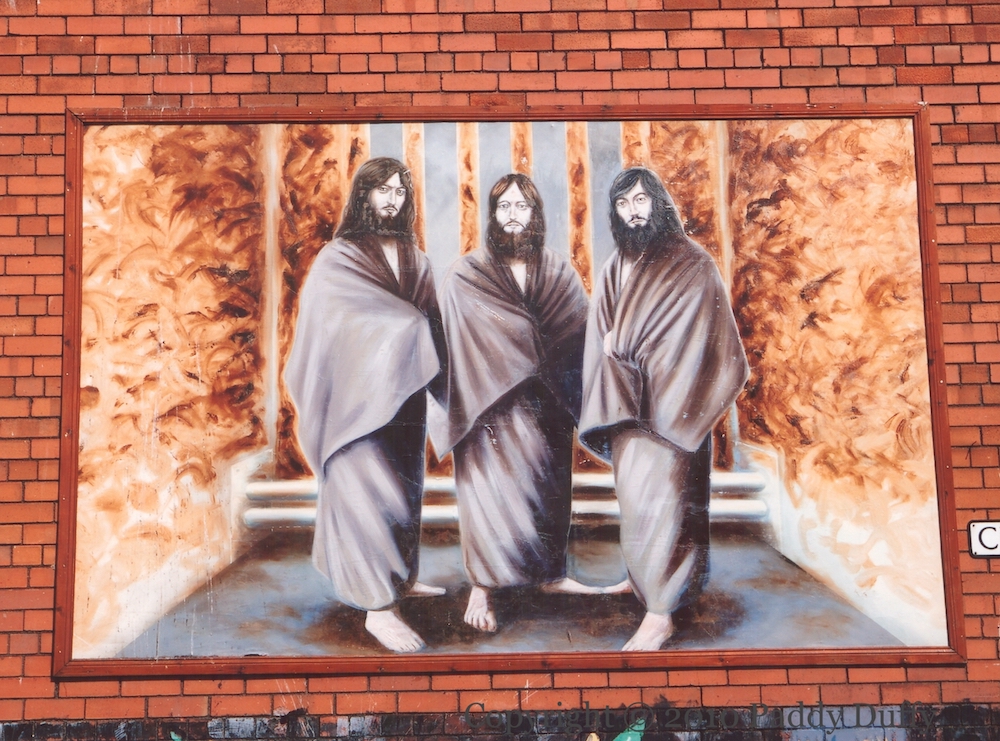
The “blanket” (Gaeilge: pluıd) protest (not wearing prison uniforms) was a response to the removal of political (Special Category) status in 1976 (WP). The “no wash” or “dirty” protest (not using toilet facilities) followed in 1978 (WP). Both forms of protest are illustrated in the board shown above: three unshaven men wear blankets and go barefoot in a cell with excrement smeared on the walls.

An information plaque was added below, on the Phoenix mural (not shown – see M04941).

Click image to enlarge
Copyright © 2010 Paddy Duffy
T00521

Not Spain, Not France

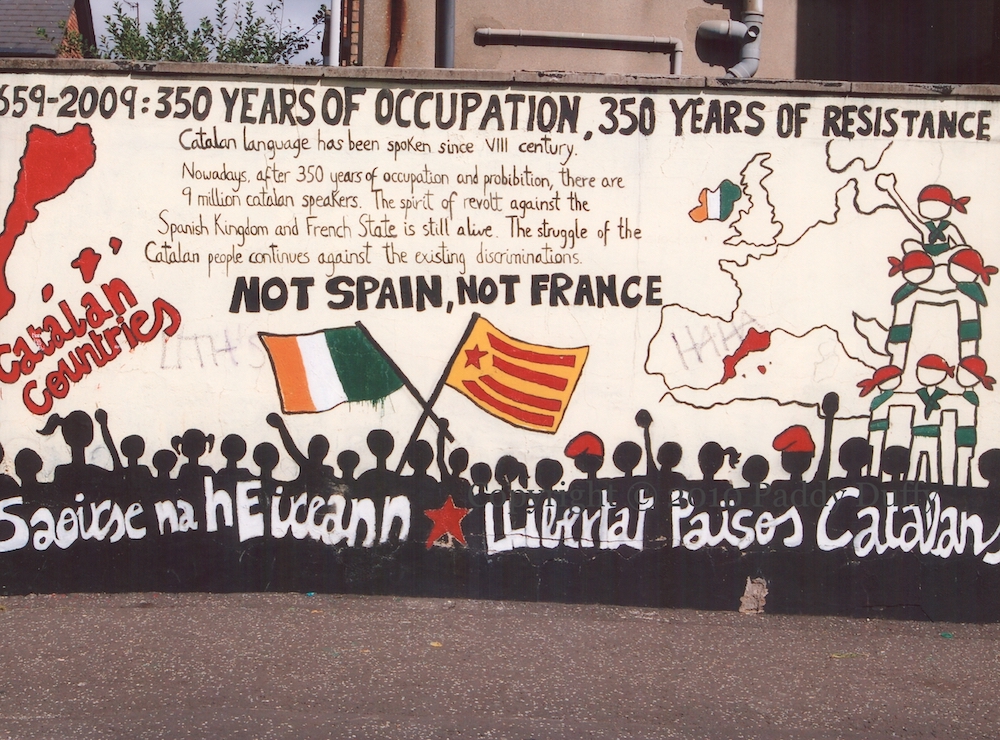
“1650-2009: 350 years of occupation, 350 years of resistance. Catalan language has been spoken since VIII century. Nowadays, after 350 years of occupation and prohibition, there are 9 million Catalan speakers. The spirit of revolt against the Spanish kingdom and French state is still alive. The struggle of the Catalan people continues against the existing discriminations. Not Spain, not France.” “Saoırse na hÉıreann, Llibertat Països Catalans.”

Clowney Street, Beechmount, west Belfast 

Click image to enlarge
Copyright © 2010 Paddy Duffy
T00520

Coıste Tours

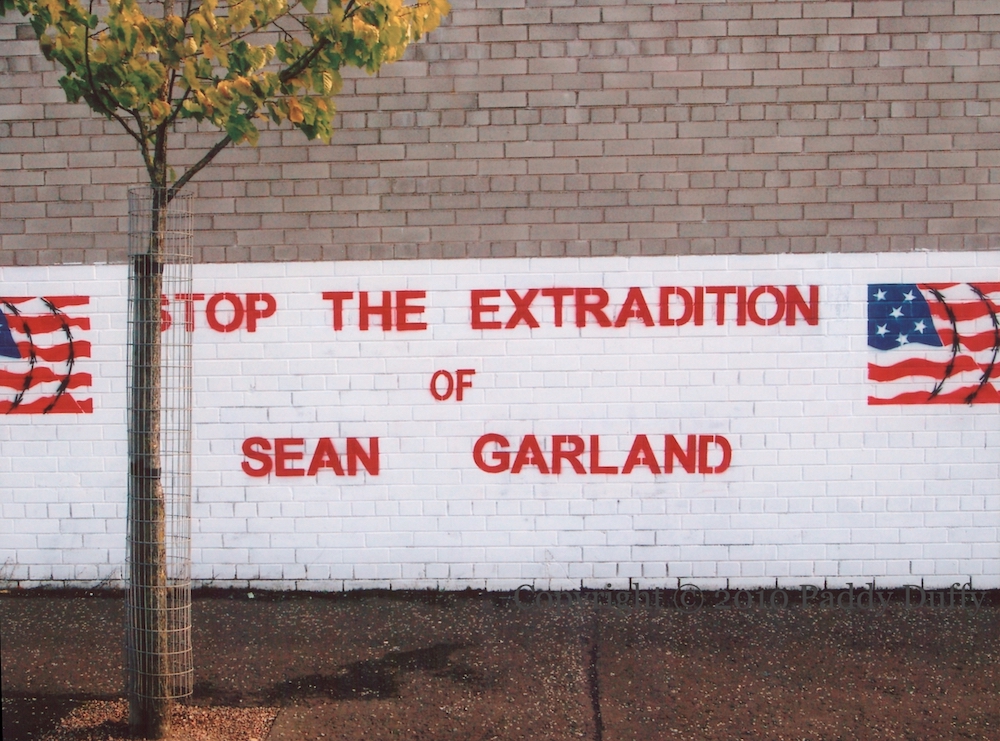
“Over 40 years ago the presence of this flag [the Irish Tricolour] on this street unleashed a vicious campaign of discrimination and violence against this community lasting decades … 45 years on … this flag can flow [sic] freely from every corner … All flags are welcome on this road and so are you … failte [fáılte] go dtí … West Belfast.”

The event referenced is the flying of the Irish Tricolour in 1964 from Billy McMillen’s electoral office, which Ian Paisley (and the RUC) found objectionable. Danny Morrison in An Phoblacht (web) has an account of the election and events. Here is news video from 1964 (DFA) of charges subsequently brought against 70 people.

The mural from Coıste Political Tours (web) is on Divis Street, just beyond down-town Belfast and directed at foreign visitors; the Union Flag, however, is not included among the display of international flags.

Click image to enlarge
Copyright © 2010 Paddy Duffy
T00517 [T00524]

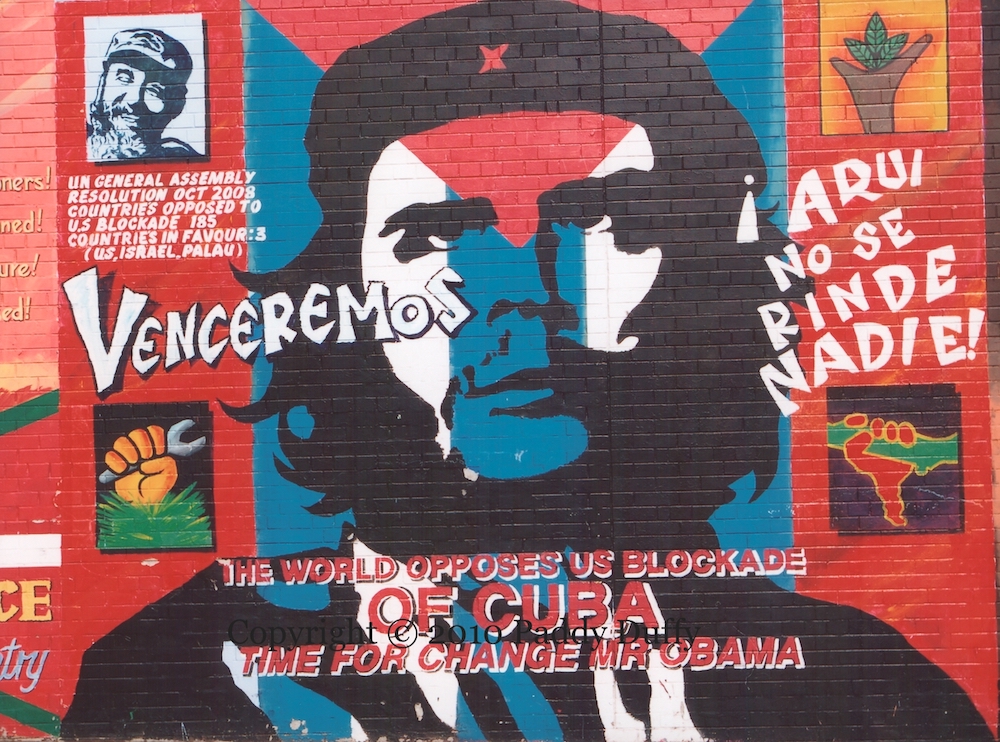
Venceremos

Here is a gallery of panels from the International Wall in Divis Street and Northumberland Street, updating the entry from 2008.

Northumberland Street:

Click image to enlarge
Copyright © 2010 Paddy Duffy
T00510 T00511 T00516 T00509 T00508 T00506 T00505 T00503 [T00504] T00507
T00512 T00515 T00518 [T00519] T00513 T00514

C Coy, 2nd Battalion, Belfast Brigade

The back wall of Clonard Martyrs Memorial Garden – that is, the so-called “peace” line – is decorated with portraits of twenty-five local óglaıgh and fıanna who died from 1920 to 1992 (though an Easter lily takes the place of Sean Gaynor on the far left).

Left: Dan Duffin, Seán McCartney, Tom Williams, Gerard McAuley, Peter Blake, Seamus Simpson, Seán Johnston, Seán Gaynor, Pat Duffin, Gerard Ó Callaghan, Seamus Burns, Danny Ó Neill, Tom McCann.

Right: Gerard Crossan, Seán Ó Riordan, Martin McKenna, Liam Hannaway, Jim McKernan, Dan McCann, “dedicated to the memory of local republican, Billy Davidson”, Tony Lewis, Joe McKenna, Brian Dempsey, Finbarr McKenna, Seán Savage, Prionsais Mac Áirt.

Click image to enlarge
Copyright © 2010 Paddy Duffy
T09501 T09502

Never Again

Fian Gerald McAuley was shot on Waterville Street by loyalists while helping residents move out of their burned-out homes on Bombay Street during the commencement of the Troubles in 1969 (An Phoblacht). This new board replaces a similar one on the other side of the street.

Bombay Street, Clonard, west Belfast

Click image to enlarge
Copyright © 2010 Paddy Duffy
T09500

Springhill-Westrock Massacre

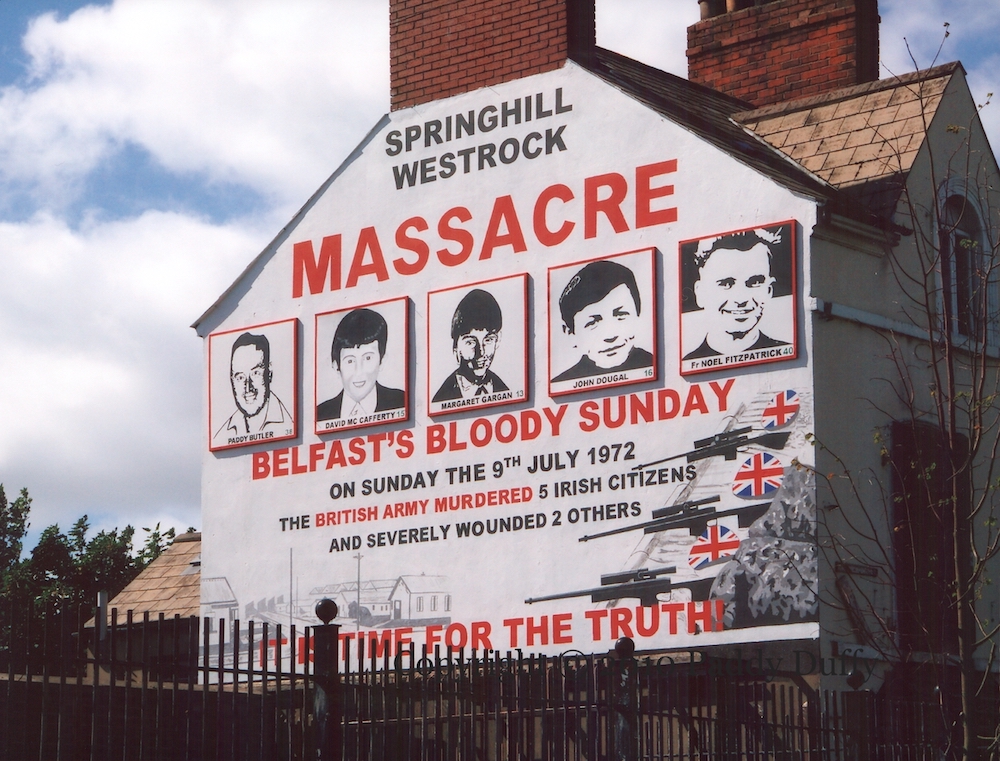
This is a mural by Mo Chara Kelly (with DD Walker, Michael Kelly, and Ta Heath) commemorating the deaths of five people shot by British Army snipers in 1972: Paddy Butler (39), David McCafferty (15), Margaret Gargan (13), John Dougal (16), Fr Noel Fitzpatrick (40). The snipers fired from JP Corry’s timber yard (shown on the right) and at the time the Westrock bungalows were still standing (shown lower left).

“Belfast’s Bloody Sunday. On the 9th July 1972 the British Army murdered 5 Irish citizens and severely wounded 2 others. It’s time for the truth.”

Springfield Road, west Belfast

Click image to enlarge
Copyright © 2010 Paddy Duffy
T00495