The large gable at the junction of the Limestone Road and North Queen Street in north Belfast – most recently the site of a celebration of Rangers’ 55th title – see We Are The People – is being repainted, beginning with the low wall in front, as shown above. The side wall on the right of the wide shot below dates back to 2017 (see Your Kingdom Will Endure Forever) and the scriptural references on it also appear in the new installation in Mervue Street – see I Will Plant Them, That They May Dwell In A Place Of Their Own. It’s possible that a King Charles installation is in progress here, too.
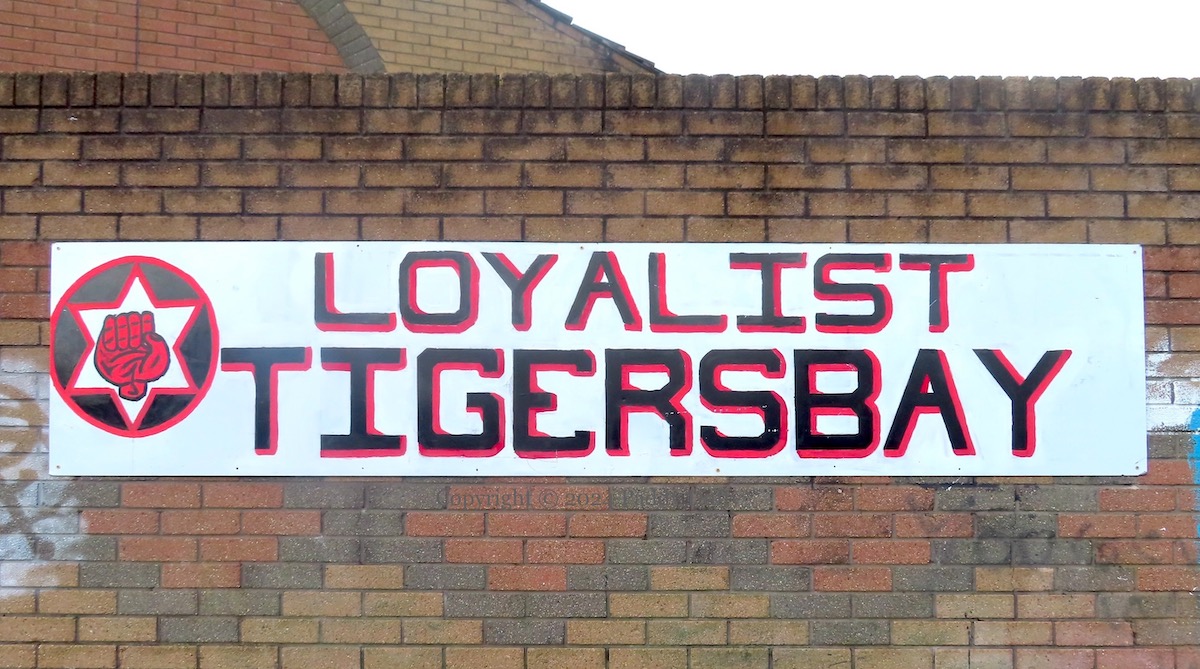
The final image is of another Tiger’s Bay territorial marker in Upper Canning Street.
Discover Ulster-Scots (web) has added some more boards in north Belfast, joining the recent gallery of famous figures at Mountcollyer Avenue (see The Scots In Ulster).
Above, Alexandra Park Ave: “The Ulster Fry – Ulster-Scots put the Ulster into the Ulster Fry with our famous soda and potato farls. Farl is an Ulster-Scots word describing the quarter round shape of the breads.” Breakfast fries as we now think of them date back only to the Victorian period and became popular particularly after WWII (WP). Soda farls (and soda bread) go back further, to the 1830s and 1870s when baking soda began to be commercially manufactured and cheaply available (ACS). Recipes can be found at the Discover Ulster-Scots ‘Food Traditions’ page.
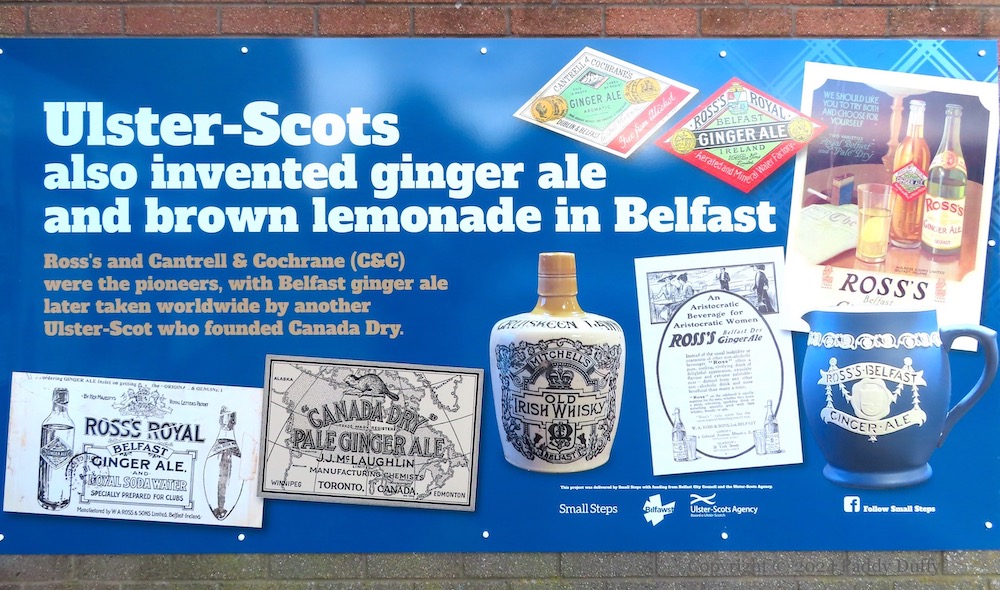
Below, from Upper Canning St: “Ulster-Scots distilleries made Belfast a global centre of whisky production. Historic Ulster-Scots brands like, Dunville’s, Mitchell’s and McConnell’s are making a comeback in the 21st century.” “Ulster-Scots also invented ginger ale and brown lemonade in Belfast. Ross’s and Cantrell & Coughran (C&C) were the pioneers, with Belfast ginger ale later taken worldwide by another Ulster-Scot who founded Canada Dry.” The labels shown use the “-y” spelling, perhaps in order to emphasise the Scottish association rather than the Irish. Cowan’s appear to have used both spellings (“whisky” and “whiskey”) in their labelling – see the gallery at Bloggin’ Fae The Burn. Dunville’s now appear to use the “-ey” spelling exclusively (web).
Finally, in North Queen St: “Ulster-Scots have been making Belfast a better place for over 400 years. Many of Belfast’s leading charitable, religious and educational institutions were founded by Ulster-Scots.” with images of BRA (James Crombie), Clifton House (possibly William Tennant is intended), the Linen Hall Library (a list of founders can be found on page 11 of this History), the Assembly buildings (of the Presbyterian church), and Queen’s (John Mowat).
The Belfast marathon (web) took place on May 5th (the same day as Hit The North) and as the runners completed their twentieth mile at the Waterworks on the Antrim Road they might have seen the mile marker shown above, which hopefully inspired them to power through ‘the wall’ they typically hit around 18-20 miles/3.5 hours of running (Marathon Handbook).
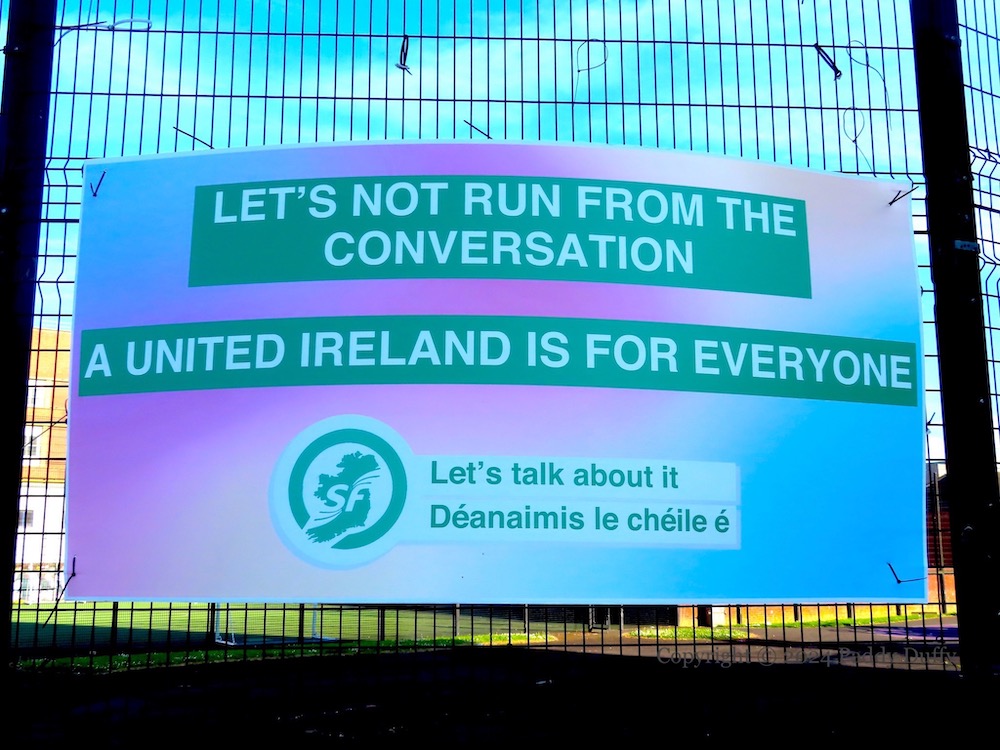
Also along the route, in North Queen St, and with a suitable theme, is the Sınn Féın placard shown below: “Let’s not run from the conversation” about a united. Ireland.
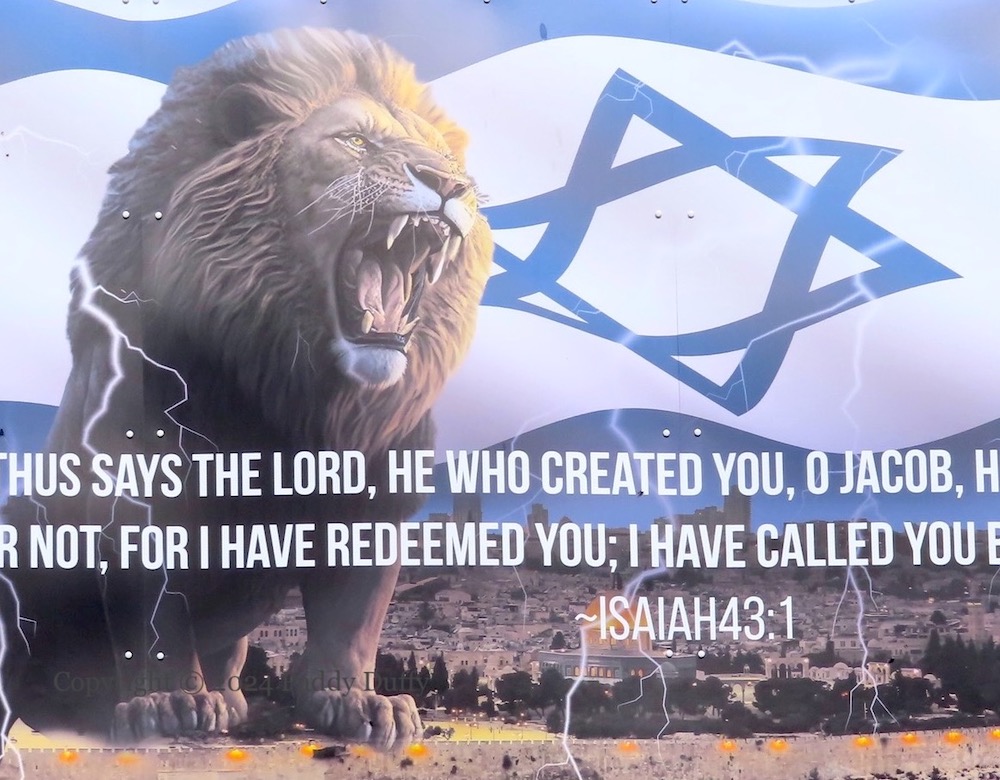
“But now thus says the Lord, he who created you, O Jacob, he who formed you, O Israel: “Fear not, for I have redeemed you; I have called you by name, you are mine.”” Isaiah 43 continues: “When you pass through the waters I will be with you … When you walk through the fire, you will not be scorched.” Thus, although the text is addressed to Jacob/Israel and the lion is a symbol of Jacob’s son Judah, whose eponymous tribe later gives its name to the Jews, Christians interpret it more generally as a promise to all believers.
In this way, this new board at Rehoboth Evangelical Mission in Mount Vernon is perhaps in the same tradition as the previous board, with its quote from John 11 (in the New Testament) promising that believers shall never die (X04693).
The inclusion of the flag of modern Israel which dates back to the Zionist movement in the late 1800s, however, gives this board a political edge, seeming to make it a token of support for Israel in its current conflict with Hamas and attack on the Gaza Strip. (The roaring lion and the lightning also give a sense of physical power.) As such, it would be (to our knowledge) the first printed board in support of Israel and an advance over the more typical flying of the Israeli flag.
Hill & White (2007 – paywall) begin their article with a survey of newspaper articles (including this free piece in Salon) about the flying of Israeli flags in Northern Ireland in 2002, explaining the practice as a response to the flying of Palestinian flags during the Second Intifada (p. 33) and an expression of admiration for Israeli’s use of physical force against its minority population (p. 37). The first appearance of an Israeli flag in the Peter Moloney Collection is from 2006, at a republican bonfire site.
If the Rehoboth board is counted as religious rather than political, the most sophisticated graphical expression of PUL support for Israel is the small paste-up seen in Ulster Supports The People Of Israel. (There is also implicit support for Israel in the board in Peter’s Hill to John Henry Patterson, which includes amongst his other exploits – including Operation Lion – his role as Godfather Of The Israeli Army.)
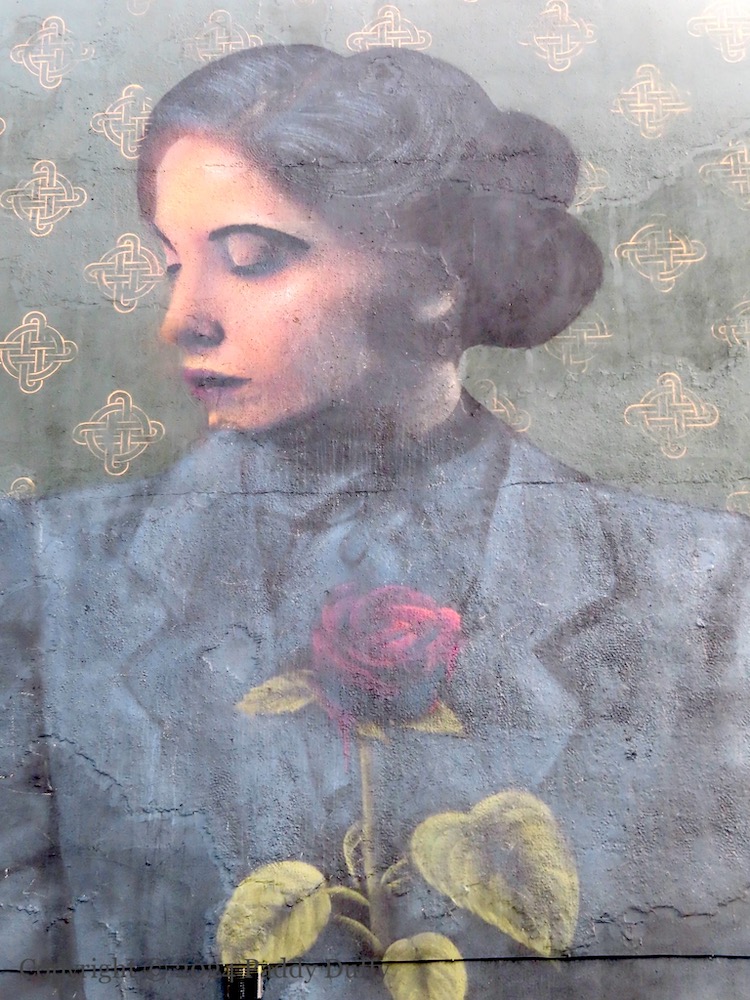
“A Róısín, ná bíodh brón ort fé’r éırigh dhuıt”/Róısín, be not sad about what has happened to you”. The song ‘Róısín Dubh’ [usually translated as ‘Dark Rosaleen’] is a love song to Ireland, in which the infatuated singer recounts the lengths he would go to on her behalf (song (youtube): Muıreann Nıc Amhlaoıbh | Caıtlín Maude | poem/lyrics in English: Mangan | Kinsella at WP).
This new piece in the New Lodge, north Belfast, was painted (presumably) by emic (ig), (presumably) under the same auspices as, and as a thematic complement to, the project we reported on in Communities In Transition. The lack of explicitly nationalist or republican signifiers is perhaps necessary if the piece is to be funded by Communities In Transition, while the cultural reference is perhaps necessary if the art is to survive on what has for the past dozen years been an anti-Agreement wall – see Damn Your Concessions, England and Unbowed, Unbroken. Another emic piece, in Creggan, Derry, has been marked with republican graffiti – see Stand Up And Speak Out. This very skilful piece walks a very fine line very precisely.
Twenty portraits in circular frames have replaced the twenty-one square portraits seen on the ‘Out Of The Ashes Of 1969’ mural in the New Lodge. From left to right, those portrayed are Michael P Neill, Seamus McCusker, Gerard Crossan, Colm Mulgrew, Francis Liggett, Brian Fox, John Kelly, Robert Allsopp, Louis Scullion, Billy Reid, Danny O’Hagan, Michael Kane, Sean McIlvenna, Jim O’Neill, Rosemary Bleakley, Martin McDonagh, James McCann, James Sloan, Dan McCann. Paddy McManus is no longer included, as compared with the earlier portraits.
For the mural without any portraits, at the time of its launch in 2012, see X00857.
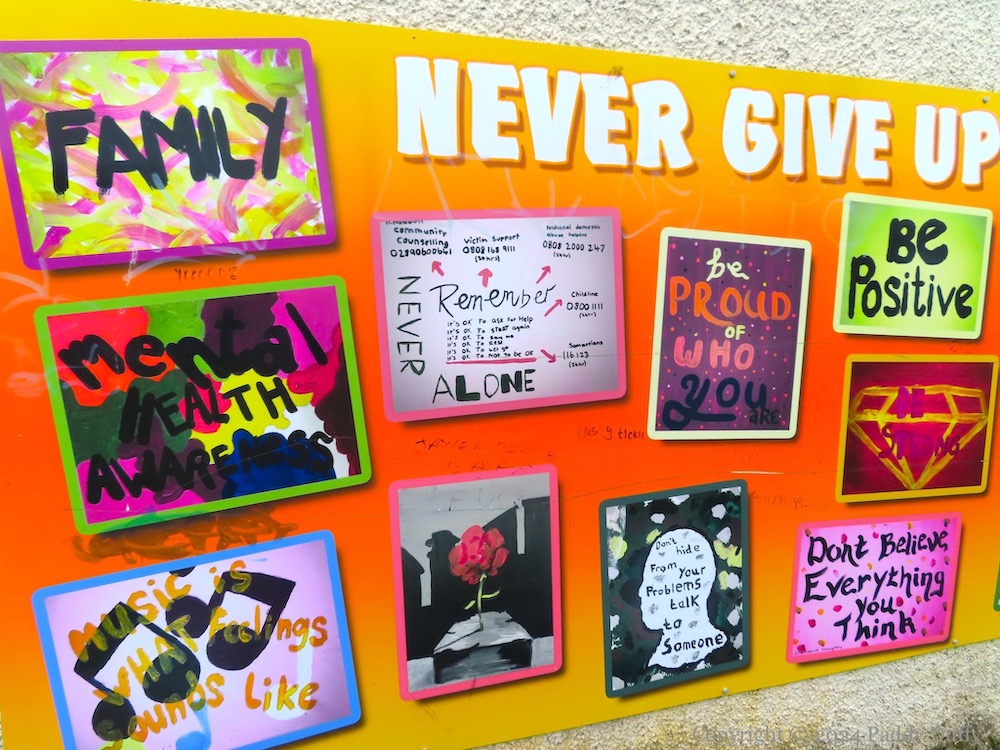
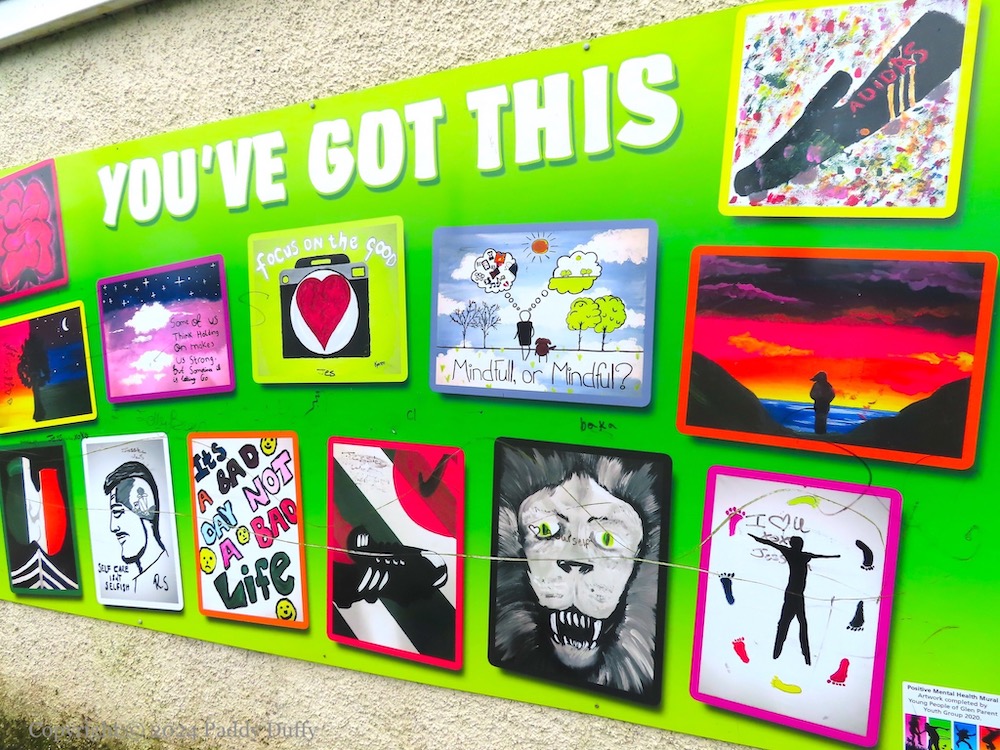
Inspirational mental-health messages in Lenadoon Avenue, west Belfast, such as “Mindfull or mindful?”, “It’s a bad day, not a bad life”, “Don’t believe everything you think”.
“North Belfast is in a crisis. RNU [Republican Network For Unity (Fb | ig)] calls for better mental health provision. Hold on, pain ends. Hope.”
Northern Ireland has the highest suicide rate in the UK, at 14.3 per 100,000 (2021), and Belfast has a suicide rate of 24.9 people (2022), and north Belfast the highest in Belfast, at a rate of 31 per 100,000 (2013-2018) (Assembly Research Matters | Zero Suicide Alliance). Here is a Bel Tel article (£) about the lack of GPs and mental health services in north Belfast, from 2021.
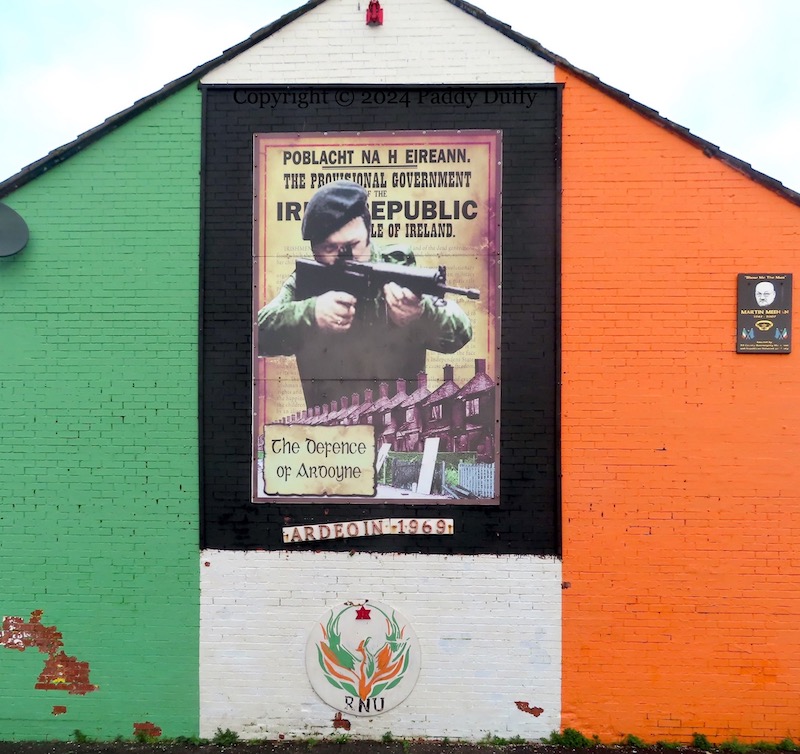
Martin Meehan joined the IRA in 1966 and was one of a few IRA volunteers defending Catholics in Ardoyne (Ard Eoın) in August 1969. Rioting did not cease there until the 16th, when British troops were finally deployed to the Crumlin Road to block mobs coming from the Woodvale and Shankill. Meehan resigned after the failure of the IRA to defend Ardoyne, Clonard, and Divis. This Magill article from the time summarises the IRA’s actions as “late, amateur and uncertain”. (Meehan would later rejoin the IRA and PIRA.)










 Paddy Duffy Collection