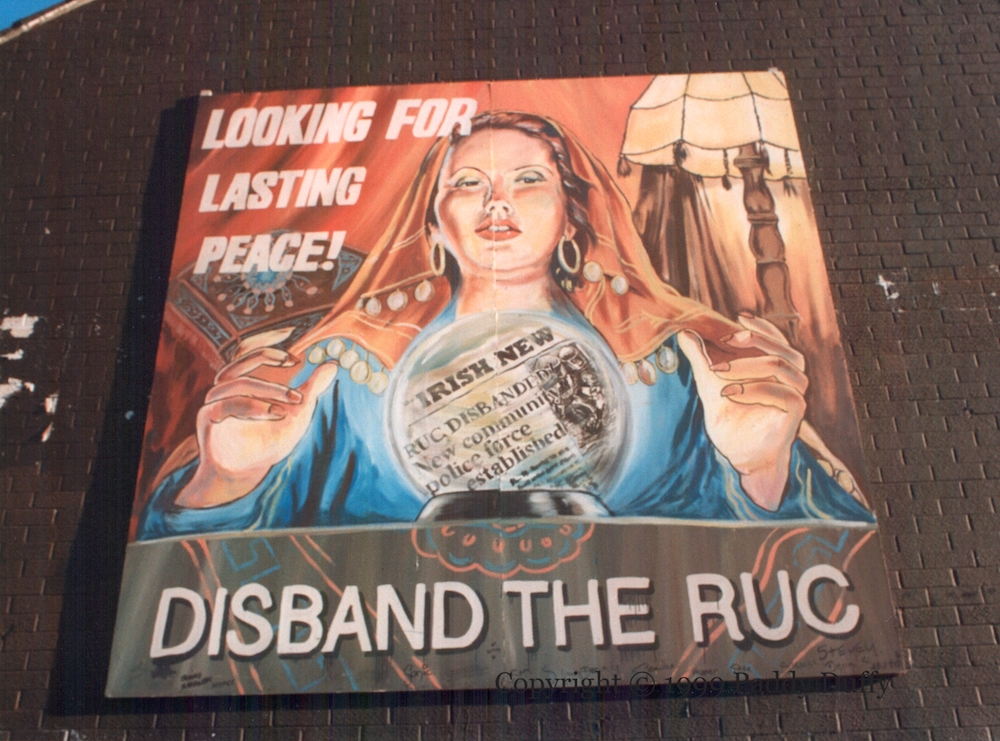
“Disband the RUC.” A fortune-teller sees the path to peace in an Irish News headline in her crystal ball: “RUC disbanded. New community peace force established”. Reform or replacement of the RUC is one of the top nationalist concerns in the peace process, after the release of POWs.
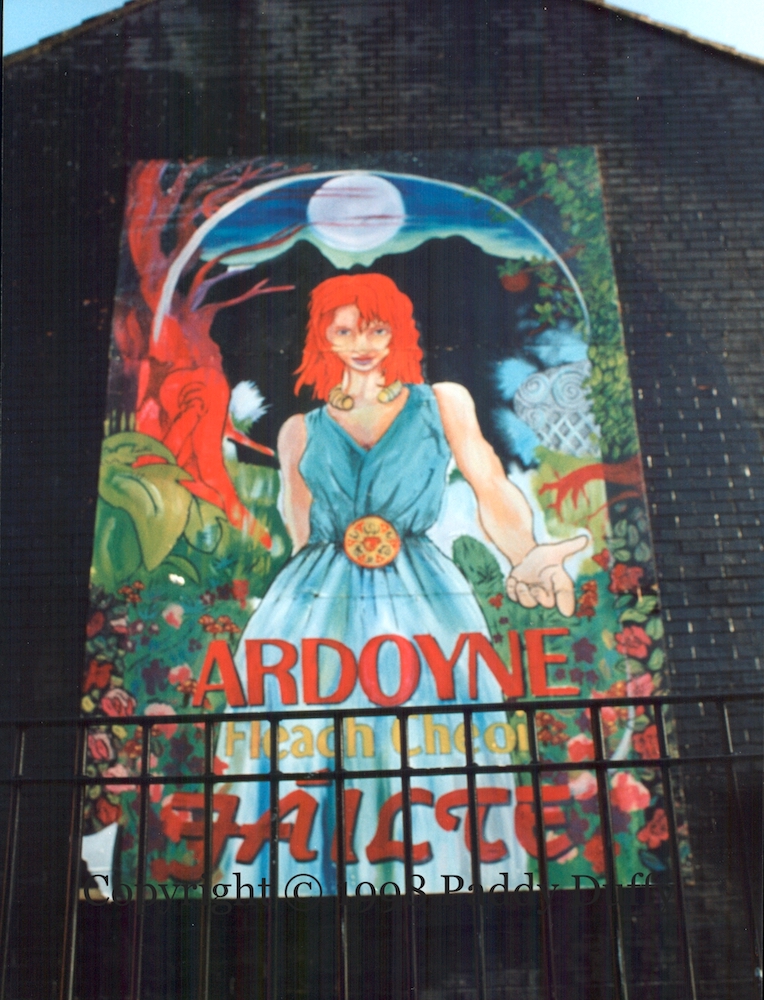
Sean Doran’s art for the cover of the programme for the 1998 Ardoyne Fleadh Cheoıl (Fb) was also produced on a large board in Ardoyne Avenue, north Belfast.
An Orange Order marcher (with skeletal face, glowing eyes, and a ‘Give way’ sign) is about to step on a protestor from the lower Ormeau who holds a sign reading “Peace – Justice” and has just released a dove that is sitting on top of the road-sign on the corner.
The scene is the Ormeau Road at Farnham Street, and the mural is in Farnham Street at the Ormeau Road; the mural thus includes a depiction of itself: the edge of the mural (with blue sky and grey pavement) appears on the wall to the left of the pizza shop with painted shutters reading “What part of NO don’t you understand?” (An image of the actual shutters, from the squire93 collection, is included below.)
In the top left is a smaller piece painted on a board: the words “Will there ever be peace? No.” are super-imposed on a grave.
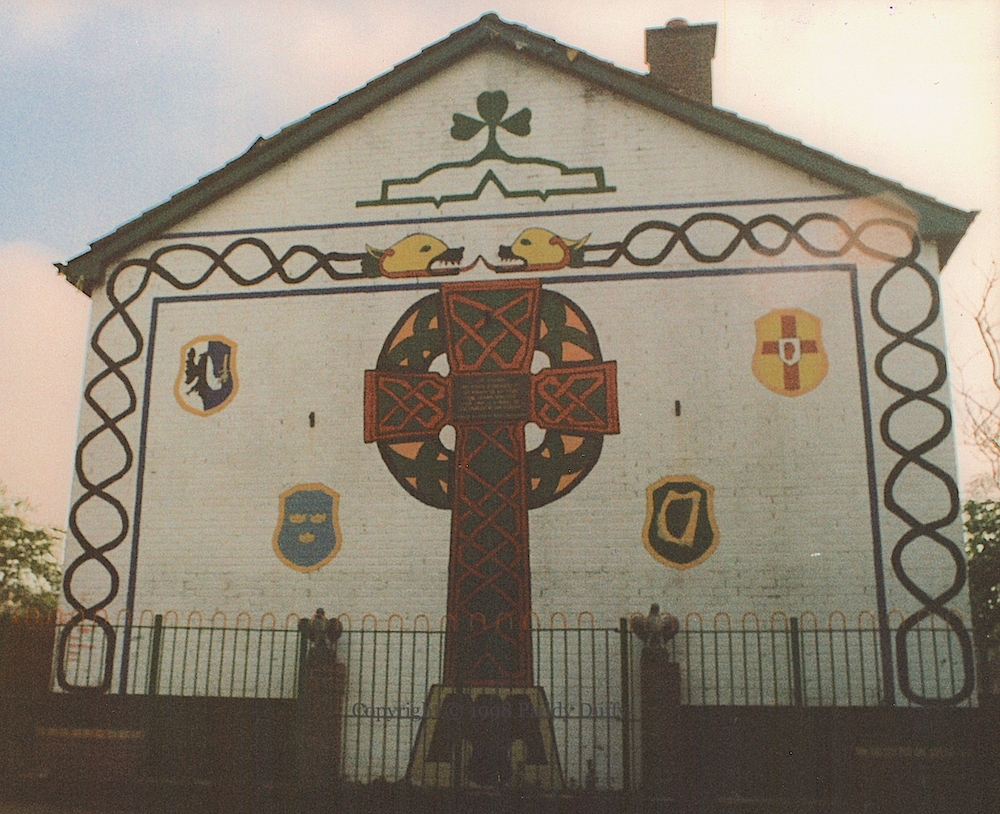
“Mıse Éıre” [I Am Ireland]. These two murals were both in the courtyard of Millview Court, off Mountainhill Road in Ligoniel and together present the fighting spirit and the loss entailed by the Irish struggle for freedom.
The plaque at the centre of the Celtic Cross reads “I ndıl chuımhne [in fond memory]. This plaque is dedicated to the memory of all those from Ligoniel who lost their lives as a result of the conflict in our country. A Mhuıre banríon na nGael guıgh orthu [Mary, queen of the Gael, pray for them]”
The second shows a Maid Of Erin harp – symbol of the United Irishmen – on top of a Tricolour attached to a pike, and a banner reading “Bás nó bua” [death or victory].
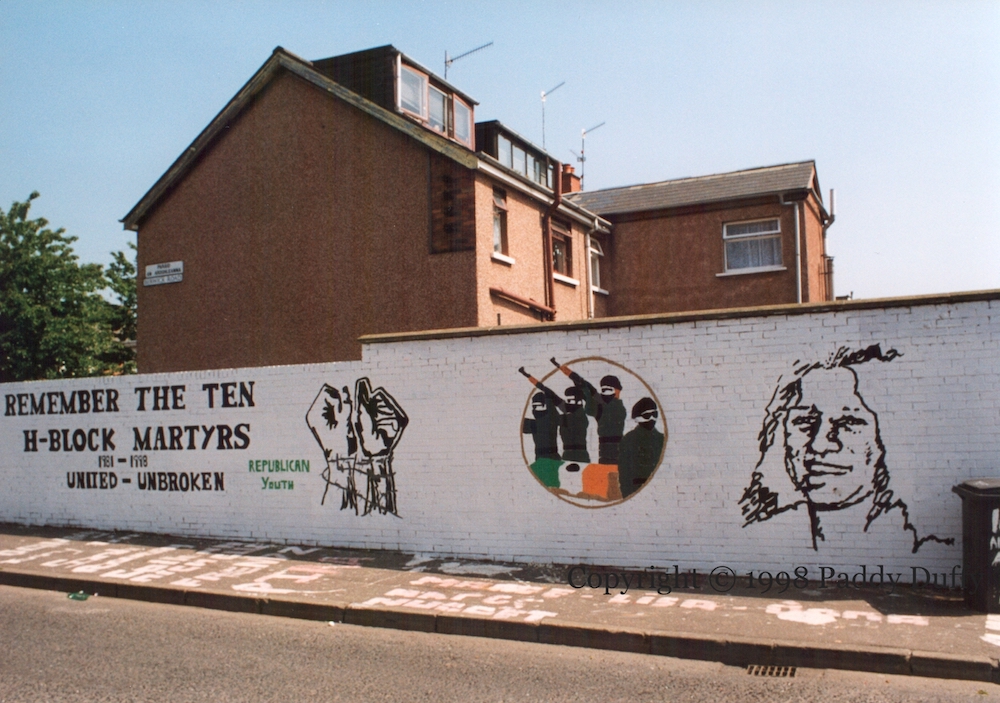
“Remember the ten H-Block martyrs. 1981-1998. Unbowed – unbroken.” With a pair of fists in barbed wire, a funeral volley fired over a coffin covered with Tricolour and beret, and a line-drawing of Bobby Sands. Signed “Republican Youth”
Berwick Road/Paráıd An Ardghleanna, Ardoyne,Ard Eoın, north Belfast/tuaısceart Bhéal Feırste
This painting of James Connolly in ICA uniform is perhaps based on Harry Kernoff’s woodcut, though with a wider head and background changed to show two flag-bearers standing on a high wall.
Berwick Road/Paráıd An Ardghleanna, Ardoyne,Ard Eoın, north Belfast/tuaısceart Bhéal Feırste
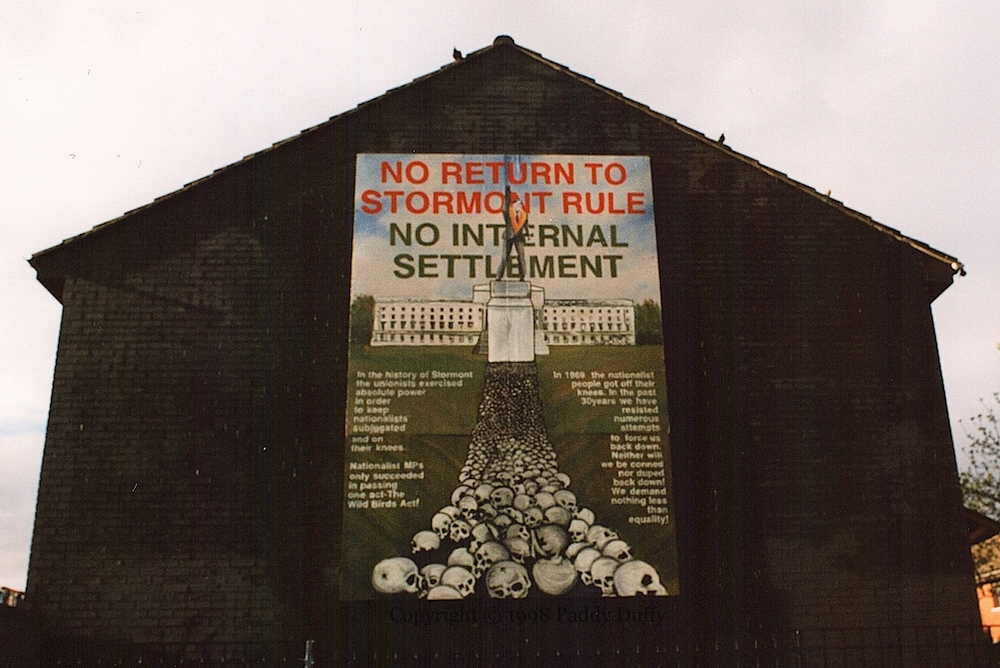
A trail of skulls flows from the base of Carson’s statue, which is adorned with an Orange sash. “No internal settlement” means a settlement among the northern parties only, but rather that there should be an all-Ireland dimension to any agreement.
“No return to Stormont rule – no internal settlement. In the history of Stormont the unionists exercised absolute power in order to keep nationalists subjugated and on their knees. Nationalist MPs only succeeded in passing one act – The Wild Birds Act! In 1969, the nationalist people got off their knees. In the past 30 years we have resisted numerous attempts to force us back down. Neither will we be conned nor duped back down! We demand nothing less than equality!”
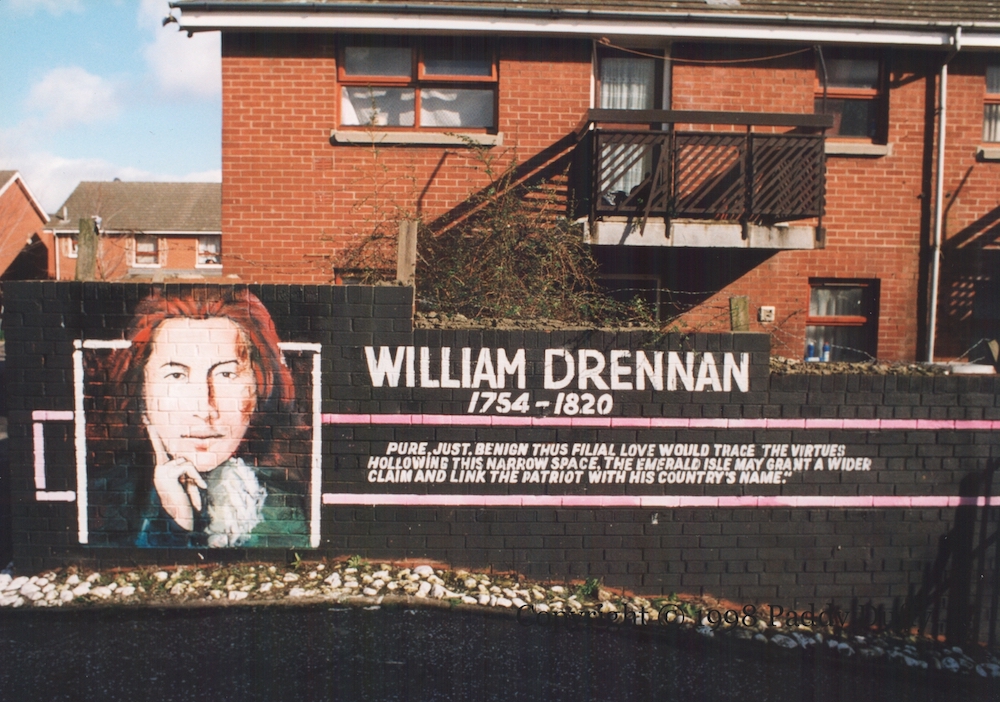
This is a trio of murals along the New Lodge Road to William Steel Dickson, William Drennan, and Mary Ann and Henry Joy McCracken. What the three have in common is that they were all Presbyterians and Irish republicans, and members of the Society Of United Irishmen.
William Steel Dickson was adjutant-general of the County Down Irishmen (see the blue plaque in Portaferry M08948) and was arrested a few days before the insurrection (WP). Like the McCrackens, he is buried in Clifton Street Cemetery.
William Drennan, 1754-1820, was a doctor, poet, a founder of the Society of United Irishmen, and the first person to refer to Ireland as “the Emerald Isle”, in his poem When Erin First Rose. The words in the mural are the epitaph on his stone in Clifton Street Cemetery: “Pure, just, benign. Thus filial love would trace the virtues, hollowing [sic] this narrow space. The Emerald Isle may grant a wider claim and link the patriot with his country’s name.”
Mary Ann McCracken (“What a wonderful clamour is now raised at the name of union, when in reality there has always been such a union between England and this country, as there is between husband and wife by which the former has the power to oppress the latter.”) and her older brother Henry Joy McCracken (“These are the times that try men’s souls … the rich always betray the poor.”) are the best-known of the figures. Henry led the Antrim uprising of the United Irishmen in 1798 and was executed for it; Mary Ann was an abolitionist and social reformer.
A collage of image from the previous 30 years, including banging bin-lids on the ground, Maıréad Farrell in Armagh prison, men on the blanket, the cages of Long Kesh, marches in support of the hunger strikers, and reproductions of various posters, against Margaret Thatcher, plastic bullets, internment, and censorship. There’s a quote from Bob Dylan in the middle, “How many times can a man turn his head and pretend that he just doesn’t see – the answer, my friend, is blowing in the wind, the answer is blowing in the wind.”
“Old Labour 1969 – new Labour 1997 – nothing has changed!” Members of the Orange Order march with a large Union Flag on the backs of the RUC (with an Orange accent on their helmets) who are holding back the protesting local Catholic residents – particularly of the Garvaghy Road in Portadown and the Ormeau Road in Belfast.
The party in power (of the UK government) was the Labour party under Harold Wilson; in the general election of May 1st, 1997, Tony Blair’s Labour party regained power from the Conservatives. The mural hopes to pressure Labour into taking definitive action on the issue of parading – see (e.g.) Approved Parade Route, No Consent, No Parade and Not All Traditions Deserve Respect.







 Paddy Duffy Collection