Perhaps because of the Covid pandemic, this mural of UDA volunteers on parade reflected in the sunglasses of one of their comrades took months to complete – it was started in late 2020 and was still unfinished in the summer of 2021.
The photograph reproduced is from the 1974 Ulster Workers’ Strike; it appeared on the cover of Don Anderson’s Fourteen May Days (CAIN).
The mural replaced the previous “UFF Formed 1973” mural – see Northern Island.
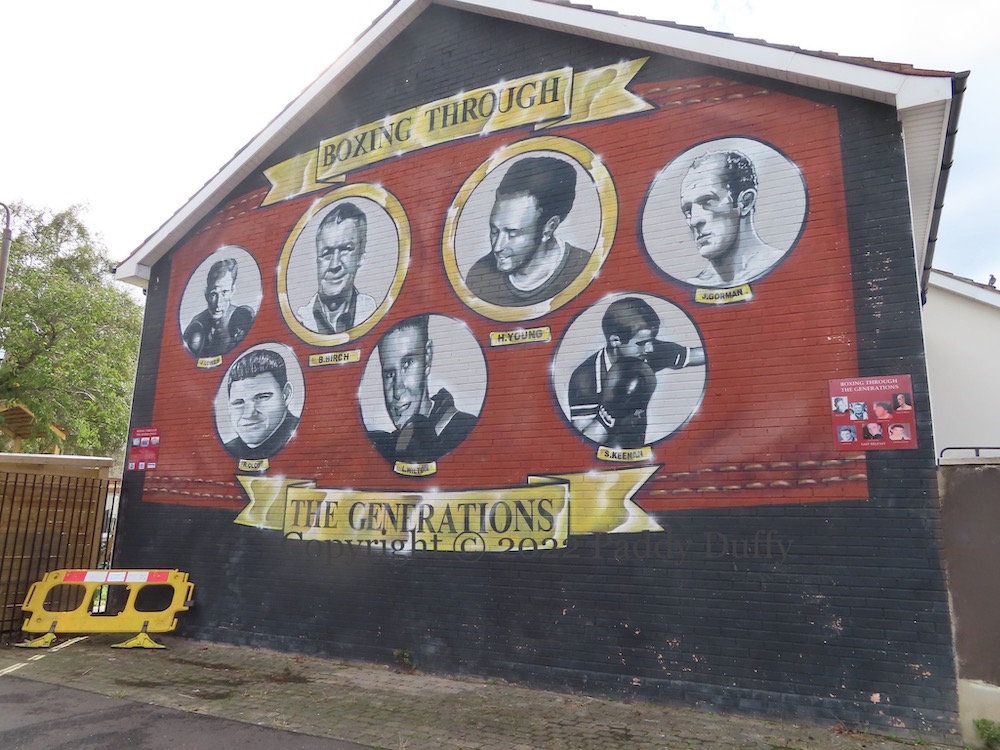
This mural features seven boxers: John Lowey, Billy Birch (’47-’54), Herbie Young, James Gorman, Ray Close (who fought Chris Eubanks to a draw for a World belt in 1993), Luke Wilton (’08-present), and Stephan Keenan.
One of the plaques show the photographs upon which the portraits in the mural were based (except Keenan’s), and the other describes the process by which the Ulster-Scots mural was replaced as part of a project by Charter NI (along with the city council and the housing executive). It reads: “Communities Moving Forward Re-Imaging Programme Phase One. The concept of renewal, change and respect lies at the heart of the ‘Communities moving forward’ programme, which recognises the importance of creativity in all its manifestations and in all our lives, reflecting the heritage of our communities in a positive manner. Boxing through the generations showcases the positive images of this proud small community.” (Also: NIHE press release)
Templemore Street, at the eastern edge of the residential part of Albertbridge Road.
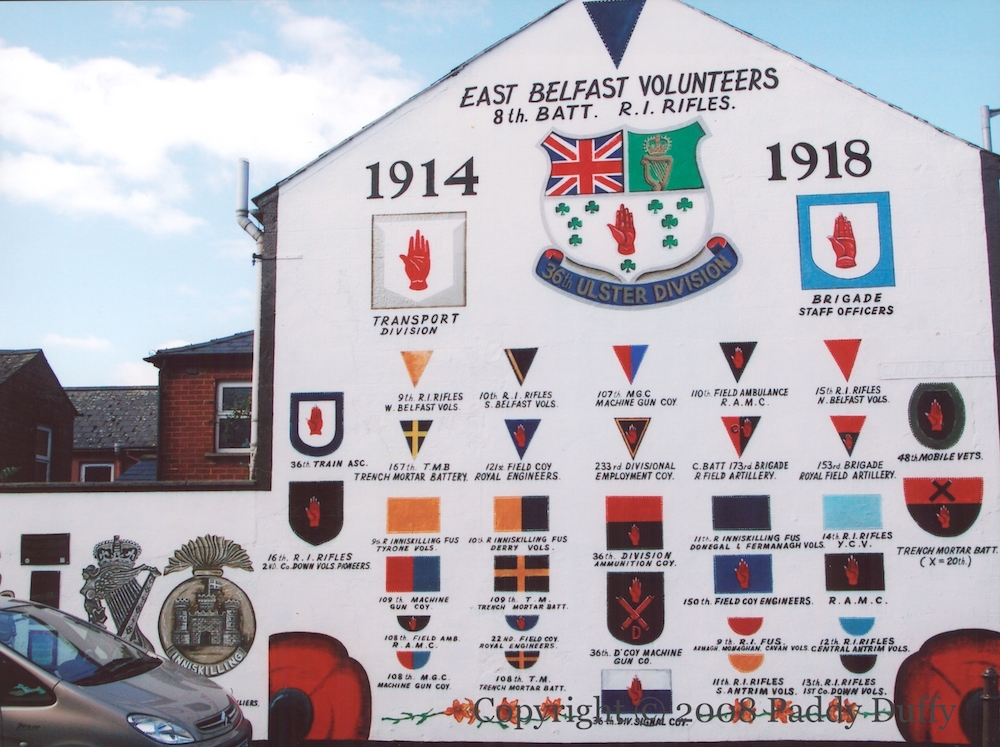
This mural at the mouth of Canada Street commemorates The main mural features insignia of more than thirty units of types from the 8th Batt. RIR, ranging from machine gunners to vets.
The plaques on the wall to the left celebrate the nine Victoria Crosses won by members of the 36th (Ulster) Division “For valour”: Cather, McFadzean, Bell, Quigg, Emerson, De Wind, Seaman, Knox, and Harvey; the final plaque is McCrae’s In Flanders’ Fields.
“In August 1971 many Protestants fled their homes as the IRA launched a bitter sectarian attack on Protestant communities throughout Belfast. The loyal people of Liverpool held out the hand of friendship in our hour of need up to 2000 terrified women and children escaped from burning homes to live in the safety of Liverpool. That act of friendship by the people of Liverpool will never be forgotten. Liverpool – Belfast a bond never broken. No surrender ” With newspaper reports by the Belfast Telegraph and Liverpool Echo. Sponsored by the East Belfast Historical And Cultural Society.
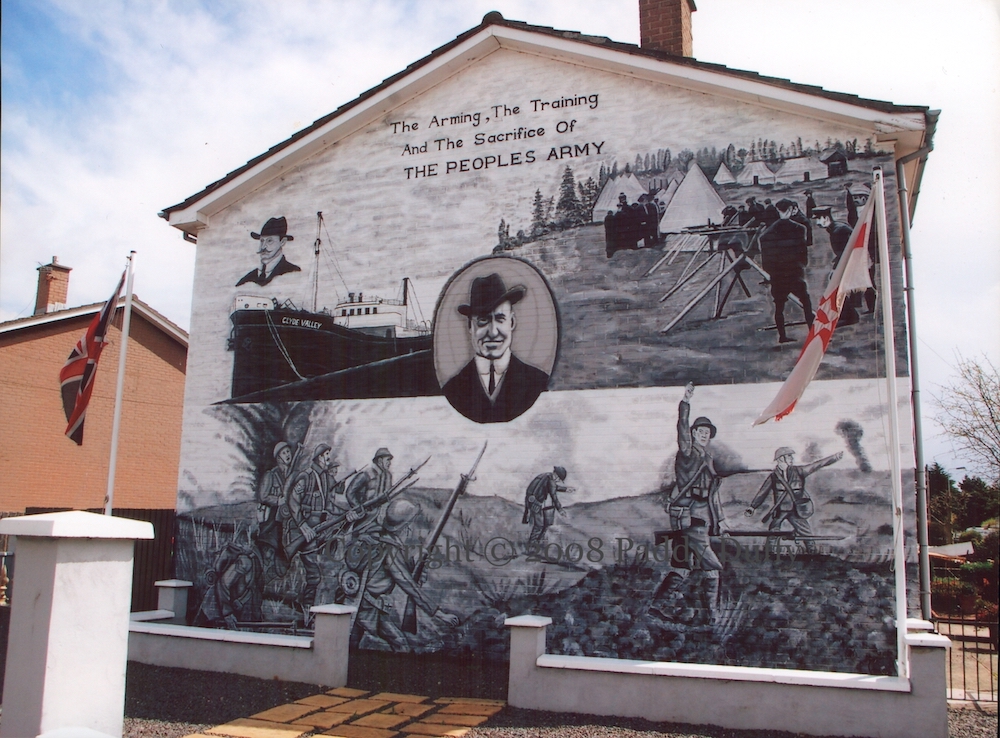
“The arming, the training, and the sacrifice of The People’s Army.” The arming of the Ulster Volunteers (top left) comes from the guns smuggled into Larne on the Clyde Valley. The training of the Ulster Volunteers shown (top right) is probably at Ballywalter. The sacrifice (bottom) is the 36th (Ulster) Division going over the top in James Beadle’s painting ‘Charge of the 36th (Ulster) Division, Somme, 1st July 1916’.
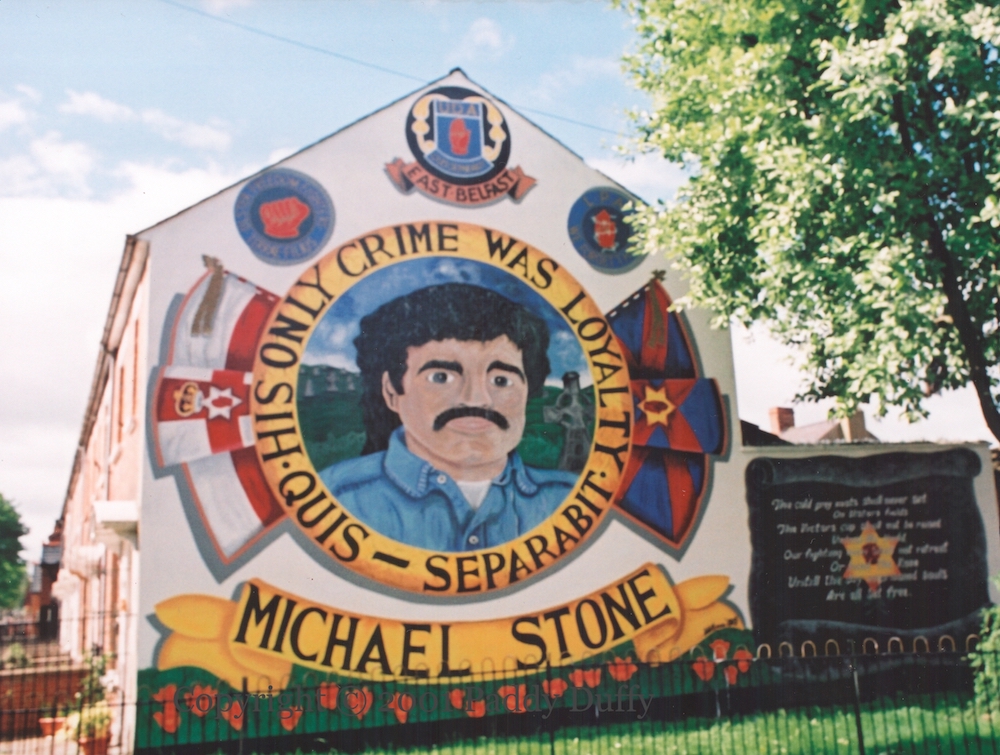
The UDA’s Michael Stone killed three mourners at the funerals of the Gibraltar 3 in Milltown Cemetery in 1988 (16th March). UDA commanders denied that member Michael Stone was acting with their knowledge or approval. This east Belfast mural perhaps is a celebration of his release, under the Belfast/Good Friday Agreement, on July 24th, 2000. “His only crime was loyalty.”
The panel on the right reads, “The cold grey mists shall never set on Ulster’s fields/The Victor’s cup shall not be raised unless we yield/Our fighting men shall not retreat or bend the knee/Untill [sic] the day imprisoned souls are all set free.”
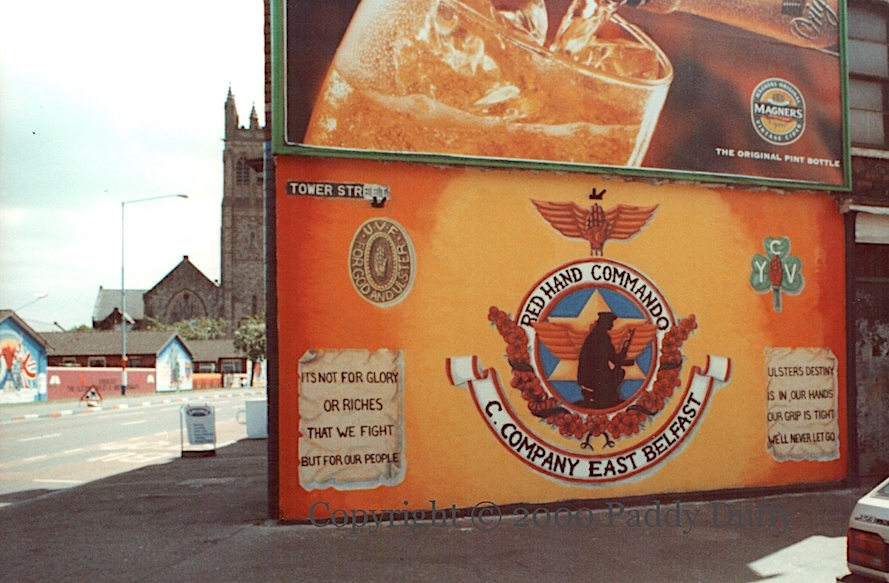
A Red Hand Commando volunteer kneels in a garland of poppies. The quote on the left – “It’s not for glory or riches that we fight but for our people” – is based on the Declaration Of Arbroath and seen also in south Belfast (For Freedom Alone) and in Bangor (Remember Them Who Gave Their All). The Declaration was also used on one of the series of murals that can be seen, in part, to the left of the image above – see Ulster’s Freedom Corner.
The quote on the right – “Ulster’s destiny is in our hands; our grip is tight; we’ll never let go.” – appears to be original to the RHC.
Tower Street, east Belfast, replacing a version that had a solid white background.
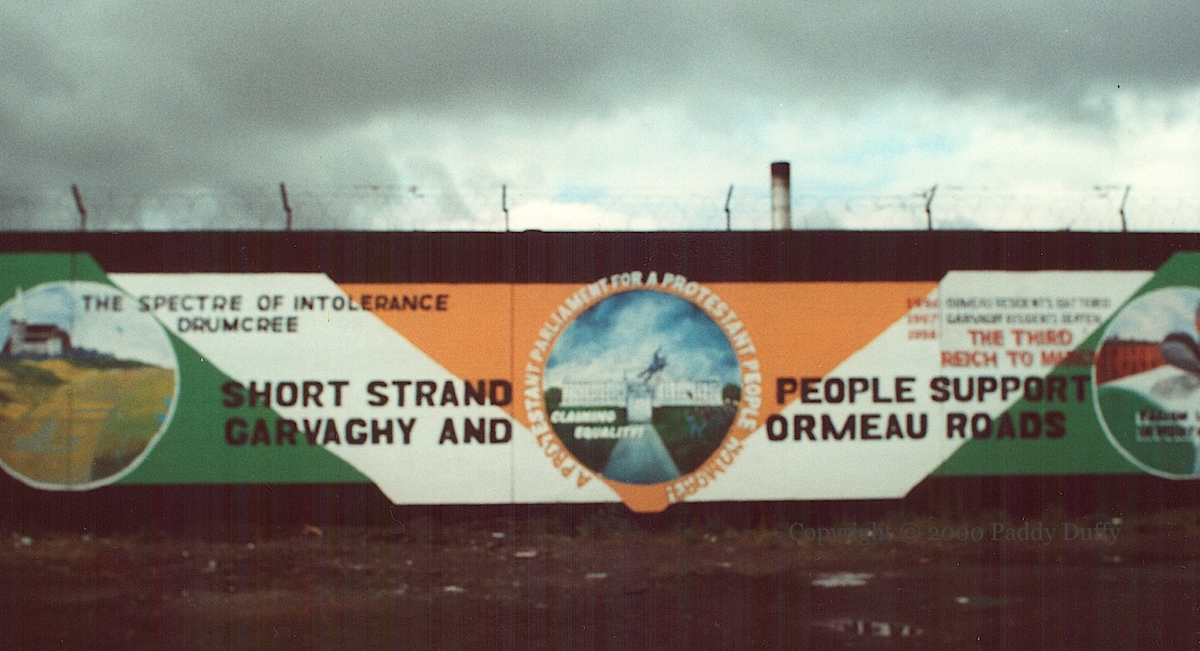
Northern Ireland’s first Prime Minister, James Craig, said in 1934, that Stormont was “carrying on a Protestant Government for a Protestant People” (NI Parliamentary Debates), though the phrase has now been transformed into the doubly alliterative “A Protestant parliament for a Protestant people”. In the centre of a long mural at the waste-ground at the top of Mountpottinger Road, people carrying Irish Tricolours tear down the statue to Northern Ireland’s most prominent leader, Sir Edward Carson, that stands outside Stormont, “claiming equality”.
The main issue that has tested the resolve of governments both local and national to the equality declared in the 1998 Belfast (Good Friday) Agreement is Orange Order parading through nationalist areas, such as the Garvaghy Road below Drumcree church in Portadown, and the Ormeau Road in south Belfast.
“Short Strand people support Garvaghy and Ormeau Roads.” On the left: The spectre of intolerance – Drumcree.” Centre: “A Protestant parliament for a Protestant people no more!” On the right “1996: Ormeau residents battered; 1997: Garvaghy residents beaten; 1998: The third reich to march.” and “Fascism lives! in Portadown”.
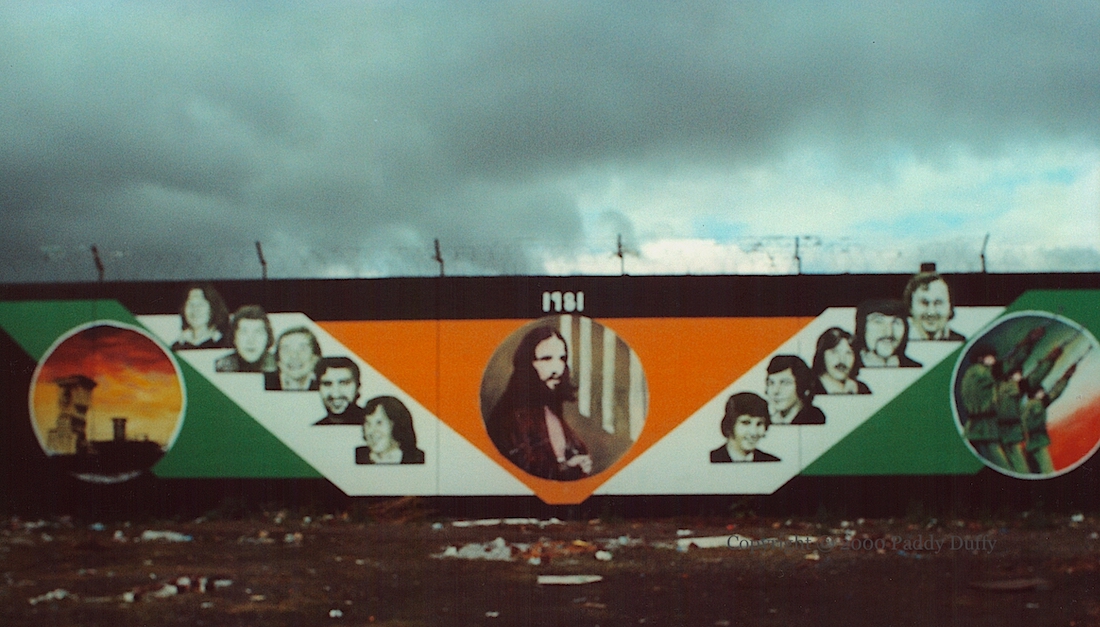
The piece is next to a hunger-strikers commemoration piece with ten portraits on shaped wooden boards against a painted background with blanket-man Hugh Rooney in the center. Between the two is a “spirit of freedom” lark and the names of the ten deceased 1981 strikers.
UDA mural in Avoniel Road showing two hooded gunmen kneel on a free-floating Northern Ireland. Avoniel Road and Dee Street would fall within the territory of 2nd battalion, east Belfast.
This mural is (probably) a companion to the Nelson McCausland book Patrick, Apostle Of Ulster: A Protestant View Of Patrick (Amazon), published in 1997. Here is a 2013 blog post by McCausland that perhaps gives a précis of the book and is in keep with the text in the panel out of shot to the left, which reads, “”All the exciting and glamourous features that tradition has added to Patrick must be removed if we wish to know what he was really like. And yet the historical Saint Patrick is more interesting and more worth studying than all these later gaudy traditions …” Bishop R[ichard]. P[atrick]. C[rosland]. Hanson”
With graffiti reading “had no feet” – a comment on the figure to the left.






 Paddy Duffy Collection