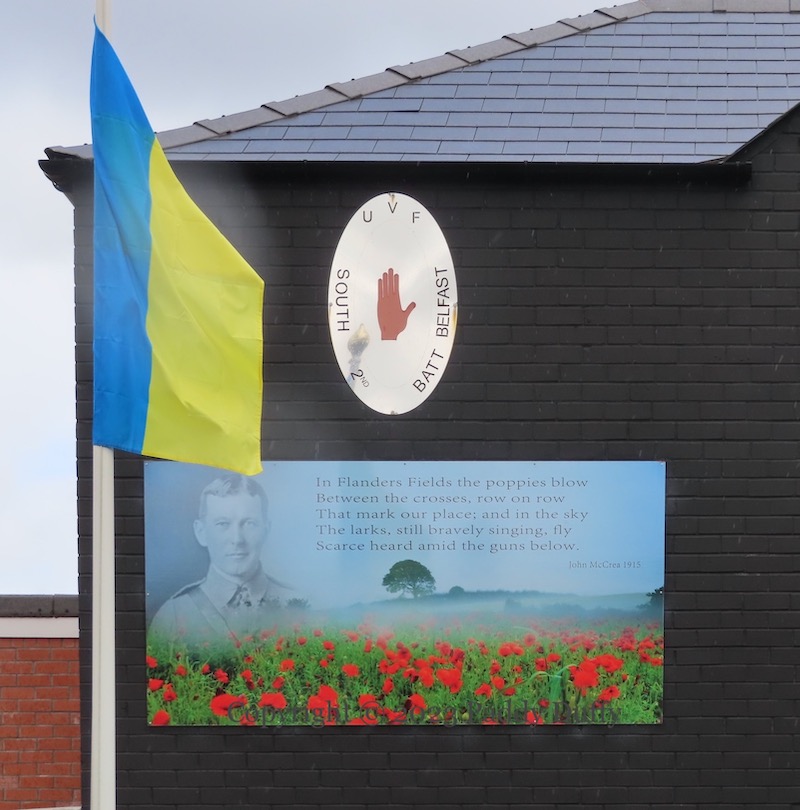
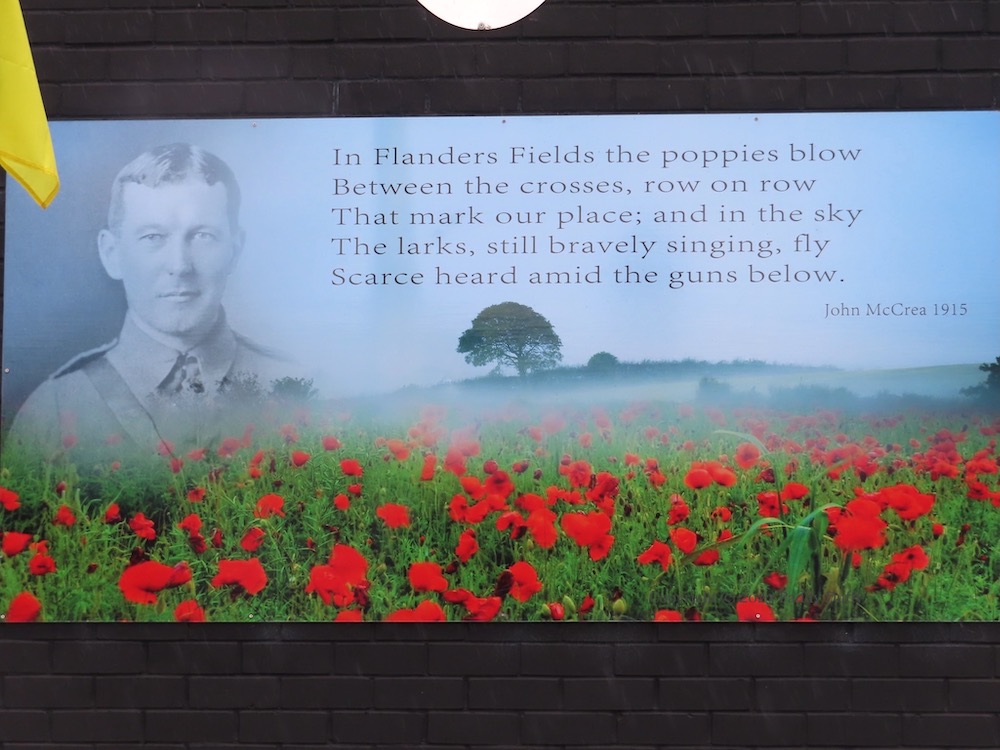
The house next to the Village memorial garden got an extension at the back in 2020 and with it the left-hand part of the house’s gable wall was extended upward (compare with the images from 2017 in Continuing Conflicts). The board with a verse from McCrea’s In Flanders Fields was present previously, but has been raised, and above it there now stands a red-hand emblem of the “UVF 2nd batt. south Belfast”.
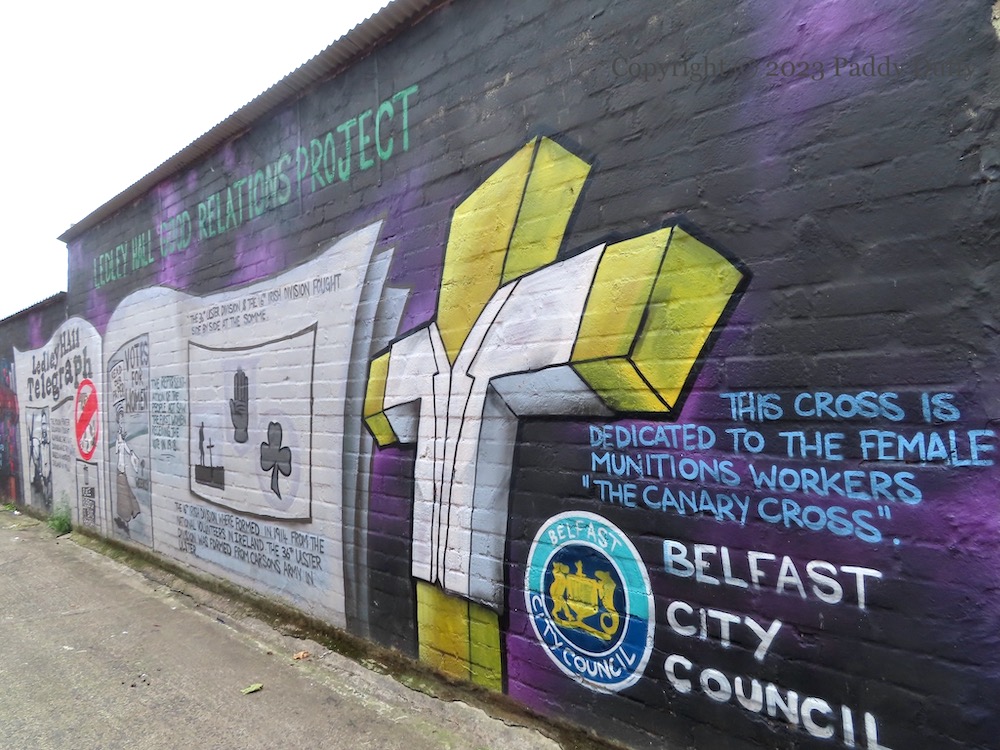
An imaginary newspaper called the “Ledley Hall Telegraph” includes stories on the 303 (Polish) RAF Squadron (which was stationed in Northern Ireland from 1943 to 1944), “Votes for women” (“the Representation Of The People Act saw the first women receiving the vote in 1918”), and the 16th and 36th Divisions (the mural says they “fought side by side at the Somme” – but the 36th was withdrawn on July 2nd after the Battle Of Albert and the 16th arrived in September and fought in the battles of Guillemont and Ginchy; both were withdrawn to Messines and both would take part in the Battle Of Messines in June 1917).
The “newspaper” is bookended by two painted crosses (for Row On Row), one for Guardsman Connor Lilley, a member of the Gertrude Star flute band, who was serving with the 1st battalion Royal Irish Guards when he was killed in an accident in Canada (Fb), and the other for WWI female munitions workers who, because of their work with TNT, risked yellowing skin both from direct exposure and from liver damage (“toxic jaundice”) (WP).
Also included is “The Kindness Hut”: “Be the reason someone smiles today”, “Kindness is free – please share”, “In a world where you can be anything, be kind”, “Take only what you need! If everyone shares there’s enough to go around”.
This is the new Sam Rockett mural in the Woodvale, replacing the mural seen in Murdered By Cowards. The old mural just featured Rockett, who died in August, 2000, in the feud between the UVF and lower Shankill UDA. This new mural also features the “ethnic cleansing” of Torrens in 2004.
Torrens sits between Cliftonville, Ardoyne, and the lower Oldpark, and was one of the many historically mixed areas in north Belfast that, with the Troubles, became increasingly segregated and separated from neighbouring areas by “peace” lines. Jarman (1996) provides eye-witness testimony of the dispute in Torrens in 1996 which saw Catholic families leave the area. Its proximity to Ardoyne (and Cliftonville), however, meant that over the next few years the houses were gradually abandoned by Protestants, culminating in 2004 when ten of the remaining Protestant families moved out of the area, alleging persistent intimidation and employing the term term “ethnic cleansing” – a term the poem to the right of the mural uses three times.
The area was eventually redeveloped from 2008-2012, with the Wyndham Street “peace” line coming down and Elmgrove Street being opened to the Oldpark Road.
The line in the poem “the resistance formed a steady band” is unclear – it might refer to loyalists being bussed into Torrens in 1996 (see the testimonies in Jarman); if it refers to B Company it would make a connection to Rockett. As it is, the connection between the two elements of the mural (if any is intended) seems to be that Rockett was from the lower Oldpark, near Torrens.
“In the name of Ireland’s cruel game/Oh, land that once sang freedom’s song/Now marred by ethnic cleansing’s wrong.//Echoes of anguish haunt the Protestants of Torrens,/Ethnically cleansed, a sinister goal,/Their weapon honed, to exact a toll.//Families robbed of essence and space,/fuelled by hated, to erase their trace.//Against the darkness, spirits sincere,/Hand in hand across the land,/the resistance formed a steady band.//Ethnic cleansing’s horrors unveiled at last,/Hearts of courage, unbreakable souls,/Truths unfurled, their power untold,/A captured scene of the evil deeds done.”
The in-progress images are from August 17th and 18th. The mural was completed for the anniversary of Rockett’s death on August 23rd. The source for the central image (of furniture being loaded into a lorry) is unknown.
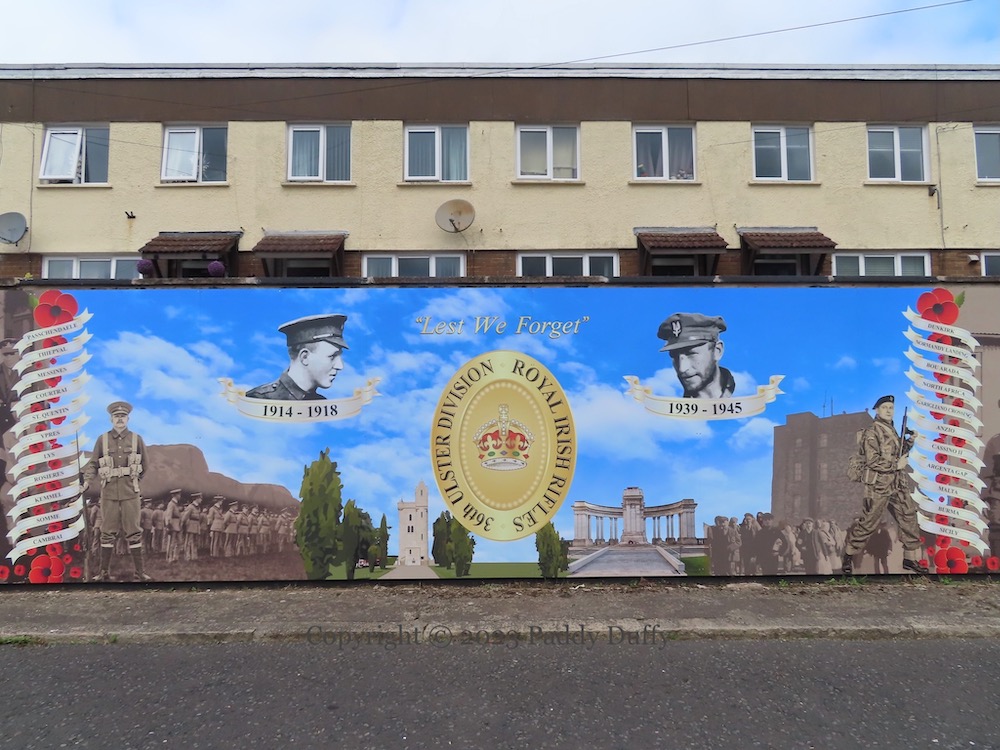
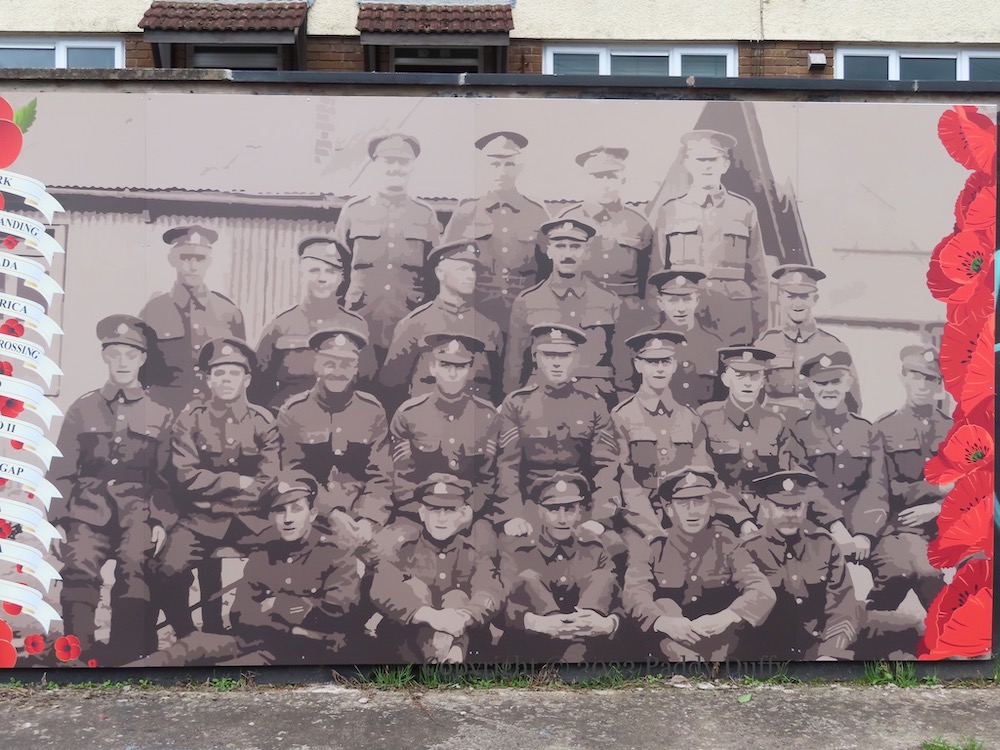
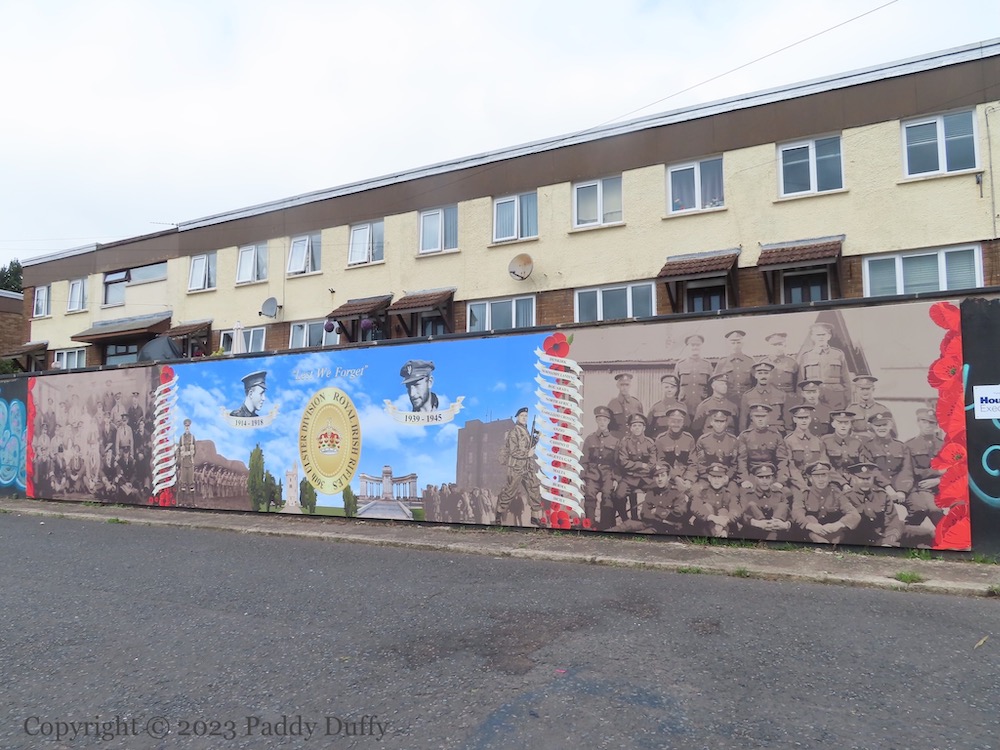
After WWI, the Royal Irish Rifles became the Royal Ulster Rifles (and later became part of the Royal Irish Rangers). This board prioritises WWI as the Rifles were part of the 36th Division. The hero of WWI portrayed in the central panel is William McFadzean, awarded the VC for falling on two live grenades in the trenches on July 1st, 1916. McFadzean is familiar from many previous murals both individually and in the company of other VC winners; for his family home in Cregagh, see Rubicon.
Alongside McFadzean, the hero of WWII is Blair “Paddy” Mayne, who was only briefly in the Ulster Rifles before making his name in the Parachute Unit (later, and better, known as the SAS). His many medals of honour are shown in an old Newtownards mural, though he was denied the VC.
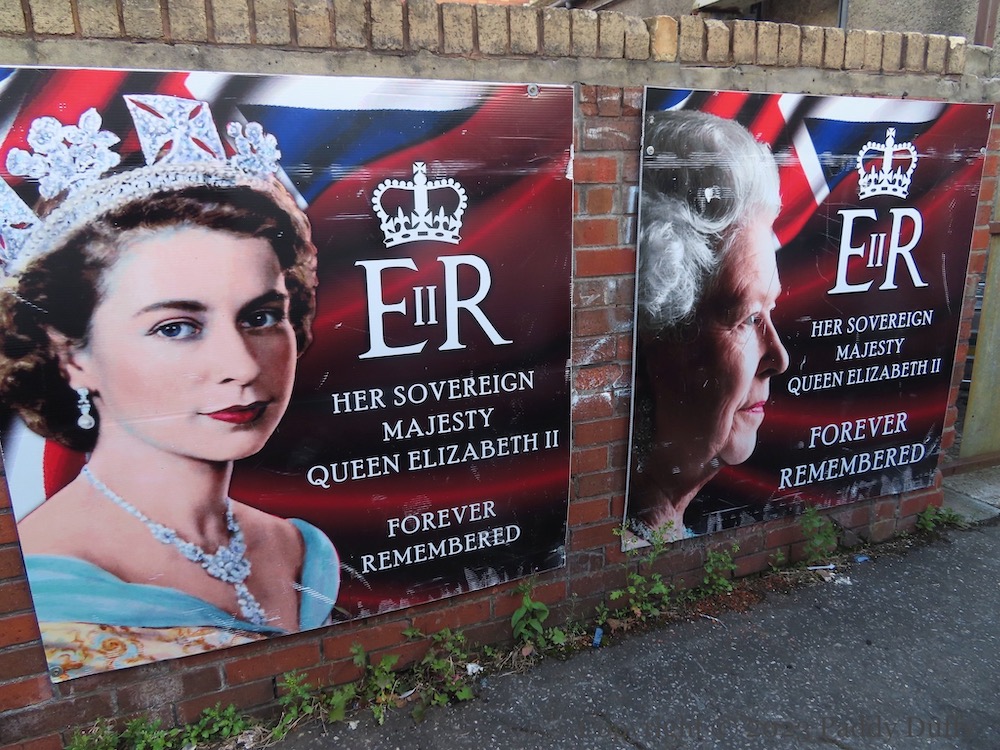
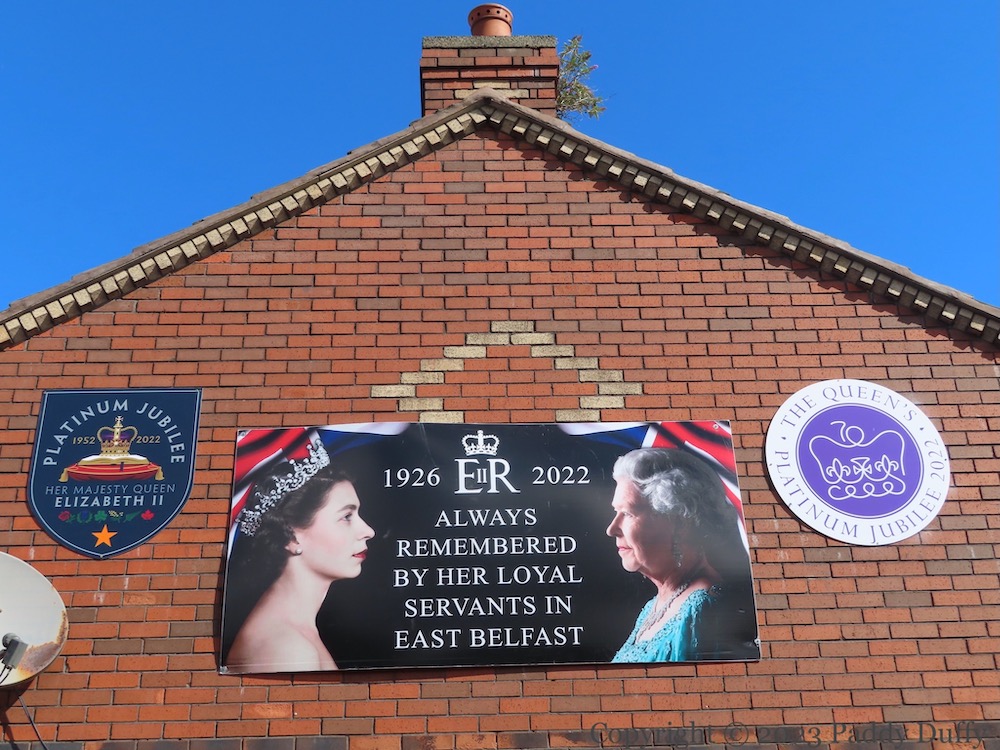
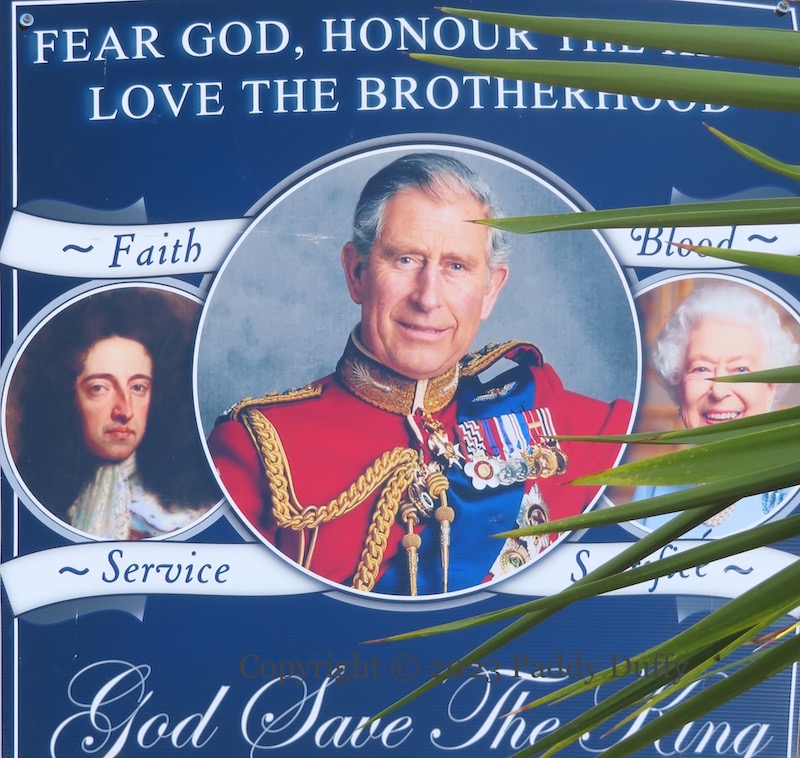
Here are three images from the blind end of Montrose Street, east Belfast, updating a post from November last year (Loyal Servants) with the addition of the boards above, on the death of Queen Elizabeth II, and the final image below, which puts the new King Charles III between Queen Elizabeth and King William III.
The portrait shows Chaplin dressed in the clothes of the barber but the words are spoken when he is dressed in the clothes of the other character he played in The Great Dictator (1940), Adenoid Hynkel, the Phooey Of Tomainia:
“We have developed speed, but we have shut ourselves in. Machinery that gives abundance has left us in want. Our knowledge has made us cynical. Our cleverness, hard and unkind. We think too much and feel too little. More than machinery we need humanity. More than cleverness we need kindness and gentleness.” (youtube)
Painted by Glen Molloy (ig) in Seymour Street, Belfast
The Windsor Women’s Centre (web | Fb) provides day-care and educational services for women in the Village, south Belfast. In the mural around the building children are depicted playing at various jobs: the mac on the “lollipop lady” (at a school crossing) is too large, the nurse is listening to the heart-beat of a teddy-bear.
On the other side of the centre from the expression of thanks for the NHS in Together We Are Stronger.
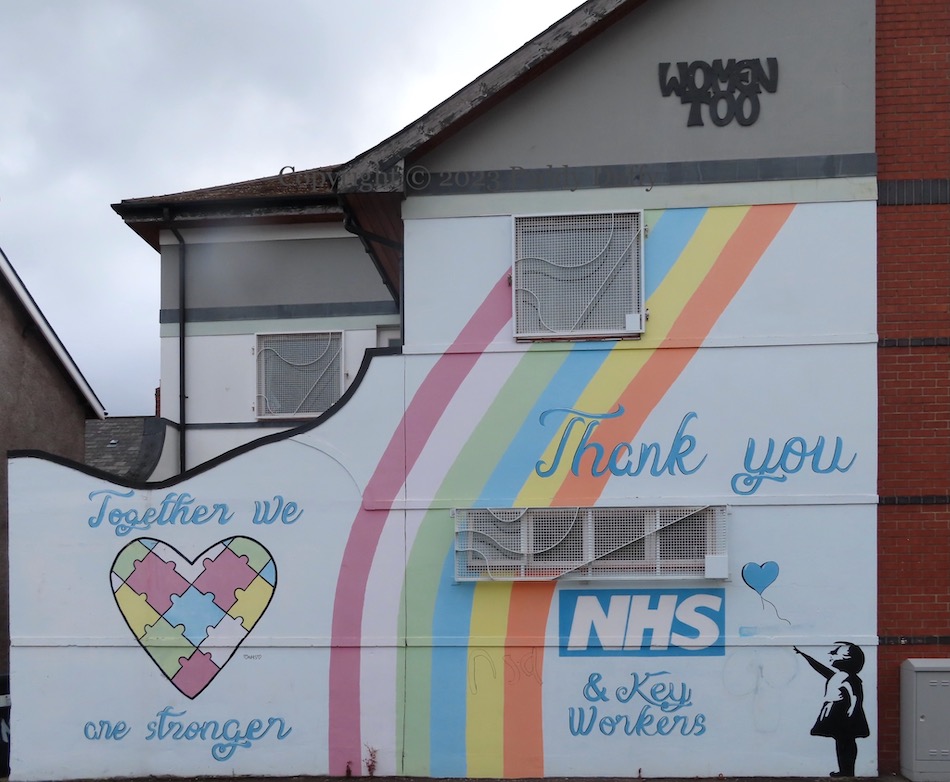
“Thank you NHS & key workers” – this is a Covid-era wall-painting in the Village, south Belfast, illustrating togetherness with a heart of interlocking jigsaw pieces and a rainbow of various colours.
Kilburn Street, replacing Women Too (whose title can still be seen in the eave above this painting), and on the other side of the Women’s Centre from Allowed To Dream, We Learn To Fly.
Here are two portraits of the recently crowned King Charles III in east Belfast. The image at the centre of the lower board is the standard one we have seen many times; the one above, however, appears to reproduce a slightly stylised painting or graphic.
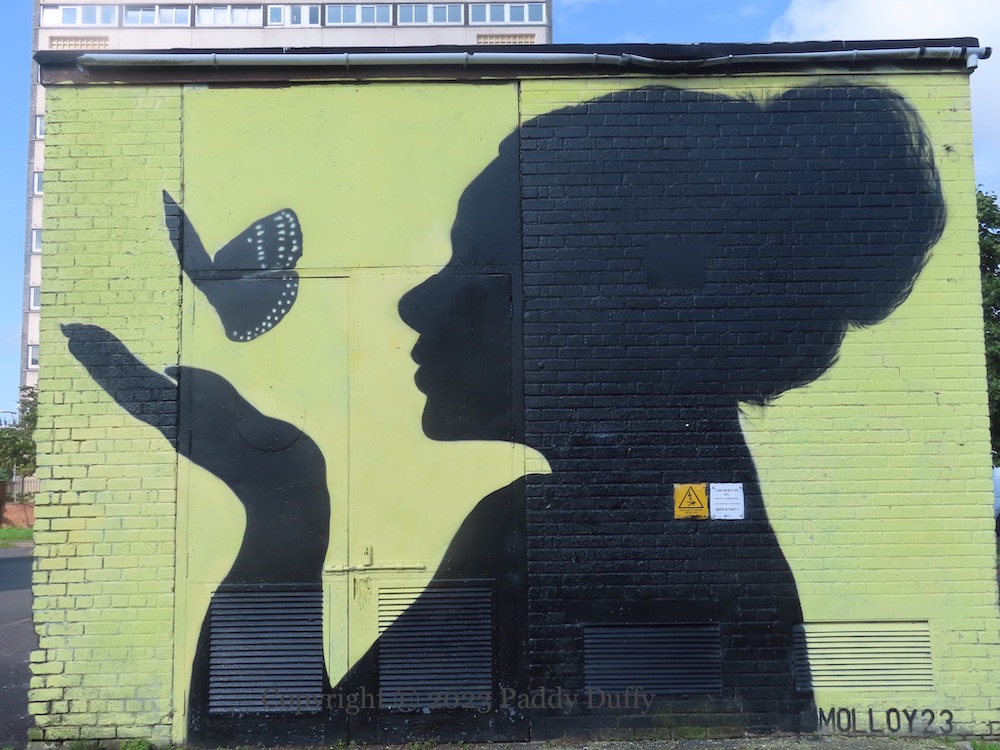
Here are five pieces of street art by Glen Molloy (ig) at Clarawood flats. The first three are new; the pair following is from earlier this year (Jan and Feb). The artist of the sixth piece is unknown. The seventh piece is by “The Spermer” (web) from 2020 and already in some disrepair – it was painted at the same time as Glen’s spitfire, shown last.
Demolition of the two blocks of flats was approved by the Housing Executive in May 2021 (Belfast Live) and by the Department Of Communities in September 2021 (Belfast Live). Demolition of Kilbroney is scheduled for the autumn and Clarawood (the tower block) for 2024 (Irish News).
(See also the Housing Executive’s ‘Action Plan’ for all tower blocks (pdf).)









 Paddy Duffy Collection