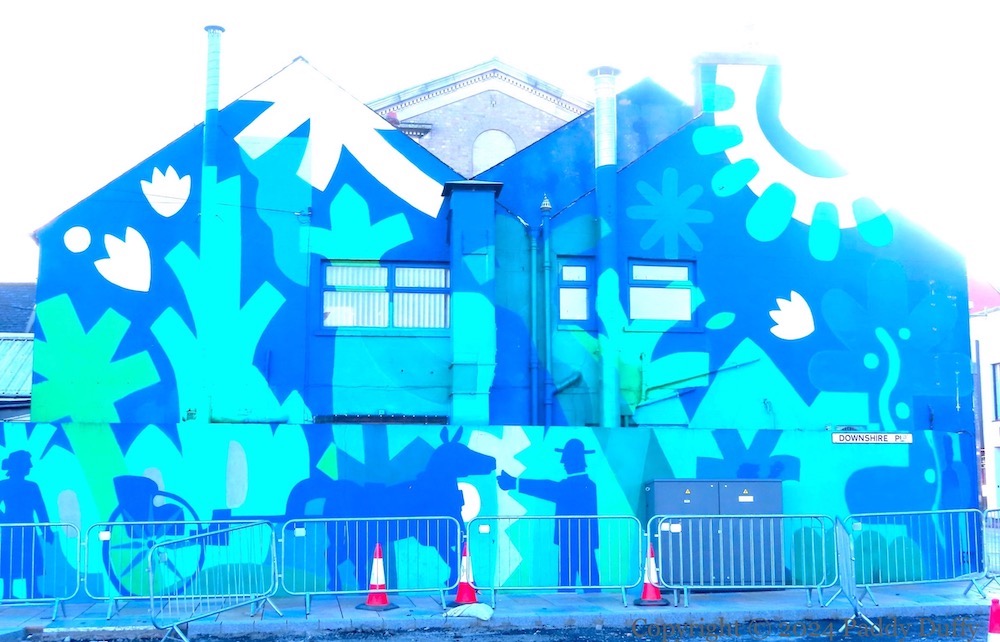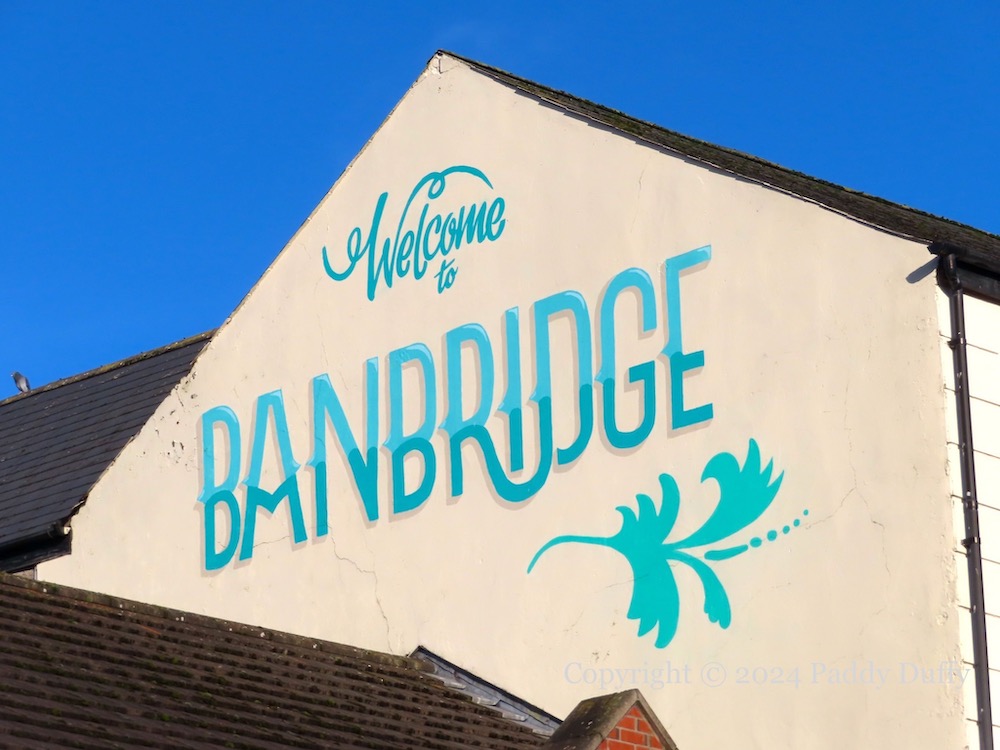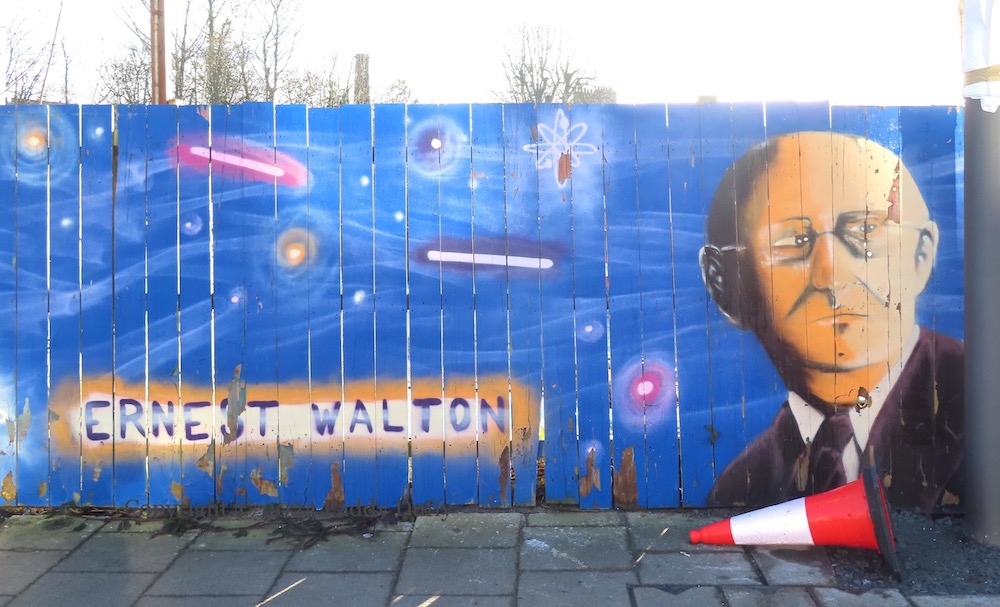
This is the new Glen Molloy mural in Carrickfergus, showing a boy practicing his baton-twirling and marching. It’s in the same style as the Little Drummer Boy in the Shankill.
The mural is in Agnes Street, at the far end of Marine Highway, heading towards Eden. The in-progress images below show Glen at work and the mural at different stages of development.
“Colonel Edward Saunderson MP, UDU founder, leader of the Irish Unionist Party. 1837-1906. Union is strength. ‘We must be prepared for every possible eventuality’ – on the issue of Home Rule 1893.”
The dates given are the span of Saunderson’s life, not his political career, which began in 1865 as MP for his home county of Cavan.
The bill under consideration in 1893 was the second Home Rule bill, which the UDU was formed to resist. The UDU initially met in Belfast in March; the manifesto of the meeting can be read on page 5 of the [Sydney] Freeman’s for 1893-04-29.
On June 8th, 1893, the Westminster government asked the police for a report on the Union, fearing its goal was armed resistance to Home Rule, and considering declaring it an illegal organisation ([Sydney] Daily Telegraph, 1893-06-10 page 5).
In September, the bill was passed in the Commons but defeated in the Lords. An account of the October meeting quotes Saunderson saying that the organisation should maintain itself by “if the necessity arose” “proving – not by words, but by deeds – that they meant what they said.” (Gympie Times & Mary River Mining Gazette, 1893-12-07 page 3).
Saunderson at the time was (also) leader of the Irish Unionist Alliance (here called the “Irish Unionist Party”) and he went on to be the first leader of the Ulster Unionist Party, from 1905 to 1906 (WP), when he died of pneumonia (WP).
The Ulster Defence Union is employed as an origin-story by the Troubles-era UDA as the UDU formed an ‘Ulster Defence Association’ – see UDU-UFF-UDA and UDU-WDA-UDA-UFF – and the name is used by the post-Agreement UDA – see Daffodil Days.
A service was held yesterday in West Kirk Presbyterian to mark the thirtieth anniversary of the bombing of Frizzell’s fish shop on the Shankill Road. As part of the ceremony, wreaths were laid at the new memorial marking the spot on the Shankill where the bomb exploded, killing nine locals — hence the Arabic “9” among the Roman numerals on the clock face — and one of the bombers (ITv footage). The clock shows the date and time that the bomb went off: 1:06 pm on Saturday October 23rd, 1993.
The new ‘clock’ memorial replaces the three plaques seen in Frizzell’s (though the circular plaque might have been incorporated into this new memorial); the board of portraits served as the cover for the memorial in the days prior to unveiling and was placed over the credit union’s ATM.
West Kirk also contains a stone and bench to the victims of the Shankill bombing. Nine trees were also planted in their memory: John Frizzell, Sharon McBride Leanne Murray, Michael Morrison, Evelyn Baird, Michelle Baird, George Williamson, Gillian Williamson, Wilma McKee.
“We remember those who were killed, those who survived and those lives changed forever.”
“‘And God shall wipe away all tears from their eyes; and there shall be no more death, neither sorrow, nor crying, neither shall there be any more pain; for the former things are passed away’ Revelations 21 v4”
The plaque above – “Ormeau Road in memory [of] Fergie” – is now somewhat incongruously above painted signage for a coffee-and-donuts shop (Bunelos | web) on the Ormeau Road, a commercial road which is also at the edge of the Ballynafeigh neighbourhood.
“Fergie” is perhaps Iain Ferguson, who died in 2021 (Belvoir & Ballynafeigh UPRG on Fb) and is remembered in a tarp on the side of the flats in Belvoir, shown below. (UPRG is affiliated with the UDA – hence the red hand and the six-pointed star in the plaque, alongside the flowers of the four nations – rose, shamrock, daffodil, thistle – and orange lily.)
The paint-bombed version of the sign for Cregagh Street Gospel Hall remained in that state for over a decade, so long a time that this is how it is recognised by many and how it is reproduced in a postcard available in Born & Bred (web) in Ann St.
The image above (and of the shop display) are from October 2023; the image of the old sign is from January 2022. It was repainted in the summer of 2022.
The hall itself was constructed in 1938, on the site of a school, and Sunday service is still held (Precious Seed).
The Executive Office’s Communities In Transition programme aims to tackle “residual paramilitary activity and associated criminality” in eight areas of Northern Ireland, including the Northland/Sunnylands area of Carrickfergus, which until now has not had any street art. (It does have some community art, also sponsored by Communities In Transition.) They have sponsored this piece of street art by Aches (ig) — reproducing in overlapping triplicate a photograph of a local girl (Fb) taken by Derry photographer Megan Doherty (web) — in Drumhoy Drive, next to the ‘residual paramilitarism’ shown below: a Red Hand Commando board.
This Castlemara, Carrickfergus, board is not remarkable so much for what it depicts — the new prince and princess of Wales, “baron & baroness of [sic] Carrickfergus” — but for what it replaces, namely, the Carrickfergus Eddie, which had been in place since (at least) 2000 — see Show No Mercy.
This means that there are no large murals of Eddie remaining; there are only some smaller versions of Eddie of boards or tarps. Eddie has his own Visual History page.
This is the second (at least) iteration of an installation along Taylor’s Avenue, Carrickfergus, showcasing the Ulster-Scots heritage of Carrickfergus and its later contributions to the United Kingdom.
The wall is 60 metres/200 feet in length and can be divided into about ten distinct panels – notes on the different panels are given below, following the order of presentation of images, which show the entire wall moving from left to right.
The original, as seen on Street View, included boards showing the Pretani Isles/British Isles, QEII, and Tom Moore. As seen here, there are now boards to King Charles III, a vintage postage stamp, ‘The Siege Of Carrickfergus’ in 1689, and ‘The Barn Mills Fallen’ of WWI.
James Orr, the ‘Bard Of Ballycarry’, was a contemporary of Robert Burns and a United Irishman. It does not appear that he wrote a poem with the line “I wish I was in Carrickfergus”.
Daniel Cambridge won his VC for service in the Crimean War (WP) and James Crichton for service in WWI (WP).
CarrickfergusHistory includes “the oldest know map of Carrickfergus” from 1560, employing the spelling “Kragfargus”.
The 2/6 postage stamp featuring Carrickfergus Castle was one of four in a “Castle series” in 1955 (WP).
“Resistance to IRA demands – “Every word spoken in Irish is like a bullet being fired in the struggle for Irish freedom” – Ulster says no to an ILA.” The precise wording and the author of the quotation are unclear. Nelson McCausland of the DUP gives it as “Now every phrase you learn is a bullet in the freedom struggle” and attributes it to Sınn Féın’s Pádraıg Ó Maolchraoıbhe in May 1982 (BelTel | Nelson’s View). The Irish language is not, of course, the exclusive property of militant republicanism, and, although the IRA has ceased its campaign and decommissioned its weapons, it is used here in conjunction with an image of a gunman firing an assault rifle in order to provoke fear against an Irish Language Act. The bill – enacted by Westminster rather than Stormont – became law last (2022) December (BBC). The poster dates from 2022 or 2021.
“Let others come after us – we welcome the chase.” The exterior wall of the Carrickfergus Rangers Supporters Club presents a gallery of the club’s managers from 1899 to 2018. In order they are William Wilton, Bill Struth, Scot Symon, David White, William Waddell, Jock Wallace, John Greig, Graeme Souness, Walter Smith, Dick Advocaat, Alex McLeish, Paul Le Guen, Ally McCoist, Stuart McCall, Mark Warburton, Pedro Caixinha, Graeme Murty, Steve Gerrard (and since then, there have been Giovanni van Bronckhorst, Michael Beale, and (currently) Philippe Clement).