
Here is an electricity box in Jubilee Park on Kingsway in Dunmurry, transformed by NOYS (ig) and Jam2 (ig) at the end of 2023.

Click image to enlarge
Copyright © 2024 Paddy Duffy
T04885 T04886

“Ruby Murray (March 29, 1935 – December 17, 1996) was a popular singer born in Moltke Street and brought up in the village. Her characteristic hoarse voice was a result of an operation on her throat in early childhood. She toured as a child singer, and first appeared on television at the age of 12. Her first single was ‘Heartbeat’ [youtube], which reached the UK top 5 in 1954. The next, ‘Softly, Softly’ [youtube], reached number 1 in 1955, a year in which Murray achieved the rare feat of having five singles in the top twenty at the same time. Ruby still holds the record for the most hit records in the Top Twenty at the same time; beating Madonna and the Beatles.” “Our thanks to Donegall Road Primary School & especially all the pupils, whose images comprise this Photo-Mosaic.”
This is a copy of the board (or perhaps even the very board) that used to be in Maldon Street. It is (now) in the Village green, which cuts Moltke Street in two.
Other Murray boards: The Village Songbird | Top Of The Pops
Click image to enlarge
Copyright © 2024 Paddy Duffy
T04884
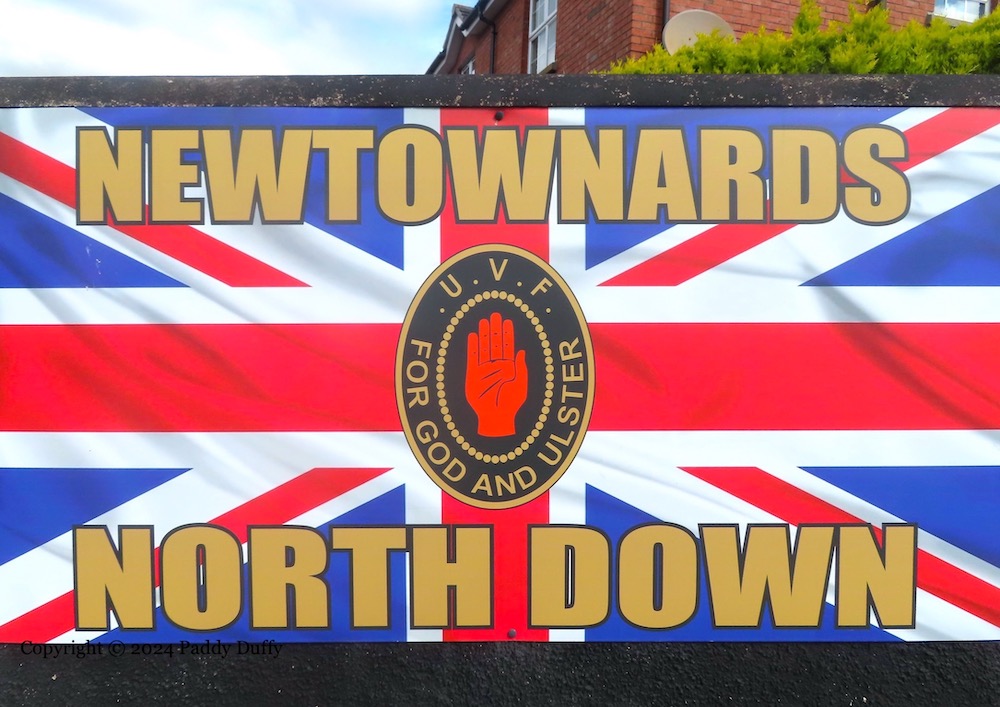
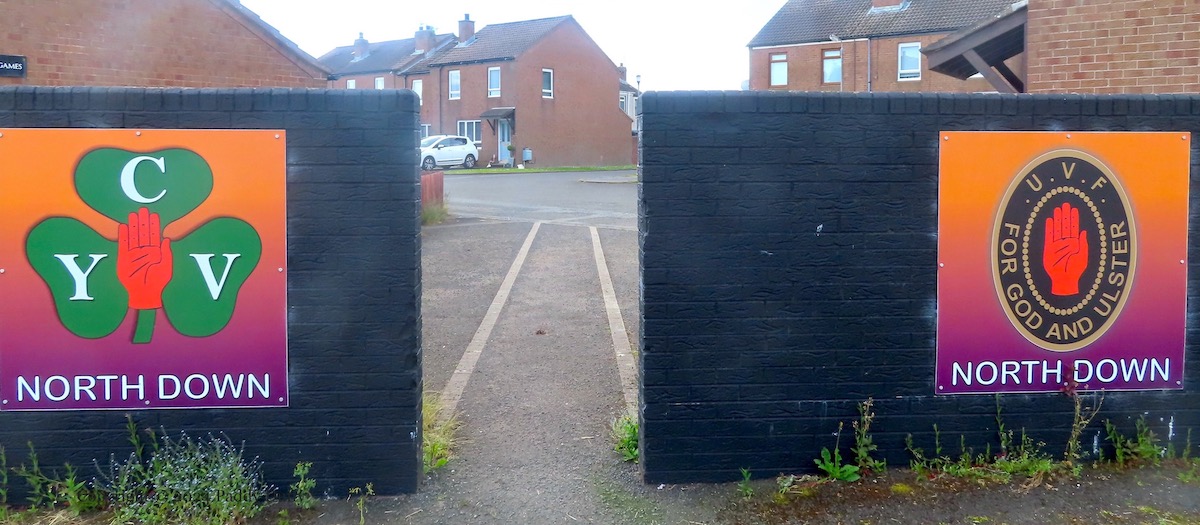
Here are some more UVF boards (in addition to those seen in 2022’s Bowtown UVF) that have been added along the length of Abbot Drive. Both “East Belfast” and “North Down” rival factions are included.
The “Lest we forget” board in the final image has been seen before, but has been moved to the location shown after being in the memorial garden.



Click image to enlarge
Copyright © 2022 Paddy Duffy
T04807 T04808 T04809 T04810 T04811

On the left (“perception”) it seems as though three youths are thieving and spraying graffiti on a wall; in fact, on the right (“reality) they are picking up litter and removing graffiti.
High Street, Newtownards


Click image to enlarge
Copyright © 2024 Paddy Duffy
T04804 T04805 T04806

Feminine Touch (web) is a beauty and tanning salon in High Street, Newtownards; the mural is on the side-wall, in Lower Mary Street.
Click image to enlarge
Copyright © 2024 Paddy Duffy
T04803

This is an election-campaign sticker in High Street, Newtownards, alleging co-operation between the Alliance party (whose signature colour is yellow) and the IRA, whose signature colours are the colours of the Tricolour (News Letter premium).
A similar campaign was waged in 2019 (Dunfermline Press | Jersey Evening Post).
Click image to enlarge
Copyright © 2024 Paddy Duffy
T04802

Steeple Veterans flute band is a part-time band drawing on “veterans” or “old boys” of the Steeple Defenders (which used to have a board nearby). The “older but no wiser” tag-line is exemplified by the fact that they dress up in costume each 12th for the return leg of the day– in 2023 they adopted Jurassic Park as their theme, with members dressed as dinosaurs, park rangers, and explorers. The black ribbons in the bottom corners are perhaps in memory of member David Johnston, who died last year (2023) (Belfast Live | BelTel).
Also included (below) is a tribute to Elizabeth II on the occasion of her platinum jubilee, a few months before she passed away in September, 2022, added next to the Somme mural seen in Ulster Volunteer Forces.
Seacash Drive/Parkhall Road, Antrim.

Click image to enlarge
Copyright © 2024 Paddy Duffy
T04791 T04792 antrim round tower
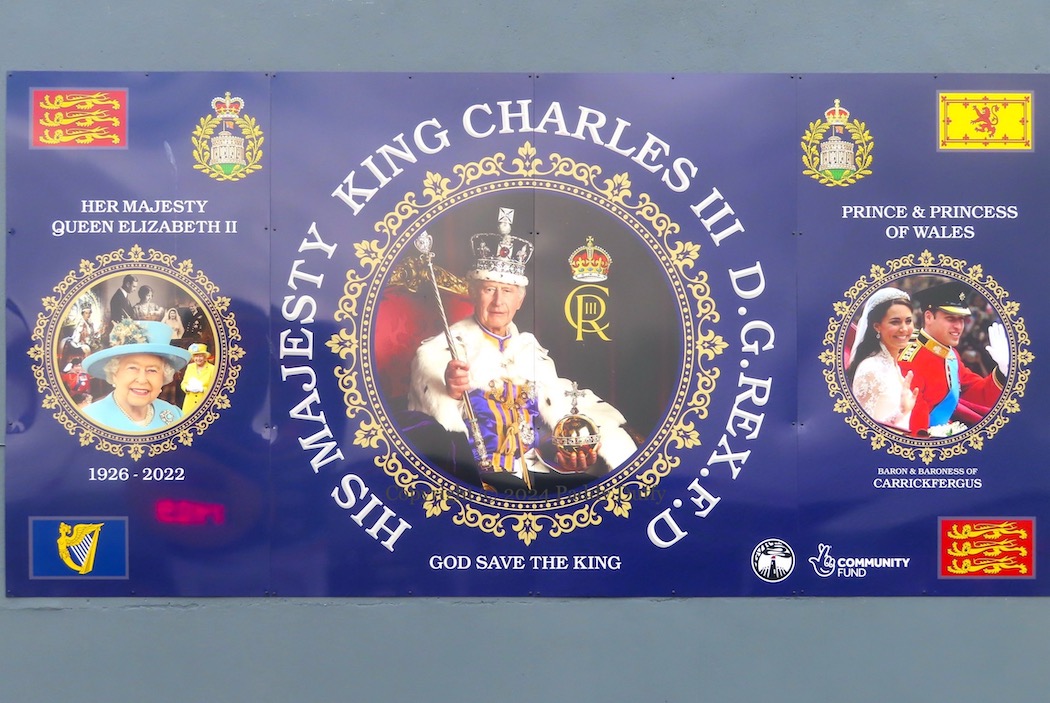
“His majesty King Charles III D.G.Rex.F.D. [Dei gratia rex; fidei defensor – King by the grace of God; defender of the faith]” successor and son of Queen Elizabeth II (1926-2022) and father to William, the current Prince Of Wales and Baron Carrickfergus (no “of”).
Each of the corners of the board shows a quarter of the royal standard, including, in the bottom left, a ‘maid of Erin’ flag representing the kingdom of Ireland, which has been present in the standard (of England, of Great Britain, of the United Kingdom) since 1603. Shortly after partition (1922) it was used as the banner of arms of the Irish Free State and later adopted as the arms of Ireland and of the President but it continues to be used in the UK royal standard. (For a history of the royal standard, see Prothero, Faul, & Grieve one | two.)
Thalia Street, south Belfast
Click image to enlarge
Copyright © 2024 Paddy Duffy
T04789

September 8th, 2022, is the date of the accession of Charles – then Prince Of Wales – the UK crown, upon the death of his mother Elizabeth at ten past three in the afternoon (as shown on the clock in the bottom left of the wide shot, below). At Balmoral Castle, the Royal Standard (in the top left of the wide shot, below) was lowered and immediately raised again, as the monarchy immediately moved to Charles and he was present in the building (WP).
The unnamed figure on the left is William, the son of Charles and his first wife, Diana, and the current Prince Of Wales. William’s son, George, on the right, is known as “Prince George Of Wales” (and his siblings similarly) rather than (as here) “George, Prince Of Wales.” The title “Prince Of Wales” is reserved for the heir to the UK throne, currently William.
“His Majesty King Charles III by the Grace of God of the United Kingdom of Great Britain and Northern Ireland and of His other Realms and Territories, King, Head of the Commonwealth, Defender of the Faith.”
Devenish Drive, Monkstown, Newtownabbey, with funding from the Housing Executive (NI World) to replace the UDA hooded gunman seen in Open & Shut.

Click image to enlarge
Copyright © 2024 Paddy Duffy
T04766c T04765 [T04767]

On this day 334 years ago (in the Julian calendar, which would be June 24th in the Gregorian), King William III landed at Carrickfergus and began his journey, via Belfast and Lisburn, to the Boyne river (outside Drogheda) where he successfully led his forces against those of James II.
After landing in Carrick, William rode by horse to Whitehouse, half-way to Belfast, where he met his commander-in-chief, the Duke Of Schomberg, who had been in Ireland since the previous August and laid siege to, and taken, the Jacobite garrison in Carrickfergus, making William’s landing there possible (WP).
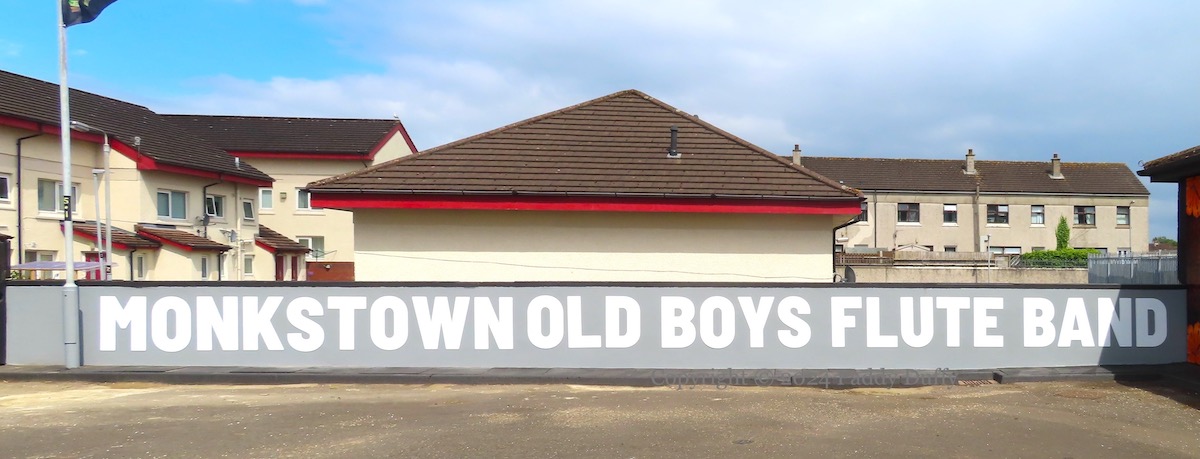
This new large board at Monkstown Old Boys (Fb) celebrates William’s landing and journey to Whitehouse, which is the point closest to Monkstown.
The image reproduced in the centre of the board (see below; a crisper version can be found at Orange Heritage) shows William meeting Schomberg at the eponymous White House, where Glas Na mBradán (the Salmons’ Stream) made a small port. Dalaradia has a 3-D flyover of what the White House and surrounding area might have looked like at the time. The remains of the White House have been restored and now house an interpretive centre (Bangor Historical Society | Causeway Coastal Route).
(For more on William’s journey from Carrick to Belfast see George Benn’s (1877) A History Of The Town Of Belfast p. 180 ff and Millin’s Sidelights (1938) – a contemporary map of the area appears at the bottom of the page. “Lord Belmont” also has a two-part history of William’s journey from Carrick to Belfast and on to Lisburn.)
Other images of William’s landing at Carrickfergus can be found in an old Bobby Jackson mural in the Fountain, Londonderry, (see the Peter Moloney collection) and in the Glenfield estate in Carrickfergus (see The Liberties Of England). There is also a statue of William in Carrickfergus harbour – see The Landing Of SARS-CoV-2 At Carrickfergus, March 2020.
The text on the board and the other images are as follows:
[The portrait of William is by Godfrey Kneller and part of the collection in the National Gallery Of Scotland.]
[The following text appears to be an excerpted and slightly modified version of a page at Orange Heritage.]
“King William was in Ulster from Saturday, June 14th, 1690 until Thursday, June 26th, only 12 days, yet he left behind a legend full of proud memories. For his part he liked what he saw. “This country is worth fighting for,” he said.
“His departure from London had been held up by parliamentary business till the end of May, when he announced that he could wait no longer and adjourned Parliament.
“Early in the morning of June 4 he set out, but on June 11th he embarked on board the yacht “Mary” with a fleet escorted by Sir Cloudesley Shovell’s squadron. On June 14th the hills of Ireland came in sight and in the afternoon the fleet cast anchor off Carrickfergus. He was rowed ashore in the Rear Admiral’s barge and at about 3.30 p.m. landed at the Old Quay under the shadow of the great Norman Castle.
[The 1973 painting of the Quaker greeting William is by Thomas Everard Spence and held by Carrickfergus Council – see Art UK. The Union Flag on the right lacks the St Patrick’s Cross – this would not be added until after the 1801 Act Of Union.]
The Garrison of the Castle had drawn up a Guard of Honour and the townspeople added their applause. The chosen spokesman was a Quaker, whose principles forebade [sic] him to doff his hat, or use such titles as Sir and Majesty. He got over the difficulty by taking off his hat and laying it on a stone and then stepping forward and saying “William, thou art welcome to thy Kingdom” which pleased the King so much that he replied: “you are the best bred gentleman I have met since I came to England.”
“With these words he mounted his horse and set off for Belfast. Half-way along the shore was the little port of Whitehouse, where most of the army disembarked. The Commander-in-Chief, the Duke of Schomberg, and his senior commanders were waiting here to welcome the King. To cover the disembarkation, earthworks has [sic] been thrown up by the engineers at Fort William and garrisoned by troops ready for action.”
[The following text perhaps draws upon the BBC page on the Battle Of The Boyne.]
“Battle of the Boyne: Although the battle has been commemorated on 12th July for more than 200 years, it actually took place on 1st July according to the old Julian calendar, and on 11th July according to the Gregorian (which replaced the Julian calendar in 1752). It was the last time that two crowned Kings of England, Scotland and Ireland faced each other on the battle field.”
[By the time of Britain’s adoption of the Gregorian calendar in 1752 the calendars had moved (in 1700) another day apart, making them eleven days apart at that time. However, eleven days rather than ten were added to all prior dates, even those before 1700 and further back, to yield July 12th as the date of the Battle in 1690.]
[The two paintings of the Battle Of The Boyne are by Jan Wyck. The painting of William on horseback is part of the (UK) Government Art Collection; the 1693 painting of the battle-field can be found in the National Gallery Of Ireland.]
[This statue of William is in the grounds of Kensington Palace (WP).]
[The painting of William and Mary is actually two portraits blurred together. See e.g. History Extra.]
[The following text appears to come from the royal.uk page on William and Mary.]
“In 1689 Parliament declared that James had abdicated by deserting his kingdom. William (reigned 1689-1702) and Mary (reigned 1689-94) were offered the throne as joint monarchs.
They accepted a Declaration of Rights (later a Bill), drawn up by a Convention of Parliament, which limited the Sovereign’s power, reaffirmed Parliament’s claim to control taxation and legislation, and provided guarantees against the abuses of power which James II and the Stuart Kings had committed.
The exclusion of James II and his heirs was extended to exclude all Roman Catholics from the throne, since ‘it hath been found by experience that it is inconsistent with the safety and welfare of this protestant kingdom to be governed by a papist prince’. The Sovereign was required in his coronation oath to swear to maintain the Protestant religion.”



Click image to enlarge
Copyright © 2024 Paddy Duffy
T04770 T04771 T04772 T04769
T04768 T04773 T04775 [T04774]
 Paddy Duffy Collection