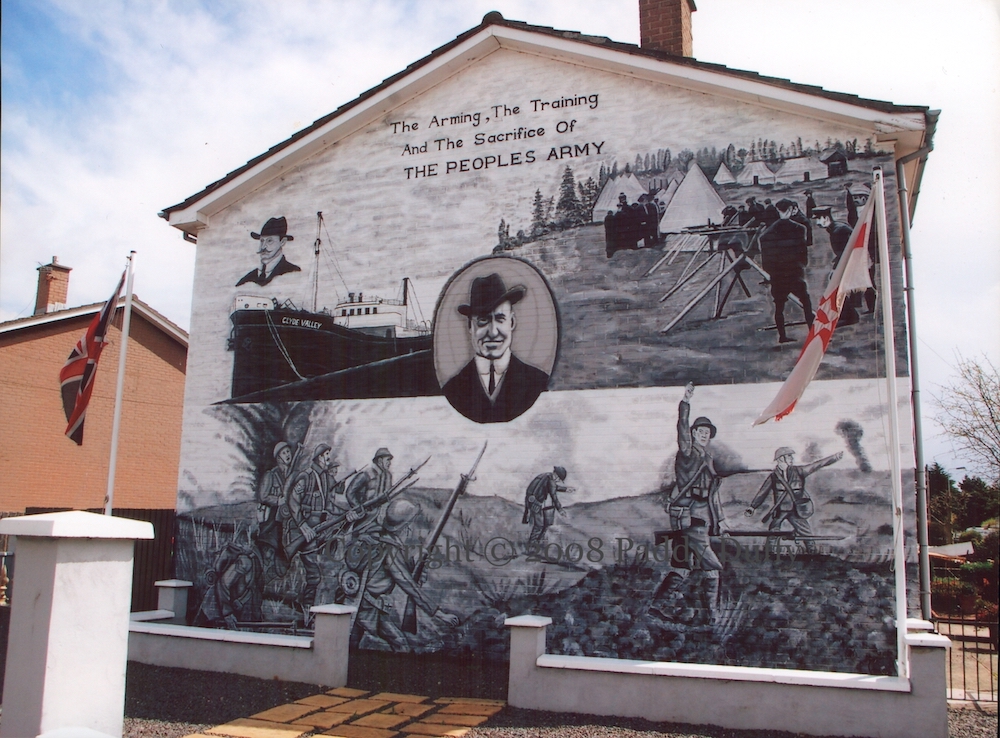
“The arming, the training, and the sacrifice of The People’s Army.” The arming of the Ulster Volunteers (top left) comes from the guns smuggled into Larne on the Clyde Valley. The training of the Ulster Volunteers shown (top right) is probably at Ballywalter. The sacrifice (bottom) is the 36th (Ulster) Division going over the top in James Beadle’s painting ‘Charge of the 36th (Ulster) Division, Somme, 1st July 1916’.
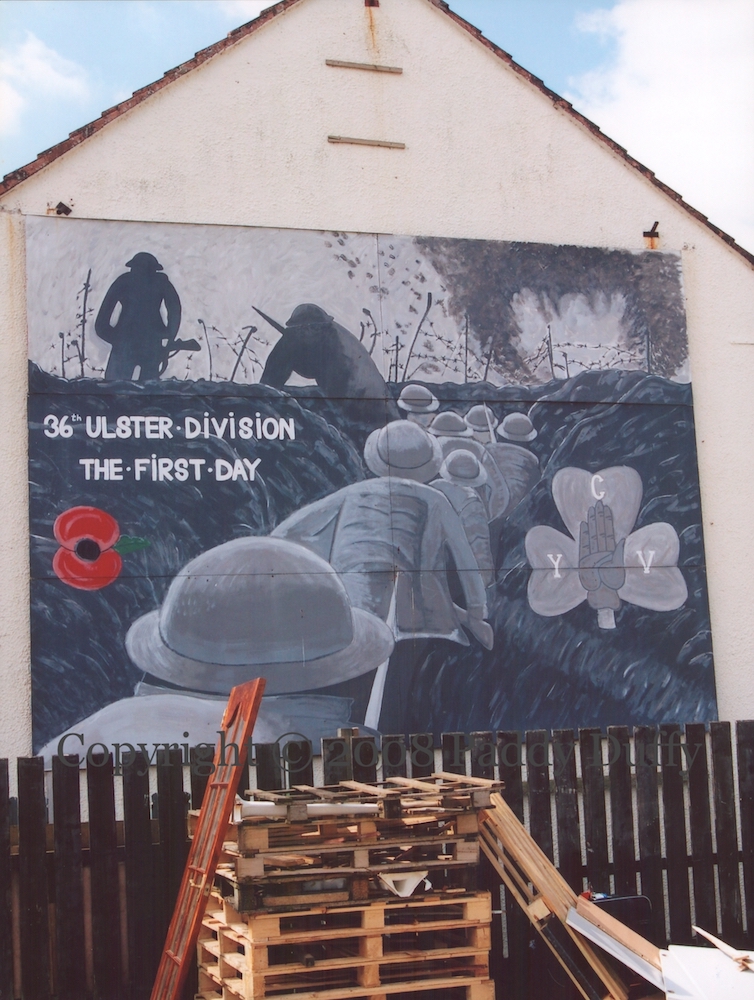
British soldiers from the 36th (Ulster) Division go over the top on the first day of the Battle Of The Somme, July 1st, 1916. The mural is a reproduction of a famous photo by Paul Popper.
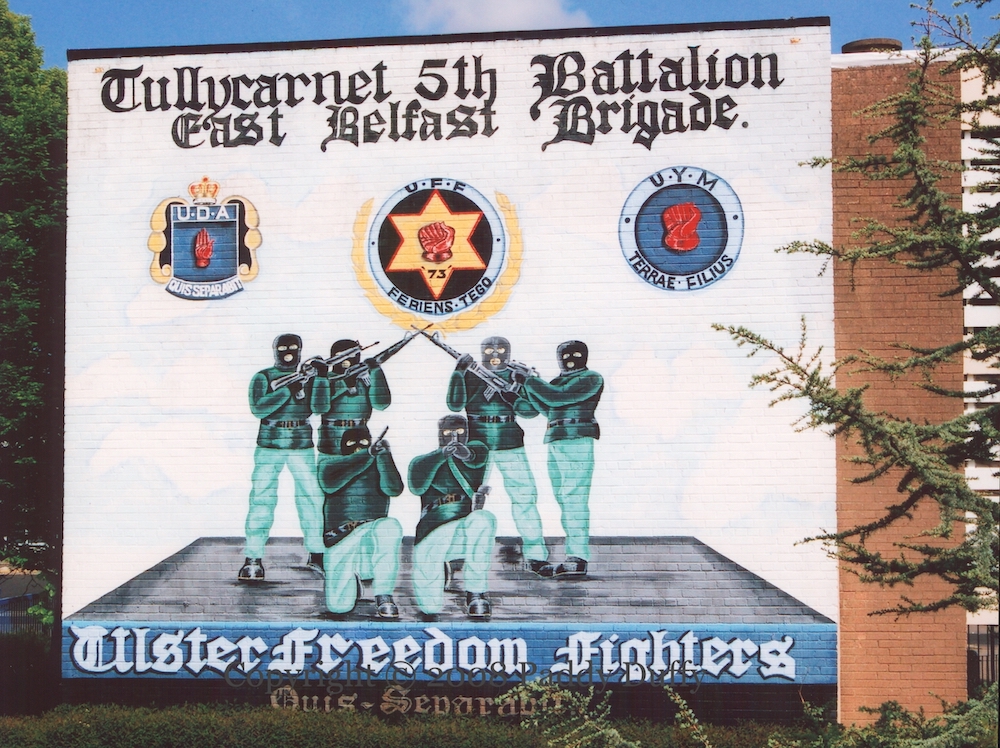
This anti-drugs mural in Tullycarnet — “Build a better future for our children – teach them to say No” — replaces a UDA mural – see Release The Political Hostages.
Painted by John Stewart in Granton Park, Tullycarnet, Dundonald
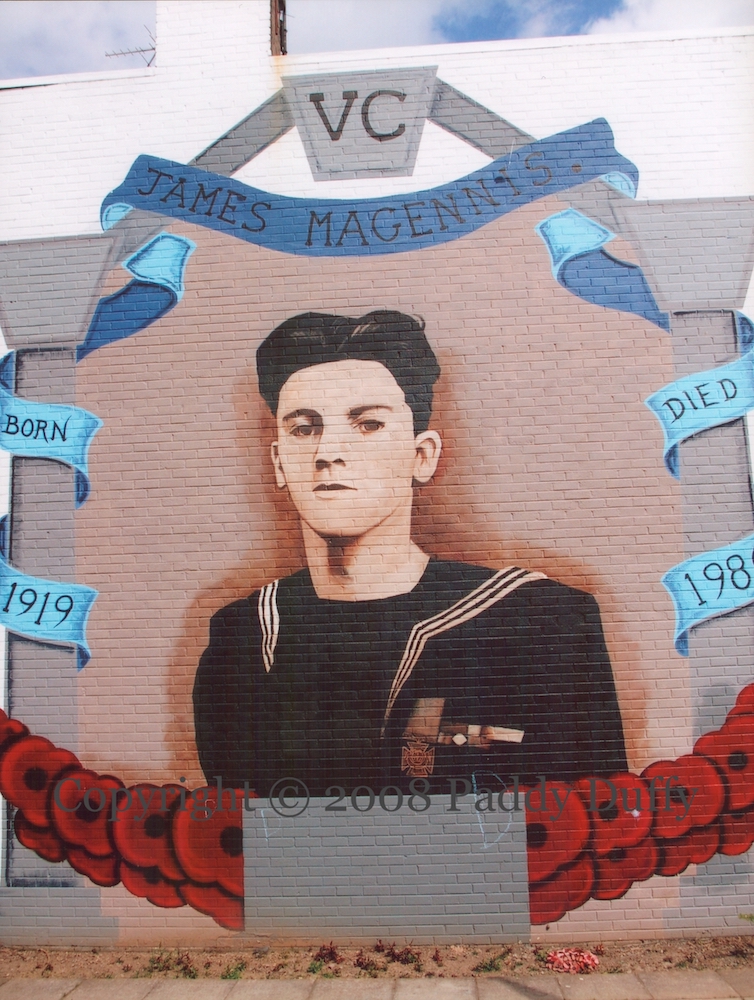
VC (Victoria Cross) recipient James Magennis was the only person from Northern Ireland awarded the VC for action during WWII (WP). Although the mural is in loyalist Tullycarnet, Magennis was a Catholic, born in west Belfast, though he lived for a time in Castlereagh.
The mural takes the place of an Eddie The Trooper mural (see Eddie’s Visual History page). There is a large memorial to Magennis in the grounds of Belfast City Hall.
Painted by Kenny Blair and produced with help from the Tullycarnet Action Group Initiative Trust (TAGIT).
These paintings are on boards on the wall around the Cathedral Youth Club in the Fountain.
Above are two boards (on the side) showing the Apprentice Boys crying “No surrender!” and the breaking of the boom that ended the siege. A 2007 entry in the Peter Moloney Collection shows three additional panels to the right, also relating to Londonderry.
“‘My forefathers were … the men who had followed Cromwell and who shared in the defence of Derry, and in the victories of Aughrim and the Boyne.’ – President Theodore Roosevelt, 20th US president, 1901-1904.” The “shutting of the gates” of Derry is represented in the bottom left.
The quote is derived from Volume 1, Chapter 5, of Roosevelt’s The Winning Of The West (available at Project Gutenberg). Roosevelt, however, is describing the forefathers of the Scotch-Irish, rather than his own forefathers, who, as the name suggests, were Dutch.
He writes, “The Presbyterian Irish were themselves already a mixed people. Though mainly descended from Scotch ancestors—who came originally from both lowlands and highlands, from among both the Scotch Saxons and the Scotch Celts—many of them were of English, a few of French Huguenot, and quite a number of true old Milesian Irish extraction. They were the Protestants of the Protestants; they detested and despised the Catholics, whom their ancestors had conquered, and regarded the Episcopalians by whom they themselves had been oppressed, with a more sullen, but scarcely less intense, hatred. They were a truculent and obstinate people, and gloried in the warlike renown of their forefathers, the men who had followed Cromwell, and who had shared in the defence of Derry and in the victories of the Boyne and Aughrim.”
Some sources claim that an ancestor(s) on his mother’s side emigrated from Gleno, Co Antrim in 1729, but this seems to be her great-great-grandfather James, who was a Scot (WP) and appears to have emigrated directly from Scotland, specifically Baldernock, in 1728 or 1729 (WikiTree | Friends Of Bulloch). The search for a connection continues, according to Irish Central.
This mural is one (and perhaps the first to be painted) in the series “From pioneers to presidents”. For more such murals, see the Visual History page about Ulster-Scots murals.
“In loving memory South Belfast Brigadier John McMichael, South Belfast UFF commander Joe Bratty.” Listed on the tombstones are Steven Audley 17 Mar 91, Harry Black 30 Sep 92, Jim Kenna 25 Jul 72, Frankie Smith 31 Jan 73, William Kingsberry 13 Nov 91, Stephen Kingsberry 10 Mar 97, Ernie Dowds 10 Oct 95, Sammy Hunt 5 Sep 76, Raymie Elder 31 Jul 94, William Hamilton 9 Sep 94, Tommy Morgan 29 Aug 94.
A Visual History page details the various appearances of Eddie The Head in his guise as a Red Coat soldier-cum-UDA volunteers. In this Village Eddie, he carries an assault rifle and wears a UDA skull-cap, but, as in the Iron Maiden album cover, is trailed by the Grim Reaper. For the “reaper come to call” verse added to the right, see M02487.
“Village, Donegall Rd, Ormeau Rd, Roden St, Lisburn Rd, Sandy Row” – South Belfast A battalion
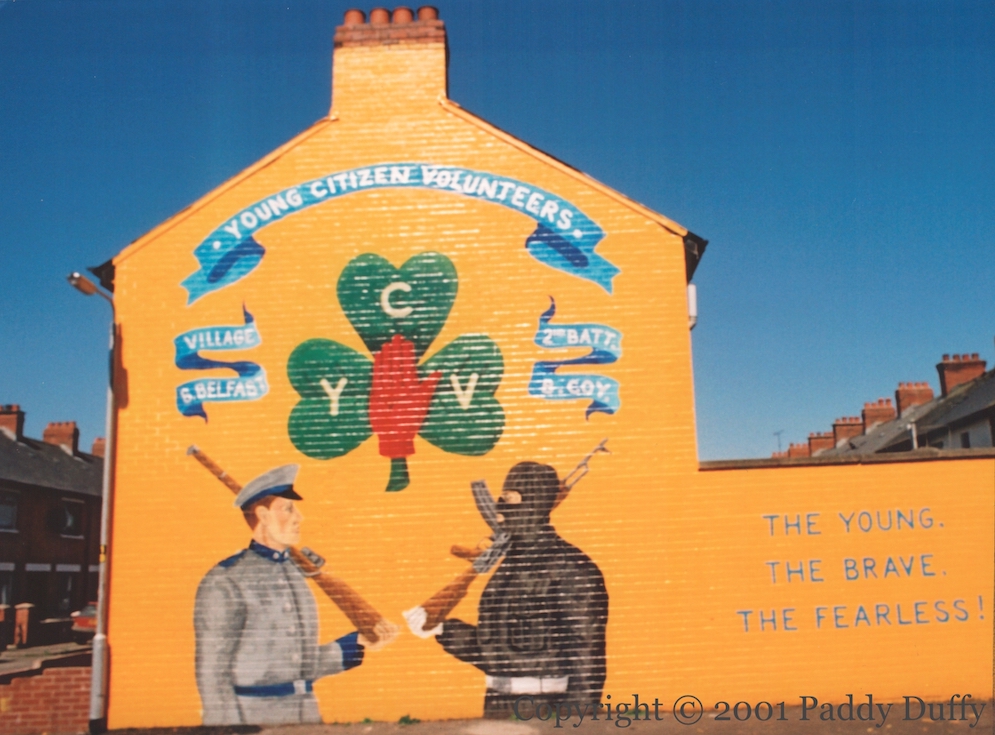
“Village, south Belfast, 2nd battalion, B company.” Young Citizen Volunteers of both the Home Rule (1912) and Troubles periods are shown shouldering rifles.