The Ulster Banner – the flag of the Northern Ireland government from 1924 to 1973 – is taken from the arms, shown here. The supporters are a lion – for the Ulster-Scots – and an elk – for the Irish (WP).
The information along the bottom reads: “Andrew Jackson was the 7th President of the USA and the first of Ulster-Scots descent, his family emigrated from Carrickfergus to North Carolina in 1765. After leading the army to victory in the Battle Of New Orleans in 1815 Jackson became a national hero and became known as “Old Hickory” after the tough wood of the native American tree. His “common man” credentials earned Jackson a massive popular vote and swept him into the Presidency for two consecutive terms (1829-1837).” He also hated the British, owned slaves, and signed the Indian Removal Act of 1830, which led to the infamous “Trail of Tears” (Irish Times).
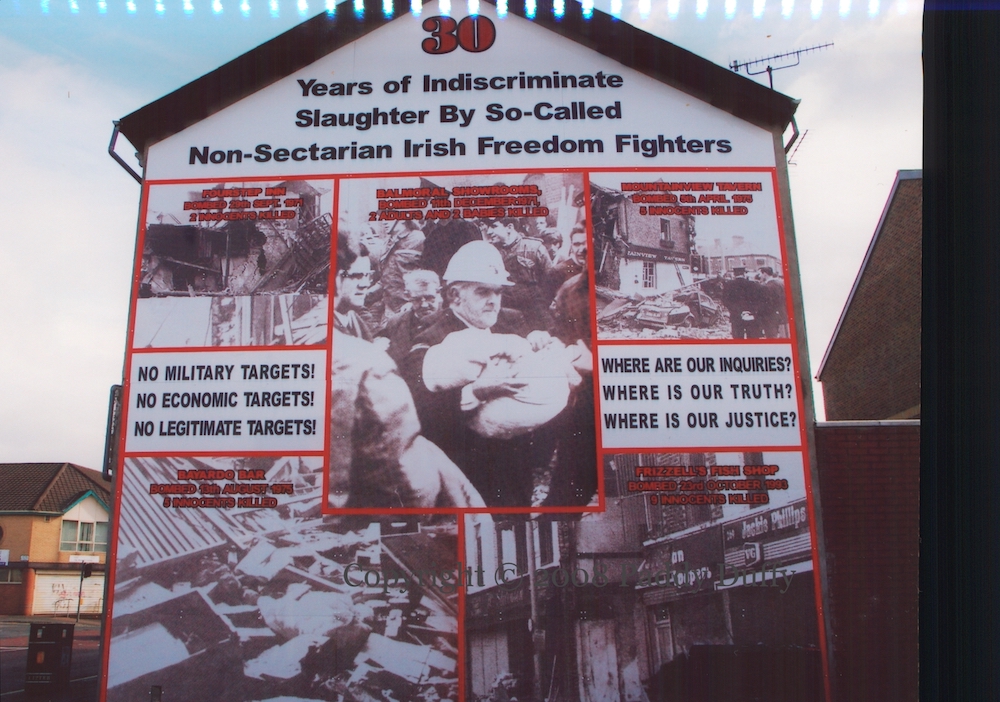
“30 years of indiscriminate slaughter by so-called non-sectarian Irish freedom fighters. No military targets! No economic targets! No legitimate targets! Where are our inquiries? Where is our truth? Where is our justice?”
The bombings listed are: “Fourstep Inn, bombed 29th Sept. 1971, 2 innocents killed”; “Bayardo Bar, bombed 13th August 1975, 5 innocents killed”; “Balmoral Showroom, bombed 11th December 1971, 2 adults and 2 babies killed”; “Mountainview Tavern, bombed 5th April 1975, 5 innocents killed”; “Frizzell’s Fish Shop, bombed 23rd October 1993, 9 innocents killed”.
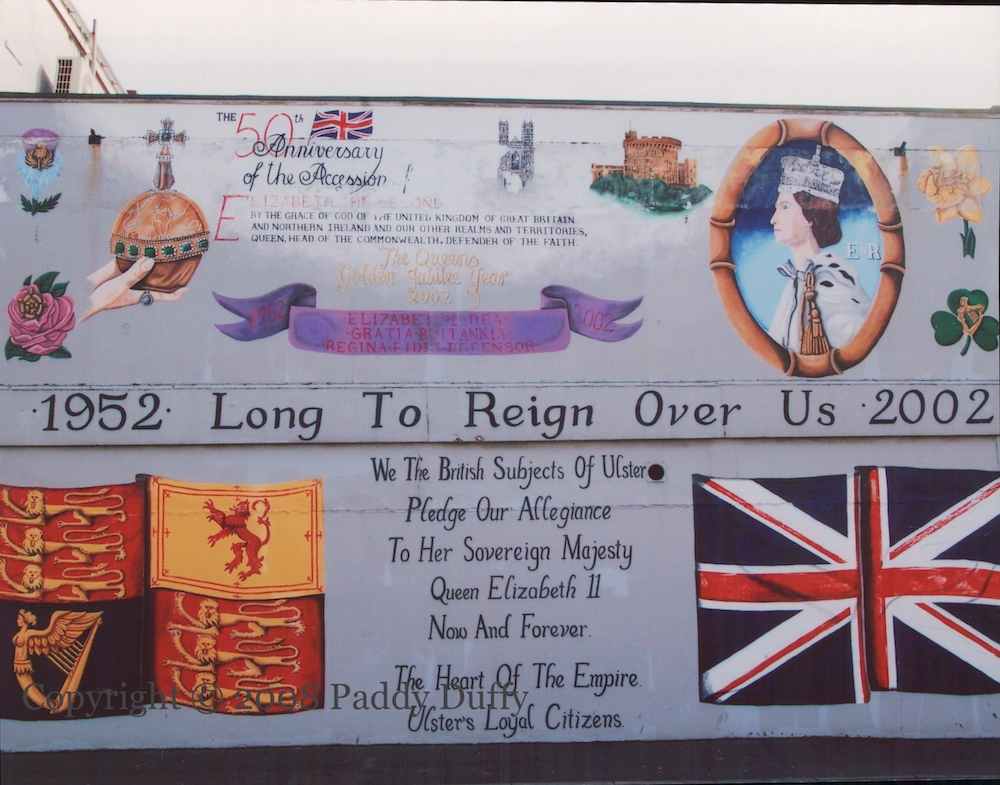
“Elizabeth the second by the grace of God of the United Kingdom of Great Britain and Northern Ireland and our other realms and territories, queen, head of the commonwealth, defender of the faith.” “Elizabeth II dea [sic] gratia Britannia regina fidei defensor”. “We the British subjects of Ulster pledge our allegiance to her sovereign majesty Queen Elizabeth II now and forever. The heart of the empire Ulsters loyal citizens.”
Elizabeth Alexandra Mary Windsor acceded to the throne of the United Kingdom in 1952 (she was crowned in 1953). 2002 was her golden jubilee year.
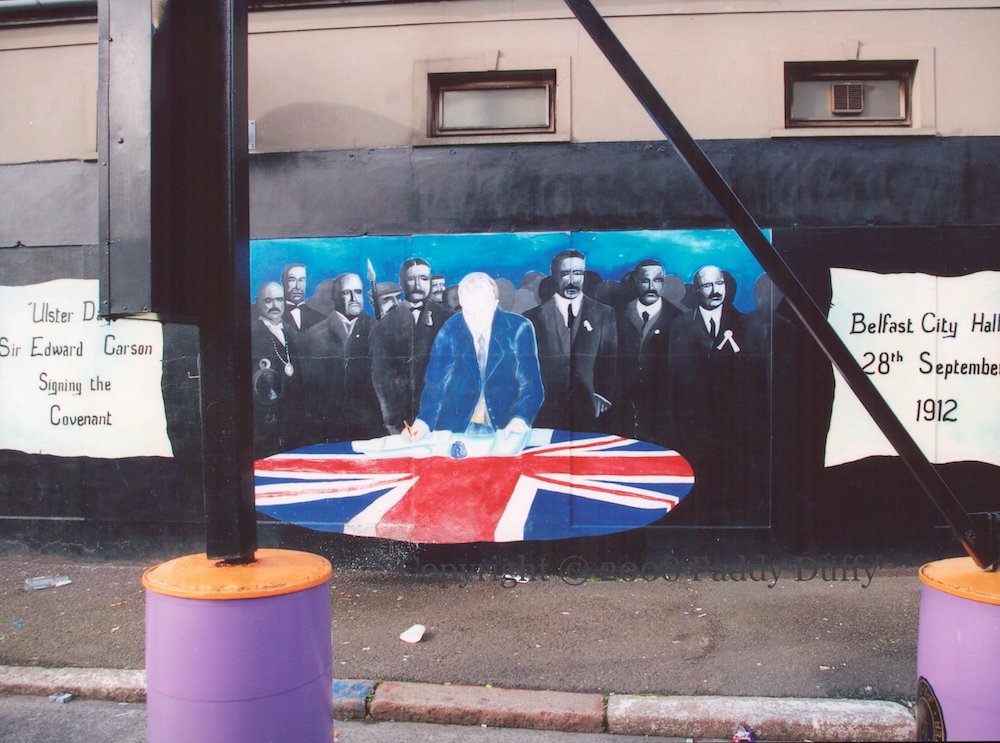
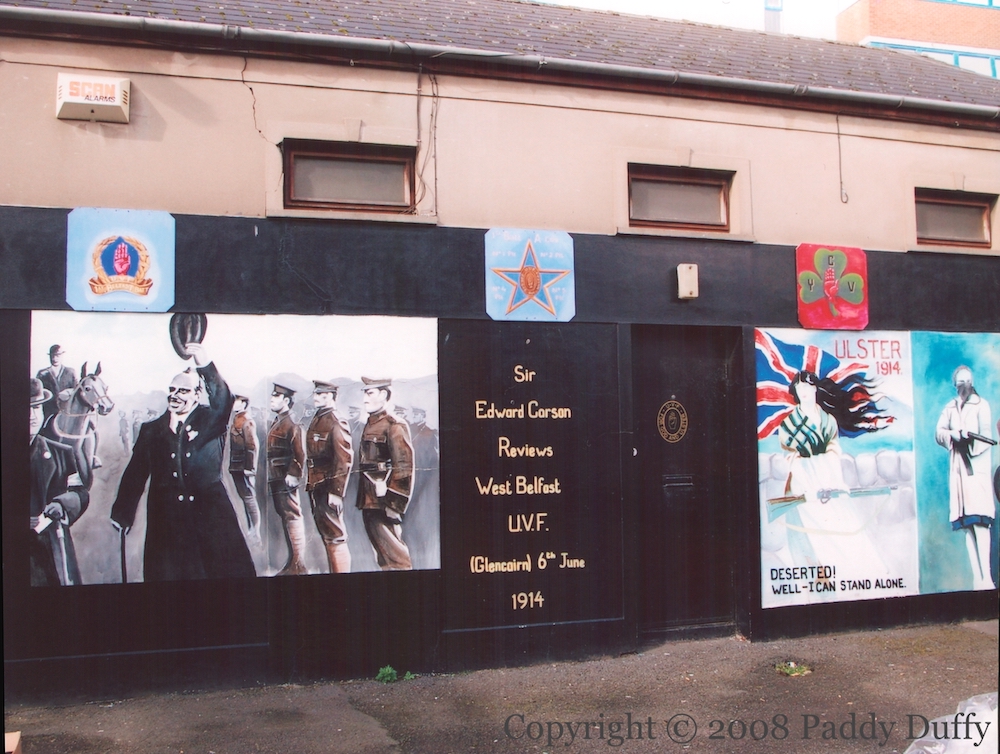
These three panels are in the courtyard of the Rex Bar in what used to be Moscow Street, celebrating resistance to Home Rule – Covenant Day September 28th 1912; the formation of the Ulster Volunteers, being reviewed at Fernhill House in Glencairn Park by Edward Carson; “Deserted! Well I can stand alone“; and (in post-partition Northern Ireland) “a Protestant farmer’s wife guards her husband against sectarian attack from across the border”.
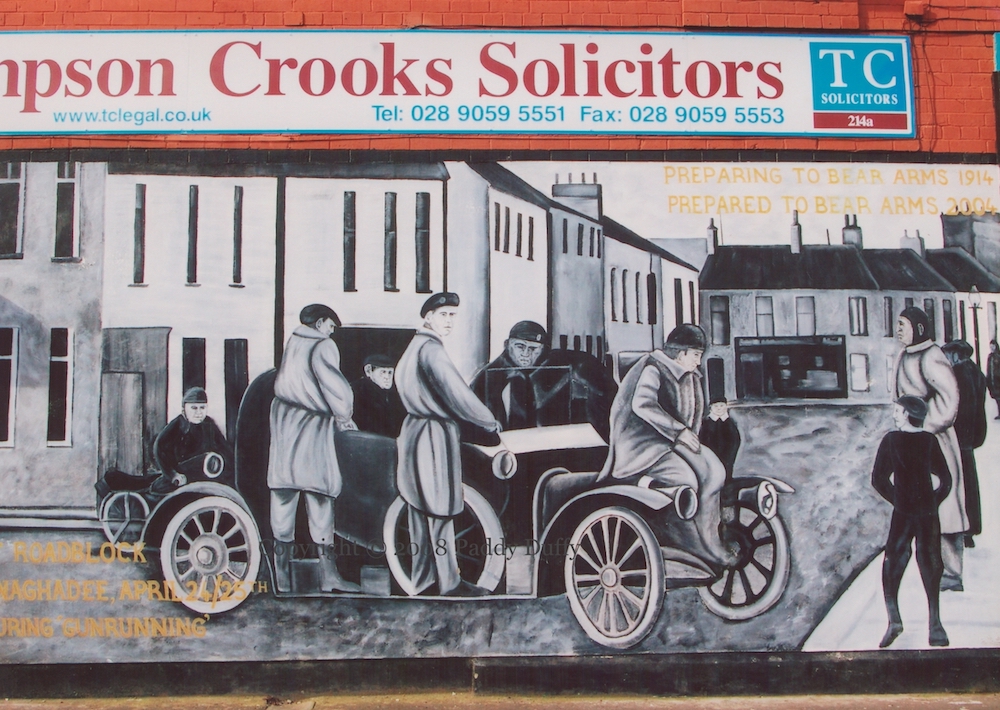
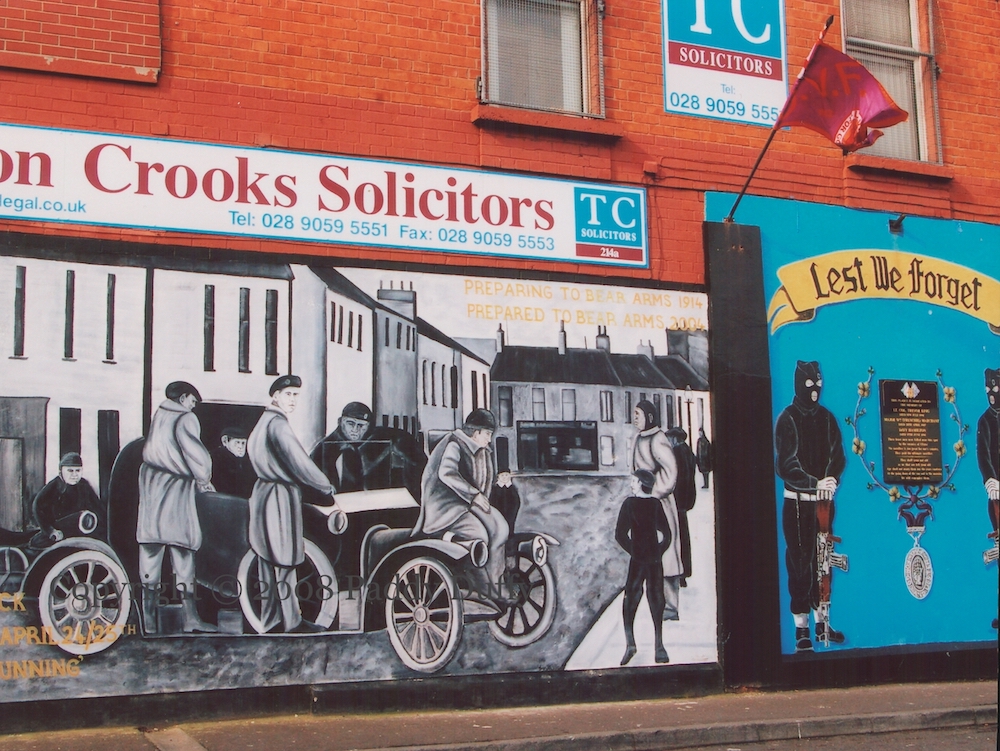
“A UVF roadblock at Donaghadee, April 24/25th 1914, during gunrunning.” The main landing was at Larne, but two small boats transported arms from the Clyde Valley in Larne to Donaghadee. Motor cars were used (for the first time in history) to distribute the rifles and ammunition across the north.
“Preparing to bear arms 1914 – Prepared to bear arms 2004.” The Ulster Volunteers/36th Division and the modern UVF are put in parallel.
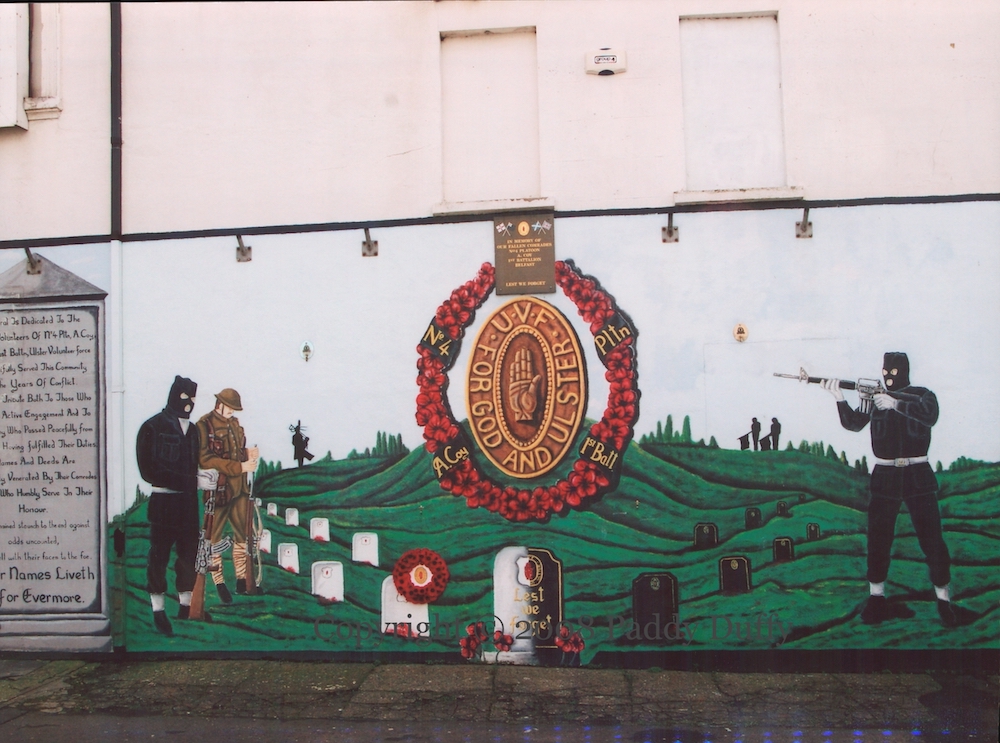
“This mural is dedicated to the fallen volunteers of No 4 Pltn A Coy, 1st Belfast Battn, Ulster Volunteer Force who dutifully served this community in the years of conflict. It pays tribute to those who died in active engagement and to the many who passed peacefully from service having fulfilled their duties. Their names and deeds are eternally venerated by their comrades in arms who humbly serve in their honour. They remained staunch to the end against odds uncounted, they fell with their faces to the foe, their name liveth forevermore.“
The plaque reads, “In memory of our fallen comrades No 4 platoon, A coy, 1st battalion, Belfast. Lest we forget”.
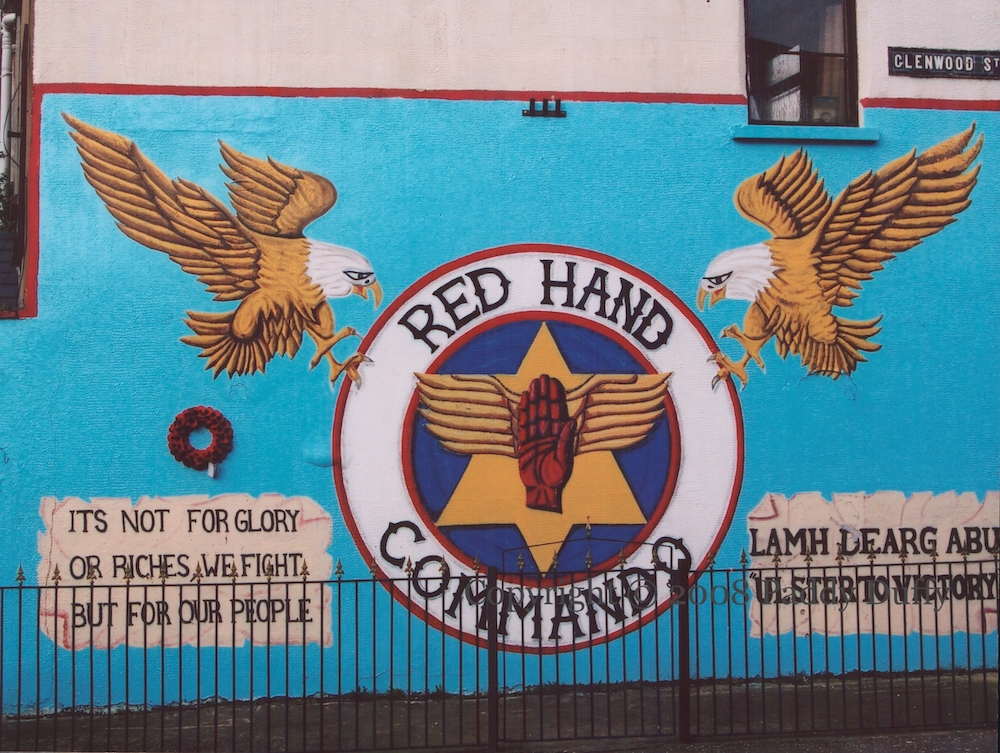
On the left: “It is not for glory or riches we fight but for our people” (from the Declaration Of Arbroath). On the right: “Lamh dearg abu” [= “Lámh dhearg abú”] [= “Red Hand to victory”], “Ulster to victory”.
With the insignia of the Red Hand Commando and a pair of bald-headed eagles.
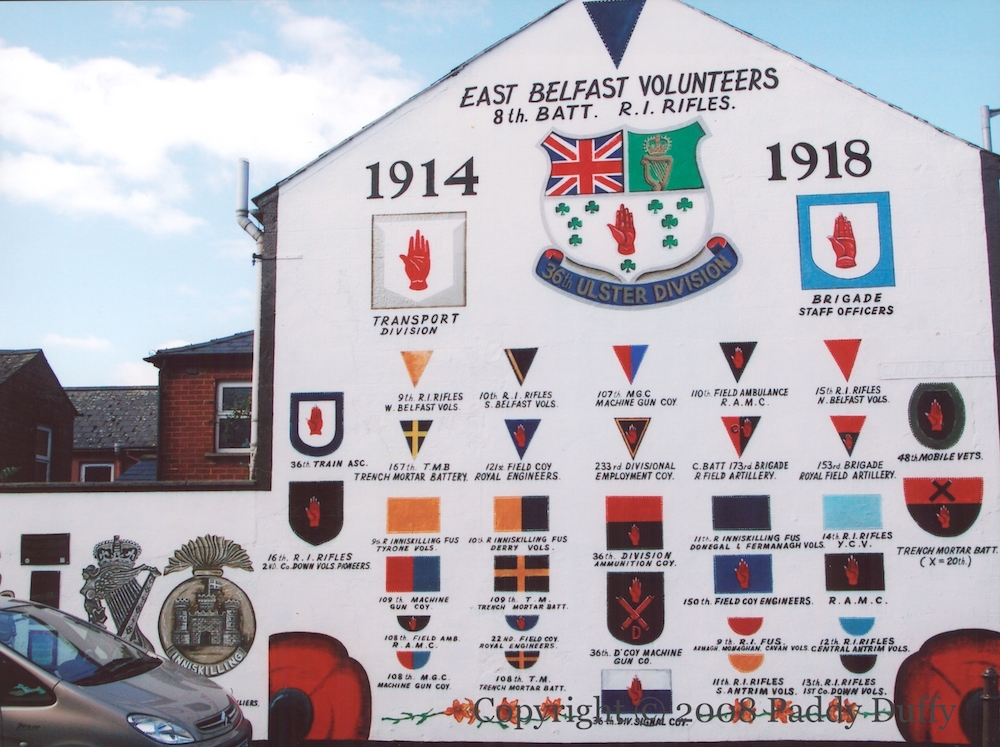
This mural at the mouth of Canada Street commemorates The main mural features insignia of more than thirty units of types from the 8th Batt. RIR, ranging from machine gunners to vets.
The plaques on the wall to the left celebrate the nine Victoria Crosses won by members of the 36th (Ulster) Division “For valour”: Cather, McFadzean, Bell, Quigg, Emerson, De Wind, Seaman, Knox, and Harvey; the final plaque is McCrae’s In Flanders’ Fields.
“In August 1971 many Protestants fled their homes as the IRA launched a bitter sectarian attack on Protestant communities throughout Belfast. The loyal people of Liverpool held out the hand of friendship in our hour of need up to 2000 terrified women and children escaped from burning homes to live in the safety of Liverpool. That act of friendship by the people of Liverpool will never be forgotten. Liverpool – Belfast a bond never broken. No surrender ” With newspaper reports by the Belfast Telegraph and Liverpool Echo. Sponsored by the East Belfast Historical And Cultural Society.