Volunteers in simplified clothing fire a funeral volley over an unseen coffin. The mural was later made more complex – see Slán Go Fóıll in the Peter Moloney Collection.
For the side wall, see Long Kesh in the Peter Moloney Collection.
Words from Padraıg Mac Pıaraıs’s poem Mıse Éıre are included alongside the portraits of the seven signatories to the 1916 Proclamation. It includes the line “Great is my glory, I who bore brave Cú Chulaınn” and Cú Chulaınn is pictured on the right, in the death pose made famous by Oliver Sheppard in a statue installed in the GPO in 1935 – see Cú Chulaınn’s Visual History page.
Mıse Éıre: Sıne mé ná an Chaılleach Bhéarra. Mór mo ghlóır: Mé a rug Cú Chulaınn cróga. Mór mo náır: Mo chlann féın a dhíol a máthaır. [Mór mo phıan: Bıthnaımhde do mo shíorchıapadh.] [Mór mo bhrón: D’éag an dream ınar chuıreas dóchas.] Mıse Éıre: Uaıgní mé ná an Chaılleach Bhéarra.
Painted by Mo Chara Kelly in Norglen Gardens, west Belfast
“In proud memory of those who gave their lives for Ireland’s freedom” (and out of sight to the left) “Also to all civilians murdered by the British crown forces” (and out of sight to the right) “Also to all civilians murdered by pro-British elements”. The Celtic cross bears three republican flags: Tricolour, Sunburst, and Starry Plough.
The volunteers (and one Sınn Féın member) listed are (on the left) “Martin Forsythe, Martin Skillen, Gerard Fennell, Terence O’Neill, John Dempsey” and (on the right) “Sean McDermott, Tom Magill, Sean Savage, Kevin McCracken, Paul Best”.
“Happy birthday, comrade”. ANC leader Nelson Mandela turned 70 on July 18, 1988. He spent the day, like every birthday since 1963, in prison; he would not be released until 1990, after which apartheid would be dismantled and Mandela become the first President of South Africa. “The future belongs to you.” The colours of the ANC join the colours of the Irish Tricolour as a background to Mandela’s portrait. Painted by Mo Chara Kelly, with the help of “Sınn Féın Youth”.
The death by hanging of African National Congress supporter Benjamin Moloise on 18 October, 1985, for the alleged murder of a South African policeman, drew international condemnation and led to widespread rioting in Johannesburg and Port Elizabeth. (ExecutedToday | Jet)
Moloise’s words, “tell the world, freedom is at hand”, originally appeared on the right of this ANC-IRA mural, paired with a phrase from Bobby Sands, “we aim to be free” on the left of the assault rifle and a zulu shield and spear. The quote and signature have been painted out due to paint-bombing. (There was (at least) one other paint-bombing of the mural – see the Peter Moloney Collection.)
The boards above the mural (“erected by Sınn Féın April 1986”) declare west Belfast an “apartheid free zone”/”ceantar saor ó apartheıd”. Note the “A/A” [anti-aparteid] emblem in bottom-left of the left-hand board.
“Beır bua” [seize victory] along the bottom is partly obscured by the skip.
Ascaıll Ard Na bhFeá/Beechmount Avenue, west Belfast
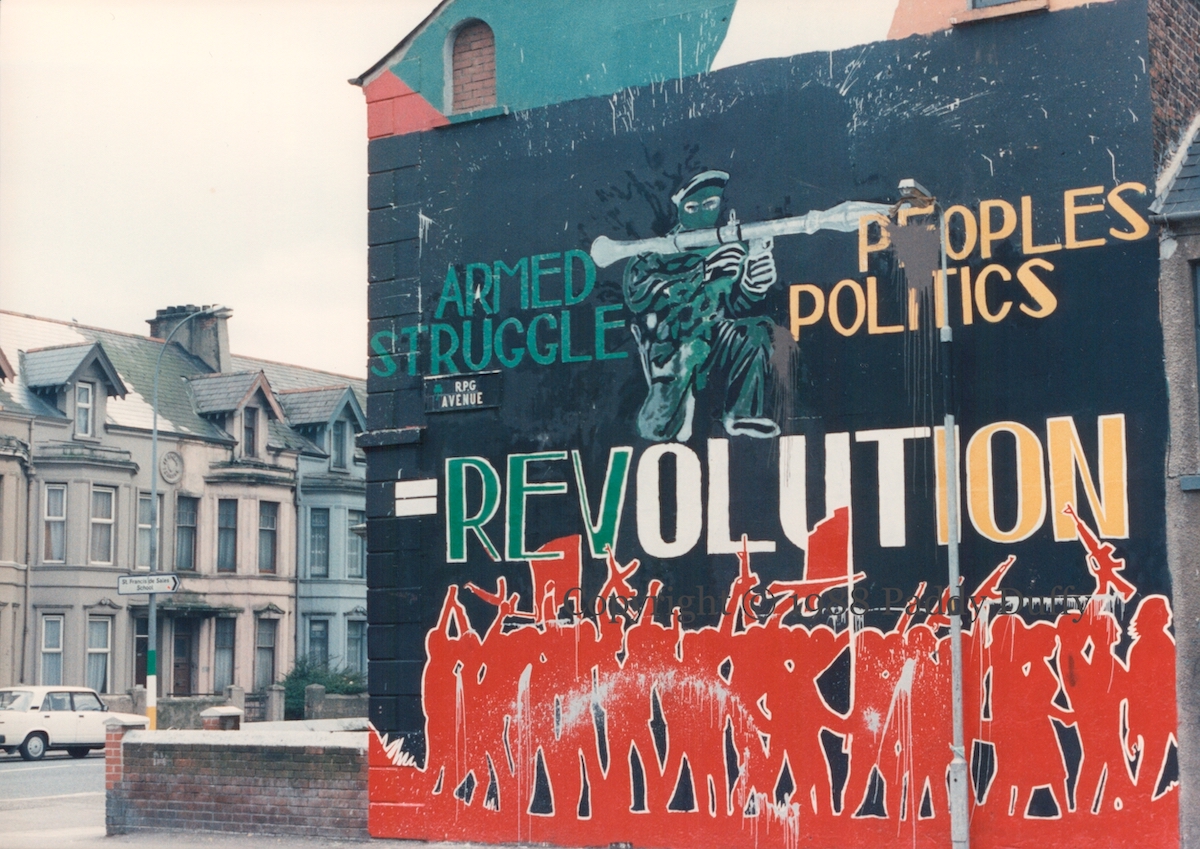
“Armed struggle, people’s politics – revolution.” A volunteer with rocket-propelled grenade launcher on “RPG Avenue” (Beechmount Avenue), west Belfast.
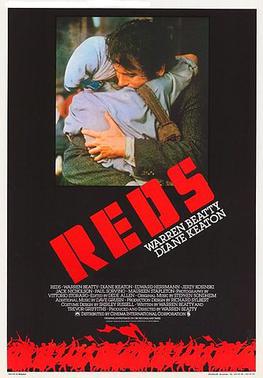
According to Rolston (1991 p. 100), the silhouettes of at the bottom are based on the movie poster for Reds.
The main panel, of three IRA volunteers with raised weapons, was painted by Sean ‘Conker’ Connolly, presumably based on or inspired by the poster below.
Also on the wall are (below right) a Tricolour and (below left) “Sinn Fein/Gerry Adams” and a small board (at the top) with a raised fist and the slogan “Unity is strength”.
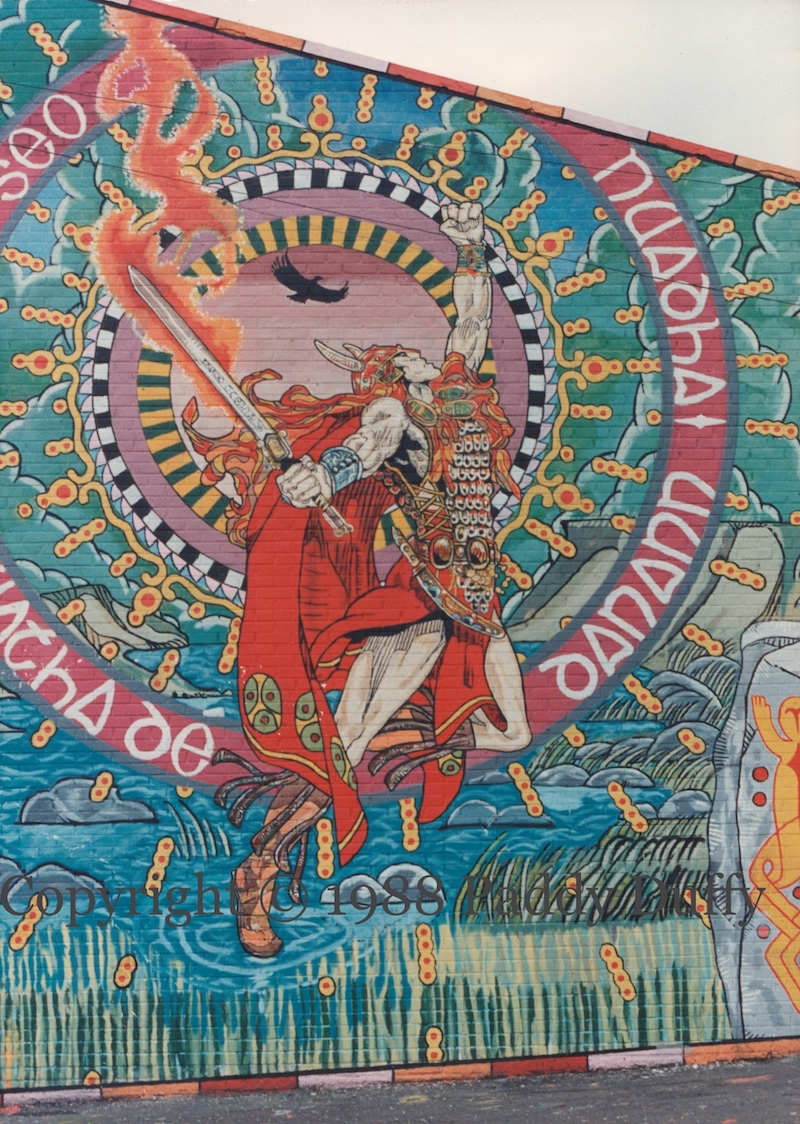
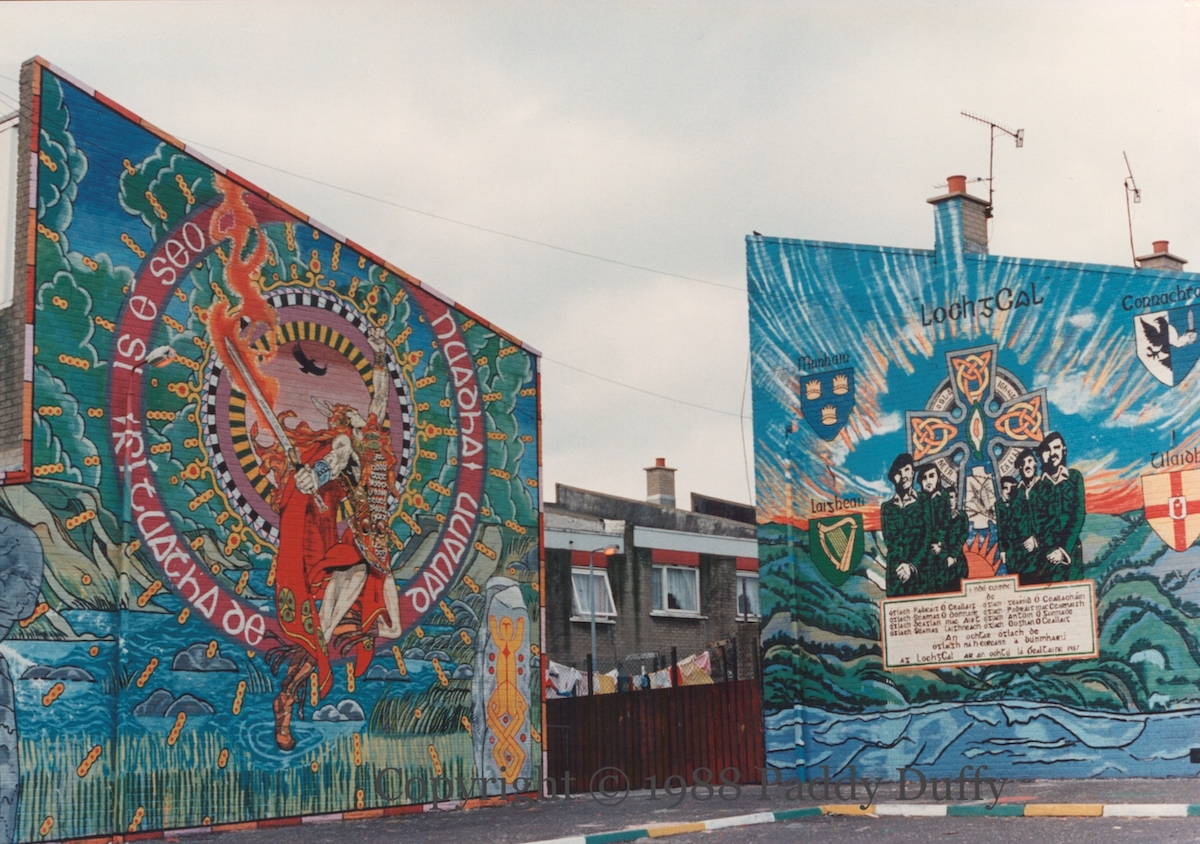
This pair of murals was painted by Mo Chara Kelly at the top of Springhill in 1987 after his release from prison. Both are inspired by the work of Jim Fitzpatrick. The central figure of the Rí Nuadha [King Nuada] mural above and immediately below comes from a painting of Fitzpatrick‘s called ‘Nuada Journeys To The Underworld’ while the background has a Fitzpatrick style and colour-scheme.
Of the myth of Nuada, Mo Chara said, “I had never heard the story of King Nuada before. Then I read the story. Wow! What a yarn! Nuada Of The Silver Arm is one of my favourite stories. As one of the Tuatha Dé Danann you had to be whole and physically perfect to hold the kingship. Nuada lost an arm in the first battle of Moy Tura and so he lost his kingship. He went into the other world, to middle earth, fought through trials and tribulations until Dıan Cécht made a silver arm for Nuada and he was restored to the kingship for another twenty years. But the moral of the story to me was that, no matter what happens, get up again and fight back. No matter how bad the situation you are in, you get back up and fight again. Do not let people isolate you. Get up and fight again. It was very inspiring!” (Painting My Community/An Pobal A Phéınteáıl – English-language version available for free.)
The Loch gCál/Loughgall mural likewise draws on Fitzpatrick for the landscape behind the Celtic cross and funeral guard in memory of the eight IRA volunteers from the East Tyrone brigade who were killed in an SAS ambush during an attack on an RUC base in May, 1987 (WP).
The names of the eight volunteers are given here in Irish and (partially) in the old script:
“I ndıl cuimh[n]e de [= ar] Óglach Pádraıg Ó Ceallaıġ [Patrick Kelly], Óglach Séamus Ó Donn[ġ]aıle [Seamus Donnelly], Óglach Deaglán Mac Aırt [Declan Arthurs], Óglach Séamus Laıghneach [Jim Lynagh], Óglach Gearóıd Ó Ceallacháın [Gerry O’Callaghan], Óglach Pádraıg Mac Cearnaıgh [Pádraıg McKearney], Óglach Antóın Ó Garmaıle [Ó Gormghaıle | Tony Gormley], Óglach Eoghan Ó Ceallaıġ [Eugene Kelly]
an ochtar óglach de óglaigh na hÉireann a dúnmharú ag Loch gCál ar an ochtú lá Bealtaine 1987.” [the eight volunteers from the Irish Volunteers [IRA] who were murdered at Loughgall on the eighth day of May, 1987]
The town (Loughgall) and the four provinces are also named in Irish. An Easter lily is at the centre of the Celtic cross in the middle of the image, above a lark in barbed wire and a gal gréıne/sunburst.
This is an interesting mural from North Queen Street, if only because of its psychedelic colour-scheme and composite style.
The two bulls (presumably from the Táın though they are not the classic brown and white bulls) provide a centre, on either side of which we find Cú Chulaınn dying (and Tuan the eagle) and a dolmen. The horse on the right is perhaps Galloper. There are four faces superimposed on flying geese. The cranes Samson and Goliath are on the left (which suggests a cross-community sponsorship) and a Pride rainbow is on the right.
A wide shot of the whole can be seen in the Peter Moloney Collection. If you have any information about the piece, please get in touch.
North Queen Street, presumably at the bottom of the New Lodge (either where the playing pitch opposite (what was then) Artillery House (now Teach Ghráınne) is, or on a wall of Gallagher’s factory, where the car park for the shopping centre now is?).
“”I have always believed we had a legitimate right to take up arms …” from an interview by IRA volunteer Maıréad Farrell, executed with her gallant comrades Seán Savage & Dan McCann.”
Yann Goulet’s Ballyseedy Memorial sculpture was rendered in paint for the funeral procession of the Gibraltar Three on March 16th, 1988. The sculpture is a reflection on the killing of eight anti-Treaty prisoners at Ballyseedy Cross (Baıle Ó Síoda), Kerry, during the Irish Civil War. From left to right, we see the dead victim, the grieving widow and orphaned child, and a person (in the painted version wearing the same clothes as the victim) defiantly striding off to take his place and seek revenge.
In the wake of the killings in Gibraltar, six more people were killed in one of the most tense weeks in Troubles history – the IRA’s Kevin McCracken on the 14th, Thomas McErlean, John Murray, and IRA-member Caoımhín Mac Brádaıgh by Michael Stone in the graveyard on the 16th, and British Army corporals Wood and Howes at Mac Brádaıgh’s funeral on the 19th.