The Catalan Countries include (in Spain) Catalonia, parts of Valencia, and the Balearic islands, plus Andorra, and (in France) the Roussillon region. In the separatist flag – the “Estelada” – the white star stands for freedom and the blue triangle stands for the sky of humanity (Vexillology), on top of the four red bars of the Senyera (WP).
“Saoırse” [freedom]. Both male and female prisoners of war are represented in this mural: by the male and female faces — the male above the silhouette of Long Kesh, the female behind bars (presumably of Armagh prison) – and by the (formerly astrological) symbols for male (Mars) and female (Venus). The mural is signed (top left): “G[erard Mo Chara] Kelly 95″.
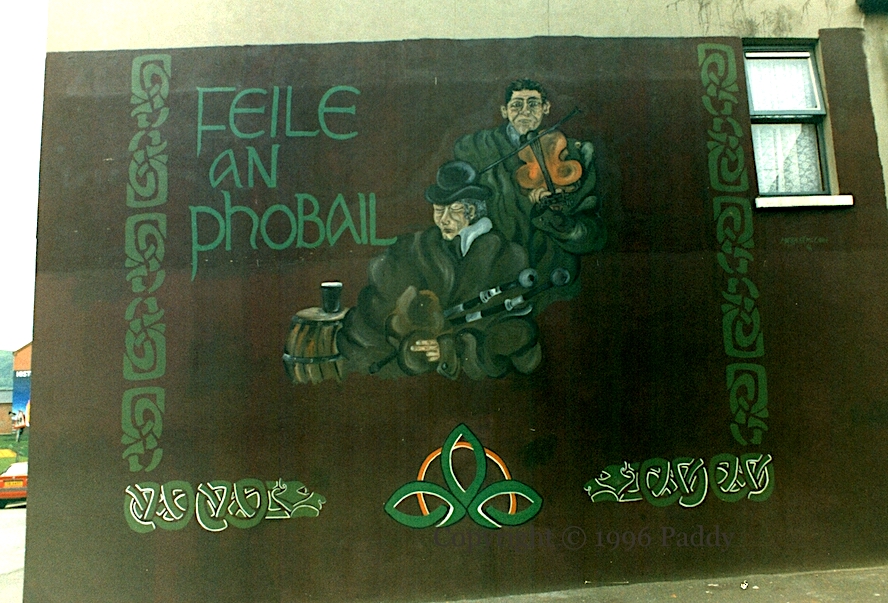
Some of the programme from the 1996 festival is available in the ‘Extraordinary Women’ collection at the Linenhall Library. 1996 was also the first year of Féıle FM (“Triple FM”) (The Can).
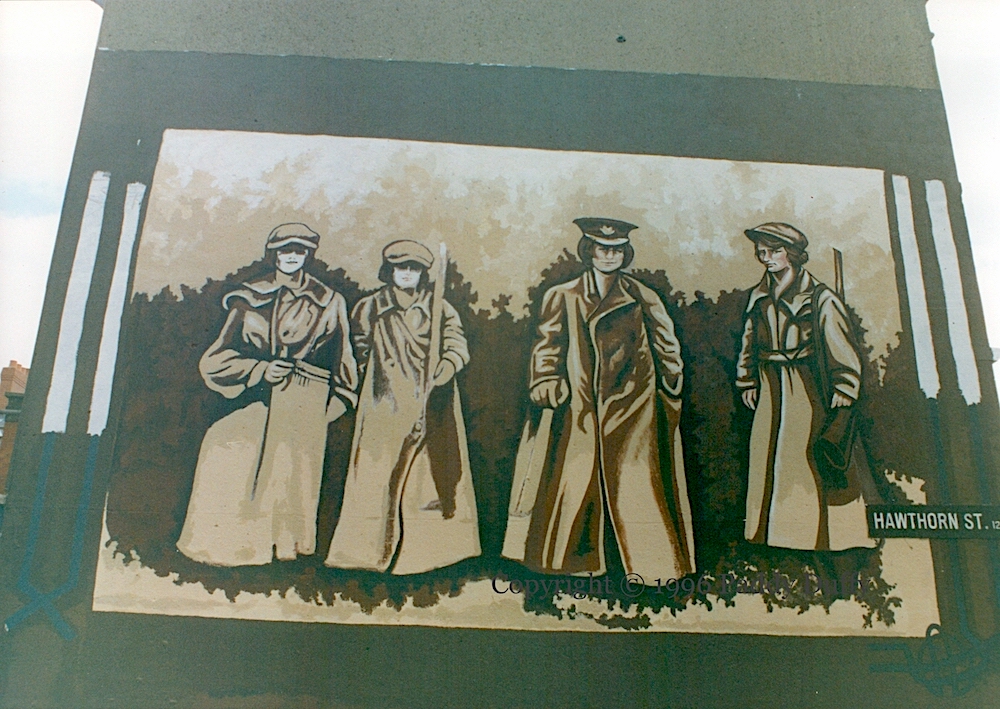
Painted by Margaret McCann in Hawthorn Street, west Belfast
Text would later be added along the bottom reading, “This mural is dedicated to the Women of Cumann Na mBan, Óglaıgh Na hÉıreann & Sınn Féın.” Image “from R[uth] Taillon’s book The Women Of 1916.” Taillon is a Canadian who moved to Belfast in 1980 and has been doing work with the women’s movement in the north and on women’s history – see NVTv.
Parading This mural demands that Orange Order marches have the consent of local residents in Derry, Garvaghy [Portadown], and lower Ormeau [south Belfast].
Parading was the central on-the-ground issue of the post-Agreement years (BBC). Resistance to Orange Order parades marching through CNR areas was led by local groups: in Derry, by the Bogside Residents’ Group, in Portadown, by the Garvaghy Road Residents’ Coalition, and in lower Ormeau by Lower Ormeau Residents Action Group. In each case, residents were appealing directly to the local lodges and to the police. (The Parades Commission would be established in 1998.)
In 1995, there was a three-day stand-off on the Gavraghy Road that resulted in a silent march without bands (CAIN). The police initially re-routed the 1996 march but reversed the decision at the last minute, citing the threat of loyalist violence, and forced residents off the street in order to accommodate the parade.
This is an in-progress image of a mural sponsored by and for the Upper Springfield Development Trust (web | until 1993 the Upper Springfield Development Forum) focusing on young people: “Mol an óıge agus tıocfaıdh sí.” (Praise youth/the young and it will flourish.”/”Youth responds to praise.”)
“Nuadha, rí Tuatha Dé Danann, buaıteor chath Magh Tuıreadh Conga, Éıre/King Nuadha of the Tuatha De Dannan, victorious at the battle of Moy Tura [at Cong, the first battle], Ireland.”
“Mo Chara” Kelly’s mural reproduces the cover of Jim Fitzpatrick’s The Book Of Conquests in the middle and adds various other elements (Visual History).
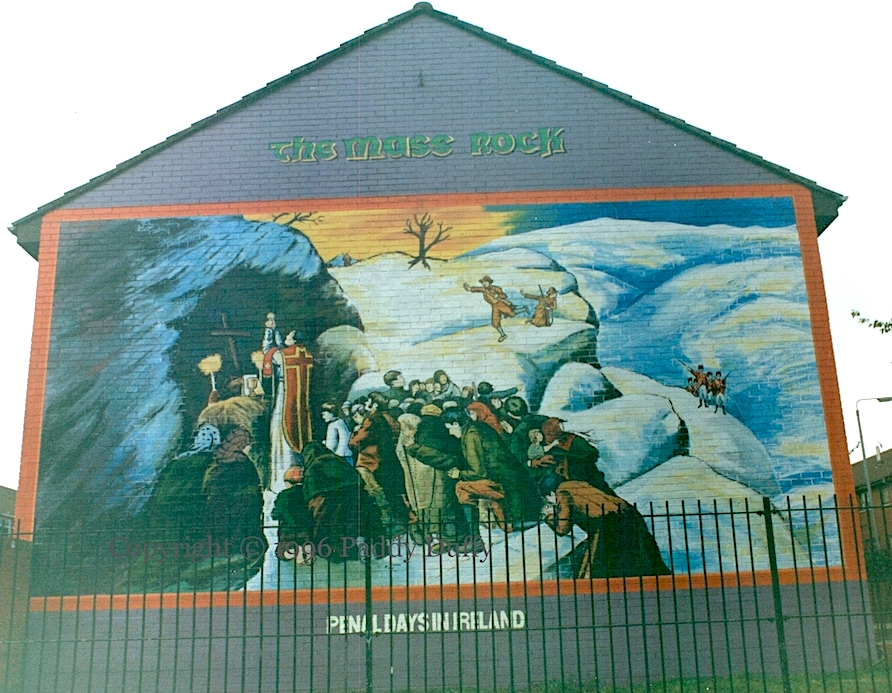
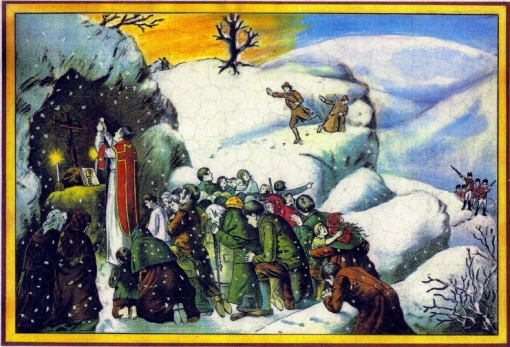
“Penal days in Ireland” – this mural commemorates the repression of Catholicism and use of mass rocks as secret locations in the days of Cromwellian conquest and the penal laws, c. 1650-1800. The 1652 Act Of Settlement (WP) banished Catholic priests from the island and services had to be held at short notice and in remote locations, with sentries posted to keep watch against soldiers from the New Model Army. Laws against the practice of Catholicism in Ireland were not lifted until the 1782 Roman Catholic Relief Act (PCUG).
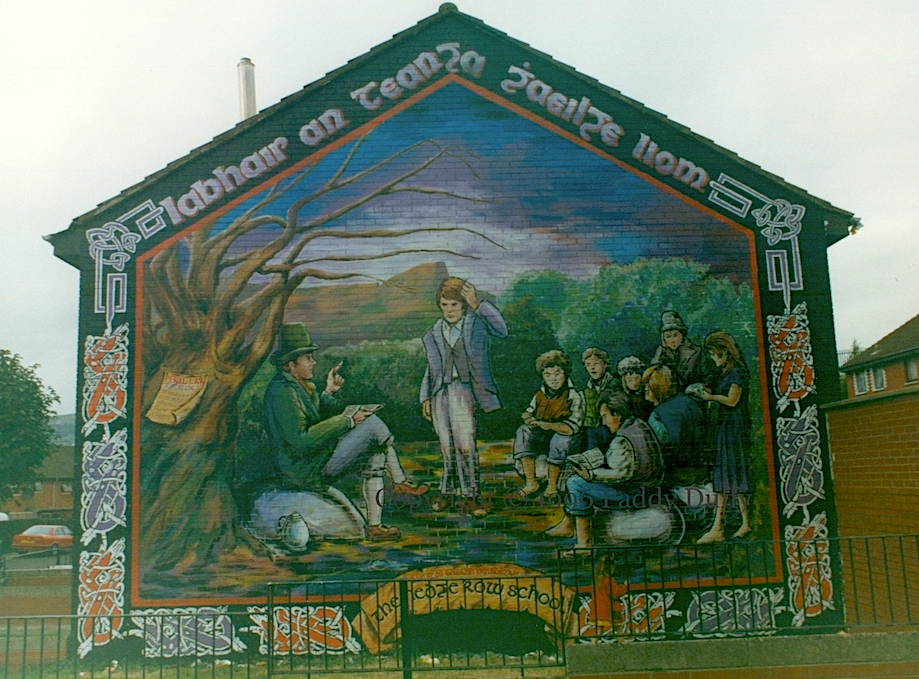
Catholic (and Presbyterian) education was prohibited by the penal laws (WP) and particularly the Education Act of 1695 (WP) – this is probably what’s on the notice on the left-hand tree. Schooling by Catholics (in Irish) nonetheless took place, in covert houses and outhouses, as well as in fields and hedge-rows. The Act was repealed in 1782, provided the teacher took an oath of allegiance to the Crown.
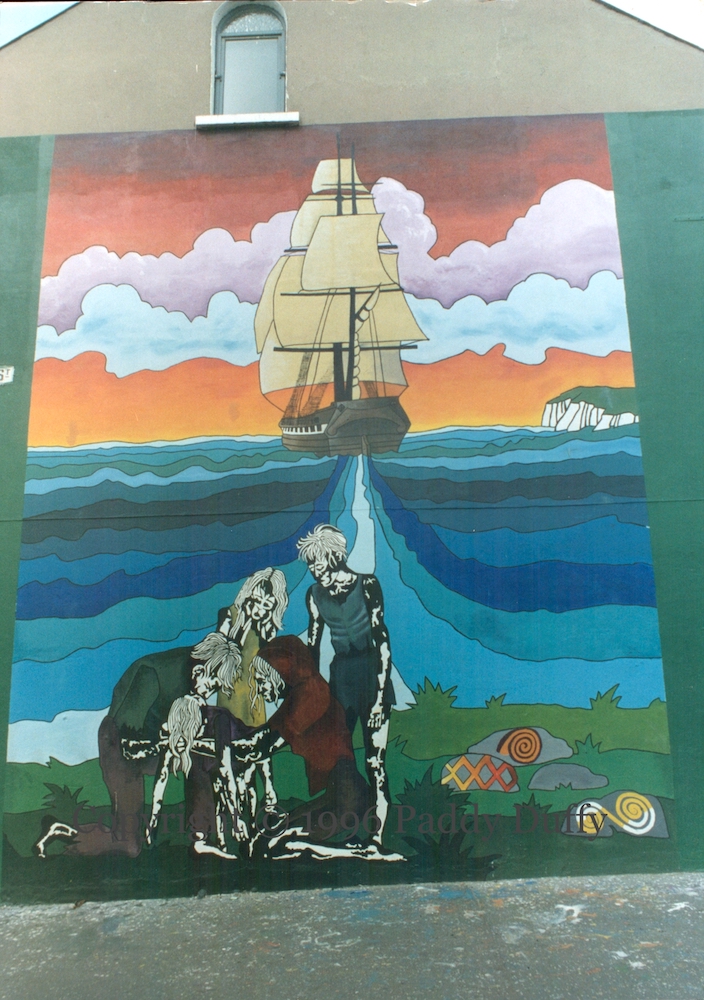
A million, and perhaps as many as 2 million – one in four Irish people – left Ireland between 1845 and 1855, many sailing on so-called “coffin ships” which had mortality rates of 30%. Another million died in the Great Hunger itself (Visual History), in most cases the proximate causes were fever and dysentery (WP | Irish Central).





 Paddy Duffy Collection