The third mural by the Bogside Artists (after The Petrol Bomber and Bernadette – Visual History) is “Bloody Sunday” (painted with Sean Loughrey), painted for the 25th anniversary of Bloody Sunday. It reproduces a Fulvio Grimaldi photograph of local priest Edward Daly waving a blood-stained handkerchief in advance of four men carrying the body of Jackie Duddy. The left-most figure has been changed into a British paratrooper, and he is trampling on a “civil rights” banner similar to the one later used to cover a body. In the background is an image from earlier in the day, of the civil rights march from Creggan to the Bogside.
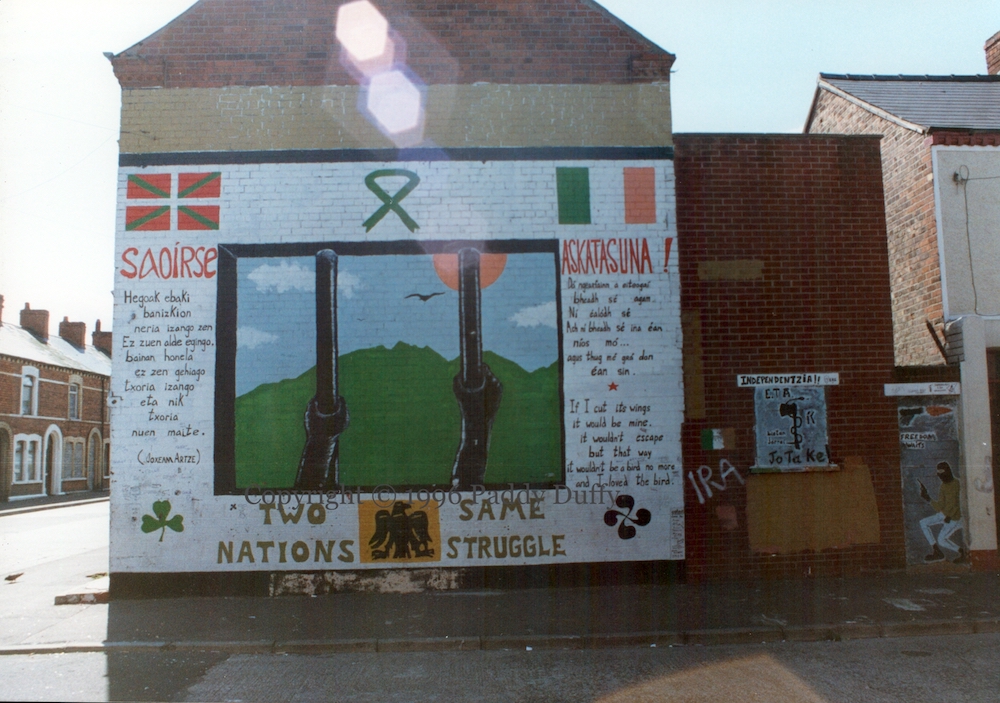
“Saoırse – Askatasuna!” Lines from Joxean Artze’s poem Txoria Txori appear in three languages – Basque, Irish, and English – in this Clonard mural:
“Hegoak ebaki banizkion neria izango zen. Ez zuen alde egingo bainan, honela. Ez zen gehiago txoria izango … eta nik txoria nuen maite.”
“Dá ngearfaınn a eıteogaí, bheadh sé agam. Ní éalódh sé, ach ní bheadh sé ına éan níos mó … agus thug mé grá don éan sın.”
“If I cut its wings it would be mine, it wouldn’t escape, but that way it wouldn’t be a bird no more … and I loved the bird.”
The bird for Irish prisoners is the lark, which can be seen through the prison bars. The green ribbon above the central image is a symbol of the campaign to release political prisoners as part of any agreement that might come out of the peace process.
For Basque prisoners the bird is the “arrano beltza” [black eagle] which appears at the bottom of the mural.
The symbols on the left and right are the Irish shamrock and the Basque “lauburu” (four heads).
Painted by the Askapena Basque Internationalist Brigade in Cawnpore Street, Clonard, west Belfast, August 1995. To the right are two small murals in support of the ETA (“Independentzia!!”, “ETA” with the snake-and-axe (politics and armed struggle) and “bietan jarrai“, “Jo ta ke!” [push on!] and the IRA (a blazing pistol above a balaclava’d volunteer with pistol, “Freedom awaits”).
The mask of “revisionism” covers the face of “truth” reading the book of “Irish history”. Originally painted in 1996 by Ciaran McKeirnan, Brian O’Loan, and Donal Daly, son of IRSP leader Miriam Daly, who was killed by the UDA in 1980, and to whom the title quote is attributed.
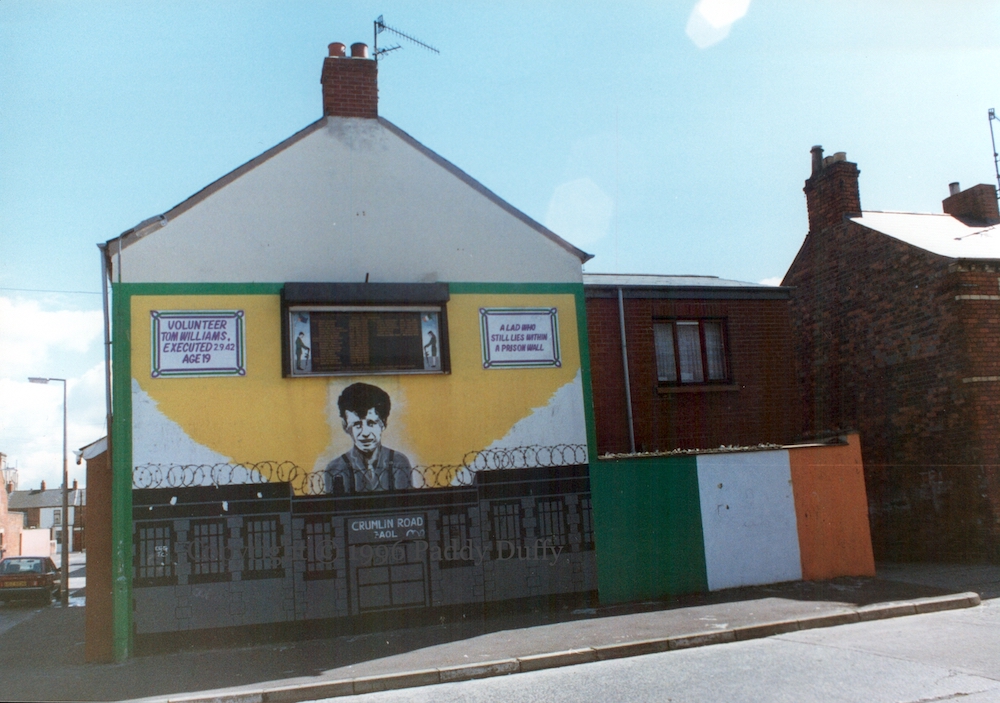
“Volunteer Tom Williams, executed 2.9.42 age 19. A lad who still lied within a prison wall.” Williams was the leader of a unit from C company, 2nd battalion, Belfast IRA, that killed RUC Constable Patrick Murphy. Williams took sole responsibility, hoping that it would save the lives of the other seven (including two women) who had taken part in the ambush. The six men were jointly convicted of the killing but only Williams was ultimately hanged, after appeals from Ireland (not yet officially ‘The Republic Of’), the Vatican, and the US State Department (RN). He was buried on the grounds of Crumlin Road gaol (and his coffin would eventually be exhumed and reburied in Milltown in 2000).
This is the second Tom Williams mural at this spot; the first was painted in 1992; both were painted by Gerard “Mo Chara” Kelly. There is a plaque to Williams above his front door in Bombay Street.
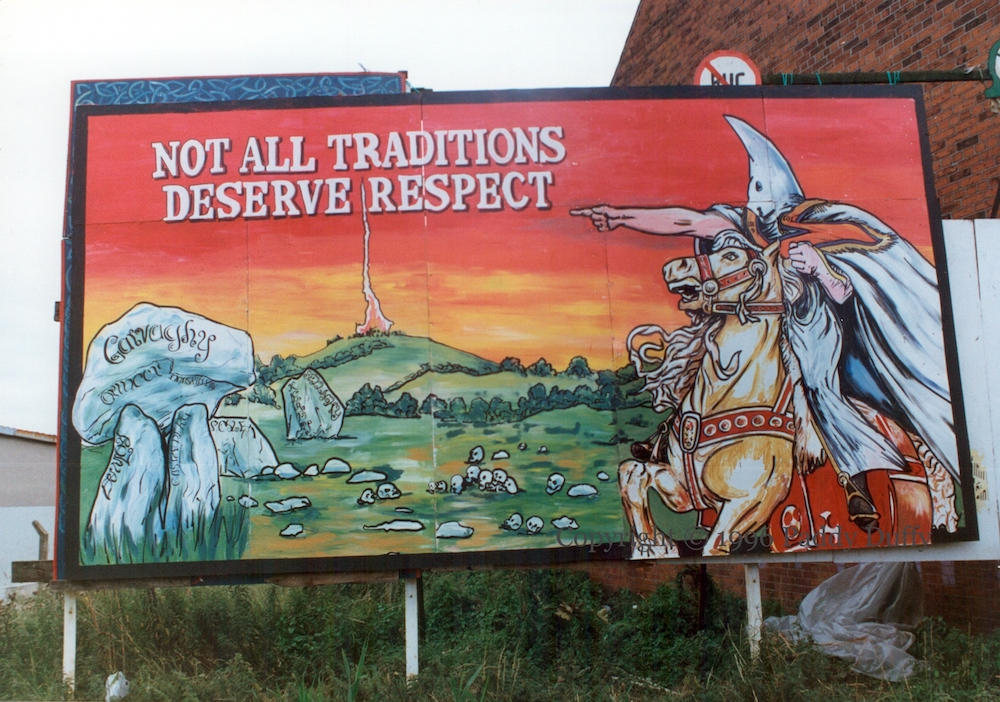
This Falls Road board is a comment on the “traditional routes” taken in Garvaghy (Portadown) and Ormeau (south Belfast) and other small towns (Enniskillen, Dunloy, Castlederg, Ros[s]lea, Keady, and Bellaghy) by the Orange Order – which now pass through CNR areas.
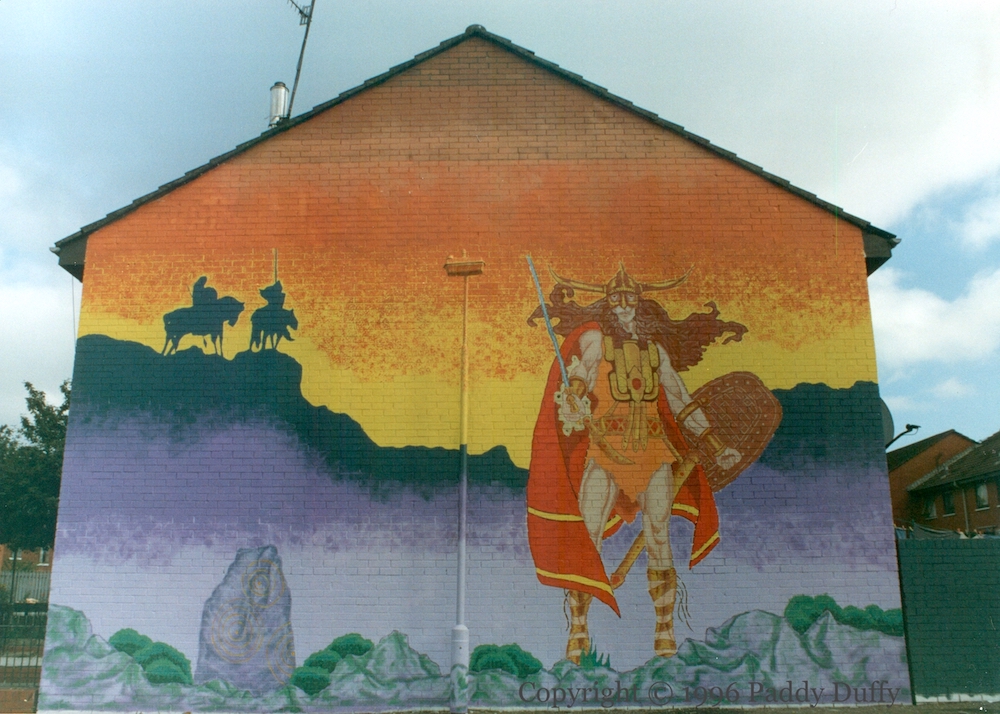
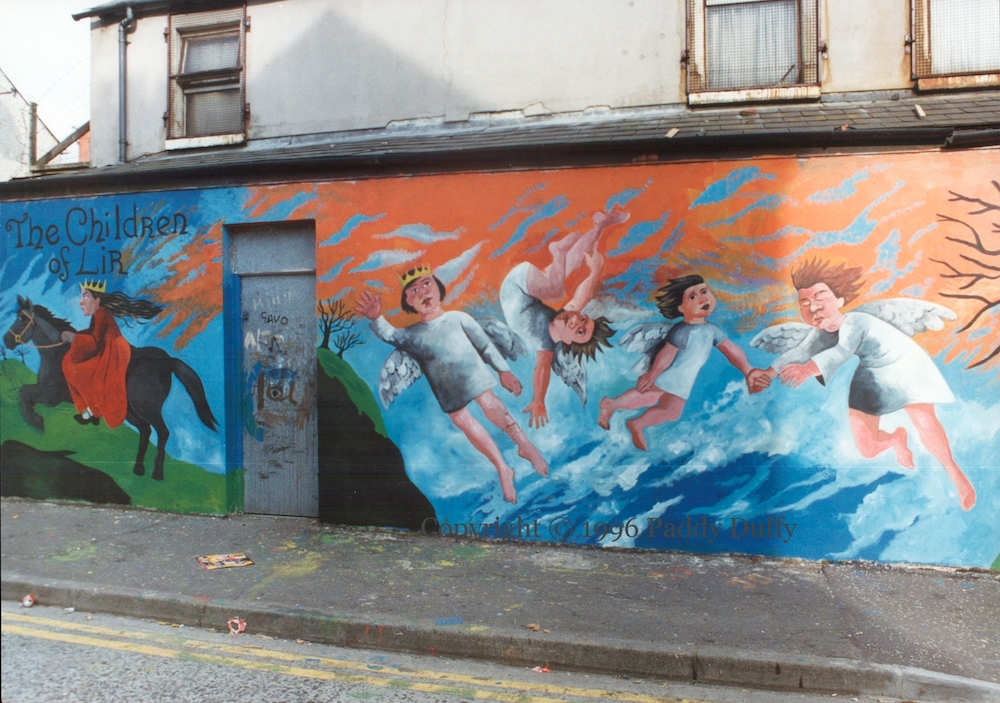
In Irish mythology, the four children of Lear – Aodh, Fıonnghuala, Fıachra, and Conn – were turned into singing swans for 900 years by their step-mother Aoıfe, who is seen on the left riding away from the site of her stepchildrens’ metamorphosis at Loch Daırbhreach (in modern Co. Westmeath). They are then restored to human form by a Christian monk but, being 900 years old, die immediately.
“Lır” (in Irish) is the genitive of (the Irish) “Lear” and the story is often referred to in Irish as “Clann Lır“; neither “Lear” nor “Lır” is pronounced like the English “(King) Lear”.
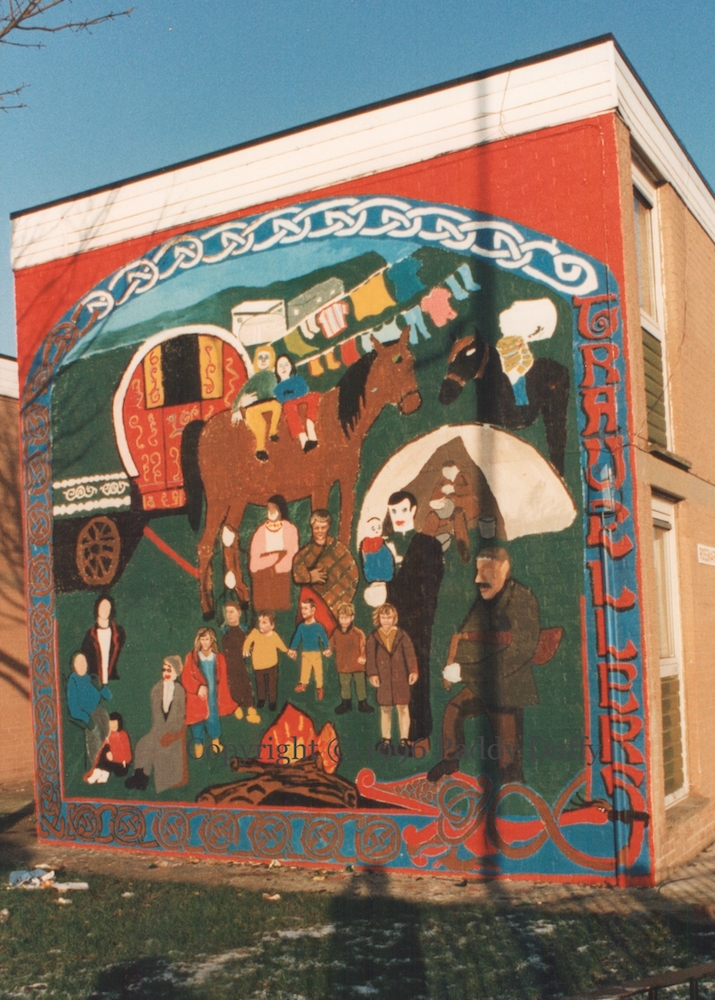
The immediate reason for this mural depicting traveller life is unknown. In 2006 (ten years after this mural) there were about 24,000 travellers living on the island of Ireland (WP | 1995 Report on travellers in Ireland (archive.org) | a good summary of the 2011 and 2016 numbers (CSO pdf).) About 2,000 were living in Northern Ireland, some at a site on the Glen Road (RTÉ has video from the site in 1987) close to this mural in Rossnareen.
This is one of about nine murals painted in 1995 for the 150th anniversary mural of An Gorta Mór/the Great Hunger (Visual History).
There is a wall to the right that reads, “There was no famine; it was genocide.” (See the Peter Moloney Collection.)
The dove on the chimney and the green ribbon below are a nod to the other main movement during this period, the release of political prisoners as a leading goal of the peace process.
This is the second Bobby Sands mural on the wall of the offices of Sınn Féın and An Phoblacht/Republican News on the Falls Road. For the first, see The Spirit Of Freedom. Gone from that first mural is the lark in barbed wire, replaced by a skyline of Maze/Long Kesh watch-towers, but the smiling Sands and the quotation from him remain: “Everyone, republican or otherwise, has his [here: “his/her”] own [particular] part to play”.





 Paddy Duffy Collection