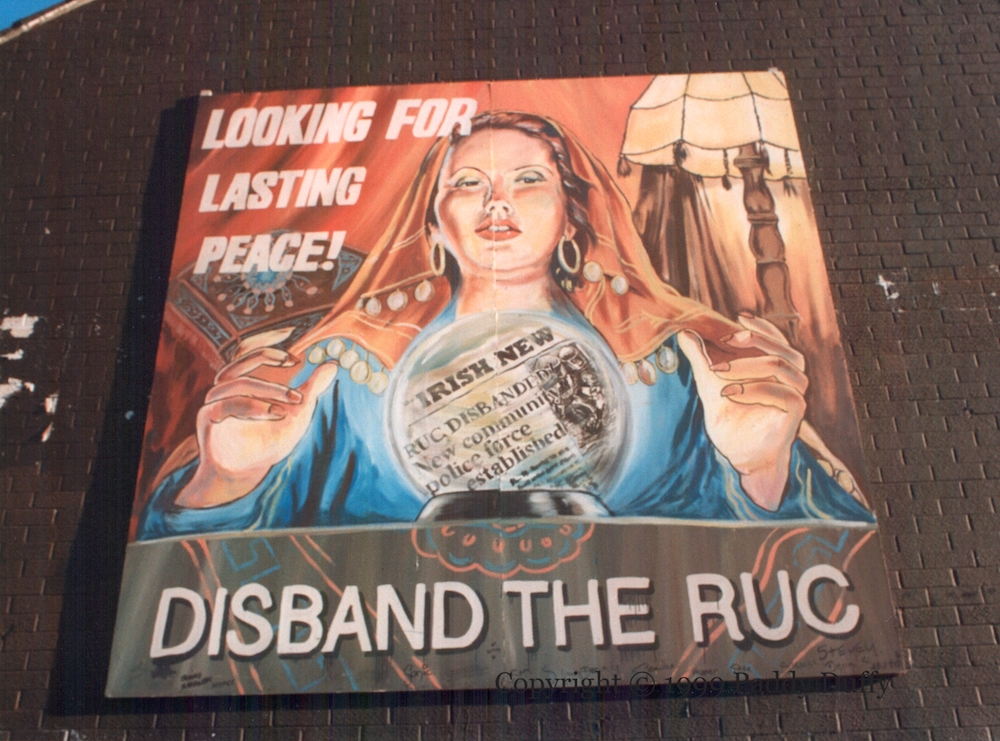
“Disband the RUC.” A fortune-teller sees the path to peace in an Irish News headline in her crystal ball: “RUC disbanded. New community peace force established”. Reform or replacement of the RUC is one of the top nationalist concerns in the peace process, after the release of POWs.
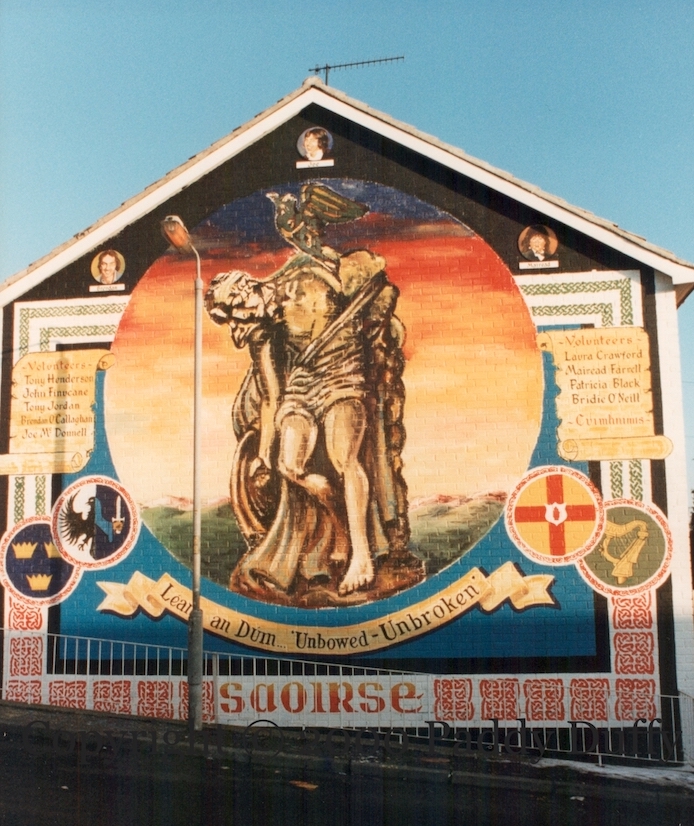
The dying Cú Chulaınn (as portrayed in bronze by Oliver Sheppard, in a statue installed in the GPO in 1935) is used as a symbol for the locals from Lenadoon area of west Belfast who fought for freedom (“saoırse”): Tony Henderson, John Finucane, Brendan O’Callaghan, Joe McDonnell, Laura Crawford, Maıréad Farrell, Patricia Black, Bridie O’Neill (subsequently changed to Bridie Quinn).
There were originally portraits of all nine people in the apex when the mural was launched in 1996, but only three remain.
A dove carries the keys that would unlock the chains that are already being rent asunder by their manacled captive in “Ceıs Fada” [Long Kesh]. Part of the “green ribbon” campaign to release republican POWs under the terms of any peace agreement.
The Gibraltar Three are IRA volunteers Maıréad Farrell, Seán Savage, and Dan McCann, who were executed by British crown forces in Gibraltar on March 6th, 1988.
Along the top is written a variation on the second half of Terence MacSwiney’s famous phrase: “[It is not those who can inflict the most but] “Those that endure the most will conquer in the end”
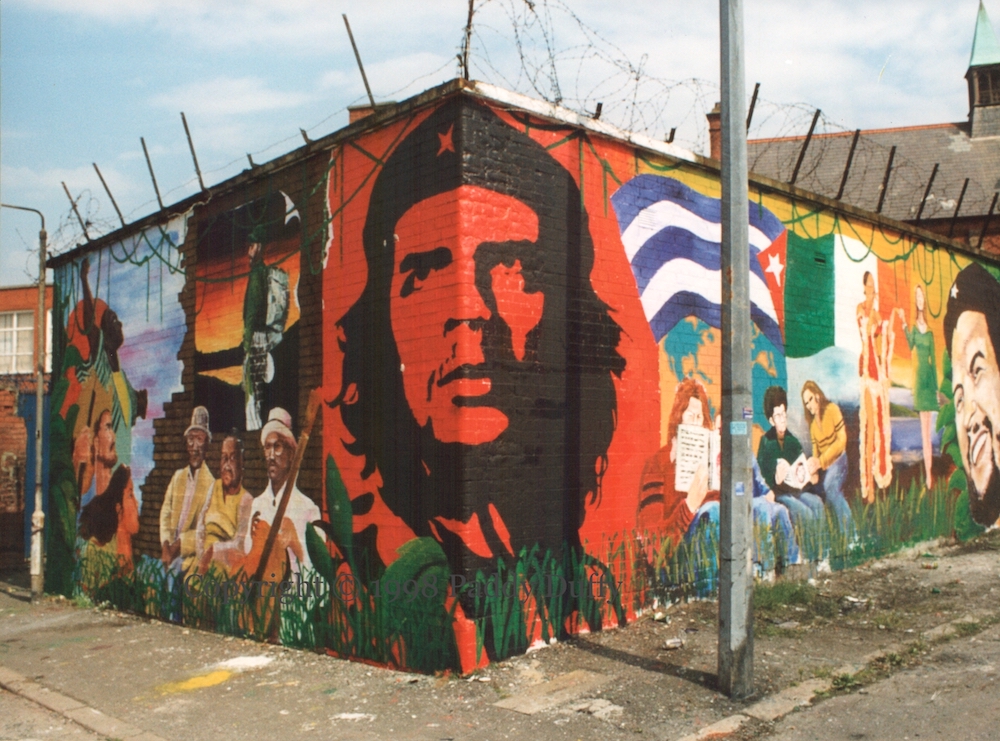
Jim Fitzpatrick’s Che (Visual History) is the linchpin of this mural in Shiels Street, Beechmount, expressing solidarity between Irish republicanism and the Cuban revolutionaries. Fidel Castro appears on the right (and in the poster on the left), and Bobby Sands is seen on the right reading a collection of Che’s speeches and writings published in English in 1969 as Venceremos! (pdf).
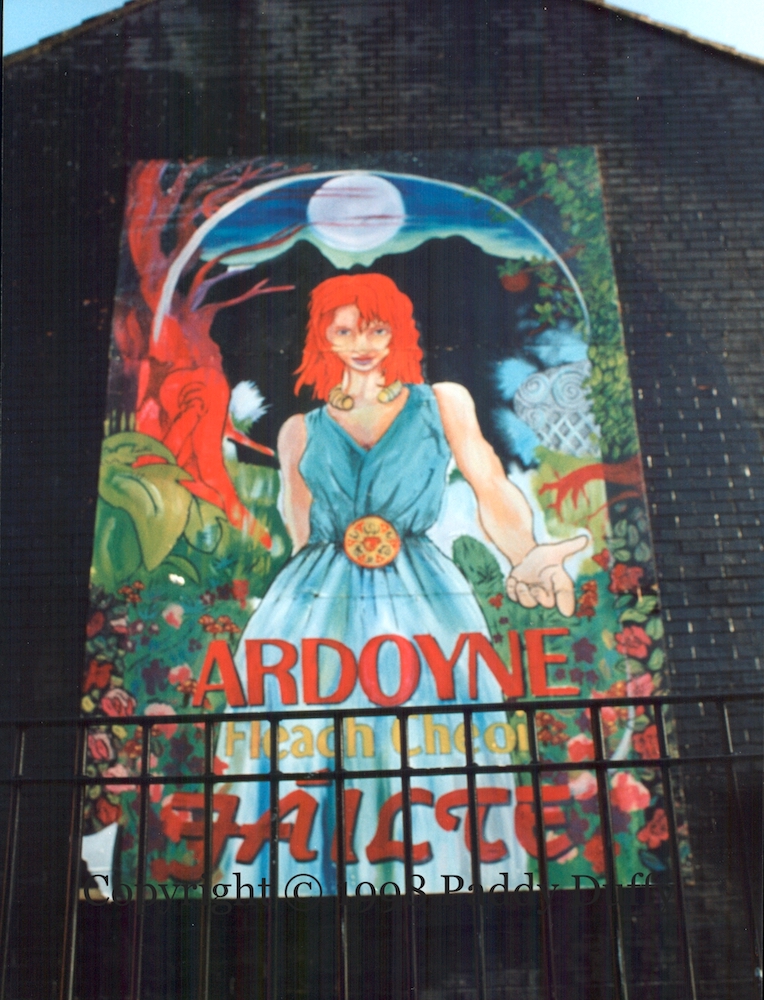
Sean Doran’s art for the cover of the programme for the 1998 Ardoyne Fleadh Cheoıl (Fb) was also produced on a large board in Ardoyne Avenue, north Belfast.
An Orange Order marcher (with skeletal face, glowing eyes, and a ‘Give way’ sign) is about to step on a protestor from the lower Ormeau who holds a sign reading “Peace – Justice” and has just released a dove that is sitting on top of the road-sign on the corner.
The scene is the Ormeau Road at Farnham Street, and the mural is in Farnham Street at the Ormeau Road; the mural thus includes a depiction of itself: the edge of the mural (with blue sky and grey pavement) appears on the wall to the left of the pizza shop with painted shutters reading “What part of NO don’t you understand?” (An image of the actual shutters, from the squire93 collection, is included below.)
In the top left is a smaller piece painted on a board: the words “Will there ever be peace? No.” are super-imposed on a grave.
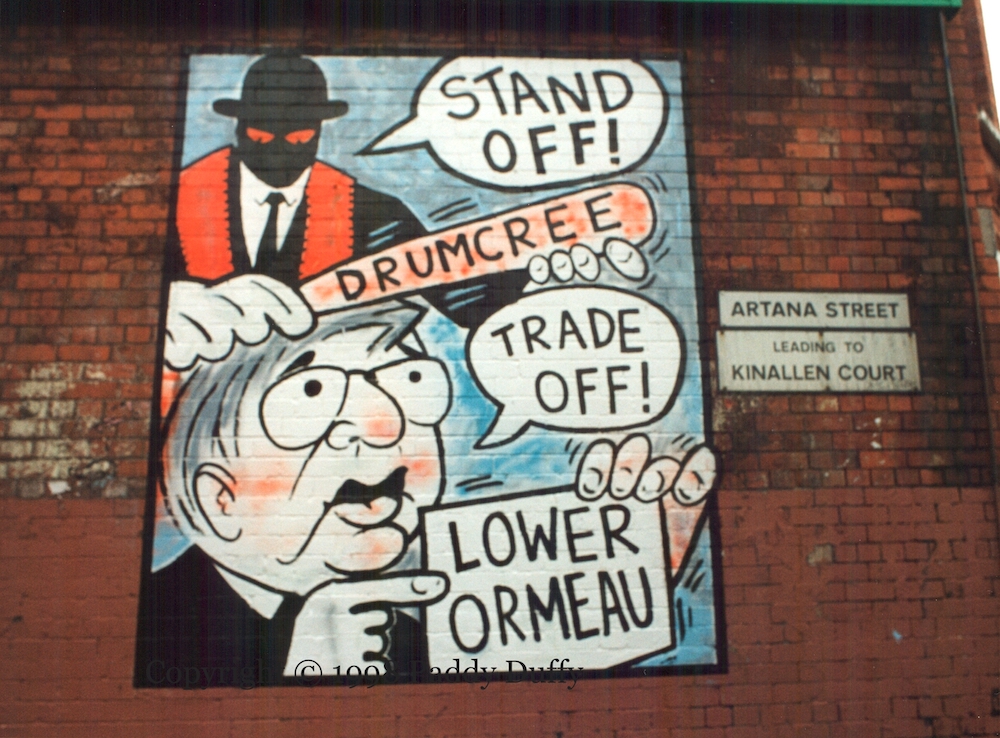
In the summer of 1998, an Orange Order march was allowed to parade along Ormeau Road. Parades Commission chairman Alistair Graham (pictured in the mural beneath the evil-eyed OO member) “insisted that the Ormeau Road decision “was not a simple trade-off for our earlier decision on Drumcree”” (Irish Times).
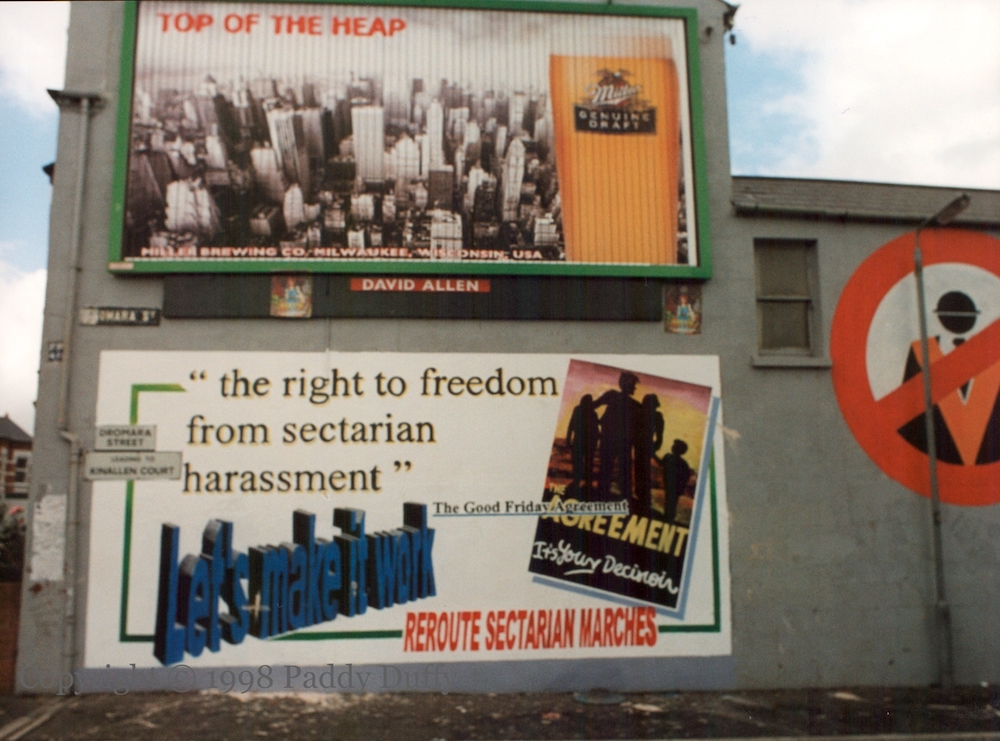
The Belfast or Good Friday Agreement promises “the right to freedom from sectarian harassment” and this mural beseeches the authorities to “let’s make it work” by rerouting “sectarian marches” such as the Orange Order parade on the Ormeau Road.
“A postcard from the edge – Having a wonderful time! How was your summer?” Postcards From The Edge was a 1990 film starring Meryl Streep and Shirley MacLaine based on the semi-autobiographical novel of the same name by Carrie Fisher (WP). In this mural, the nationalist community is locked in the dark while the Orange Order parades loudly on the Ormeau Road in south Belfast.







 Paddy Duffy Collection