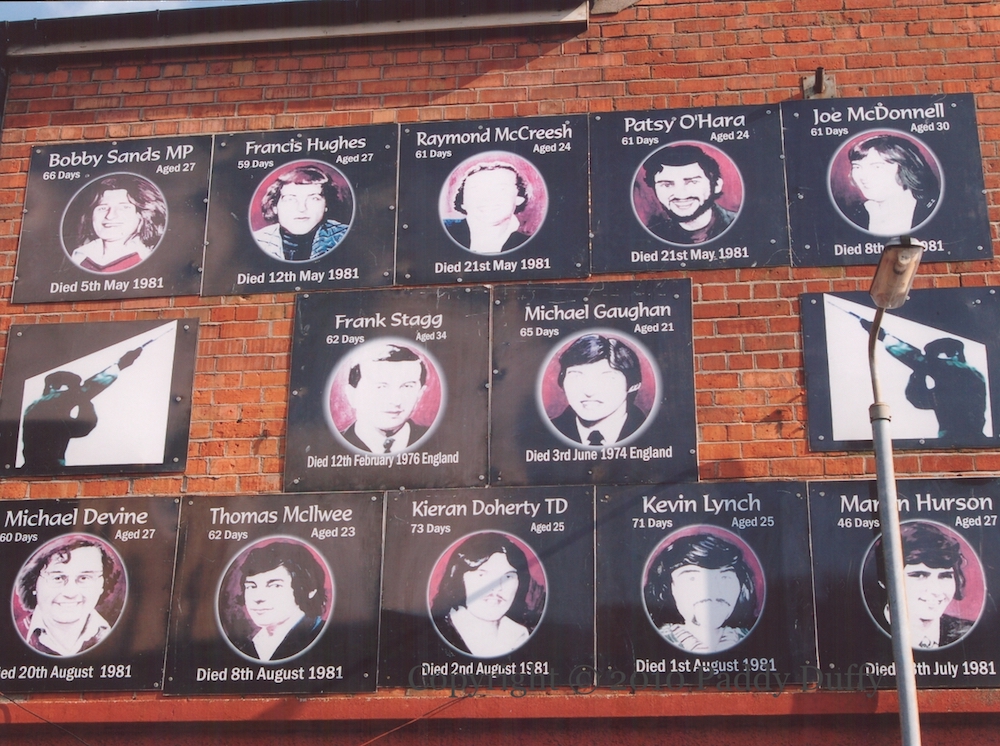
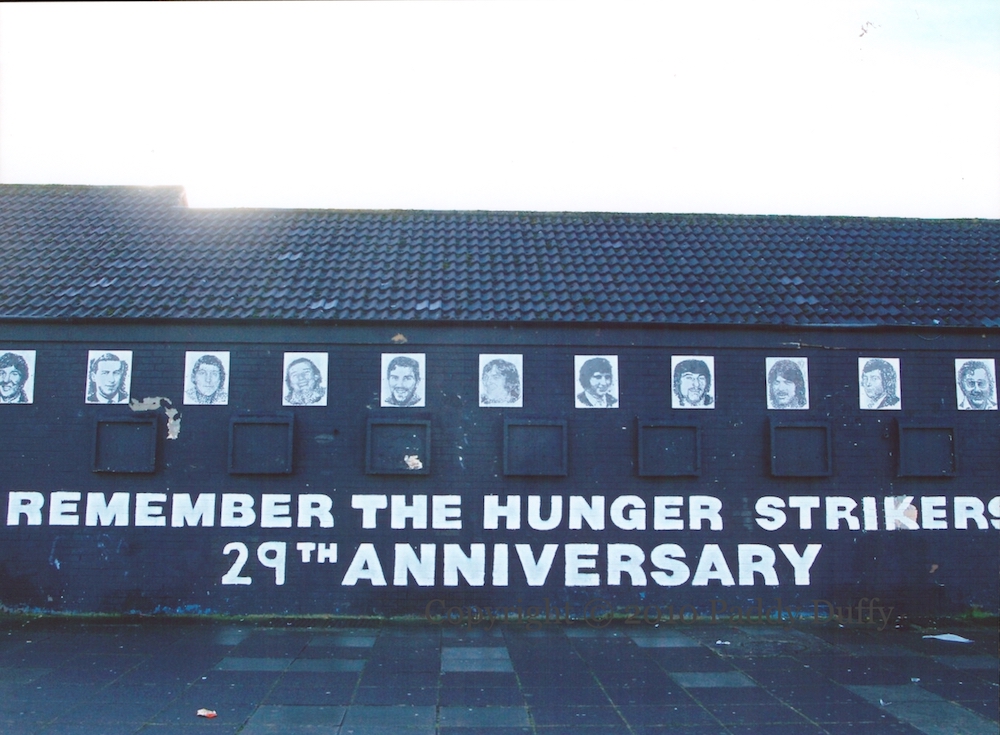
This gallery of portraits of the hunger strikers of the Troubles era includes Frank Stagg and Michael Gaughan. This is the third such gallery of portraits – the first is here; the second can be seen in Google StreetView.
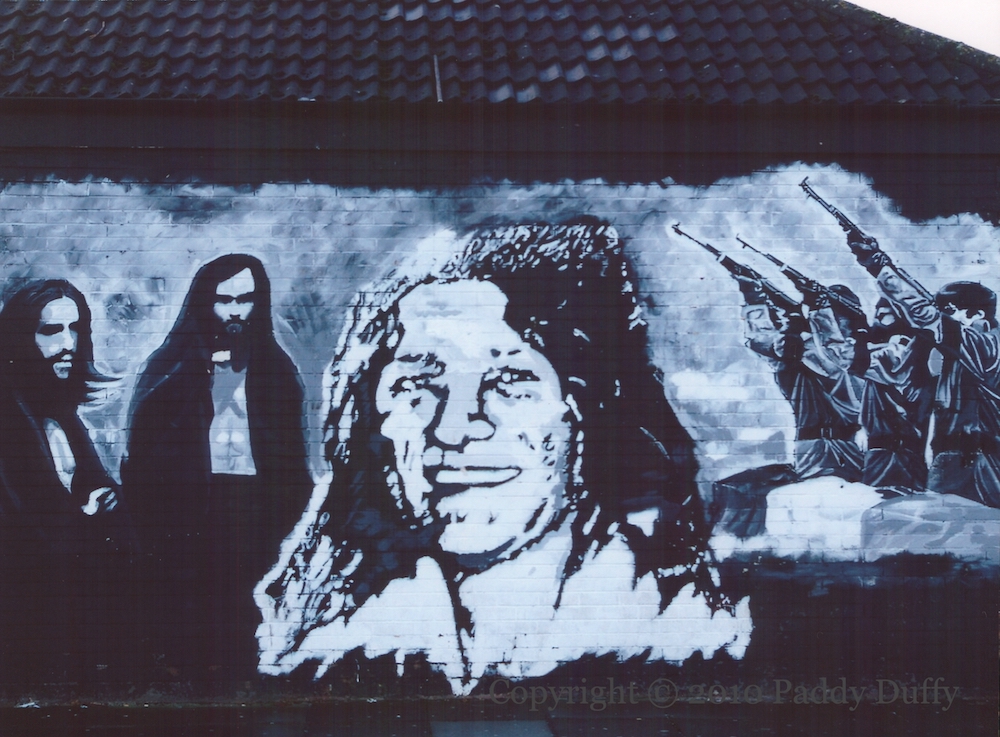
Frank Stagg and Michael Gaughan are included alongside the deceased 1981 hunger strikers in a gallery of portraits that has been updated annually since (at least) 2006. The large panel shows blanket-men Hugh Rooney and Freddie Toal, and Bobby Sands, the first to die in 1981.
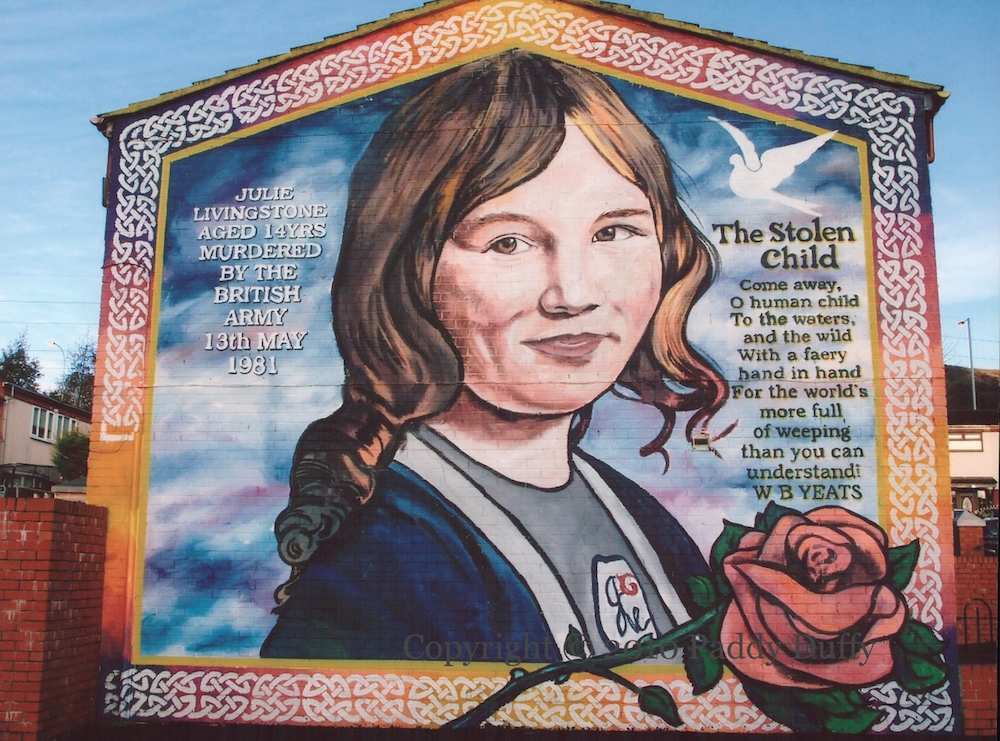
“Julie Livingstone aged 14 yrs. Murdered by the British Army 13th May 1981.” “The Stolen Child – Come away, O human child/To the waters and the wild/With a faery hand in hand/For the world’s more full of weeping/Than you can understand! – WB Yeats.” Livingstone was killed by a plastic bullet.
There is also a stone and plaque near the spot she was struck, on the Stewartstown Road.
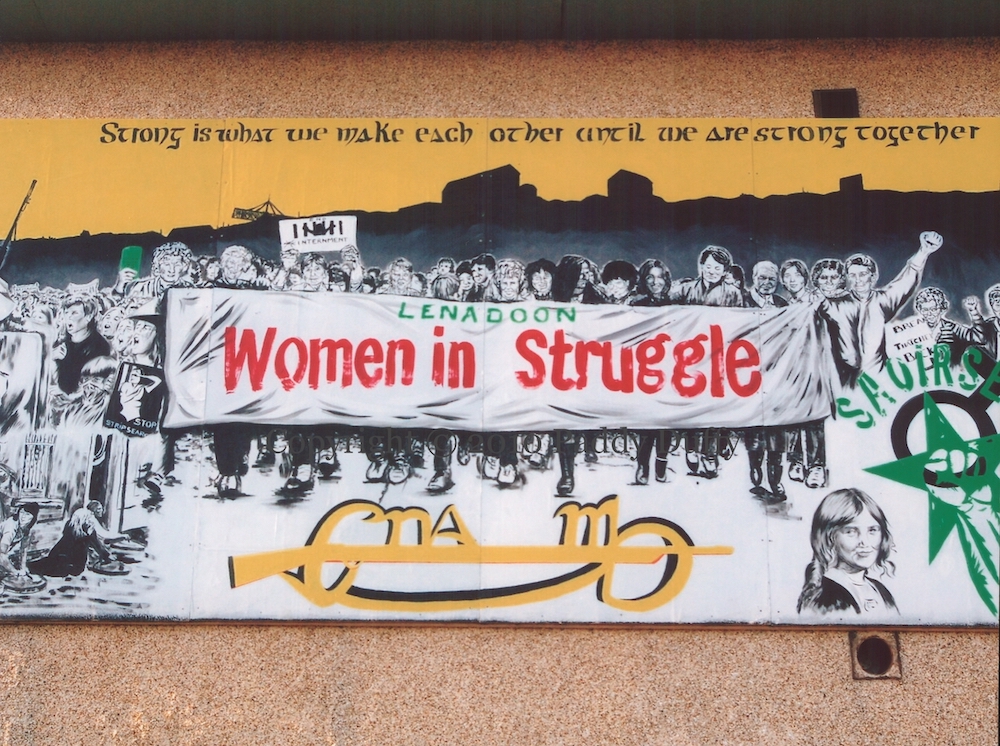
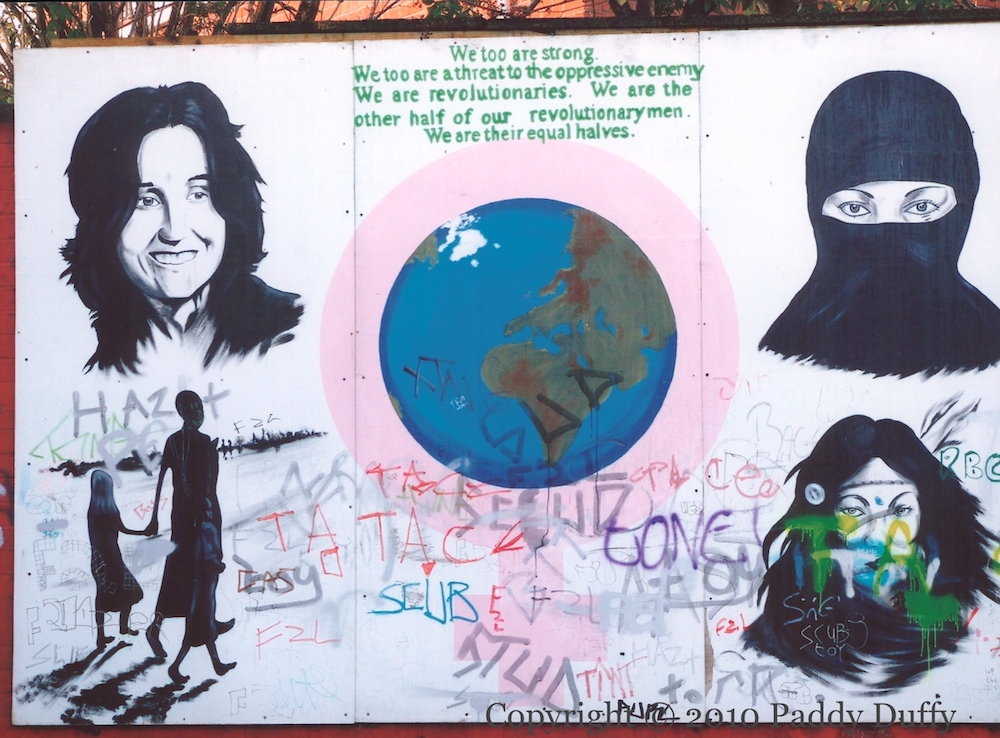
“Strong is what we make each other until we are strong together.” Women in struggle, (clockwise) banging binlids, undergoing strip searches, protesting internment, victims of plastic bullets (Julie Livingstone), fighting in Cumann Na mBan.
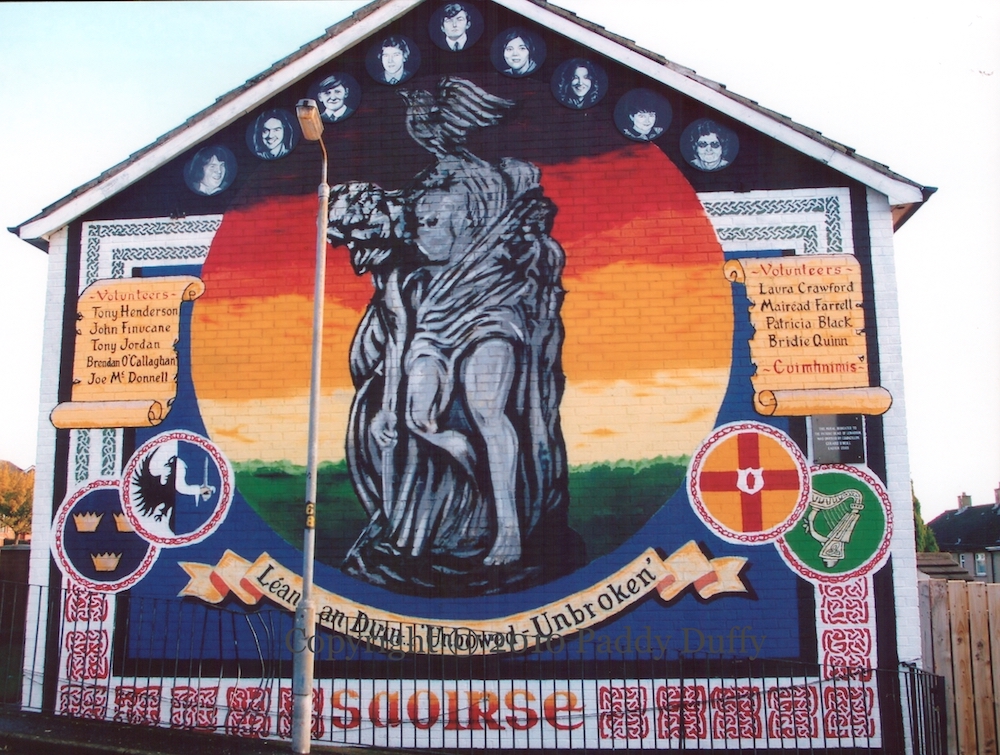
The main Lenadoon mural is refreshed and more portraits and a plaque added (on the right). The dying Cú Chulaınn (as portrayed in bronze by Oliver Sheppard, in a statue installed in the GPO in 1935) is used as a symbol for the locals from Lenadoon (including IRA volunteers) who fought for freedom (“saoırse”). They are listed on the scrolls to each side and in the portraits in the apex: Tony Henderson, John Finucane, Brendan O’Callaghan, Joe McDonnell, Laura Crawford, Maıréad Farrell, Patricia Black, Bridie Quinn (previously listed as Bridie O’Neill).
For the previous version (though without the three faces it initially had, of O’Callaghan, McDonnell, and Farrell) see M01934.
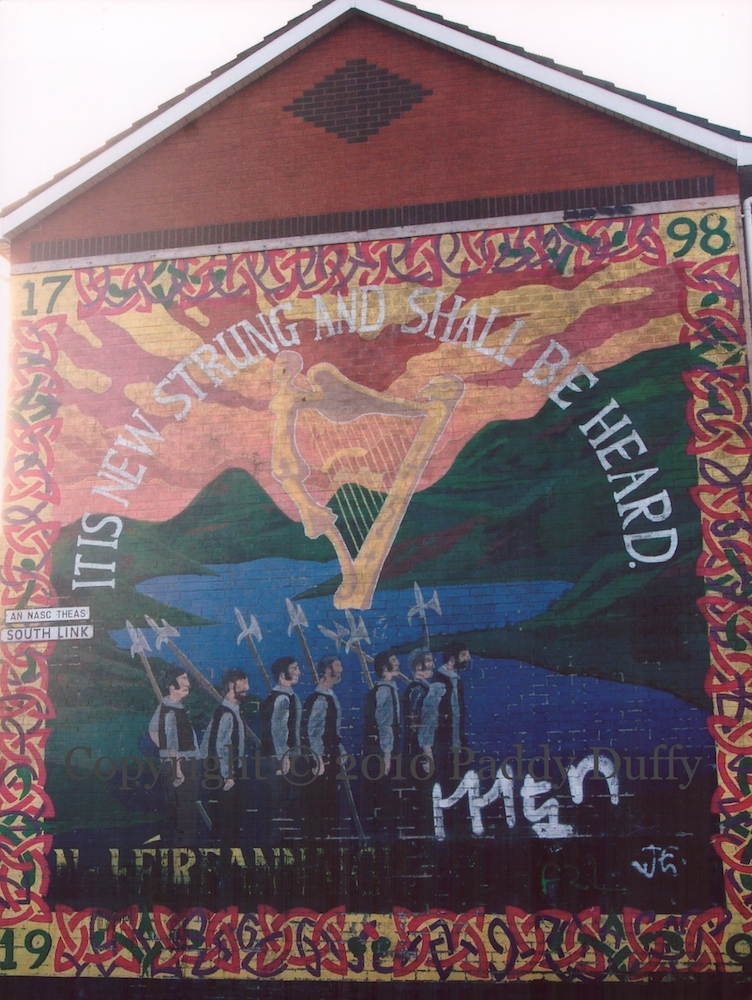
Andrea Redmond painted this mural in Andersonstown for the 200th anniversary of the 1798 rebellion by Na hÉıreannaıgh Aontaıthe (the United Irishmen), who used a harp – specifically a Maid Of Erin harp – as their emblem. To the right, out of shot, are the words Liberté, Égalité, Fraternité.
The mural is in decent shape despite being twelve years old, except for the graffiti at the bottom. The graffiti on the two boards to the side is more obscuring.
The first is devoted to the role of women in global struggles: “We too are strong. We too are a threat to the oppressive enemy. We are revolutionaries. We are the other half of our revolutionary men. We are their equal halves.” The IRA’s Maıréad Farrell is in the top left.
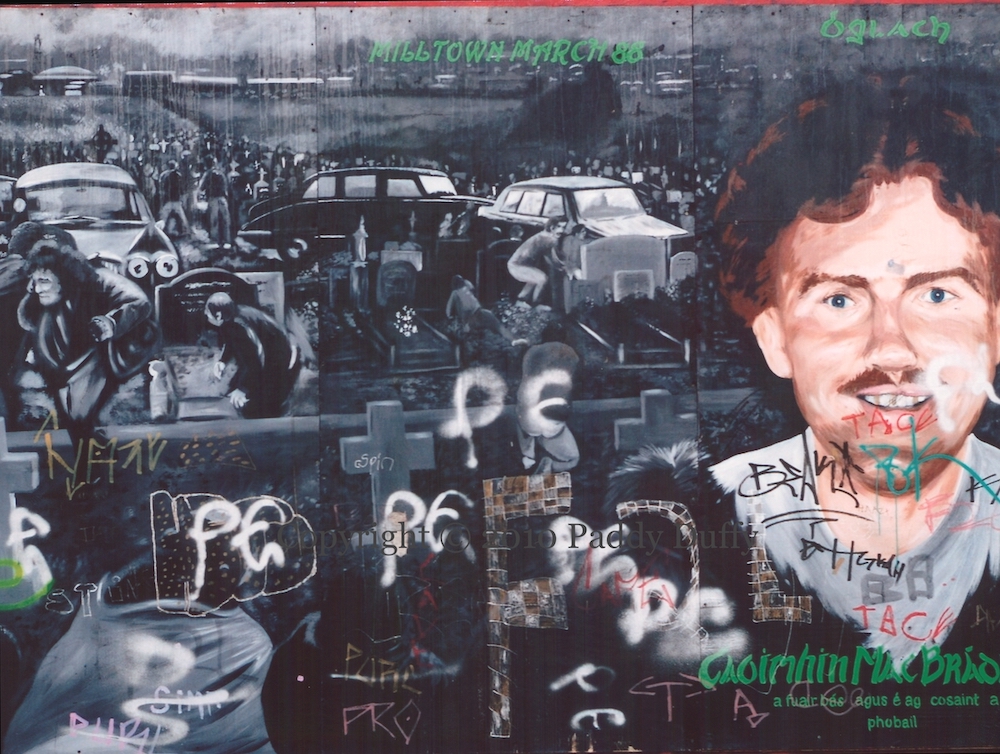
The second commemorates “Óglach Coımhín Mac Brádaıgh a fuaır bás agus é ag cosaınt a phobaıl.” [Volunteer Coımhín Mac Brádaıgh, who died while defending his people.] Mac Brádaıgh was killed pursuing loyalist gunman Michael Stone, who was attacking the funeral of the Gibraltar 3 (including Farrel), in Milltown Cemetery, on March 16th, 1988.
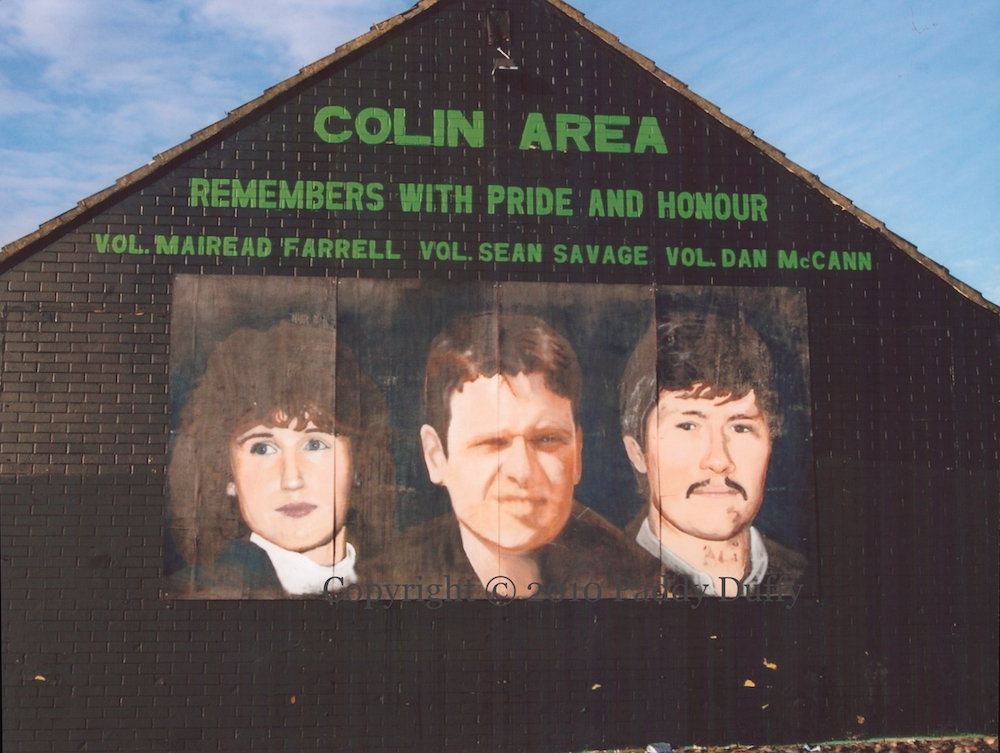
“Colin area remembers with pride and honour, [IRA] Vol. Maıréad Farrell, Vol. Sean Savage, Vol. Dan McCann.” The Gibraltar 3 were killed by SAS soldiers in 1988.
There was originally a board below the portraits with a quote from Farrell “Everyone tells me I’m a feminist. All I know is that I’m just as good as others, and that especially means men. I am definitely a socialist and I’m definitely a Republican. I believe in a united socialist country, definitely socialist. Capitalism can offer our people nothing and yet that’s the main interest of the British in Ireland – Oglach [sic] Maıréad Farrell.”
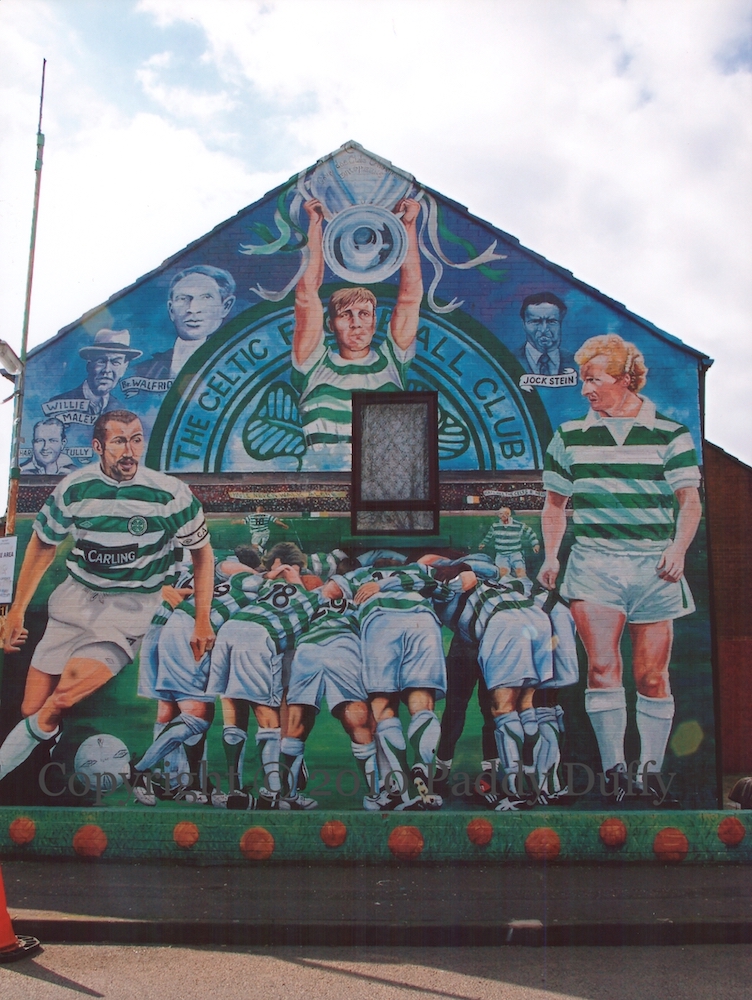
Glasgow Celtic football club was founded in 1888 by Brother Walfrid who is partially obscured here by a leaf to the left of centre. Joining him in the apex are (from left to right) Charlie Tully (of Belfast and Glasgow Celtic), Willie Maley (the first manager), [Wilfrid], Billy McNeil lifting the European Cup in 1967, Jock Stein (player 1951-1957 and manager 1965-1978). On the field are former players Henrik Larsson (1997-2004) and Jimmy Johnstone (1962-1965) on either side of the team “doing the huddle”.