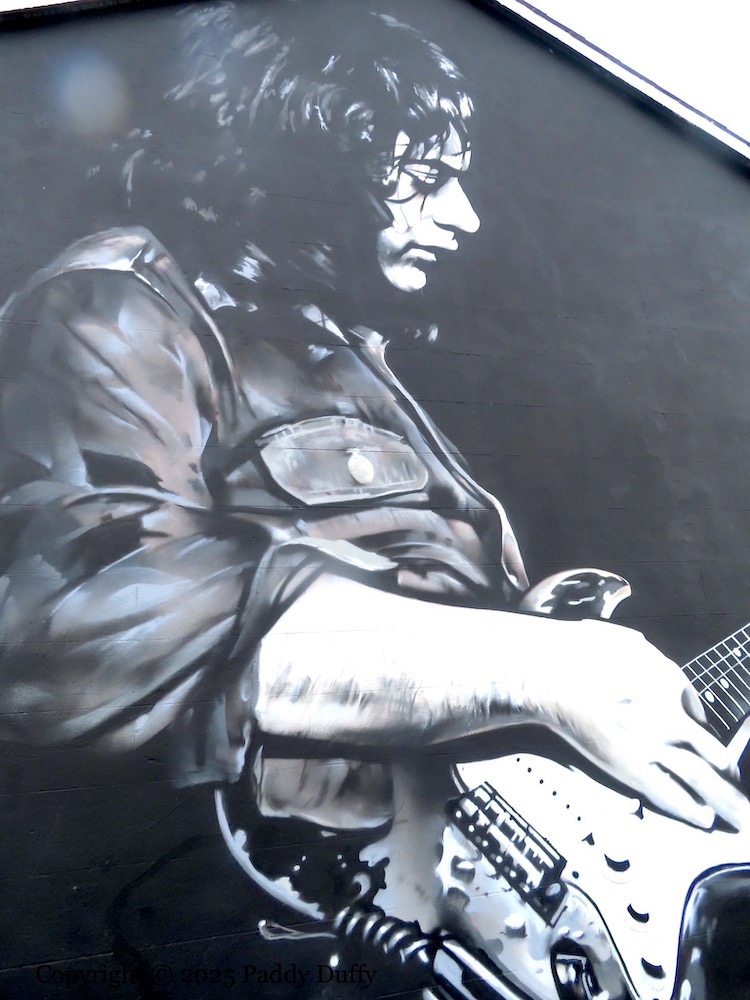
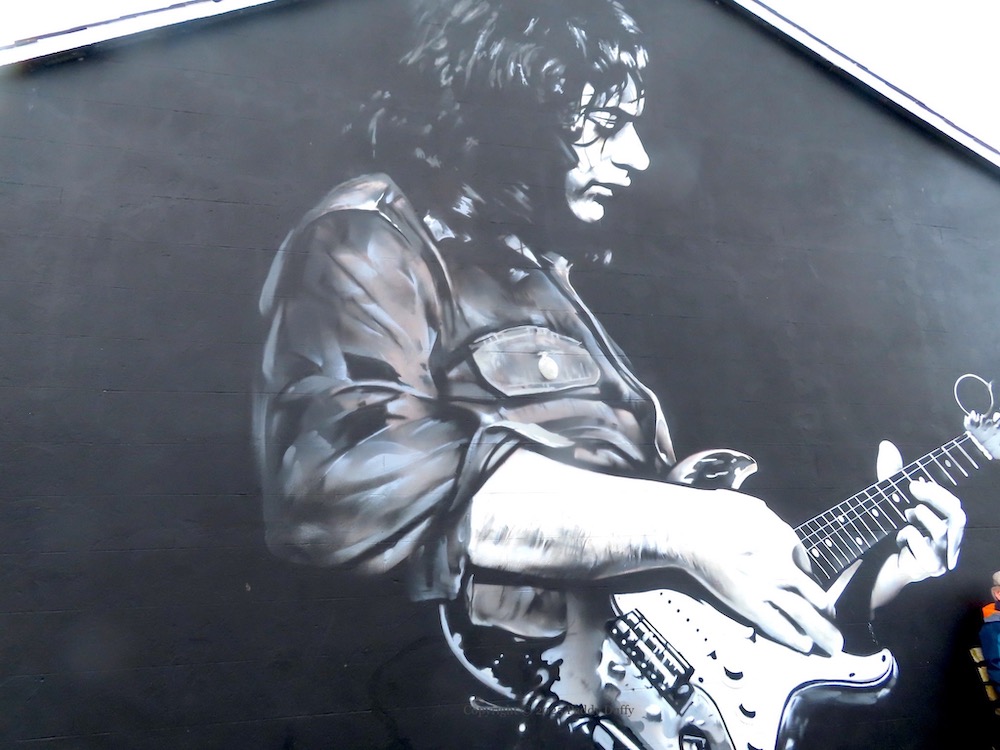
The 21st Rory Gallagher International Tribute Festival (web) starts on Thursday May 29th in Ballyshannon, the County Donegal town in which the guitarist was born in 1948. In addition to the festival, Gallagher is remembered in the town by both a mural and a statue.
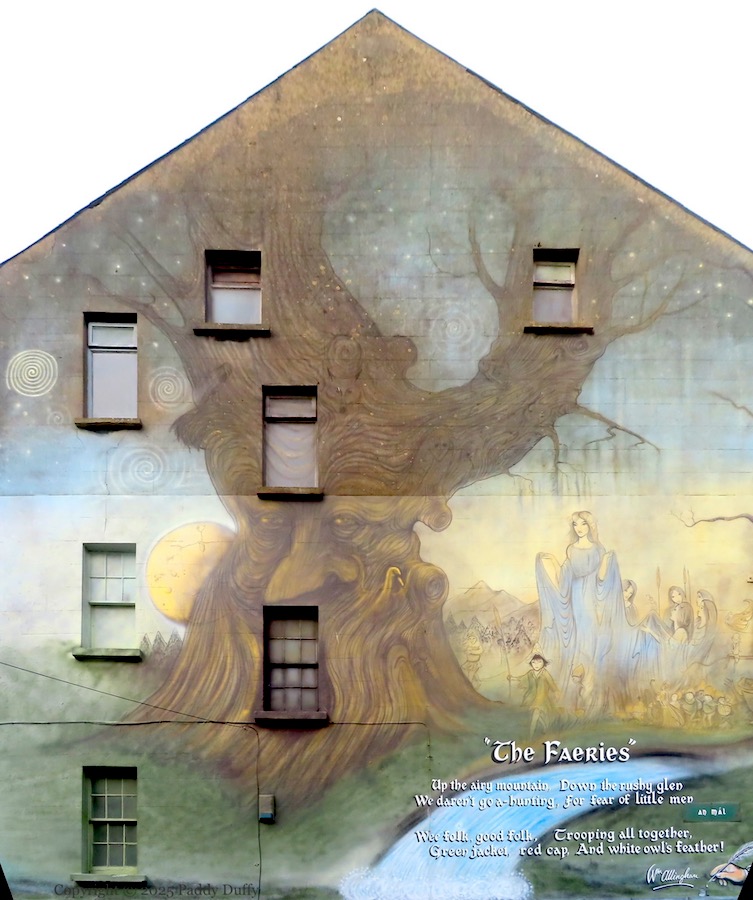
The mural is in Main Street, Ballyshannon/Béal Átha Seanaıdh; the statue is on The Mall/An Mál, next to The Faeries. As of January, 2025, there is also a statue of Gallagher in Belfast.
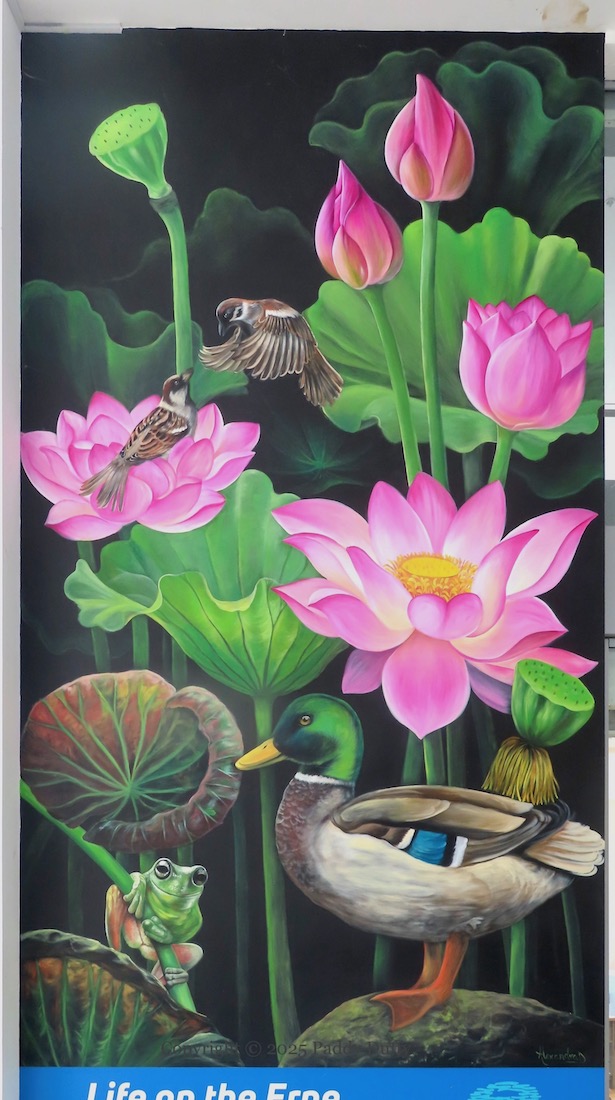
This is an extra-large (two-storey) wall-painting by Alexandra Demian (Fb | Seedhead) at the entrance to Erneside shopping centre in Enniskillen. She will be painting at this year’s (2025) Hit The North (line-up) in Belfast in early May.
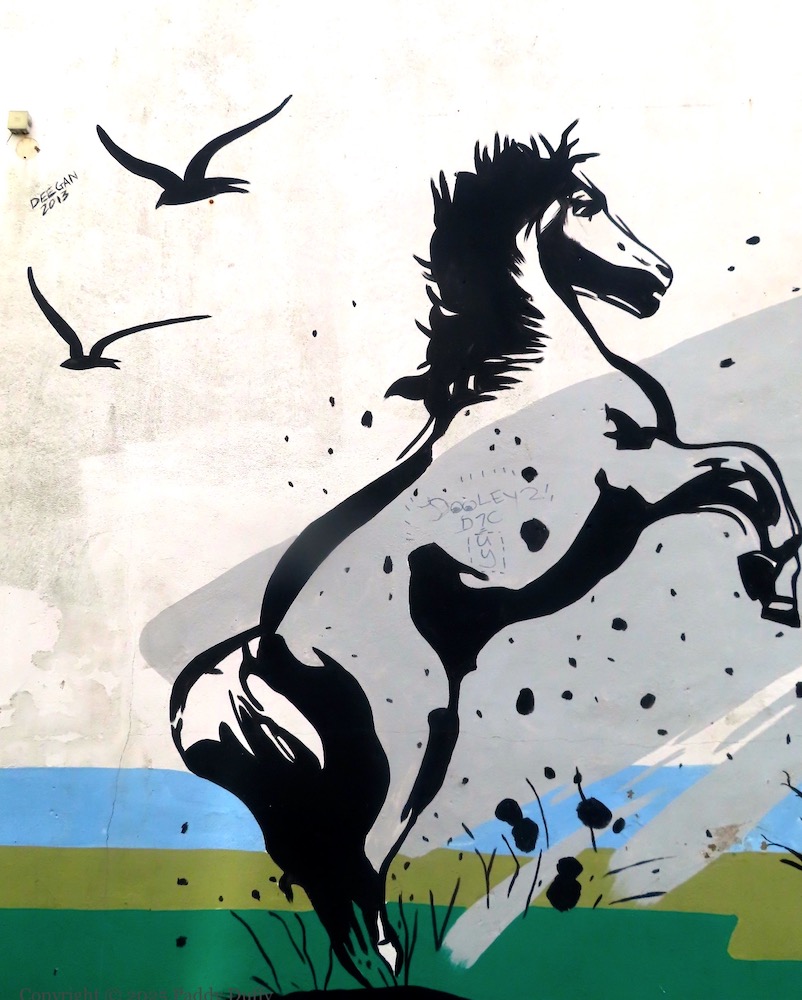
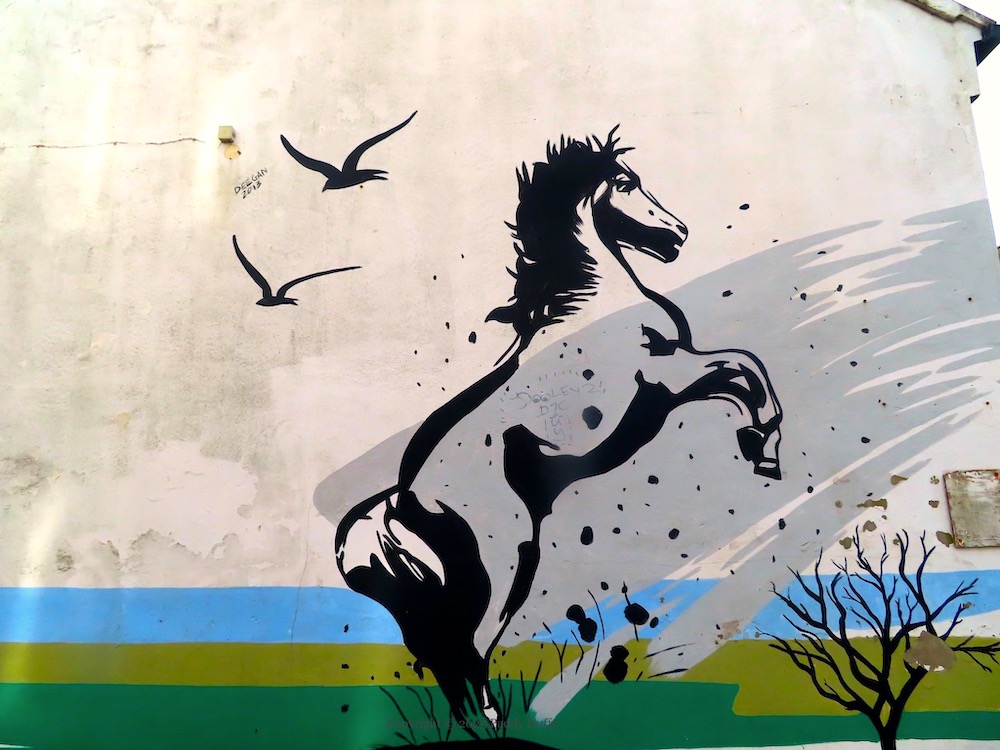
The “West End Horse” in Bundoran was painted by John Deegan (Fb) in 2013 (Discover Bundoran). The “Big wave” on the wall of Madden’s is by Nik Purdy of Blow Designs (ig), who also did murals of James Connolly in Sligo and of local literary figures in Carrick-On-Shannon.
“Up the airy mountain/Down the rushy glen/We daren’t go a-hunting,/For fear of little men.//Wee folk, good folk,/Trooping all together,/Green jacket, red cap,/White owl’s feather! – Wm Allingham”
Customs-officer, magazine editor, and poet William Allingham was born in Ballyshannon, Co Donegal, in 1824, and his ashes – brought back from London – are interred in St Anne’s church in the town (WP). “The Faeries” (poetry.com) was first published in his 1850 collection Poems (UCC) and remains a staple of children’s and mythological collections.
The art shown here is on The Mall/An Mál in Ballyshannon/Béal Átha Seanaıdh.
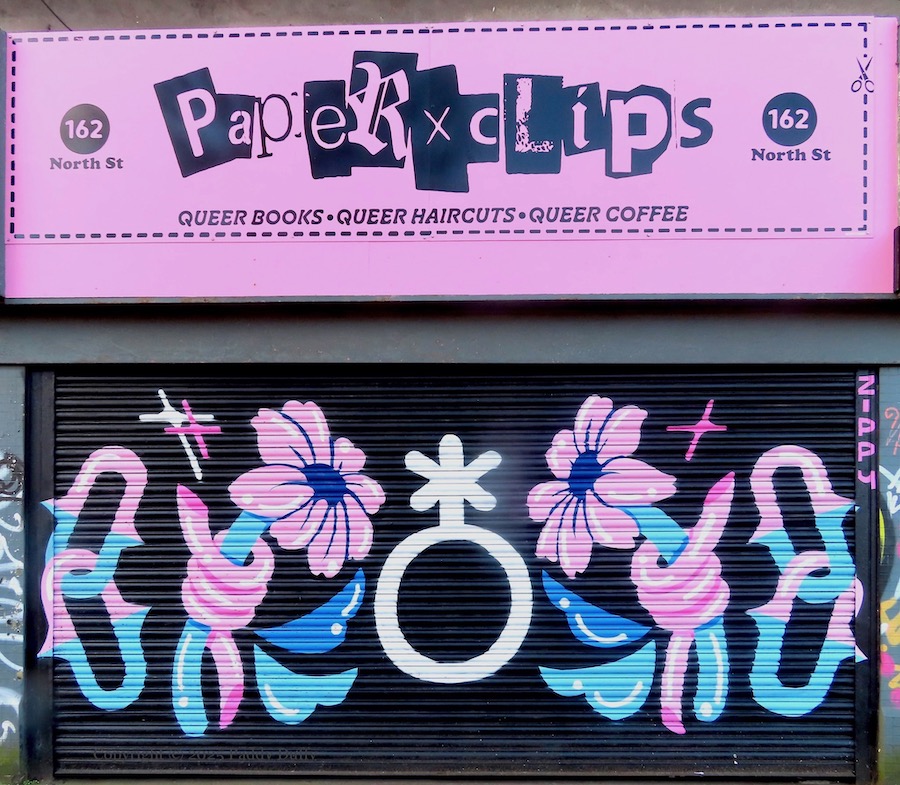
Paper x Clips (web) – providing queer books and haircuts, and also hot drinks – moved into its new North Street digs in November (2024) and to go with the renovations and re-opening had the shutters to the shop painted by Zippy (web) with the genderqueer symbol between barbed-wrapped daisies and linked chains.
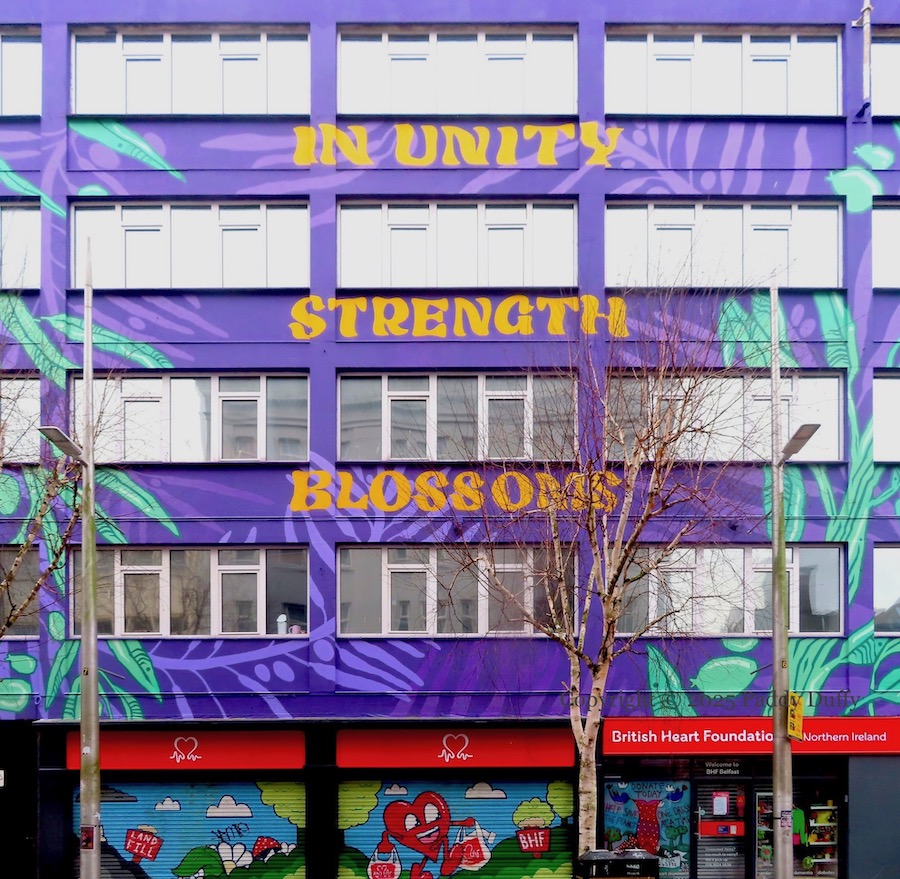
This spring ArtsEkta (web) will launch “Olive Tree House” as a new cultural hub in Belfast city centre with meeting-, studio-, and gallery-spaces. The name is a return to the original name of the building, used from 1958-2014, after which time it has been known as “Concentrix House” (Future Belfast) – Concentrix moved to Maysfield in 2017 (Concentrix). The building’s facade has been painted with olive trees by Zippy (web).
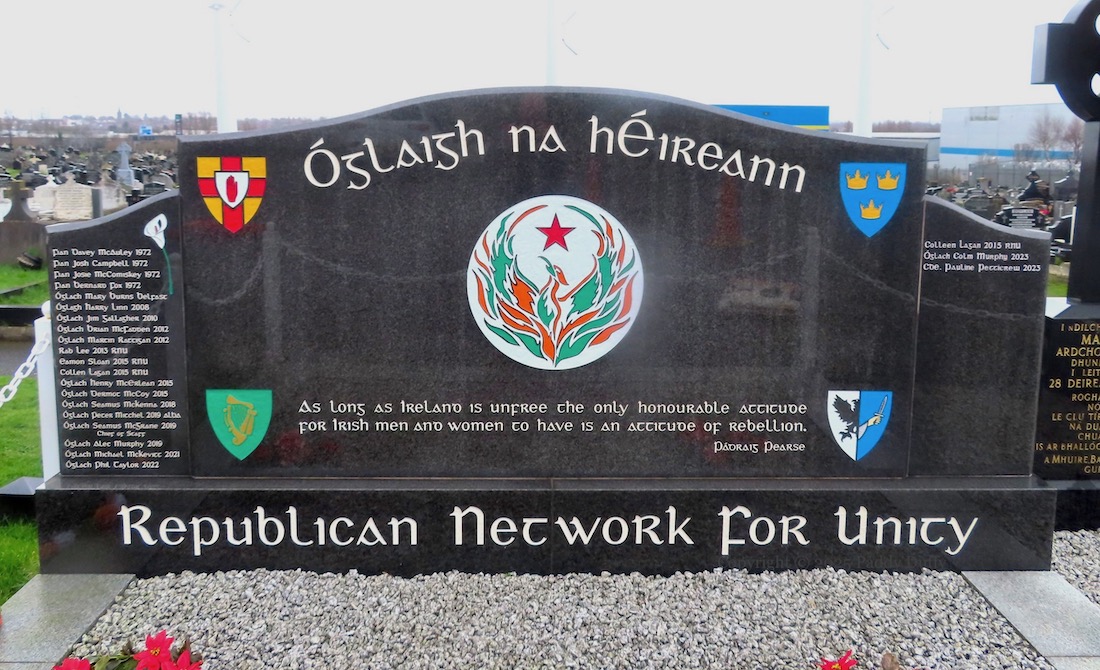
“”As long as Ireland is unfree the only honourable attitude for Irish men and women is an attitude of rebellion” – Pádraıg Pearse”. Pearse wrote the lines in July 1913, in an essay for Irish Freedom (Cartlann), though with “revolt” rather than “rebellion”.
The stone features the phoenix and the lily, and the crests of the four provinces of Ireland. It was unveiled in 2023 and an image of it was used in an RNU board on the Falls Road.
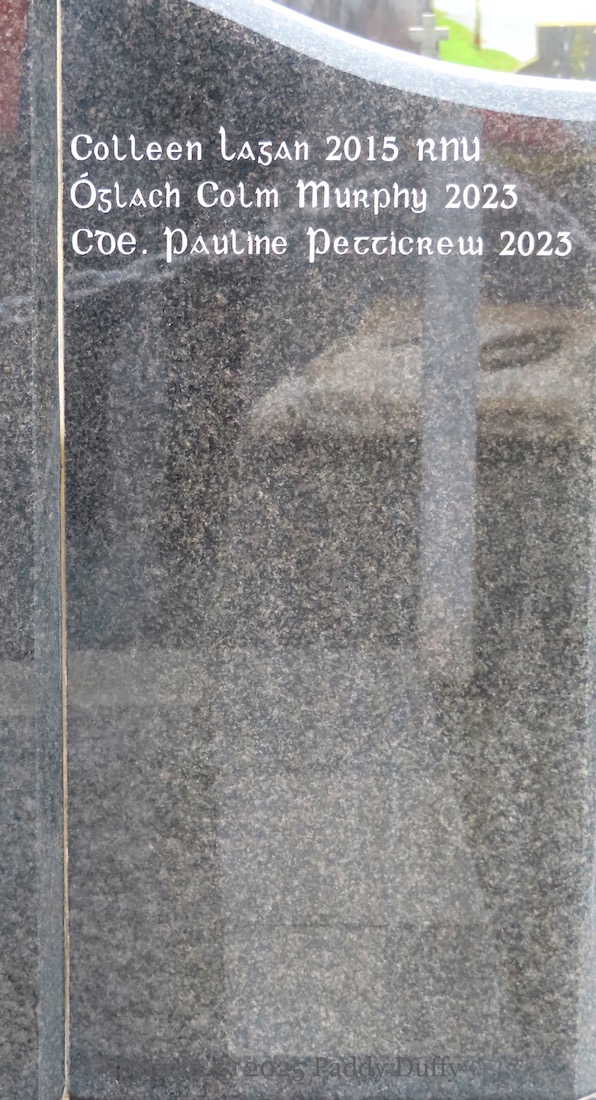
Among the volunteers listed are the four Ardoyne Fıanna who died in 1972 (commemorated in Ardoyne) and Michael McKevitt, founder and (alleged) chief of staff of the RIRA/Óglaıgh Na hÉıreann (WP) who died in 2021.
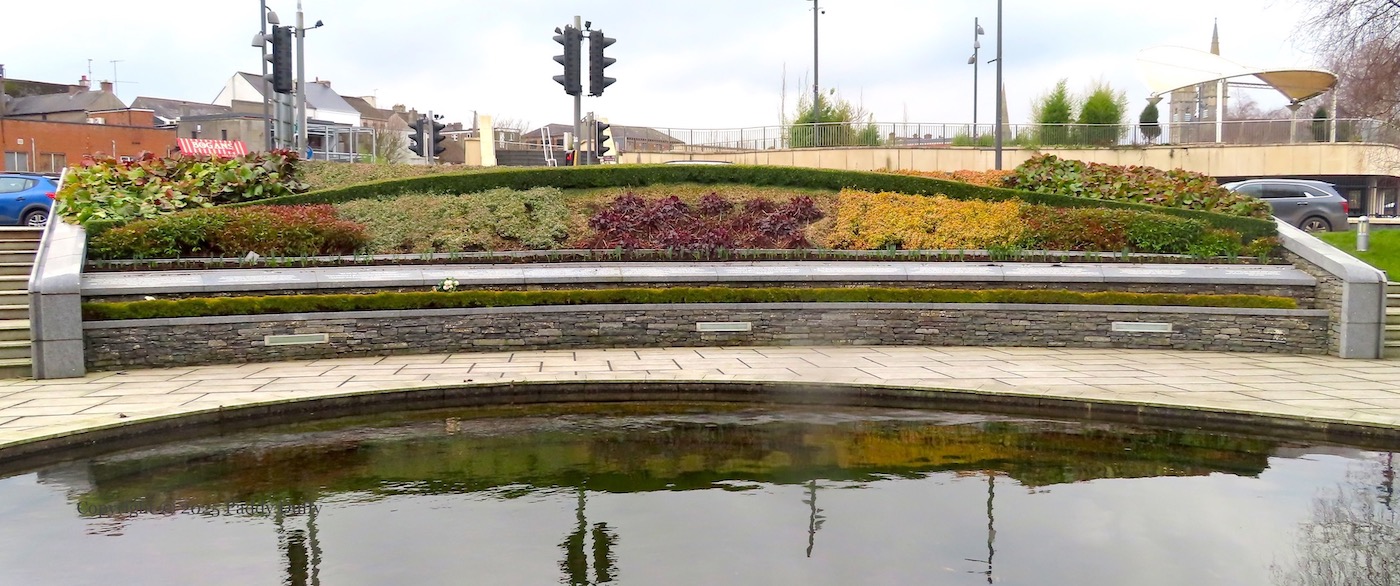
This memorial to the victims of the Omagh bombing is in a green-space along the Strule river about 300 metres (WP) from the spot where an RIRA car-bomb exploded on the afternoon of 15th of August 1998, killing twenty-nine people and injuring more than 200 others.
The garden was opened on the tenth anniversary, in 2008 (replacing a smaller obelisk). It includes 31 mirrors on poles (including a set of unborn twins in the number of deceased) which are part of a reflective system that sends sunlight towards a crystal pillar in Market Street that marks that spot of the bomb (Troubles Archive).
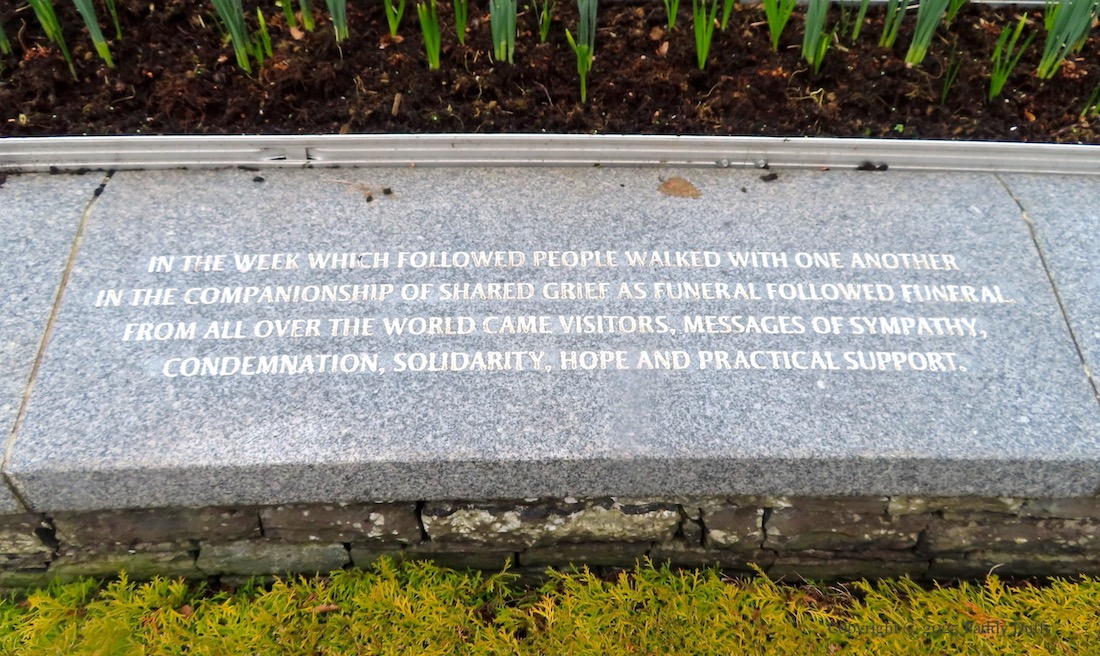
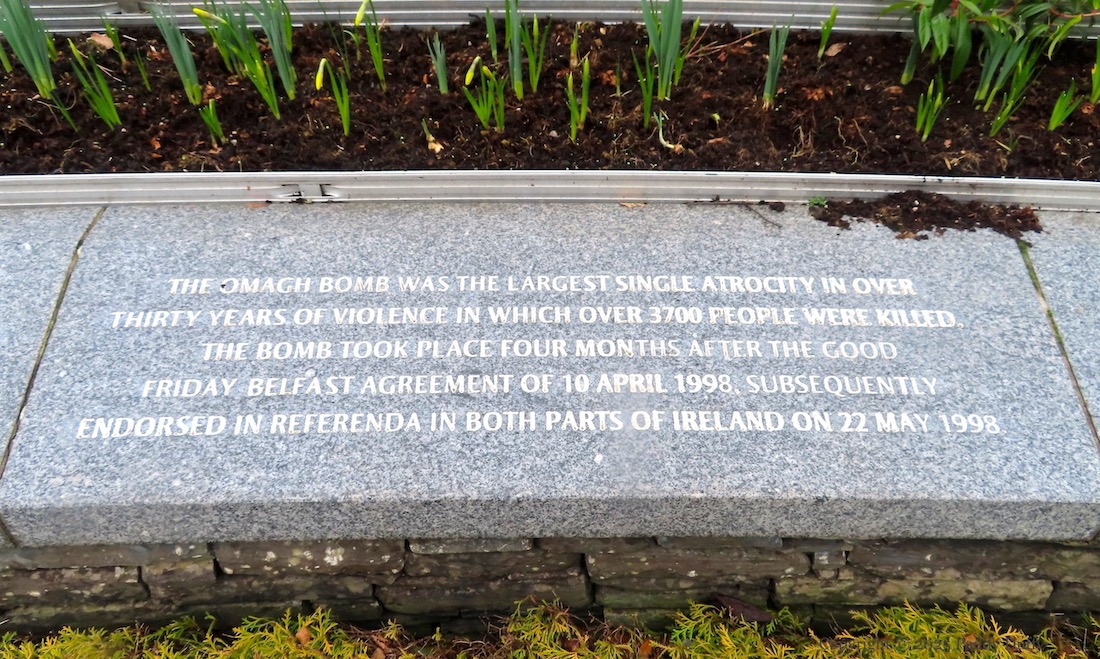
There are also a series of engraved stones on an arc around the pool that tell the story of the day and its aftermath, as well as naming the dead:
“Weather wise it was one of the best days that summer had seen. Ordinary people were doing ordinary things on an ordinary day. In one fateful moment all this was changed forever. Time stood still, futures were obliterated, loves were shattered, hearts were broken. In the carnage, emergency personnel and many ordinary people reached out, helped the injured, gave hope to the dying and held the dead. That evening a great silence descended on the town. In the week which followed the people walked with one another in the companionship or shared grief as funeral followed funeral. From all over the world came visitors, messages of sympathy, condemnation, solidarity, hope and practical support. The Omagh bomb was the largest single atrocity in over thirty years of violence in which over 3700 people were killed. The bomb took place four months after the Good Friday/Belfast Agreement of 10 April 1998, subsequently endorsed in referenda in both parts of Ireland on 22 May 1998. In the years that followed people Omagh and elsewhere sought to rebuild their lives, their families, their community, and to create a new future. Regardless of the past, every new days dawns as a gift laden with its own possibilities, as the morning sun banishes the darkness of night.”
One of the stones reads “Bear in mind these dead/Coınnıgh ı gcuımhne na maırıbh seo/Tened en cuenta a estos muertos – (John Hewitt)”; two of the victims were Spanish.
Drumragh Avenue, Omagh
“Saturday 15 August 1998 at 3.10 PM. To honour and remember the 31 men, women and children who were killed, the hundreds injured and those whose lives were changed forever in the Omagh bomb. ‘The light shines in the darkness and the darkness has not overcome it’ (John 1.5)”
“To honour and remember 31 people murdered and hundreds injured from three nations by a dissident republican terrorist car bomb. (Omagh Support And Self Help Group)”
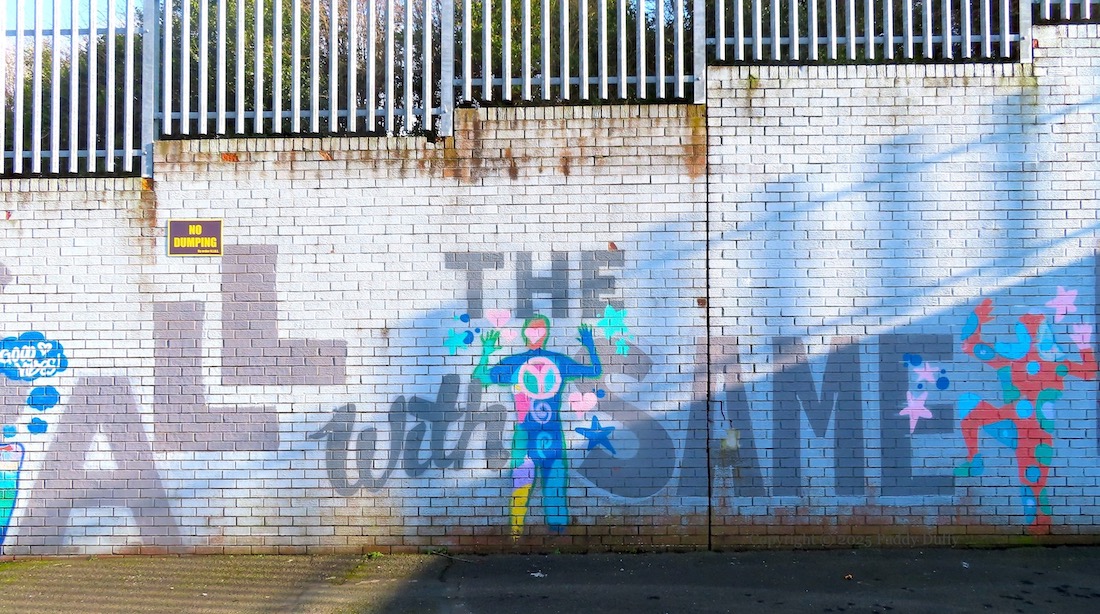
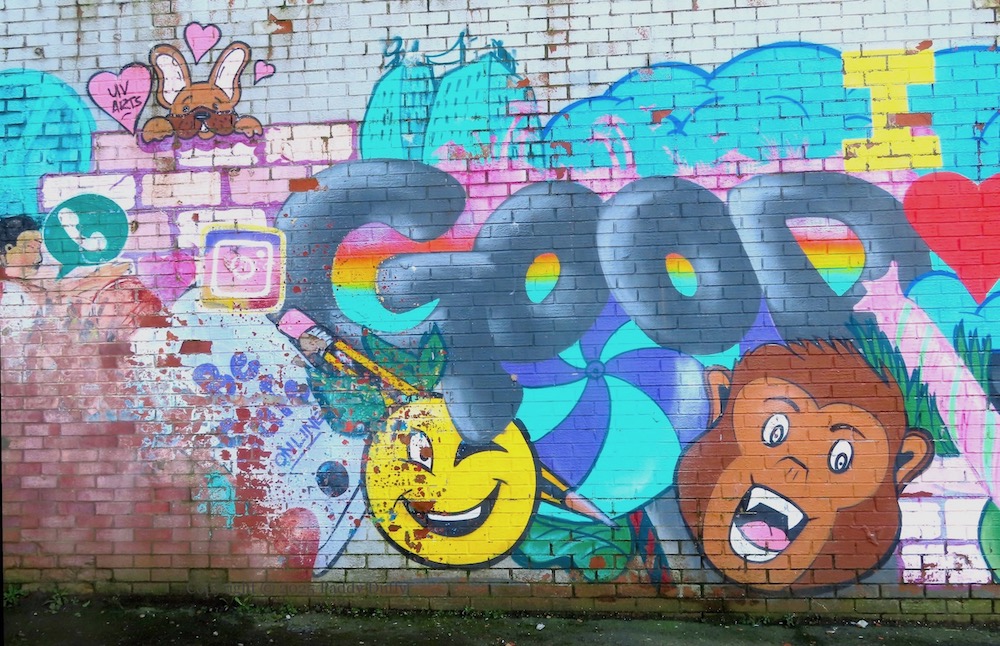
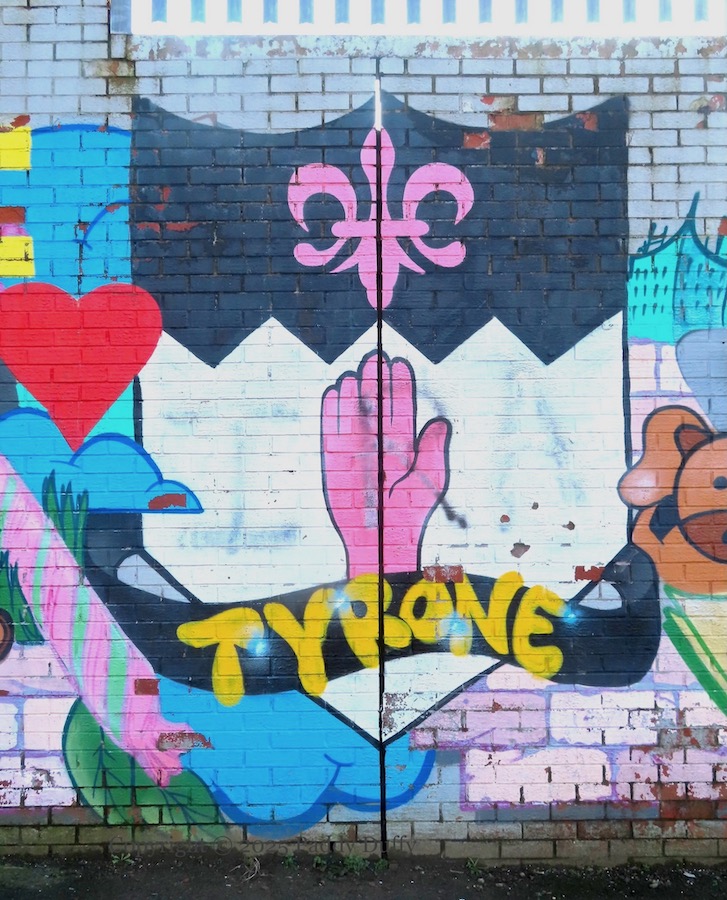
These are part of two pieces of youth art in the top car park of Springhill Park, Strabane.
Above, on the north wall, “[Don’t tar us] all with the same [brush]”, and below, on the east wall, “Good vibes” by local you youth with UVArts (web), from 2018 (youtube).


















 Paddy Duffy Collection