“Civilisation has its roots in the soil & without soil there will be no future life – Tá an duıne fréamhaıthe san ıthır, gan í ní hann dó” by Ed Reynolds (web | tw) and Tancredi Caruso. Together they put on an exhibition and painted a mural for the Belowground Visions Of Life project (Soil Security Programme). The mural is outside Bunscoıl Mhıc Reachtaın (hence the Irish translation) in the old ‘Little Italy’ area of Belfast. Sand or soil has been added to the mural to give it texture.
Bunscoıl Mhıc Reachtaın (McCracken Primary) is an Irish-language school named after the famous Belfast family and in particular after Mary Anne McCracken, who was a campaigner in the 1800s for the education of children both male and female (among with many other causes – see previously the post on the bust of Mary Anne in Carrick Hill, opposite Clifton House: The World Affords No Enjoyment Equal To That Of Promoting The Happiness Of Others.
The bunscoil opened in 1999 in the New Lodge, before moving to its current location (and site of this mural) in Lancaster Street (Naíscoıl Mhıc Reachtaın). (Lancaster Street is itself named after the controversial Quaker educator, Joseph Lancaster (WP) – Joe Baker p. 72.) According to an Irish News report in 2020 on Irish-language schools, the bunscoıl at that time, at least, had more pupils than its approved maximum.
The school borrows from the teaching philosophy of Patrick Pearse (Belfast Media), discussed previously in connection with Coláıste Feırste in An Tusa An Chéad Laoch Eıle?
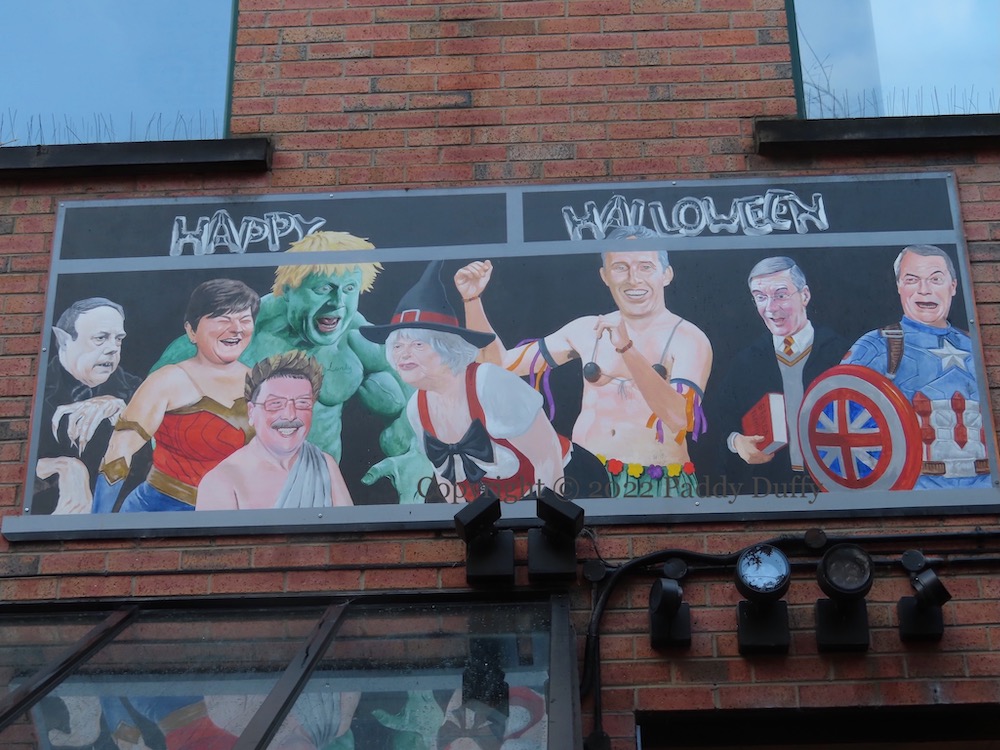
They have on their Halloween costumes, but can you name all of the politicians (some local, some from Britain) that are partying in courtyard of the Dark Horse, Belfast?
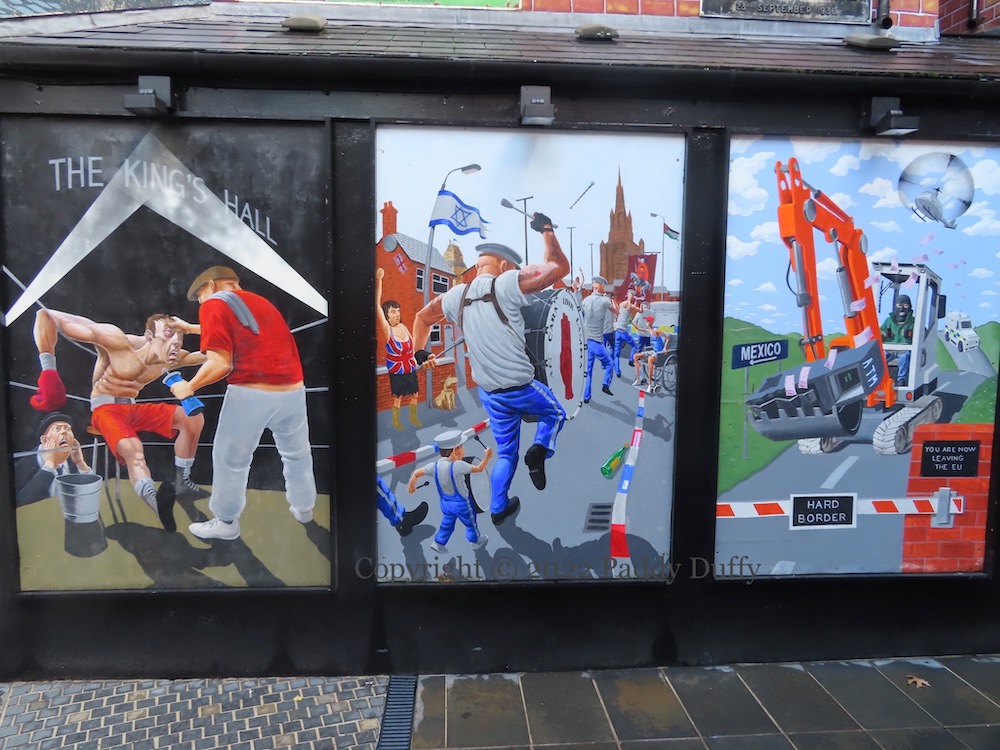
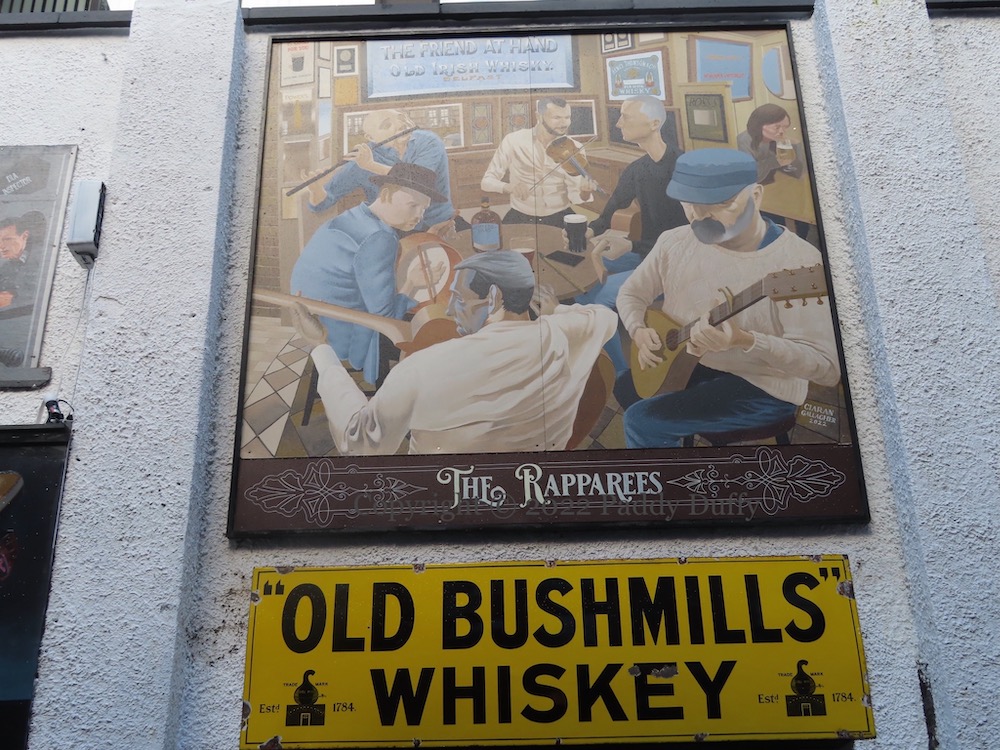
Easter marks the unofficial start of the PUL marching season, with many marches today by various Apprentice Boys bands. The season runs until the end of August, with a high point around July 12th (Parades Commission | CAIN calendar). The painting above (by Ciaran Gallagher (ig) in the Dark Horse courtyard for a nine-part series called The Friend At Hand) packs in many familiar tropes: King Billy on a banner, kerb-stones painted red-white-and-blue, the Israeli flag flying from a lamp-post, and a bottle of Buckfast lying in the gutter. Decorating the skin, however, is rare, and the use of Irish – “an cara ıdır lamha [lámha]” [“in aıce láımhe” or “ag an láımh”] – on a Lambeg drum is unknown.
The other panels in the group of three show a boxer being attended to in his corner at the King’s Hall and a masked man leaving the EU and heading for Mexico off with an ATM in the bucket of an excavator.
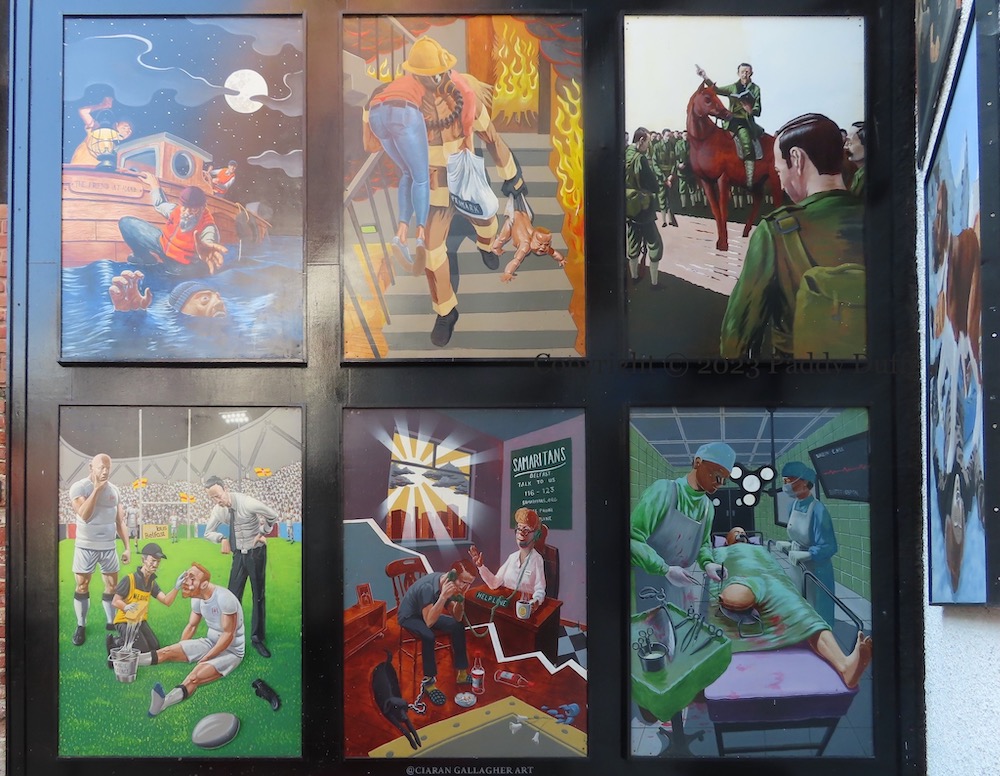
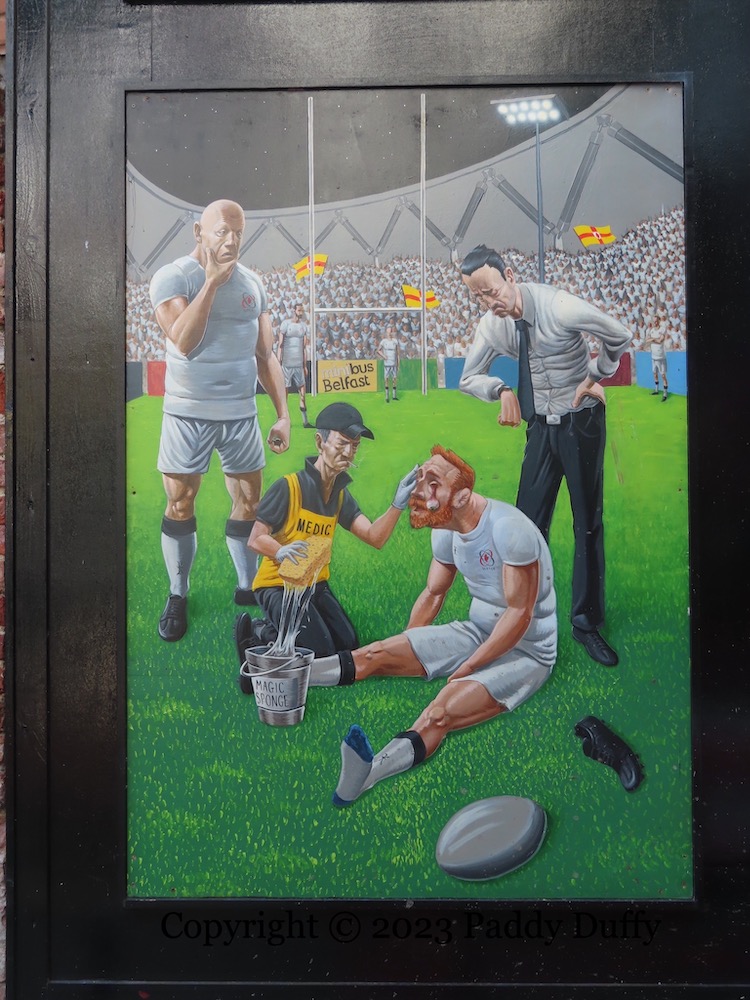
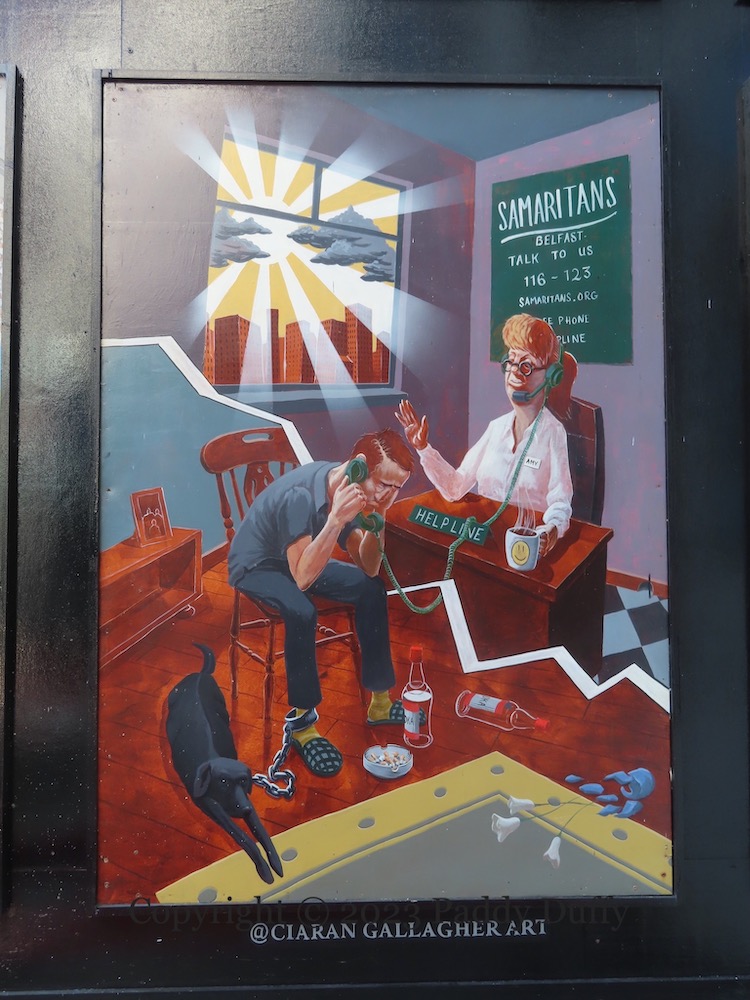
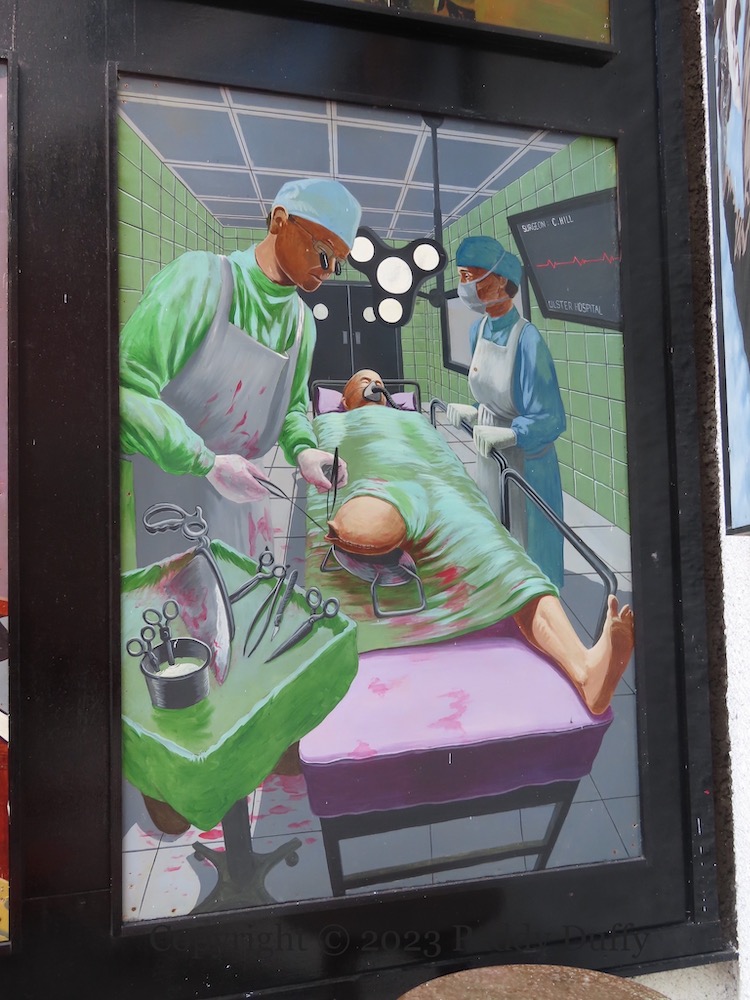
Six more are included together, below: a fisherman is rescued from drowning; a medic attended to an injured player; the Samaritans helpline; a firefighter carries two people from a burning building; a surgeon operates; a chaplain reads to troops.
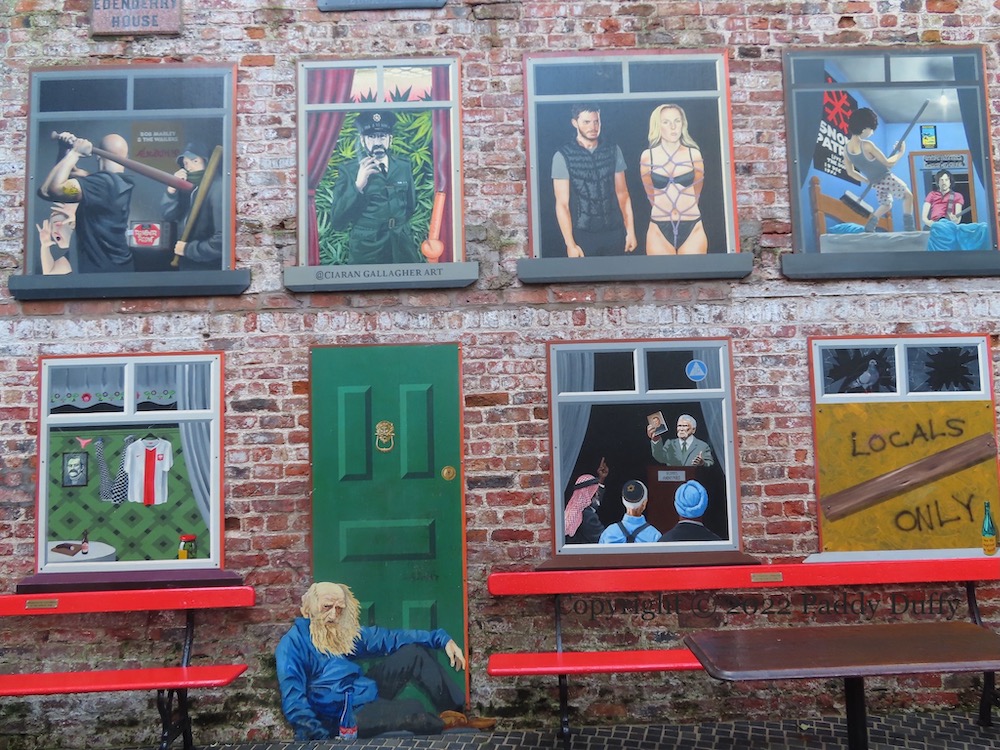
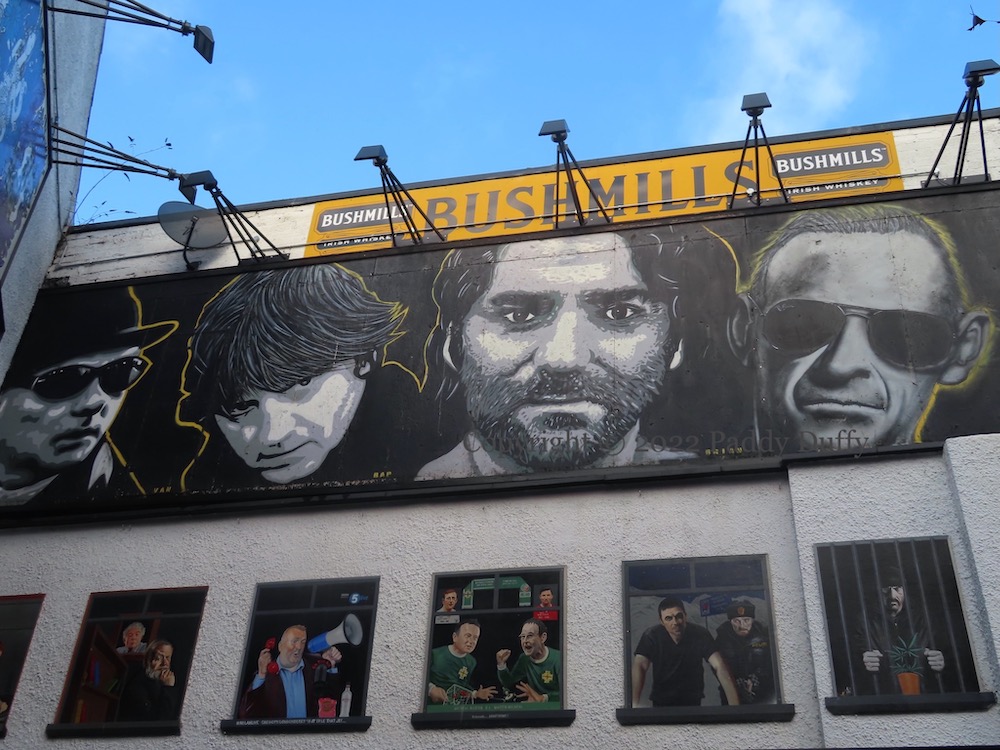
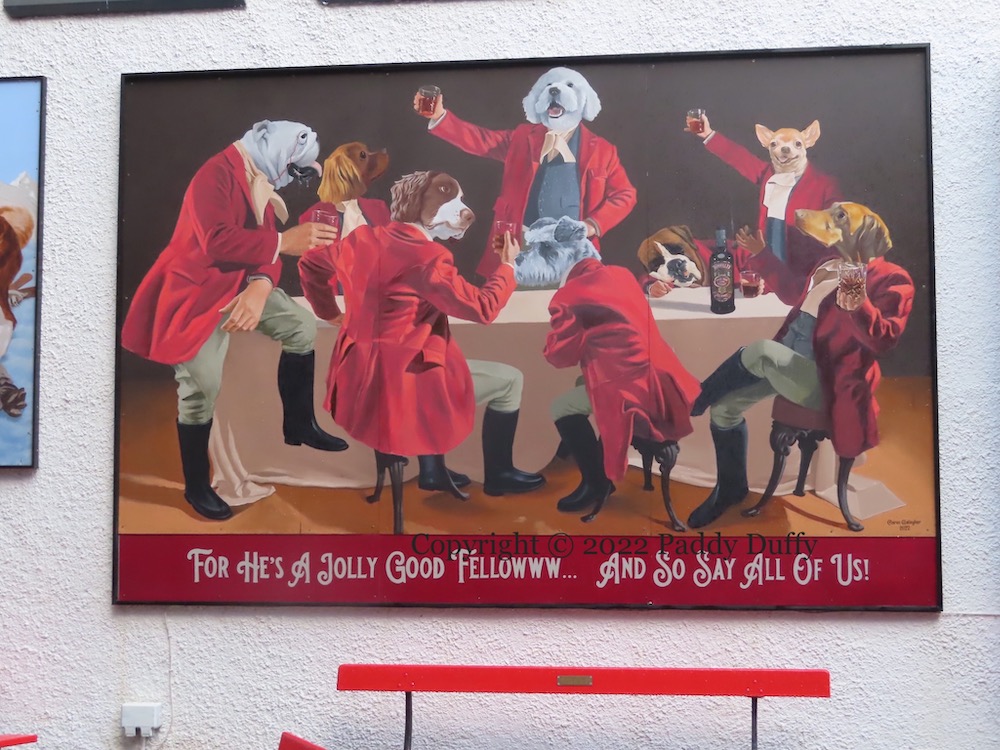
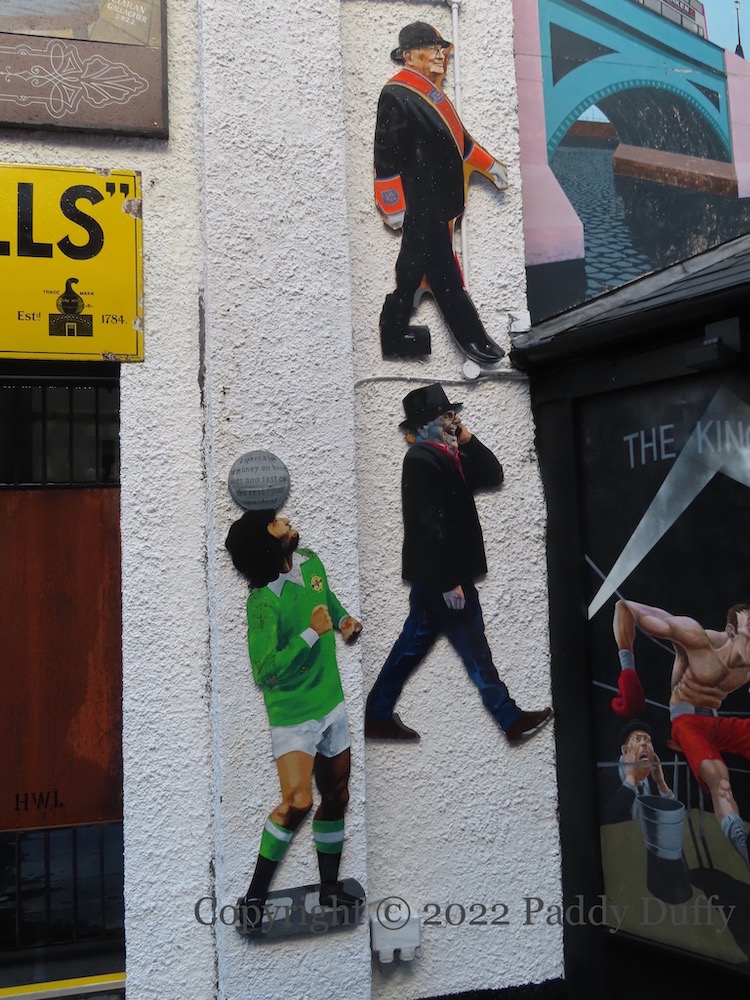
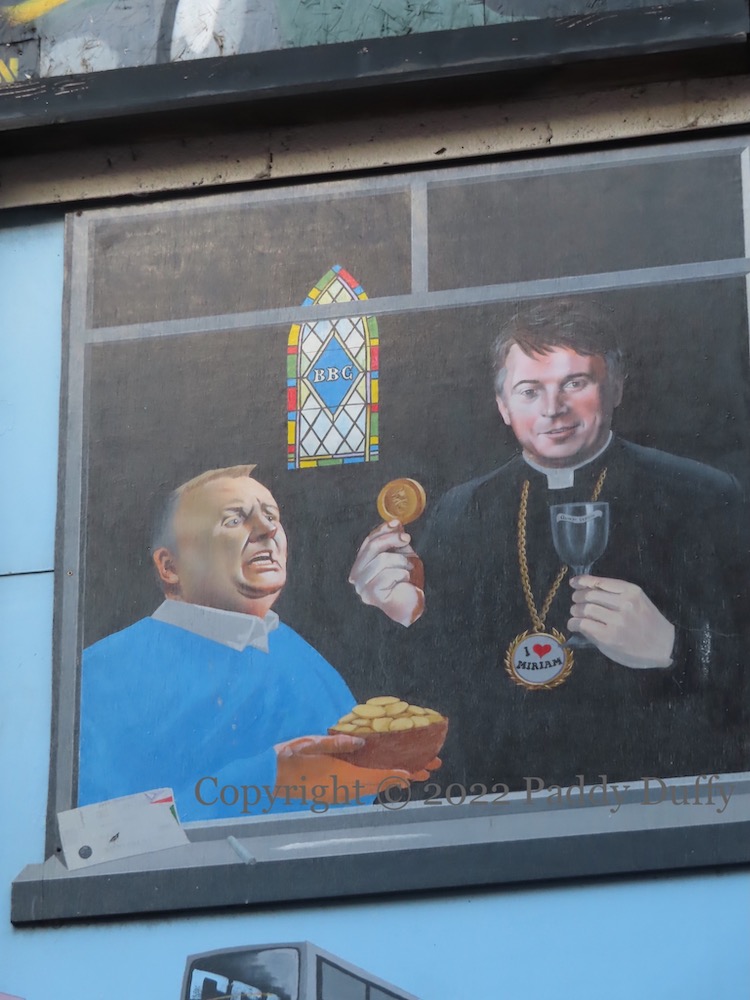
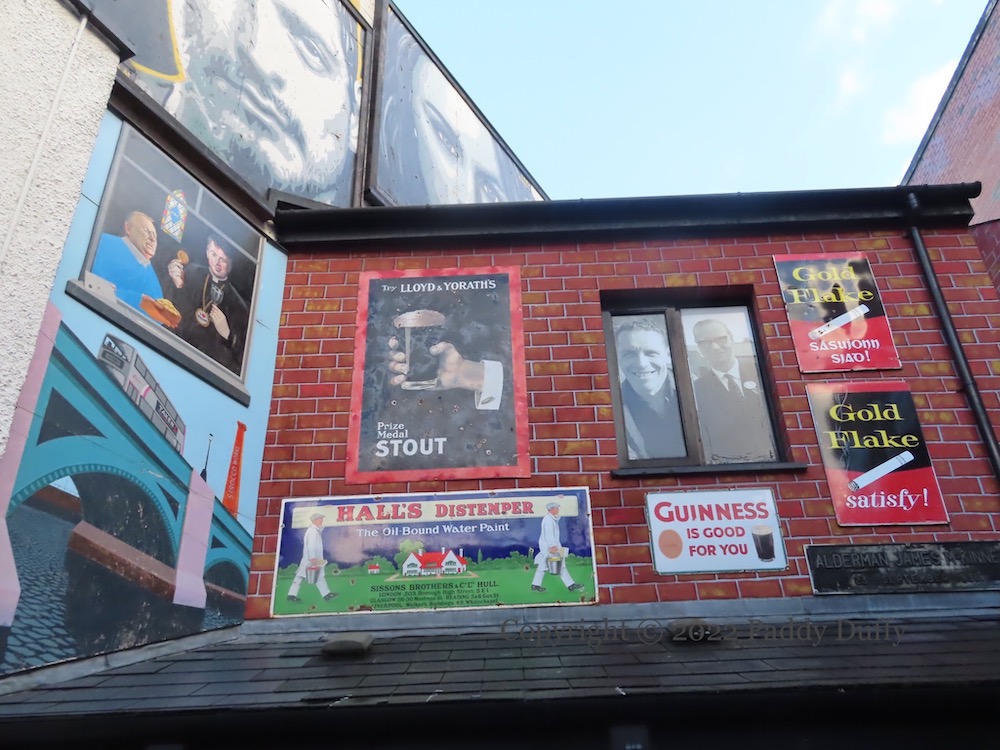
Here is a gallery of many of the pieces in the courtyard of the Dark Horse bar in Belfast city centre, presented in clockwise order from the entrance on Commercial Court.
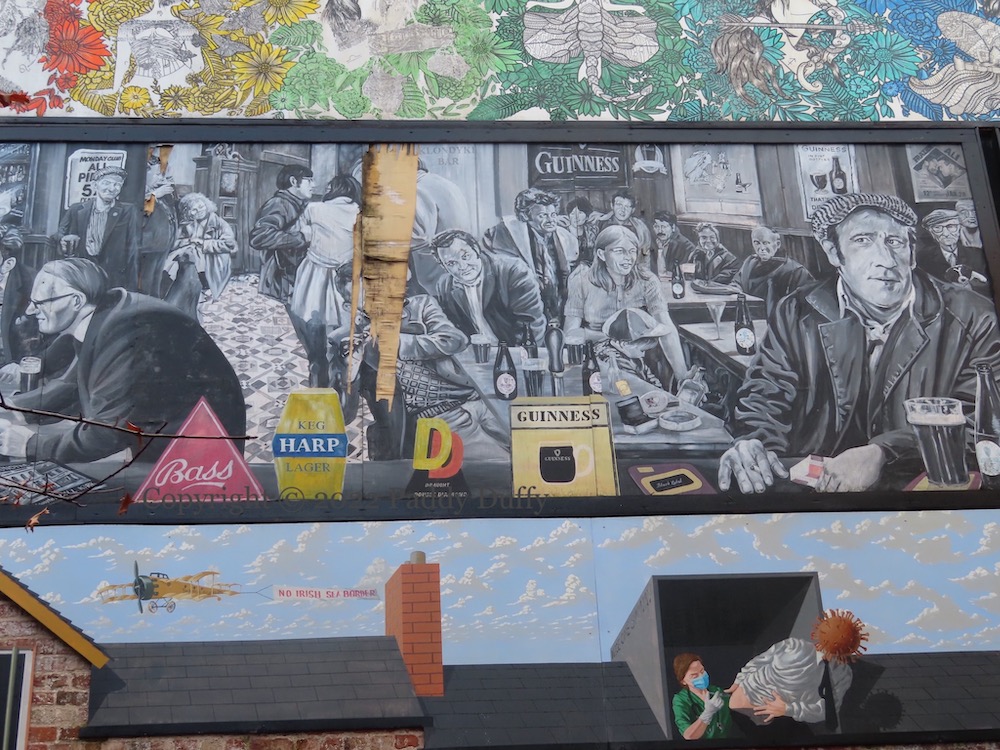
Above and immediately below: the scene in the Klondyke Bar. Links to additional pieces can be found at their appropriate places in the “rotation”, below.
Martin McGuinness and Ian Paisley in the clouds
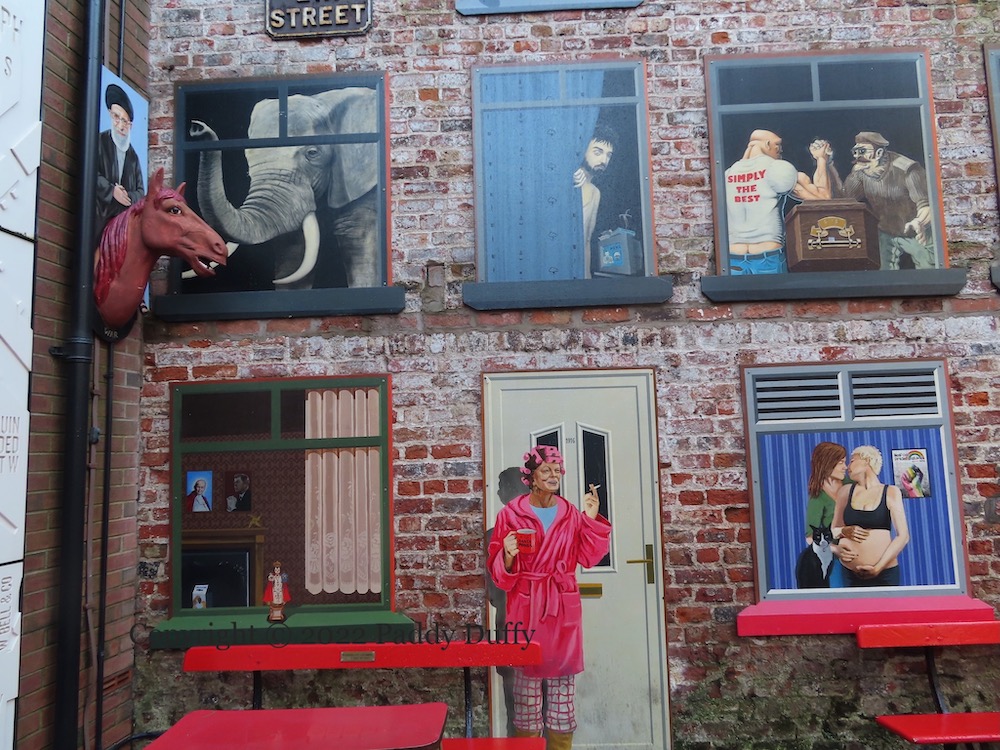
Belfast Stripped Bare – a view into people’s houses by Ciaran Gallagher (web); many of the painted pieces in the yard are by Gallagher.
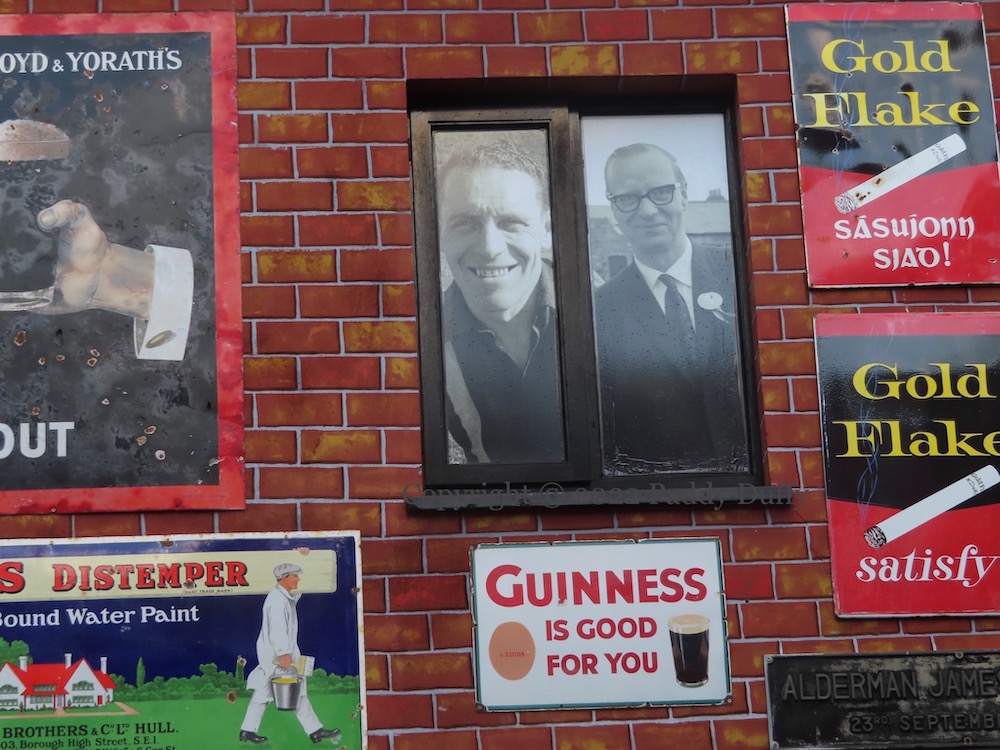
A variety of vintage advertisements from the late 1800s and early 1900s: Lloyd & Yorath’s stout (Newport, Wales), Hall’s paints (Hull), Guinness, Gold Flake tobacco (in both English and Irish: Sásuíonn sıad!), Batey’s ginger beer (London), Gilbey’s wines, Mew’s brewery (Isle of Wight).
“Ourma says if you stick t’herown diet of land-an-dairy prod you’ll be firmanna an’trim down” – a saying in which the names of all six Northern Irish counties are (phonetically) included.
“Time changes! But the sacrifice remains the same.” The board shows, in black and white, a WWI soldier, who is comforting another solider, in modern gear and in colour. The emblems of the 36th (Ulster) division and Royal Irish Rifles are also shown. Sponsored by the EU and the Cosy Somme Association. This is a repainted version of the original (late 2013) board which had faded badly.
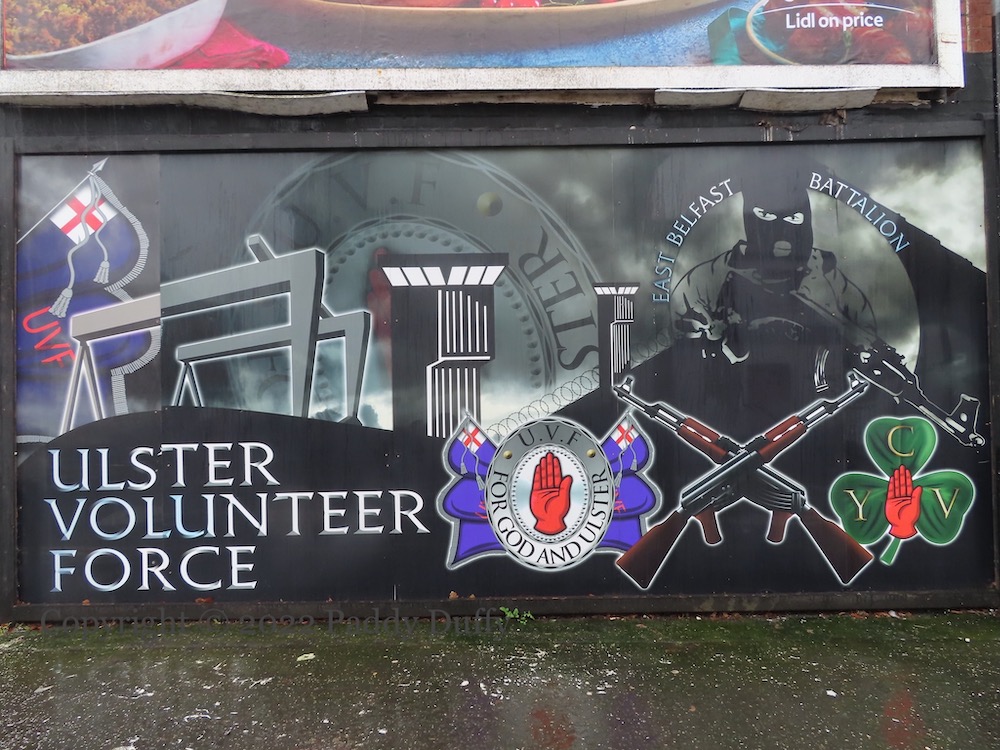
The previous UVF mural in Carrington Street (Volunteering | On Your Side) was paint-bombed in October, 2020, (Keep It Local) but was quickly replaced by this computer-generated board showing the Harland & Wolff cranes, a Long Kesh watch-tower, and a hooded gunman from the UVF’s East Belfast Battalion.
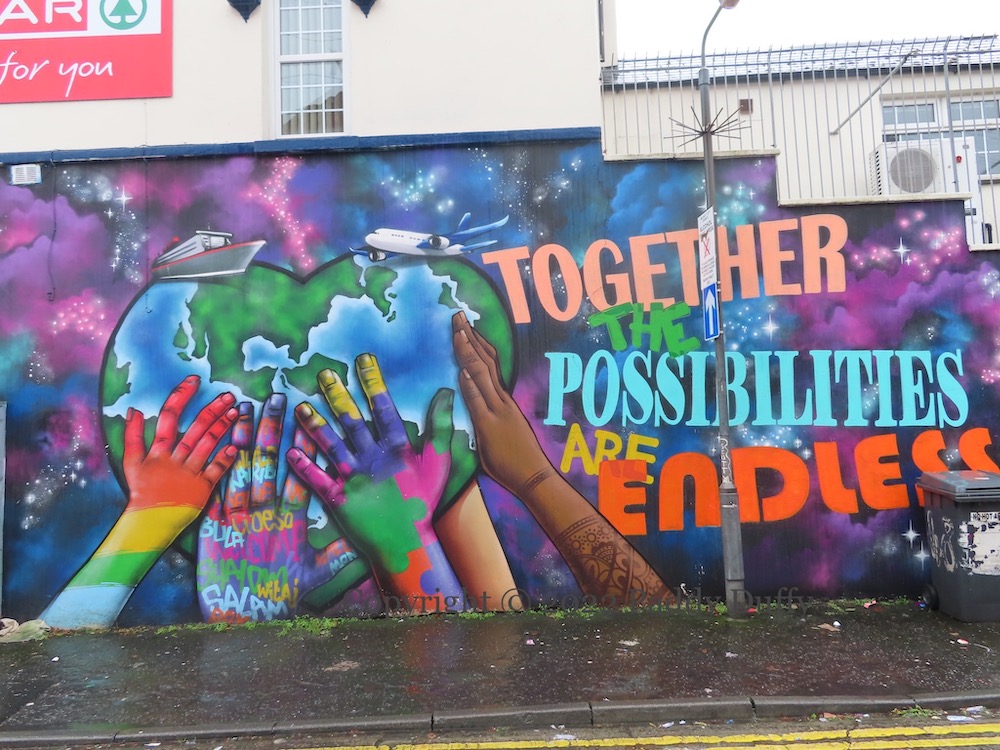
This east Belfast mural showing hands of many colours holding up a heart-shaped earth was produced last year in tandem with a diversity night in memory of the Pakistani-born owner of the Spar on whose side it is painted (Belfast Media).
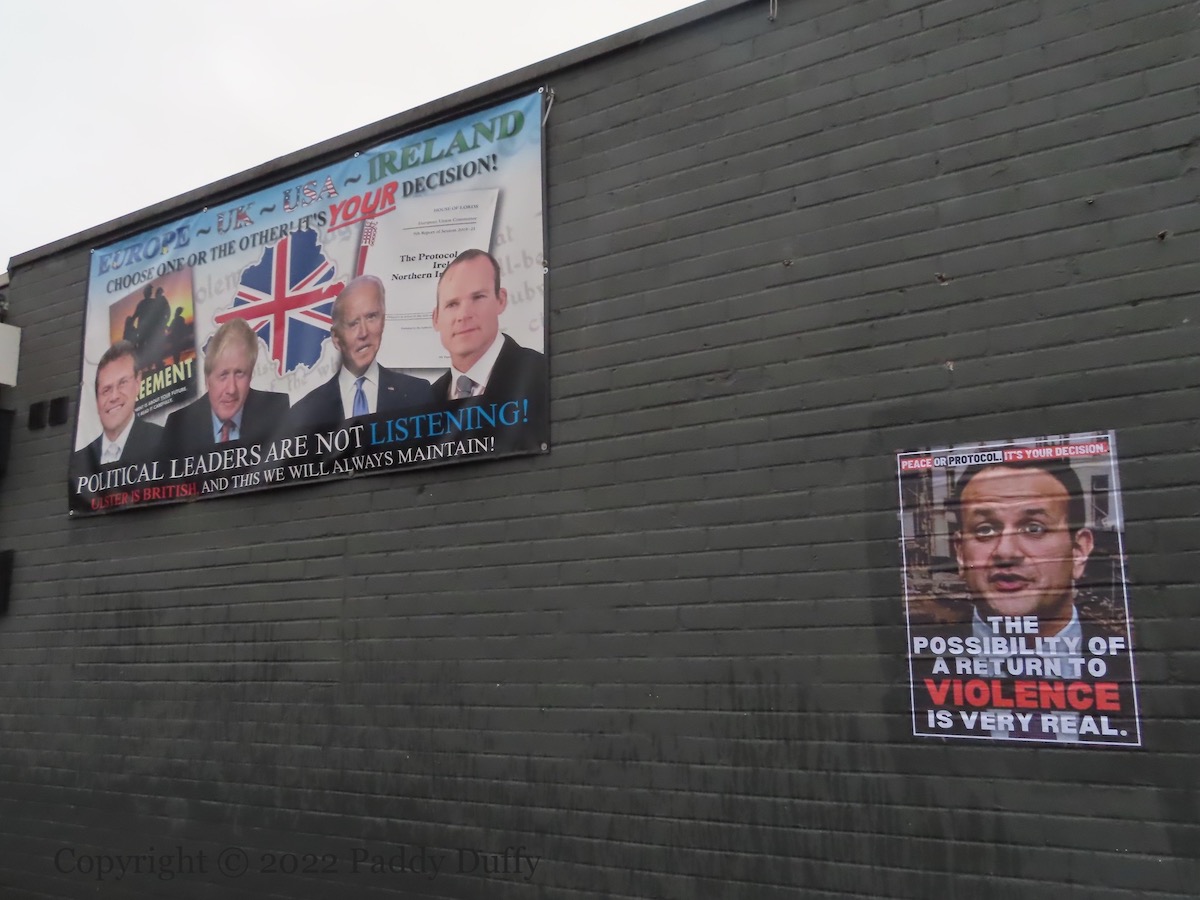
Left: After a break for the funeral of the Duke Of Edinburgh, the Loyalist Communities Council has resumed its protest of Brexit with a banner campaign (Irish News). The banner seems to be offering viewers the choice of one of four affiliations (“Europe – UK – USA – Ireland – choose one or the other! It’s your decision!) but the “correct” answer is at the bottom (and in the faded background of the Covenant): “Ulster is British and this we will always maintain!” even though “Political leaders are not listening!” (including, perhaps, Arlene Foster and the DUP.) The Belfast Agreement (Good Friday Agreement) allows people in Northern Ireland to identify themselves as Irish, British, or both.
Right: “Peace or protocol – it’s your decision”, aimed at Leo Varadkar on the day that he again became Taoiseach (Irish Times) and repeating his words back to him from a speech in 2018: “The possibility of a return to violence is very real”. At that meeting, Varadkar was anticipating violence by anti-Agreement republicans in response to customs posts on the Ireland-Northern Ireland border, and brought a newspaper describing the death of four customs officials, two lorry drivers, and three IRA volunteers at a Monaghan post in 1972 (BelTel).
The authors of this poster are not known, but the parallel statement (mutatis mutandis) would be that anti-Protocol agents – perhaps the “young loyalists” that the UVF “can no longer contain” (UK Daily; see also RTÉ from November) – might return to acts of violence such as the 1974 “Dublin & Monaghan Bombings” that killed 33 people – in the background of the poster is part of a photograph (included below) of bomb damage in Talbot Street – if the Protocol’s “Irish Sea border” is not removed.
Ballysillan Road and (below) Oakmount Drive (near Mount Vernon), north Belfast.
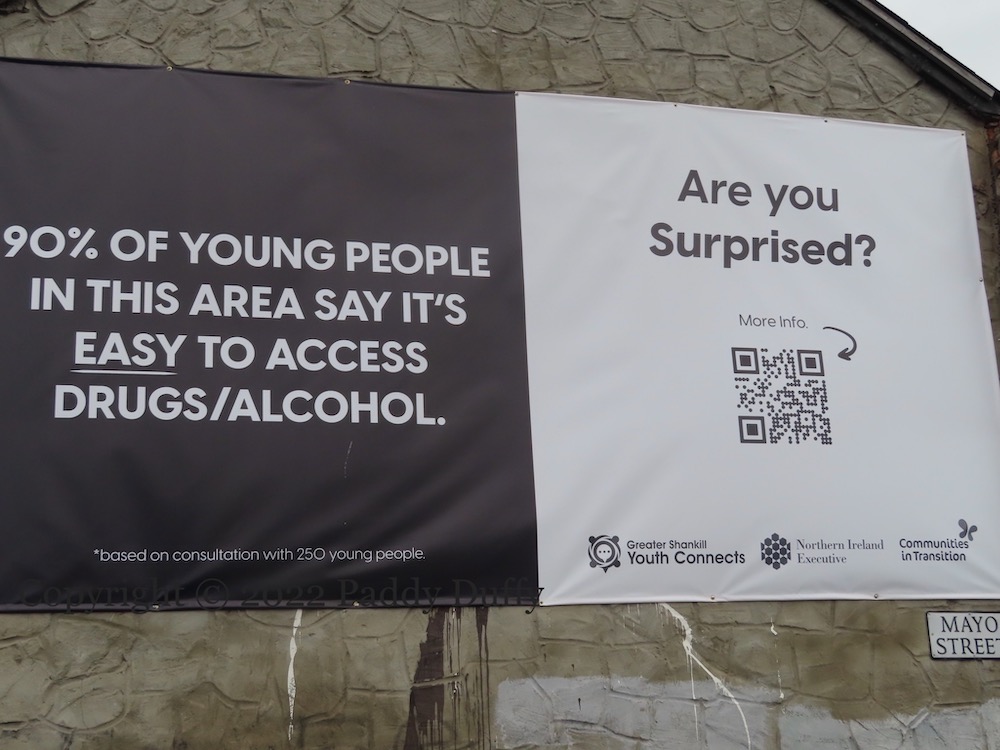
“90% of young people in this area say (based on consultation with 250 young people) it’s easy to access drugs/alcohol. Are you surprised?” For more on this campaign by Greater Shankill Youth Connects (Fb) promoting their “Shankill Talks” forums, see Belfast Live.




















 Paddy Duffy Collection