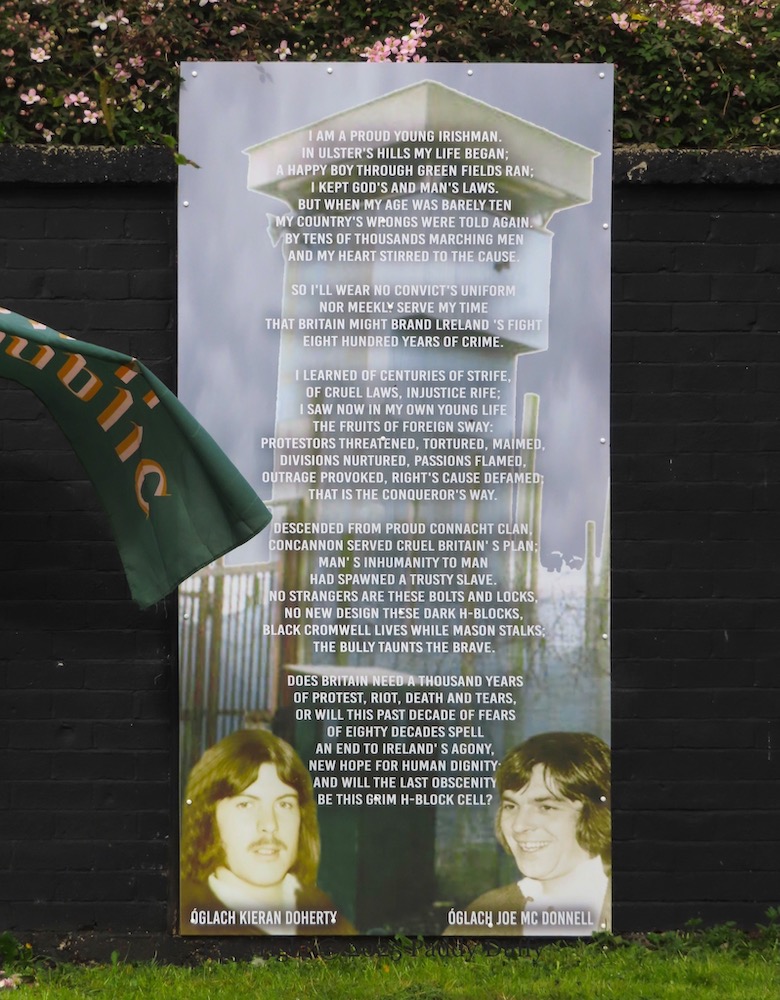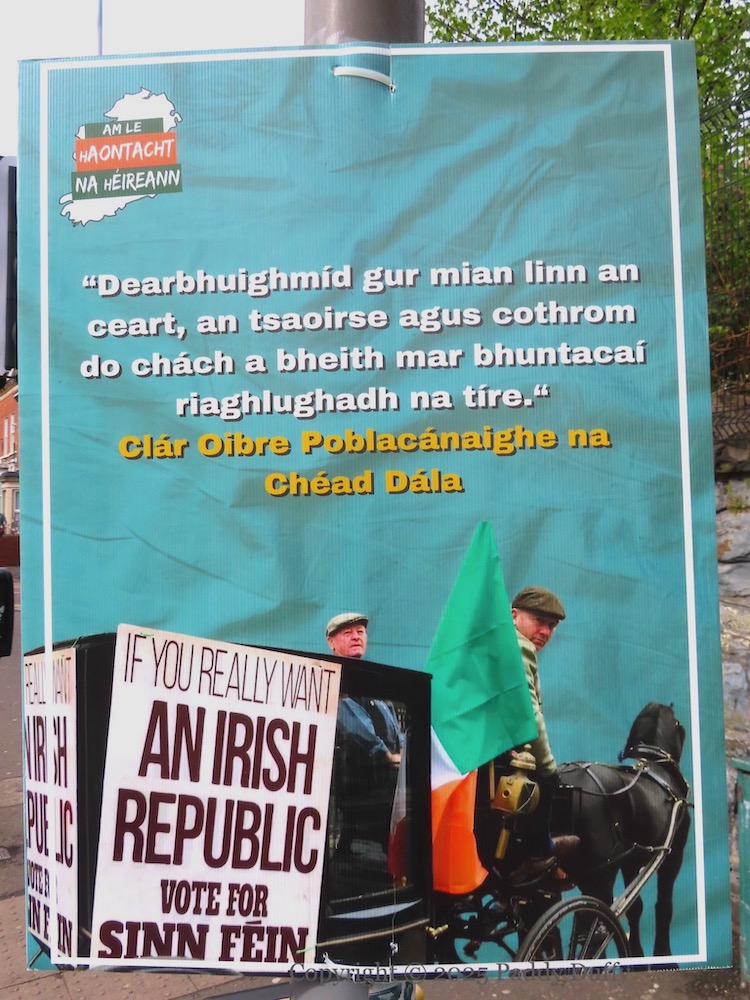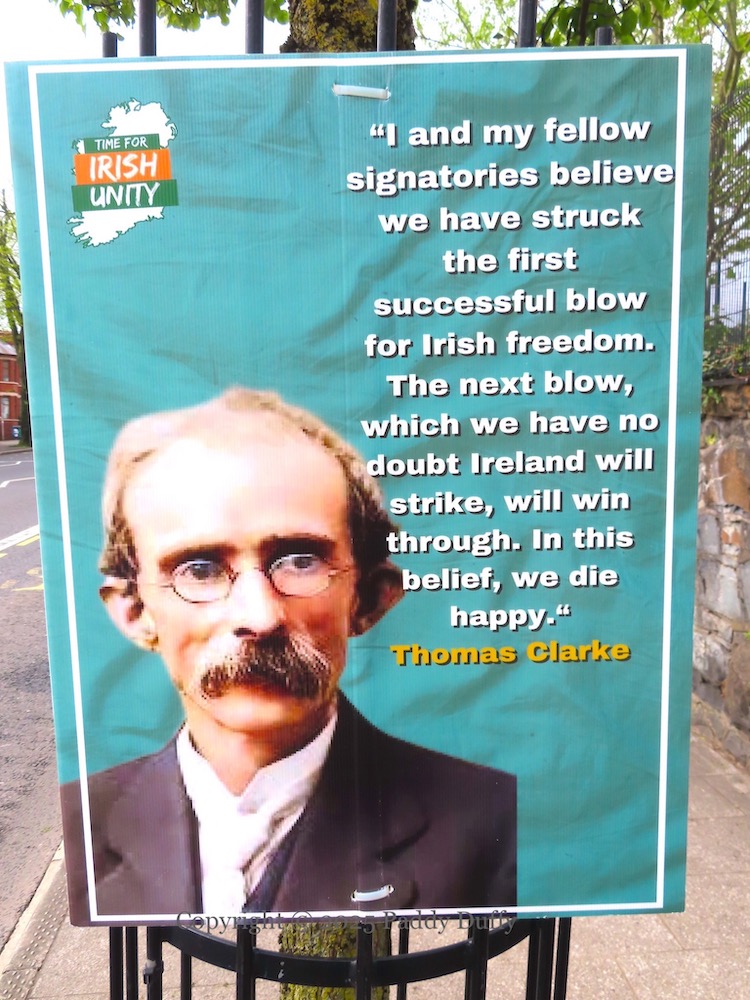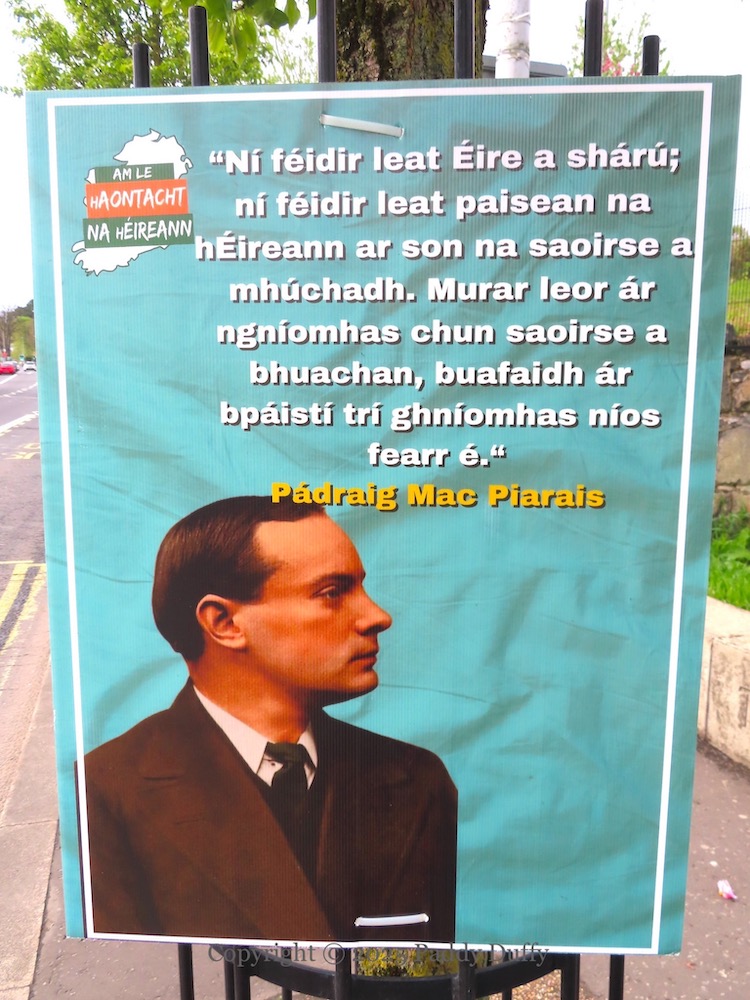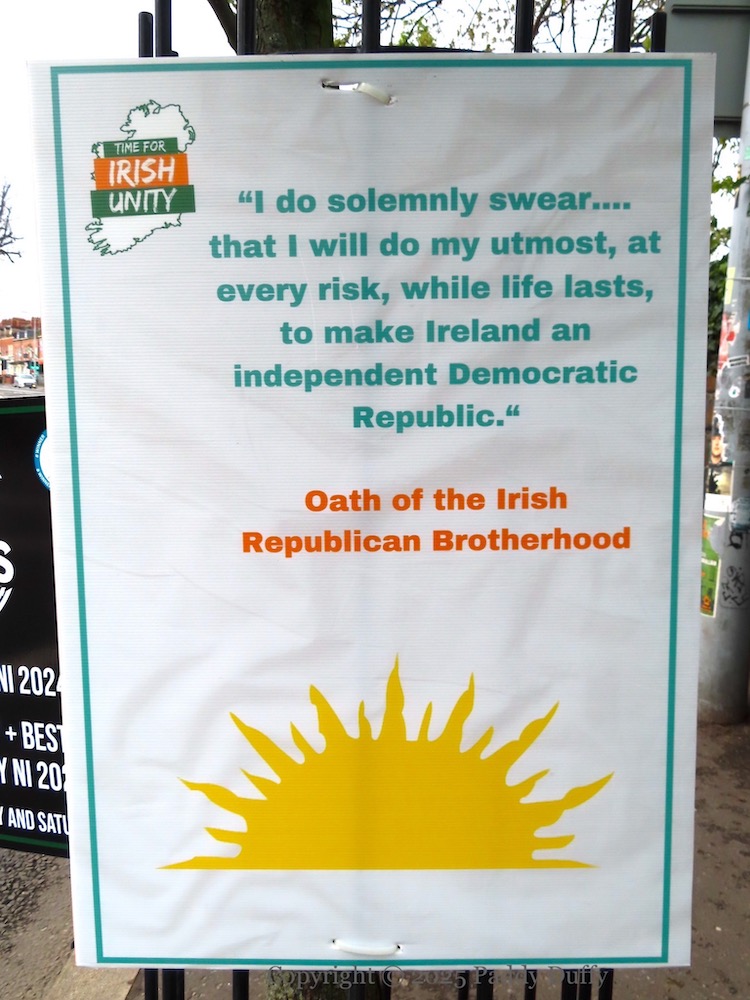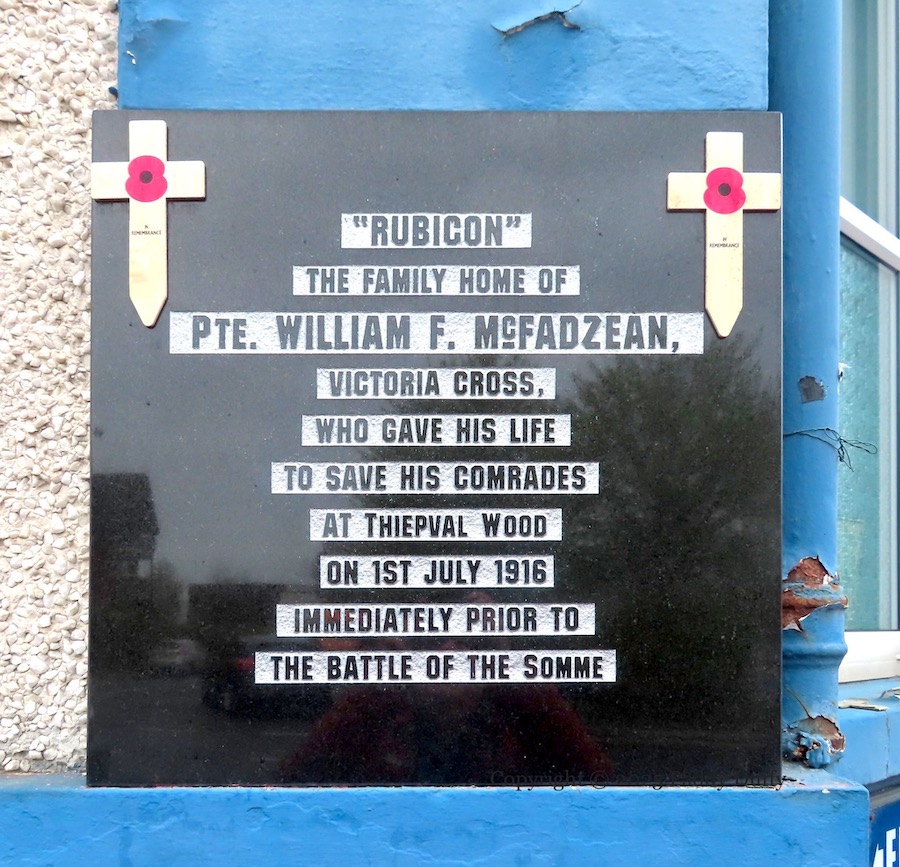
“H” for “H-blocks” and for “hunger” – the flower garden in front of the hunger strikers’ memorial in Rossville Street, Derry, has been replaced with this “H” in white pebbles among black.
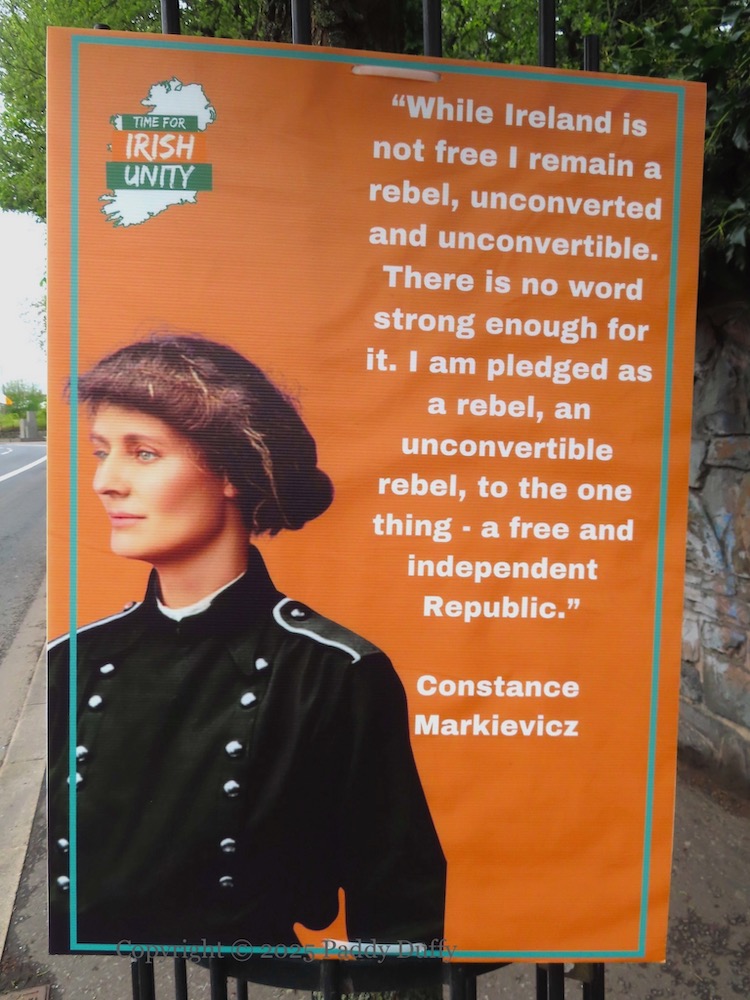
The 1918 ‘Representation Of The People’ act gave 8.4 million women in the United Kingdom the right to vote (WP). (For the two women on the left holding the ‘Votes For Women’ sign, see Women’s Hall And Cost-Price Restaurant.) In that same year, Countess Constance Markievicz was the first woman elected to Westminster and became Sınn Féın Minister For Labour in the first Dáıl Éıreann that was established as an alternative. Ten years earlier, she had co-founded Na Fıanna Éıreann with Bulmer Hobson. The names of Derry fianna are listed on the right. “Fuaır sıad bás ar son saoırse na hÉıreann.” (This board replaces the former Fianna mural that celebrated the centenary in 2009.)
To the left (above) is a “Join RSYM” stencil with the names of the ten deceased 1981 hunger strikers; to the right is a picture of the memorial across the street to the dead of the 3rd battalion of the Doıre Brigade Óglaıgh na hÉıreann.
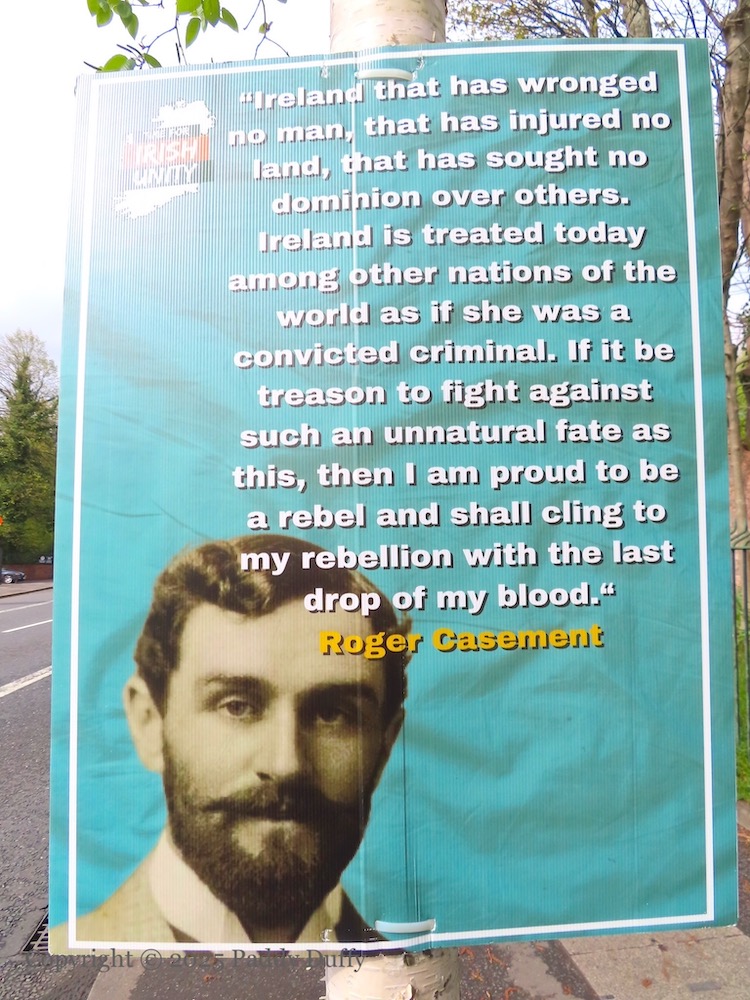
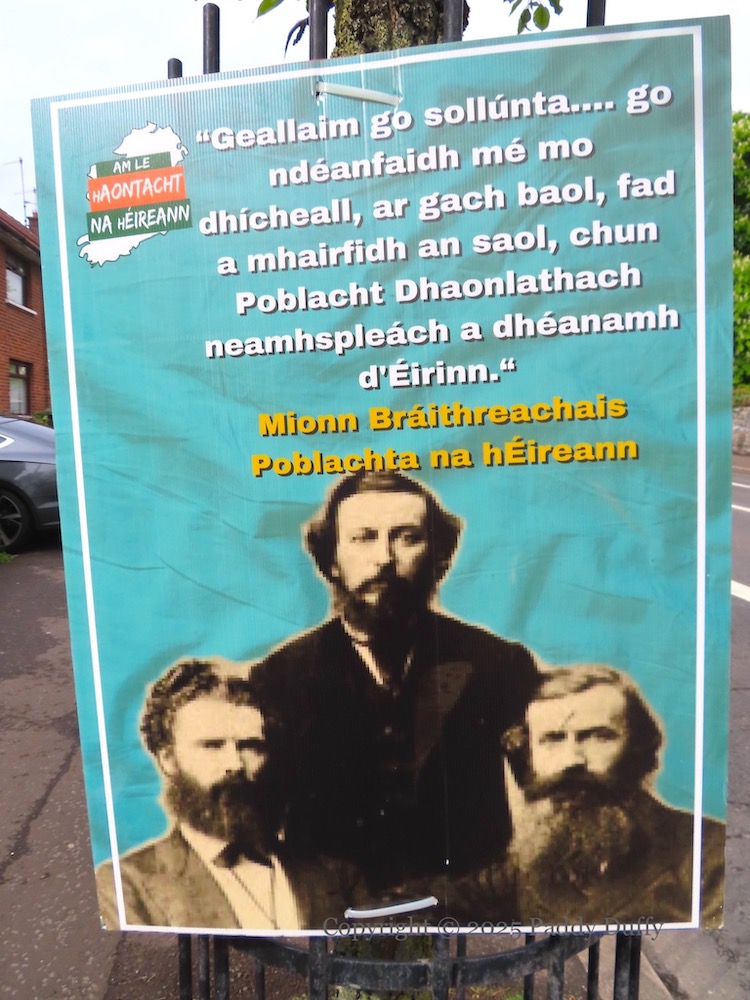
“But while Ireland is not free I remain a rebel, unconverted and unconvertible. There is no word strong enough for it. I am pledged as a rebel to the one thing – a free and independent republic.”
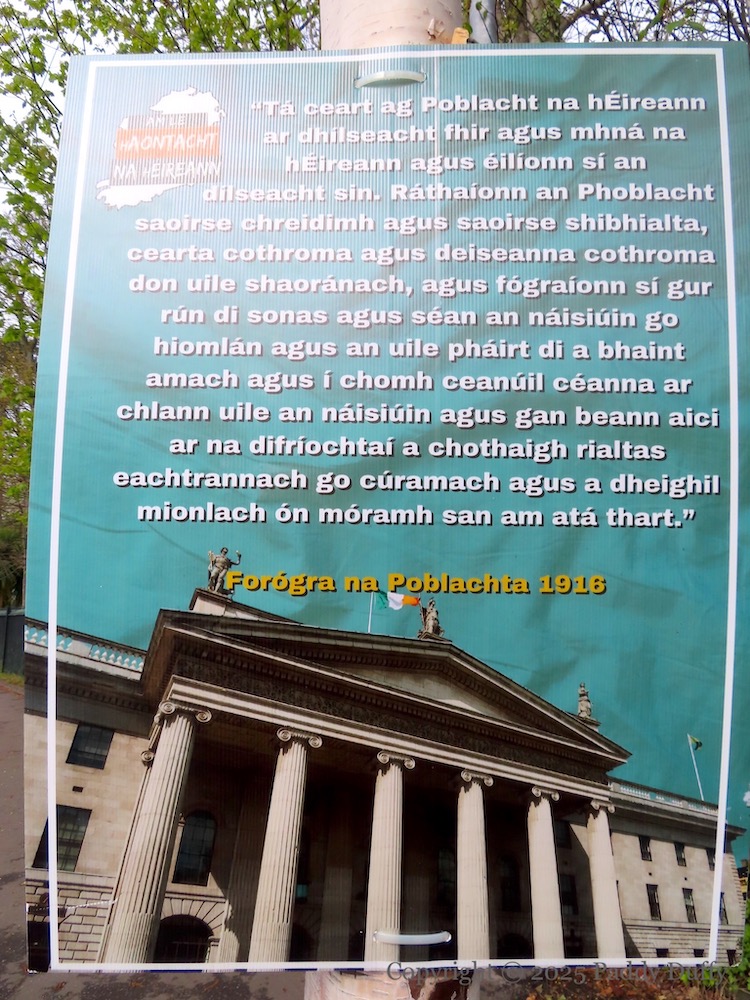
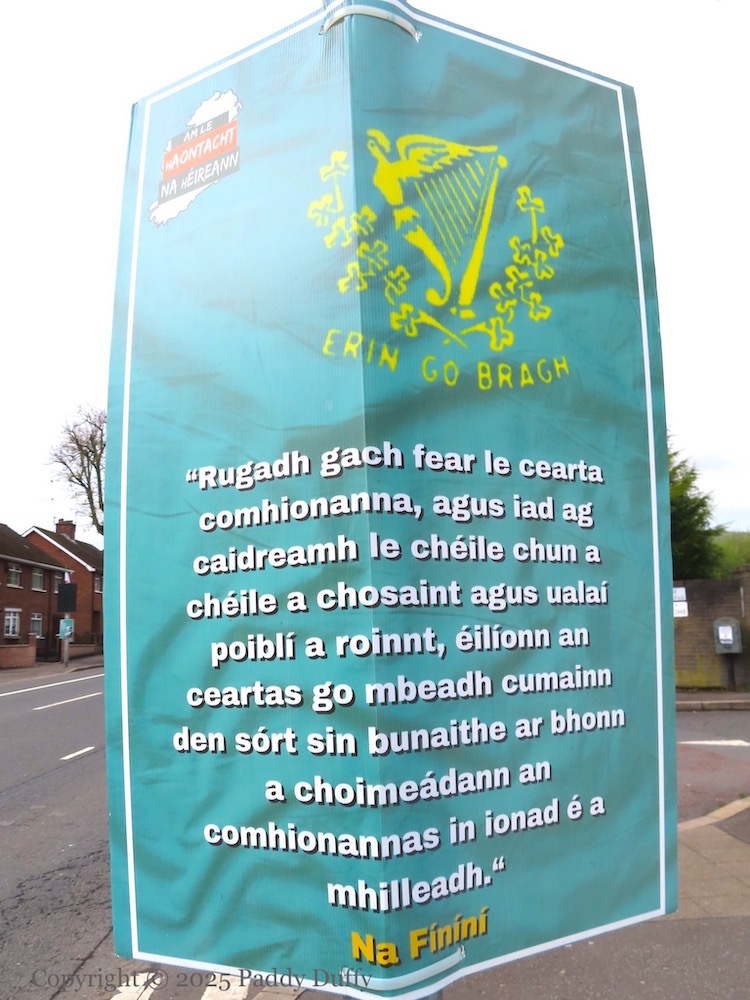
“Ach a fhad is nach bhfuıl Éıre saor, seasfaıdh mé an fód mar cheannaırceach, gan géılleadh, gan athrú. Níl focal dá bhfuıl atá chumhachtach go leor. Tá gealltanas tugtha agam mar cheannaırceach, cuspóır amháın a chur ı gcrích – poblacht shaor agus neamhspleach.”
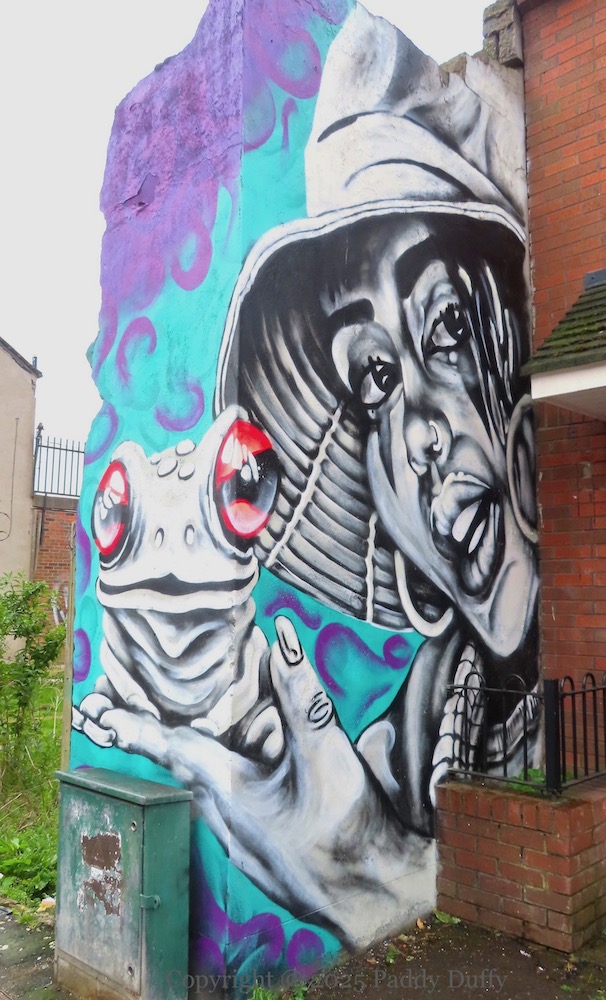
Here is a painting of a model from Femelle Studios (ig) by London artist Mr Cenz (web | tw) in Londonderry’s Waterside, with support from UVArts (ig). With “Death dealers out” graffiti to the right.
This is the second mural in Derry to Sister Clare Crockett. The first was in her Brandywell home (see All Or Northing!!) while this one is in Shantallow. Crockett became a nun in 2001 and died at the age of 33 in an earthquake in Ecuador in 2016 – the mass for the seventh anniversary of her death was held last month (youtube).
This is the mural painted by UVArts (web) to accompany the About Us film exhibition that visited London-/Derry in March, showing life from the Big Bang until the present day, commissioned by Unboxed.
A new painting of Amelia Earhart has been created by JEKS (ig), on the side of the Foyle building, North West Regional College, on Queen’s Quay. A number of sources claim without citation or measurement that it is the tallest piece of street art in the north – both the BBC and the Chamber Of Commerce use the passive “thought to be”. Its closest competitor would be the recent piece by Zabou on the Telegraph Building in Belfast – see Broken Promises.
The Foyle Building has six “levels” (NWRC) while the original Telegraph Building had four storeys (Archiseek). In addition to comparing images of the two paintings, you can also judge by comparing Street View images of the buildings: Derry vs Belfast.
Information about Earhart’s connection to the Maiden City can be found in the entries on the printed board (But What Do Dreams Know Of Boundaries?) and the mosaic (Flying Solo) to Earhart in Derry.
“For Mickey Griffiths, the punk of this parish.” In the 1970s and ’80s, Mickey Griffiths from the Brandywell, Derry, served as drummer and lyricist for a series of Derry punk bands: Idol Threats, Dick Tracy & The Green Disaster, The Shameless Hussies, and The Hitlers (NIPunk). Griffiths died in November of 2018 (Derry Now) and this mural was painted in Castle Street/Magazine Street by UV Arts (ig) to remember both him and the 45th anniversary of the Undertones’s hit ‘Teenage Dreams’ (Fb).
Ireland’s most famous export is not its music – including Fontaines D.C. (web) – or its stout – including Guinness – but its people, about 10 million of them since 1800 (WP). The youngster in this new mural by Dublin artist ACHES (ig) is torn in different directions.
Tillie & Henderson’s shirt factory opened in 1856 at the junction of Abercorn Road and Foyle Road, Derry (next to the ‘Hands Across The Divide’ statue) and survived until 2003 when it was demolished after a fire (BBC); an apartment block was planned for the site (Derry Journal | BBC) but as yet nothing has happened. It was the largest such factory in the world and one of 44 shirt factories in the city in 1900, all of which employed women, many starting in their teens.