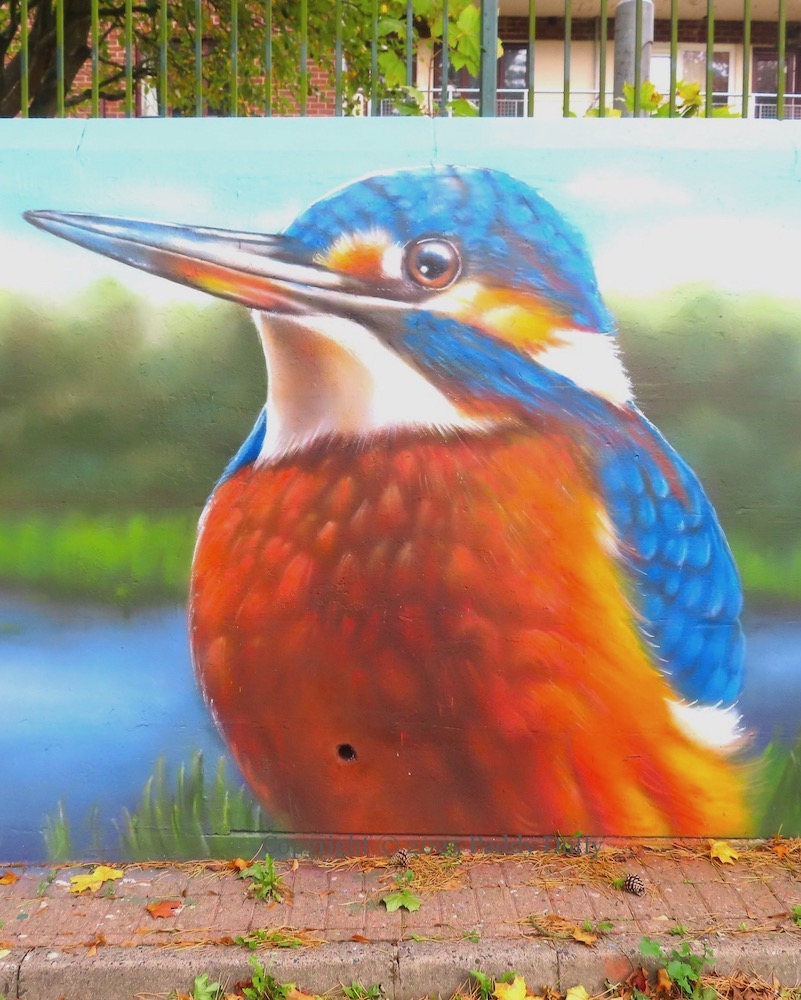
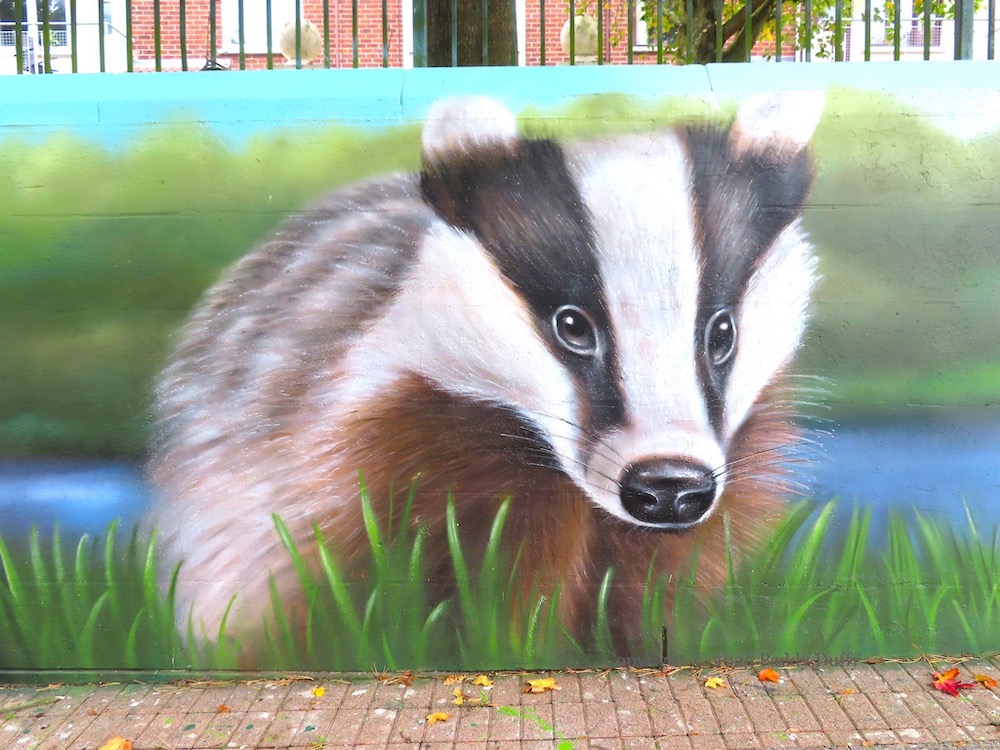
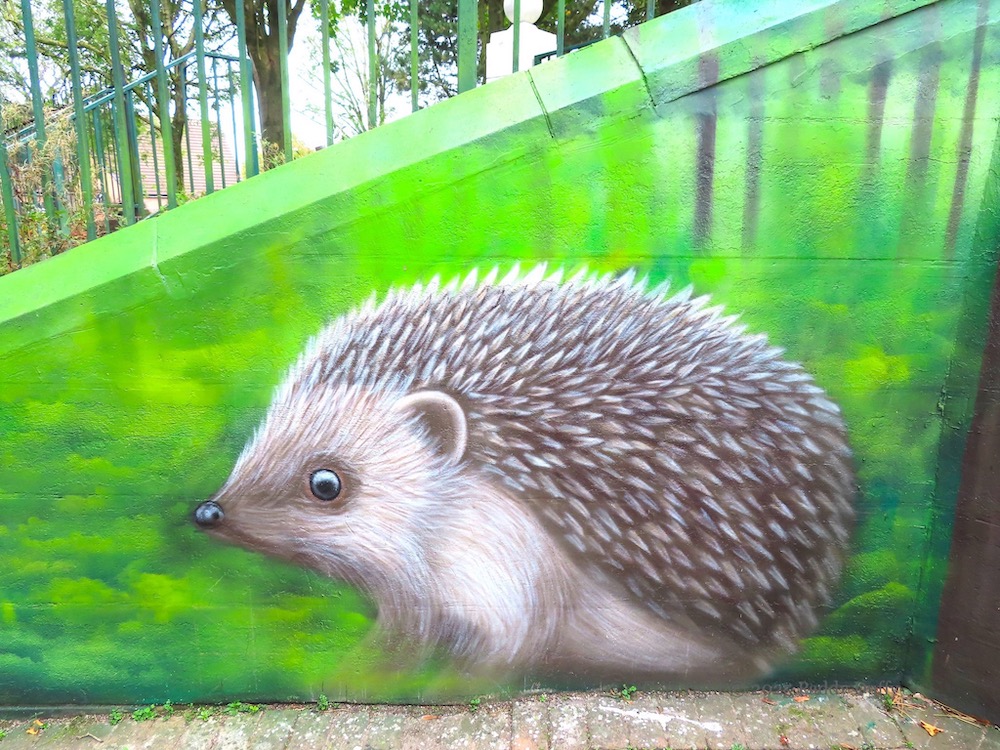
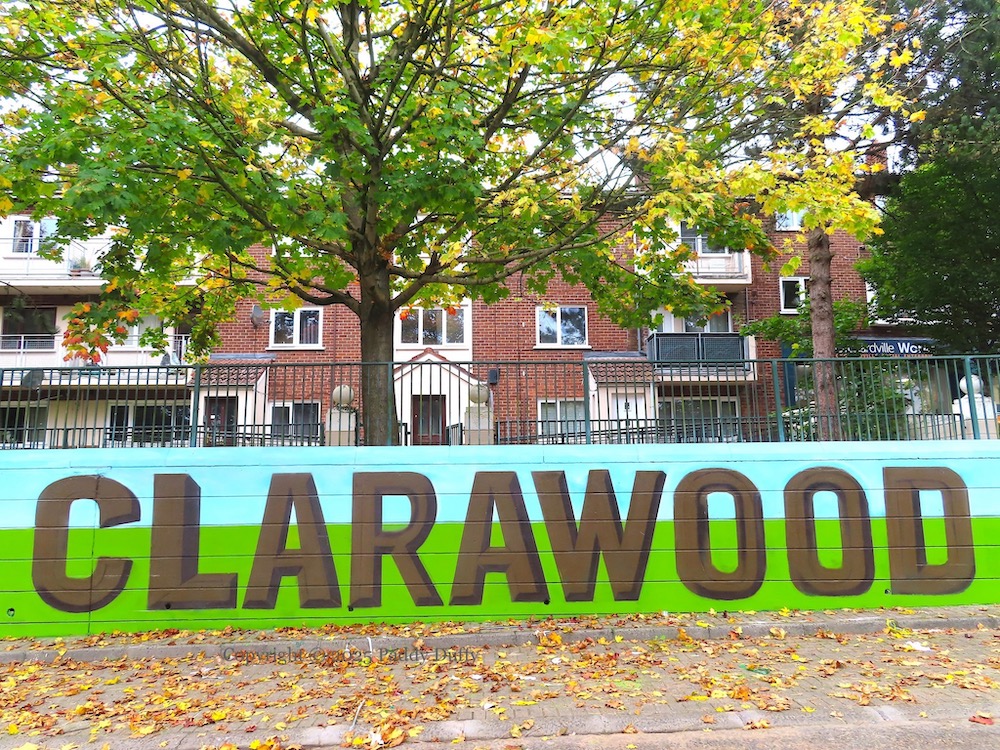
Here are a kingfisher, heron, badger, owl, squirrel, fox, and hedgehog by Glen Molloy (ig) in Knockwood Park, Clarawood, east Belfast. The closest place one might be able to see any of these creatures – particularly herons – is in the Marsh-Wiggle pond, along the Connswater (East Side Greenways).
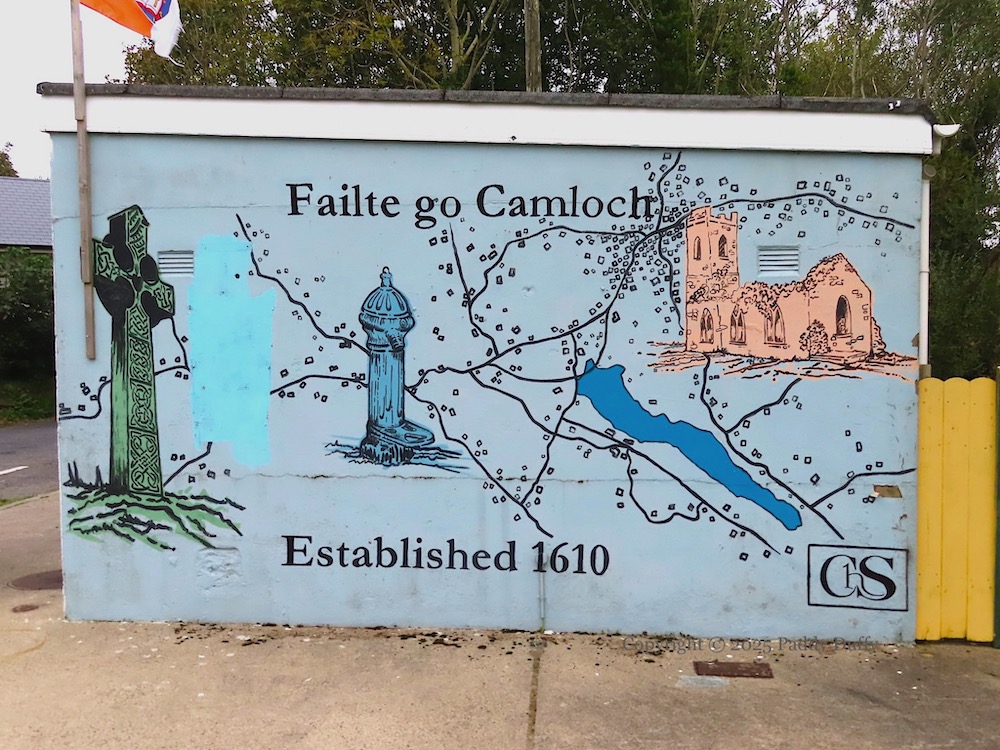
This mural is on the pump-house at the junction of Sturgan Brae and Newtown Rd, west of Camlough town and at the northern end of the “cam loch” [crooked lake]. The lake and the junction are visible in the centre-left, with the village itself just below the “h”. The map is between (to the left) the Celtic cross in the republican plot in St Malachy’s and a turn-of-the-century (1900) village water-pump (NBHS) and (to the right) the ruins of St Jude’s church (Christ Church).
The referent of “established 1610” is not clear. “ChS” in the lower right is perhaps “Camlough Heritage Society” (BBC).
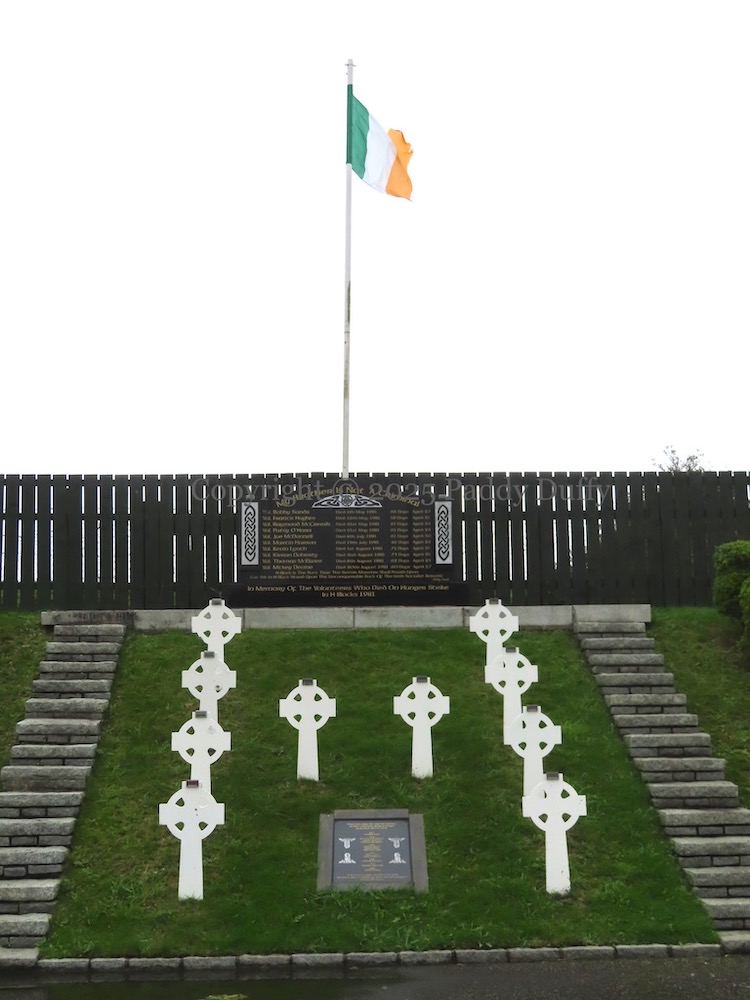
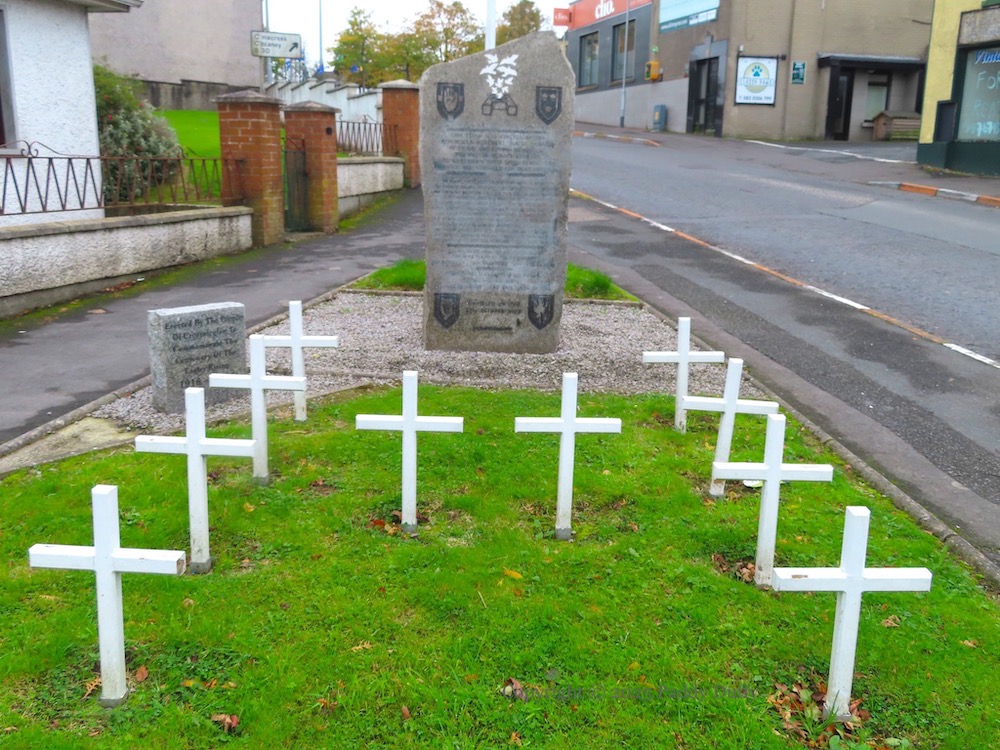
The brothers in question are Raymond and Brian McCreesh, from Camlough, Co Armagh. Raymond is third in the list of the ten deceased 1981 hunger strikers on the large stone at the top of the slope: “In memory of the volunteers who died on hunger strike in H-Blocks 1981.” The quote along the bottom reads, “H-Block is rock that the British monster shall perish upon for we in H-Block stand upon the unconquerable rock of the Irish socialist republic – Bobby Sands”; the source of the quote in unknown.
The lower stone reads “These men made the supreme sacrifice for their country by dying on hunger strike from 1917 to 1976: 1917 Thomas Ashe; 1920 Michael Fitzgerald, Joseph Murphy, Terence McSwiney; 1923 Joseph Whitty, Denis Barry, Andy Sullivan; 1940 Tony Darcy, Sean McNeela; 1946 Sean McCaughey; 1974 Michael Gaughan; 1976 Frank Stagg. “It is not those who can inflict the most but those that can suffer the most who will conquer” – Terence McSwiney.”
The final image is a call from “Independent Republicans Armagh [Fb]” to commemorate Dessie Grew and Martin McCaughey, who were riddled with bullets fired by the SAS as they moved weapons near Moy, Co Tyrone, in 1990 (RN | youtube).
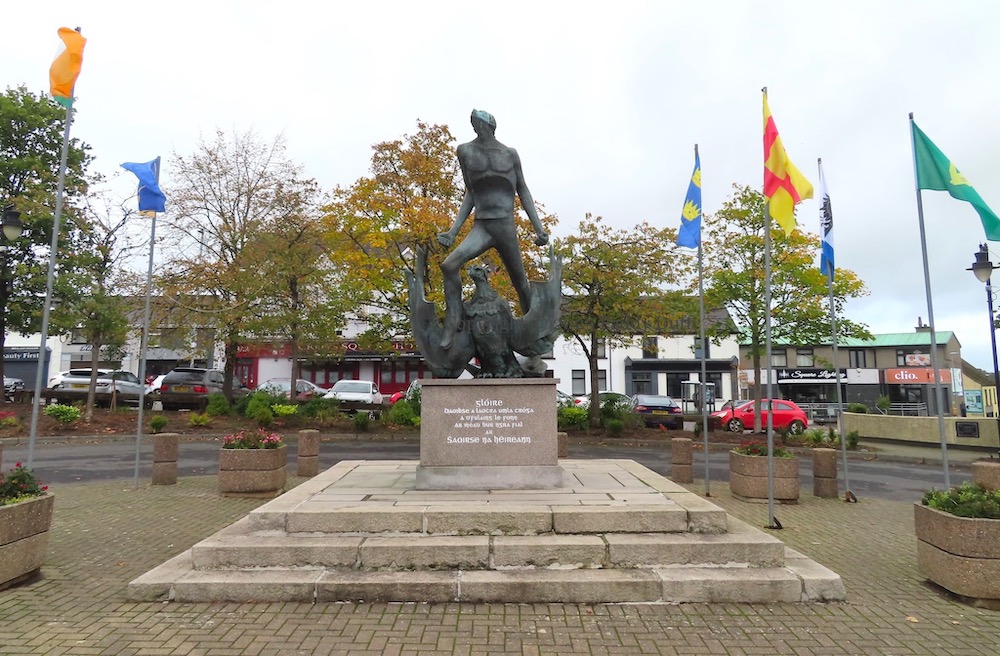
This is the republican memorial in the centre of Crossmaglen (in Cearnóg An Chaırdıneıl Ó Fıaıch). The monument was produced by Yann Goulet (1979), the same sculptor who did the memorial at Ballyseedy (1959), and like that work, this one depicts a young man striding forward in anger and anguish, though in this case he arises from a phoenix.
“Glóıre daoıḃse a laoċra uṁla cróga a d’ḟulaıng le fonn ar ṁéad ḃur ngrá fıal ar Ṡaoırse na hÉıreann.” “Glory to you all praised and humble heroes who have willingly suffered for your unselfish and passionate love of Irish freedom.”
To the right of the statue (in the corner of the car-park) is a plaque marking “the spot where the rosary was said each night during the 1981 hunger strike”, “unveiled by formed hunger striker Paddy Quinn on 6th May 2006”.
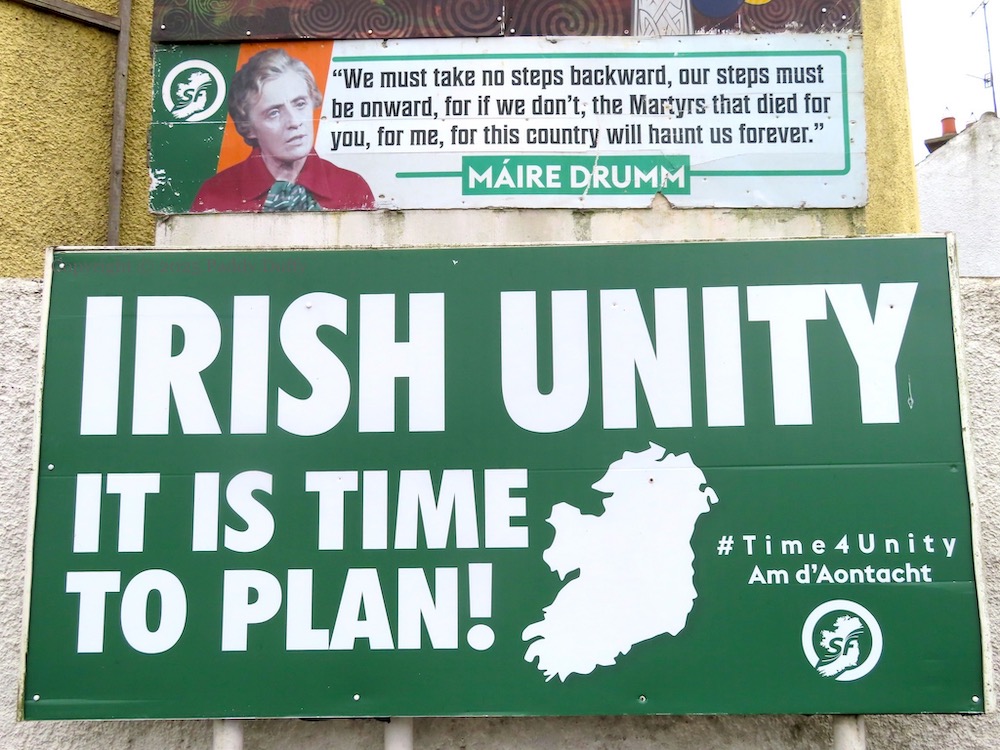
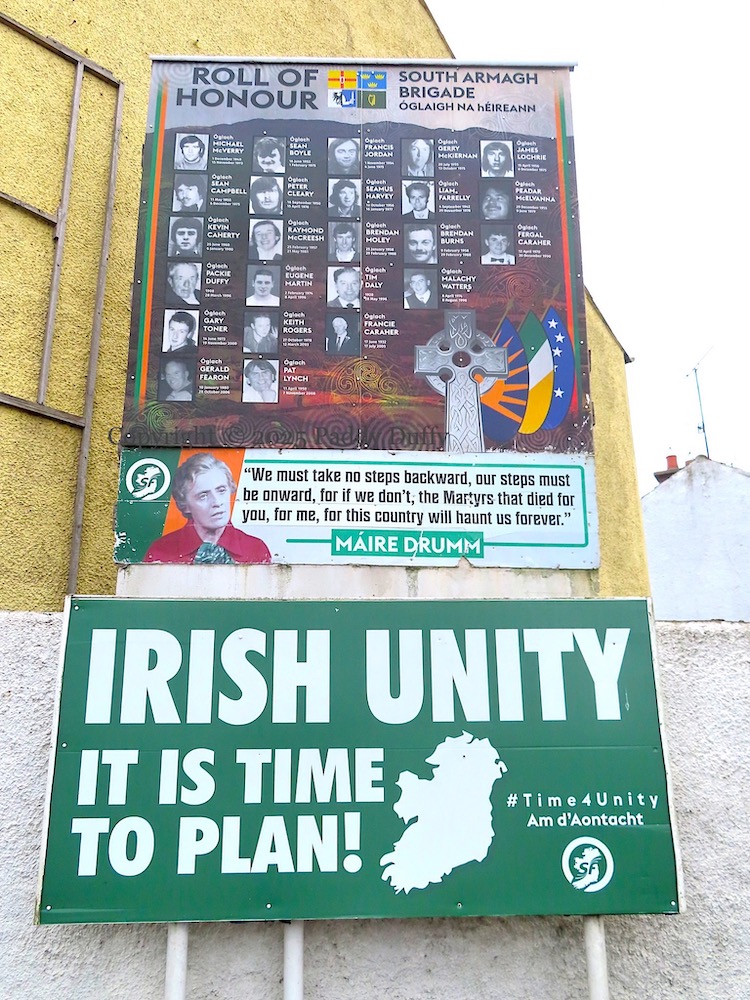
“We must take no steps backward, our steps must [or: will] be onward, for if we don’t, the [ghosts of the] martyrs that died for you, for me, for this country will haunt us forever [or: for eternity].” The words of Máıre Drumm (from an anti-internment rally in Dunville Park on 10th August, 1975 – RN p. 4) appear below a roll of honour for the IRA’s South Armagh Brigade. The list of volunteers is included below; in 1976 Drumm herself was shot dead in her bed by the RHC in the Mater hospital where she was a patient (WP) – she was Vice President of Sınn Féın at the time.
Michael McVerry, Sean Boyle, Francis Jordan, Gerry McKiernan, James Lochrie, Sean Campbell, Peter Cleary, Seamus Harvey, Liam Farrelly, Peadar McElvanna, Kevin Caherty, Raymond McCrees, Brendan Moley, Brendan Burns, Fergal Caraher, Packie Duffy, Eugene Martin, Tim Daly, Malachy Watters, Gary Toner, Keith Rogers, Francie Caraher, Gerald Fearon, Pat Lynch
Twelve more of the martyrs – the Troubles-era hunger-strikes – are on the stone across the street (for a close-up, see the Peter Moloney Collection).
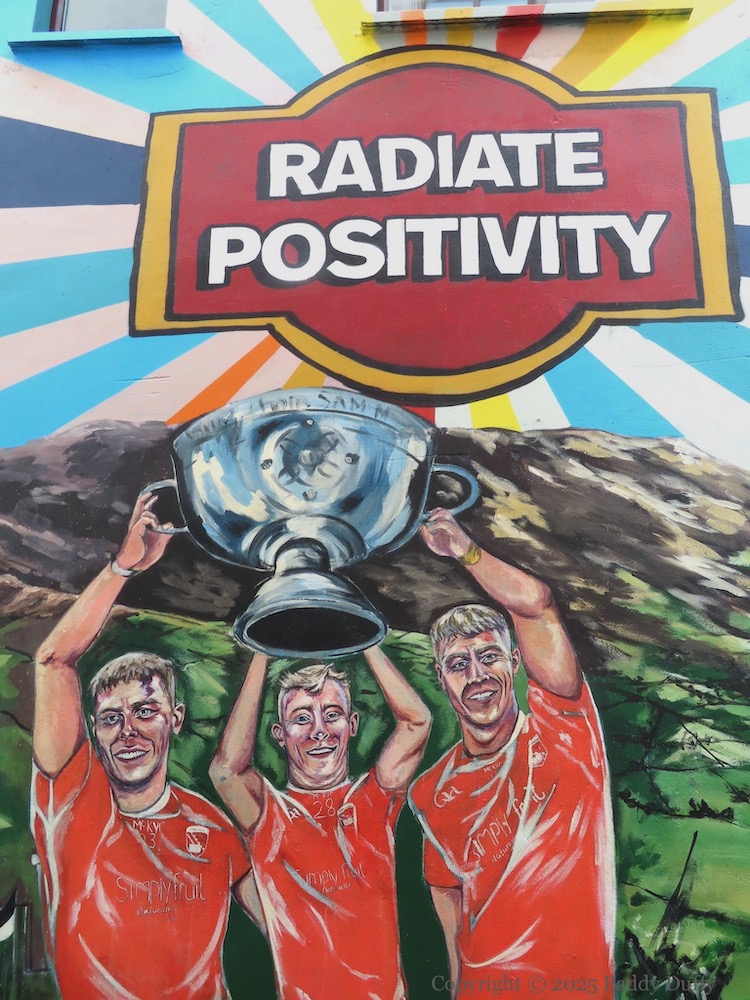
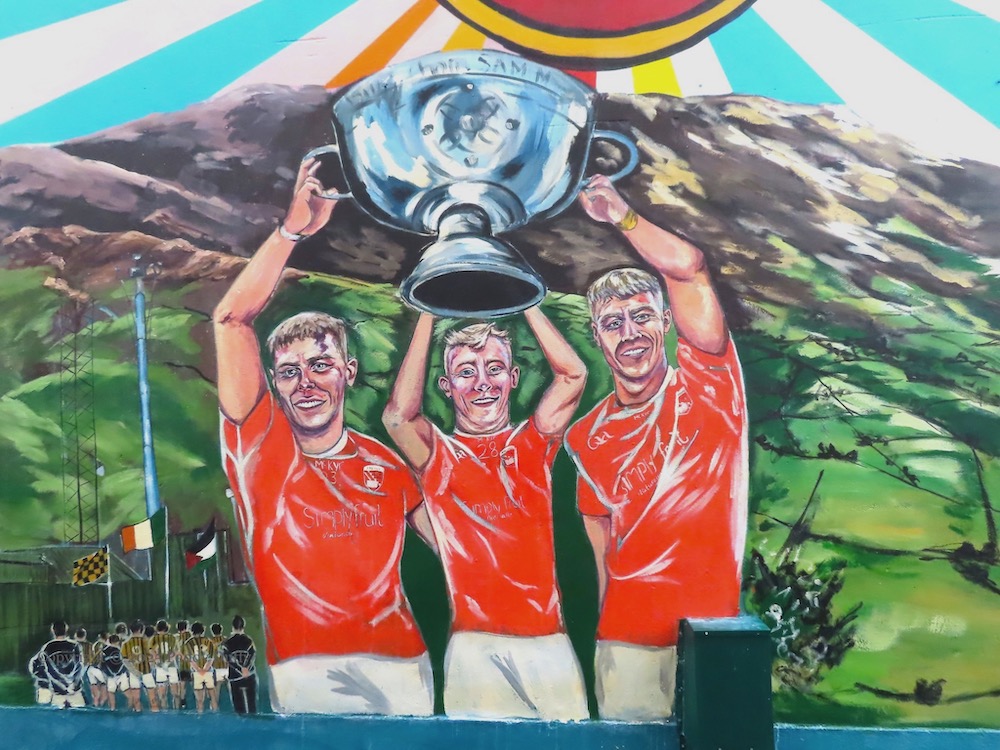
Armagh won the All-Ireland Senior football championship in 2024, with a squad that included three players from Crossmaglen: Oısín O’Neill, Cıan McConville, and Rían O’Neill.
In the bottom-left corner, players from Crossmaglen Rangers turn to face the Irish tricolour, flanked by the club flag and the flag of Palestine – the flags fly below the watchtower of a British Army barracks (perhaps based on an image from the 2005 Armagh final – Irish Times).
On the right is an umbrella in pride colours, below which people can pose and take pictures: “Snap & tag us”.
This is a revised version of the mural, which originally bore the Ernesto Cardenal quote, “They tried to bury you/us but they didn’t know you/we were seeds” (ig).
“Vol. Brendan Burns, Vol. Brendan Moley, 29 February 1988.” Burns and Moley died “on active service”, meaning the premature explosion of a bomb they were loading into a van (RTÉ video | Sutton | RN). There is a plaque at the spot at which the pair was killed, on the nearby Donaldson’s Road – see M08795. Burns was wanted in connection with the Narrow Water ambush of 1979 (UPI).
“You were being oppressed by the political and military might of the foreign invader. We tried to protect you, we gave you the best that we could, but our time ran out, before the battle was won. Now it’s time for you to give the best you can. Stand together with your comrades we sadly left behind. Be proud to carry on the struggle for the freedom of our land.”
There was a march in Belfast (in early September) which went to the offices or stores of some of these businesses (Independent) because they fund or support the Israeli military – the links above outline the connections. There are also campaigns from various groups (here is IPSC’s) to boycott consumer goods from Israeli producers.
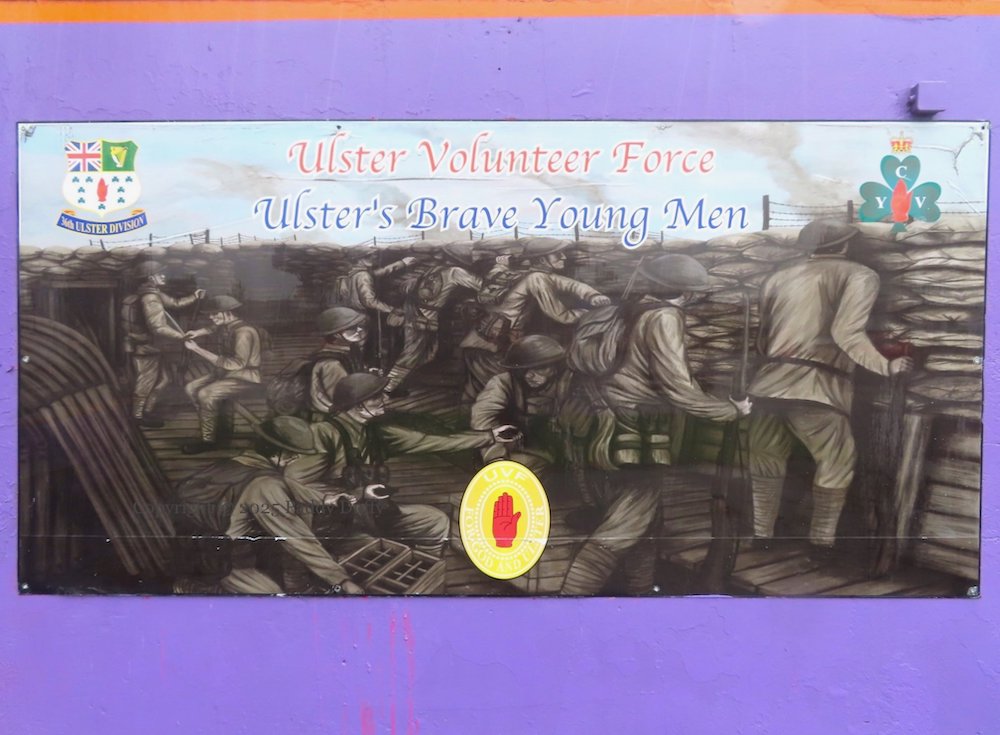
The background to the Avenue Road “Memorial to the 36th (Ulster) Division and to other men of Ulster who served in the Great War 1914 – 1918” has been repainted in the purple and orange of the UVF and the wall simplified by the removal of two smaller boards to each side of the main board (above) which shows soldiers looking out over the edge of a WWI trench. (For the the previous boards, see the Peter Moloney Collection.)
The seat is dedicated to “Jack”, an 11-year-old member of the Avenue Road Memorial flute band who died in 2019 (News Letter), with boxing gloves and emblem of the NI soccer association. 2 Timothy 4:7 says, “I have fought the good fight, I have finished the race, I have kept the faith.”
Avenue Road, Lurgan
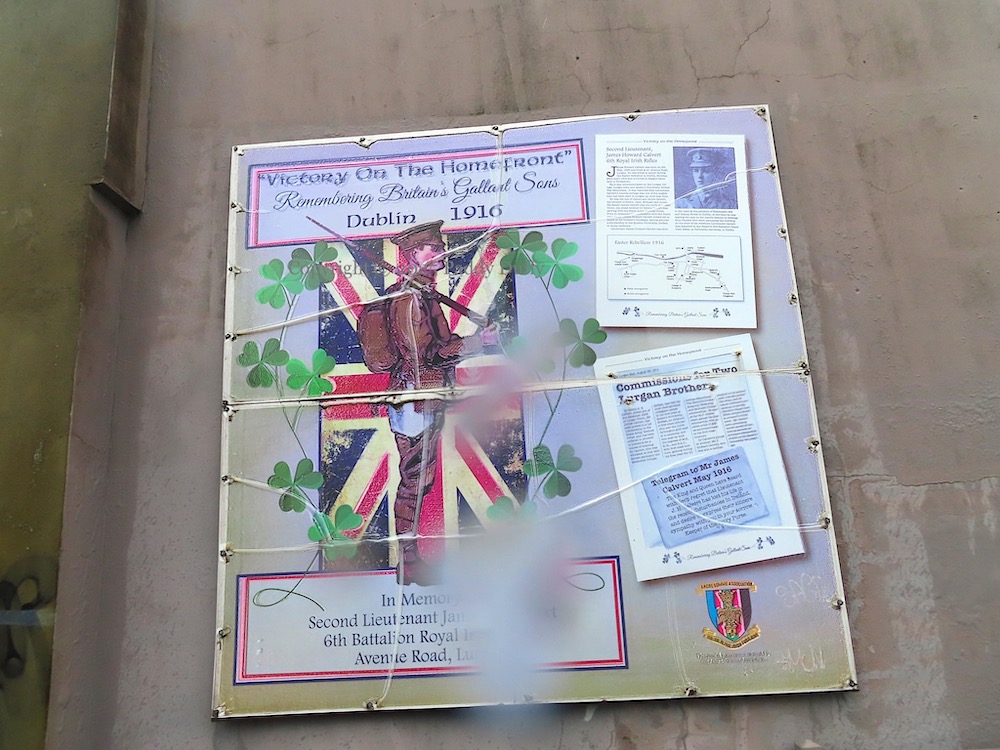
The final image is of a board in nearby King’s Park Mews to a soldier who died on “the homefront” – Dublin during the 1916 Rising – Second Lieutenant James Howard Calvert of the 6th Royal Irish Rifles.Calvert lived at 41 Avenue Road, Lurgan.
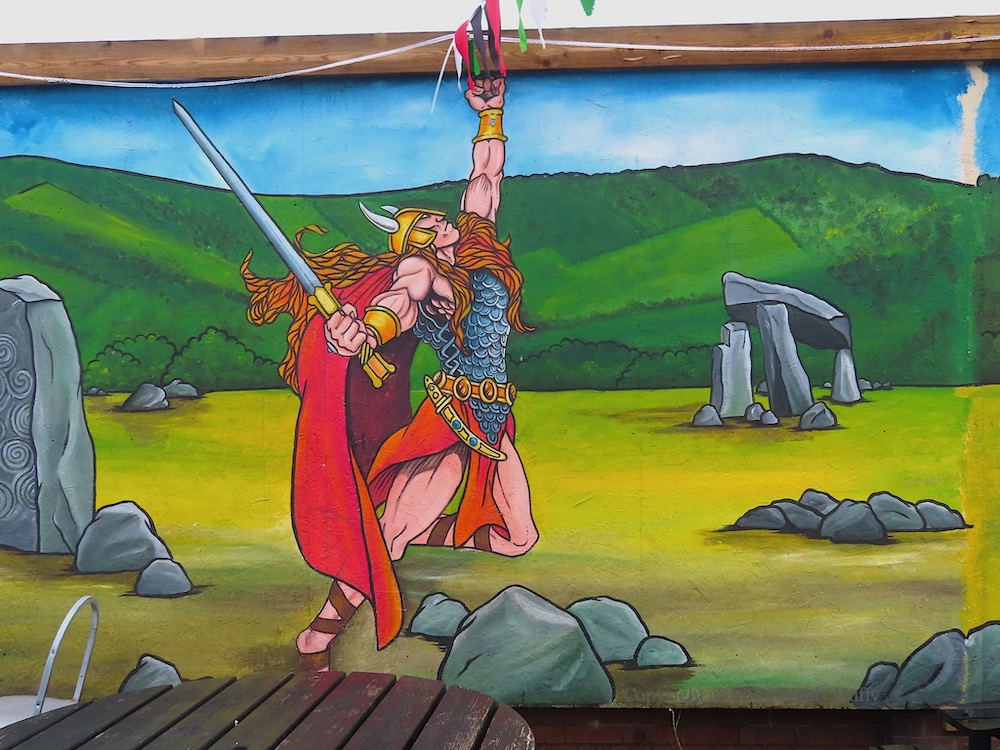
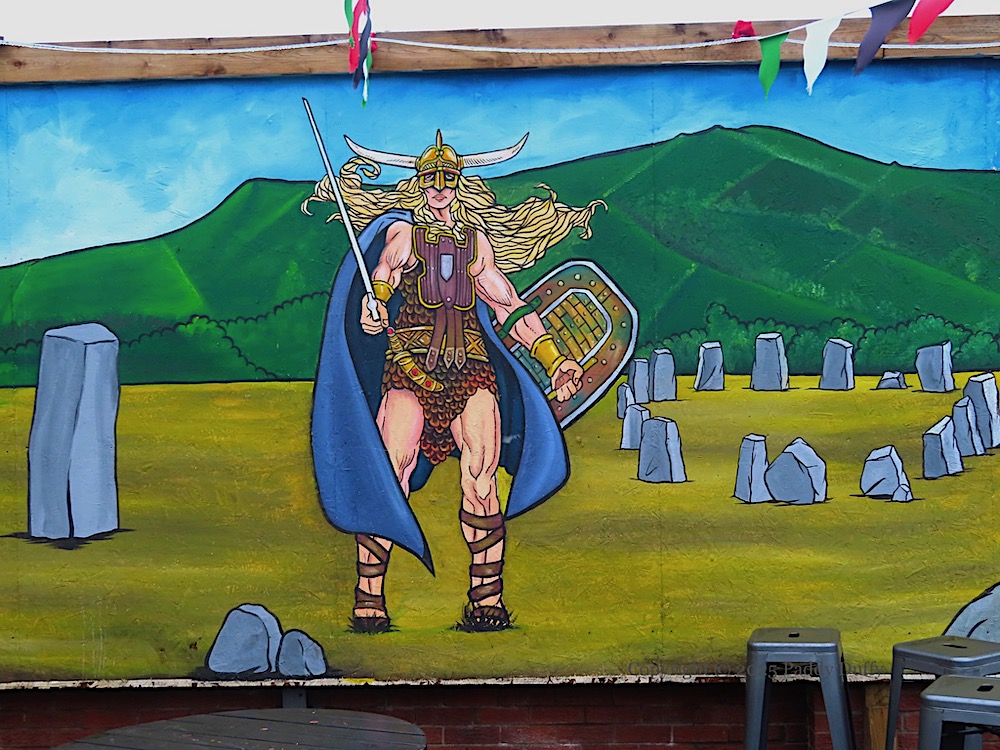
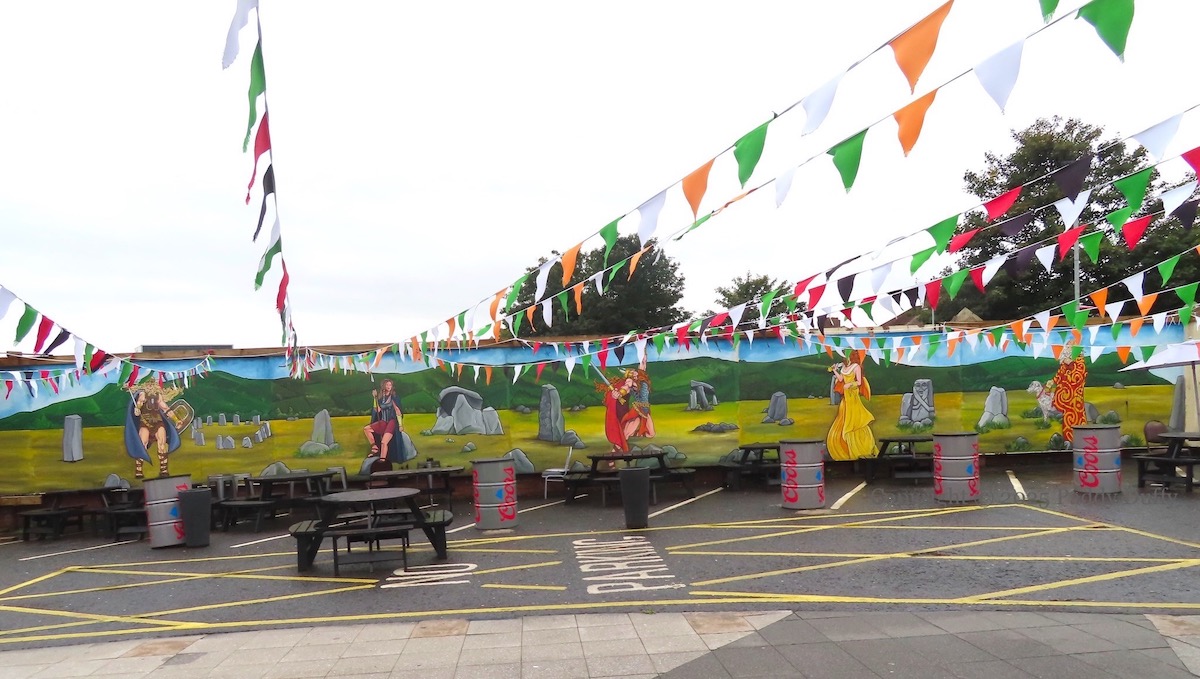
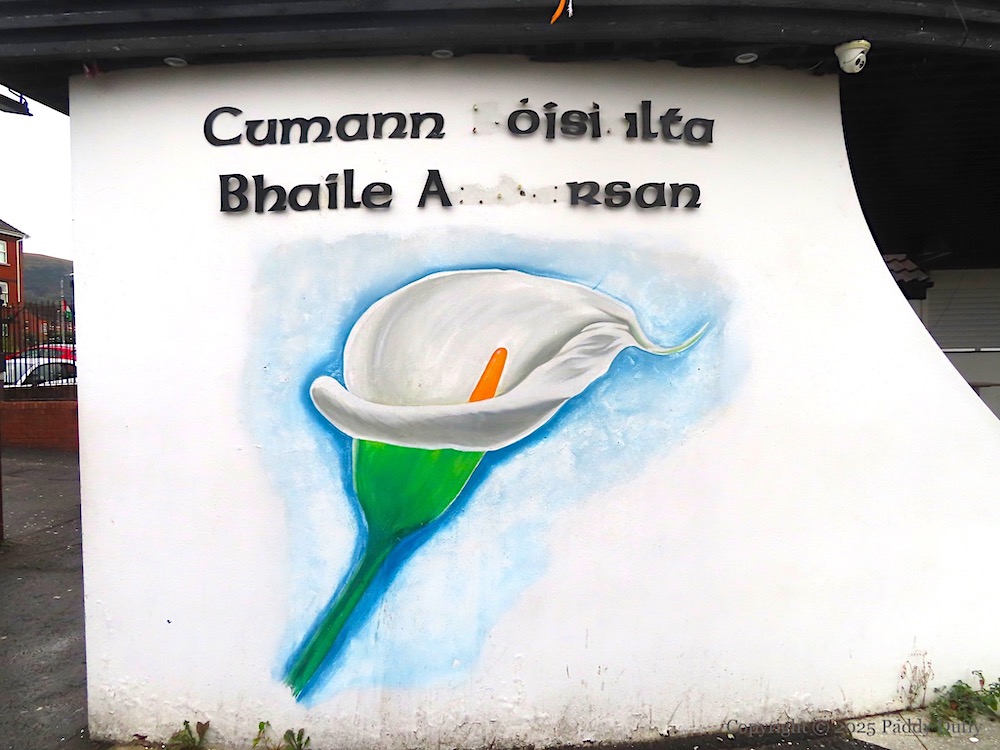
Here are five mythological figures placed against a backdrop of Celtic Ireland, including standing stones, a dolmen, a stone circle, and the Janus figure on Boa Island (WP), from the wall of the PD/Cumann Sóısıalta Bhaıle Andarsan.
















 Paddy Duffy Collection