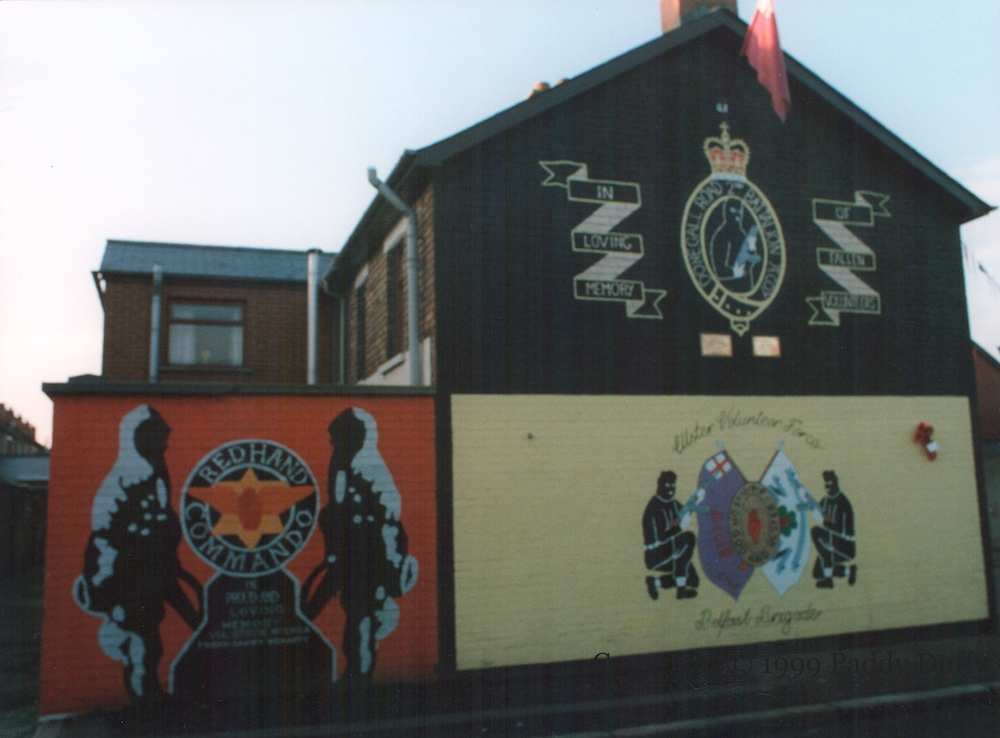
“In loving memory of fallen volunteers [from the] Ulster Volunteer Force Belfast Brigade, Donegall Road 2nd Battalion, A Coy”. The two plaques unfortunately cannot be read.
The side wall shows volunteers with lowered weapons flanking a memorial “In proud and loving memory of Vol. Stevie McCrea, Friend Sammy Mehaffy”.
Along the top are the emblems of the Royal Inniskilling (27th) Fusiliers (featuring Crom castle), Royal Irish Rifles (featuring the Maid Of Erin harp), Royal Irish Fusiliers (featuring the barossa eagle).
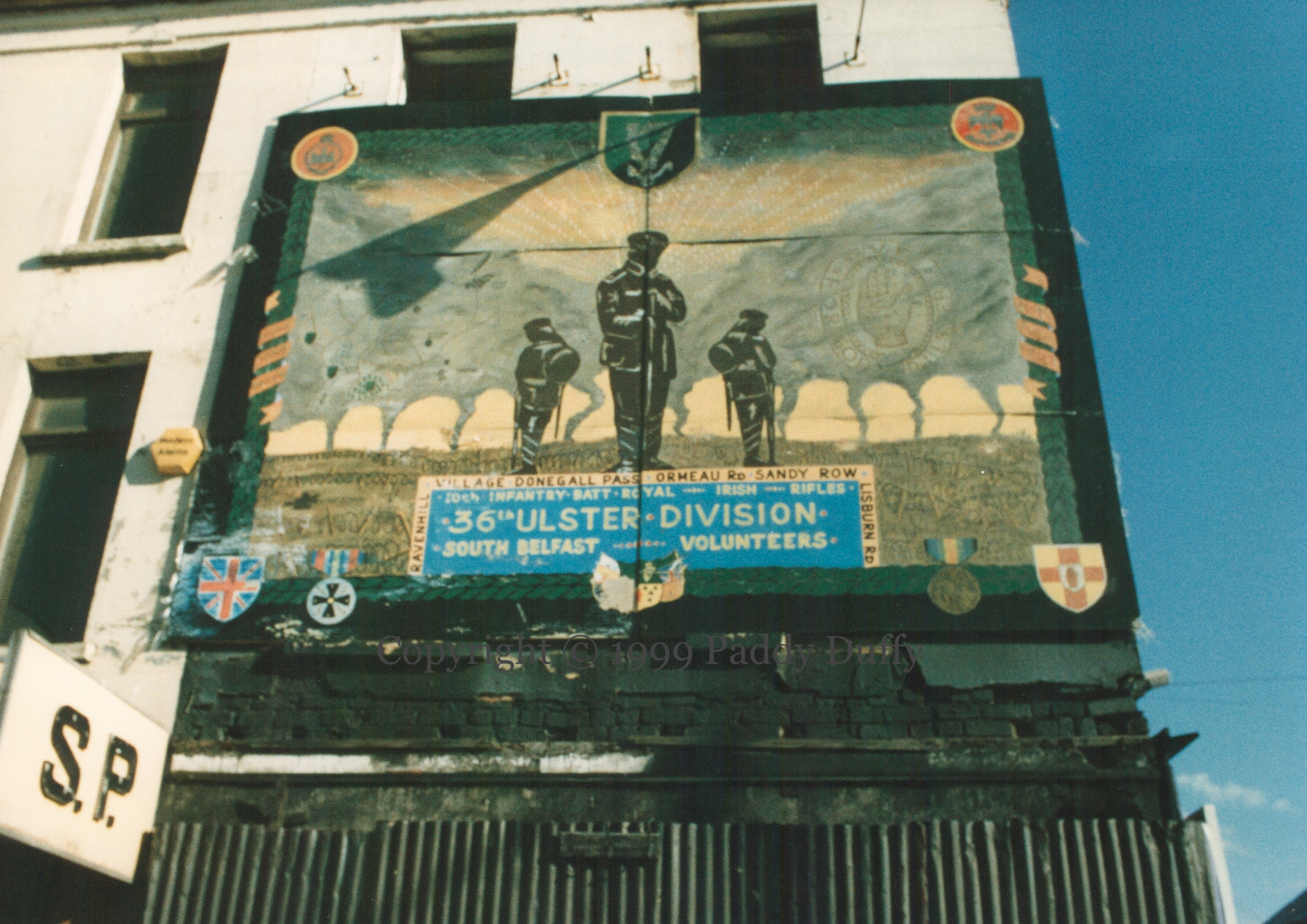
Wrapped around the left column are “Ballykinler, Finner, Clandeboye” – three of the training camps of the 36th. Wrapped around the right column is “Lest we forget”.
The central text reads: “Ravenhill – Village – Donegall Pass – Ormeau Rd – Sandy Row – Lisburn Rd. 10th infantry battalion Royal Irish Rifles, 36th (Ulster) Division, South Belfast Volunteers”
The Union Flag appears in the lower left, next to an unidentified medal, while the flag of Ulster (rather than Northern Ireland, which did not yet exist) appears in the lower right, next to a Victory medal. (In a previous version of this painting, the Union Flag was a VC and the medal was a Distinguished Conduct Medal.) Between them is the emblem of the 36th Division.
The main image shows three graveside mourners standing in a field of barbed wire and in front of ?mis-shapen tombstones?, all against a background of sunrise over a mountain on which have been superimposed (left) a map of the Somme and (right) a large UVF emblem.
Painted by Ron McMurry on boards. Donegall Pass, south Belfast
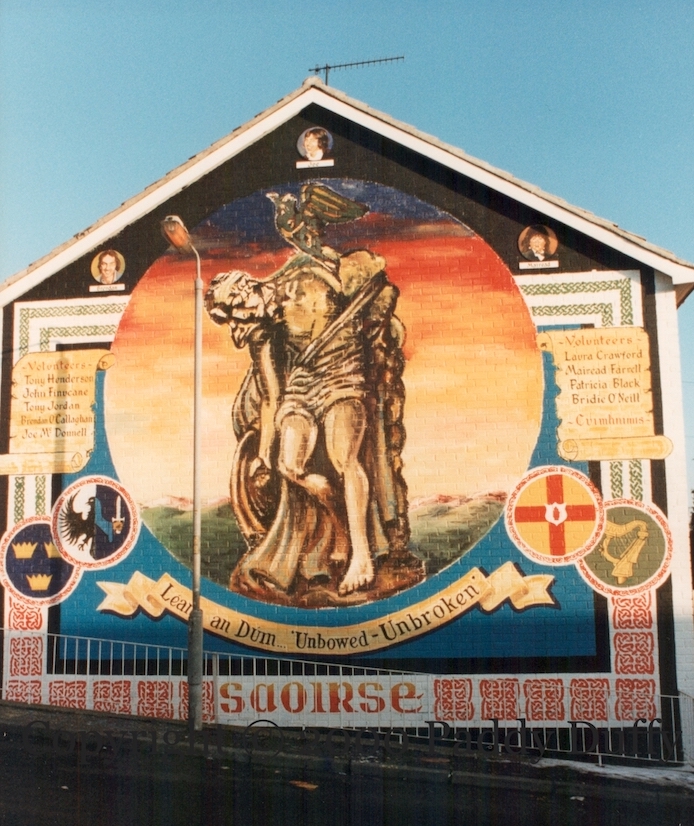
The dying Cú Chulaınn (as portrayed in bronze by Oliver Sheppard, in a statue installed in the GPO in 1935) is used as a symbol for the locals from Lenadoon area of west Belfast who fought for freedom (“saoırse”): Tony Henderson, John Finucane, Brendan O’Callaghan, Joe McDonnell, Laura Crawford, Maıréad Farrell, Patricia Black, Bridie O’Neill (subsequently changed to Bridie Quinn).
There were originally portraits of all nine people in the apex when the mural was launched in 1996, but only three remain.
A dove carries the keys that would unlock the chains that are already being rent asunder by their manacled captive in “Ceıs Fada” [Long Kesh]. Part of the “green ribbon” campaign to release republican POWs under the terms of any peace agreement.
The Gibraltar Three are IRA volunteers Maıréad Farrell, Seán Savage, and Dan McCann, who were executed by British crown forces in Gibraltar on March 6th, 1988.
Along the top is written a variation on the second half of Terence MacSwiney’s famous phrase: “[It is not those who can inflict the most but] “Those that endure the most will conquer in the end”
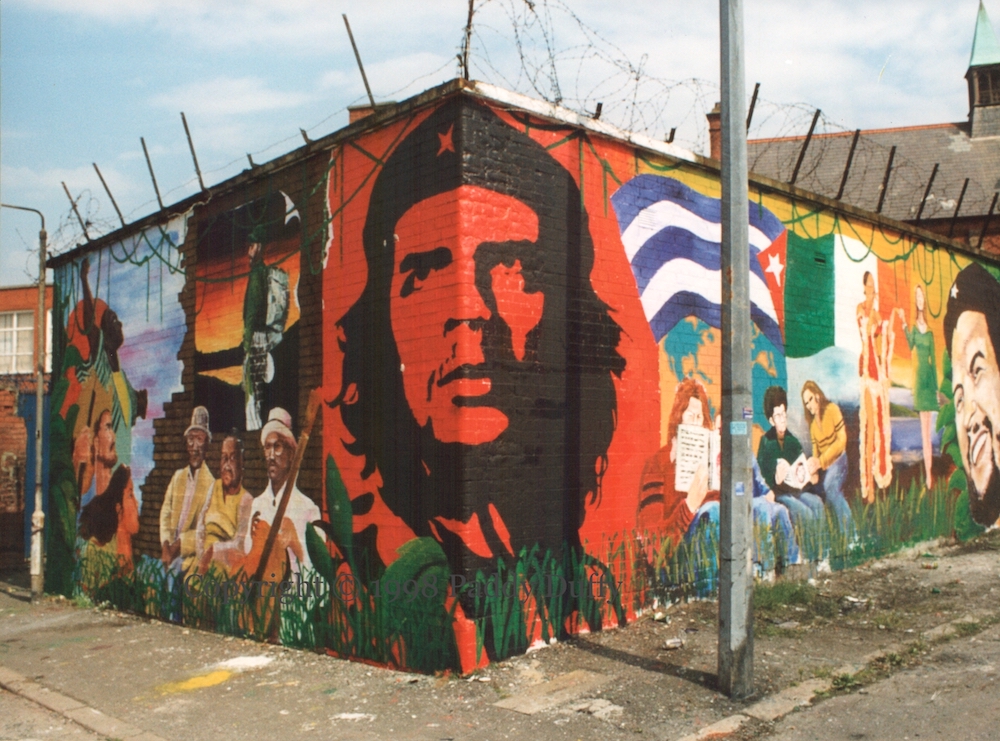
Jim Fitzpatrick’s Che (Visual History) is the linchpin of this mural in Shiels Street, Beechmount, expressing solidarity between Irish republicanism and the Cuban revolutionaries. Fidel Castro appears on the right (and in the poster on the left), and Bobby Sands is seen on the right reading a collection of Che’s speeches and writings published in English in 1969 as Venceremos! (pdf).
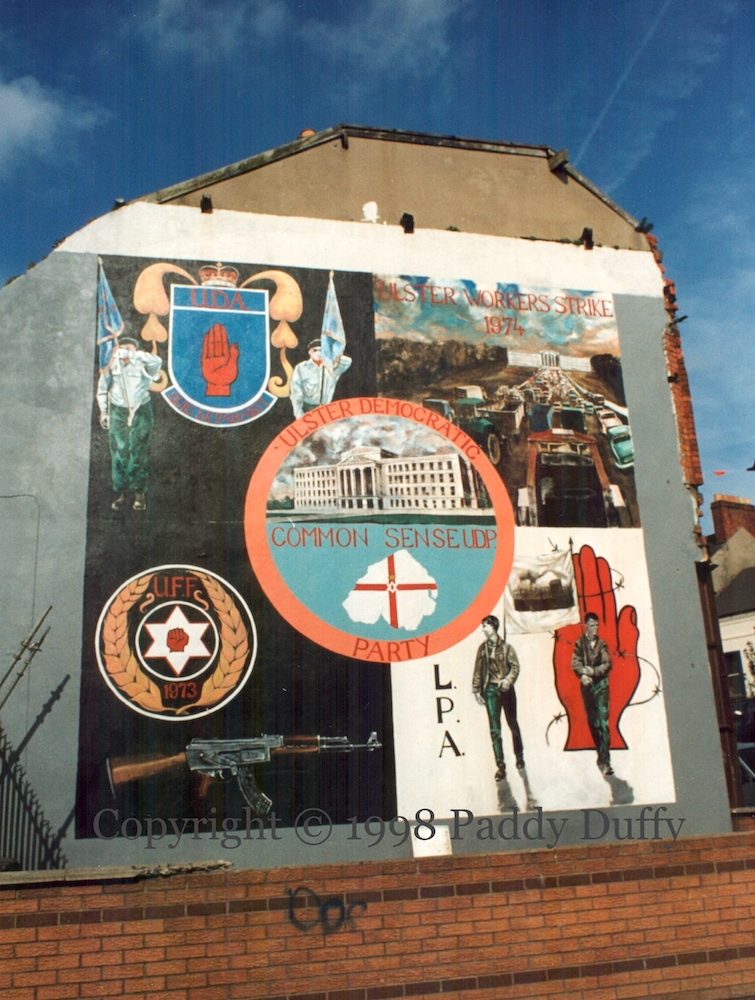
The Ulster Democratic Party (UDP) was the political wing of the UDA, and supported a policy of an independent Northern Ireland (as described in the policy document ‘Common Sense‘). It won a few council seats in the late 1980s and early 1990s (and dissolved in 2001) (BBC-NI).
The top-right panel is similar to this Victor Patterson photograph of the farmers’ protest at Stormont during the Ulster Workers’ Council strike that brought down the Sunningdale Agreement in 1974.




 Paddy Duffy Collection