God, Give Us Men!

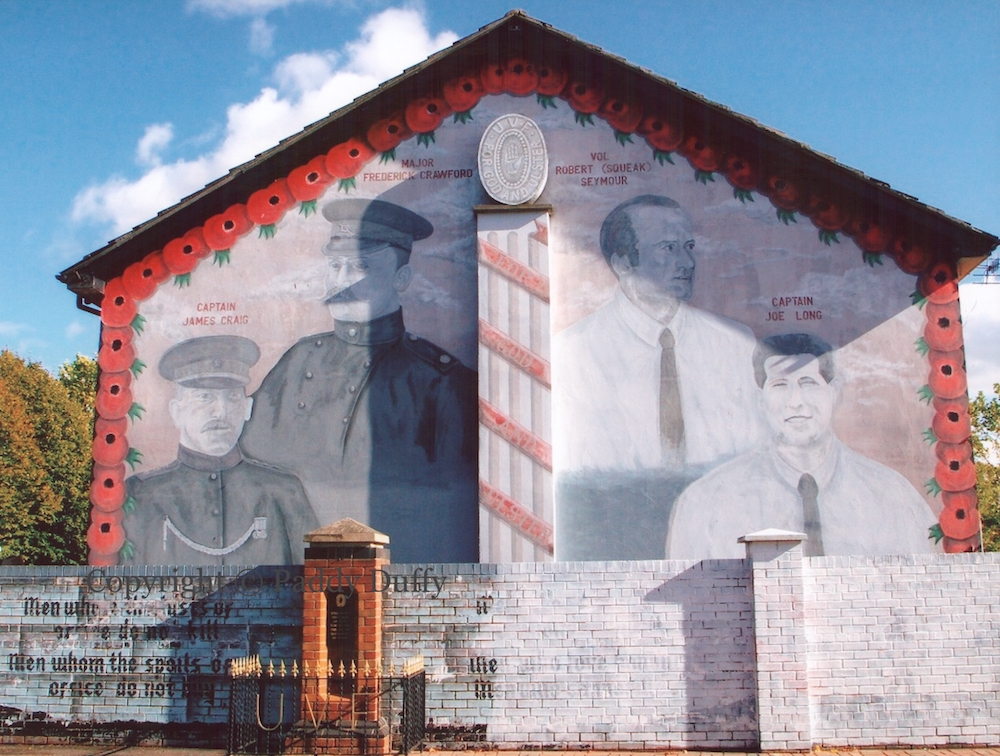
“Men whom the lusts of office do not kill/Men whom the spoils of office do not buy/Men who possess opinions and will/Men who love honour; men who cannot lie” – part of a poem by Josiah Gilbert Holland.

The men on the left of the mural are Captain James Craig (who fought in the Second Boer War before becoming a unionist leader, organiser of the the Ulster Volunteers, and first Prime Minister Of Northern Ireland) and Major Frederick Crawford, who fought in both Boer Wars and organised the Larne gunrunning.

The four others, listed both on the plaque in front of the mural and on the stone in the memorial garden (constructed in 2003) are UVF volunteers Robert Seymour, shot dead by the PIRA; James Cordner and Joseph Long, who were killed in a premature explosion, and Robert Bennett, killed by the British Army during a riot. (Seymour and Long are on the right of the mural.)

Fraser Pass, Ballymacarrett, east Belfast

Click image to enlarge
Copyright © 2011 Paddy Duffy
T00617
We Support Our Troops

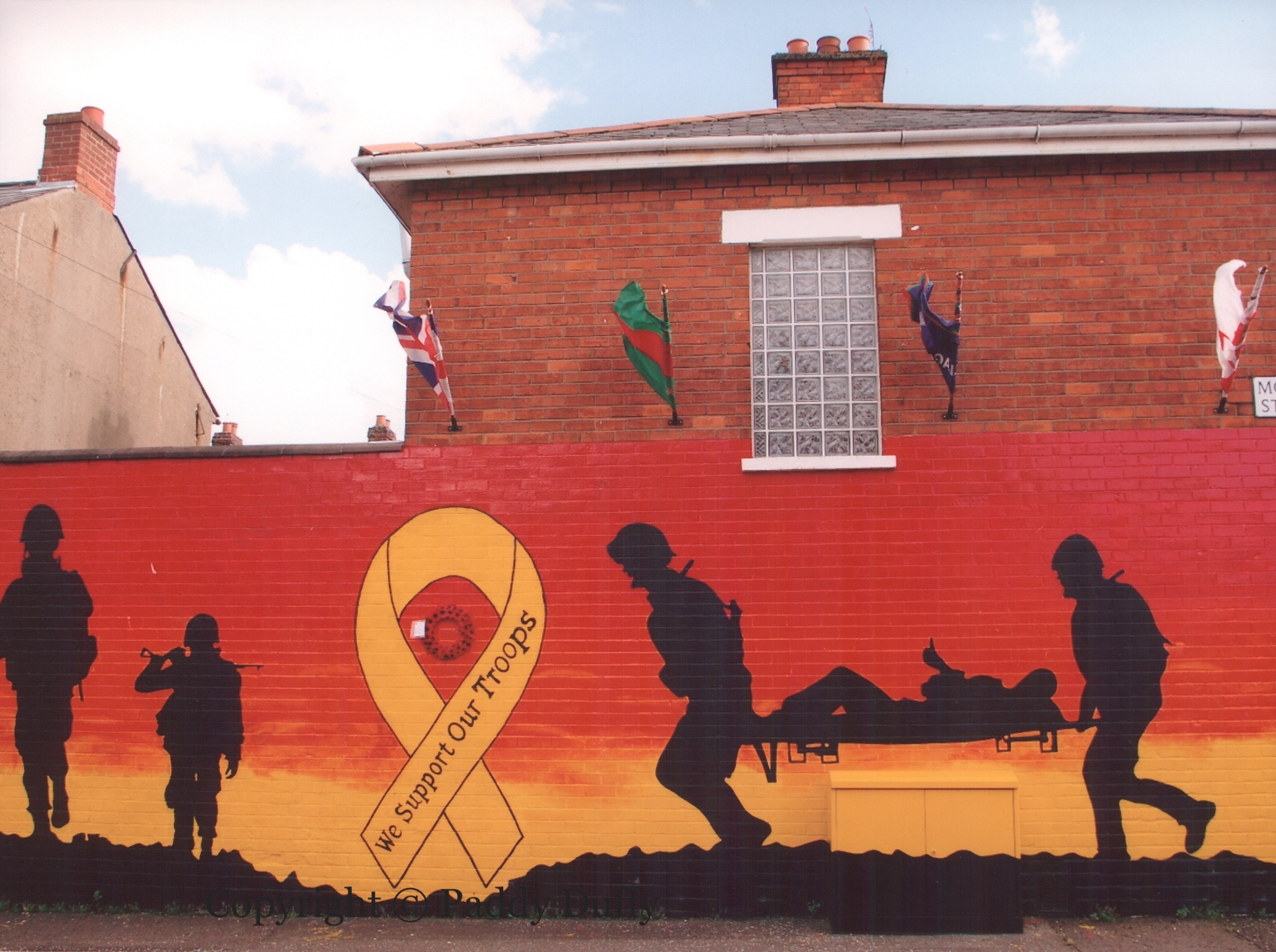
The photograph of a stretchered soldier giving a ‘thumbs up’ (shown below) was set up and photographed by Captain Ed Hodges of the King’s Royal Hussars in Basra, Iraq, in 2007 (Daily Mail). In silhouette (as shown here) it has become the icon of the Help For Heroes charity raising money for British forces.

Moltke Street, Village, south Belfast

Click image to enlarge
Copyright © 2011/2012 Paddy Duffy
T00613

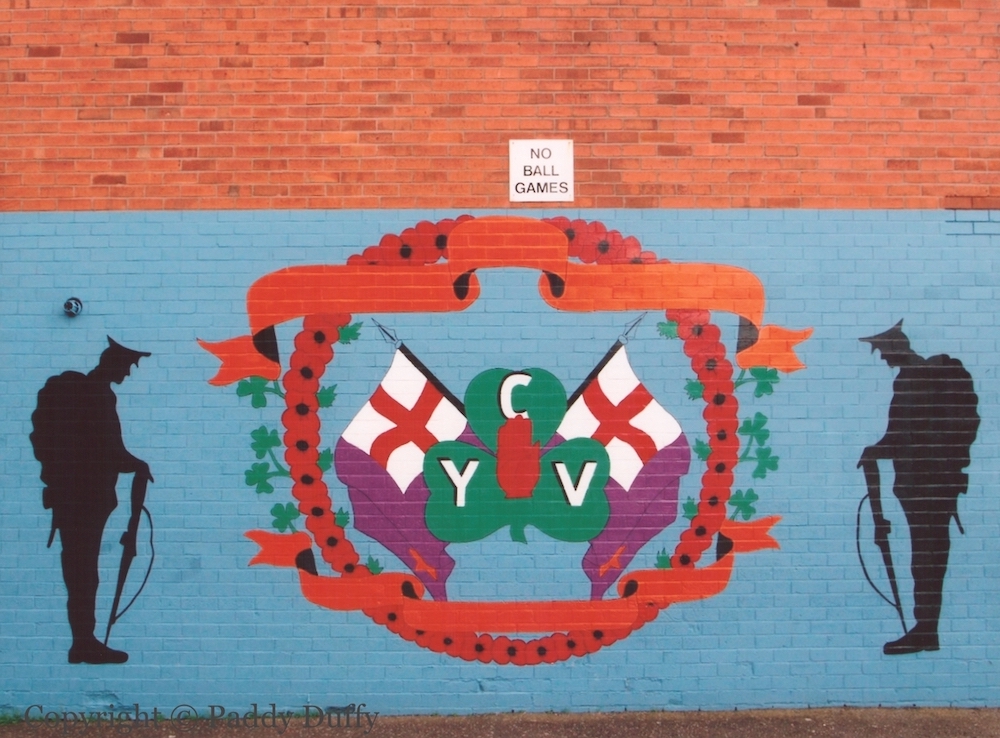
YCV

The shamrock in the wreath represents the Irish divisions of the British Army in WWI – the 36th, the 10th, and the 16th. The Young Citizen Volunteers formed the fourteenth battalion of the Royal Irish Rifles and so part of the 36th (Ulster) Division during the first world war.

Benburb Street, Village, south Belfast

Click image to enlarge
Copyright © 2012 Paddy Duffy
T00610

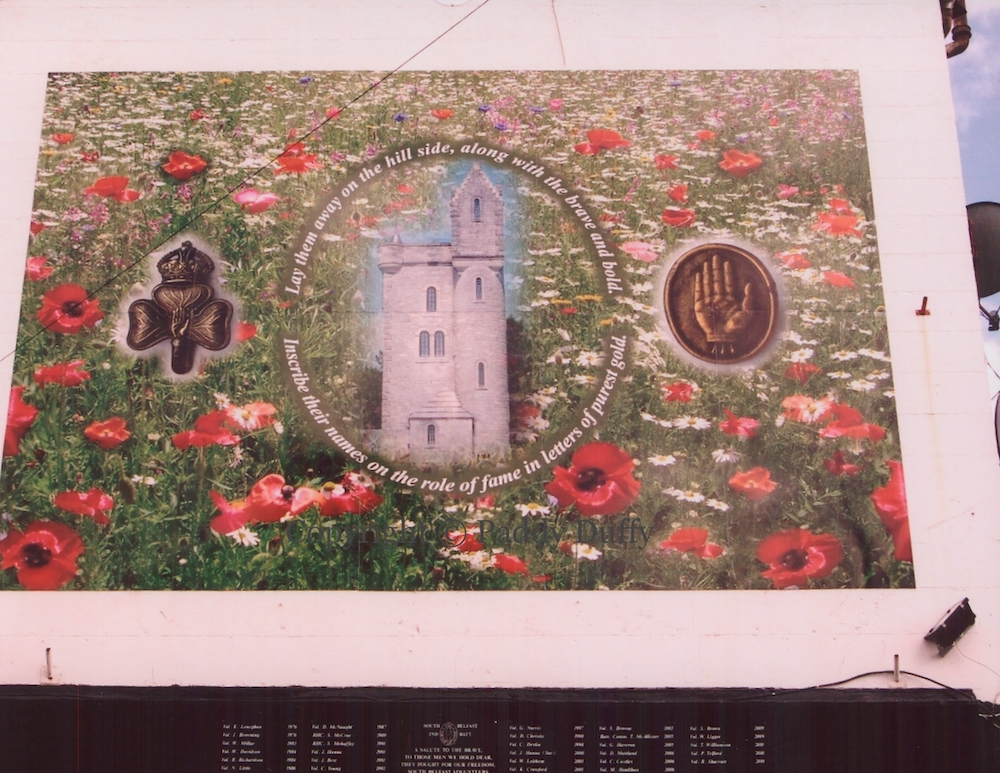
Lay Them Away On The Hill Side

“Lay them away on the hill side/along with the brave and the bold/Inscribe their names on the role [sic] of fame/in letters of purest gold.” The Ulster Tower at Thiepval commemorates the WWI dead of the 36th (Ulster) Division. The words, however, come from a song about James Daly, who was executed by firing squad for taking part in a 1920 mutiny of the Connaught Rangers in India in protest of the activities of the Black and Tans.

Below the board is a roll of honour for the “UVF South Belfast 2nd battalion”: “A salute to the brave/to those men we hold dear/they fought for our freedom/south Belfast volunteers.”

Compare this mural to the previous (Here Lies A Soldier), which does not include any reference to the Great War.

On the side of The Hideout, Pine Street, Donegall Pass, south Belfast

Click image to enlarge
Copyright © 2011/2012 Paddy Duffy
T00609

The United Kingdom

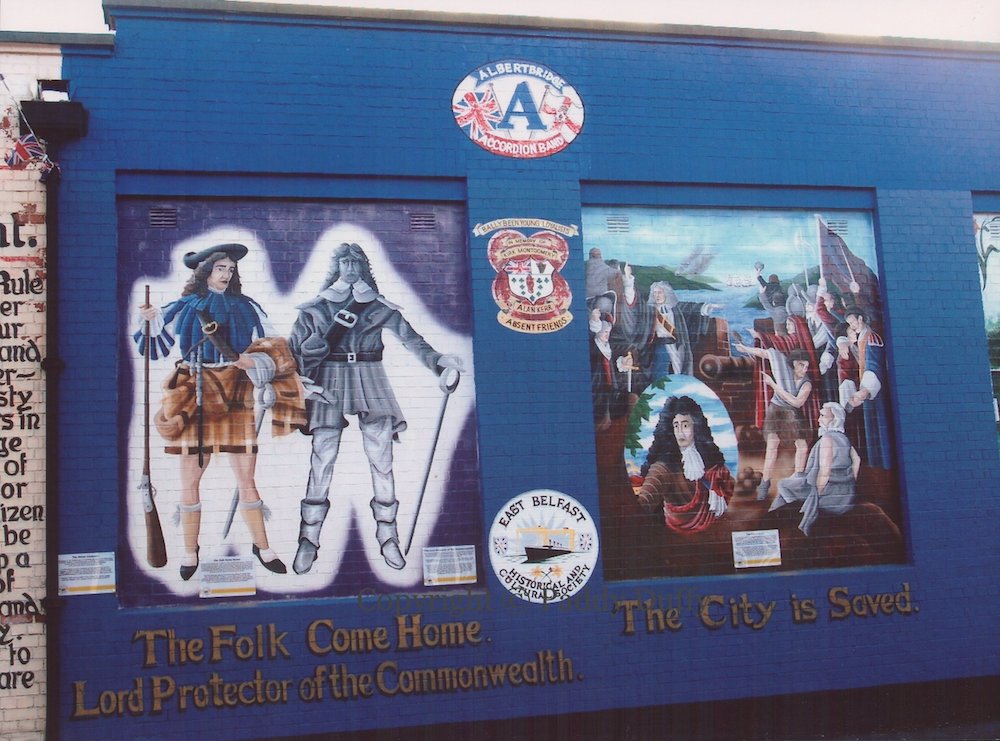
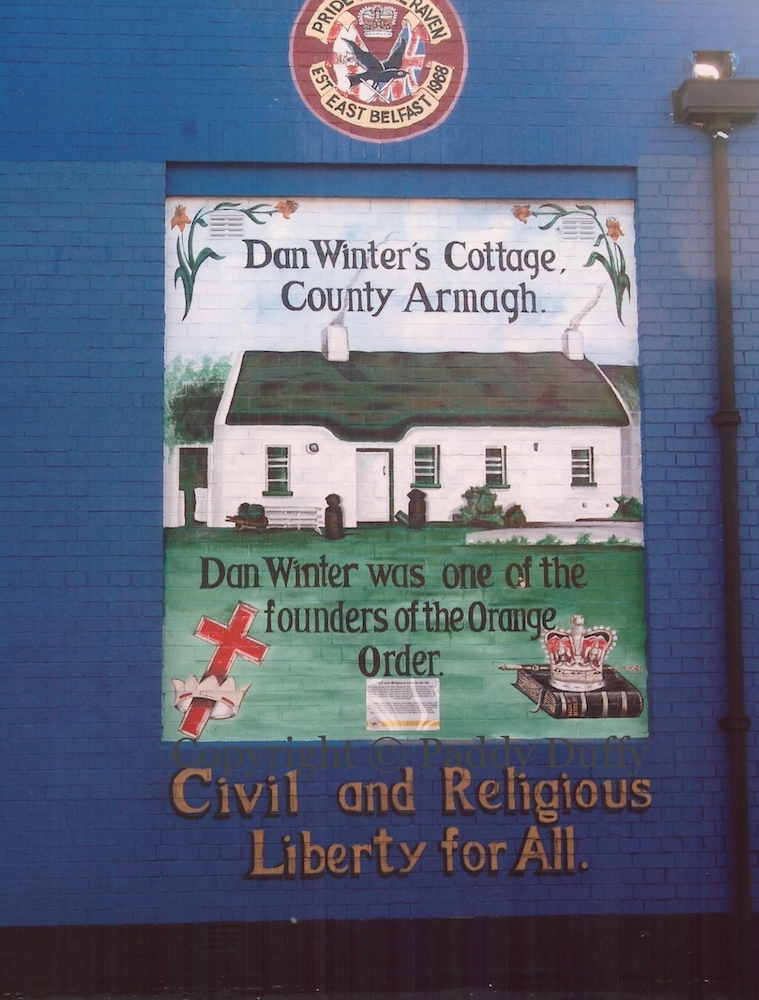
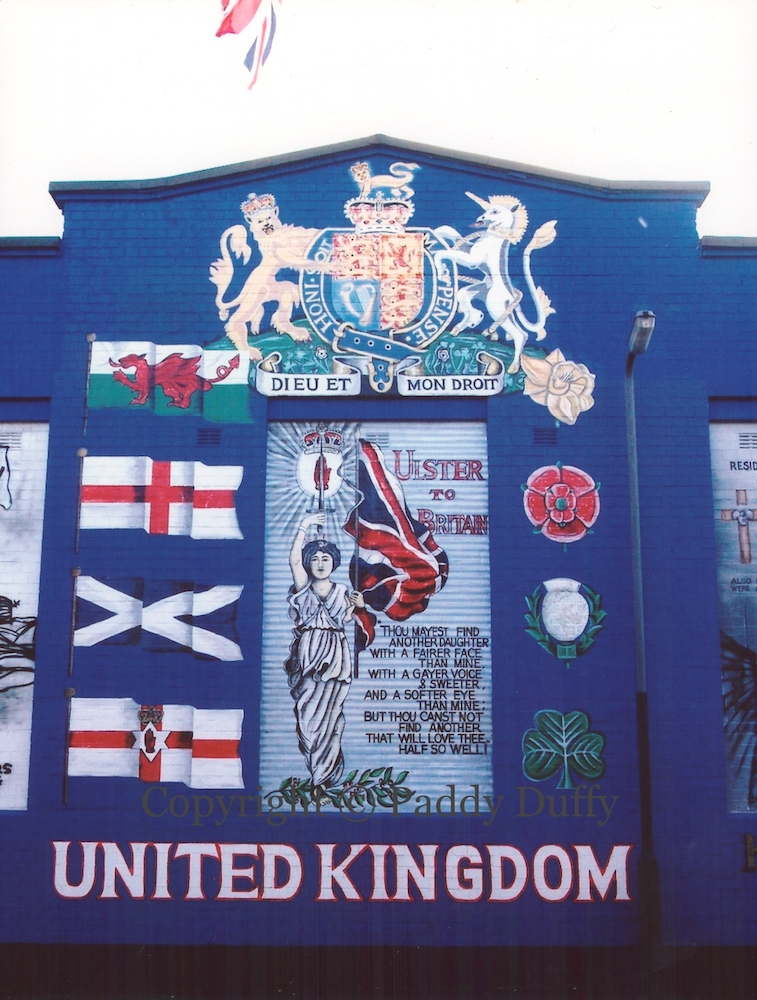
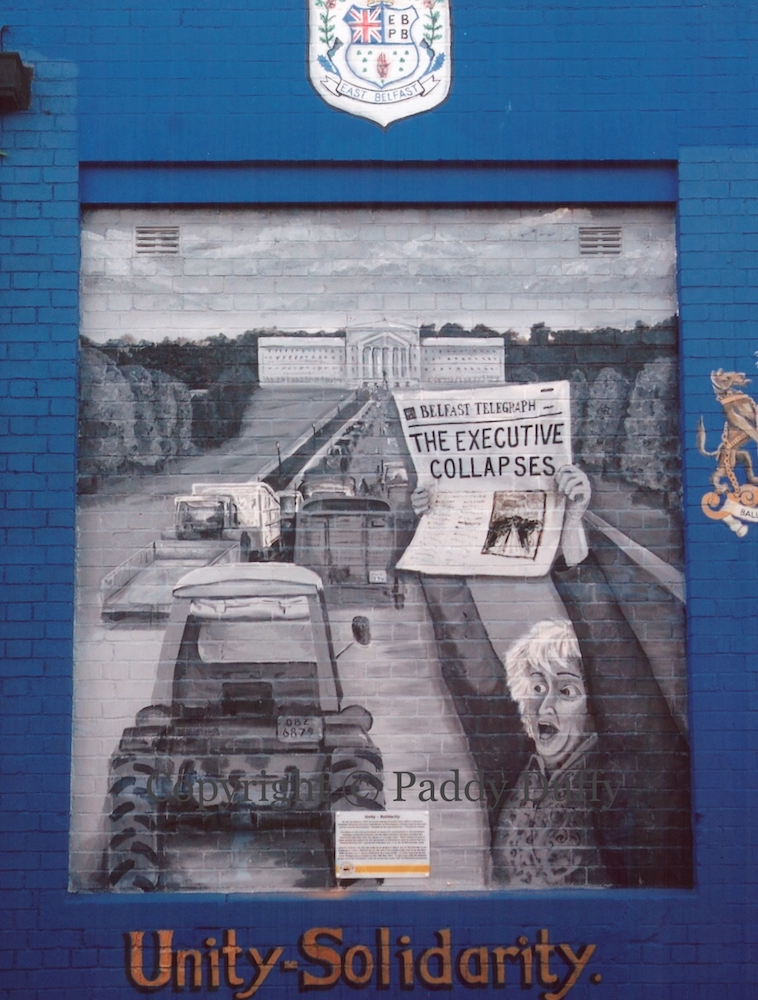
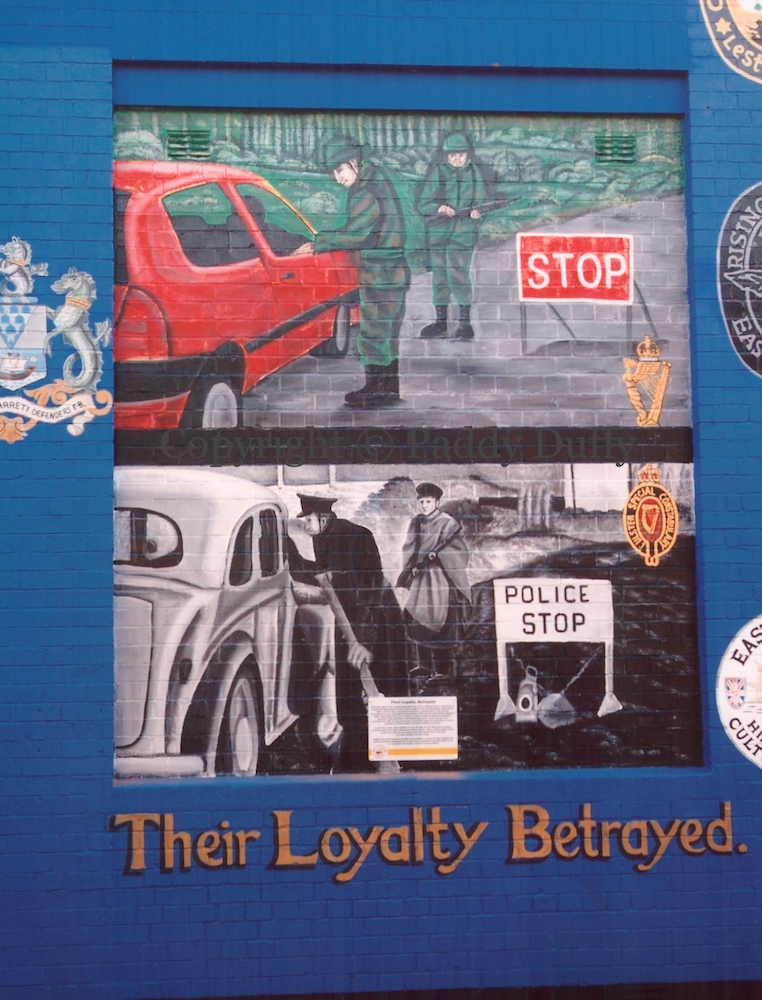
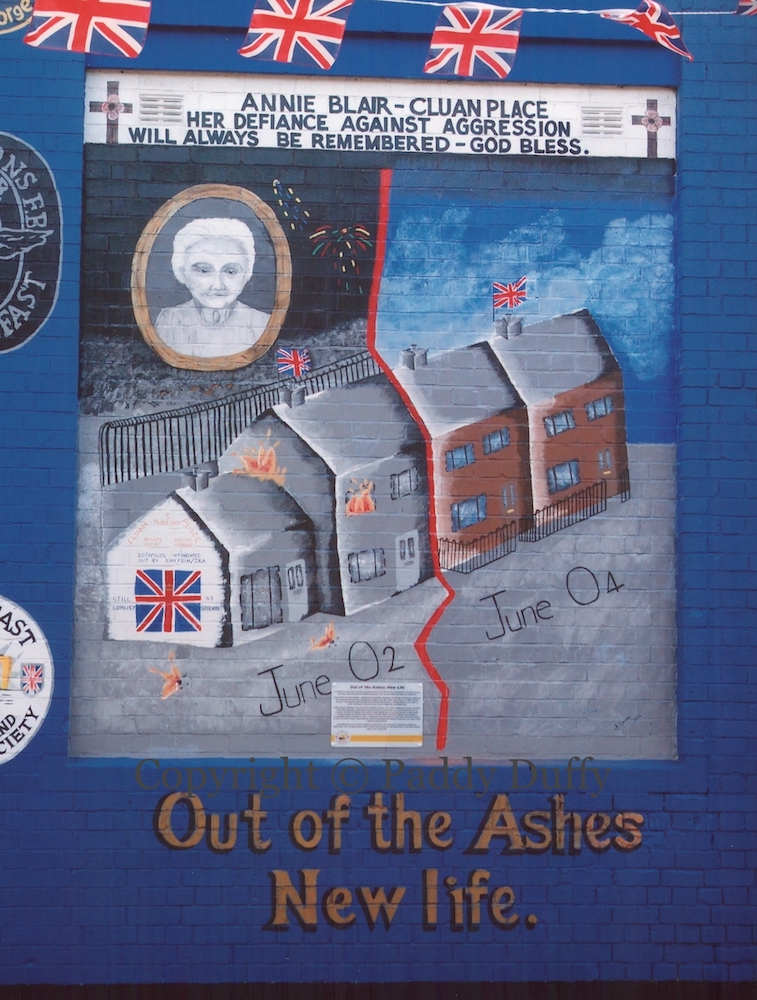
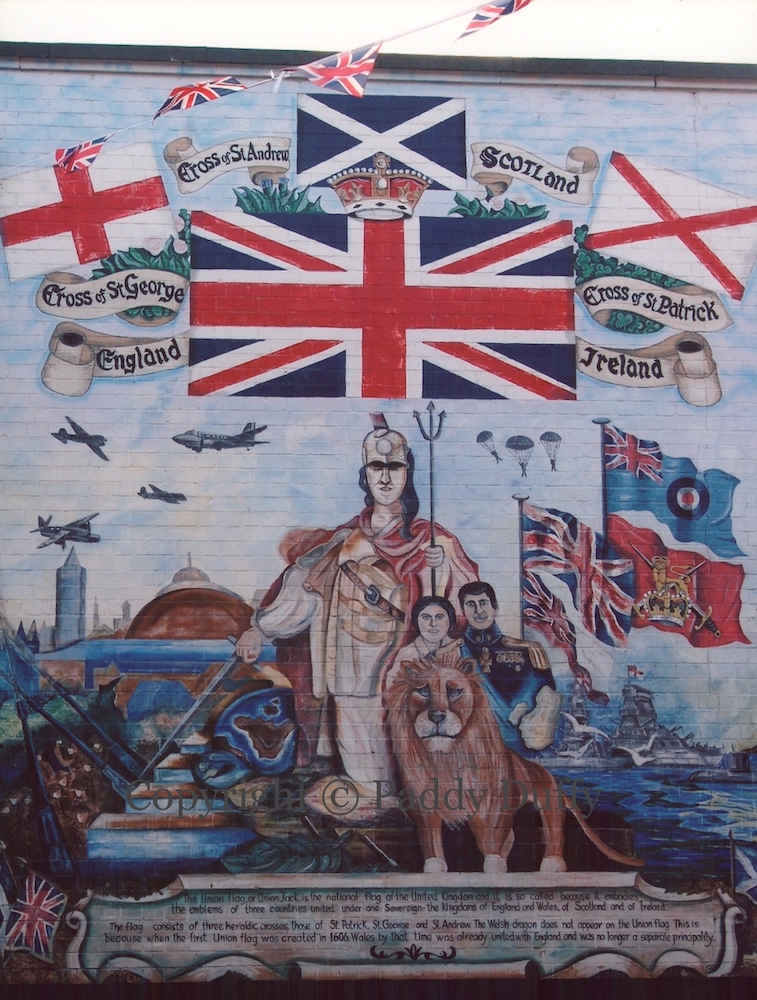
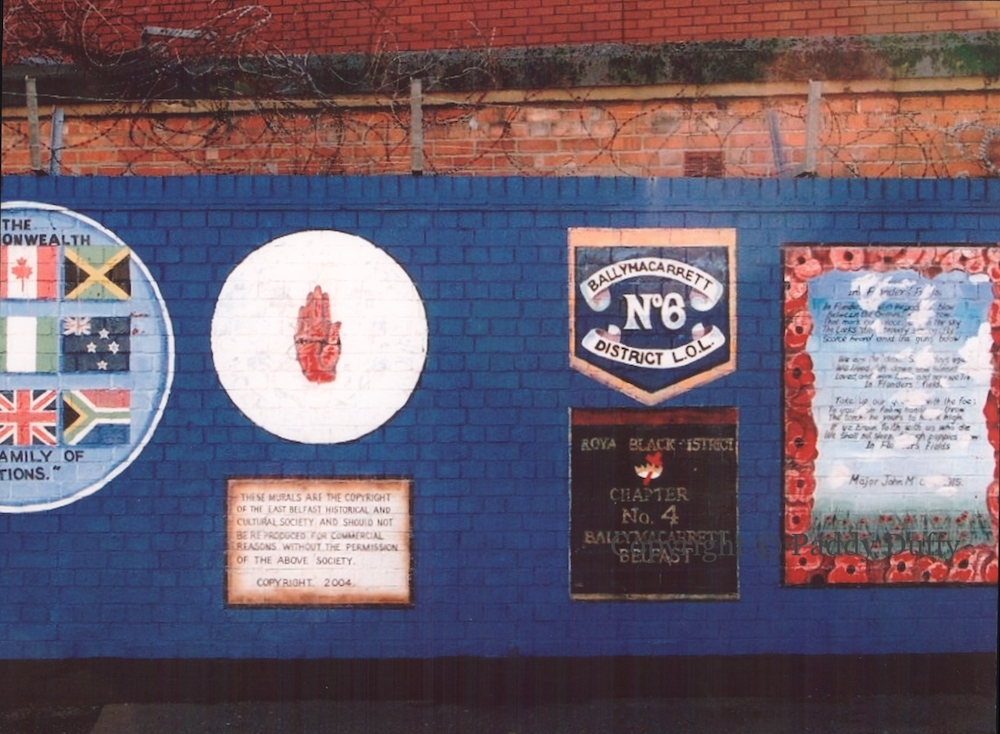
In 2004 the East Belfast Historical And Cultural Society sponsored a series of 14 murals in Thorndyke Street charting Protestant history from Cromwell to Cluan Place. From left to right, these are:

  • The Covenant
  • “The Folk Come Home. Lord Protector of the Commonwealth” (Cromwell)
  • “The City Is Saved” (Siege Of Derry)
  • “Civil And Religious Liberty For All.” “Dan Winter’s cottage, County Armagh. Dan Winter was one of the founders of the Orange Order”
  • “Better The Grave Than Slavery.” “How is freedom measured? By the effort which it costs to retain. Freedom!” (WW1)
  • “Their Sacrifice, Our Freedom.” “As we scrambled over the trench ladders, the YCV flag appeared. Jim Maultsaid” (WWI)
  • “United Kingdom”
  • “Hitler Attacks Belfast”
  • “Defending The Community” (Paramilitaries)
  • “Unity – Solidarity” (Sunningdale Agreement)
  • “Their Loyalty Betrayed” (UDR/B Specials)
  • “Out Of The Ashes, New Life.” “Annie Blair – Cluan Place. Her defiance against aggression will always be remembered – God bless”
  • Britannia. “The Union flag, or Union Jack, is the national flag of the United Kingdom and it is so called because it embodies the emblems of three countries united under one sovereign – the Kingdoms of England and Wales, of Scotland and of Ireland. The flag consists of three heraldic crosses, those of St Patrick, St George and St Andrew. The Welsh dragon does not appear on the Union flag. This is because when the first Union flag was created in 1606, Wales by that time was already united with England and was no longer a separate principality.”
  • Commonwealth/Sponsors

The murals were launched in 2004 and information panels were added in 2005.

Click image to enlarge
Copyright © 2012 Paddy Duffy
T00587 T00600 T00593 [T00604] T00594 T00589 [T00607]
T00588 [T00608]
T00596 [T00595] T00597 [T00606] T00598 T00599 [T00605] T00590 [T00603] T00591 [T00592] [T00602]
T00601

A Better Future

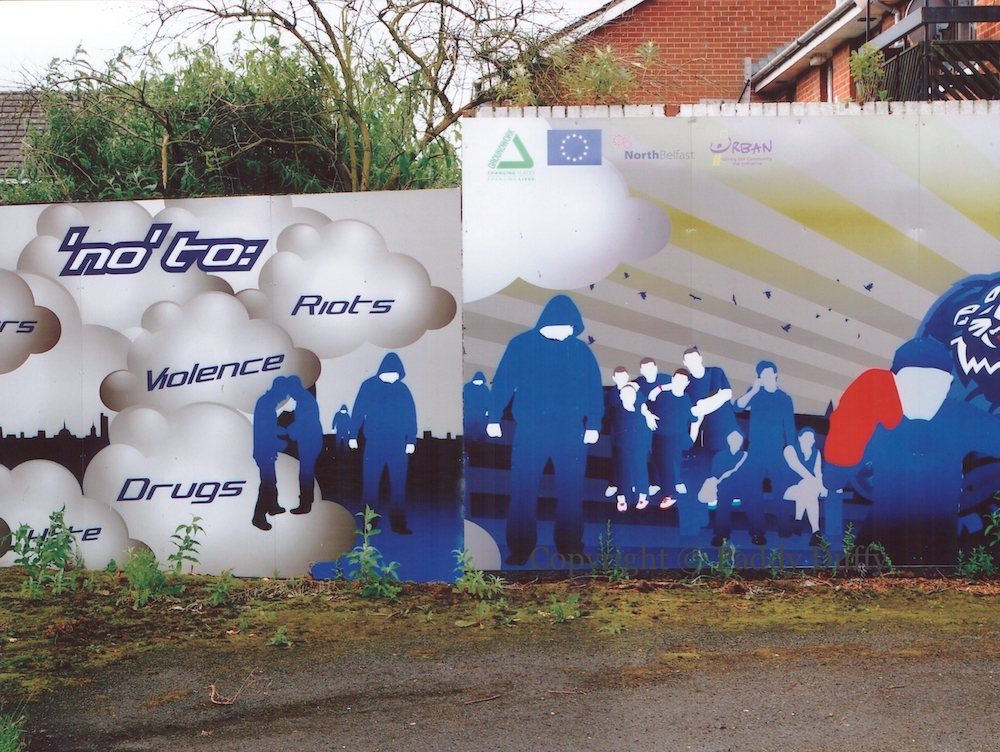
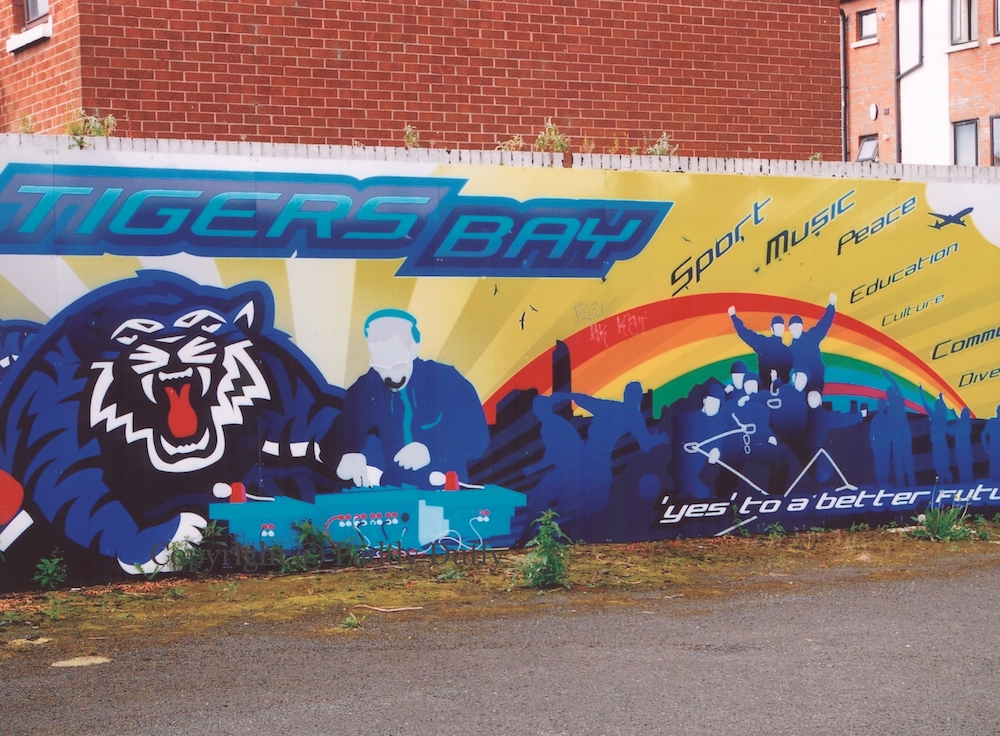
Tiger’s Bay says “‘No’ to dealers, riots, violence, drugs, hate.” on the black-and-white left and, on the right, “‘Yes’ to a better future … sport, music, peace, education, culture, community, diversity.” With funding from Groundwork, the European Union, NorthBelfast, Urban [development? regeneration?].

Replaces Loyalist Tigers Bay.

Click image to enlarge
Copyright © 2009/2010/2011/2012 Paddy Duffy
T00670 T00671

100 Years Of Conflict

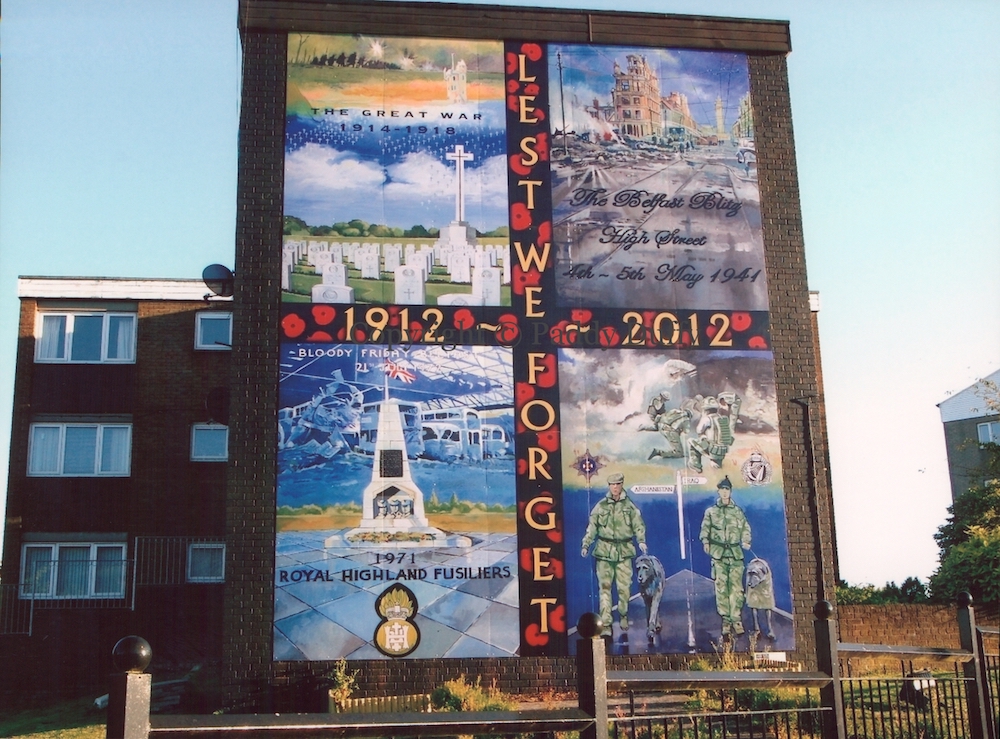
The three-storey mural above is in Ballysillan and replaced a UVF mural when it was added in 2011. The mural is the work of Jim Russell while artist-in-residence at Arts For All. The information below was provided by Arts For All.

The Great War: The first panel commemorates the Great War that ravaged Europe from 1914 to 1918 and shows troops advancing into battle, the Ulster Tower at Thiepval commemorating the sacrifice at the Somme and an image showing one of the war cemeteries and highlighting the true cost of war.

Second World War: The second panel features some of the devastation visited upon Belfast during a series of Luftwaffe raids during the early years of the Second World War. Belfast suffered greatly with over 1,000 people dying in four nights of bombing in April and May of 1941.

The Troubles: In the third panel highlight the dark history known as the Troubles. It features two events from the years of that time – the murder of the three young off-duty Scottish soldiers in 1971 [the monument depicted was featured in The Highland] and the Bloody Friday bombings of July 1972. In the midst of the horror that accompanied the early years of the Troubles these events still caused many to struggle to understand how people could carry out such atrocities.

Present Day Conflict: Panel four brings us up to the present day. Military service is a tradition for many in Northern Ireland and for many their first overseas trip came on the back of an overseas posting whilst serving in one of the Armed Forces. From times past, through the World Wars, the Korean War, to more recent conflicts in Iraq and Afghanistan soldiers and regiments drawn from Norther Ireland continue to play a role.

N Circular Road, north Belfast

Click image to enlarge
Copyright © 2012 Paddy Duffy
T00703 [T00708]

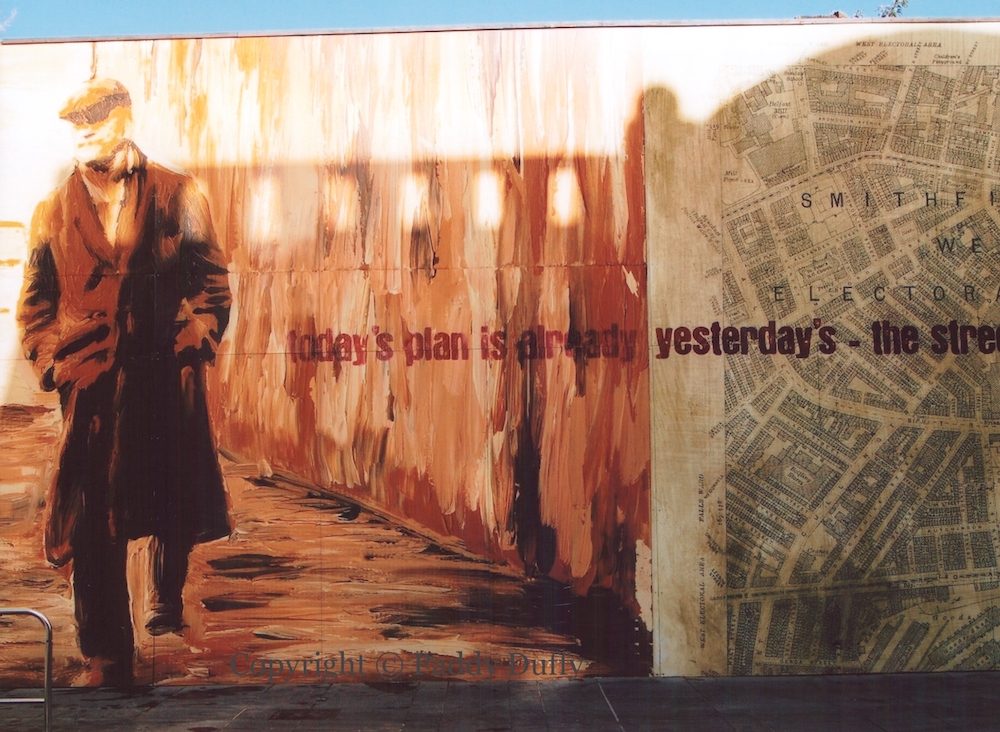
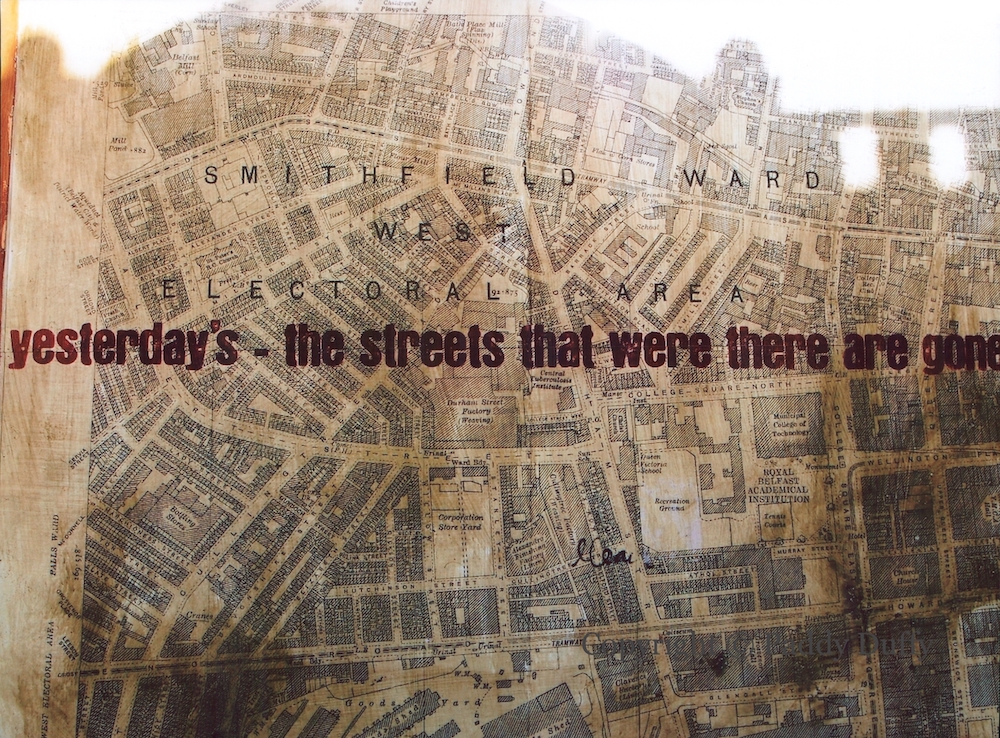
The Plan For Today

“Today’s plan is already yesterday’s – the streets that were there are gone”. Euphemistic nonsense on a giant hoarding on Castle Street in the city centre, fronting a building site. In keeping with the theme of easy erasure of the past, the words “love joy peace” have been removed from the original 1955 photograph (Belfast Live).

Click image to enlarge
Copyright © 2012 Paddy Duffy
T00774 T00775