Young people from the Lower Shankill pose in the style of a movie poster: “You must have dreams and goals if you are ever going to achieve anything in this world.” The info panel (shown below) incorrectly states that the board replaces a loyalist H-Block mural (of which there were two versions: yellow (M02473) | orange) and, before that, a UDU-UFF-UDA mural; these were on different walls and this board replaces only the Maze mural.
This is the second of five pieces of re-imaging in the lower Shankill. The first was I Am Not Resilient.
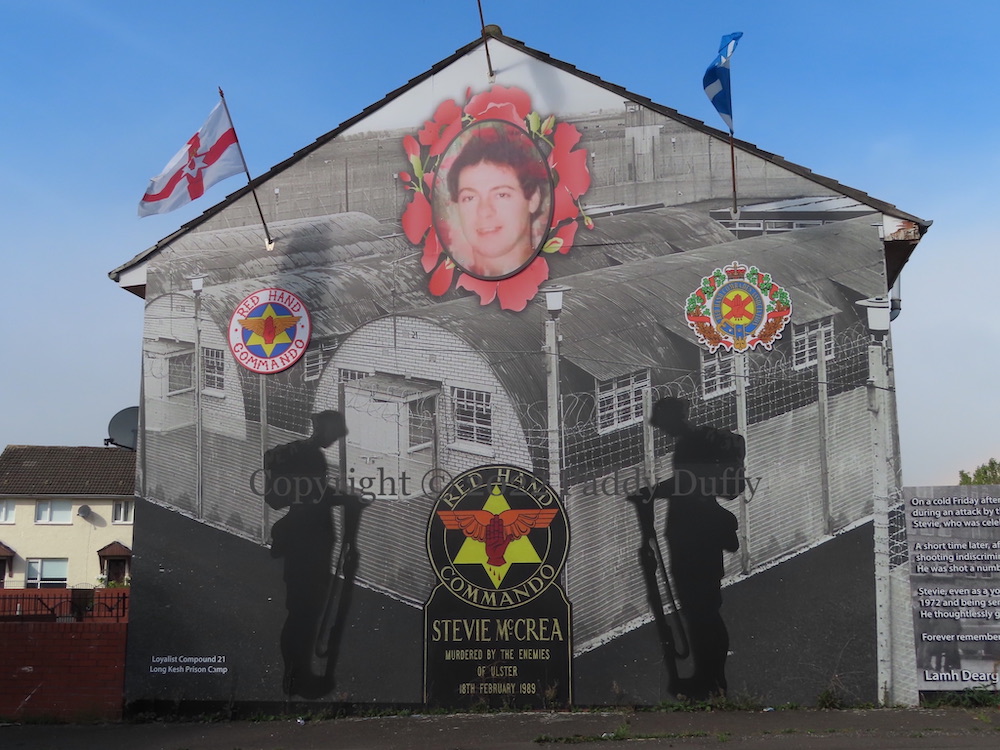
“On a cold Friday afternoon in February 1989, a young Red Hand Commando volunteer, Stevie McCrea, gave up his life to save others during an attack by the IPLO – a republican drug gang – at the Orange Cross Club just off the Shankill Road. Stevie, who was celebrating his last day on a work-out scheme with friends, went to the club for a farewell drink. A short time later, after gaining access through the outer door of the club, three IPLO gunmen burst into the main bar and started shooting indiscriminately. Stevie reacted immediately, placing himself between the gunmen and his friends. He was shot a number of times. Sadly he died from his injuries two days later. Stevie, even as a young man was a willing and active volunteer for the RHC, which culminated with him being arrested in October 1972 and being sentenced to life imprisonment early in 1973. Stevie served 16 years as a political prisoner in Long Kesh. He thoughtlessly gave up his life for others. A true soldier of Ulster. Forever remembered by friends and comrades. Lamh dearg abu.”
This new photographic mural, with “Loyalist Compound 21, Long Kesh prison camp” as a background, replaces a painted one to McCrea that had stood since 2000.
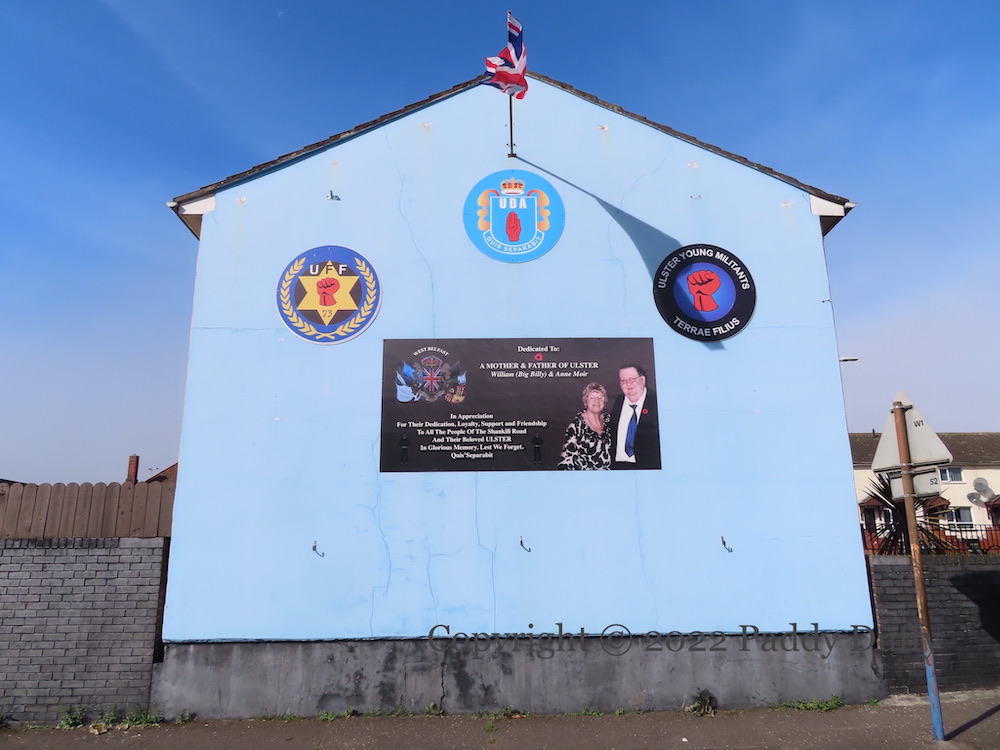
Billy Moir, who died in May 2016, was a central figure in the Glasgow flute-band scene. The board above, dedicated to Billy and his wife Anne, is in the lower Shankill estate. “Dedicated to a mother & father of Ulster: William (Big Billy) & Anne Moir, in appreciation for their Dedication, Loyalty, Support and Friendship to all the people of the Shankill Road and their beloved ULSTER. In Glorious Memory, Lest We Forget, Quis Separabit.”
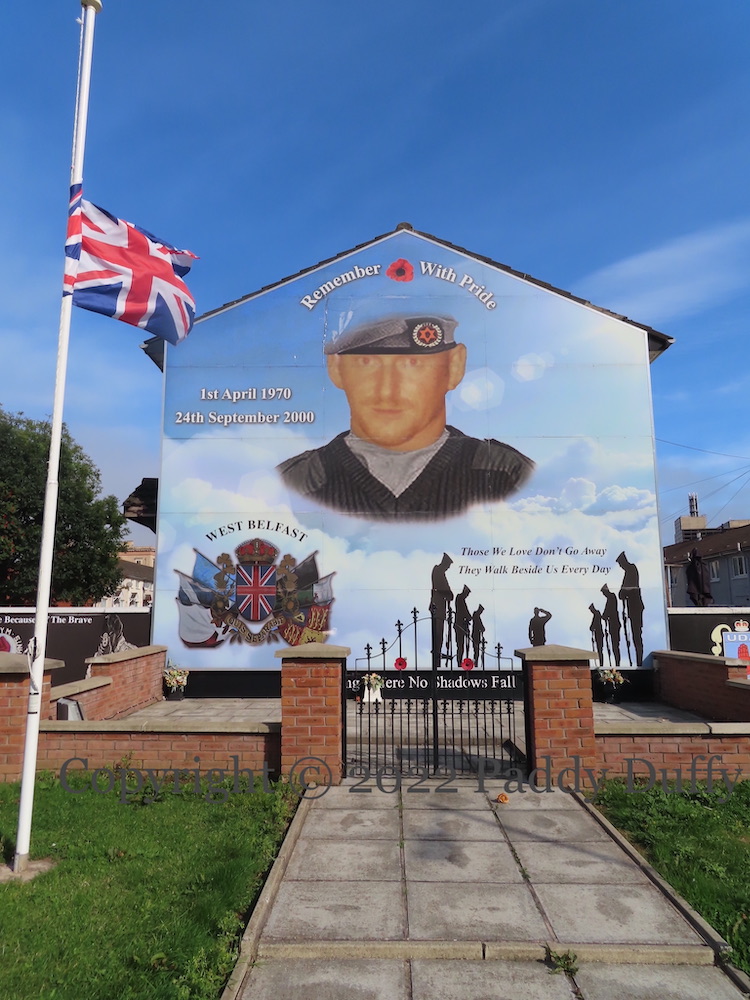
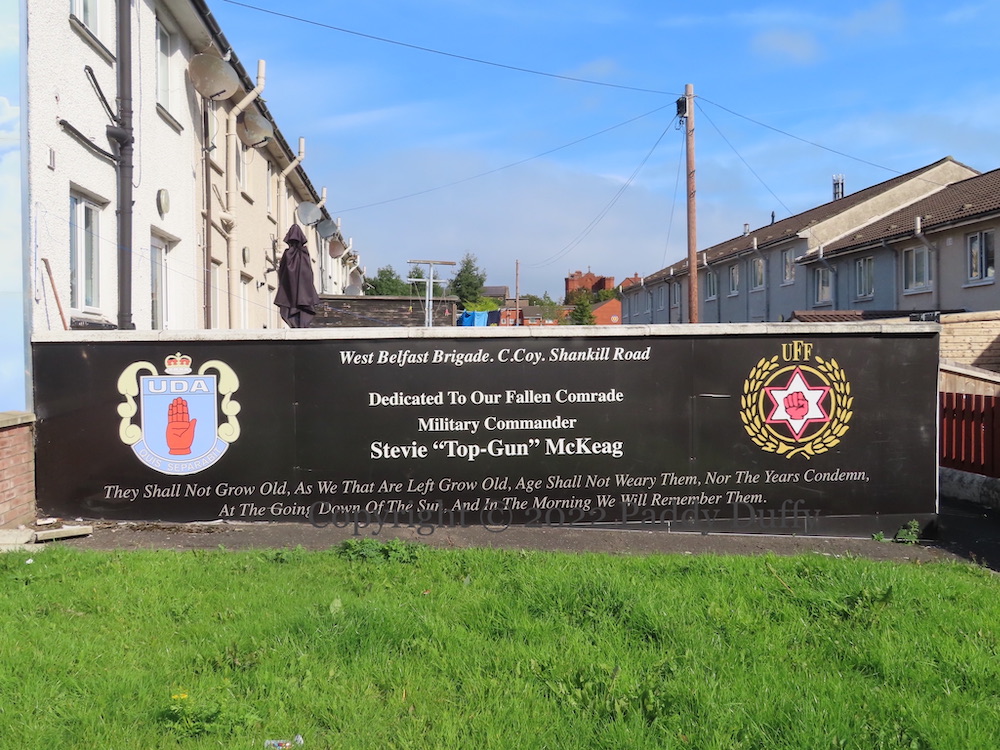
“Remember With Pride” (with a poppy). Although the dates of his birth and death are given, Stevie “Top Gun” McKeag’s name appears only on the side-wall of this new mural in the lower Shankill estate. McKeag was the top assassin in the UDA during the 1990s, claiming at least 12 victims. Both his WP page and this Guardian article describe his career and preeminent standing within the UDA.
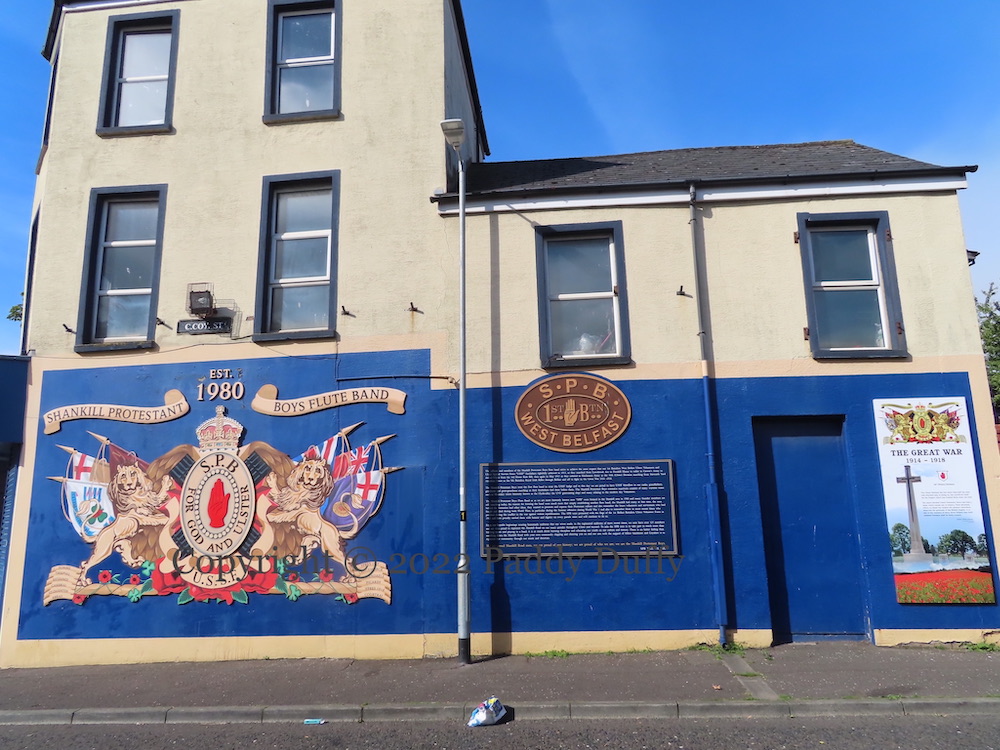
At first glance the piece above looks like a colourful mural but it is in fact a large painted carving of lions rampant on either side of the emblem of the Shankill Protestant Boys flute band, named for the Shankill Boys of the original Ulster Volunteers and the Ulster Special Service Force unit within it which was designed to be a unit of “first responders”, ready to react at short notice to action by republicans or British forces anywhere in northern Ireland (historyireland).
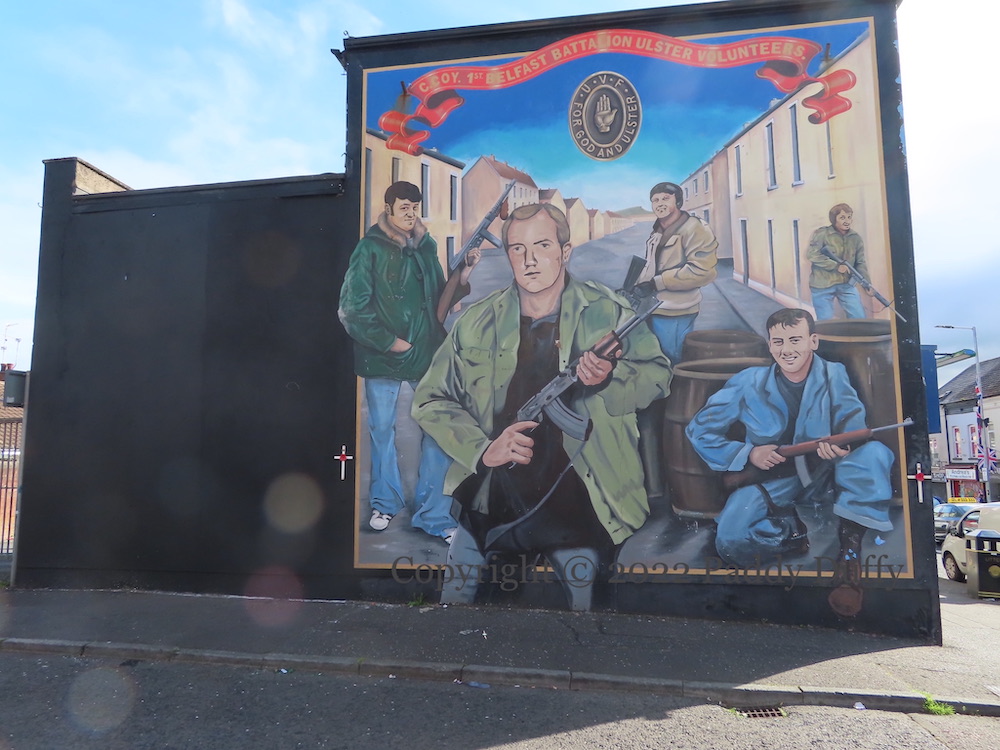
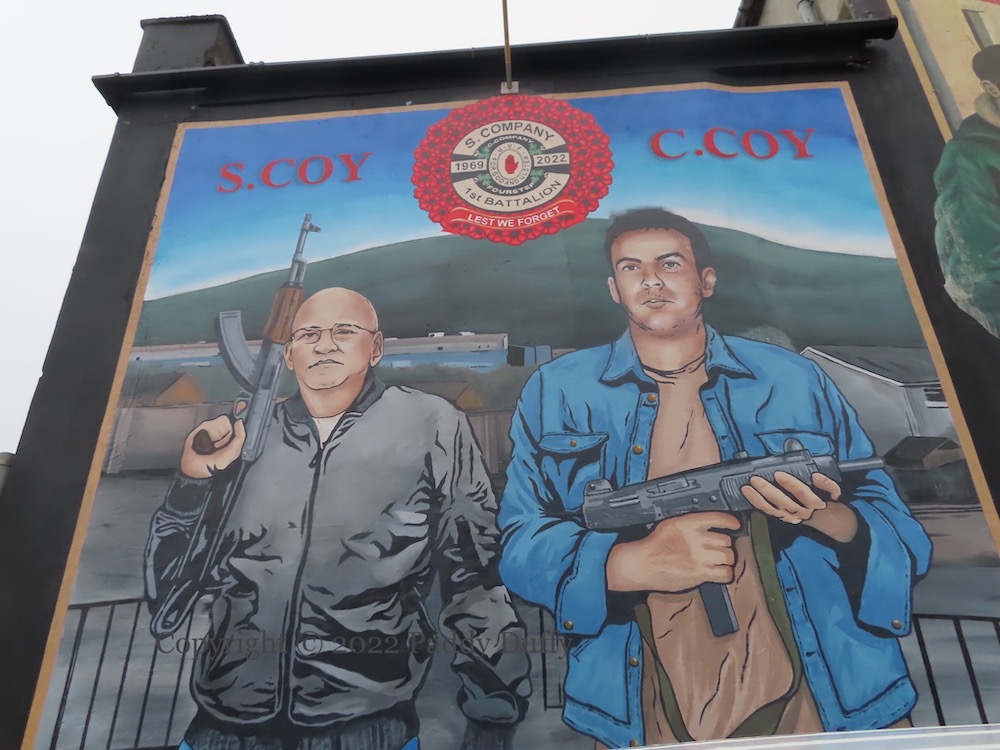
UVF volunteers (l-r) Thomas Chapman, James McGregor, Robert McIntyre, William Hannah, and Robert Wadsworth, who were killed between 1973 and 1978, are commemorated in a new mural in Carnan (or “C. Coy”) Street. The mural is unusual in that it shows bare-faced full figures; loyalist murals sometimes include head-shots (at the top of the mural, in the apex of a gable wall, e.g. Standing Guard) but only masked men appear as full figures. There is a similarity in composition and style (and perhaps even palette) to existing Republican murals such as this one of five B. Coy IRA volunteers in Ballymurphy.
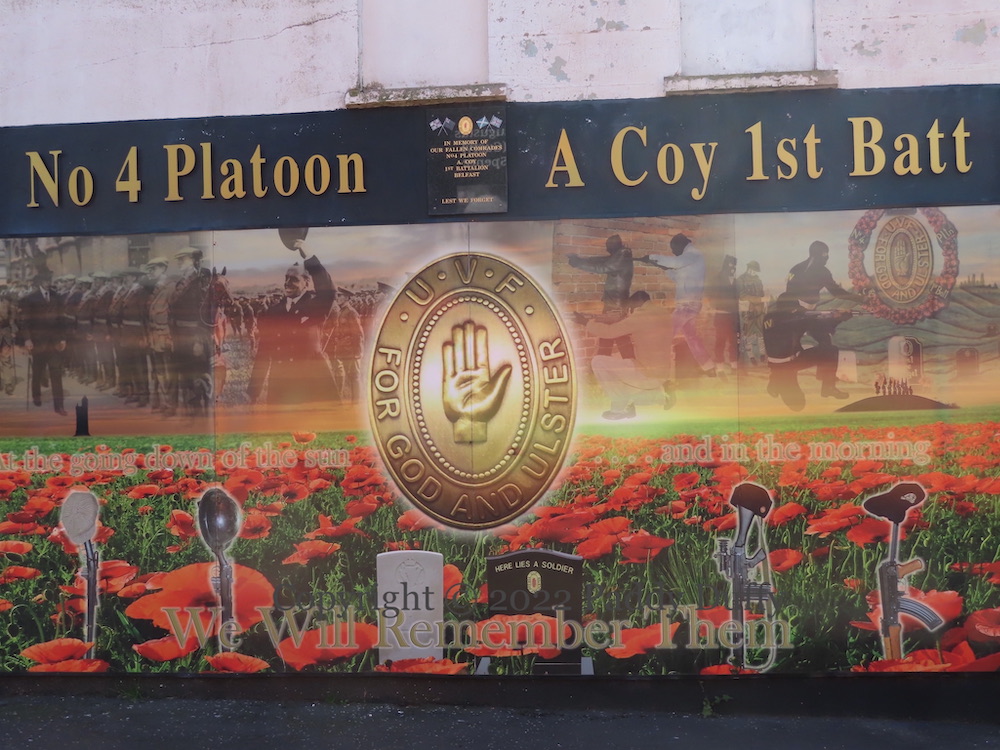
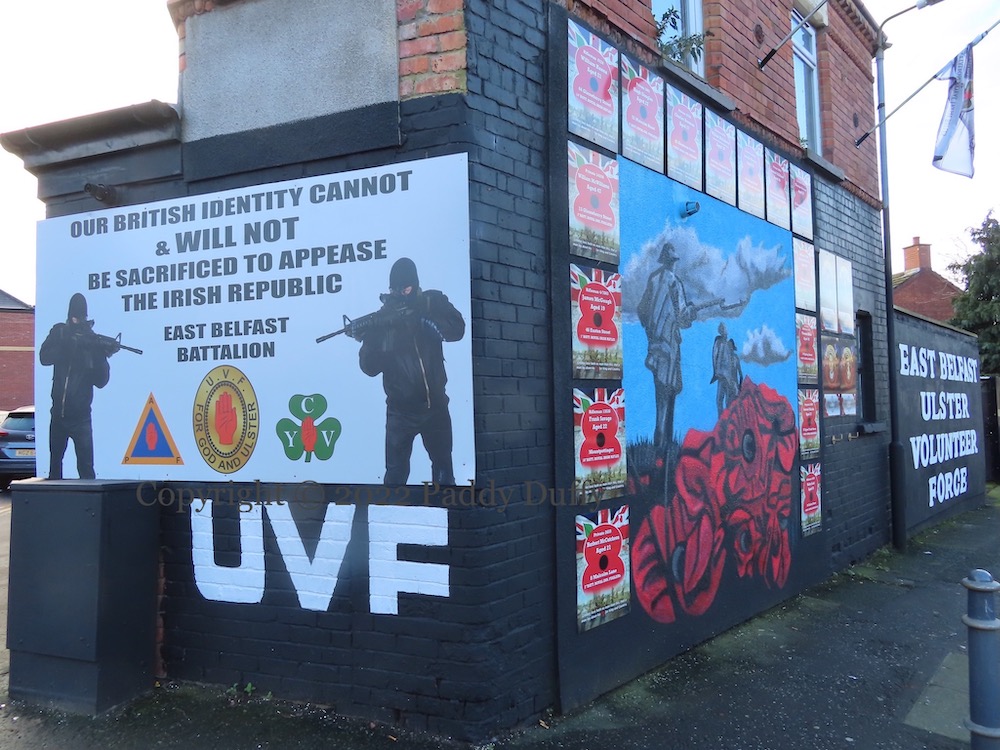
Four generations of headgear and rifles, from 1912 to the present, are featured in this new UVF board in Glenwood Street. A portion of the previous No. 4 Platoon ‘graveyard scene’ mural it replaces can be seen in the top right, with black figures superimposed. The title of the post, which comes from Ecclesiasticus 44, appears on the accompanying info panel along with a verse from Laurence Binyon’s poem For The Fallen. The fourth verse of Binyon’s poem is more often quoted, as in What Do We Forget When We Remember and At The Going Down Of The Sun.
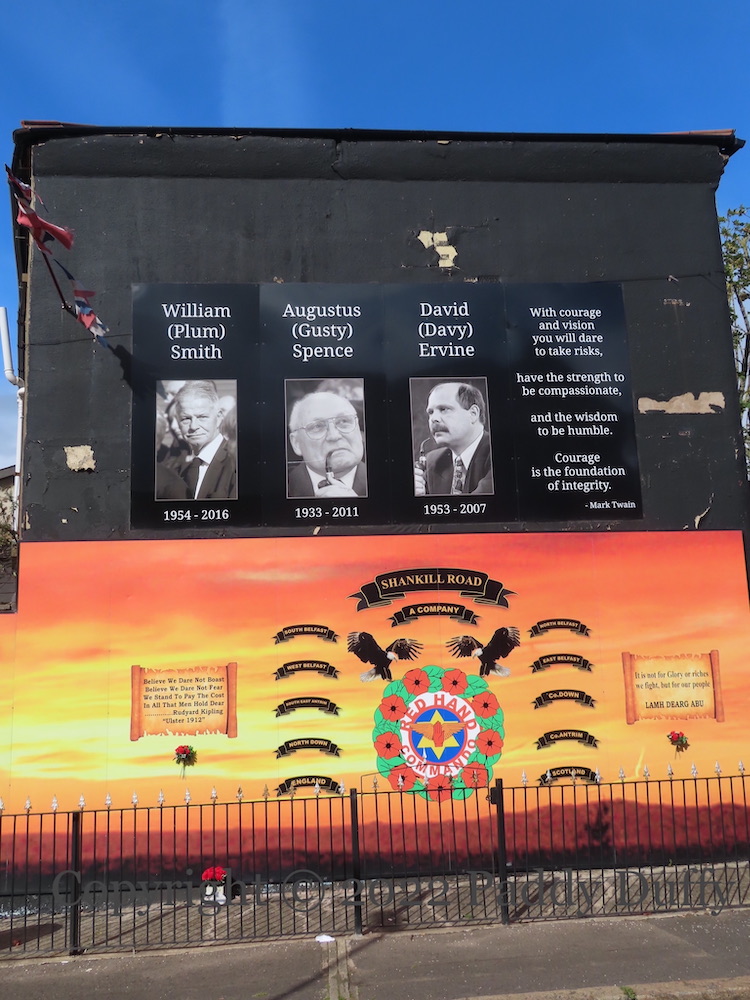
“With courage and vision you will dare to take risks, have the strength to be compassionate, and the wisdom to be humble. Courage is the foundation of integrity. – Mark Twain.” (The quote does not appear to be from Twain but is widely attributed to Keshavan Nair, who wrote a book on “lessons from the life of Ghandi”.)
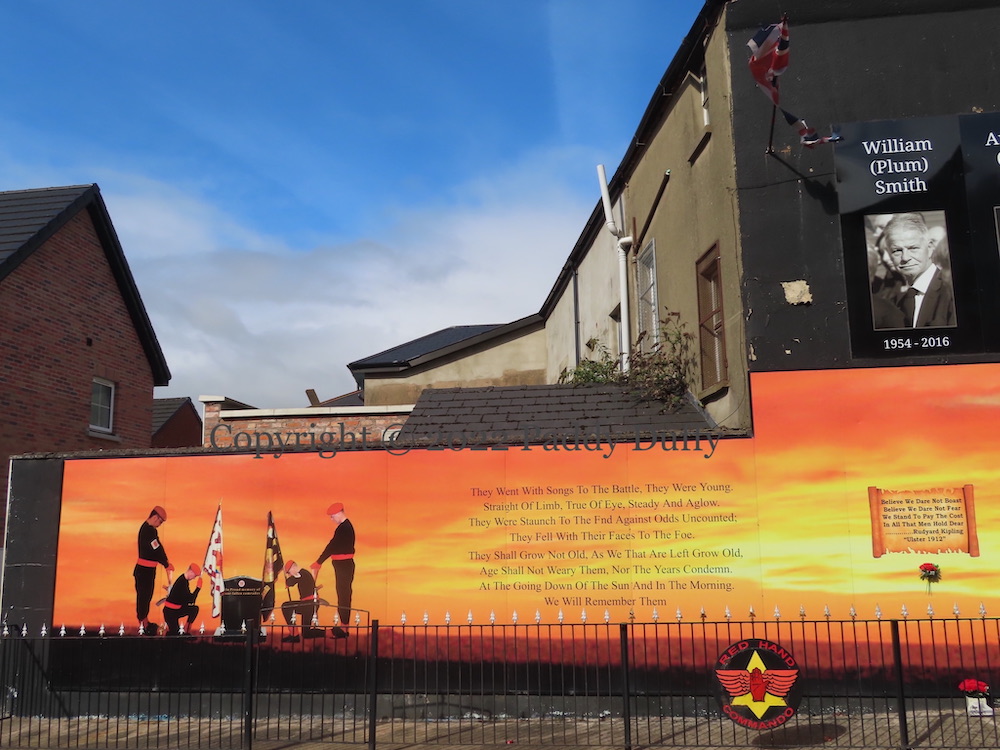
This board above the Red Hand Commando mural in Glenwood Street honours three UVF men who turned to politics and community work: Augustus (Gusty) Spence, who was among the earliest members of the UVF and after release in 1984 joined the PUP and set up the Shankill Activity Centre; David Ervine, also a UVF and PUP leader – see David Ervine and Memory Chair; Plum Smith, a founder member of the RHC and later shop steward and PUP leader – see RIP Plum Smith.







 Paddy Duffy Collection