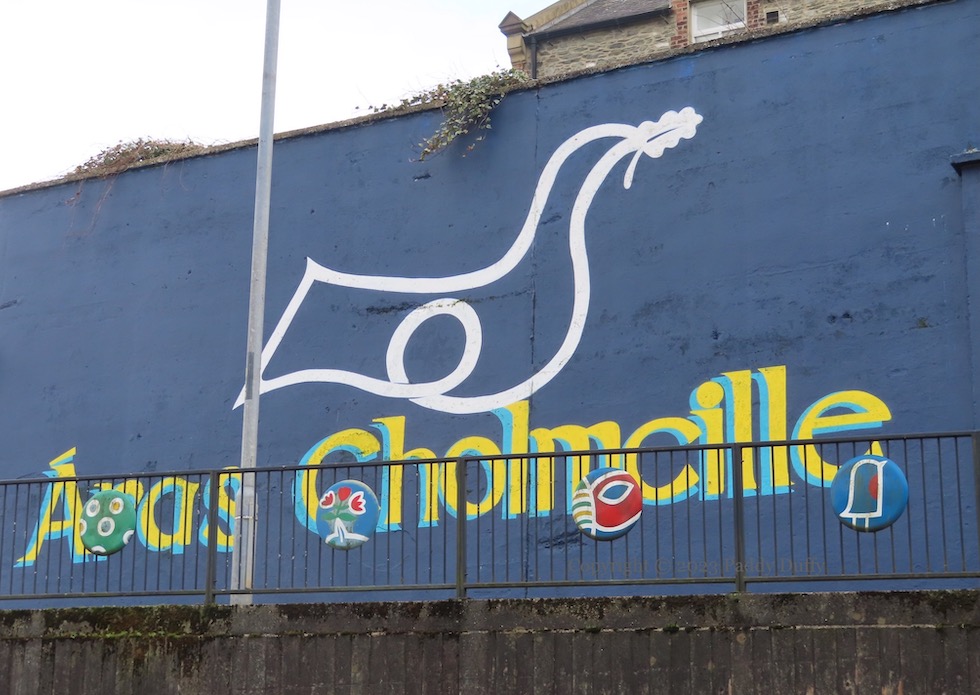
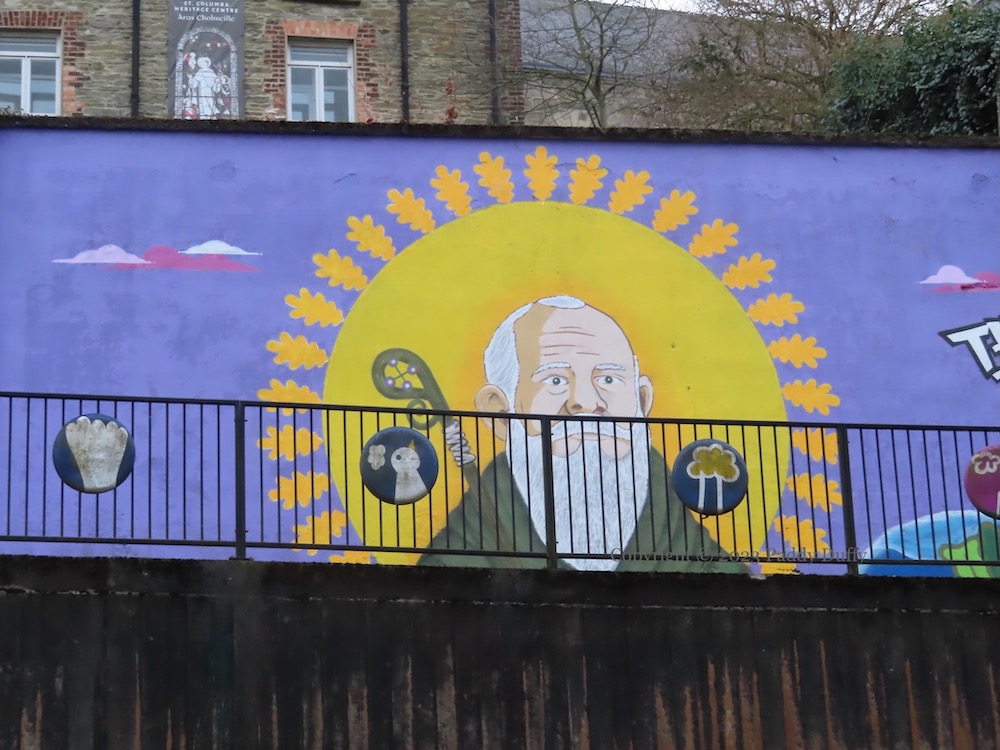
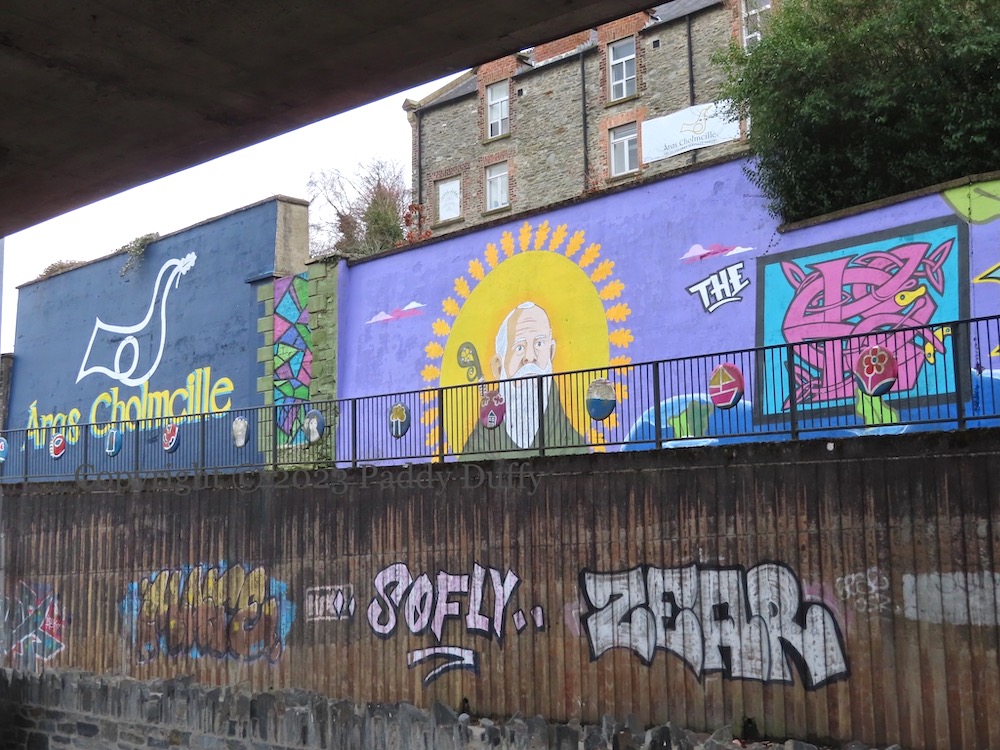
These murals – painted by Peaball (web) – are on the wall of the Lecky Road overpass below the St Columba Heritage Centre (web) in Long Tower.
Click image to enlarge
Copyright © 2023 Paddy Duffy
T02097 T02098 T02099
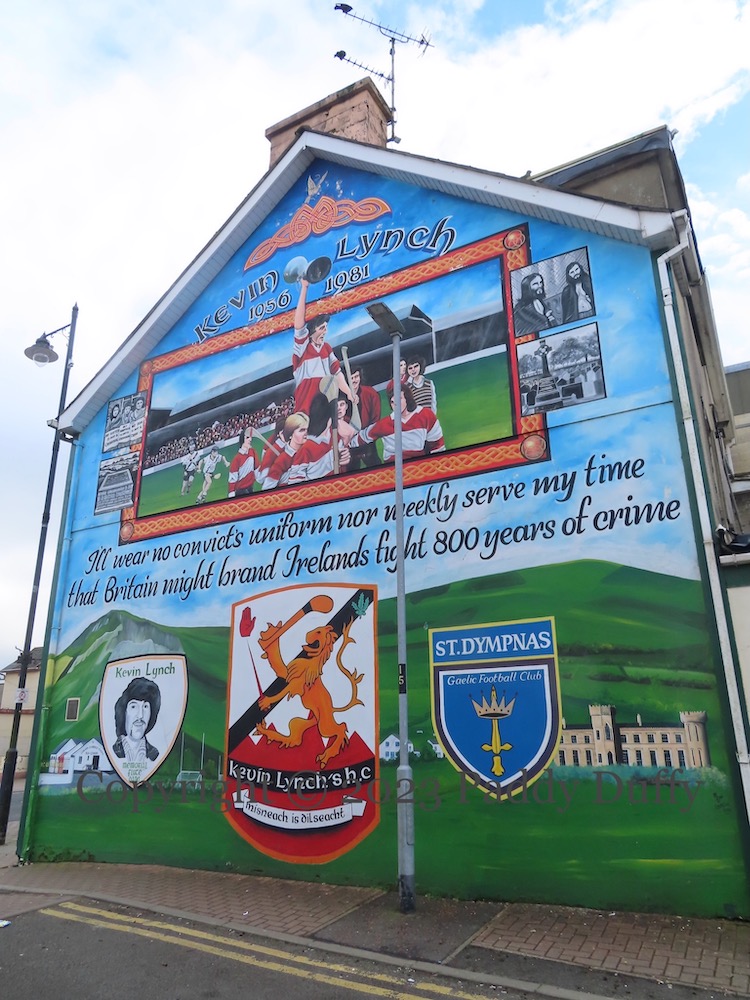
This is the repainted version of the mural to Kevin Lynch in Dún Geımhın/Dungiven. Lynch died after 71 days on hunger strike – the longest-surviving striker – in Long Kesh/the Maze prison (WP).
The four black-and-white squares show (top left) Mary Nelis, Kathleen Deeny and Theresa Deery, protesting the arrests of their sons; (bottom left) the memorial to Lynch in nearby Park, where has was born; (top right) blanket-men Hugh Rooney and Freddie Toal; (bottom right) Lynch’s gravestone in Dungiven.
Along the bottom are the emblems of Kevin Lynch Memorial flute band (Fb), Kevin Lynch’s hurling club (“mısneach ‘s dílseacht”), and St Dympna’s football club, Luton (Fb).
“Mural unveiled on Saturday 4th August 2012 by Bridie Lynch & Jeannie McTaggart to commemorate Kevin Lynch and his comrades who died in the 1981 hunger strike.”

Click image to enlarge
Copyright © 2023 Paddy Duffy
T02036 T02037

Clare Crockett gave up her acting career (IMDb) to become a Servant Sister. She is pictured in the info board along with the five postulants who died with her during a 2016 earthquake in Playa Prieta, Ecuador. A web site has been established in her memory and a movie made about her life; there have been calls to make her a saint (Irish News).
Painted by UV Arts (tw) in Derry’s Brandywell, where she originally came from (BelTel).
“Sr Clare Crockett was born in Derry 14th November 1982. The daughter of Gerard and Margaret Crockett. During a Holy Week Retreat in Spain in the year 2000 she experienced the intensity of the Lord’s Death and Resurrection that led to a deep conversion of her life. Sr Clare entered the Servant Sisters of the House of the Mother 11th August 2001. She went to found a new community in Jacksonville, Florida in October 2006. Sr Clare took Perpetual vows 8th September 2010. In 2014, Sr Clare undertook the mission in Ecuador. She died in an Earthquake, protecting her pupils 16th April 2016. She was buried in Derry 2nd May 2016.”
Deanery Street, Brandywell, Derry
There is another Sister Clare mural in Shantallow.
Update: this mural was repainted in 2026 – see Sister Clare Crockett.

Click image to enlarge
Copyright © 2024 Paddy Duffy
T02150 T02151

This is a blue-backgrounded version of the formerly grey UFF mural in Lincoln Court, Londonderry, seen previously in 2015.
Click image to enlarge
Copyright © 2023 Paddy Duffy
T02047
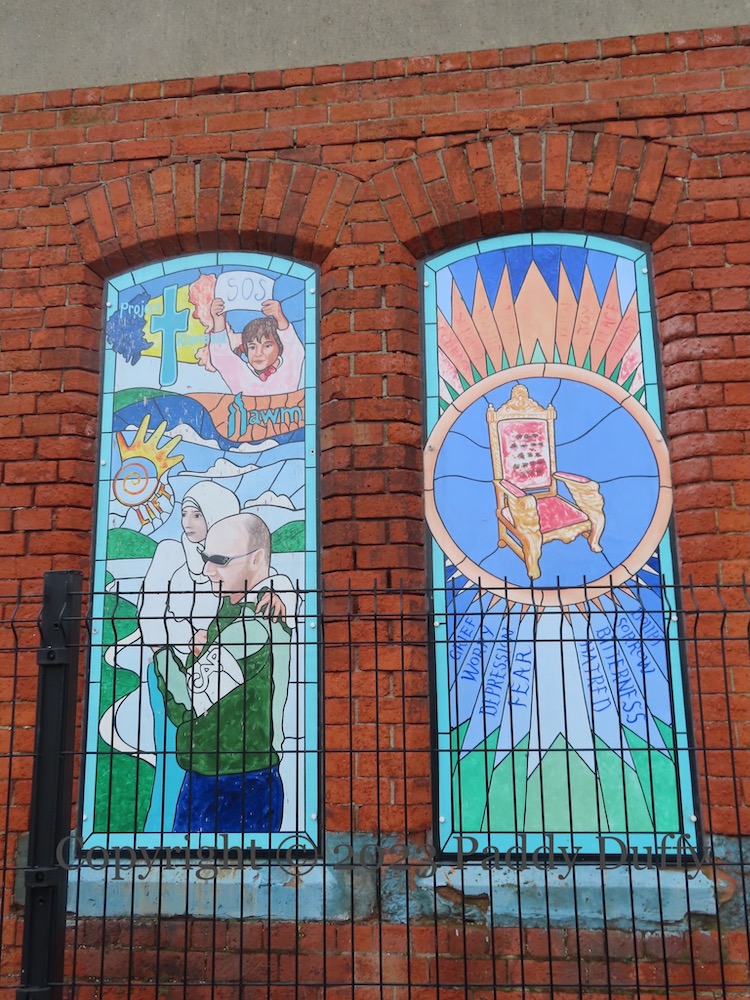
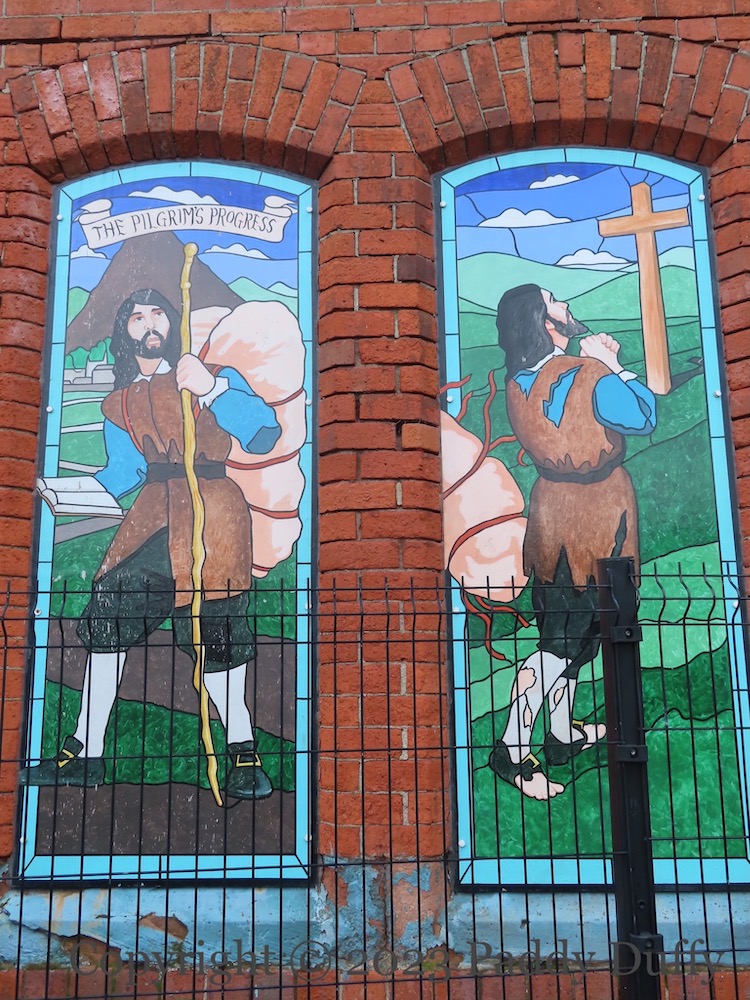
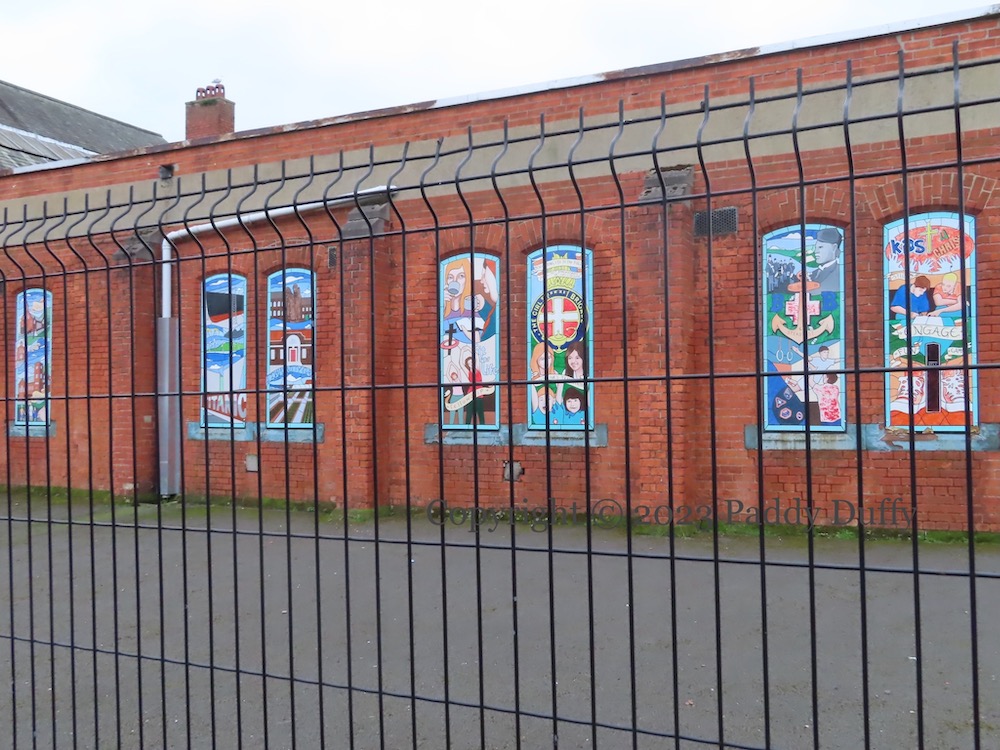
These images show the religiously-themed panels in eleven windows on the side and back of Newington Presbyterian.
Click image to enlarge
Copyright © 2023 Paddy Duffy
T02031 T02032 [T02033] T02034

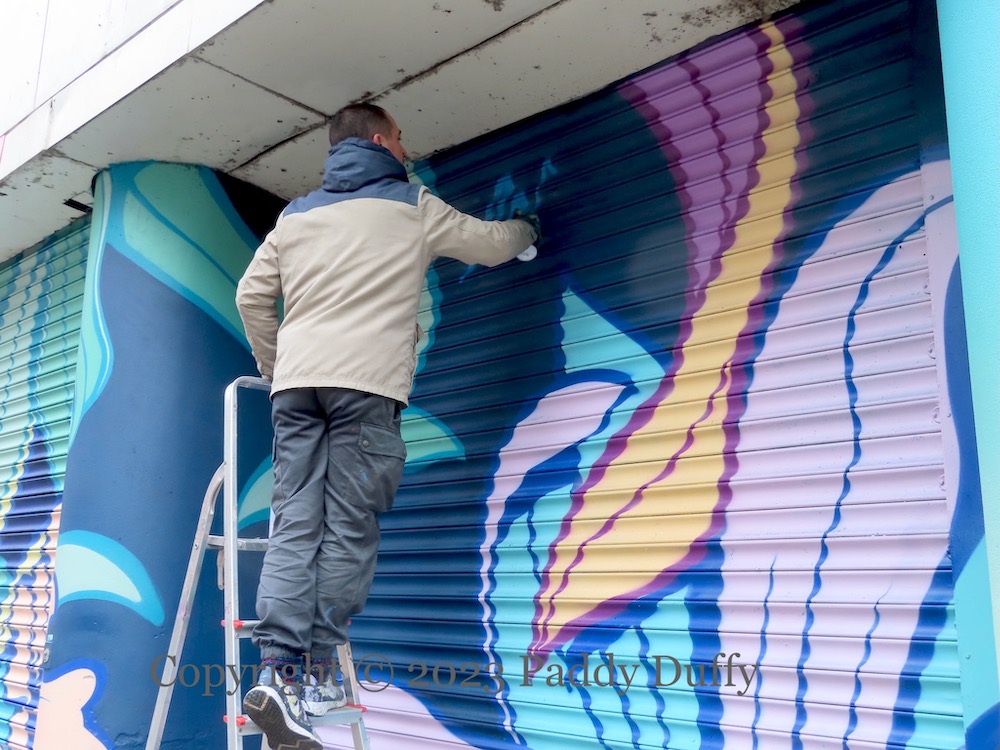
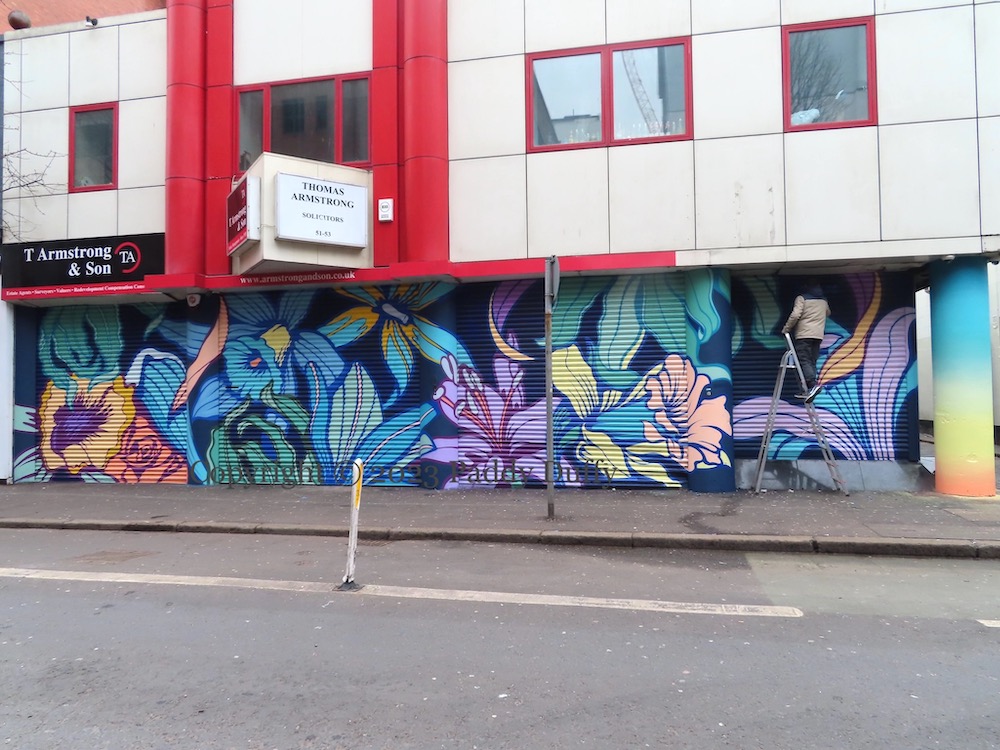
Here are both the new and the old pieces from French artist (now based in London) Nerone (ig | web). The new piece is a wide arrangement of flowers in Upper Arthur Street. The older piece (shown in the final image, below) is from 2021’s Hit The North, “Life Won’t Wait” above the night-club (currently Club Lux) in Dunbar Road.

Click image to enlarge
Copyright © 2023 Paddy Duffy
T02017
T02014 [T02013]
T02015
T01860

900 people died and half the homes in Belfast were destroyed or damaged in the Belfast Blitz of WWII (WP). in the apex of this mural a Nazi bomber sets buildings alight; in the main panel, people, including a milkman, walk among the bombed-out buildings and play a piano that has been pulled from the rubble.
Painted in 2013 by JMK, in Hogarth Street, Tiger’s Bay, north Belfast
Click image to enlarge
Copyright © 2023 Paddy Duffy
T02030 [T02039]
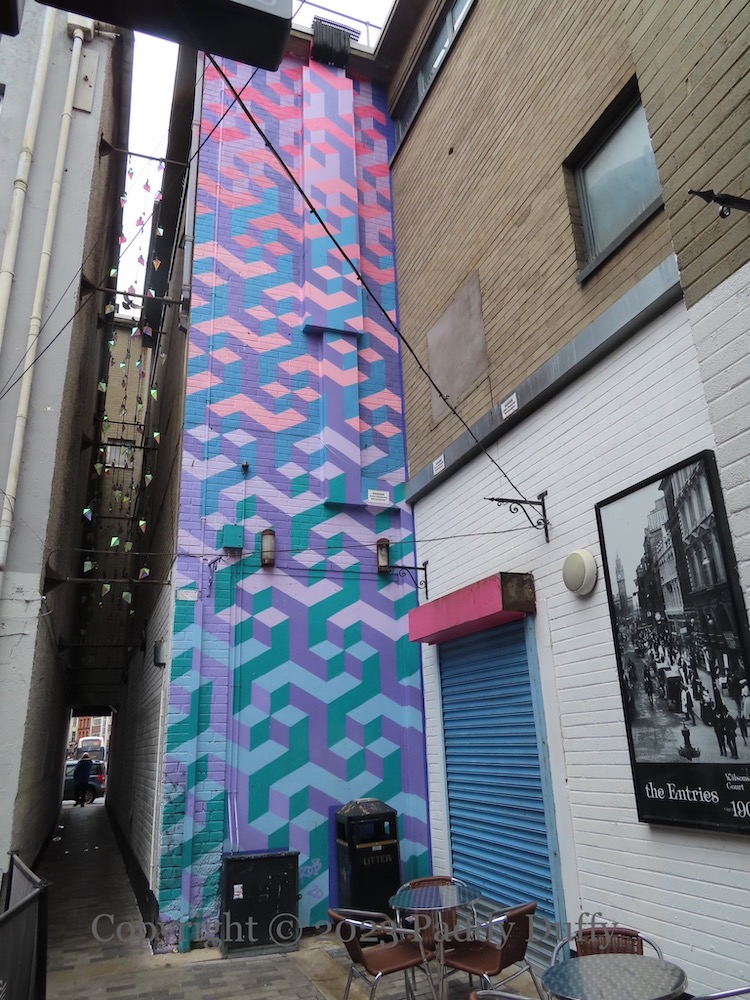
The Northern Star newspaper began publication in 1792 in Wilson’s Court, Belfast, under the editorship of Samuel Neilson, to cover local news and express the views of the United Irishmen. It became so popular that it survived until 1797, despite the Irishmen being outlawed in 1793 with the declaration of war between Britain and France and Neilson being arrested in 1796. Walter Cox, editor of The Irish Magazine And Monthly Asylum For Neglected Biography) wrote a ‘Sketch Of The Life Of Samuel Neilson’ for the September, 1811, edition (p. 396 ff) and wrote that “The Northern Star, under his managment, was indeed a planet of light and heat; its influences were commensurate with its circulation and its circulation was only restricted by the ocean. It warmed the cold; it animated the feeble; it cheered the afflicted; it stimulated the intrepid and instructed all. Pernicious dogmas, false reasonings, slavish superstitions and gothic prejudices, which broke the people into different sects and marshalled them against each other, disappeared before it.” (O’Brien 1998 | History Ireland)
The mural – in Wilson’s Court, Belfast – is by Rob Hilken and called “Light And Heat”.
See previously: Olaudah Equiano | Belle Martin and the Visual History page on the Belfast Entries Project
Click image to enlarge
Copyright © 2023 Paddy Duffy
T02005 [T02004]
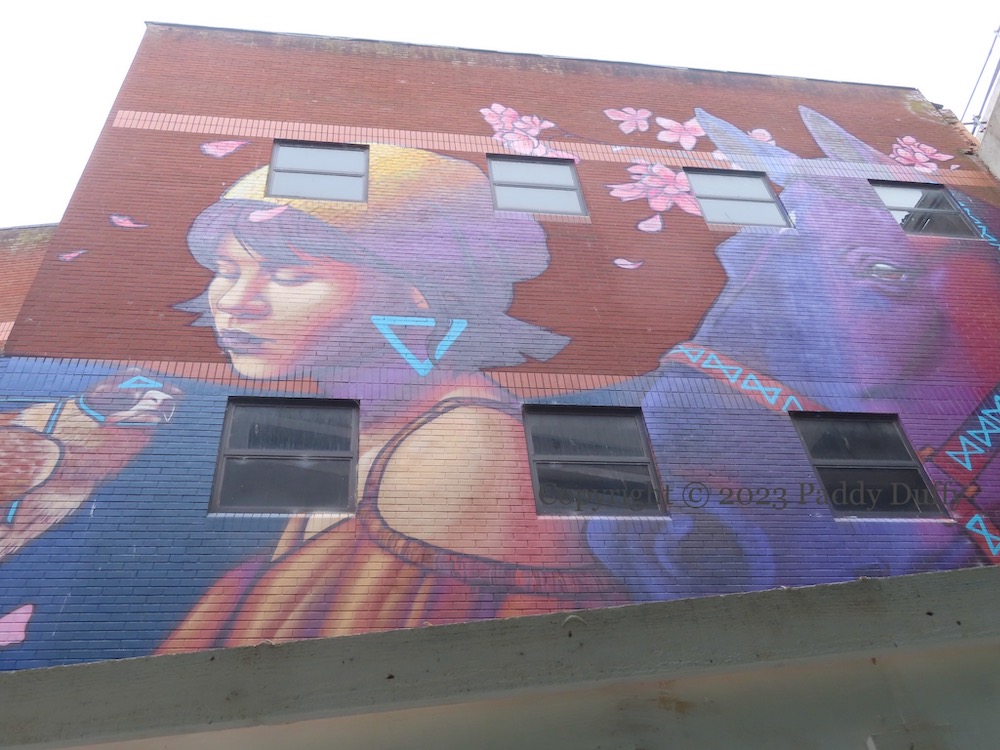
Castle Arcade is so-called because it is the site of both the original castle of Belfast, built by the Normans in the late 12th century and then rebuilt by Arthur Chichester in 1611. Chichester’s castle had “spacious gardens which extended from the river along to Cromac Woods and near Stranmillis” with “orchards, bowling greens and cherry gardens … fish ponds,” for “hunting, hawking, and other sports”. It was destroyed by fire in 1708 after which the area became commercialised as a market (ArchiSeek | Mary Lowry | BBC | Belfast Entries).
By Friz (ig) and Gerry Norman (ig).
See previously: You’ve Got The Key Of The Street.
Click image to enlarge
Copyright © 2023 Paddy Duffy
T02009 [T02006] [T02007] [T02008] [T02010] [T02011]
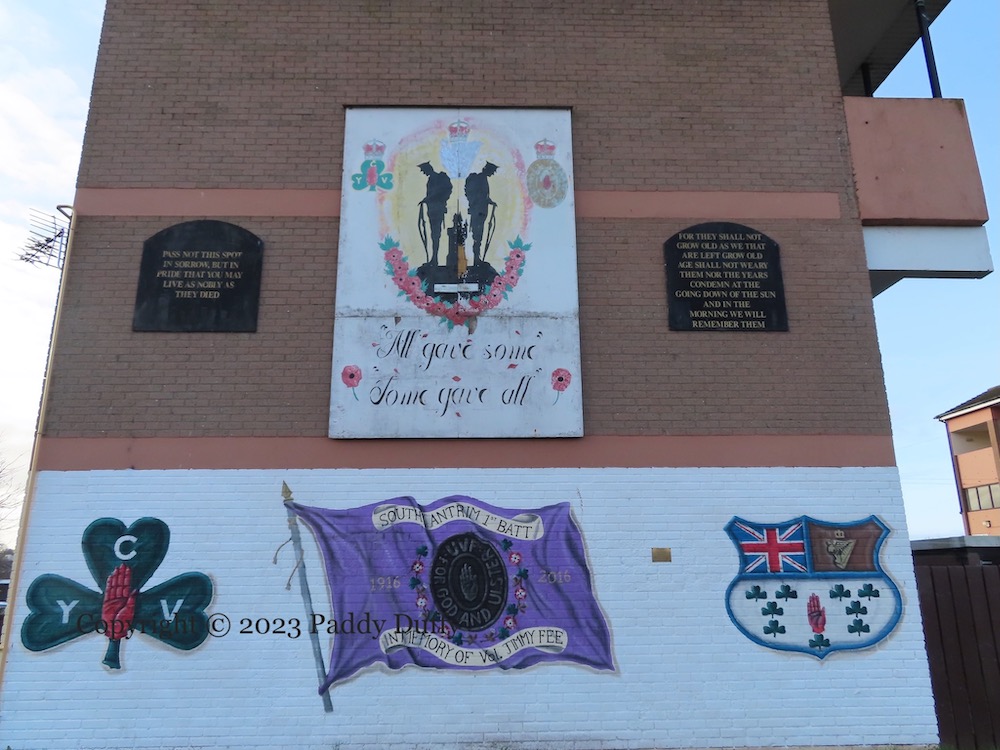
There has been a 36th Division board on this wall since 2003 (see Steeple Defenders) and this second one is now more than a decade old – see the 2013 post on Peter’s site. It is accompanied by two quotations:
“Pass not this spot in sorrow but in pride/That you may live as nobly as they died.” These lines are also used in a WWI memorial mural in Carlingford Street, Belfast.
“They shall not grow old as we that are left grow old./Age shall not weary them nor the years condemn./At the going down of the sun and in the morning, we will remember them.” from Binyon’s For The Fallen.
The mural below, with YCV and 36th Division emblems and a “South Antrim 1st Batt” flag was added in 2016. There’s no mention on-line of “Vol. Jimmy Fee” of the 1st (and only) battalion of the South Antrim brigade.
The board and mural are on the gable next to the Steeple memorial mural to Denver Smith; between the two gables is the UVF flag shown below.

Click image to enlarge
Copyright © 2023 Paddy Duffy
T01978 T01979 Parkhall Road all gave some some gave all thank you nhs
 Paddy Duffy Collection