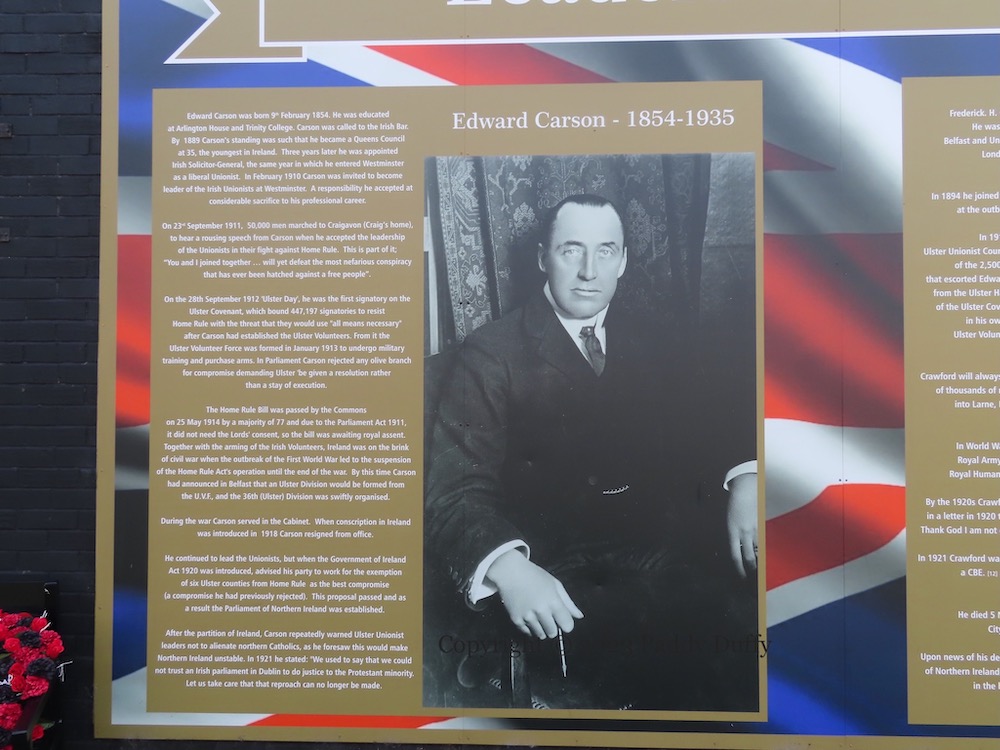
Carson, Crawford, and Craig are lionised as resisters of devolvement of Ireland to Dublin in the early twentieth century. Despite calling Home Rule “the most nefarious conspiracy that has ever been hatched against a free people” and vowing to fight it by “all means necessary”, including the Ulster Volunteers armed by Crawford’s “guns for Ulster”, Edward Carson “warned Ulster Unionist leaders not to alienate norther Catholics, as he foresaw this would make Northern Ireland unstable.”
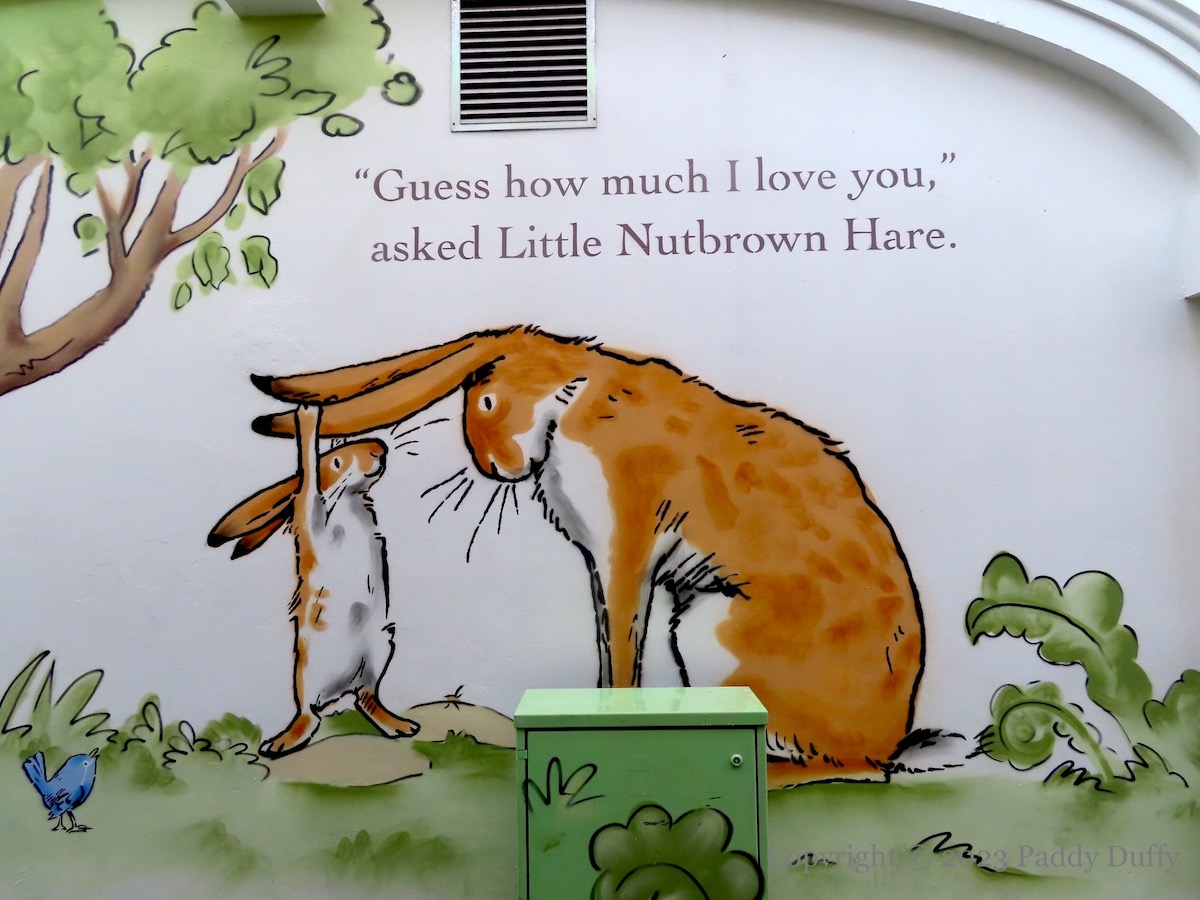
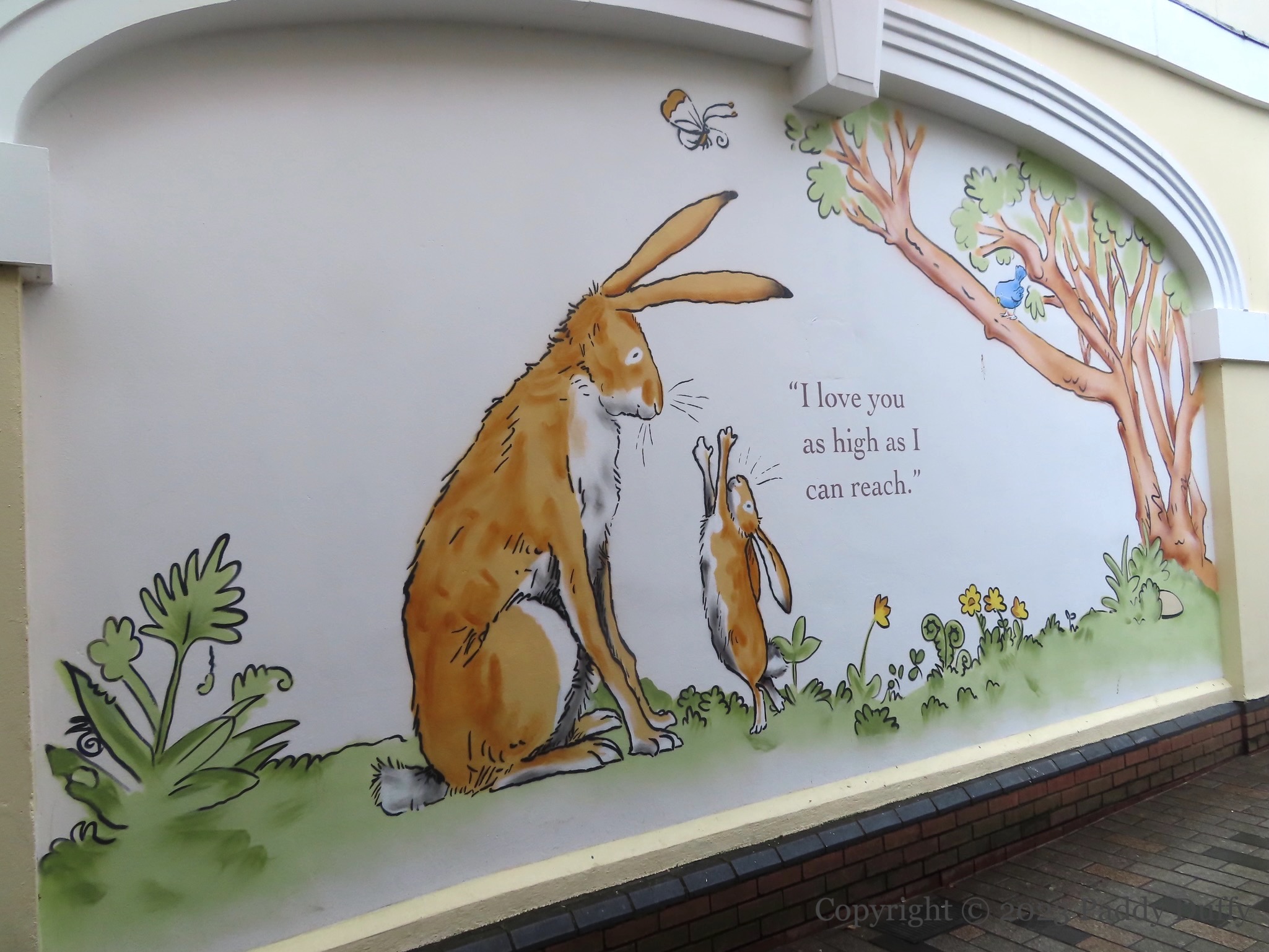
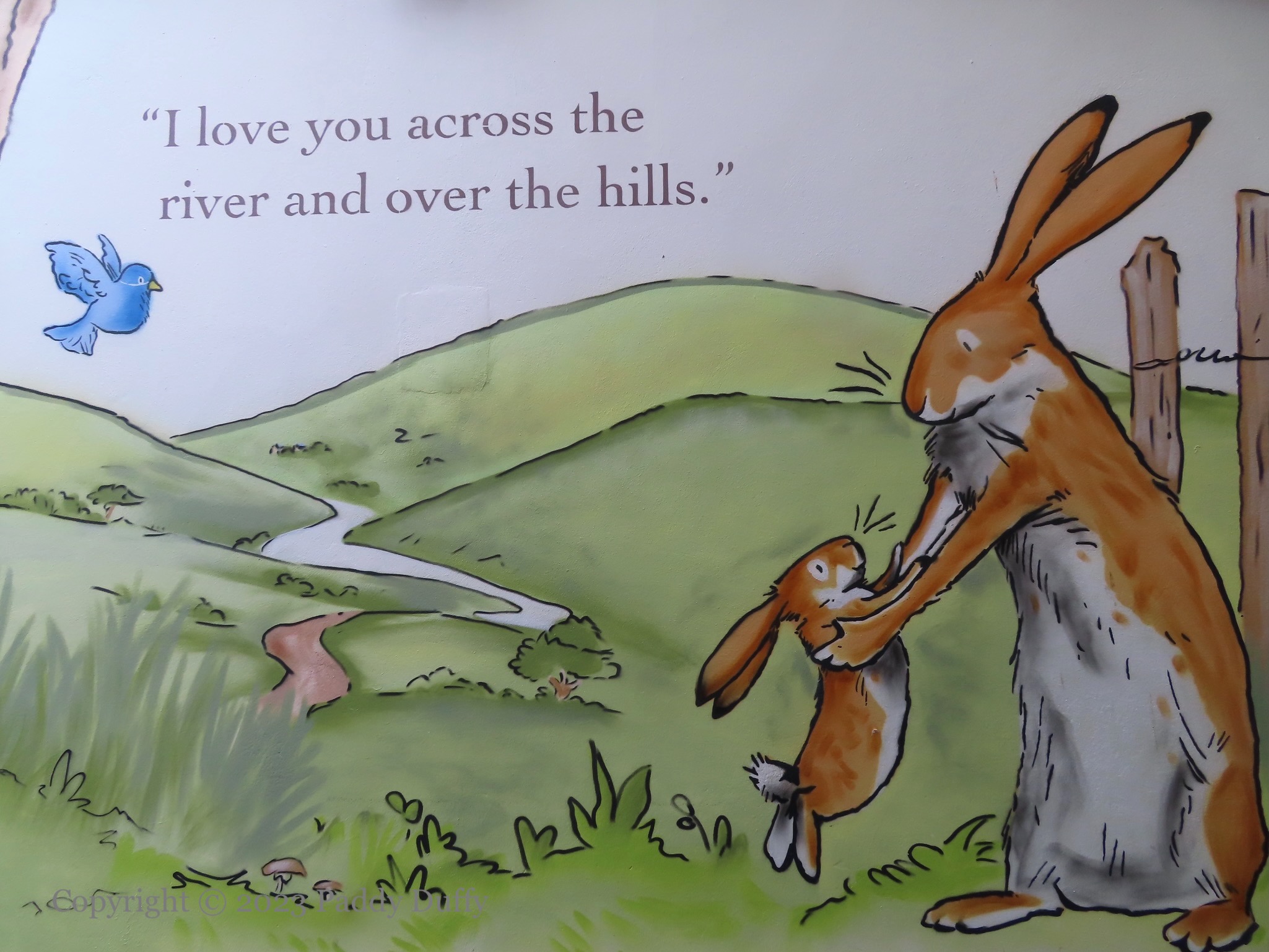
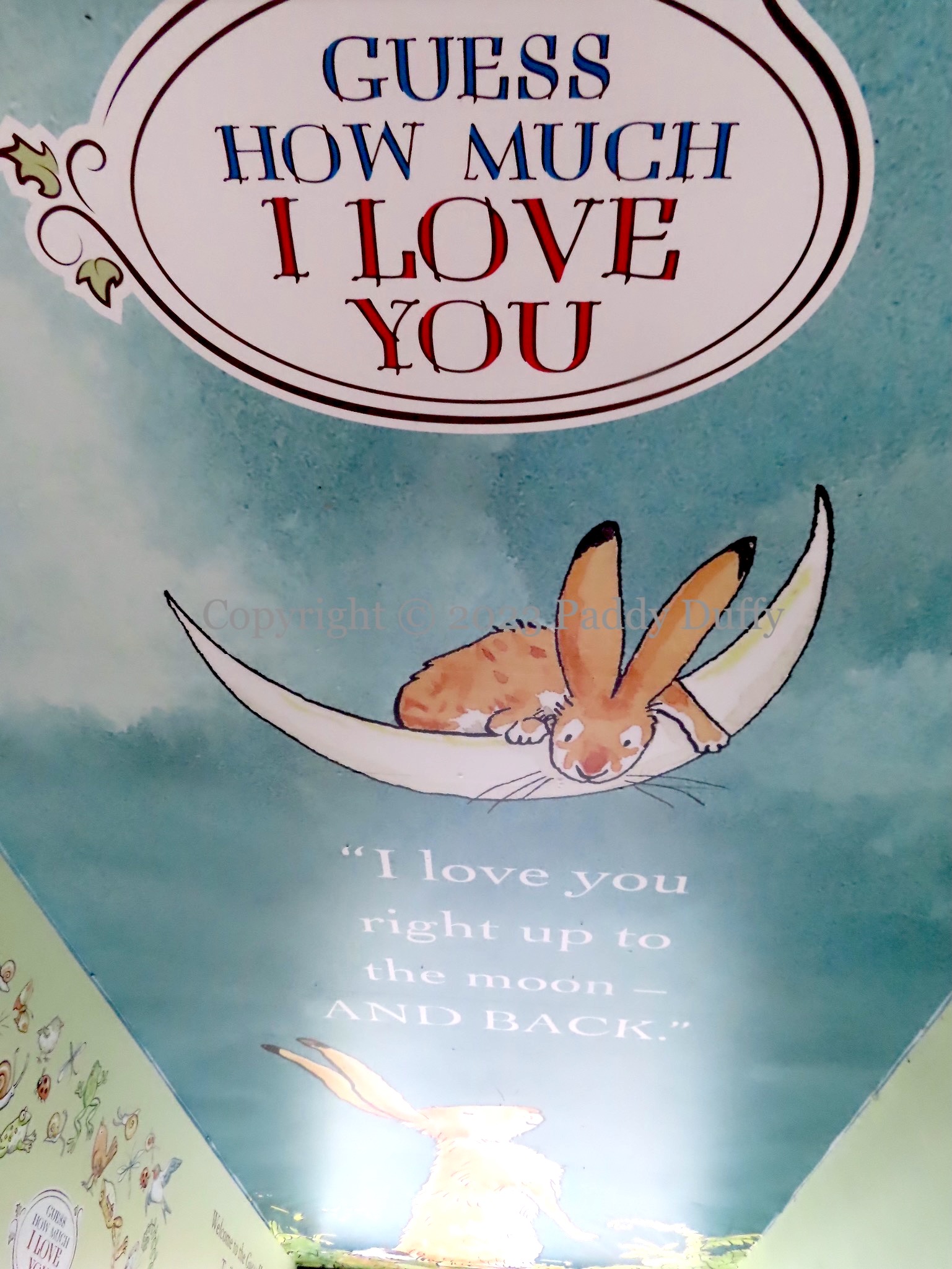
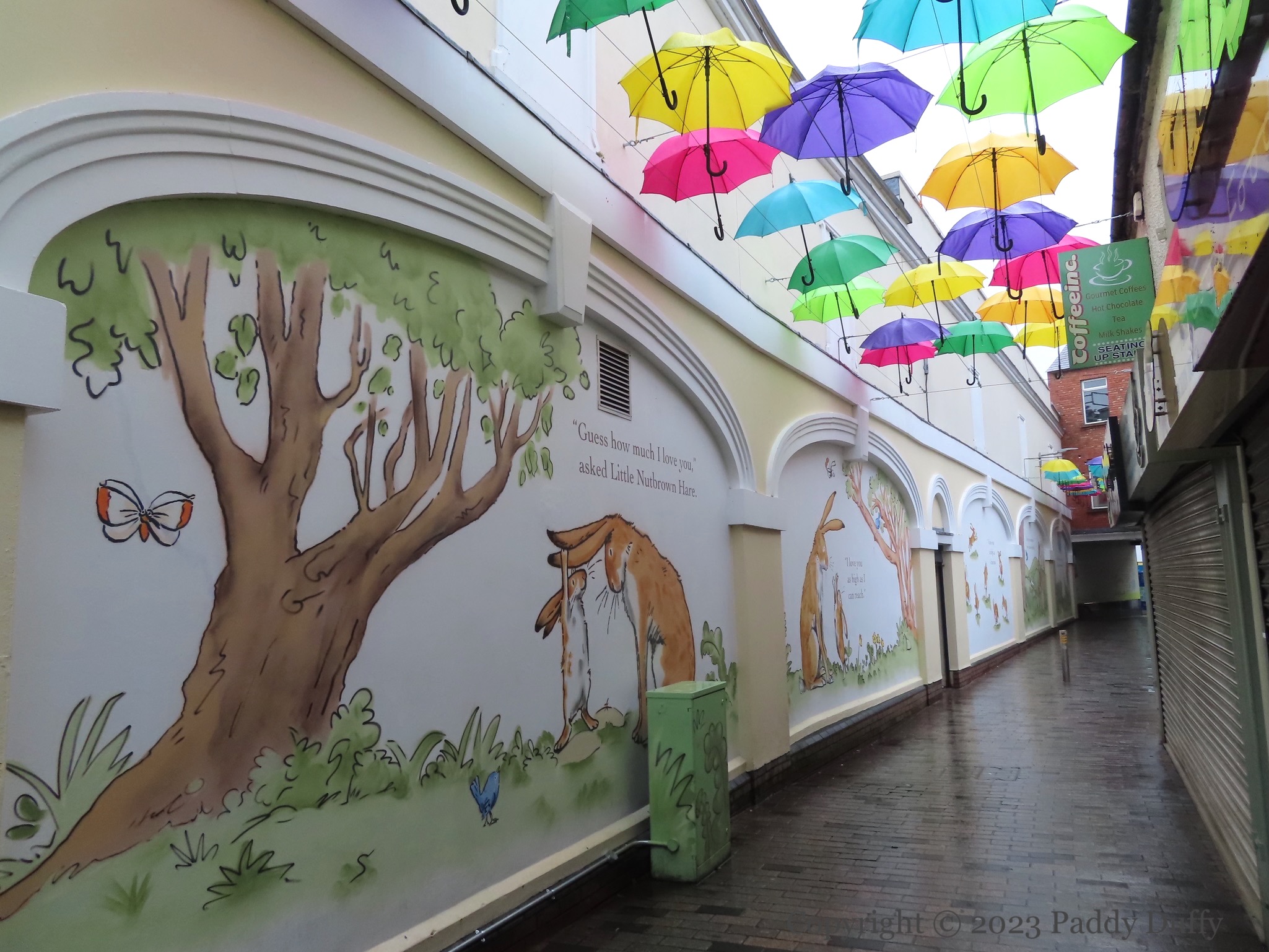
Little Nutbrown Hare and Big Nutbrown Hare use the landscape and the limits of their attributes to express how much they love each other. Parts of Sam McBratney and Anita Jeram’s book are made large for the walls of Haslem’s Lane in McBratney’s home town of Lisburn. The murals were painted by Visual Waste (ig) as part of a new public art trail from Lisburn CC.
“”Guess how much I love you,” asked Little Nutbrown Hare. “I love you as high as I can reach.” “I love you as high as I can hop.” “I love you across the river and over the hills.” “I love you right up to be moon,” said Little Nutbrown Hare. “I love you right up to the moon — AND BACK.””
Above is a mural in Carlingford St, east Belfast showing gravestones of two deceased locals: “6322 Private J. Condon, Royal Irish Regiment, 24th May, 1915, age 14” and “10/16015 Rifleman S. Thompson Royal Irish Rifles, 5th October, 1918”. Their gravestones are the end-point of a journey that began with the Covenant and the Ulster Volunteers (illustrated by images of Carson, the Covenant, gun-running, and Volunteers drilling).
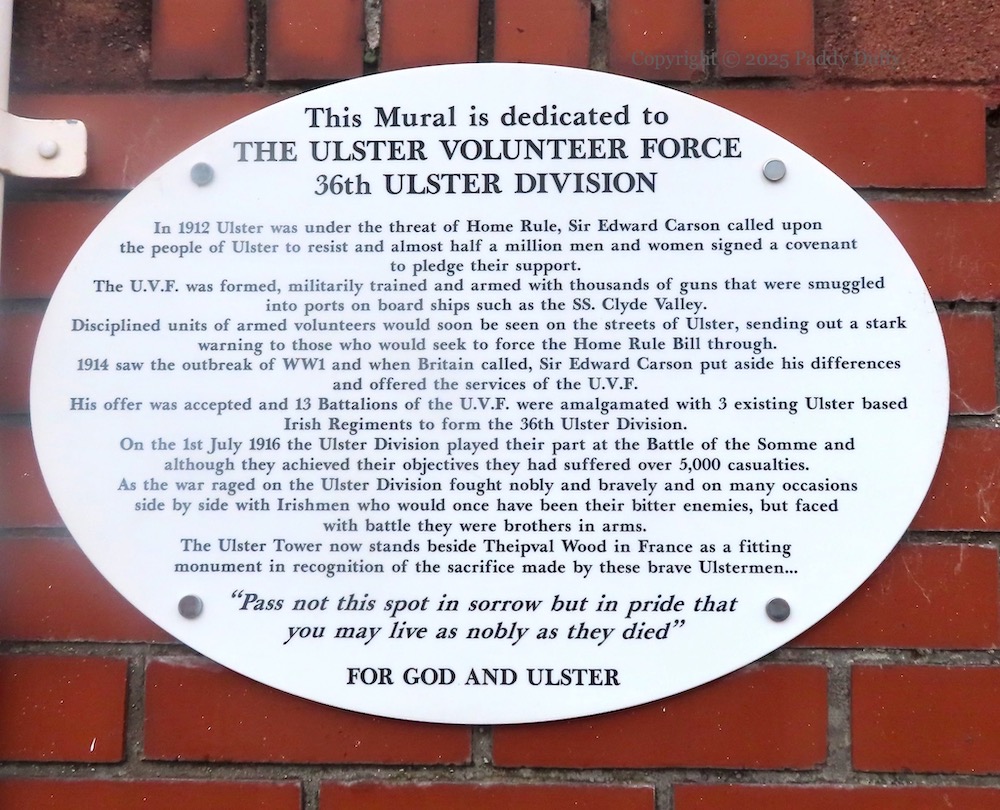
To the left is a plaque describing the journey from the Covenant to the Ulster Volunteers to the Somme: “In 1912 Ulster was under the threat of Home Rule, Sir Edward Carson called upon the people of Ulster to resist and almost half a million men and women signed a covenant to pledge their support. The U.V.F. was formed, militarily trained and armed with thousands of guns that were smuggled into ports on board ships such as the SS. Clyde Valley. Disciplined units of armed volunteers would soon be seen on the streets of Ulster, sending out a stark warning to those who would seek to force the Home Rule bill through. 1914 saw the outbreak of WW1 and when Britain called, Sir Edward Carson put aside his differences and offered the services of the U.V.F. His offer was accepted and 13 battalions of the U.V. F. were amalgamated with 3 existing Ulster based Irish regiments to form the on the 36th (Ulster) Division. On the 1st july the Ulster Division played their part at the Battle of the Somme and although they achieved their objectives they had suffered over 5,000 casualties. As the war raged on the Ulster Division fought nobly and bravely and on many occasions side by side with Irishmen who would once have been their bitter enemies, but faced with battle they were brothers in arms. The Ulster Tower now stands beside Theipval [sic] Wood in France as a fitting monument in recognition of the sacrifice made by these brave Ulstermen … “Pass not this spot in sorrow but in pride that you may live as nobly as they died” For God and Ulster”
There is also a side-wall (out of frame to the right) with the words of Captain Wilfrid Spender, describing the first day of the Battle Of The Somme, 1916, but it is in poor condition.
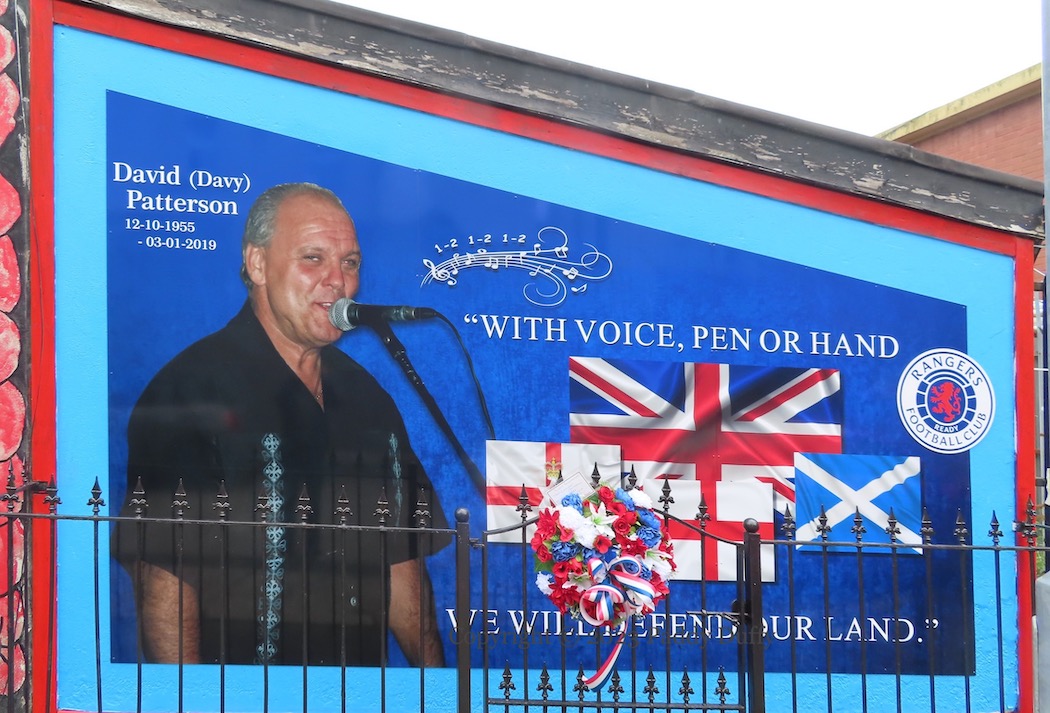
“With voice, pen or hand we will defend our land.” David (Davy) Patterson (12-10-1955 – 03-01-2019) was a member of the 1st East Belfast Rangers Supporters Club (Fb) and Albertbridge Glentoran Supporters Club (Funeral Times). This memorial board is the side-wall to the Somme Society mural (see Their Name Liveth Forevermore) and the Red Hand Commando memorial garden in Hunt Street, east Belfast.
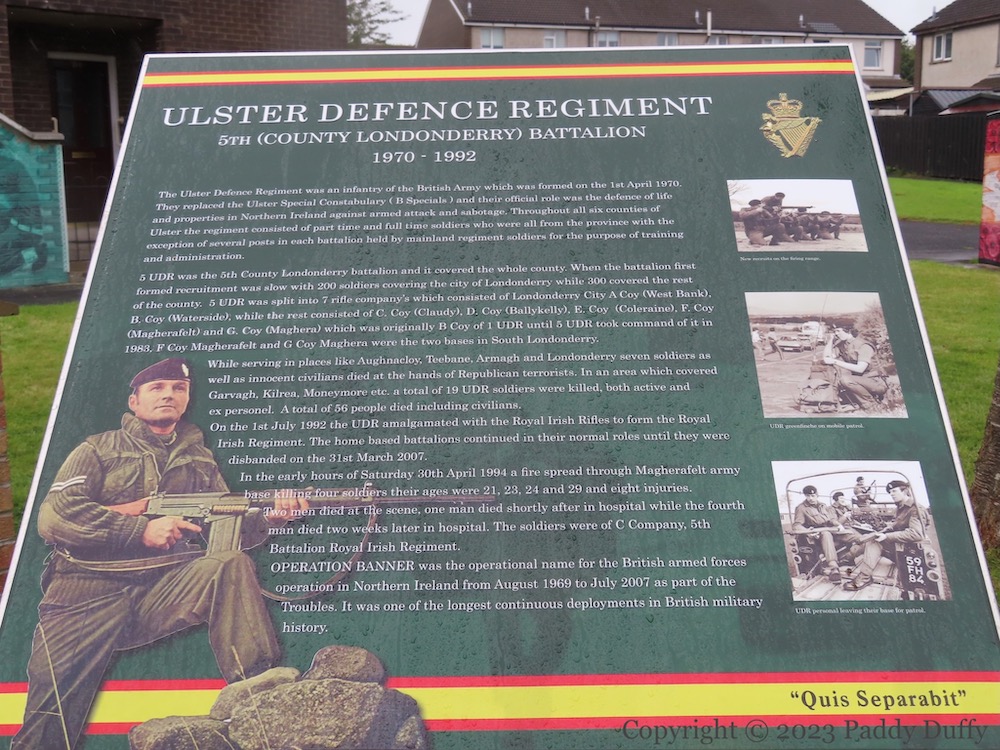
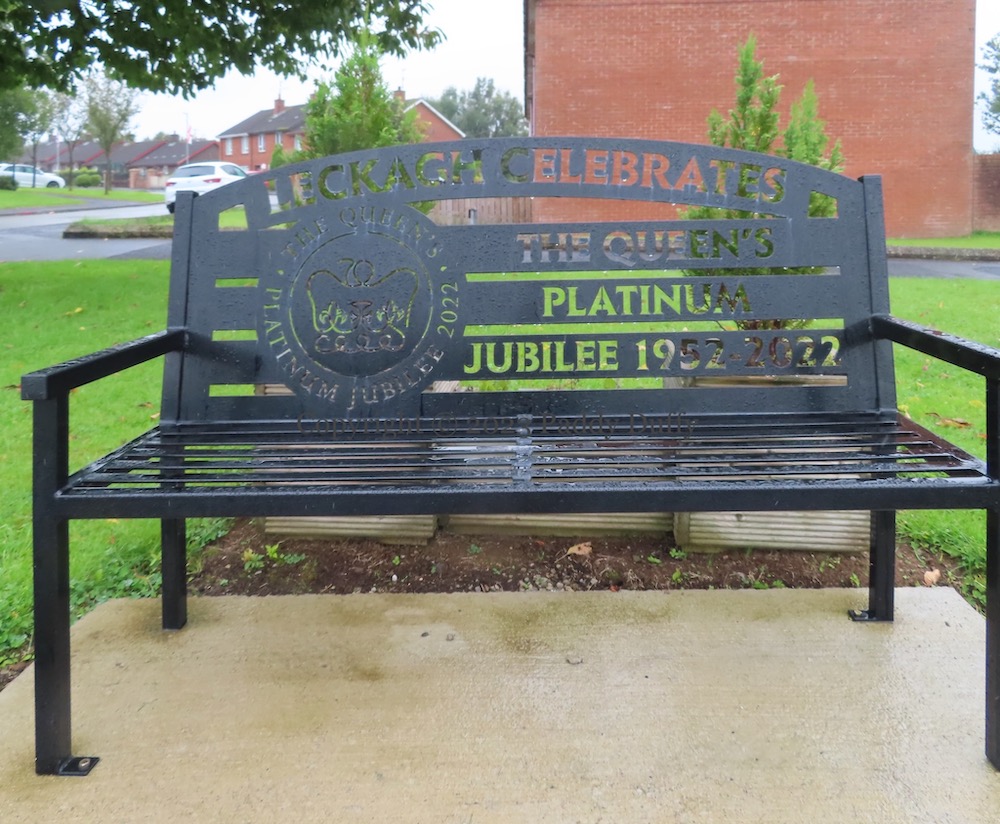
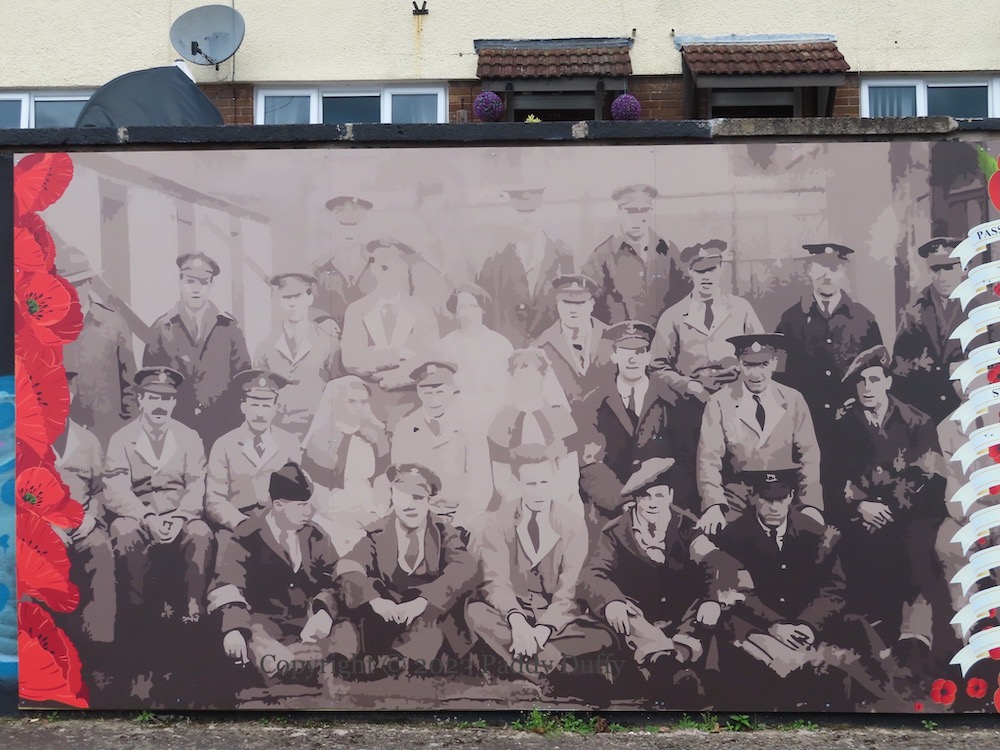
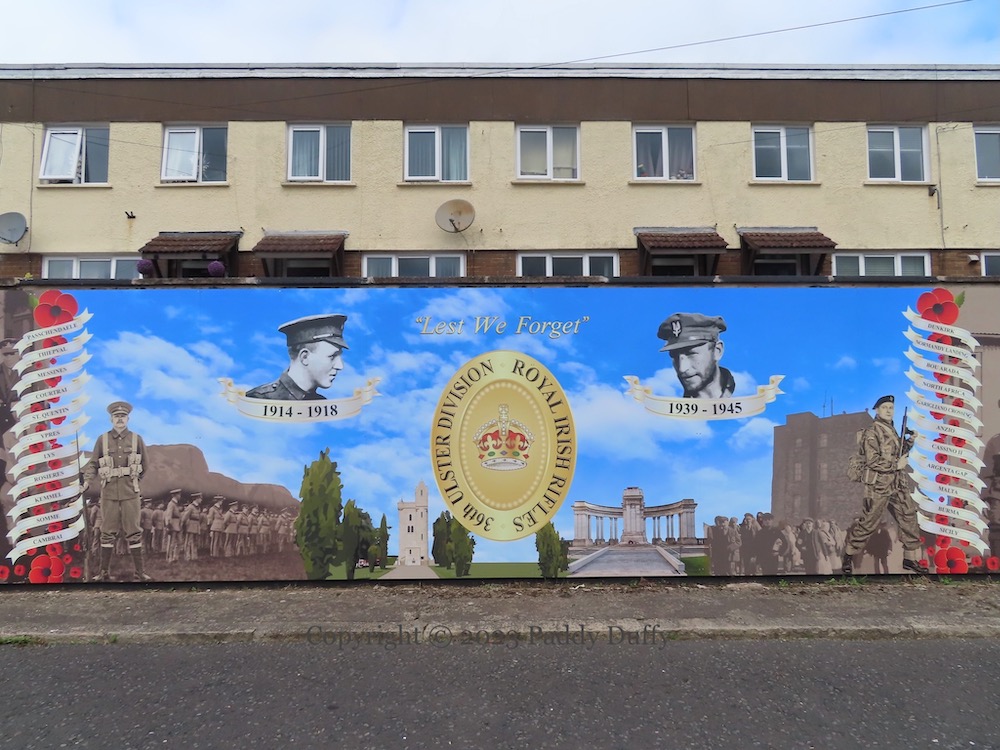
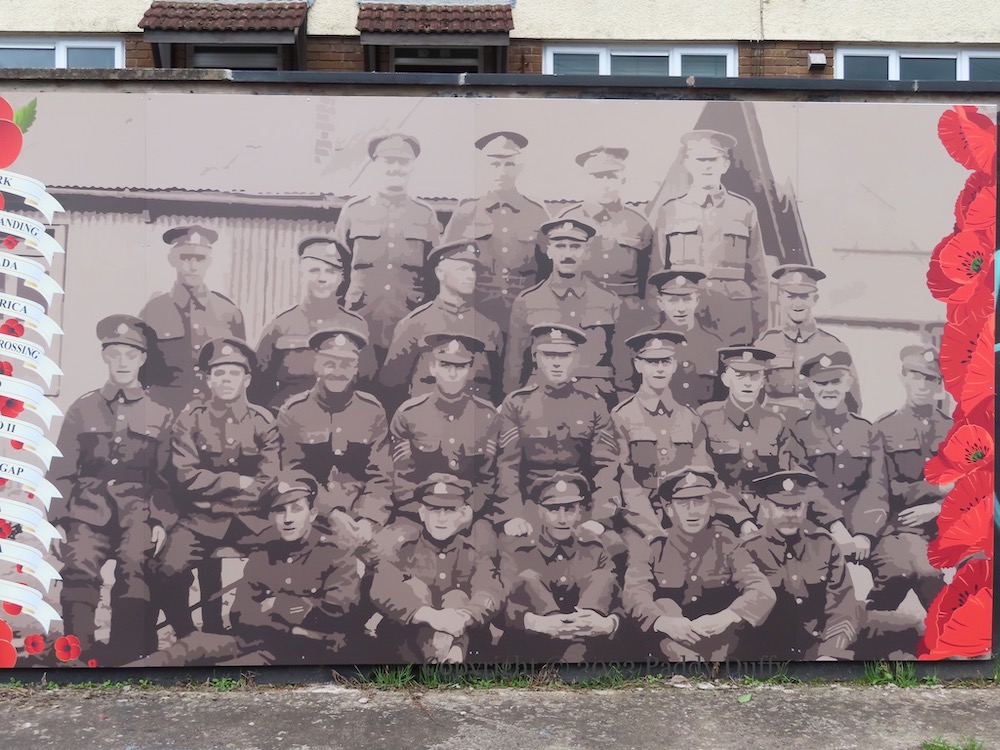
This selection of images from Leckagh Drive, Magherafelt, focuses on the memorials to the dead of WWI (and WWII in the mural above), with an additional board commemorating the UDR 5th (County Londonderry) battalion); there is also a mural and some plaques commemorating (modern-day) UVF volunteers, which will be in tomorrow’s post.
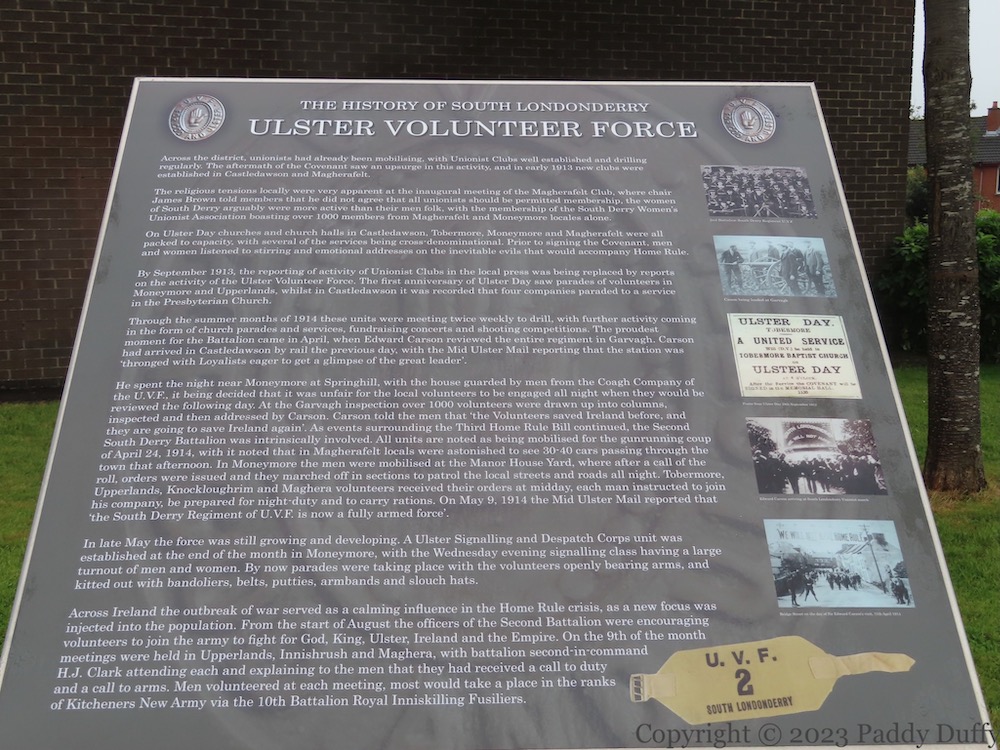
The board shown in the final image provides a history of the South Londonderry volunteers from towns such as Magherafelt, Castledawson, Moneymore, and Tobermore. Edward Carson reviewed the volunteers in April 1914. Later that same month, arms were received from the weapons landed in Larne. In the Great War, the men from the area served in the 10th battalion of the Royal Inniskilling Fusiliers in the 109th brigade of the 36th Division.
“Always remembered by the officers and volunteers of South Londonderry/Randalstown Ulster Volunteer Force.” This memorial mural and plaque in Magherafelt names Charlie Wright, Jonathan Wallace, Ken Wilkinson, and Ian McArthur.
Of these, Wilkinson seems the most well-known, as he served as a PUP representative for the area. He commented on sectarian tensions in Randalstown in 1999 (An Phoblacht) and in Coleraine in 2009 (Irish Examiner), and spoke against sueprgrass trials in 2011 as a member of FAST (Irish Times | see previously FAST and FASTing For Human Rights And Justice); he was accused of intimidation of Catholics in Antrim in 2003 (An Phoblacht). He stood for a number of elected positions (e.g. 2013) but was unsuccessful.
Ostensibly for his stand against drug-sellers, in 2010 a pipe-bomb (BBC), and in 2011 a make-shift car-bomb (BelTel), were placed against his home and he received death threats in 2013 (politics.ie). He died in 2021 (BelTel | News Letter | Irish News).
The plaque in the memorial garden (shown below) reads, “This plaque is dedicated in memory of all of the loyalist people of Ulster who have suffered at the hands of the enemies of our land. Lest we forget.”
This UDA board on the eastern side of the Leckagh estate names six men who “gave everything in defence of our civil and religious liberties”: Lindsay Mooney (remembered also in the Fountain and Lincoln Court areas of Londonderry), Benny Redfern (this board replaces a board dedicated to Redfern alone), Cecil McKnight (Waterside), Gary Lynch (Waterside), Ray Smallwoods (Lisburn), William Campbell (Coleraine).
“North Antrim – Londonderry – Tyrone brigade”, “Remembered by all South Londonderry & Tyrone 6th batt.”
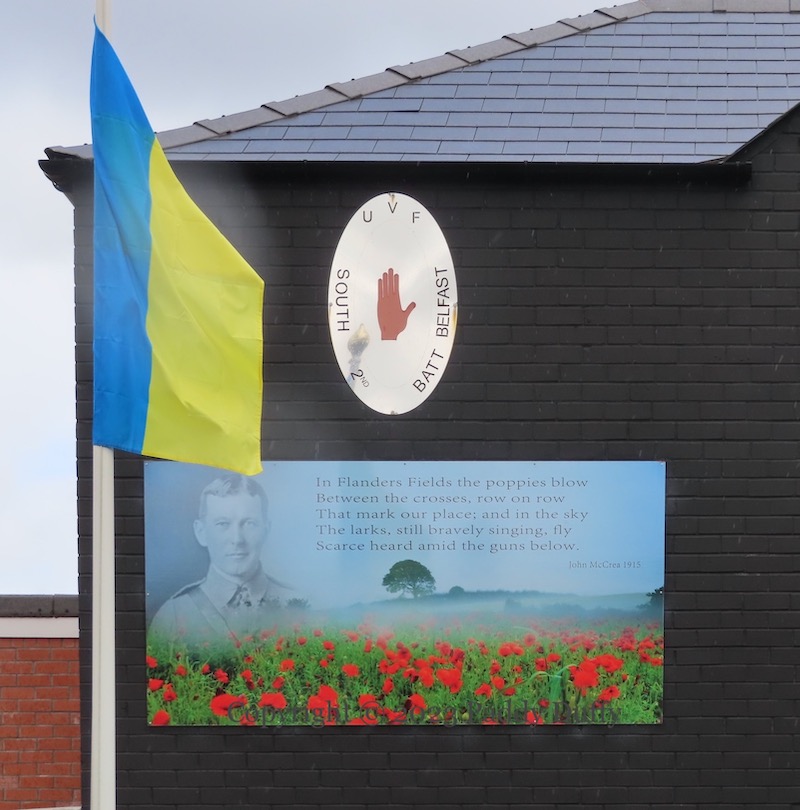
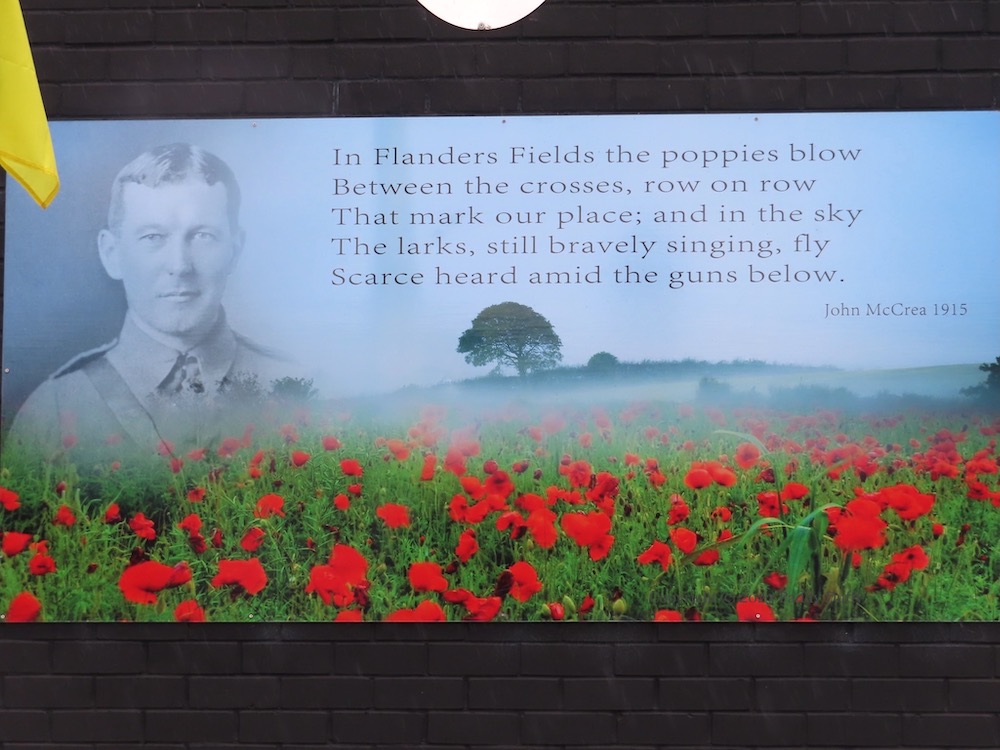
The house next to the Village memorial garden got an extension at the back in 2020 and with it the left-hand part of the house’s gable wall was extended upward (compare with the images from 2017 in Continuing Conflicts). The board with a verse from McCrea’s In Flanders Fields was present previously, but has been raised, and above it there now stands a red-hand emblem of the “UVF 2nd batt. south Belfast”.
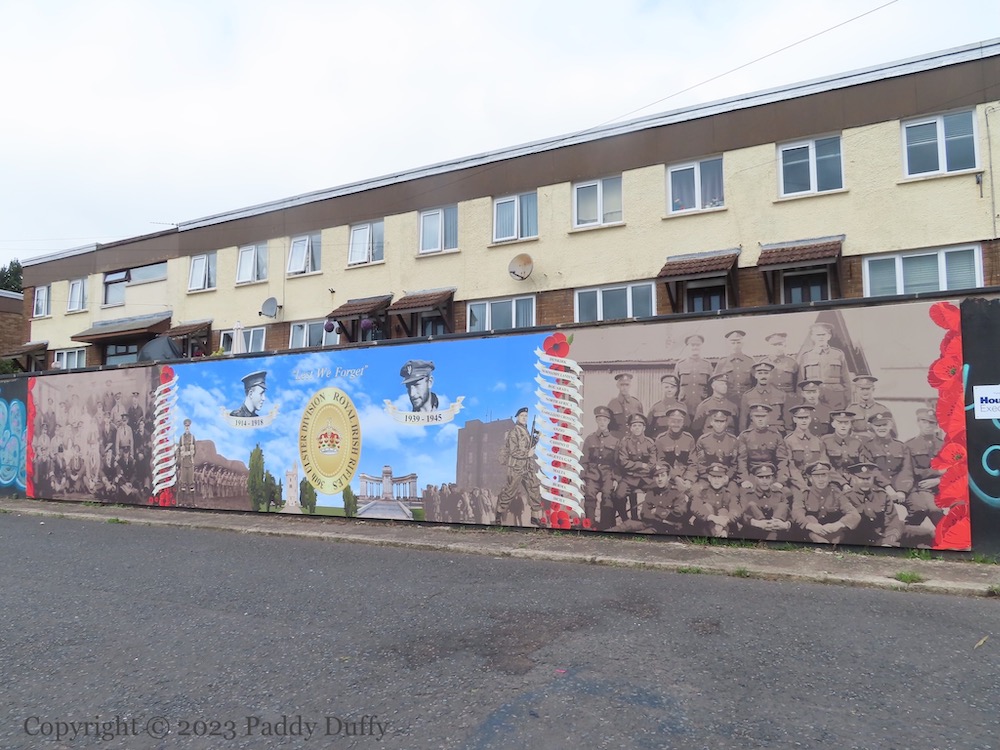
After WWI, the Royal Irish Rifles became the Royal Ulster Rifles (and later became part of the Royal Irish Rangers). This board prioritises WWI as the Rifles were part of the 36th Division. The hero of WWI portrayed in the central panel is William McFadzean, awarded the VC for falling on two live grenades in the trenches on July 1st, 1916. McFadzean is familiar from many previous murals both individually and in the company of other VC winners; for his family home in Cregagh, see Rubicon.
Alongside McFadzean, the hero of WWII is Blair “Paddy” Mayne, who was only briefly in the Ulster Rifles before making his name in the Parachute Unit (later, and better, known as the SAS). His many medals of honour are shown in an old Newtownards mural, though he was denied the VC.














 Paddy Duffy Collection