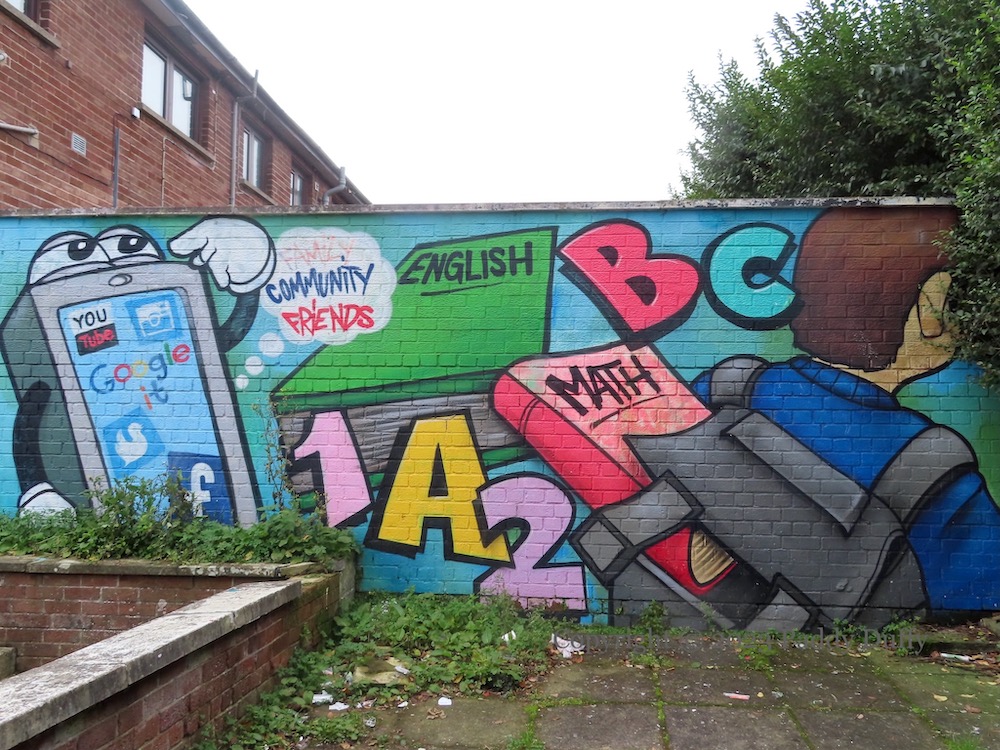
Which direction will you go in? To the negative west of the compass of “choice” lie “Alcohol, paramilitaries, drugs”; to the positive east are “Education, employment, life. On the side panel, youngsters are encouraged to study English, math(s), social media and Google.
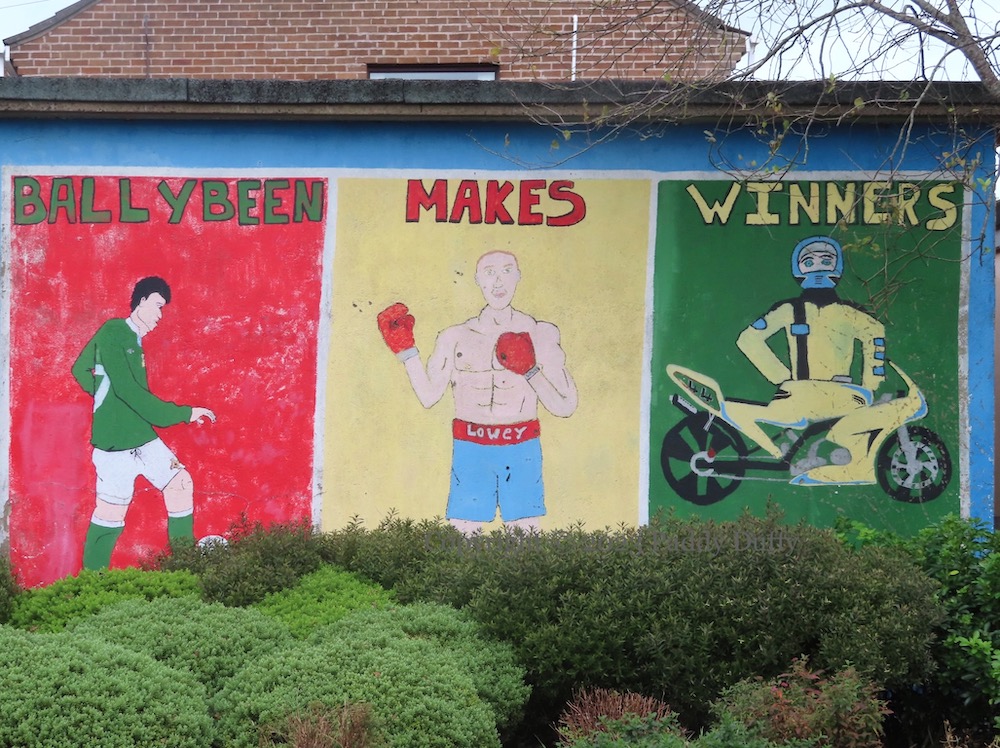
And further down Brooklands Drive, “Ballybeen makes winners” in sports: soccer, boxing, and motorcycle racing. The boxer is John Lowey, who represented Ireland at the 1988 Olympics; he is also featured in Boxing Through The Generations and Ballybeen Dream which last also includes three local footballers.
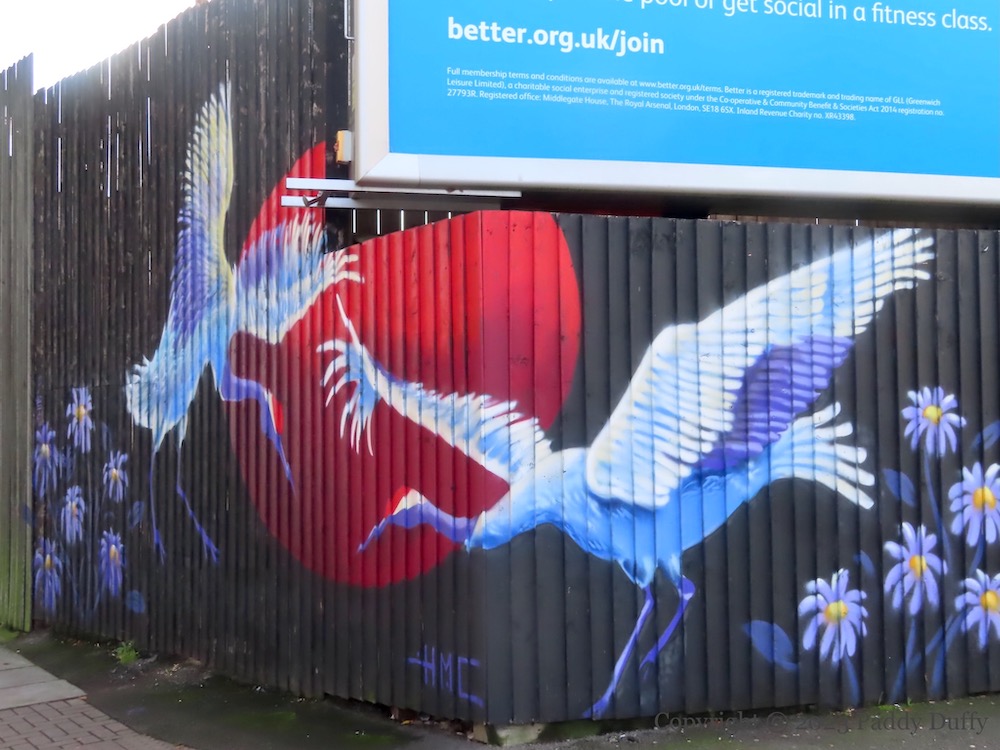
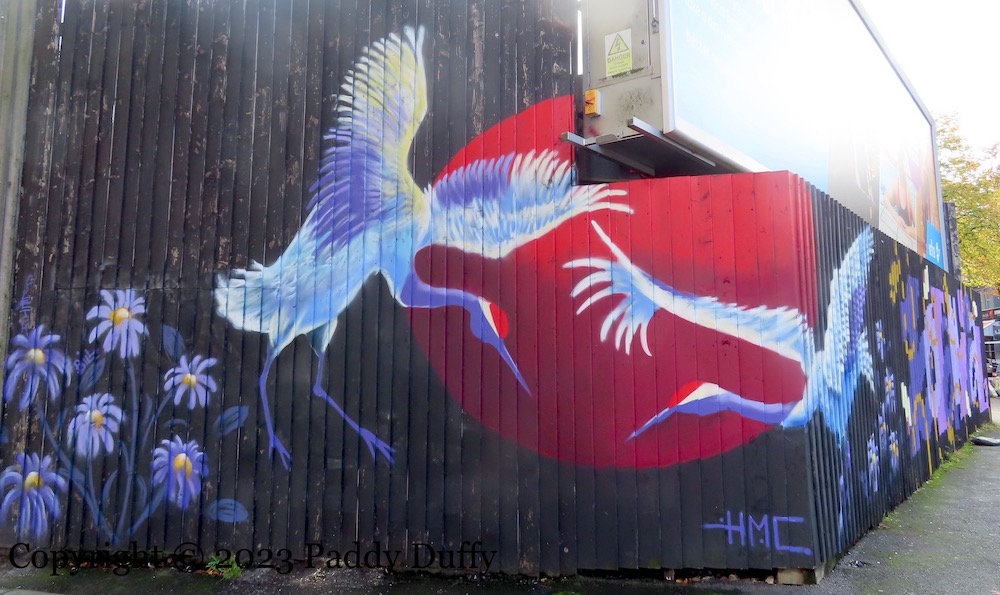
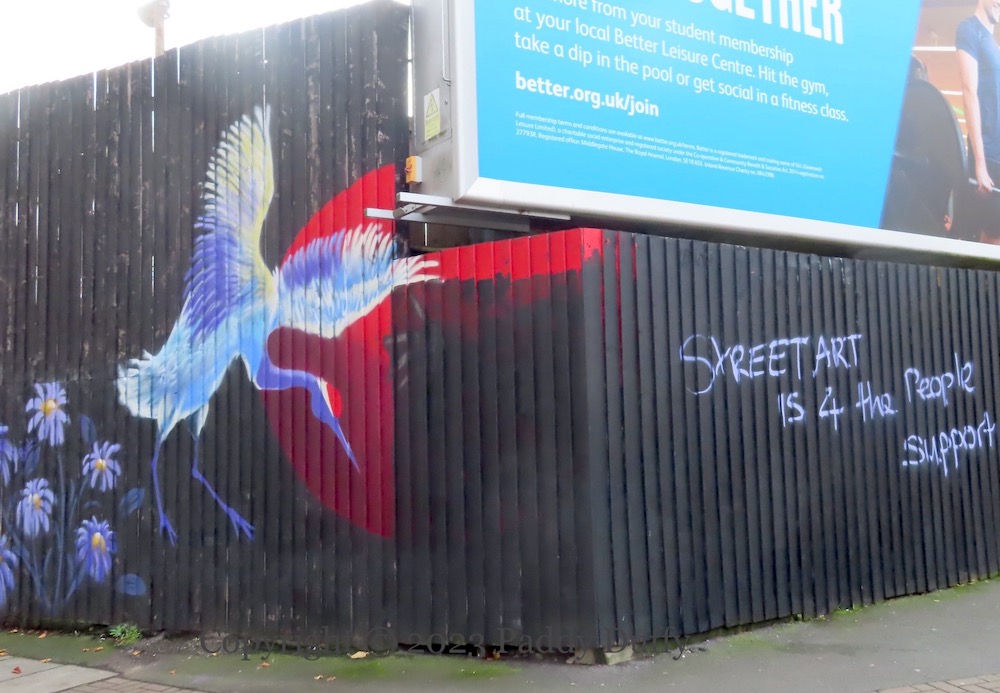
In Japanese mythology, cranes are symbols of longevity because they are reputed to live for a thousand years (KZN). These cranes, however, were painted on September 24th by HM Constance (ig) and Zippy (ig) at the junction of Donegall Pass and Botanic Ave for the Open Botanic festival, and they were still in place on October 1st when the first two photos shown here were taken, but by October 4th the front fencing (on the Botanic Avenue side) had been painted over, taking out the crane on the right.
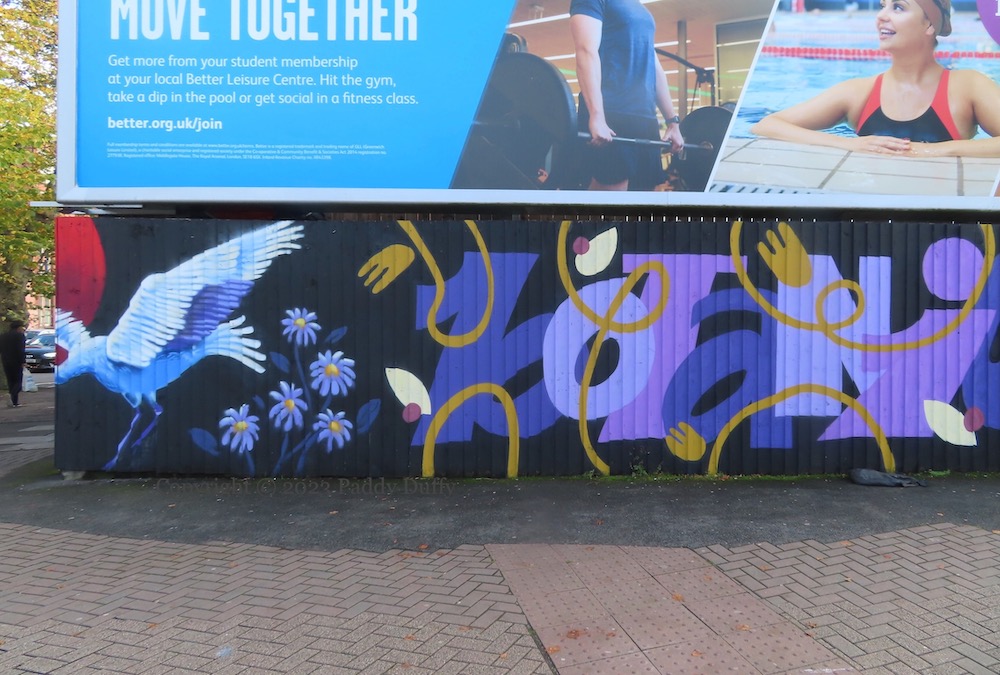
According to this BelTel article, the fence below the billboard is property of the ad company (JC Decaux) and not the landlord (who had given permission for the art), and so Decaux painted it over, as a neutral surround is part of the ad presentation. As can be seen from the fourth image, below, the painting-over included some of the side fencing, though this was done fairly carefully – it removed the head and wing of the wrap-around crane without touching the other crane.
Artist HMC expressed her disappointment, though noted that “street art is never permanent, it’s meant to be painted over by future artists or graff writers” (ig). Adam Turkington, director of Seedhead Arts, likewise decried the obliteration to the Telegraph, saying, “Who controls the aesthetic of our city? … Are we not allowed to have some beautiful art that’s not trying to sell us things?”
The graffiti was added on the 5th or 6th and was still visible yesterday (8th): “Street art is 4 the people – support your local artists!” We would expect Decaux to paint out the graffiti, in keeping with their policy. And perhaps HMC will restore the red sun and artist’s signature to the side panel. If either happens, this page will be updated.
See previously: the crane as a symbol of peace on the Cupar Way “peace” line: Tsuru.
This memorial in the Coleraine diamond commemorates the six civilians who died in an IRA car-bomb explosion in Railway Road in 1973.
“In loving memory of those killed on Railway Road 12th June 1973 – never forgotten”, “Nan Davis, Elizabeth Palmer, Robert Scott // Francis Campbell, Dinah Campbell, Elizabeth Craigmile”, “What you leave behind is not what is engraved in stone but what is woven into the lives of others – Pericles”.
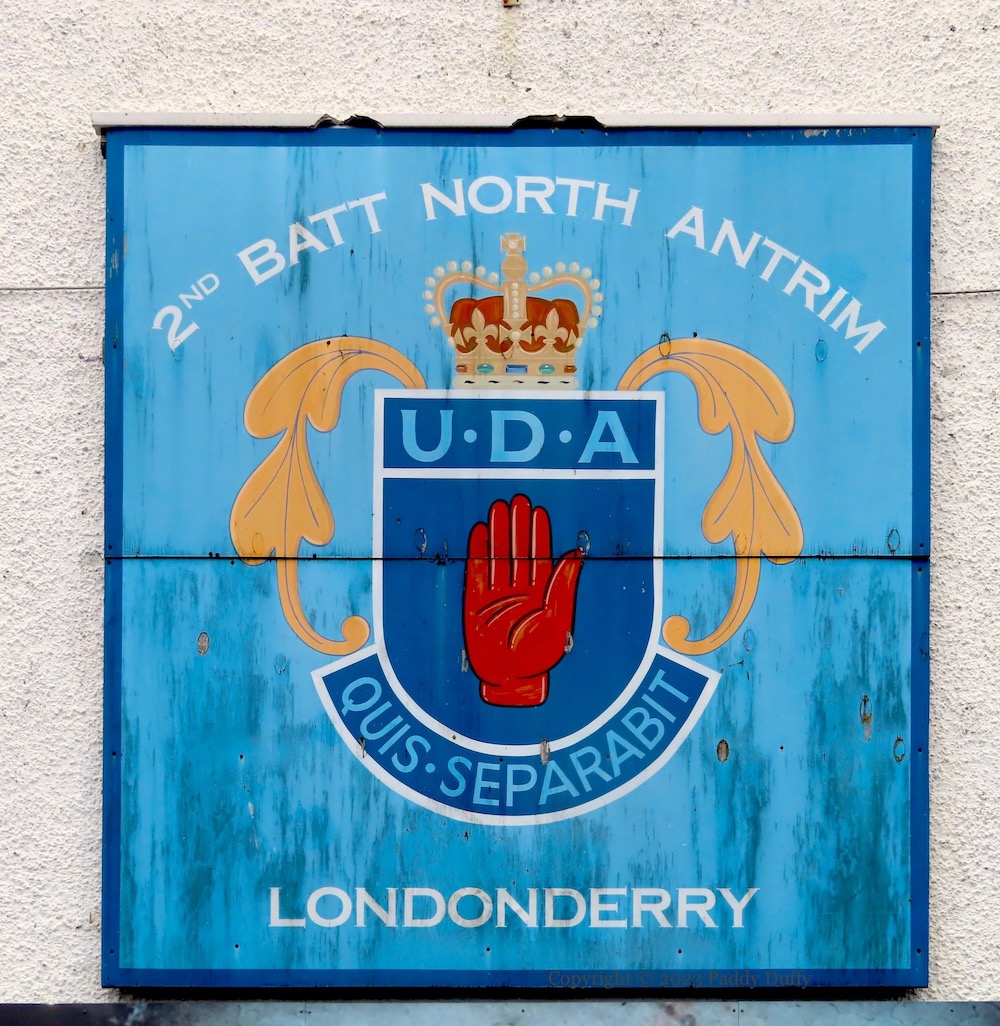
An anti-drug-dealing message (see Peace Impact Programme) has been added below the (2nd battalion North Antrim & Londonderry) UDA emblem (seen previously in 2012) in Linden Avenue, Coleraine.
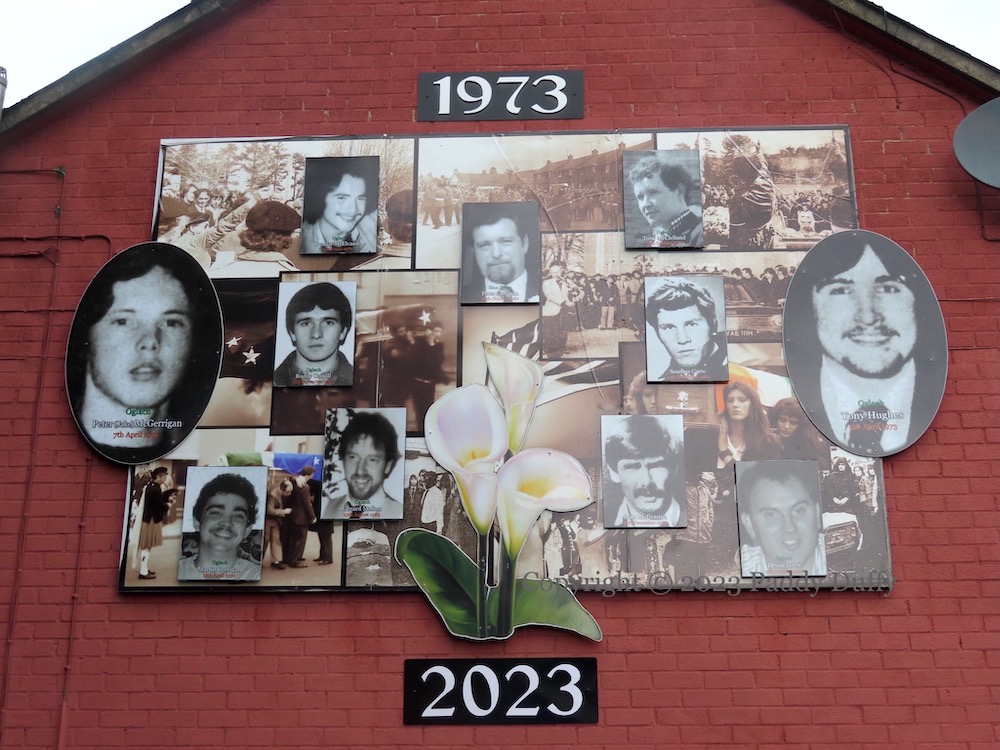
Jake McGerrigan and Tony Hughes of the OIRA were both shot and killed by British forces in the Windmill Hill area of Armagh in a 48-hour period spanning April 7th and 9th, 1973. (Lost Lives #791 incorrectly gives March 7th for McGerrigan.) The board shown above was mounted in Navan Street for the 40th anniversary of their deaths, in 2013, and the lower date has now been updated for the 50th anniversary.
The larger portraits on either side are of McGerrigan and Hughes; between them are (left) Peadar McElvanna, Roddy Carroll, Gerard Mallon, Martin Corrigan, (middle) Peter Corrigan, (right) Tony McClelland, Seamus Grew, Sean McIlvanna [McIlvenna], Dessie Grew.
There is an individual plaque to Hughes (shown immediately below) at the spot where he was shot and a stone (shown below; for text see McGerrigan – Hughes) to both of them in the same alley; there is also a stone (not shown) to McGerrigan in Windmill Avenue. (Video of Jake McGerrigan’s funeral.)
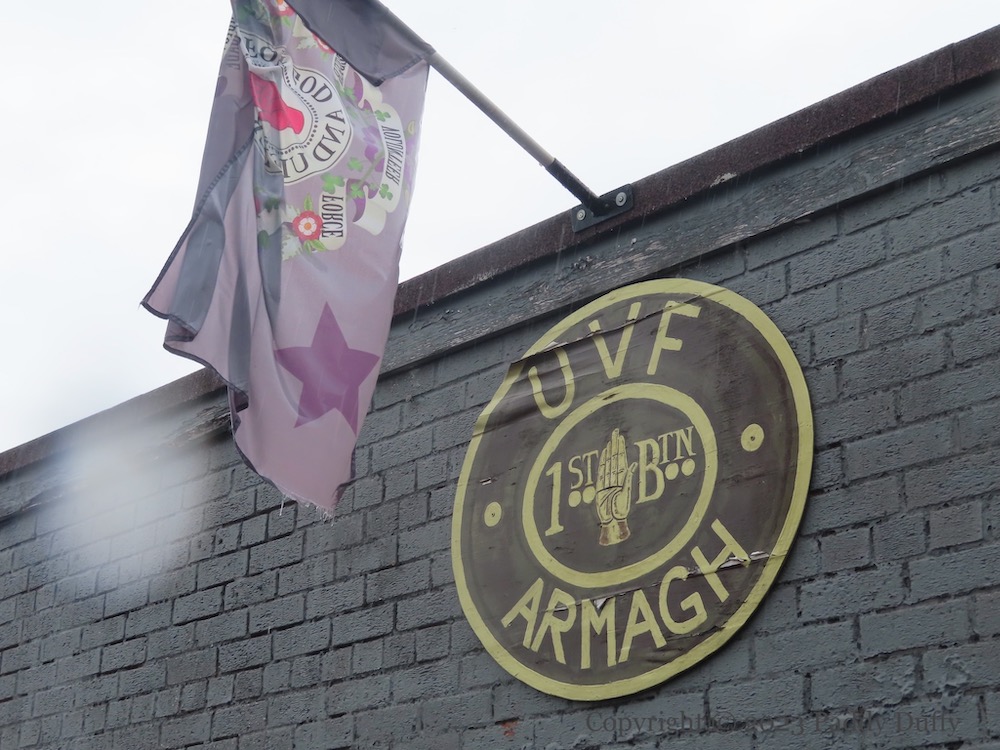
These two boards from the Armagh True Blues flute band (Fb) in Barrack Hill commemorate the Ulster Volunteers of 1912 who went on to join the 9th (County Armagh) battalion of the Royal Irish Fusiliers (Wartime Memories).
The “1st batt” emblem (in the third image) applies to both the Ulster Volunteers of the Home-Rule era and the Troubles-era Mid-Ulster UVF.
Quotations from Pádraıg Mac Pıaraıs [Patrick Pearse] and Séamus Ó Conghaıle [James Connolly] are super-imposed upon an Irish-language version of the 1916 Proclamation. From Mac Pıaraıs: Ní [h]amháın saor ach Gaelach chomh maıth; ní [h]amháın Gaelach ach saor chomh maıth [not merely free but Gaelic too; not merely Gaelic but free too]; from Ó Conghaıle: “The cause of labour is the cause of Ireland, the cause of Ireland is the cause of labour’ (from ‘The Irish Flag’ 1916).
The portraits might well be by, or based on, prints by Jim Fitzpatrick (Revolutionaries).









 Paddy Duffy Collection