Glentaisie Drive – site of this mural by Friz (web) – is named for Glentaisie, the glen – one of the nine Glens Of Antrim, at the foot of which lies Ballycastle – and Glentaisie is named for Taise Taobhgheal (Taise the bright-cheeked), daughter of King Donn of Rathlin island, renowned for her beauty, and who lived in the glen with her husband Congal, who had to kill the Norwegian king Nabghdon to prevent her being carried off (Archaeology Ireland). Or so they say. She also inspired the name “Fair Head” for the local cliffs. Or so they say.
In later years (1565), Sorley Boy MacDonnell was taken prisoner by the O’Neill’s after a battle in Glentaisie (WP).
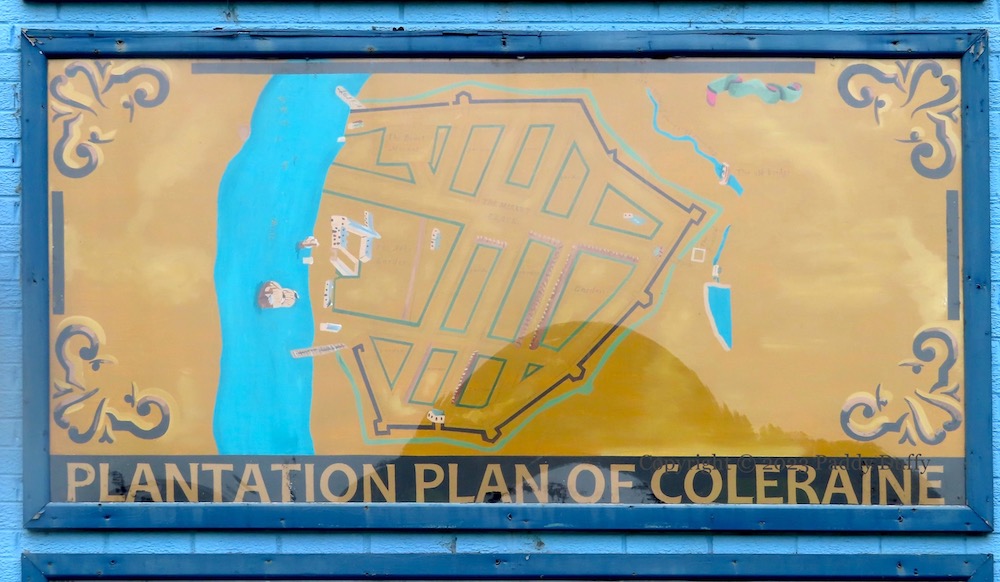
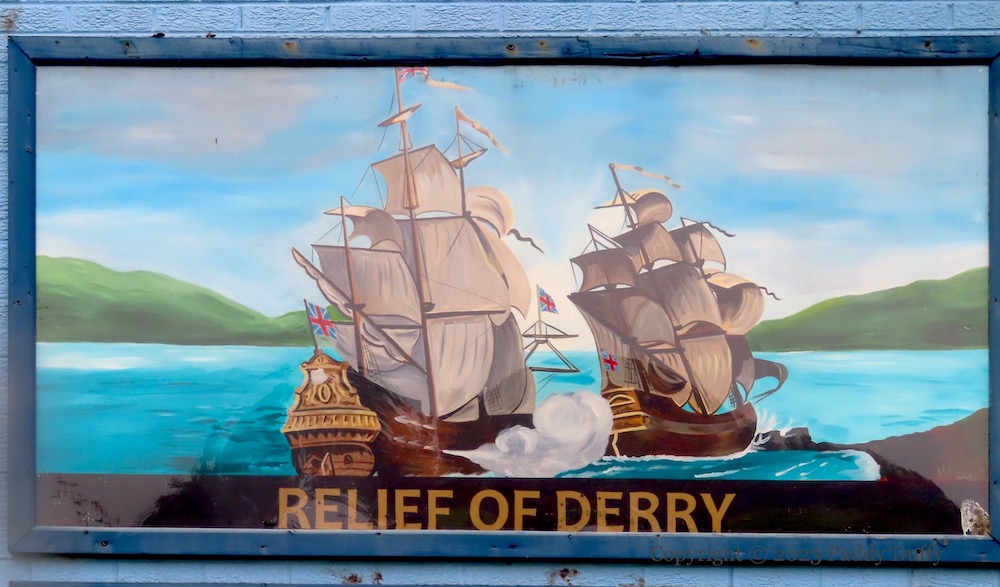
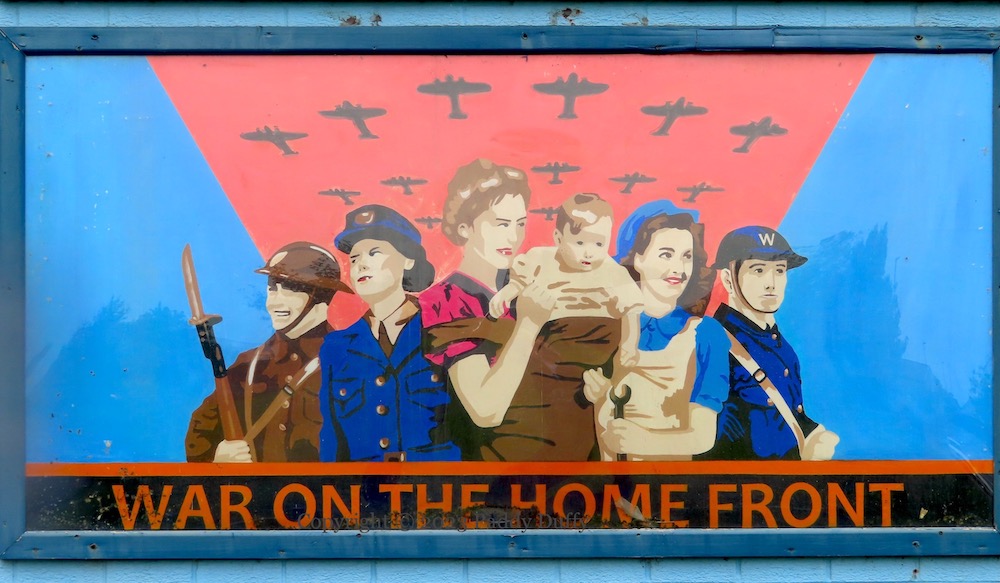
Footsteps through the history of Coleraine, from top to bottom: Martin Luther (c. 1521); John Knox, who led the reformation in Scotland (c. 1560); the plan of Coleraine (c. 1611); the relief of Derry (1689); the Williamite campaign (1690); (and then a jump to) WWI (“Christmas truce, western front”); WWII (“War on the home front”).
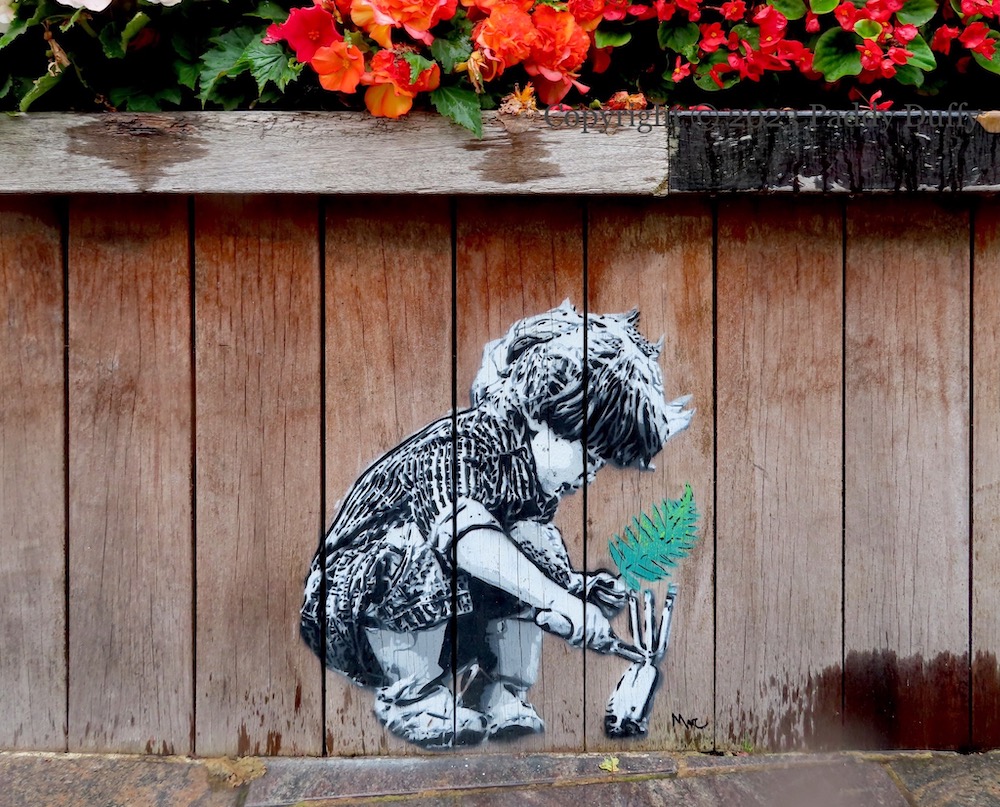
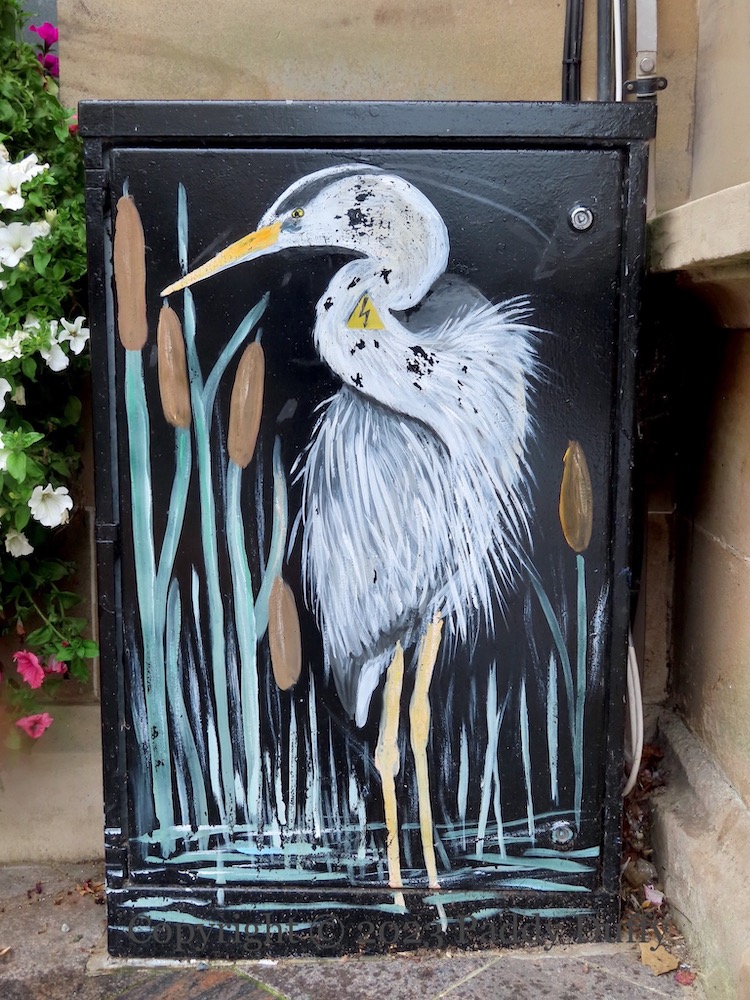
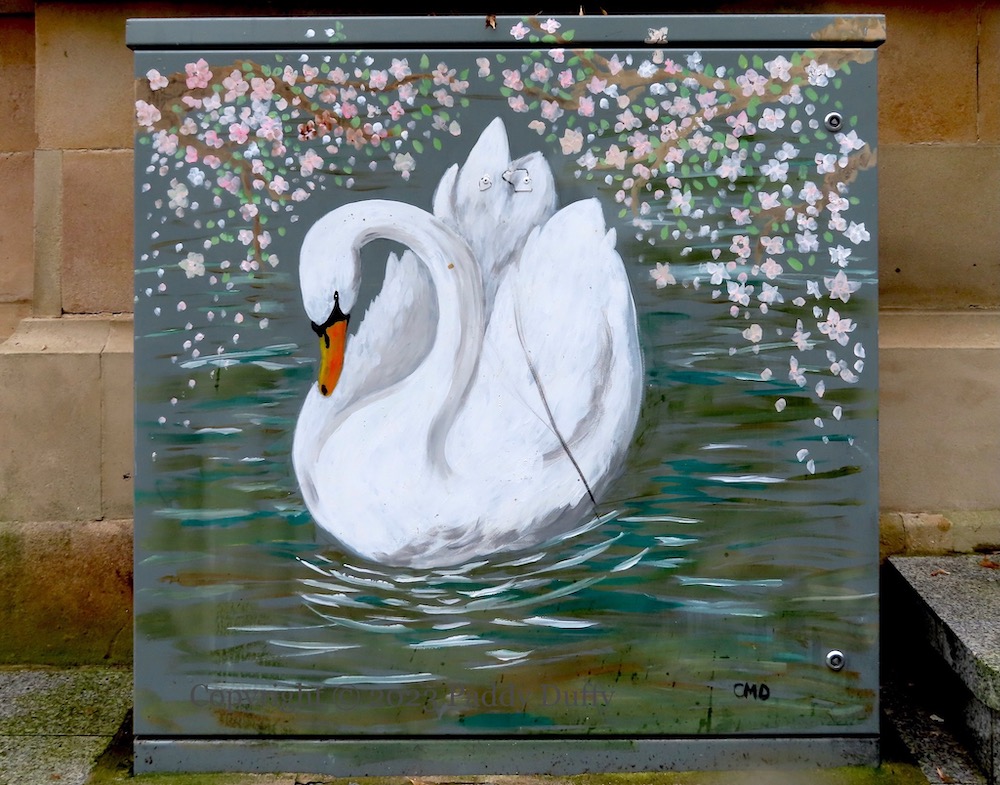
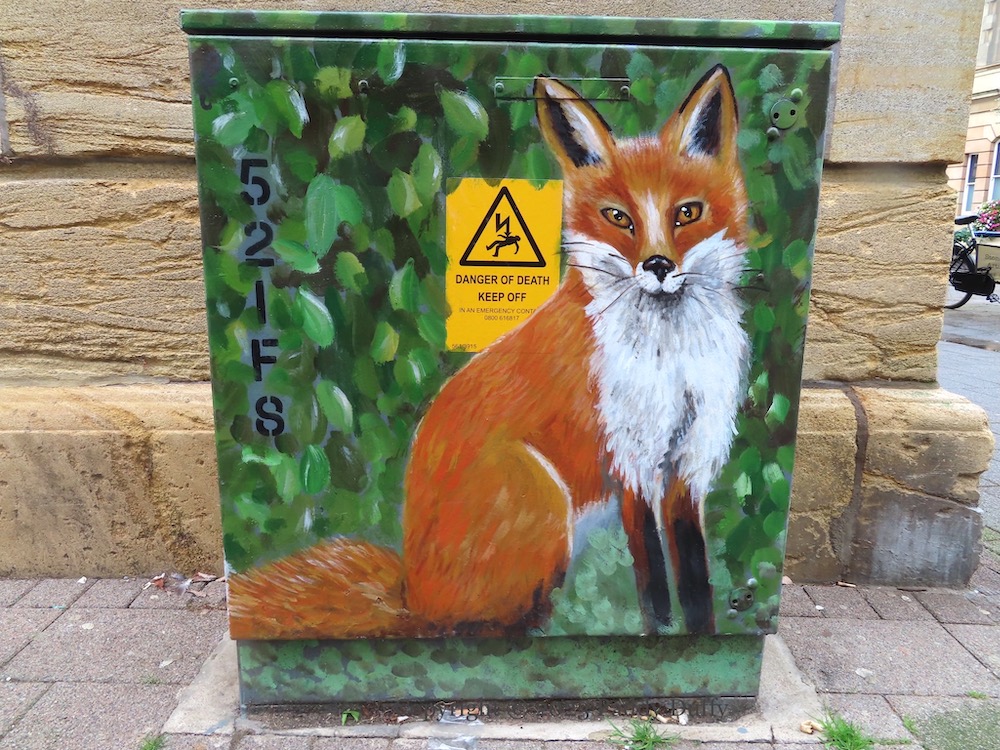
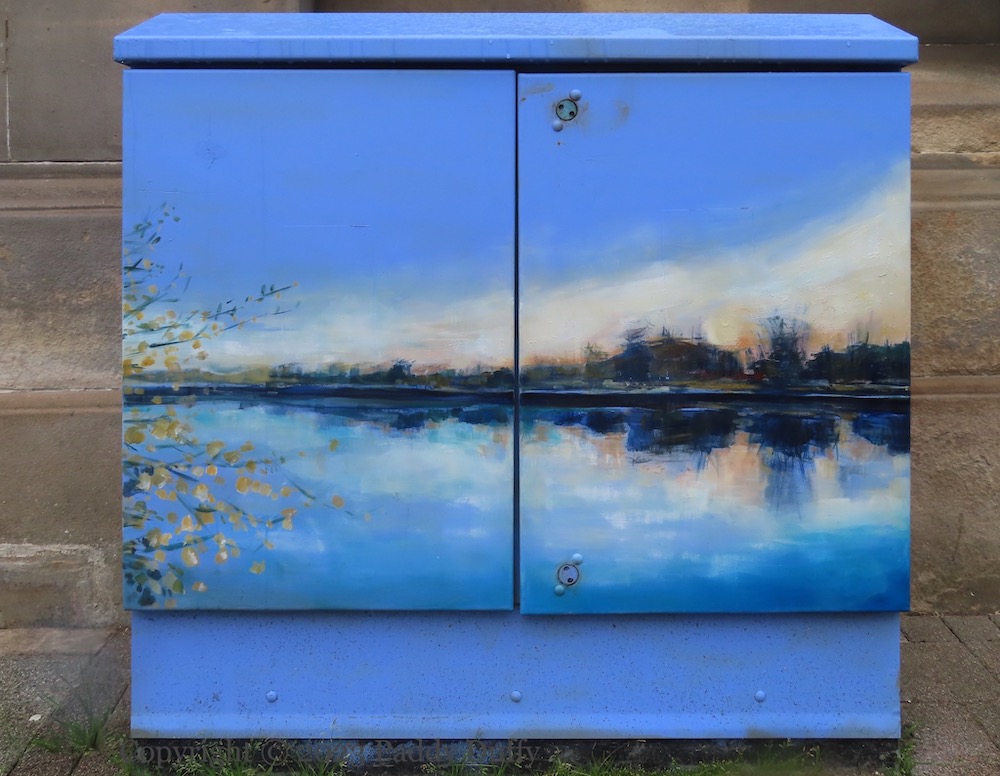
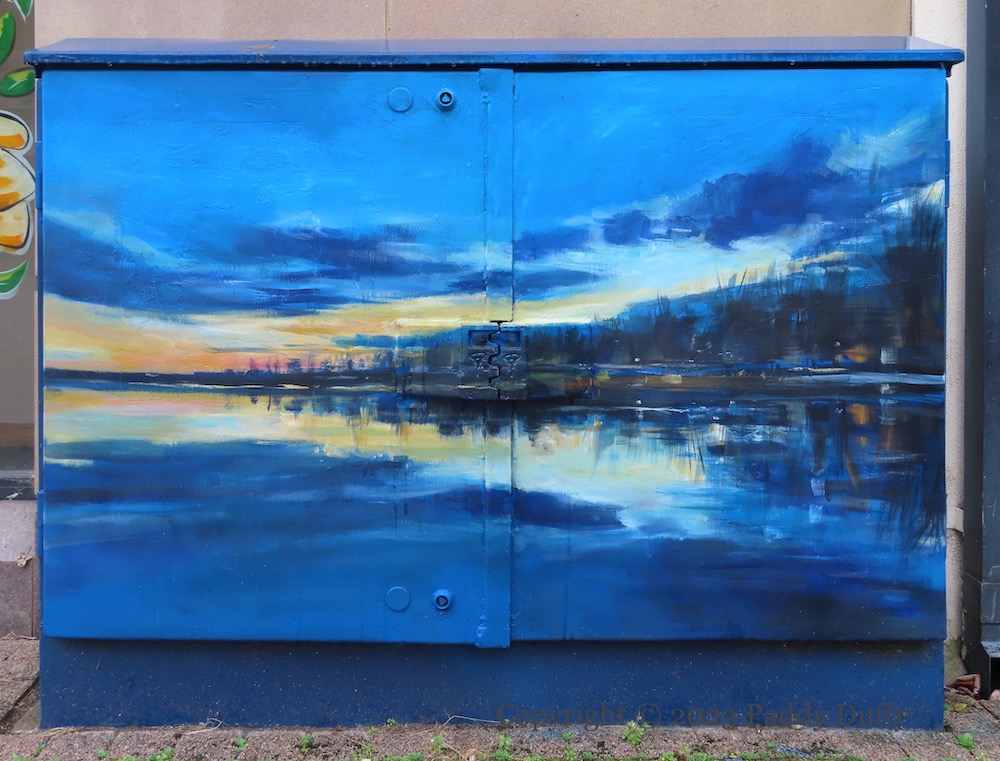
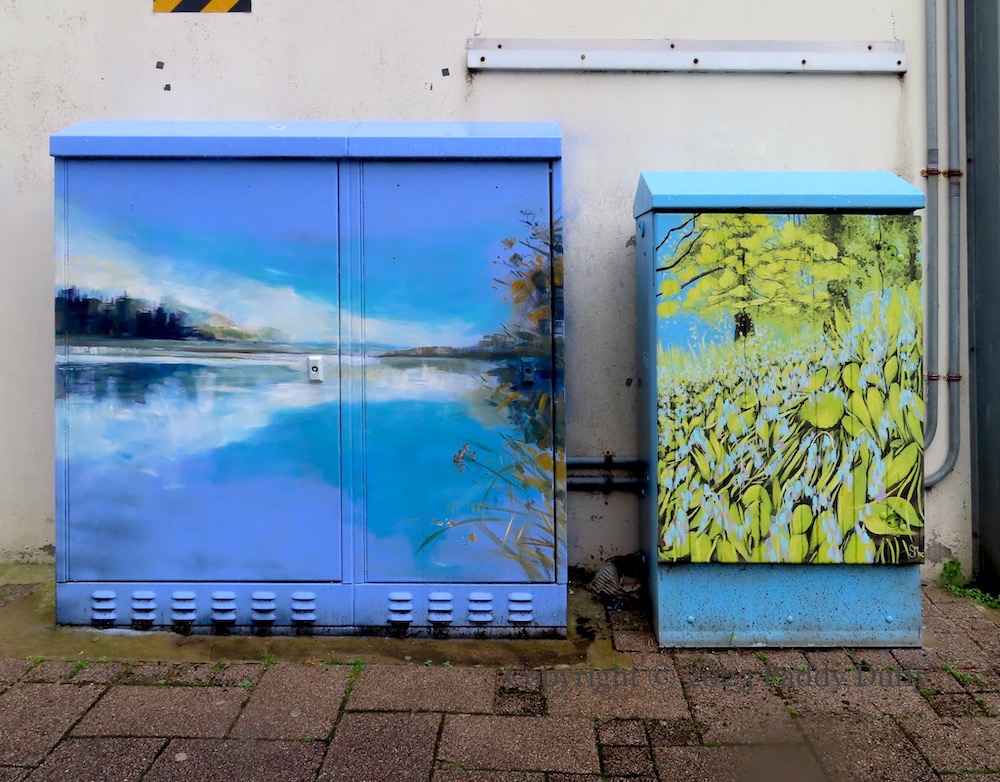
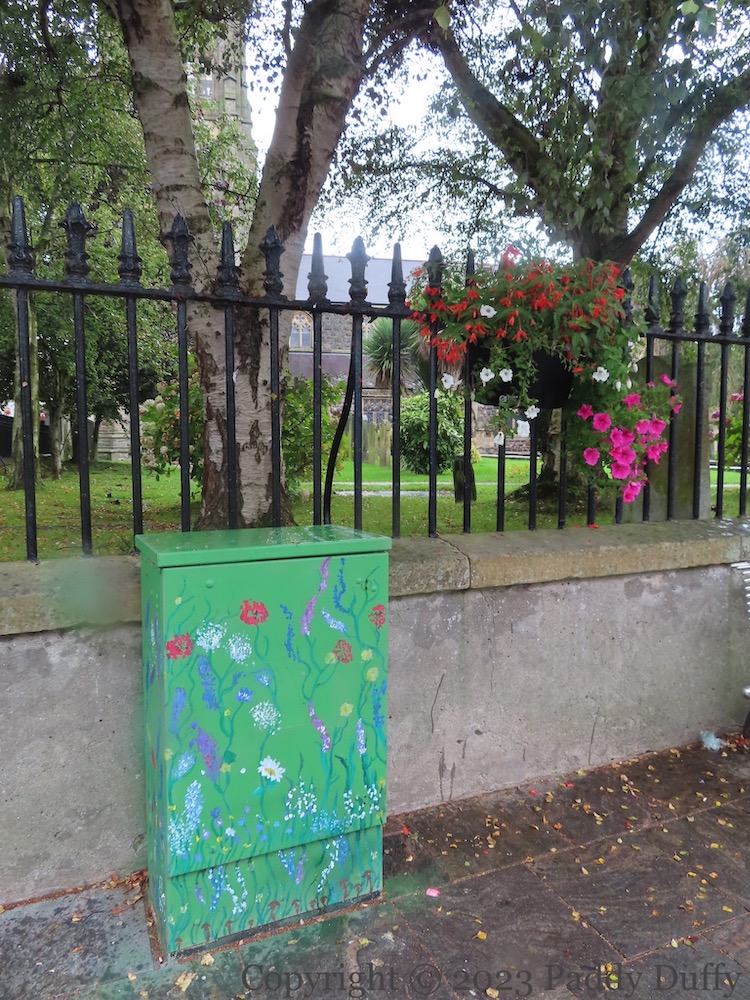
All of the pieces shown here were produced in the summer of 2023 for Coleraine’s ‘Revitalise’ programme, co-ordinated by Michelle McGarvey (ig) for Causeway Coast & Glens borough council with funding by the Department Of Communities. They are on utility boxes and planters all over the town centre.
For some of the large pieces of street art in the town, including many produced for ‘Revitalise’, see Nook Of The Ferns. More information and images can be obtained from Causeway Coast & Glens borough council (press release | map).
The first four are from Marc Holmes’s (ig) Voyage Of Discovery series.
On the right, Major Quality and Miss Sweetly from the lid of a Quality Street tin. The confectionery collection was itself named after J.M. Barrie’s 1901 play and Coleraine native “Hugh Thompson” [Hugh Thomson] (WP | NVTv) provided the illustrations for a 1913 edition (many can be seen at RBKC); these probably inspired the “soldier and lady” characters for the tins (the leads in the play are called Captain Valentine Brown and Miss Phoebe Throssel), though they were drawn by Harold Oakes (WP); the tins and ads from 1936 can be seen at Metro. The image reproduced here is from the 1950s.
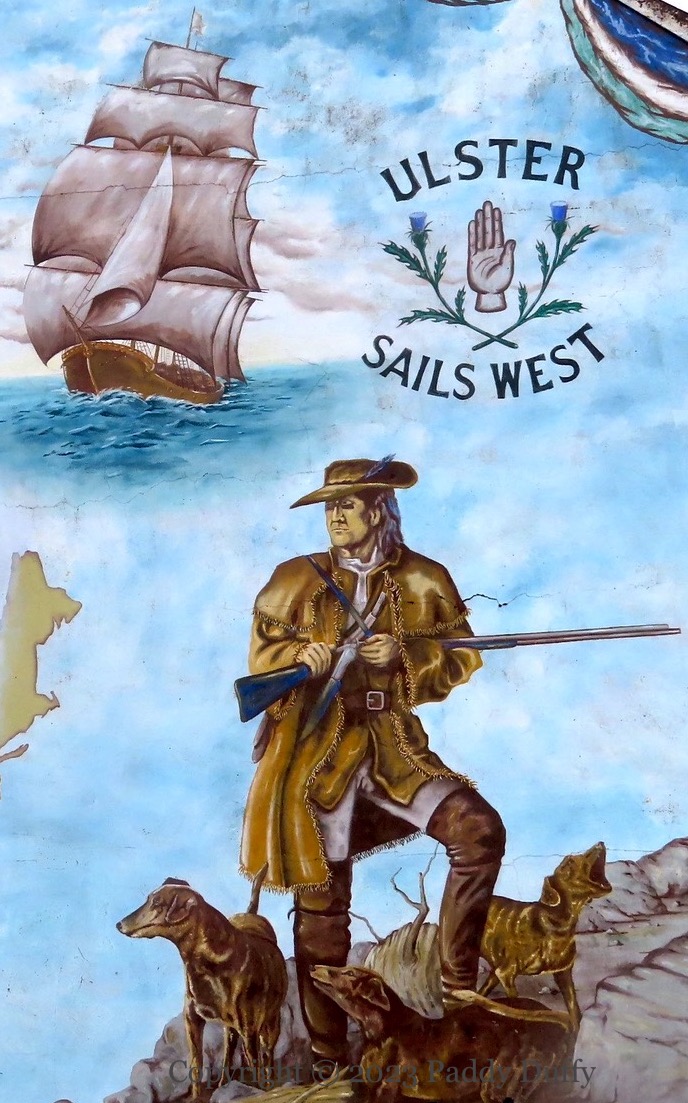
This Ballymoney mural goes all the way back to at least 2004 and to the wave of Ulster-Scots – or as here, “Scotch-Irish” – murals painted in PUL areas after the promotion of Ulstèr-Scotch as a parallel language to Irish by the Good Friday/Belfast Agreement.
As the Visual History page on Ulster-Scots Murals shows, most of these murals made a connection to (what would-become) the United States, to where about a quarter million people emigrated (WP). The mural is intended to tell a story of emigration (signified by the sailing ship), American independence (the McKinley quote), and American expansion (the frontiersman).
The Scotch-Irish were Presbyterians and supporters of breaking the ties to Great Britain. In 1893, Governor Of Ohio (and later US President) (Ulster Nation) William McKinley said, “They were the first to proclaim for freedom in these United States. Even before Lexington [i.e. the outbreak of the Revolutionary War, on April 19, 1775] the Scotch-Irish blood had been shed for American Freedom.” (According to William Marshall’s book Ulster Sails West, the battle McKinley is referring to took place on the Alamace river in North Carolina in 1771 (p. 29).)
The frontiersman on the right is generally taken to be David “Davy” Crockett (Rolston in Al Jazeera | McCormick J2024) because of the Scotch-Irish heritage on his father’s side. Crockett, however, was born in 1786 and so does not fit with the McKinley quote. Daniel Boone – though of English stock – would provide an appropriate referent for the revolutionary period, having lived from 1734 to 1820. The image is in fact a 1991 sketch of a frontiersman by David Wright (web), called “The Long Knife”, and the figure is referred to generically as “a trapper” by the artist (BBC).
None of the conquests of European-American colonists provides a good parallel to unionism, due to the complicated nature of political conflicts both there and here. The Americans, of course, threw off British rule in their revolution; Irish unionists want to remain part of the UK. And Crockett died in the Battle Of The Alamo in the Texas Revolution; that is, he died fighting for Texan independence from the Mexican government, which again doesn’t line up well with the desire of Irish unionists to remain part of the United Kingdom. (For another strained analogy involving the Scotch-Irish and US political history, see The War Of Northern Aggression and its discussion in the Ulster-Scots Murals page.)
The reason for its inclusion is the simpler idea that the Scotch-Irish are a rugged and feisty people who are not to be trifled with, whether in North America or Ireland.
Painted by Kenny Blair (Fb) in Hillview Avenue, Ballymoney; sponsored by the North Antrim Cultural And Musical Society and funded by the Heritage Commission. “Ulster Sails West” is the title of a 1943 book by WF Marshall (Isles Abroad).
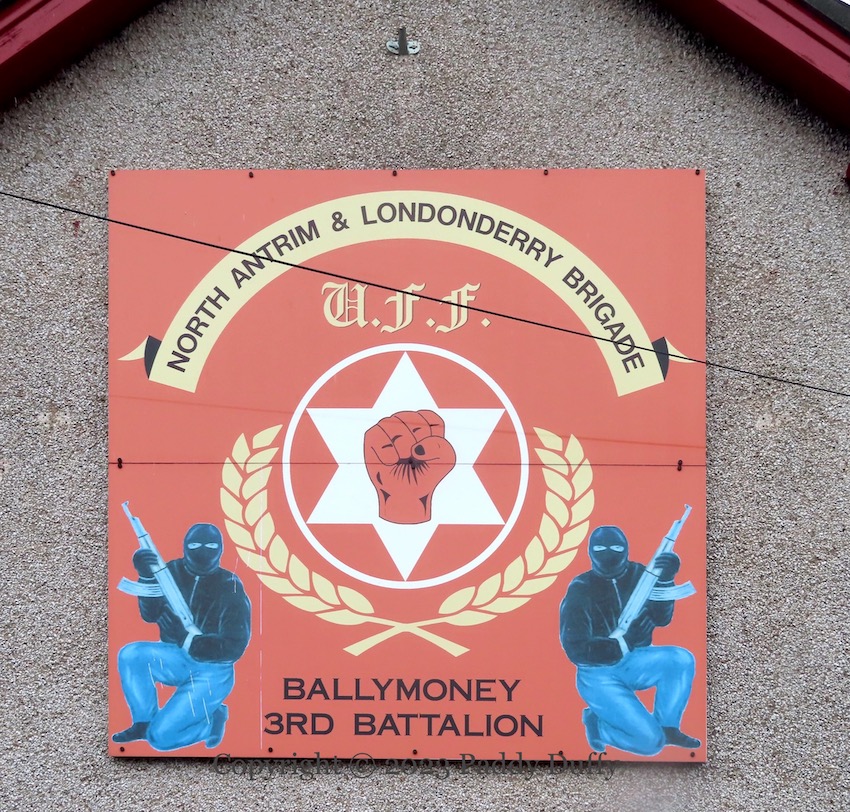
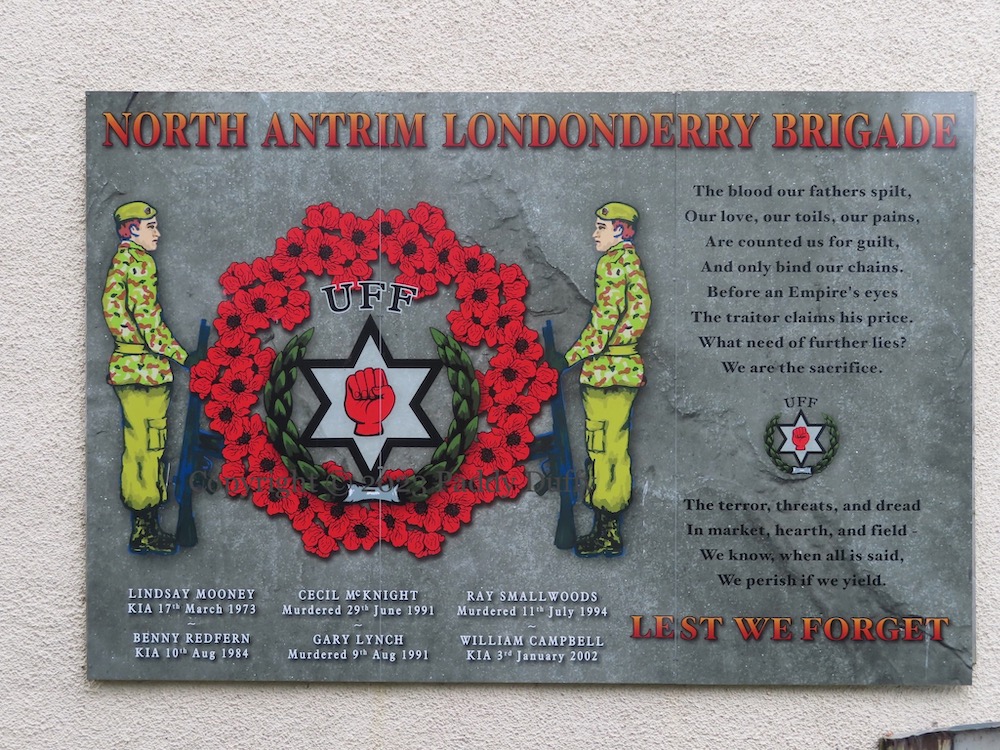
“North Antrim & Londonderry brigade, UFF, Ballymoney 3rd battalion” – hooded men with assault rifles remain on the walls in Alexandra Avenue/The Crescent, Ballymoney.
This street art, unfortunately by both a hedge and parked cars, is by Shane O’Driscoll (web) in Church Street, Ballymoney, inspired by the town’s history as a market.
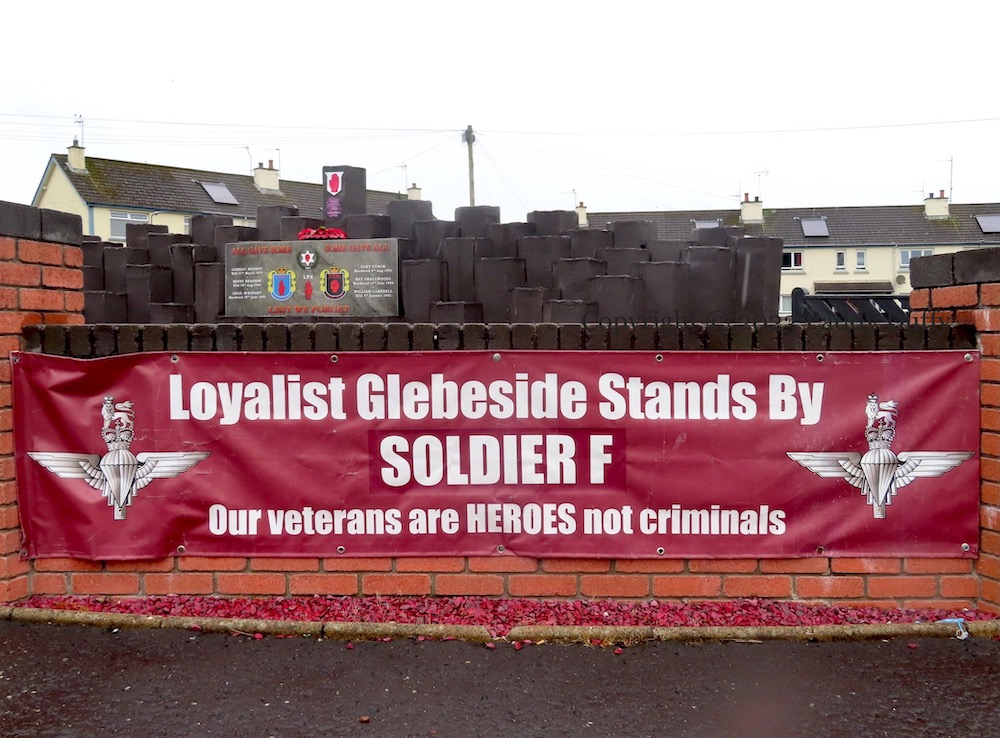
“Loyalist Glebeside Stands by Soldier F – Our veterans are HEROES not criminals.” Despite the support of Ballymoney loyalists, a court in Derry ruled in mid-December that Soldier F would stand trial on two murder charges and five attempted murders (BBC | BBC video), ahead of the forthcoming implementation of new legislation that would exempt former British Army personnel from prosecution (see Bill Of Shame).
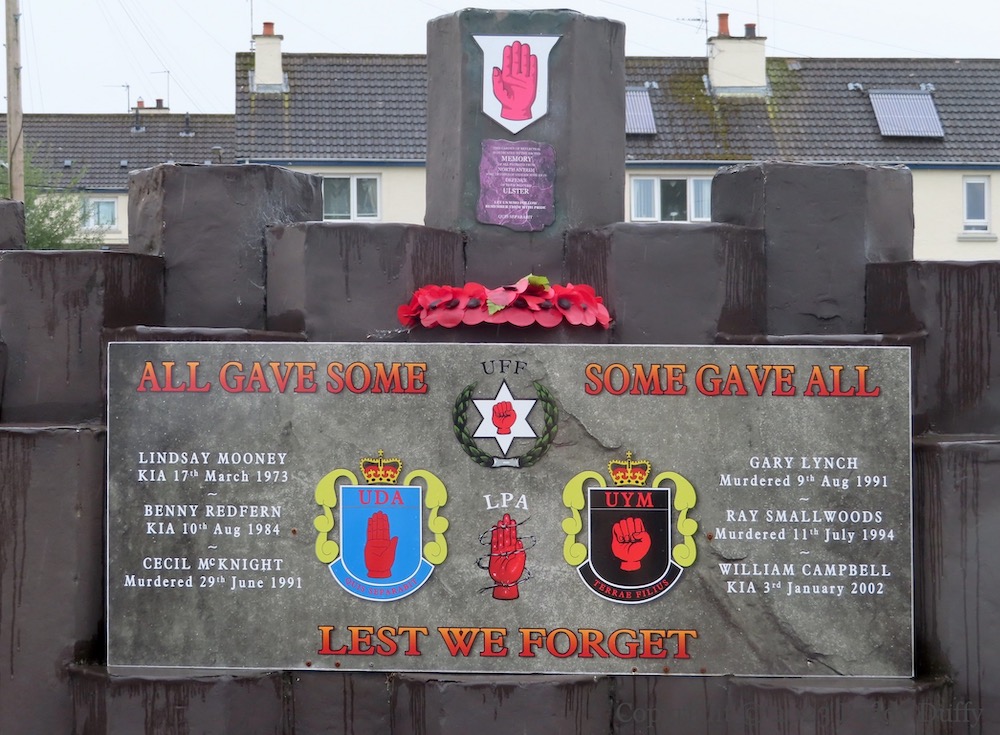
The tarp is next to the Causeway-style UDA memorial in Alexandra Avenue: “This garden of reflection is dedicated to the sacred memory of all patriots from North Antrim who in times of danger rose up in defence of their beloved Ulster – Let us who follow remember them with pride. Quis separabit. Lindsay Mooney, Benny Redfern, Cecil McKnight, Gary Lynch, Ray Smallwoods, William Campbell.”
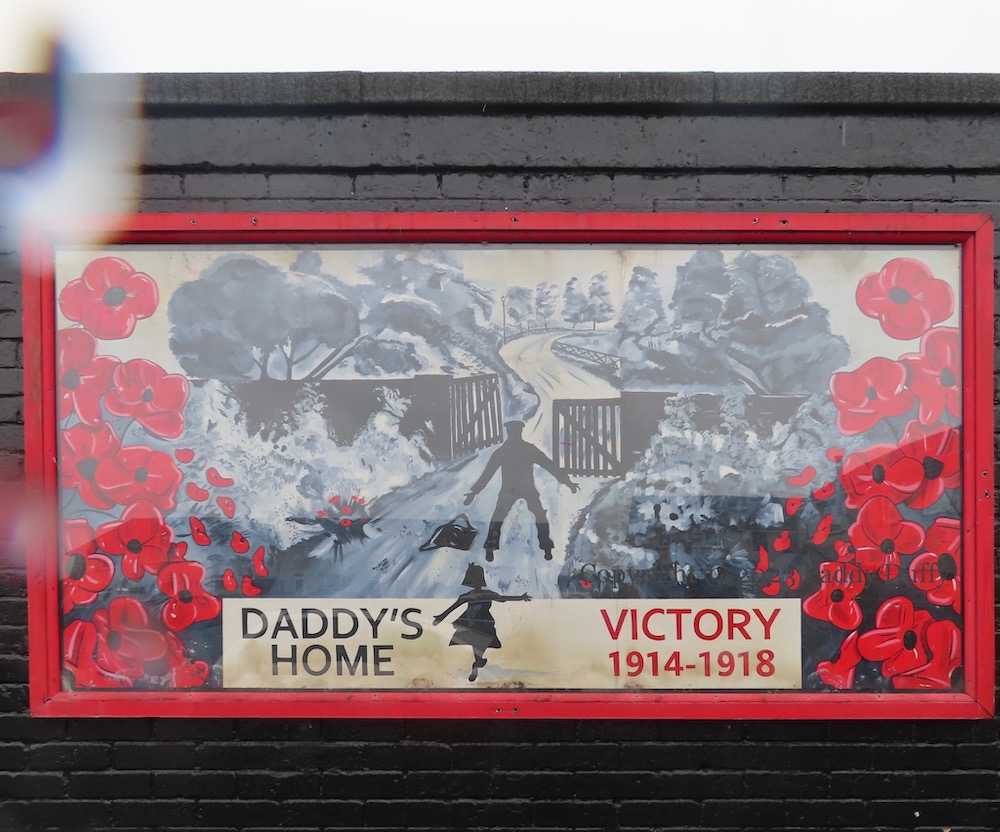
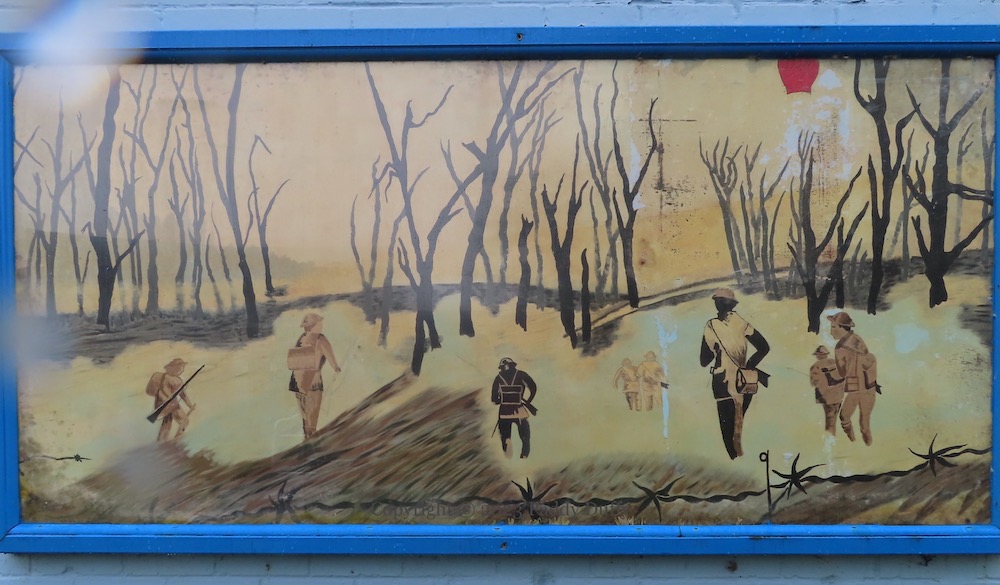
There was previously a mural of the UDA emblem and flags on the substation on the Loughanhill side of Ballysally (Coleraine) (seen in The Hell They Call Highwood) which has now been replaced by the painting of a daughter greeting her father who is returning home after “Victory 1914-1918”. There is also a new version of the painting of the attack on Highwood, as seen below.
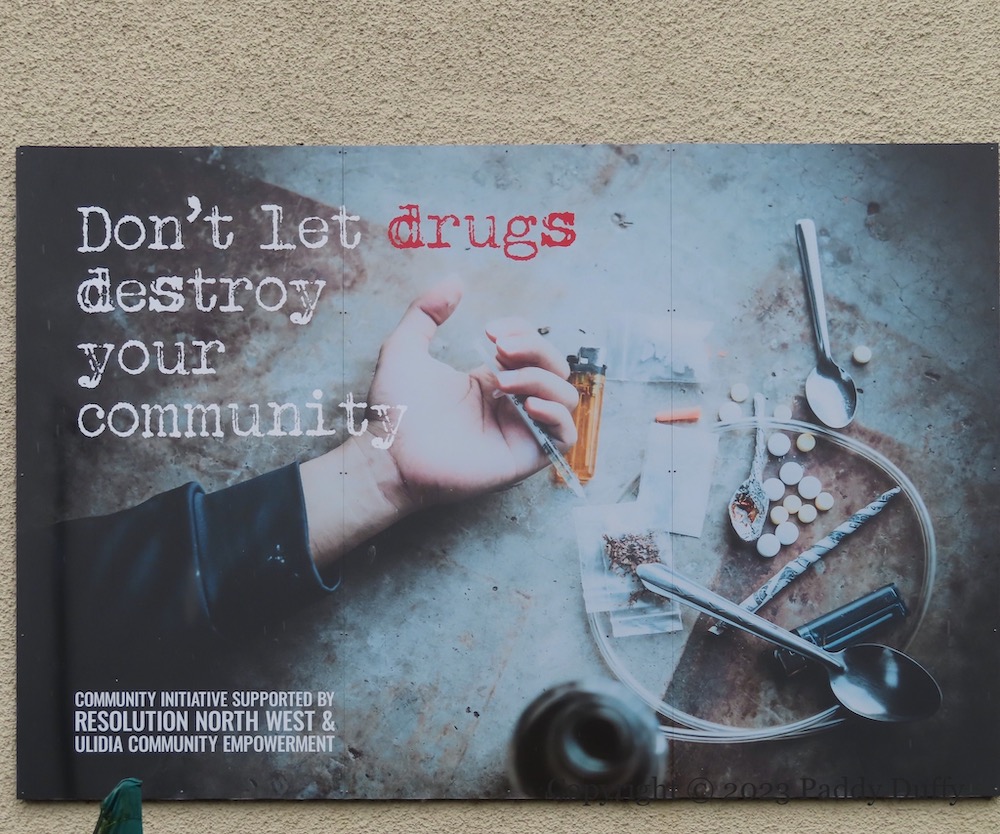
Here is a survey of the UDA boards in Carnany estate, Ballymoney. Many of these have been seen before (in Ulster’s Past Defenders, Ulster’s Present Defenders, The Terror, Threats, And Dread, and Ballymoney UDA). The anti-drugs board in the final image is new (see previously the one in Londonderry: Peace Impact Programme) and the one shown above and immediately below is an updated version of the board shown in Past, Present, For All Time. The dates given in the earlier version were 1972 and 2016; in this one, for “50 years of service”, they are 1971 and 2021. 1971 is the typical date given for the formation (in Belfast) of the the UDA; the 1972 date might have been a specific reference to the North Antrim And Londonderry brigade or the beginning of the Londonderry UDA’s actions, with bomb attacks on a factory and a pub in Donegal in October and November, 1972 (WP).




















 Paddy Duffy Collection