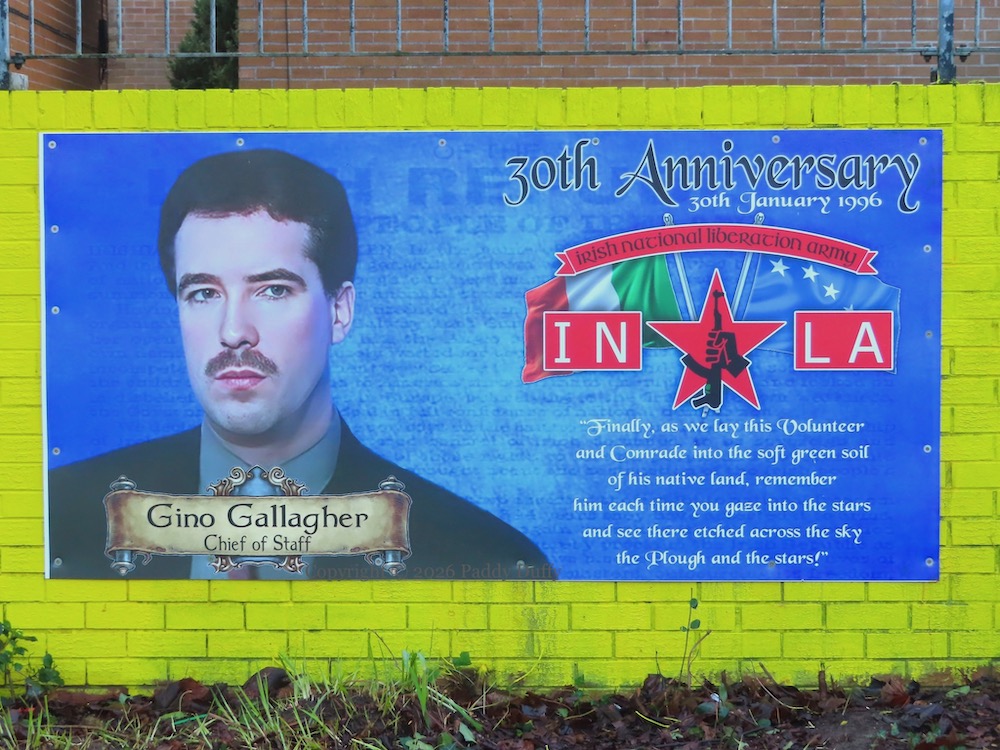
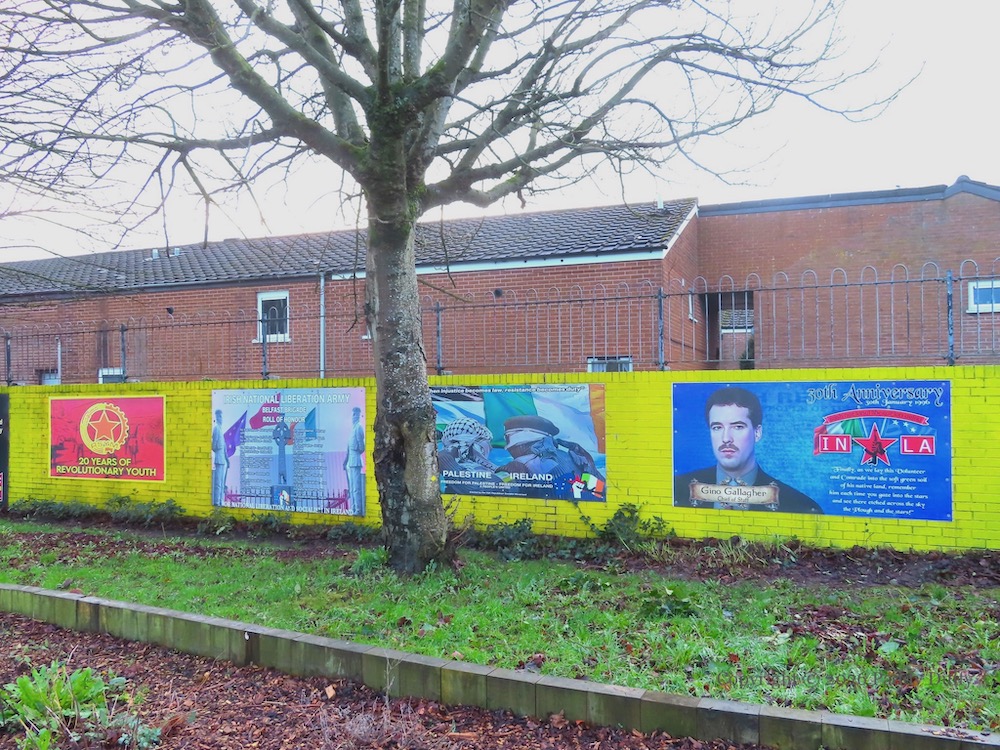
This memorial board to Gino Gallagher was mounted the day before the thirtieth anniversary of his death in 1996, possibly by former colleagues (Irish Times | Republican News). On the 31st, a colour party paraded to Gallagher’s grave in Milltown (youtube).
“Gino Gallagher, chief of staff, 30th anniversary, 30th January 1996. Irish National Liberation Army/INLA. “Finally, as we lay this volunteer and comrade into the soft green soil of his native land, remember him each time you gaze into the stars and see there etched across the sky the plough and the stars!””
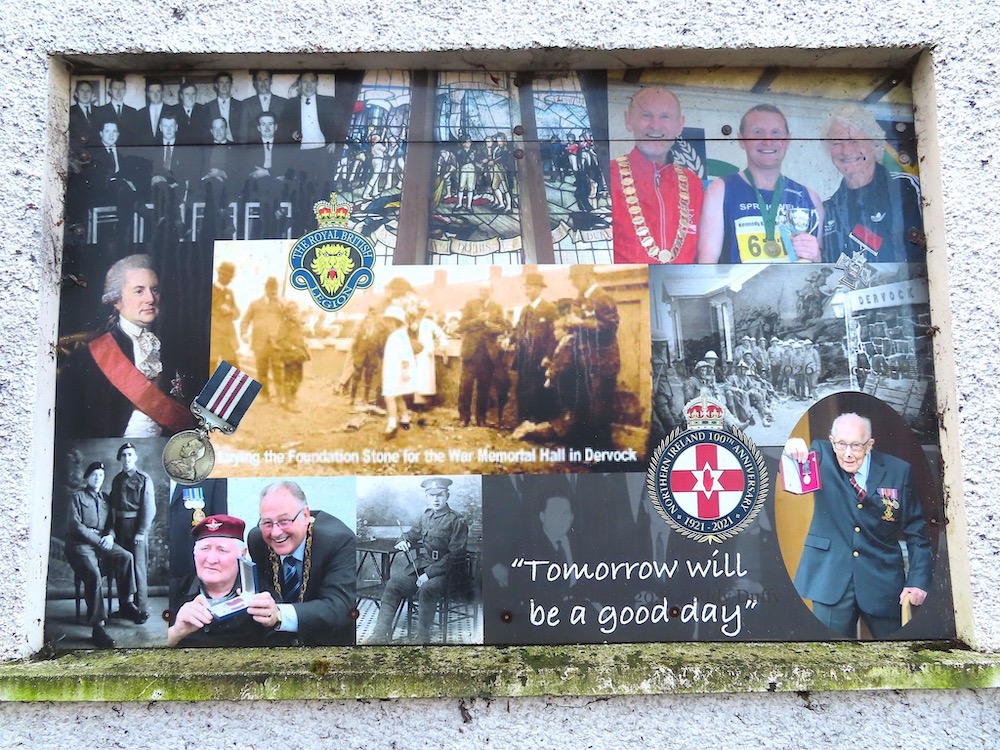
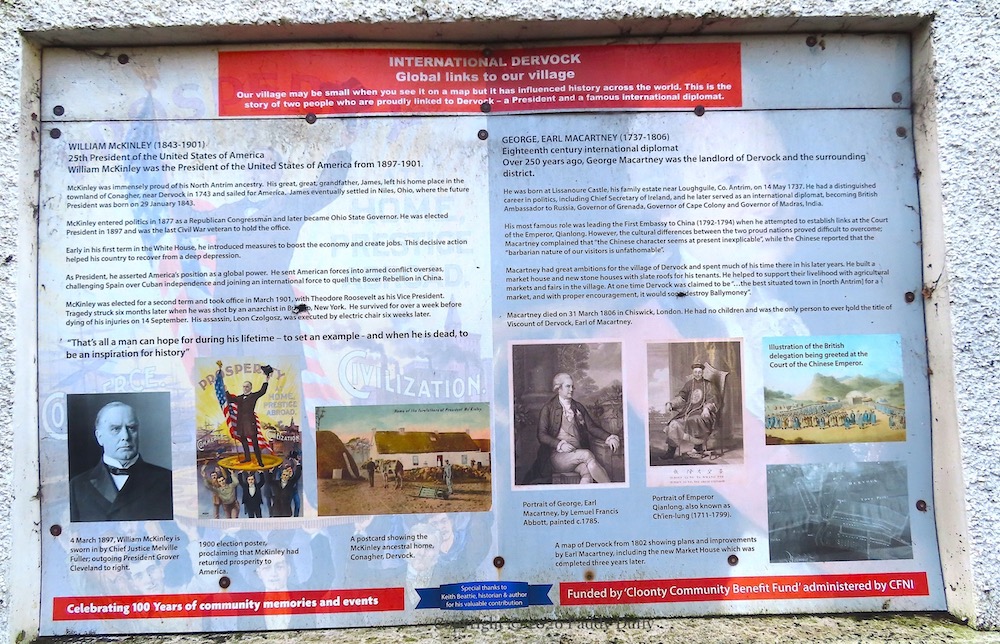
“Our village may be small when you see it on a map but it has influenced history across the world. This is the story of two people who are proudly linked to Dervock – a President and a famous international diplomat.”
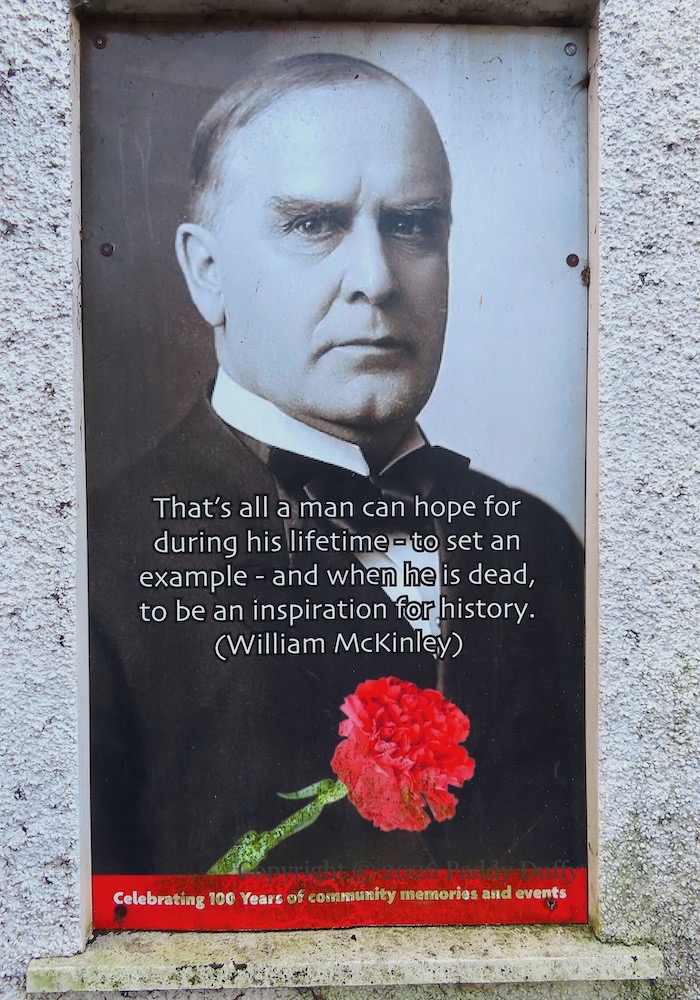
The President is “William McKinley (1843-1901) 25th President of the United States … from 1897-1901. McKinley was immensely proud of his North Antrim ancestry. His great, great, grandfather, James, left his home place in the townland of Conagher, near Dervock in 1743 and sailed for American. James eventually settled in Niles, Ohio, where the future President was born on 29 January 1843. … “That’s all a man can hope for during his lifetime – to set an example – and when he is dead, to be an inspiration for history.””
The second figure is “George, Earl Macartney (1737-1806) Eighteenth century diplomat. Over 250 years ago, George Macartney was the landlord of Dervock and the surrounding district. He was born at Lissanoure Castle, his family estate near Loughguile, Co. Antrim, on 14 May 1737. … His most famous role was leading the First Embassy to China (1792-1794) …”
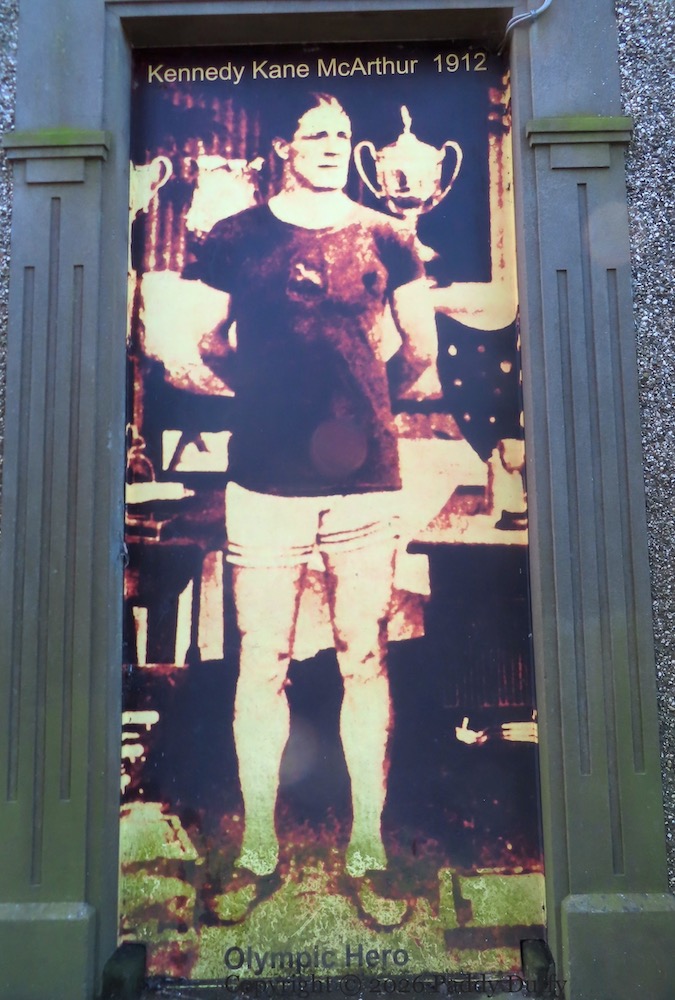
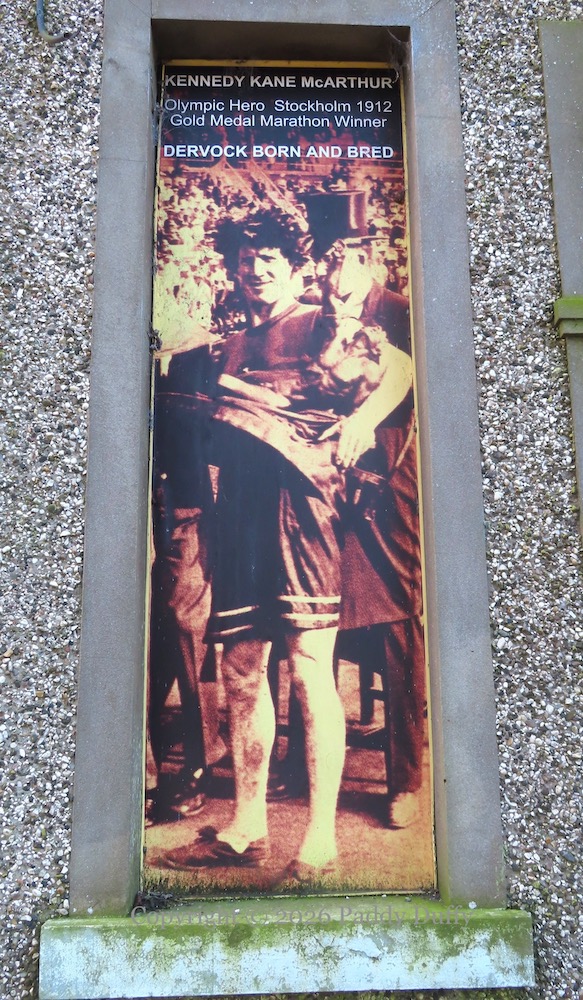
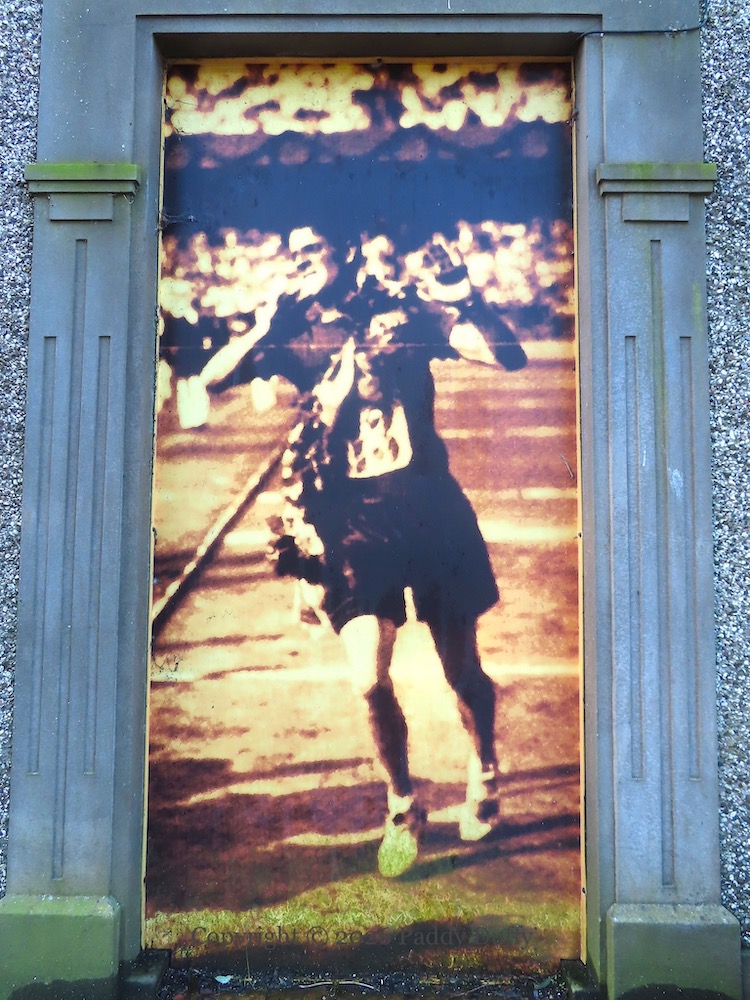
“Kennedy Kane McArthur, Olympic hero, Stockholm 1912, gold medal marathon winner. Dervock born and bred.”
Ken McArthur emigrated from Dervock to Johannesburg, South Africa, at age 20 and ran his first marathon at 28. Four years later, he represented South Africa at the Olympics and was victorious in the marathon (WP). There is footage of the race at olympics.com.
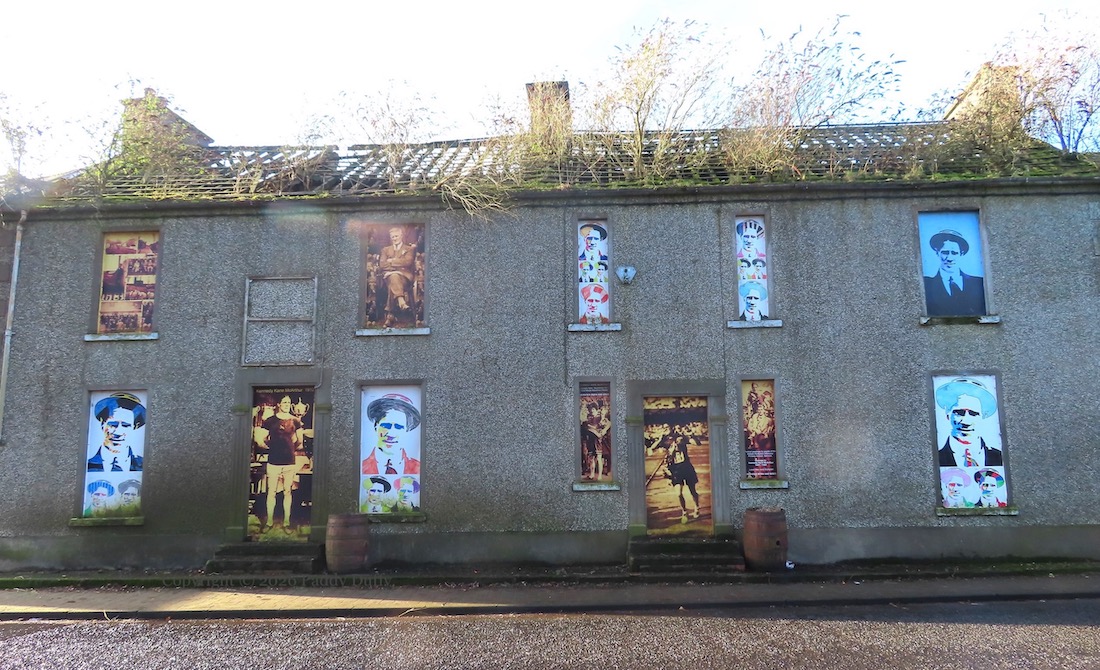
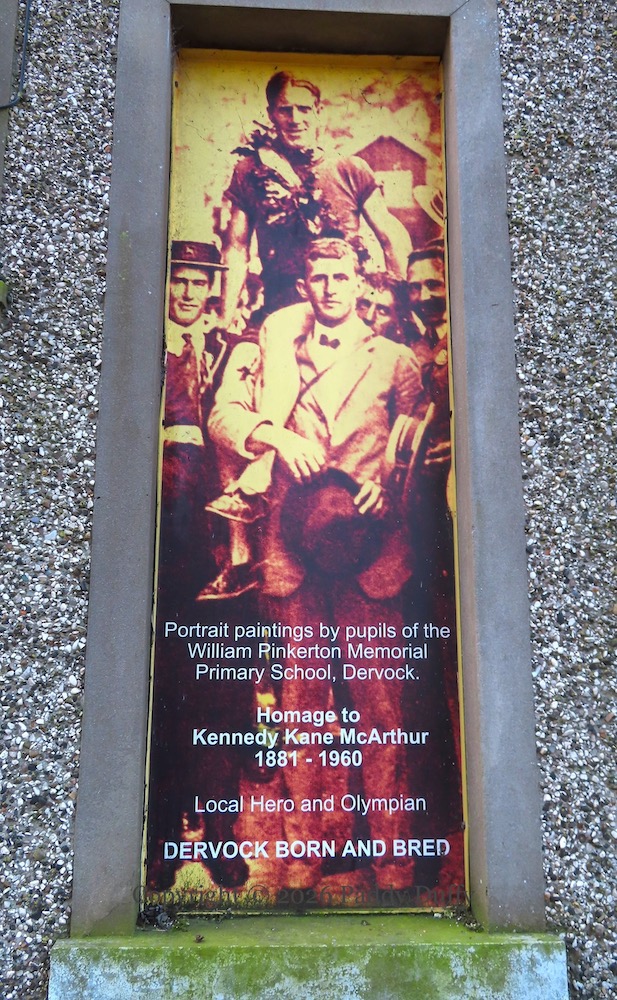
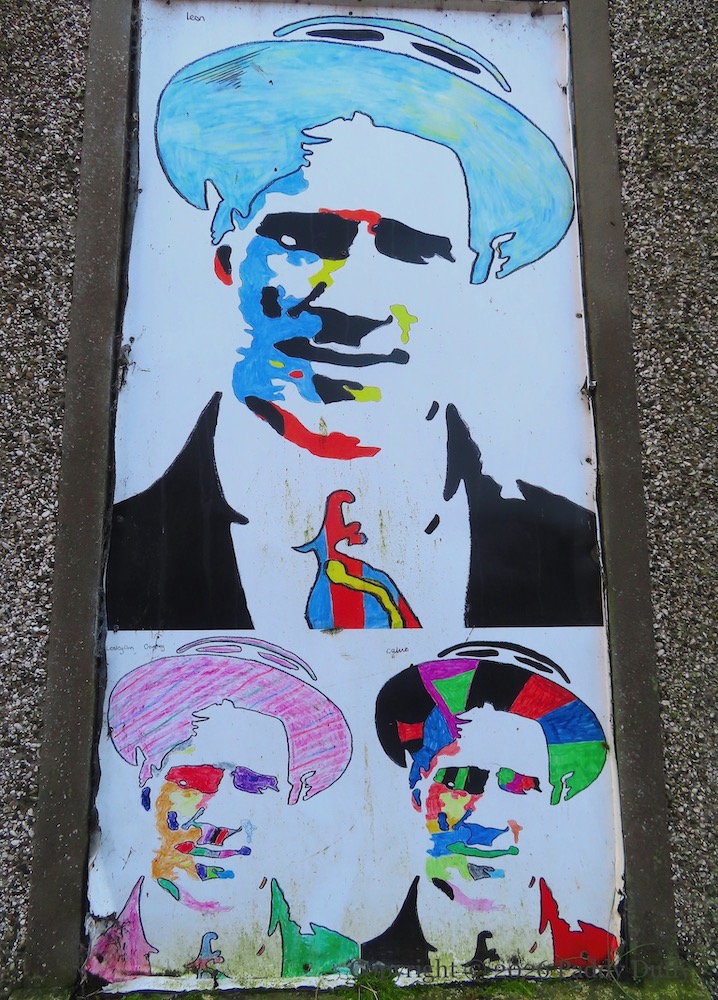
“Portrait paintings by pupils of the William Pinkerton Memorial primary school, Dervock. Homage to Kennedy Kane McArthur, 1881 – 1960, Local hero and Olympian. Dervock born and bred.”
Castlecat Road, Dervock
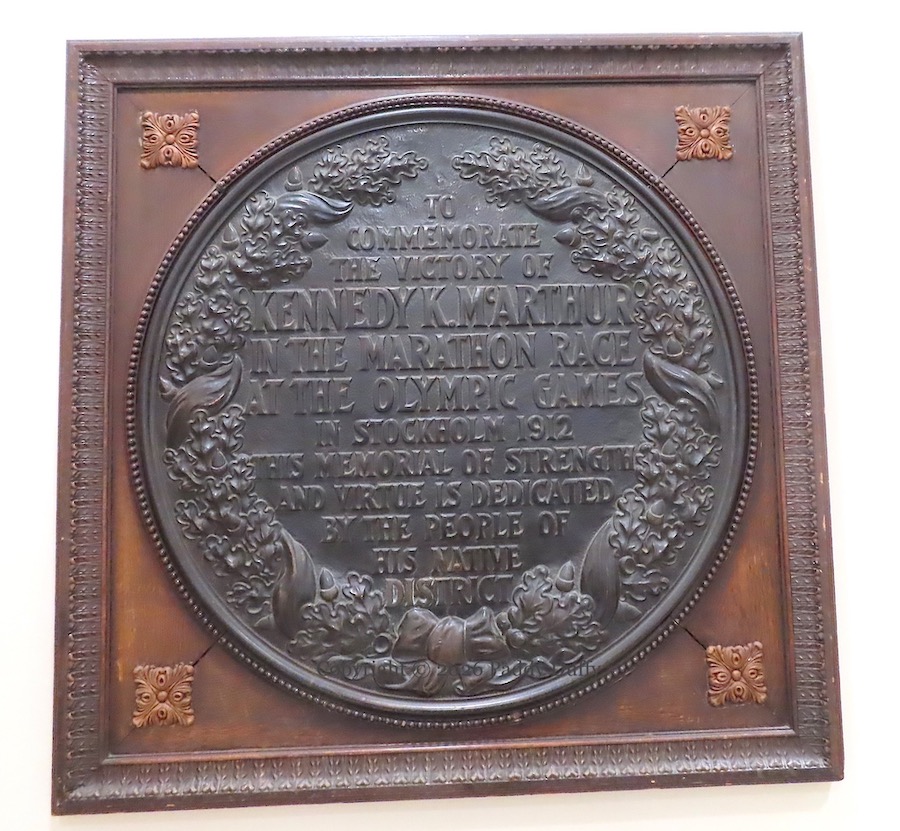
The large medallion is in the visitor centre in Townsend Street, Ballymoney. It reads, “To commemorate the victory of Kennedy K. McArthur in the marathon race at the Olympic Games in Stockholm 1912. This memorial of strength and virtue is dedicated by the people of his native district.”
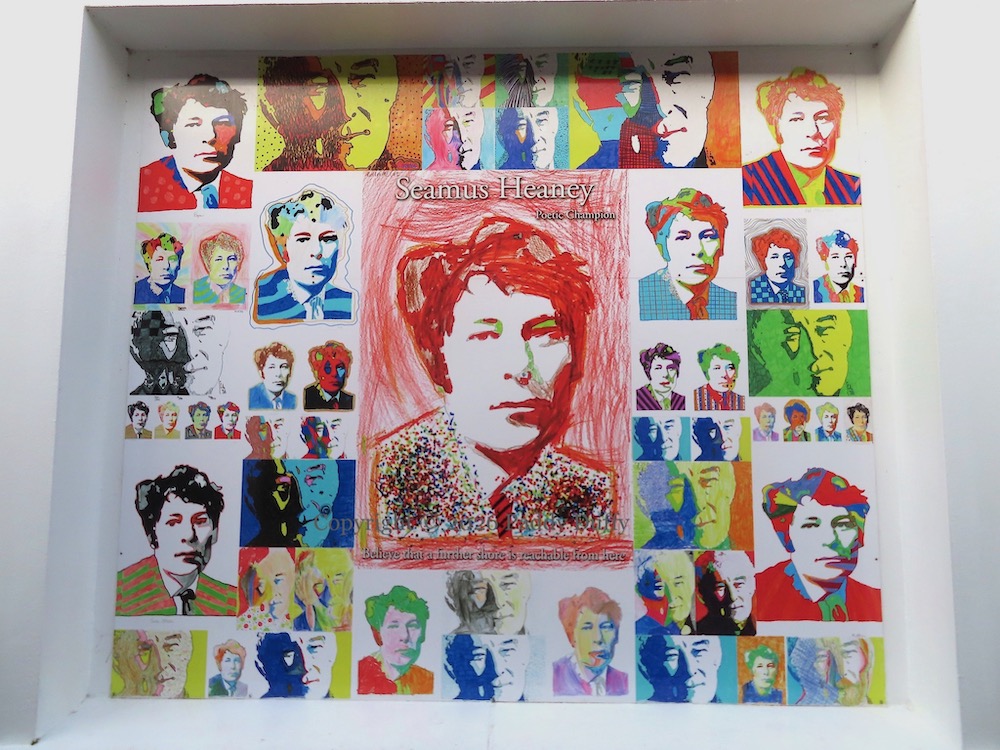
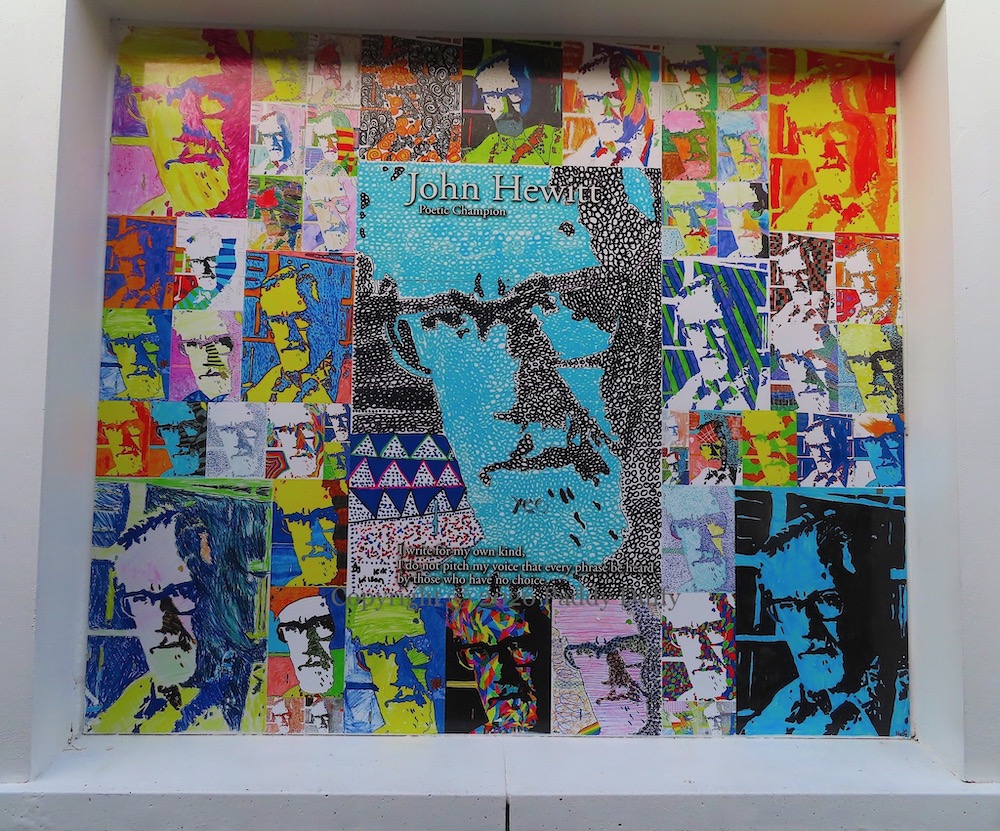
These two panels were created by Ross Wilson (web) along with children from four local Ballymoney schools (BBC | NI World). They portray two famous poets from Northern Ireland, Seamus Heaney and John Hewitt and include a line from a work of each:
Seamus Heaney’s “Believe that a further shore is reachable from here”, comes from The Cure At Troy (youtube).
The quotation from John Hewitt is the first line of the poem I Write For: “I write for my own kind, I do not pitch my voice that every phrase be heard by those who have no choice.”
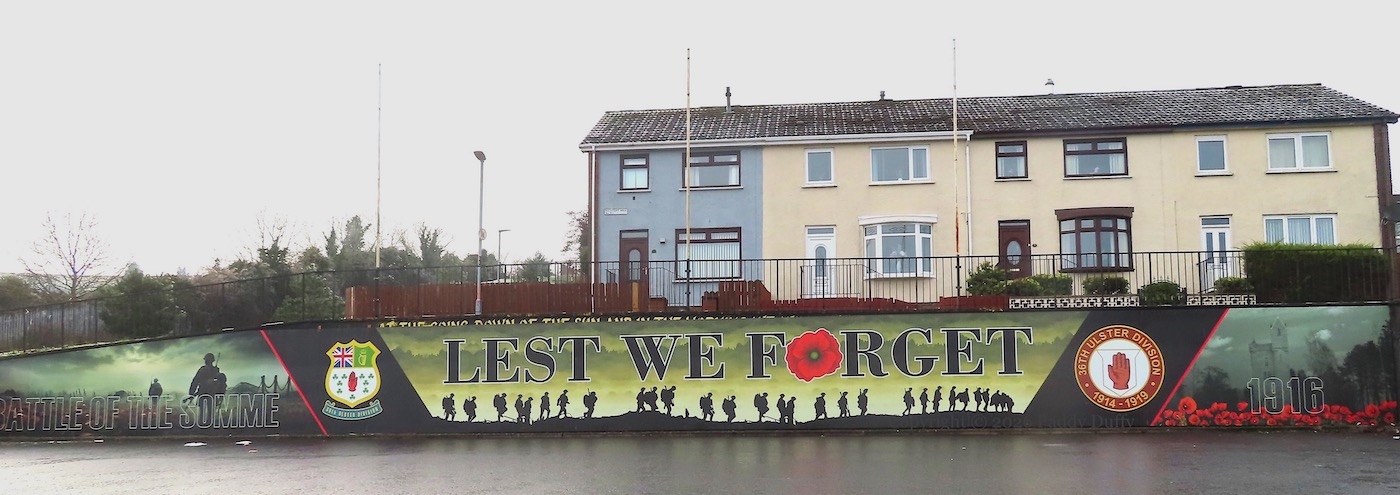
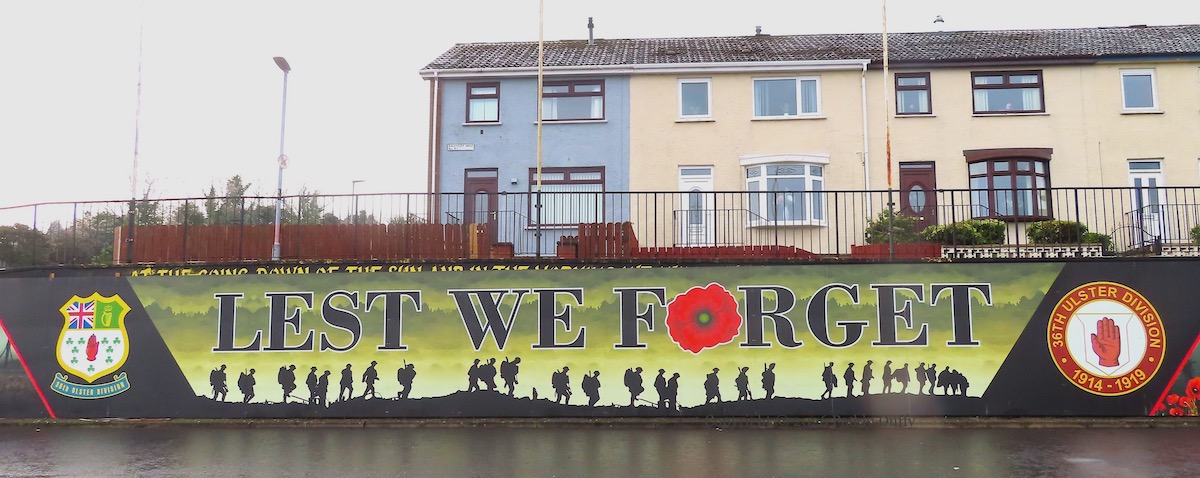
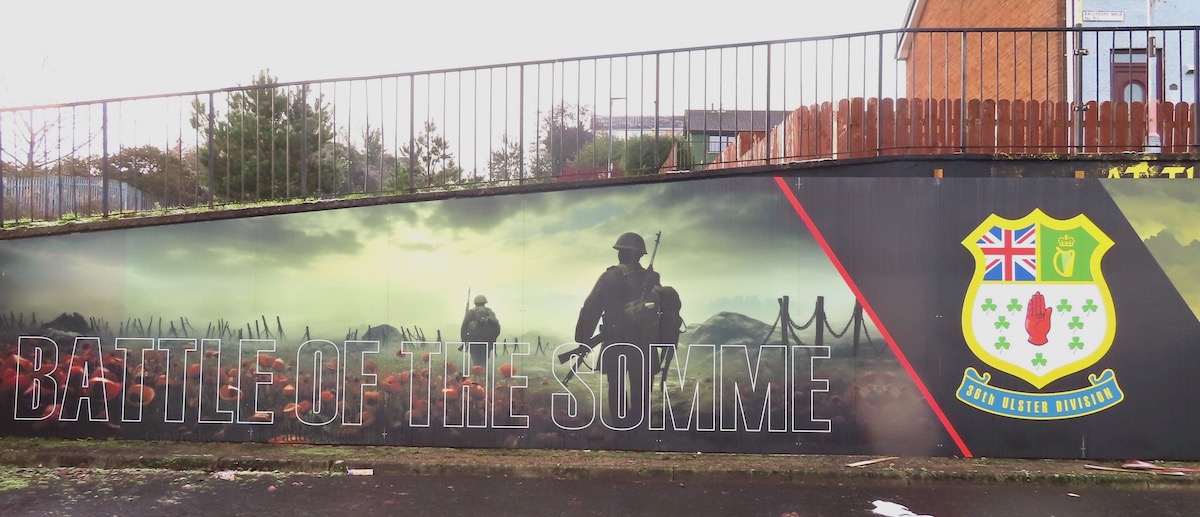
The badge or insignia of the 36th (Ulster) Division most frequently seen in murals is the one on the left of this board in Ballyduff, combining a red hand on a field of shamrocks with the Union Flag and the harp of the Royal Irish Rifles. The simpler insignia of the 36th Division on the right is being seen more frequently – it features a left-handed red hand, while the other uses a right-handed red hand, as do the flags of Ulster and of Northern Ireland.
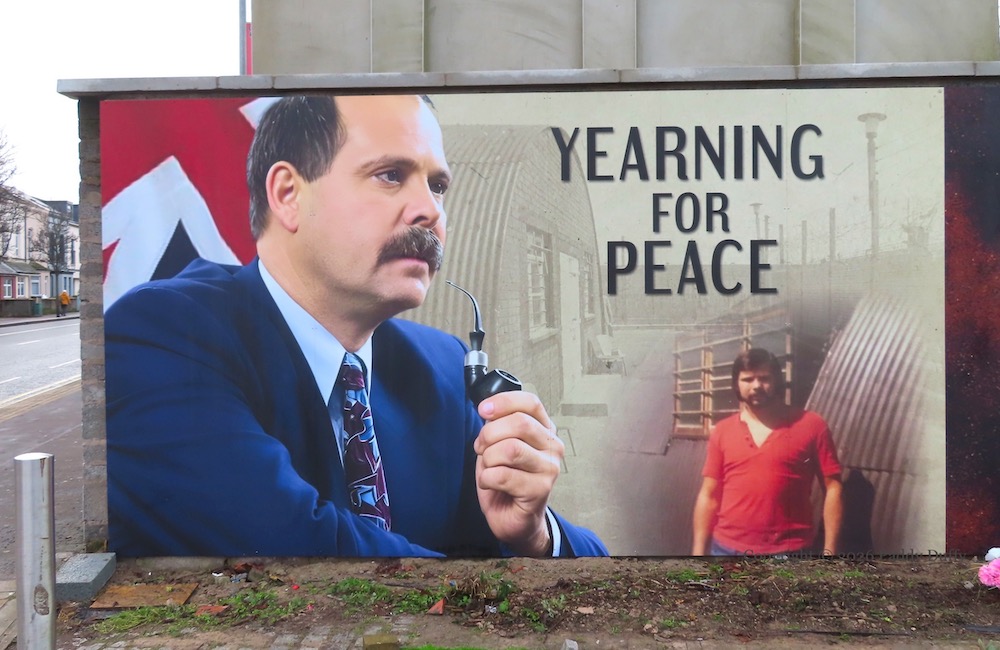
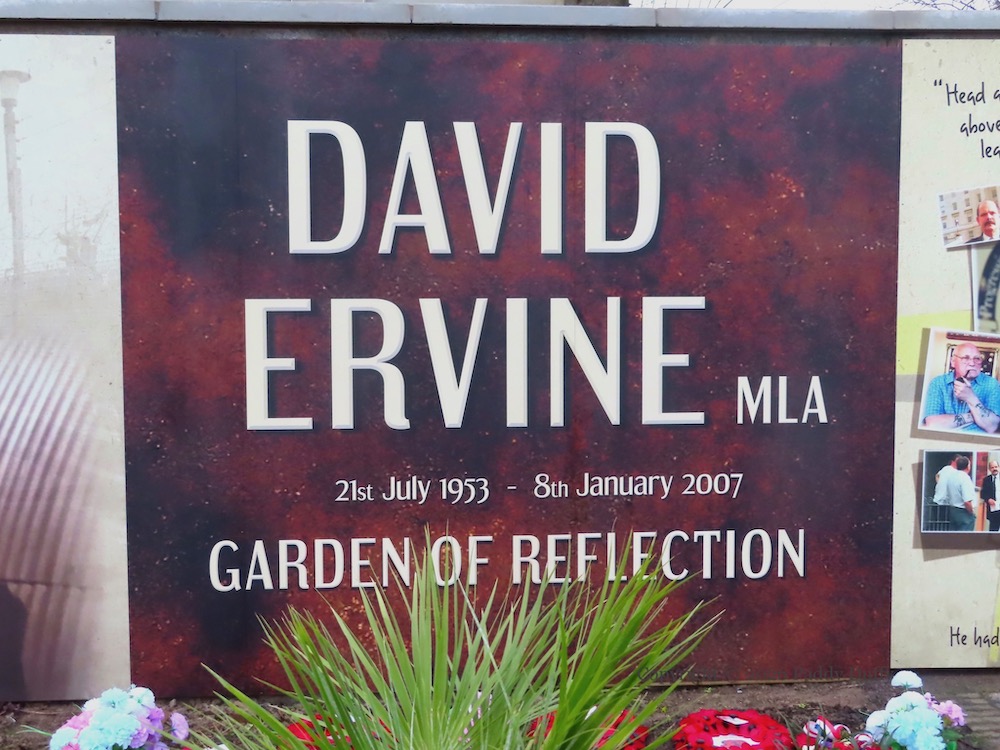
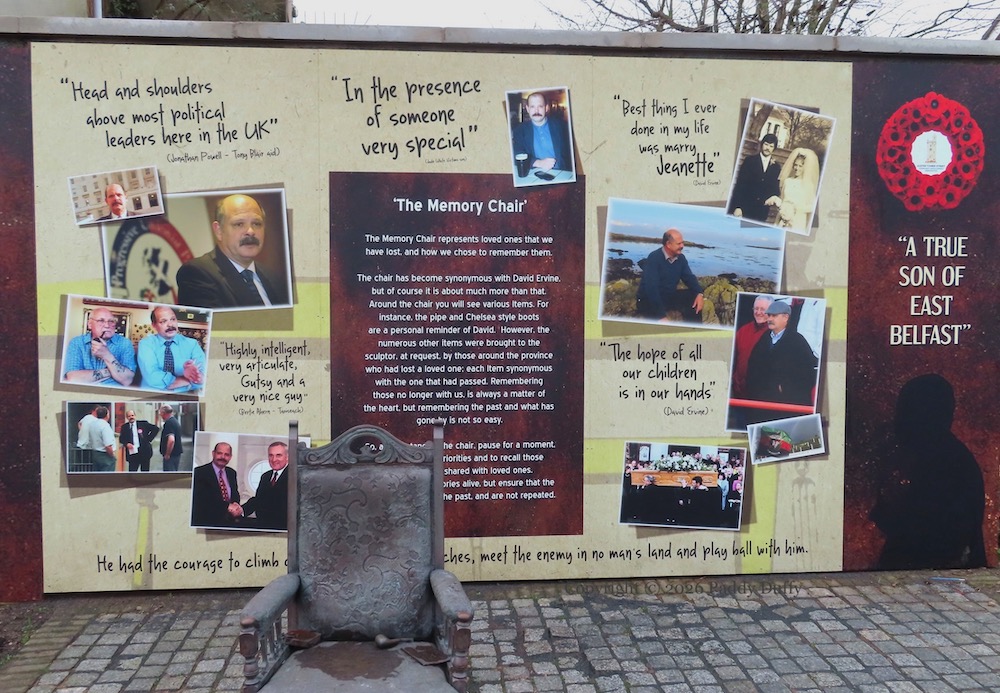
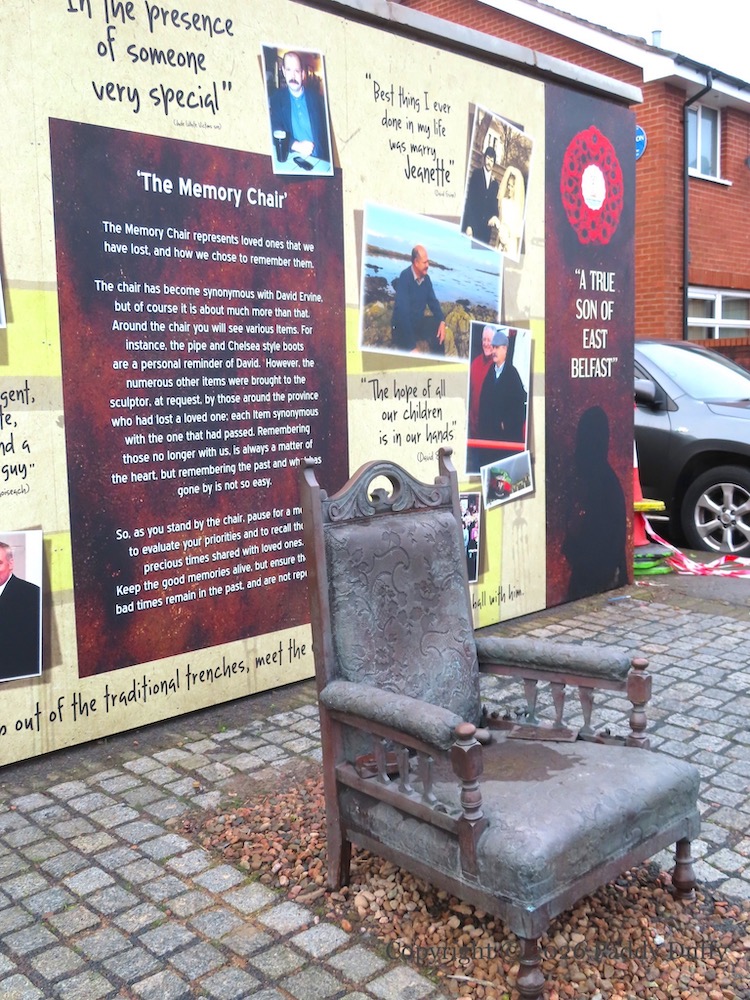
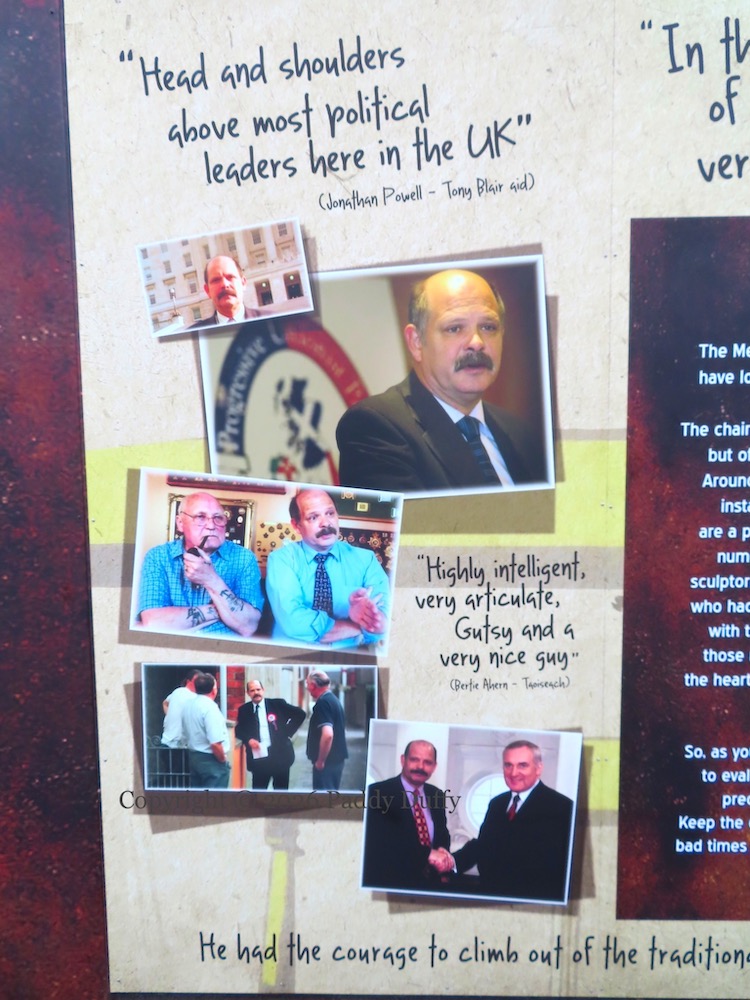
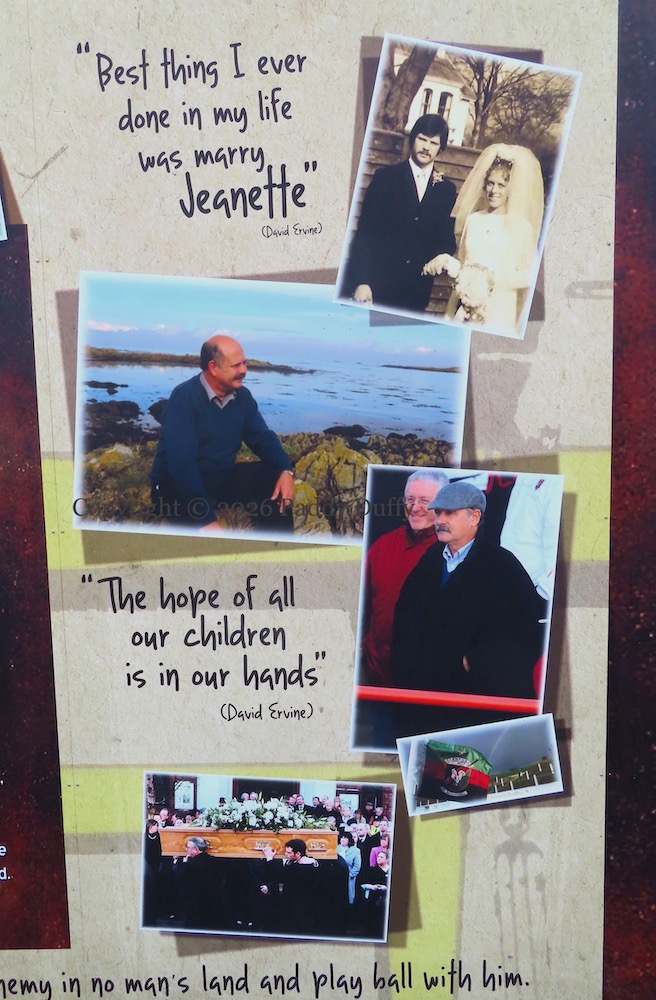
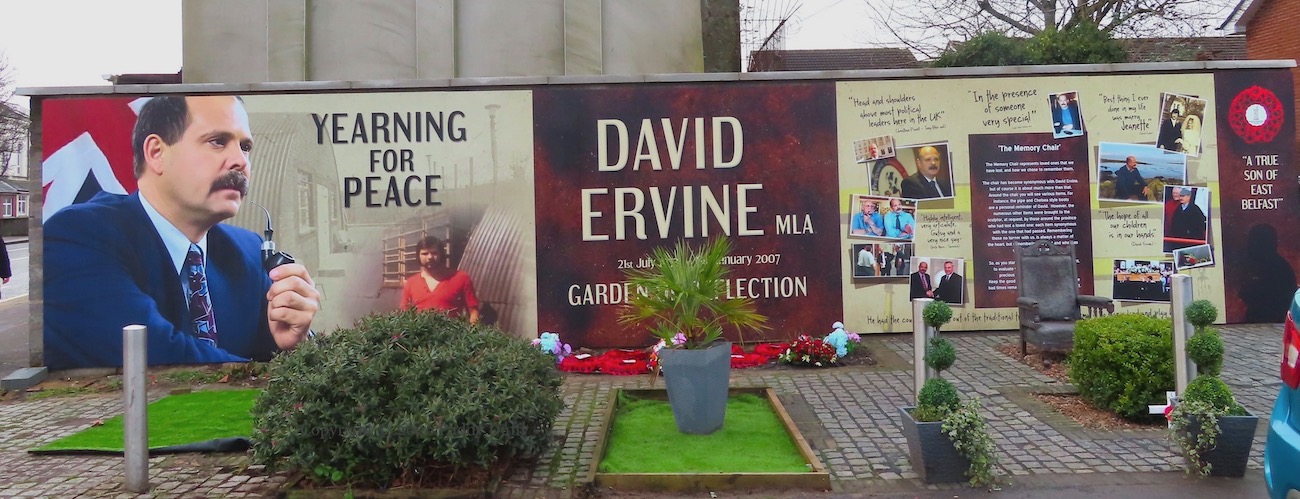
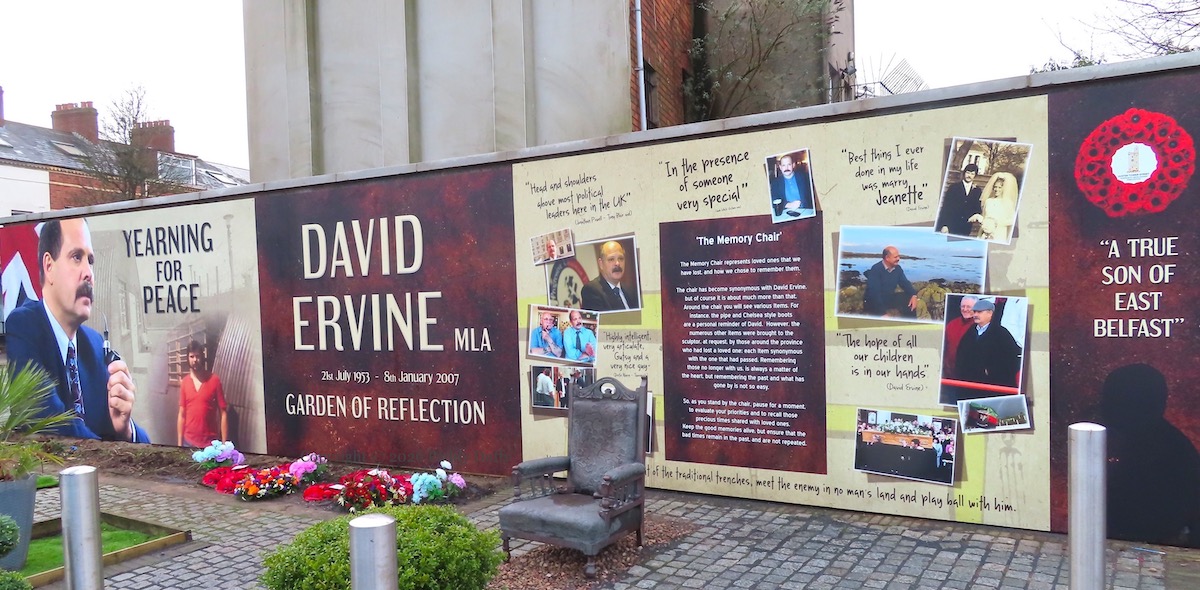
On the anniversary of David Ervine’s death, January 8th, a new board was launched in his memory, with images of Ervine “yearning for peace” in the cages of Long Kesh, where he met Gusty Spence (the pair can be seen together in the middle of the first column of photographs).
After his release, Ervine turned to politics, running unsuccessfully as a PUP candidate for Pottinger in the Belfast City Council elections of 1985 (WP); he would eventually be successful in 1997. In 1998 he was returned by Belfast East in the Assembly election (ARK). He helped bring about the loyalist ceasefire in 1994 – which was read aloud by Spence (youtube) – and was pro-Agreement in 1998 (DIB | Guardian | Slugger).
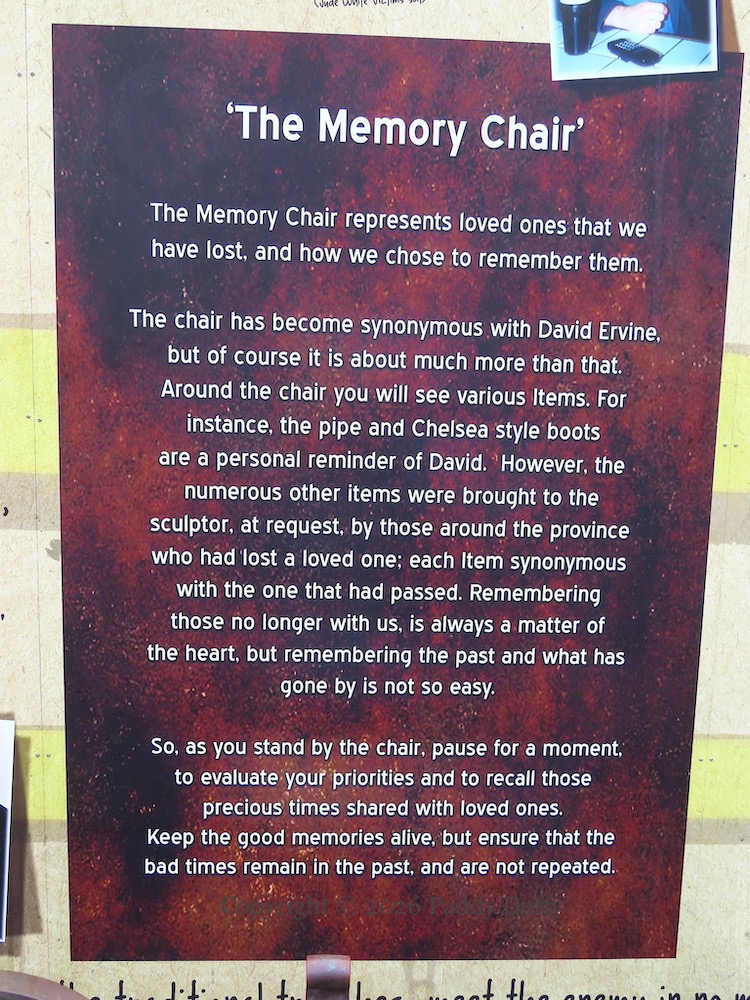
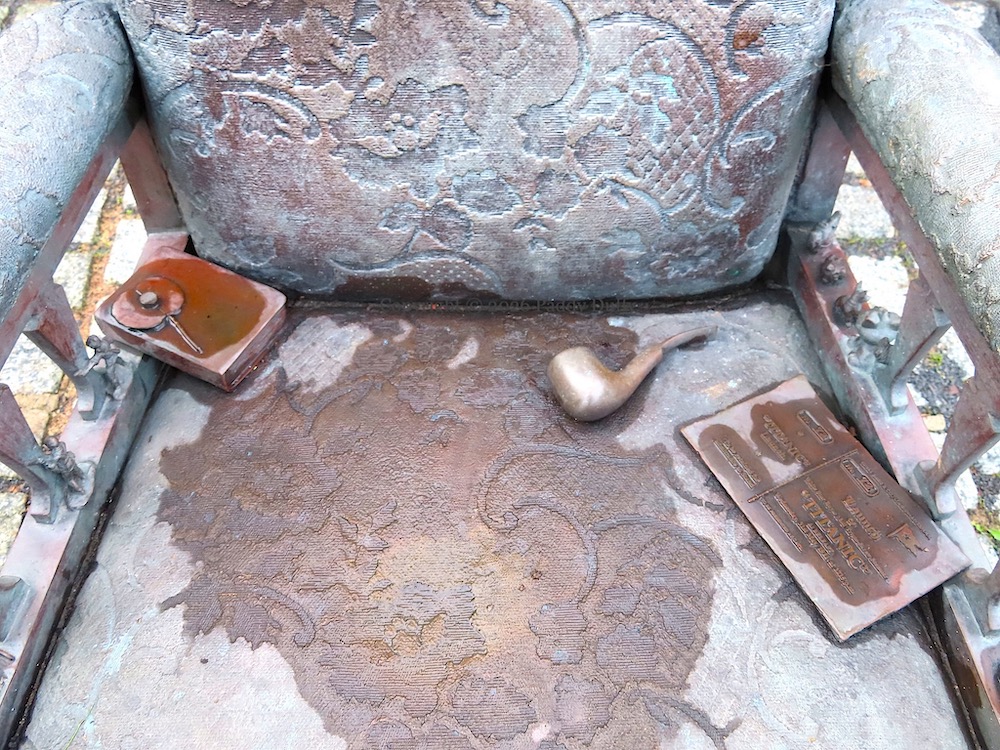
The information about the Memory Chair sculpture makes mention of Ervine’s boots but it seems they have not survived the mothballing of the sculpture which was last seen on site – boots included – in 2014.
This memorial for Glen “Spacer” Branagh, launched on the twentieth anniversary of his death in 2021, is at the junction of Canning Street and Orchard Street, north Belfast.
For information and the earlier plaque on N Queen St, see Forever Young.
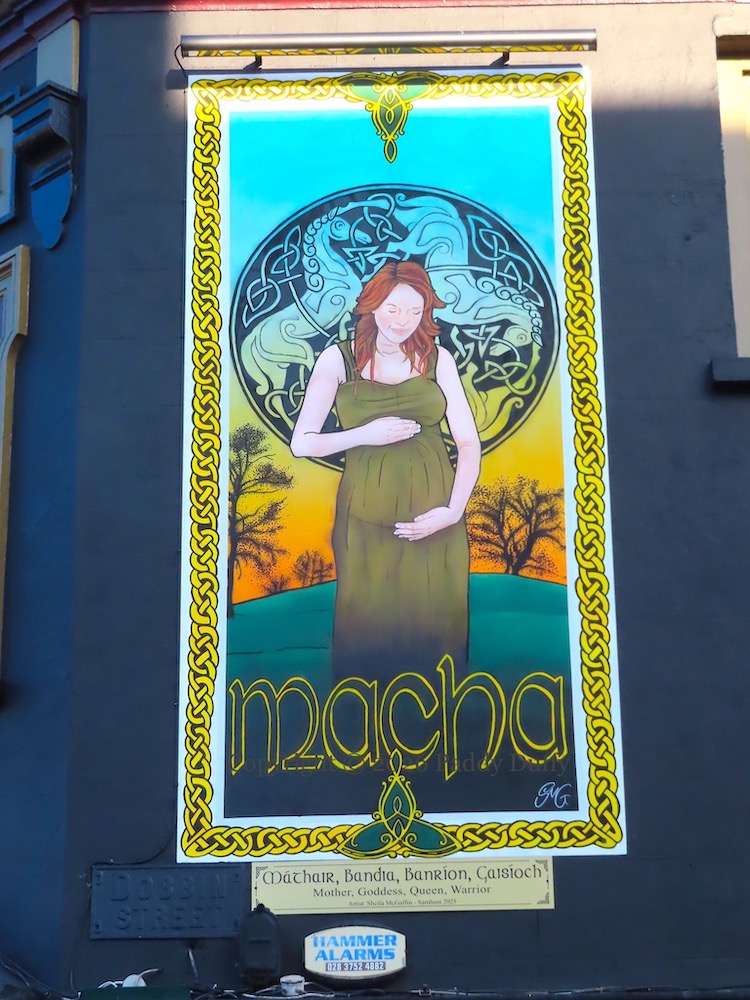
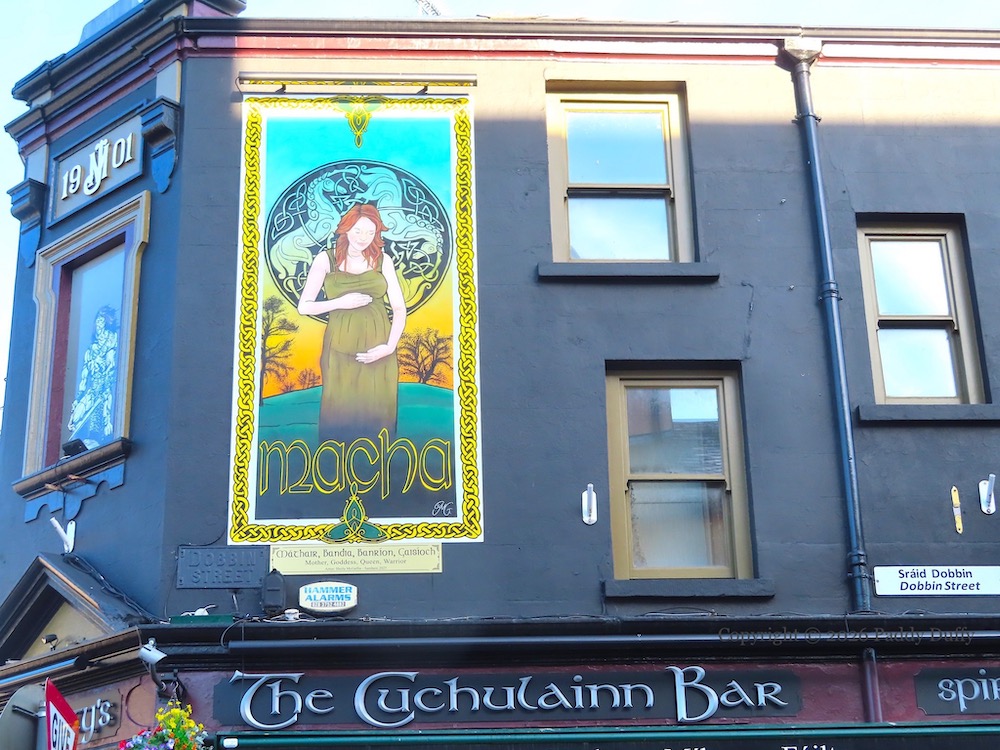
“Macha – máthaır, bandıa, banríon, gaıs[c]íoch/mother, goddess, queen, warrior.” Armagh is named after Macha, who is shown here pregnant against knot-work of three interwoven horses. In one story about Macha, she wins a race against the horses of Connor, the king of Ulster, even though she is pregnant. The race caused her to give birth and she cursed the men of the Red Branch for nine generations, which would leave them all – except for Cú Chulaınn – unable to fight to the forces of Medb (Visual History).
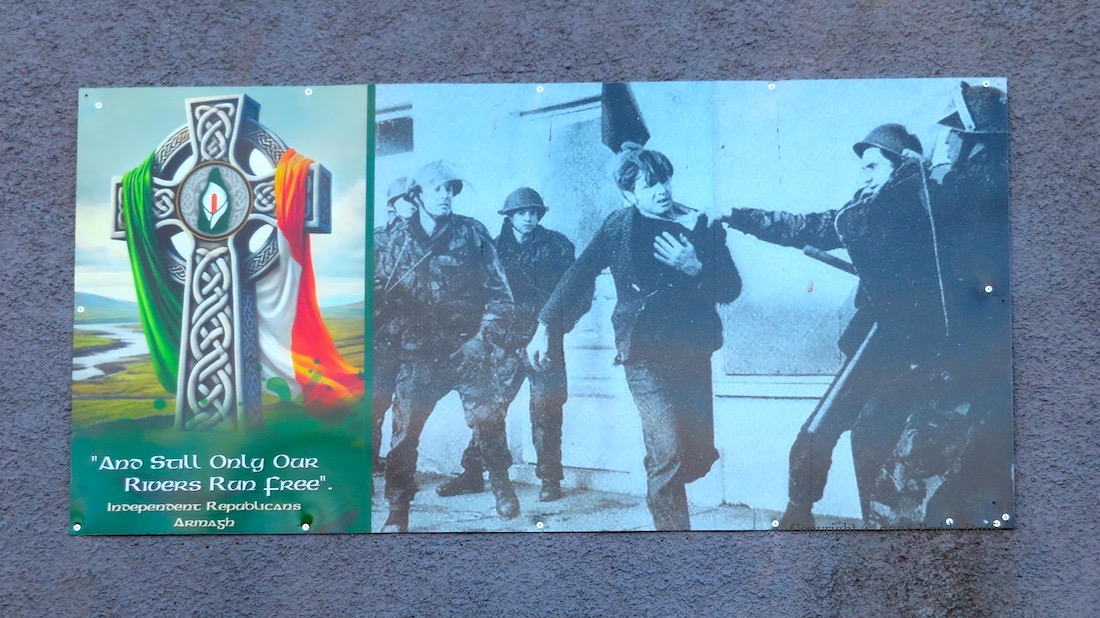
The photograph on the right is real: it shows British troops collaring a civilian in Coalisland in December 1971 – photographer unknown. The image on the left – a Celtic cross draped with a Tricolour – is AI slop. The first (or at least, an early and prominent) use of AI to produce images was Stop The Slaughter In Gaza from November 2023, and it is becoming more frequent in printed boards and wall-painting.
“”And still only our rivers run free” [youtube] – Independent Republicans Armagh [Fb]”
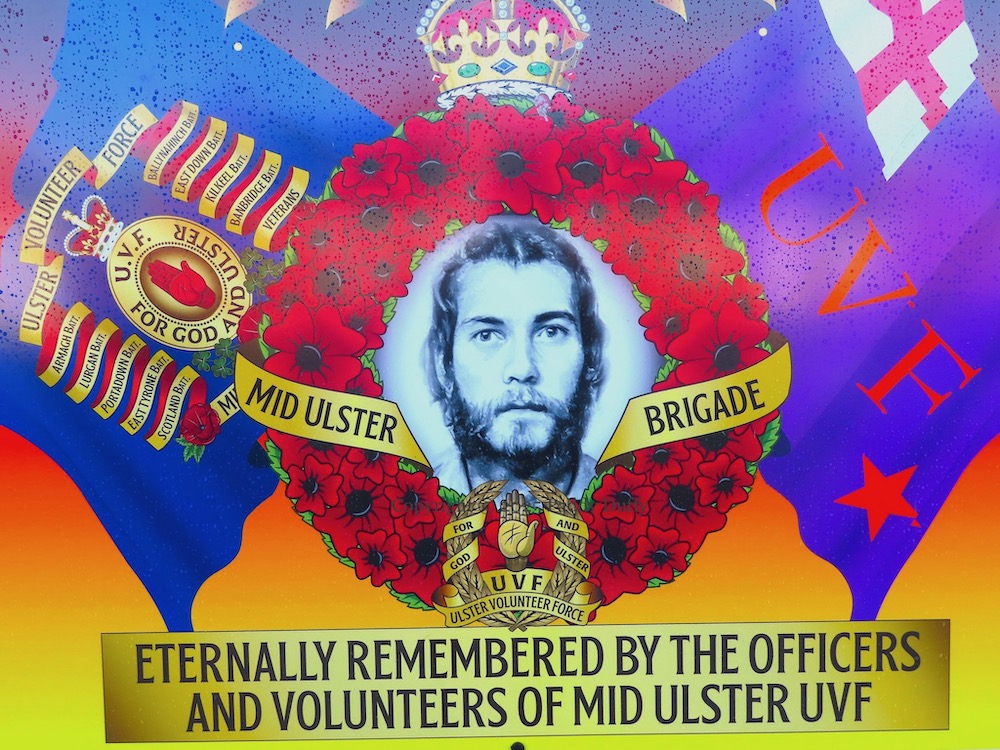
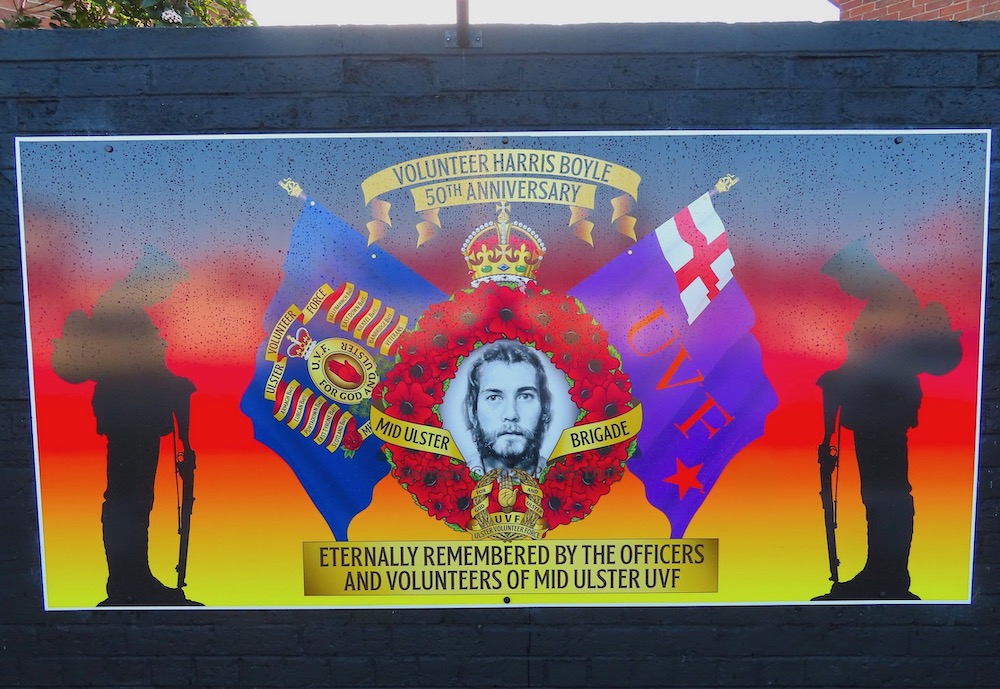
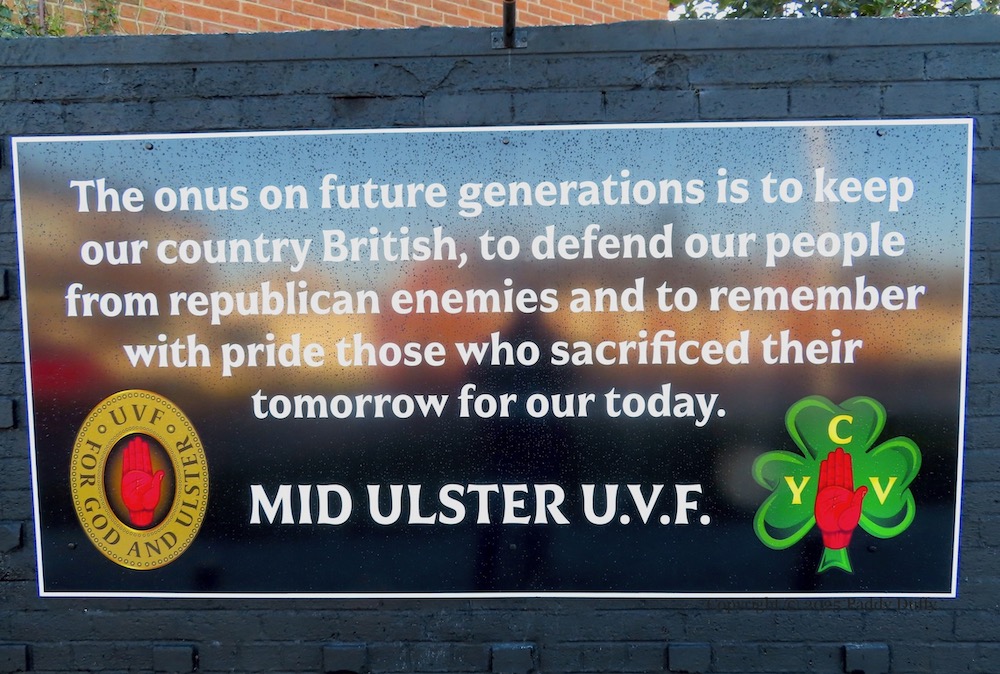
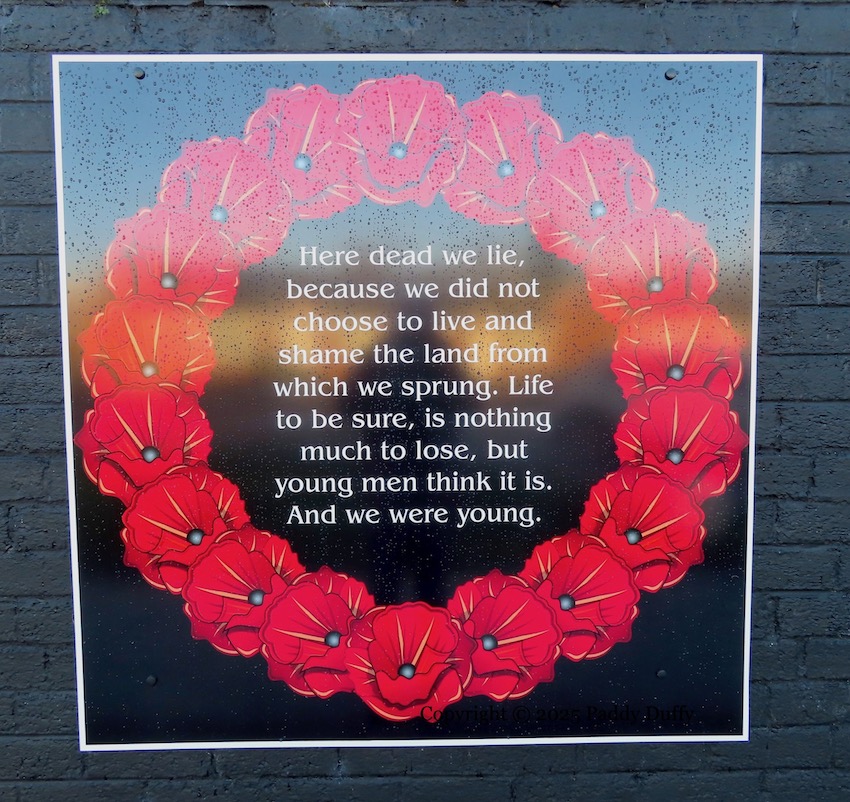
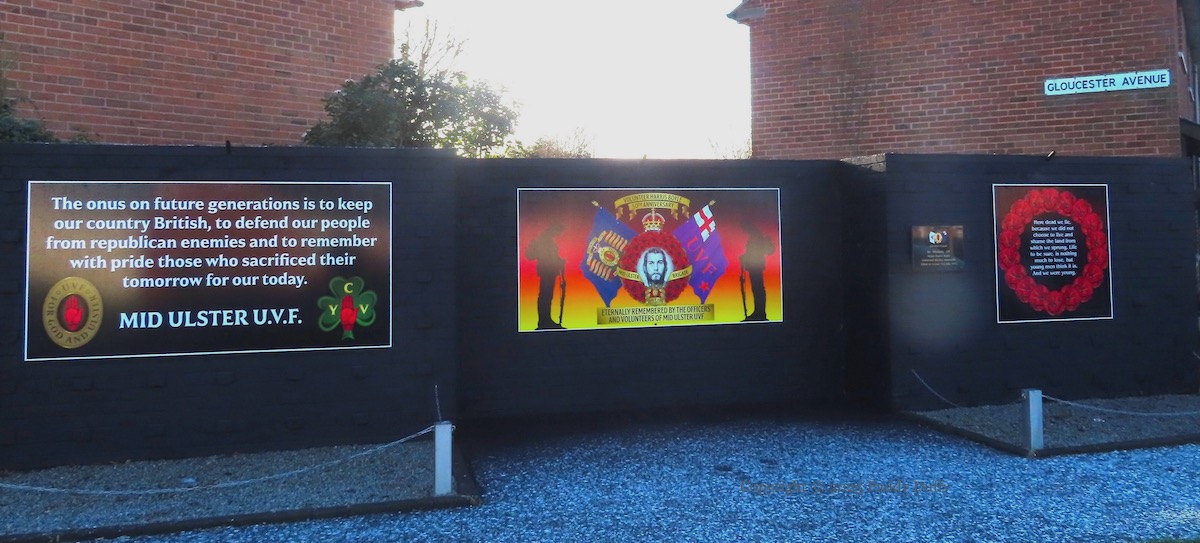
This entry updates 2024’s Here Dead We Lie – the plaque to Boyle and Somerville remains as before (it was originally mounted in 2005) but all three of the boards have been updated. The two on the extremes have the same content as before, while the central board marks the “50th anniversary” of the death of “Volunteer Harris Boyle”, “eternally remembered by the officers and volunteers of Mid-Ulster UVF”. Both Boyle and Somerville were members of both the UDR and UVF; they were “killed in action” when the bomb they were planting on the minibus of the Miami Showband went off prematurely. A parade in Boye’s memory took place in Portadown (BBC). Surviving Showband members and their sympathisers also marked the anniversary – on July 31st, 2025 – with a service at the spot of the attack (BBC).
The boards are at the junction of Gloucester Avenue and Princess Way in Portadown – Boyle was from the Killicomaine estate; Somerville is individually commemorated in Moygashel.



 Paddy Duffy Collection