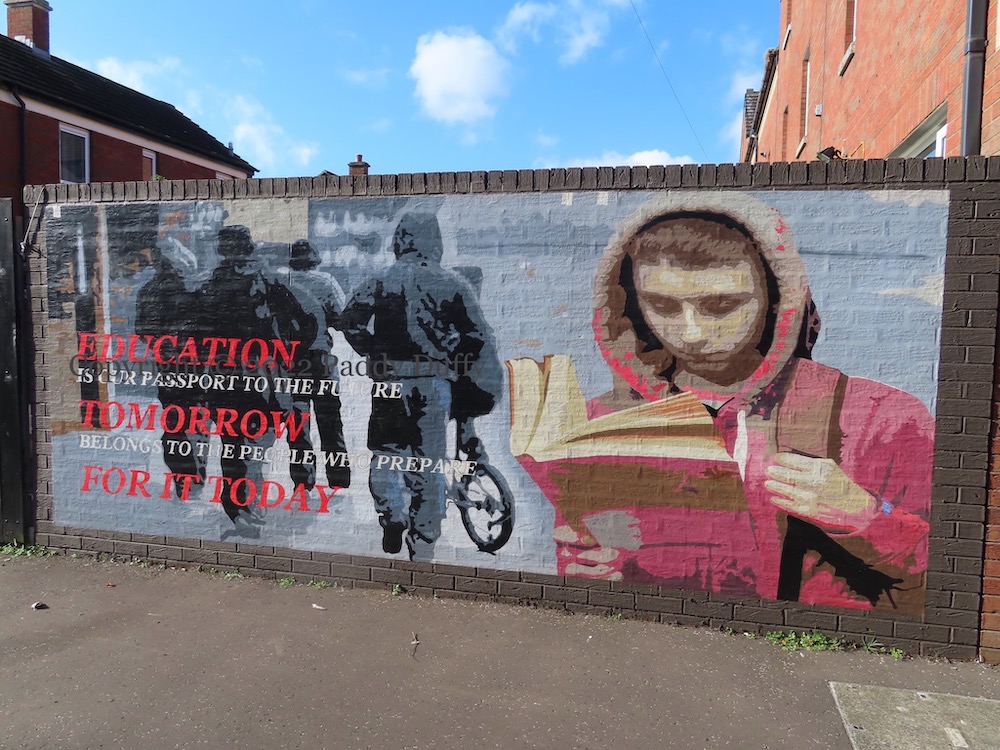
“Education is our passport to the future. Tomorrow belongs to the people who prepare for it today.” This mural, which promotes education over gangs, joins various UVF murals in Pine Street, Donegall Pass – see Death’s Parade Ground and .
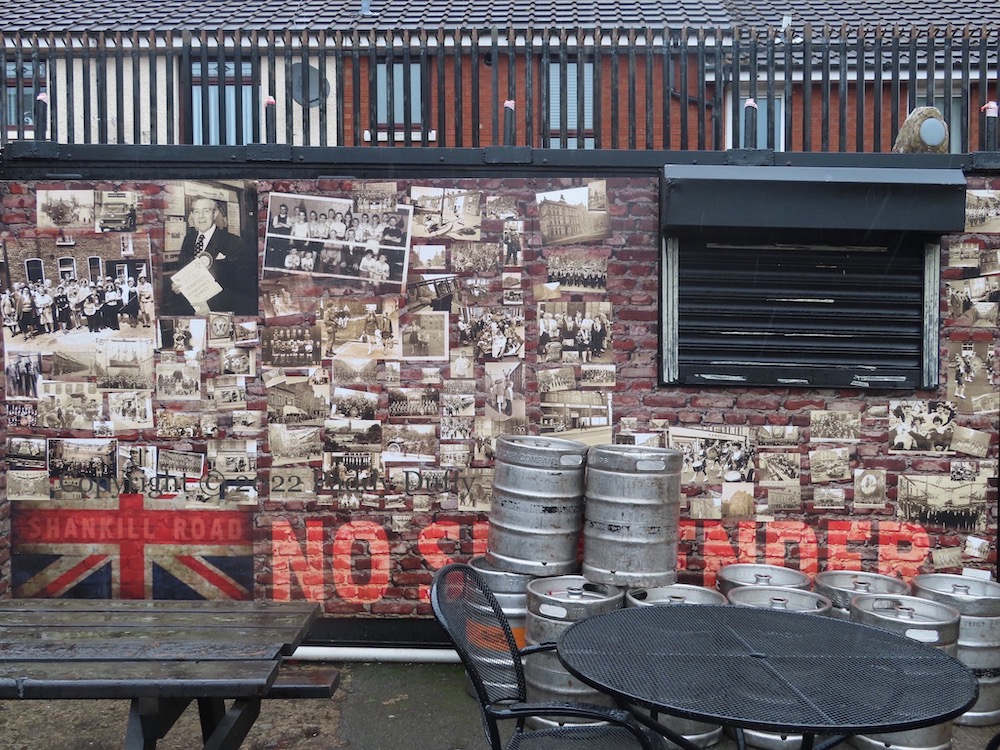
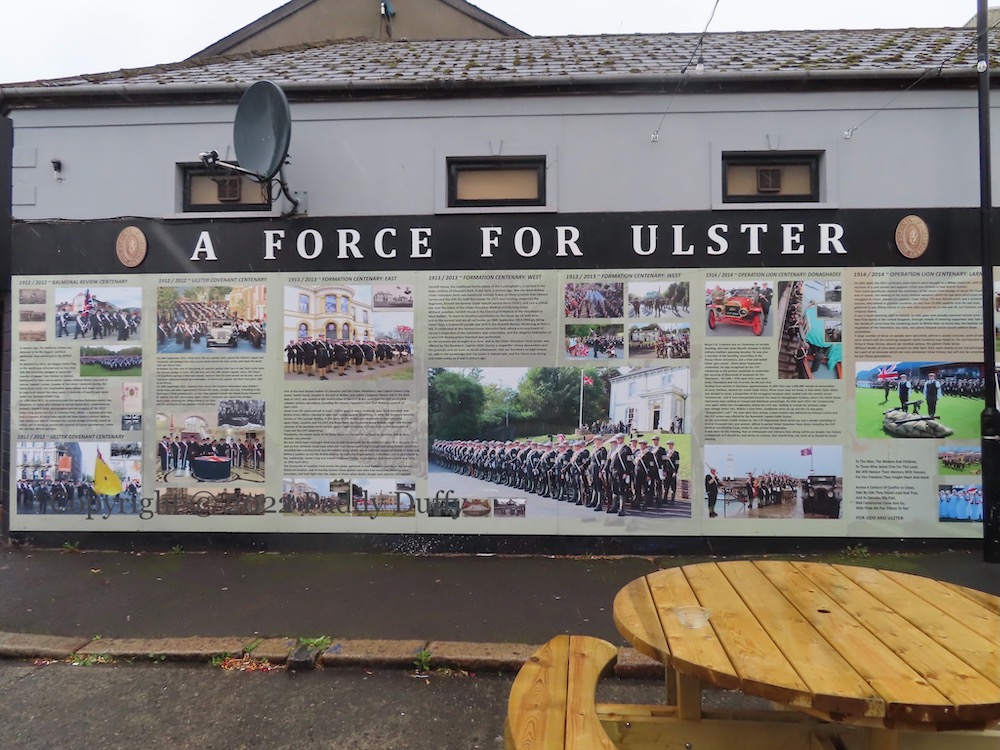
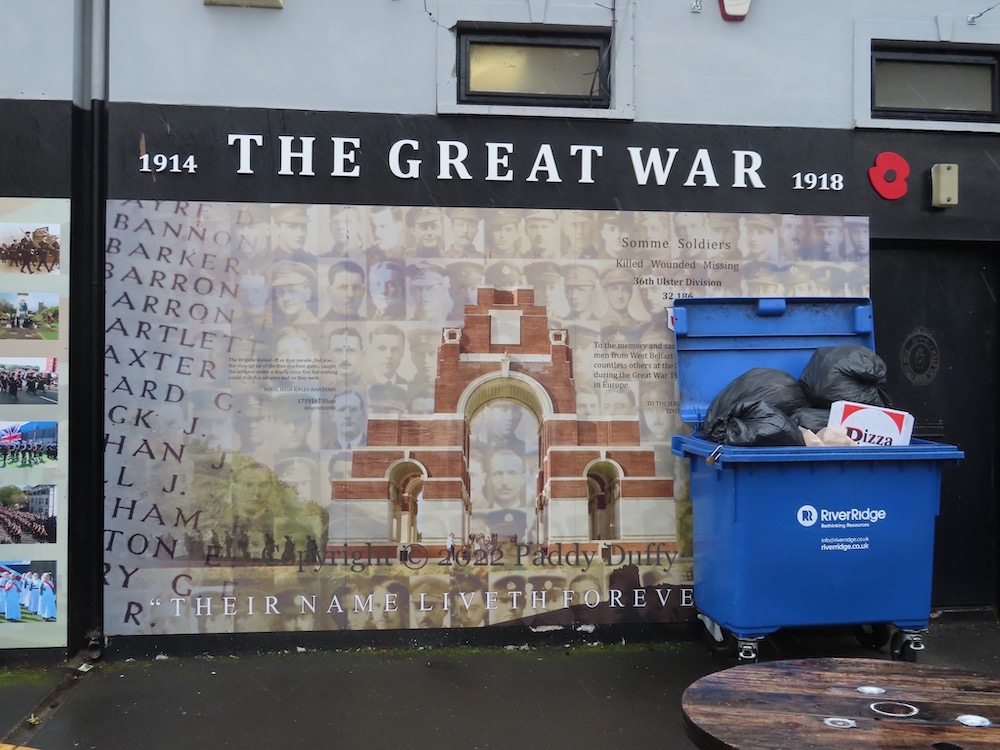
This is the scene at the Rex Bar at (the old) Moscow Street on the Shankill, including, below, three boards describing the formation of the Ulster Volunteers (‘A Force For Ulster’) and using the Thiepval Memorial To The Missing Of The Somme against a background of portraits to commemorate the losses suffered by the 36th (Ulster) Division of the British Army, which the Volunteers became, at the Somme and in other battles, mowed down by “the Hun machine guns” (‘The Great War’). 32,186 men from west Belfast were killed, wounded, or missing. “To them bravery was without limit, to us memory is without end”.
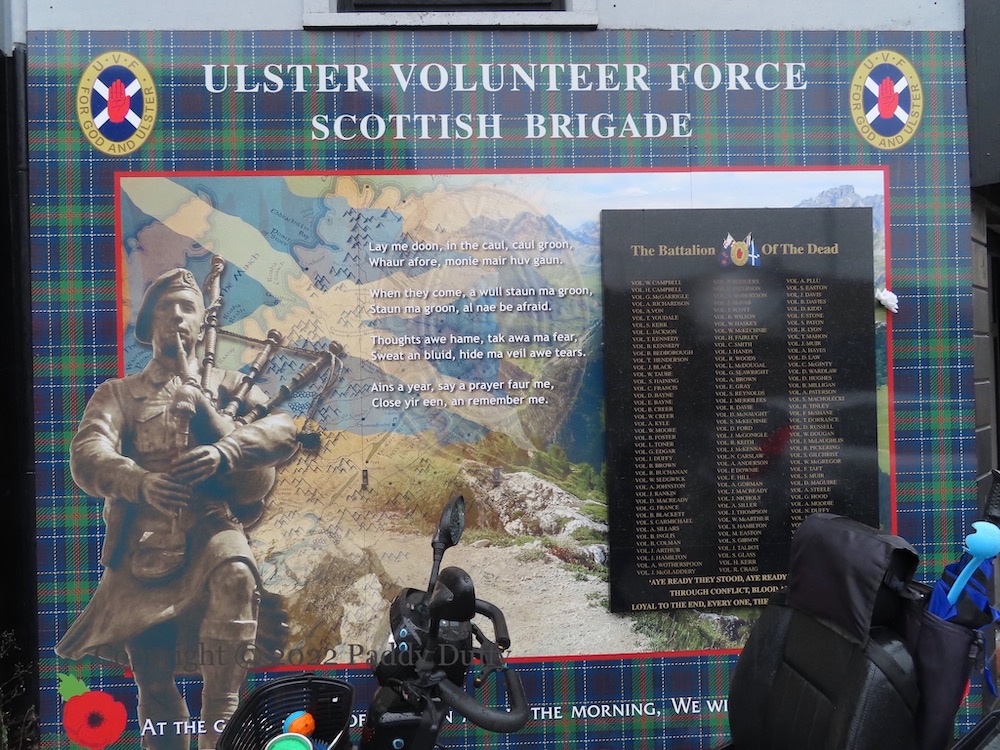
On the Shankill proper (at the newly-christened “Scots Corner”) is a board and plaque to the UVF’s “Scottish Brigade”: “Aye ready they stood, aye ready they fought, through conflict, blood and tears, loyal to the end, every one, the Scottish volunteers.” “Aye ready” was the motto of the 59th Scinde Rifles of the British Indian Army (and later of the Canadian Navy) but is best known from the label of Camp Coffee, in which a Highlander was served a cup of Camp by a Sikh servant (nowadays, they both have a cup of their own).
A Scottish soldier plays the pipes over a list of the “Battalion Of The Dead”, Scottish volunteers from the (modern) UVF. The list is led by William “Big Bill” Campbell, who has had a small plaque in his memory at this spot since (at least) 2014. Preacher and DUP politician George Seawright (see A Crown Of Life) is also included – he was born in Glasgow in 1951.
“We in Ulster will tolerate no Sinn Féin but we tell you this – that if, having offered you our help, you are yourselves unable to protect us from the machinations of Sinn Féin, and you won’t take our help; we tell you, we will take the matter into our own hands …. ” A quote from Sir Edward Carson (probably, 12th of July, 1920 rather than 1912 – Treason Felony | RTÉ) replaces the previous “free men” quote (see M03378); the poppies between the emblems in the main panel are also new, as is the plinth the hooded gunmen are standing on, which reads “1912 East Belfast Ulster Volunteer Force” (also, “1981 Gareth Keys 2008″). In other words, the mural has been softened (slightly) by adding historical elements.
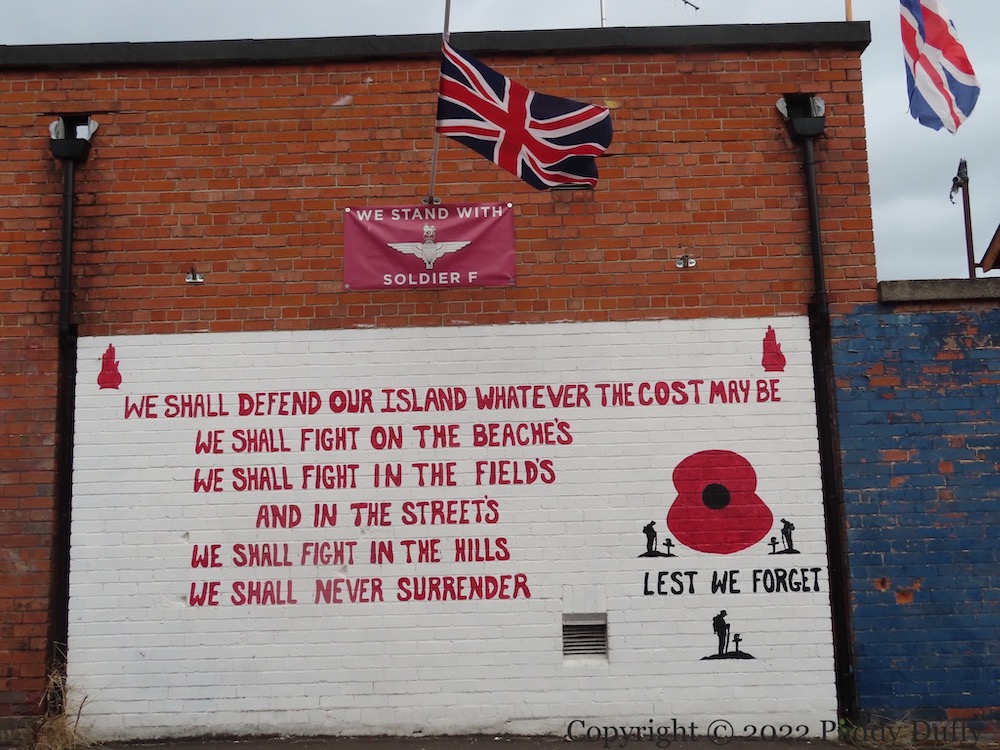
The mural in Castlereagh Parade was repainted for the centenary of the end of WWI, but with some notable differences from the previous version. Three flag-holders have been added above. On the right are now a poppy and mourning soldiers. The quote comes from a speech by Winston Churchill on 1940-06-04 – “We shall defend our island whatever the cost may be. We shall fight on the beaches. [We shall fight on the landing grounds.] We shall fight in the fields and in the streets. We shall fight in the hills. We shall never surrender.” – but the current first line was previously omitted in favour of another Churchill quote: “We have nothing to offer but blood, tears, and sweat.” See: Whatever The Cost May Be.
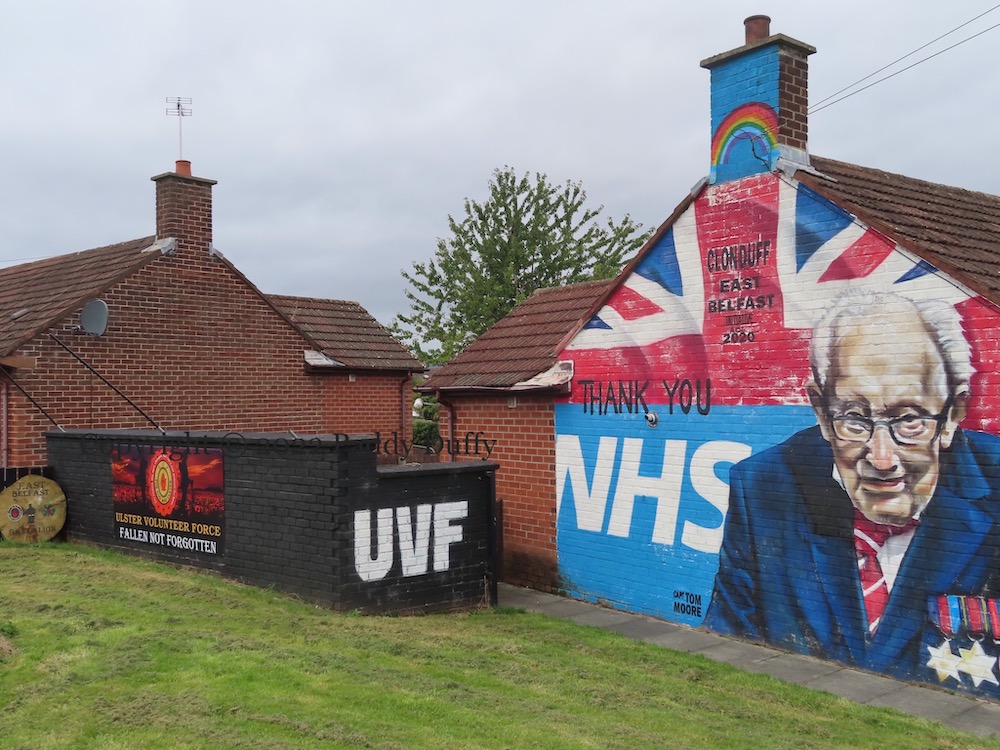
The civic spirit of Bedfordshire’s Captain Tom Moore has been celebrated in murals across the UK, including this one by Blaze FX in Clonduff. Moore attempted to raise funds for the NHS during covid by doing laps around his garden with his walker in advance of his hundredth birthday. He originally aimed at raising 1,000 pounds but ended up raising 30 million after the effort went viral.
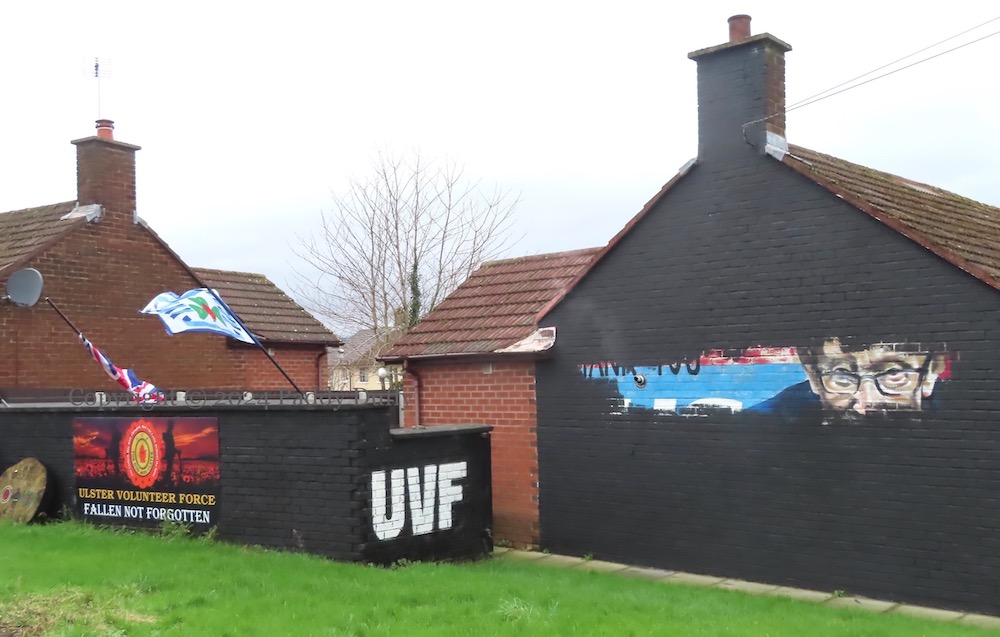
On the left is a tree cross-section (or “tree disk”) (on the left) that has been decorated with a hooded gunman and the insignia of the (east Belfast) UVF and YCV, along with a printed board with “The uniform may have changed but the cause remains the same. Ulster Volunteer Force” around the UVF emblem and “Fallen, not forgotten” below. There is a very close variant of this wording on a mural in Bowtown (Newtownards).
Tullyard Way, Castlereagh
Update, 2024: the mural has been – mostly – blacked out
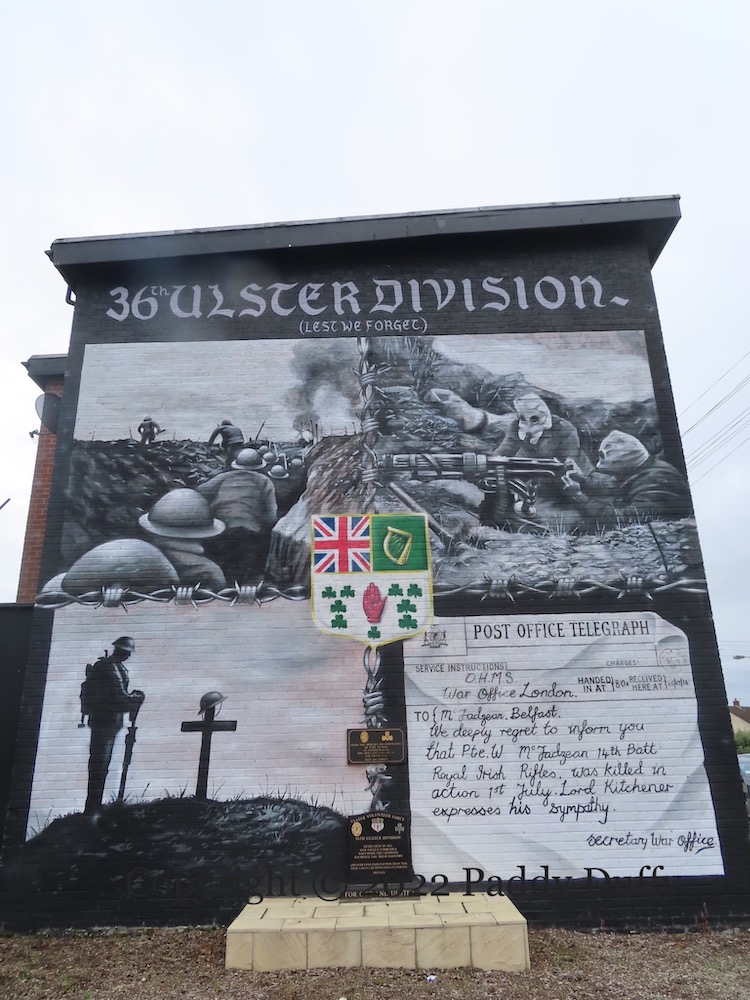
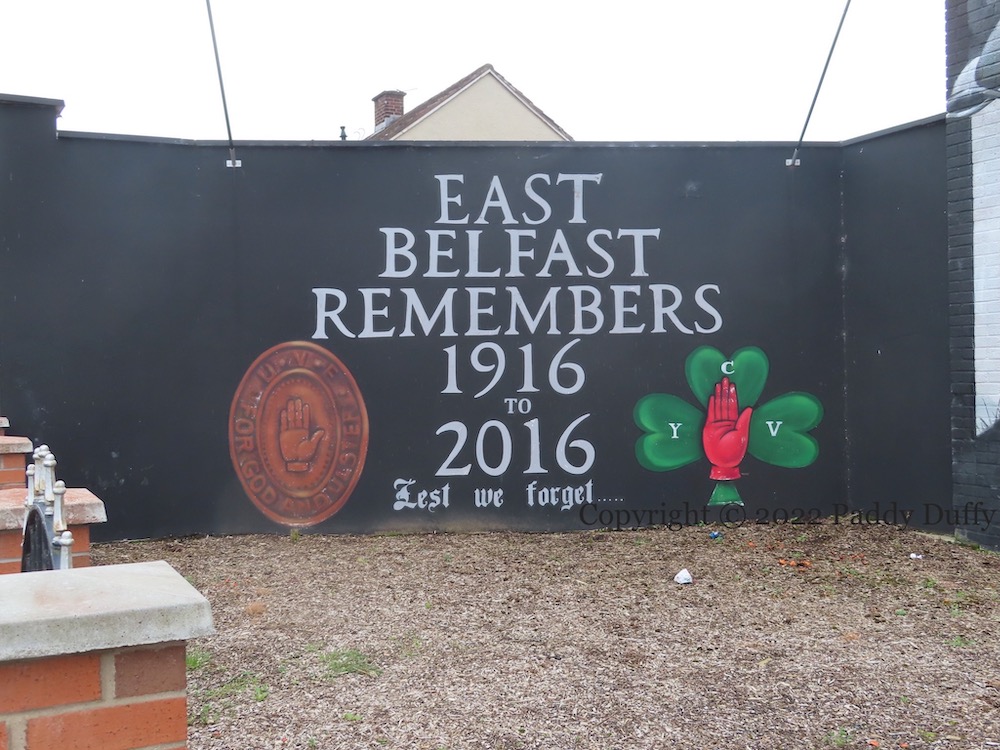
As the plaque indicates, the mural was originally painted in 2006 for the 90th anniversary of the Battle of the Somme. The side wall was painted for the 100th anniversary.
The plaque was originally in the plinth below the headstone – see Killed In Action.
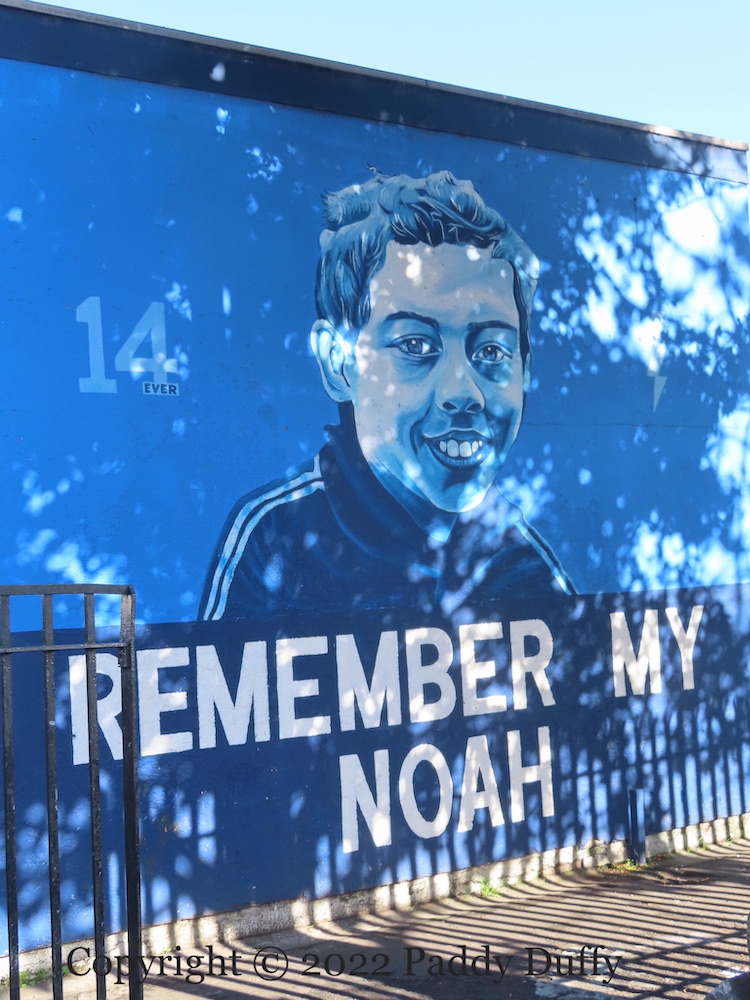
“Remember my Noah.” Noah Donohoe was 14 when he died after disappearing on June 21st, 2020. The mural “14 4 Ever” mural is in the New Lodge, which also has A Heart In A Heart.
Left: “The Annals of the Four Masters record that in 665 AD, the Battle of Farset (Belfast) took place between the County Down Dal Fiatach, self styled Ulaid, and the Pretani or Cruthin where Cathasach, son of Laircine, was slain. This was an attempt by the Dal Fiatach to encroach on the Curtain territory of Trian Congail. The “third of Congal”, which encompassed territory on both sides of the Lagan, corresponding more to less to Uppers and Lower Clandeboye, including modern Belfast. Cathasach was Congal’s grandson. The battle was the first mention of Belfast in Irish history.”
The battle scene shown is Jim Fitzpatrick’s vision of the battle of Moira (in 637), rather than “Bellum Fertsi”. The salience of this description of intra-Ulster fighting is that there is a contention that the Cruthin were Scots (Picts) thus allowing for the idea (employed especially by the UDA – see Ulster’s Defenders and Defender Of Ulster From Irish Attacks) that present-day northern Protestants have a heritage, and a history of fighting for what is roughly Co. Antrim, that pre-dates the plantations. For more information and a similar board, featuring the tower blocks of Rathcoole rather than Cuchulainn and the Battle of Moira, see Kingdom Of The Pretani. For the debate over a connection to the Picts, see WP.
The Annals date back to the 1630s though they mostly comprise a variety of earlier sources.
The image of the gentleman with the sword appears to be a stock fantasy image, used for at least two characters in Game Of Thrones fandom (Rhaegon Targaryen and Lord Cameron Umber).
Middle: 2021 was the centenary of the creation of Northern Ireland and the year in which Scottish football club Glasgow Rangers won their 55th league title. Support for the club is widespread among the PUL community in Northern Ireland; local soccer and the international team is overseen by the IFA.
Right: “Centenary of cultural expression 1921-2021. Sons Of Belfast LOL 743. Castleton Temperance LOL 867. The Memorial LOL 1197. Belfast Harbour LOL 1883. The Coote Memorial LOL 1921. Cave Hill Temperance LOL 1956.”
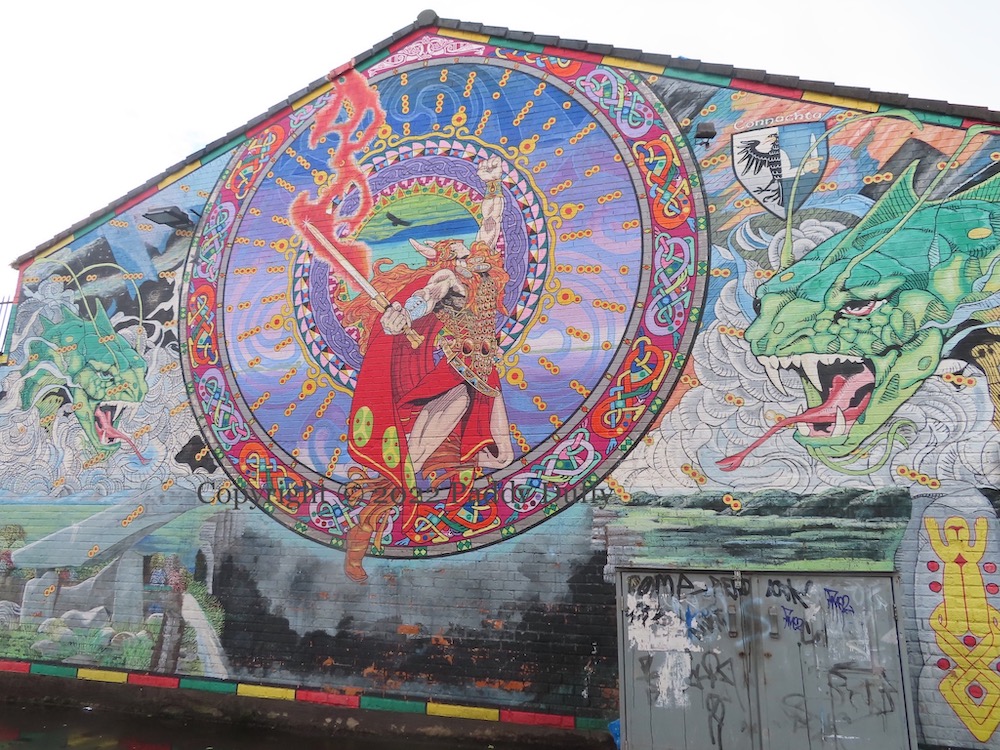
Gerard ‘Mo Chara’ Kelly first painted a mural of King Nuada in 1987, a year after being released from Long Kesh. He reproduced an illustration by Jim Fitzpatrick on a gable wall in Springhill (see images from 1987 | 1988 | 1989). This post-peace version is on the side-wall of the Whiterock Road Spar and was painted as statement of Kelly’s own rebirth after ceasing to work with funding agencies such as the Upper Springfield Development Trust.
Thomas Ashe was working as an Irish teacher in Dublin when he joined the Irish Volunteers and in 1916 served as a battalion commander in the Easter Rising, for which he was sentenced to penal servitude for life. He went on hunger strike in May 1917 and again in September when he was rearrested by the British authorities for a “seditious” speech. He died on September 25th, one hundred years ago, becoming “an chéad staılceoır ocraıs a maraíodh san 20ú haoıs” (“first hunger striker to die in the 20th century”).
In the five circles around his portrait are Countess Markievicz, Pádraig Pearse, and James Connolly – fellow fighters in the Rising – and (in the bottom left) Máırtín Ó Cadhaın (author of Cré na Cılle and IRA member interned during WWII), and the symbol of Laochra Loch Lao and more generally of An Ceathrú Gaeltachta/Gaeltacht Quarter (see previously The Big Plan and Onwards). In the middle is a march from An Dream Dearg in support of Acht Na Gaeılge (an Irish language Act) past the Bobby Sands mural on Sevastopol Street.