“Serving the community for over fifty years.” BTCIC is the current name for what was previously the West Belfast Taxi Association. Black taxis have been running up and down the Falls since 1970, providing an alternative form of transportation to local people during the Troubles when buses were cancelled or, as in this picture, burnt out and used as barricades. They now, in addition, provide tours of the murals (such as the Bobby Sands mural in Sevastopol Street) and Belfast city. Taxi Trax has a web site but here provides a phone number for those already at the International Wall, where there has been a black taxi mural since 2003. There are other WBTA murals in Beechmount and Ardoyne. The painters have signed the mural: Doherty’s Coal Merchant and Lyons Tea.
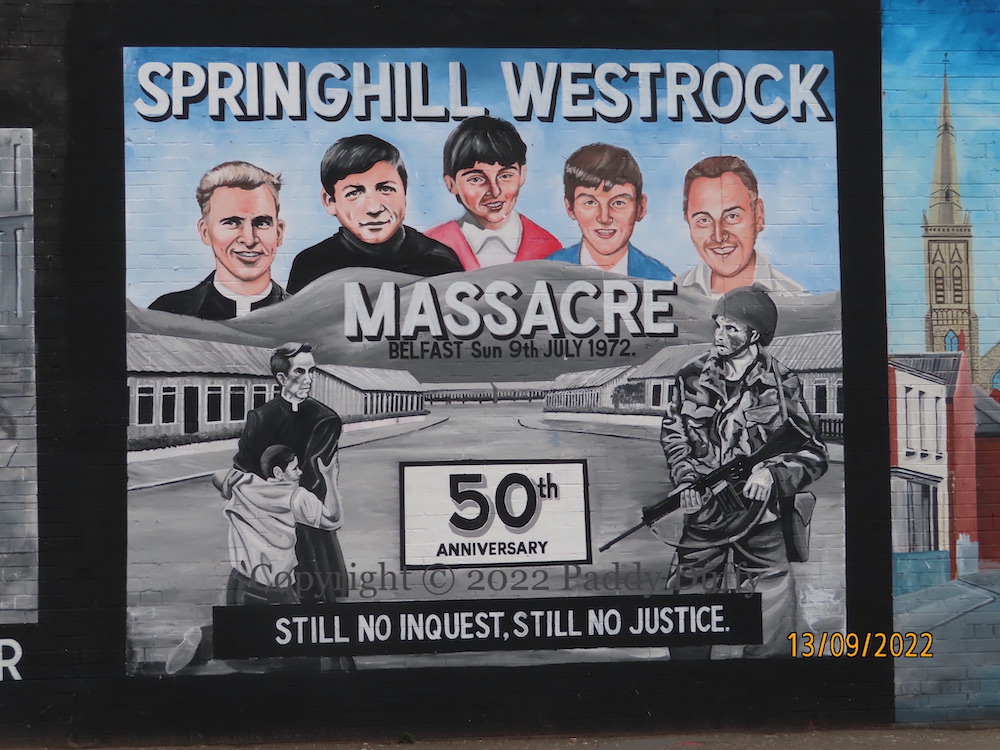
A march took place on July 9th, 2022, to mark the 50th anniversary of the Springhill-Westrock massacre, in which five people were killed by the British Army. A new inquest was directed by the AG in 2014 but has been repeatedly delayed; it is scheduled to begin next year (Belfast Live).
The march was organised by the Springhill-Westrock Campaign (Fb | tw); it began at the memorial plaque in Springhill and ended at the memorial garden in Westrock (Irish News). See also Keep On Praying.
The mural shows the pre-fab aluminium bungalows built in Westrock in 1949.
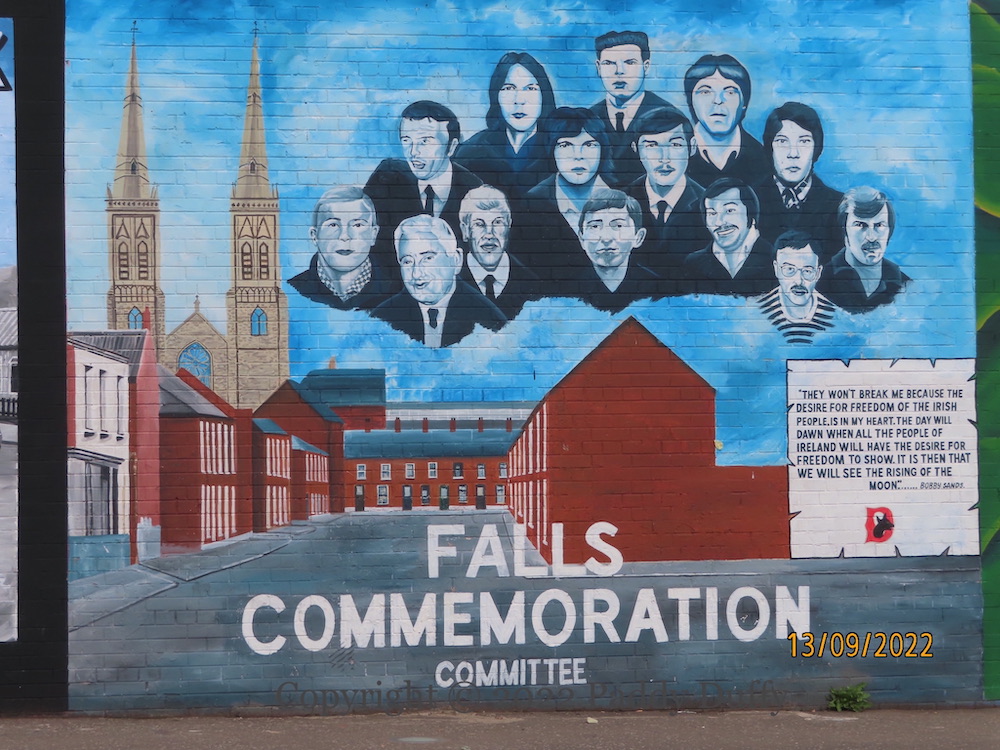
The Falls Commemoration Committee (Fb) organises an annual commemoration for IRA D company volunteers from Divis and the lower Falls (as well as special events for the fiftieth anniversary of the Falls Curfew in 2020). The fourteen local volunteers are portrayed in a group above St Peter’s. They include the five volunteers who died in 1972 and were depicted in a mural previously at this spot.
“‘They won’t break me because the desire for [freedom and the] freedom of the Irish people is in my heart. The day will dawn when all the people of Ireland will have the desire for freedom to show. It is then that we will see the rising of the moon’ – Bobby Sands [March 17th, 1981]” Originally in Irish: “Ní bhrısfıdh sıad mé mar tá an fonn saoırse, agus saoırse mhuıntır na hÉıreann, ı mo chroí. Tıocfaıdh lá éıgın nuaır a bheıdh an fonn saoırse seo le taıspeáınt ag daoıne go léır na hÉıreann. Ansın tchífıdh [chífidh] muıd éırí na gealaí.”
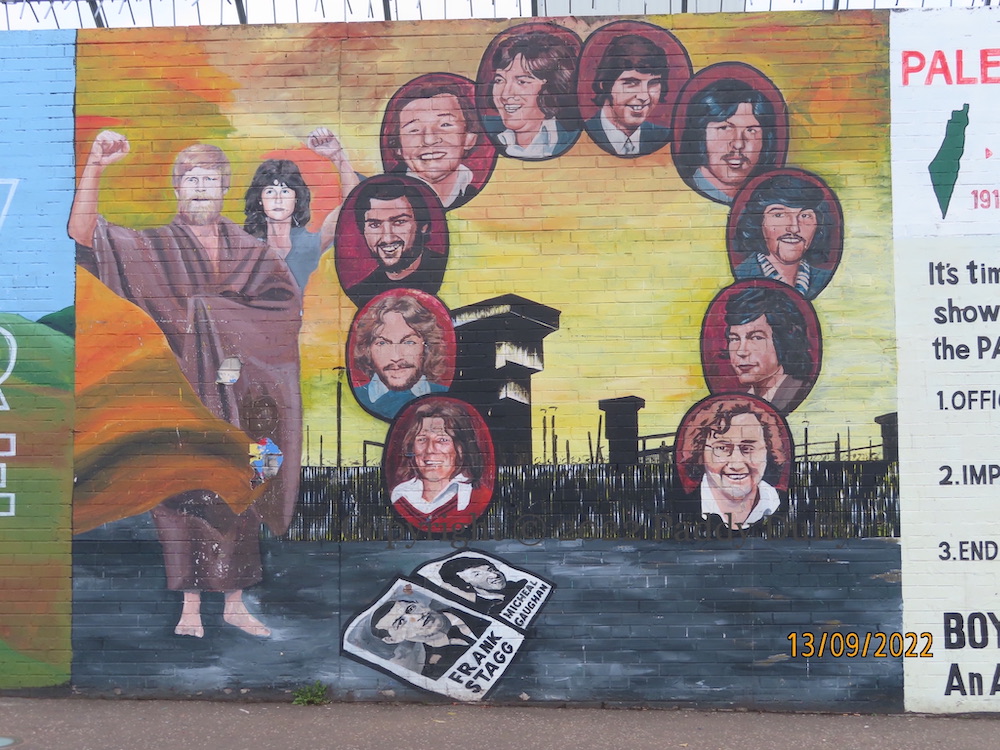
In 2014, after the Nugent/Hughes mural at the corner of Divis and Northumberland Streets (see Belfast’s Infamous Prison) was painted out to make way for a pro-Catalonia vote mural (see Votes About Votes), Kieran Nugent was added to the hunger-strikers mural further down the international wall, along with Mairéad Farrell, who was the second person, after Nugent, to refuse to wear a prison uniform. In 2016, that mural was revised for the Easter Rising centenary, by painting Kilmainham jail in the background. This background was later changed (c. 2019) to the watch-towers of Long Kesh, as shown above.
“Am le haontacht na hÉıreann” [Time for Irish unity]. Between stints in prison in 1976, Bobby Sands carried a green harp flag – symbol of Ireland and in particular of the United Irishmen – in an August march to protest the withdrawal of political status (Gérard Harlay/Bobby Sands Trust). He is shown here marching under the #TimeForUnity message on Slıabh Dubh in the campaign for a border poll and Irish unity “lenár lınn”/”in our time” (Fb | tw).
The Great March Of Return was a six-week protest by Palestinians in Gaza. Most protestors at the border fence with Israel were non-violent but there are reports of some with rocks, burning tyres, Molotov cocktails on a kite, and an AK-47 (WP). It ended (officially – incidents have continued) on May 15th, Nakba Day, the “day of the catastrophe”, meaning the displacement of Palestinians in the 1948 war. The protest demanded that refugees be allowed to return home – there are 1.1 million living in Gaza. During the protest more than 100 Palestinians died, many by live fire by Israeli forces, and more than 13,000 were injured. According to the mural above, “It’s time the Irish Government show some humanity and act for the Palestinian people. 1. Officially recognise the state of Palestine. 2. Impose economic sanctions on Israel. 3. End all diplomatic ties with the apartheid state. Boycott Israel, an apartheid state.”
The wheelchair protester shown on the right is double amputee Saber Al-Ashkar. He has not, however, been reported dead, as the text below the image (and reports on Twitter and elsewhere) suggests: “They took his land, his legs, and finally his life.” The death might refer to another such protestor Fadi Abu Salah, who was killed in May (Alaraby) (or Ibrahim Abu Thuraya, who was shot in December 2017 – Independent obituary). The UN Commissioner for Human Rights called the killing “incomprehensible” (Guardian); an internal IDF investigation found that Abu Thuraya was not shot by Israeli snipers (Times Of Israel).
The mural was was originally painted without the carton of Cookie Dough ice-cream in Al-Ashkar’s sling. Vermont-based ice-cream maker Ben & Jerry’s announced that it would no longer sell its products in the Occupied Palestinian Territory which it says is subject to an “internationally recognised illegal occupation”. In response, Israel threatened parent company Unilever with “extreme consequences” (Reuters).
Before playing in the Falls Park as part of Féıle in August, Irish-language rap group Kneecap (web) revealed a mural in Hawthorn Street showing a PSNI land-rover on fire next to the phrase “Níl fáılte roımh an RUC [The RUC is not welcome]”.
Outraged responses to the mural have come from all quarters. The line comes from their song C.E.A.R.T.A. (youtube), about making sure the police don’t find the satirically enormous array of drugs – “cóc, speed, Es, agus moll marıjuana” to name only a few – they hope to take at a party: “Seans ar bıth go bhfaıghıdh sıad mo mhála MD/Mar tá cóısır ann anocht ‘s níl fáılte roımh an RUC”.
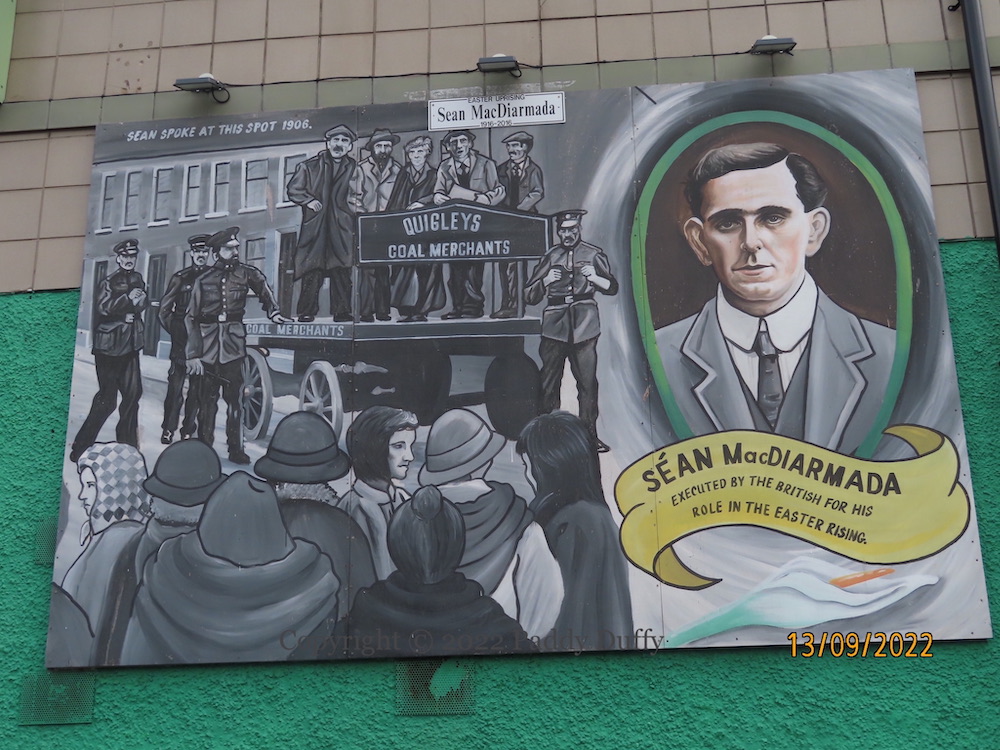
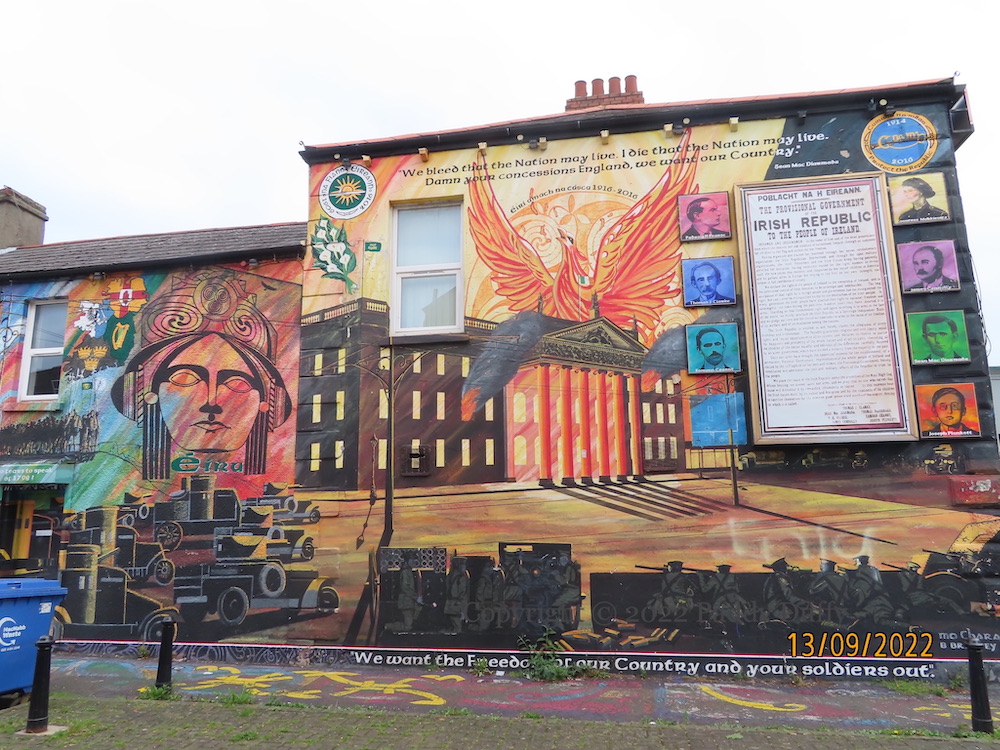
Seán Mac Dıarmada was born in Leitrim, left for Glasgow at age 15, but after two years returned to Belfast in 1905 (working on the trams) and – according to the new mural above – spoke from the back of a coal lorry in Clonard Street, outside the Clonard branch of the Ancient Order Of Hibernians. Mac Dıarmada was for a short time an AOH member, before moving on to the Irish Republican Brotherhood and Irish Volunteers, which led to his participation in the 1916 Easter Rising and execution on May 12th of that year.
The title of this post is historian F.X. Martin’s assessment of Mac Dıarmada, quoted in a pamphlet on Mac Dıarmada from the National Library Of Ireland, which includes reproductions of letters from and about Mac Dıarmada. The NLI made more letters available today (2016-02-08). (See also this Irish Times write-up).
Arrayed against the forces of the British Army (which are shown in armoured cars and in sniping positions in the foreground of the mural, along the whole length of the wall) are various symbols of Irish nationalism: Oliver Sheppard‘s 1911 statue of Cú Chulaınn dying; the pikemen of the 1798 Rebellion (featured yesterday: Éırí Amach 1798); the four provinces of Ireland; Érıu the mythological queen of Ireland/Éıre as designed by Richard J King/Rísteard Ó Cíonga; Easter lilies; the emblems of Na Fıanna Éıreann and Cumann Na mBan on either side of a quote from (The Mainspring) Sean MacDiarmada “We bleed that the nation may live; I die that the nation may live. Damn your concessions, England: we want our country”; a phoenix rising from the flames of the burning Dublin GPO (inspired by Norman Teeling’s 1998 painting The GPO Burns In Dublin); the GPO flying an ‘Irish Republic’ flag; portraits of signatories and other rebels — (left) Padraig H. Pearse, Thomas J Clarke, Eamonn Ceannt, Thomas MacDonagh, (right) Countess Markievicz, James Connolly, Sean MacDiarmada, Thomas Plunkett; the declaration of independence, placed over the advertising box of AA Accountants – see the in-progress shot below. For more work-in-progess images, see yesterday’s post, Éırí Amach 1798. At the very bottom is a quote from the mother of Gerard ‘Mo Chara’ Kelly, Harriet Kelly: “We want the freedom of our country and your soldiers out.”
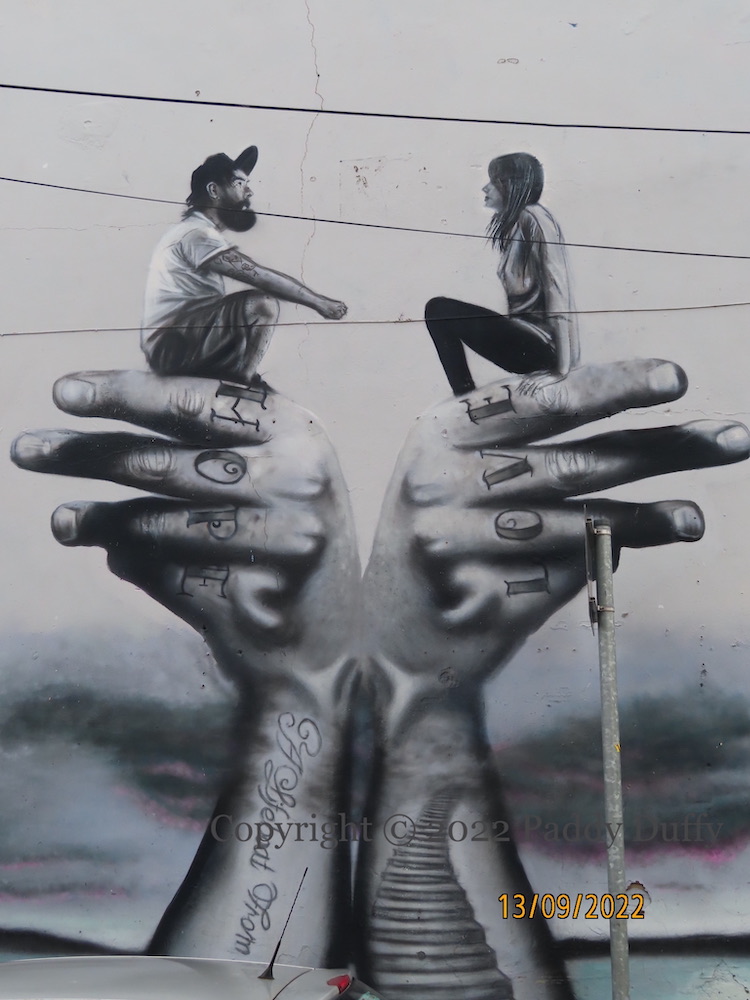
emic (Eoin McGinn Fb | Web |Tw) has been at work on the Falls Road painting a mural for the Suicide Awareness & Support Group. Two figures face each other, seated on the index fingers of hands tattooed with “hope” and “love”.




 Paddy Duffy Collection