Ballyclare Comrades football club – whose motto is ‘Nihil nisi optimi’ [nothing but the best] – was founded in 1919 by members of the local Great War ‘comrades’ association. That heritage is used here for the Ballyclare Protestant Boys flute band. In the centre, between images from WWI, the flowers of the four ‘home nations’ are joined by orange lilies, and in the shield are the lion and the unicorn from the coat of arms of the UK.
“To Flanders fields some men in our town were sent and along their way many would repent their priority goal to keep Ulster free that we may have freedom both you and me as part of Great Britain they fought and died and their names we will remember and remember with pride. Lest we forget. Comrades from Ballyclare. Nihil nisi optimi. The Comrades.” “Ballyclare Protestant Boys Est. 2004”
“When Ulster men are proudly glad of the land where they were born/And when England’s cry for help was heard we told them have no fear/For across the flanders fields we send our Ulster Volunteers.”
These are just a few lines from the song First Of July Morn and are used here to recall how the Ulster Volunteers – formed to fight against the imposition of Home Rule – became the 36th Division in WWI, and suggest that the British government should continue to support the Northern Ireland state beyond its one-hundedth anniversary and the current impasse over the NI Protocol of Brexit as a reward for loyalty.
The song’s alternate titles “England’s Treachery” or “Englishman’s Betrayal” give a better feel for the attitude of the whole thing: that England betrayed Ulster by having “sold away” the three counties of Donegal, Cavan, and Monaghan, and that “Ulster men” should “never more be led away, to fight in foreign lands/Not to die, for someone else’s cause, at an Englishman’s command” (youtube). The application to the current situation would then be that loyalism cannot rely on the good nature of the English and should ready itself for “perfidious Albion” to (try to) give away the six counties as well.
“Ballyclare says no to a Irish Sea border.” “Loyalist Ballyclare will never accept an border in the Irish Sea.” “The Belfast Agreement has been broken – the deal’s off.”
Ballynure Rd/Main Street, Ballyclare, next to The Comrades.
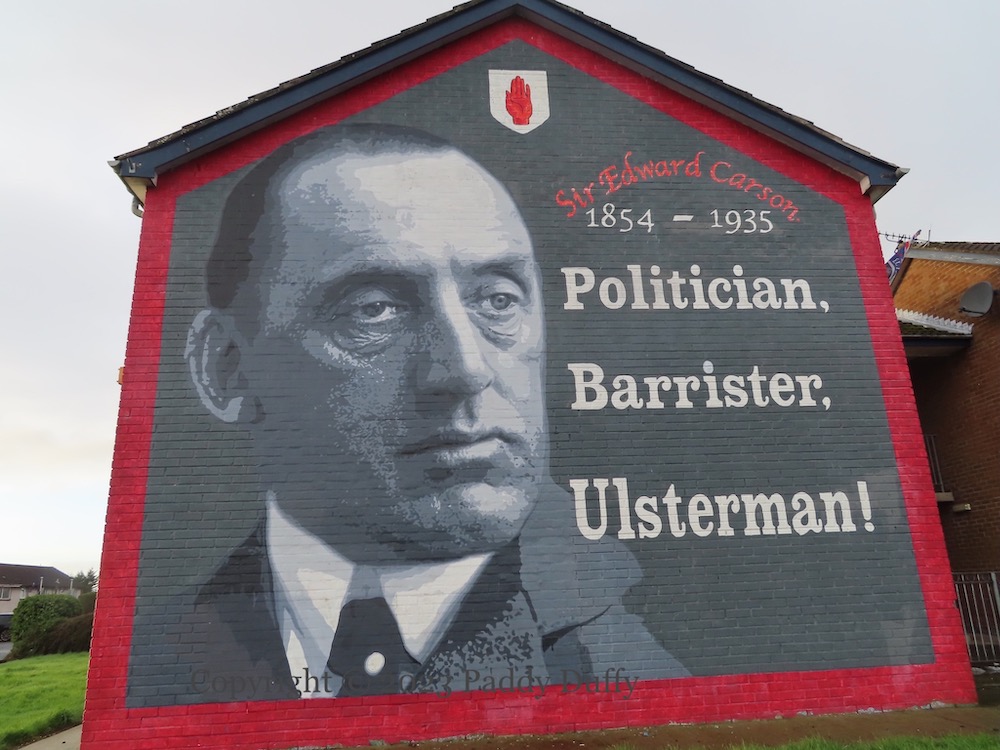
Sir Edward Carson, 1854-1935, was born and raised in Dublin, and practiced law there for many years, but he is most famously associated with the Unionist campaign against Home Rule and the creation of “a Protestant province of Ulster” and eventually the six-county state of Northern Ireland.
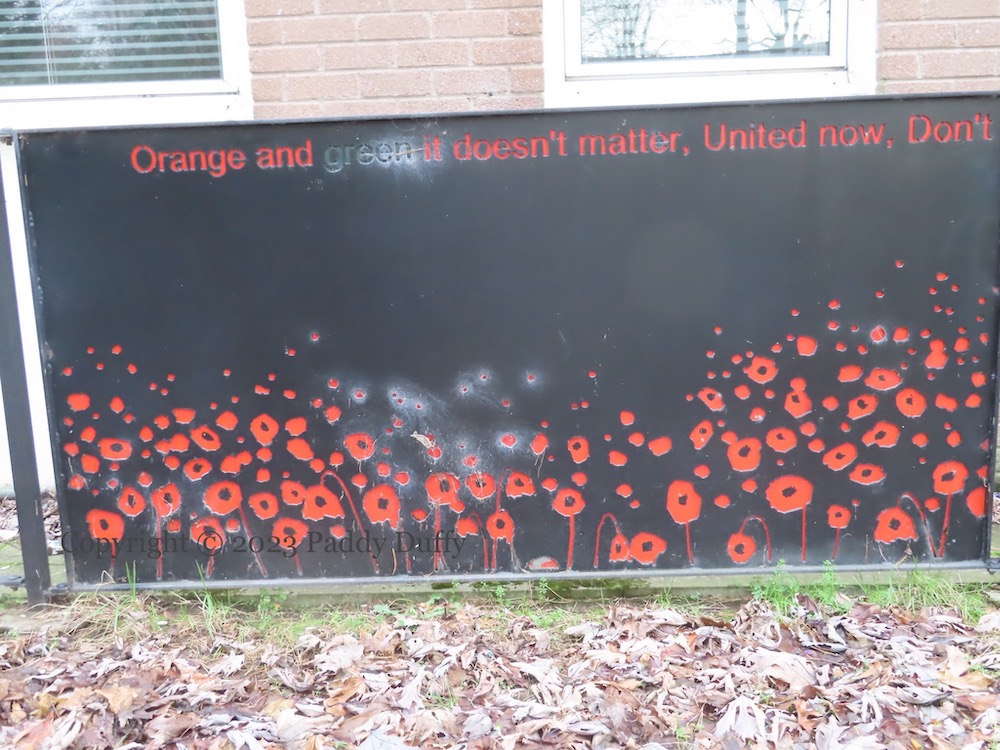
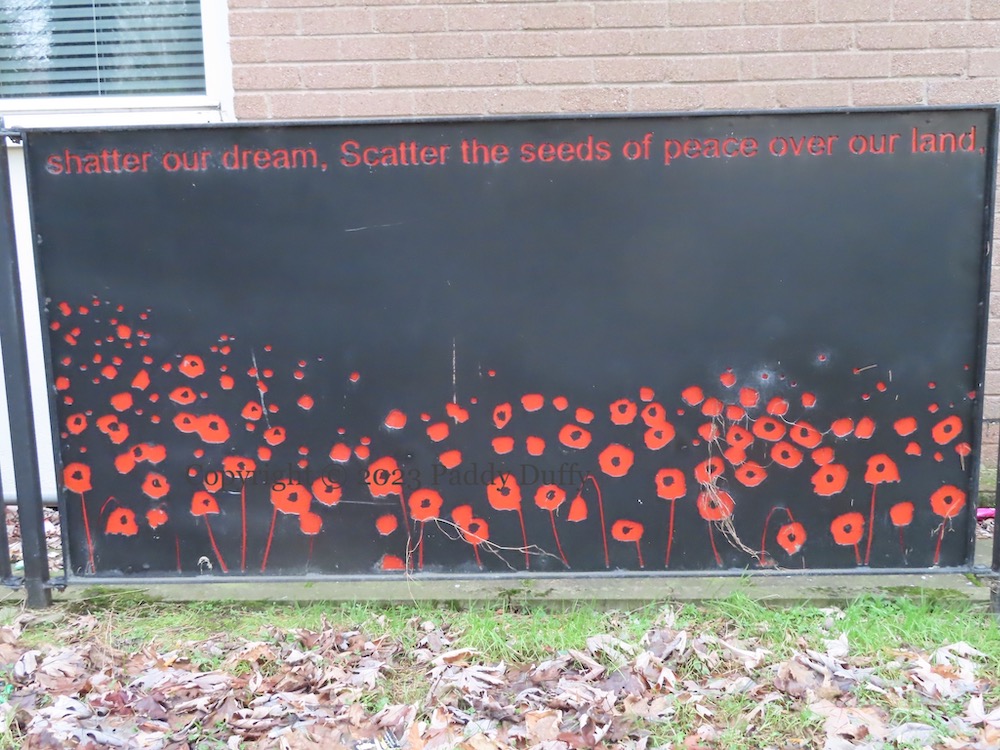
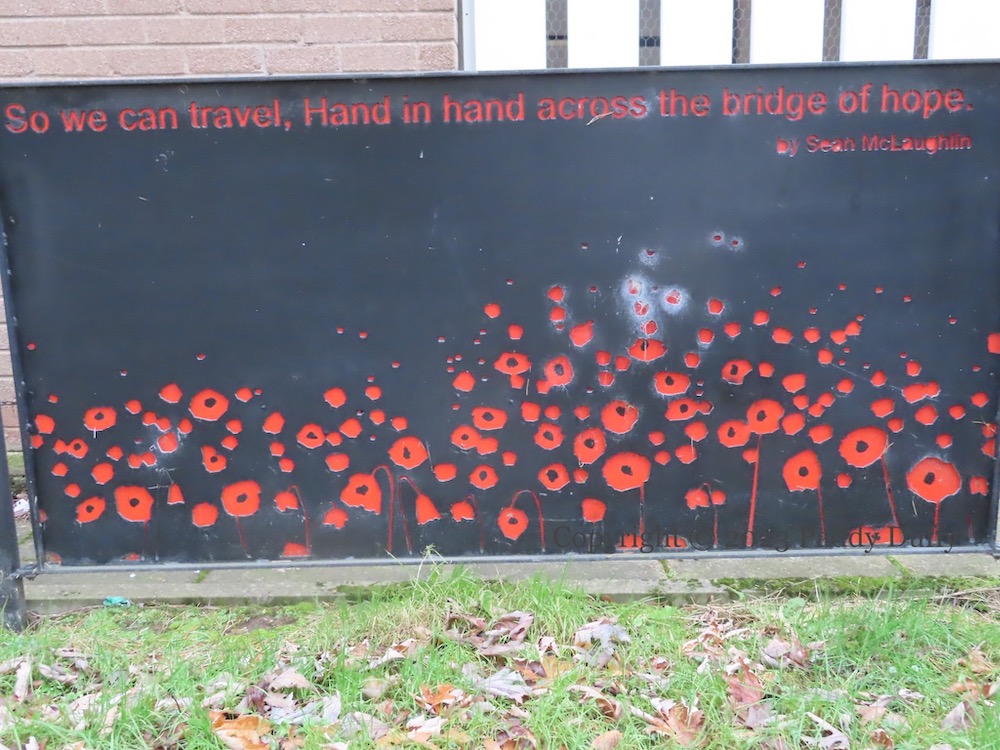
A three-piece stone in the same Tullycarnet garden as the war memorial and peace mural. “Orange and green it doesn’t matter, United now, Don’t shatter our dream, Scatter the seeds of peace over our land, So we can travel, Hand in hand across the bridge of hope.” by Sean McLaughlin, a twelve-year-old who was killed in the Omagh bombing of 1998 (WP). The garden was unveiled June 2010 (IFI).
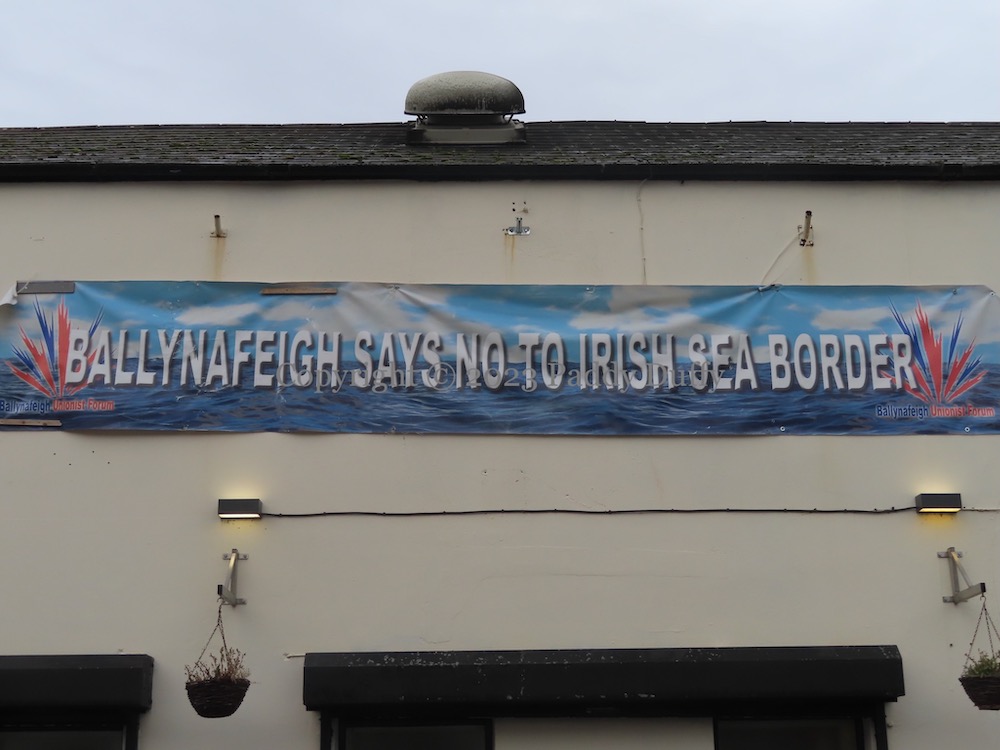
” … to Irish Sea border”. This tarp is on the Walmer Street side of the Ballynafeigh Apprentice Boys flute band’s social club. For the King Billy emblem over the Blackwood Street entrance, see M05390.
Left: After a break for the funeral of the Duke Of Edinburgh, the Loyalist Communities Council has resumed its protest of Brexit with a banner campaign (Irish News). The banner seems to be offering viewers the choice of one of four affiliations (“Europe – UK – USA – Ireland – choose one or the other! It’s your decision!) but the “correct” answer is at the bottom (and in the faded background of the Covenant): “Ulster is British and this we will always maintain!” even though “Political leaders are not listening!” (including, perhaps, Arlene Foster and the DUP.) The Belfast Agreement (Good Friday Agreement) allows people in Northern Ireland to identify themselves as Irish, British, or both.
Right: “Peace or protocol – it’s your decision”, aimed at Leo Varadkar on the day that he again became Taoiseach (Irish Times) and repeating his words back to him from a speech in 2018: “The possibility of a return to violence is very real”. At that meeting, Varadkar was anticipating violence by anti-Agreement republicans in response to customs posts on the Ireland-Northern Ireland border, and brought a newspaper describing the death of four customs officials, two lorry drivers, and three IRA volunteers at a Monaghan post in 1972 (BelTel).
The authors of this poster are not known, but the parallel statement (mutatis mutandis) would be that anti-Protocol agents – perhaps the “young loyalists” that the UVF “can no longer contain” (UK Daily; see also RTÉ from November) – might return to acts of violence such as the 1974 “Dublin & Monaghan Bombings” that killed 33 people – in the background of the poster is part of a photograph (included below) of bomb damage in Talbot Street – if the Protocol’s “Irish Sea border” is not removed.
Ballysillan Road and (below) Oakmount Drive (near Mount Vernon), north Belfast.
Above and immediately below: banners of two Australian Republican support-groups, holding banners reading “Australian Aid for Ireland QLD [Queensland] Branch – The Spirit of Freedom” and “The Casement Support Group – Saoirse Melbourne”.
Fourth, Australian Manufacturing Workers Union (amwu.org.au) sponsored the mural above in Conway Street. Then-secretary Craig Johnston is on the left in the back. The flag to the right is the flag of the Eureka Stockade. It joins others sponsored by Australian groups: A Bunch Of Live Wires (sponsored by the Electrical Trades Union) | Caırde Sınn Féın | Australian Aid For Ireland & Saoırse Melbourne. “Casement Memorial – In proud memory of the 10 Republican prisoners who died on hunger strike in “H” blocks of Long Kesh in 1981. ‘It is not those who can inflict the most but those who can endure the most who will conquer’ – Terence McSwiney. Unveiled by Martin McGuinness, Sınn Féın MP MLA Minister for Education Wednesday 6/12/2006 Donated by AMWU, Craig Johnston Secretary.”
Finally, the Australian Electrical Trades Union (ETU) in Victoria. “Says Joe, ‘Those that they forgot to kill went on to organise.’” from ‘(The Ballad Of) Joe Hill’.
“This we will always maintain.” The Northern Ireland government’s coat of arms was approved for use in 1924, three years after the government was established. Its “supporters” – the red lion of Scotland and an Irish elk, carrying (respectively) Irish harp and De Burgh flags, and standing on a grassy mound with flax plants – were added later.
This mural celebrating the centenary of Northern Ireland’s creation, in the Woodburn estate, Carrickfergus, accurately shows the Tudor crown on the arms, as was used at the time of creation and prior to the Edwardian crown (WP).
“Loyalist Woodburn celebrates 100th anniversary Northern Ireland”. Maintain the union of (left to right) England (St George’s Cross), Wales (The Red Dragon), Northern Ireland (Ulster Banner), Scotland (St Andrew’s Saltire). Along the fence we have the NI coat of arms and Captain Sir Tom Moore.
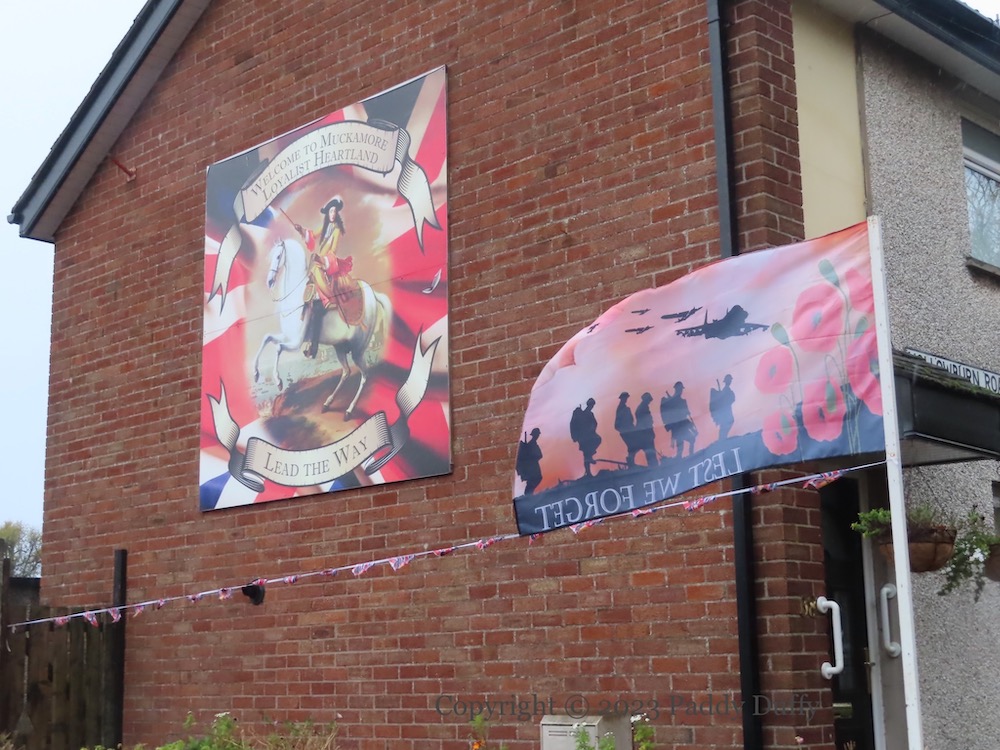
Above, a “Welcome to loyalist Seymour Hill” board with flags and poppies, and a (2021) tarp “Seymour Hill says no to the Irish Sea border”.
Below, Queen Elizabeth II 70th/platinum Jubilee banners remain on either side of the UDA board above the Seymour Hill shops, even after her death in September (previously there were two NI Centenary banners). There are orange lilies at the four corners of the UDA emblem.