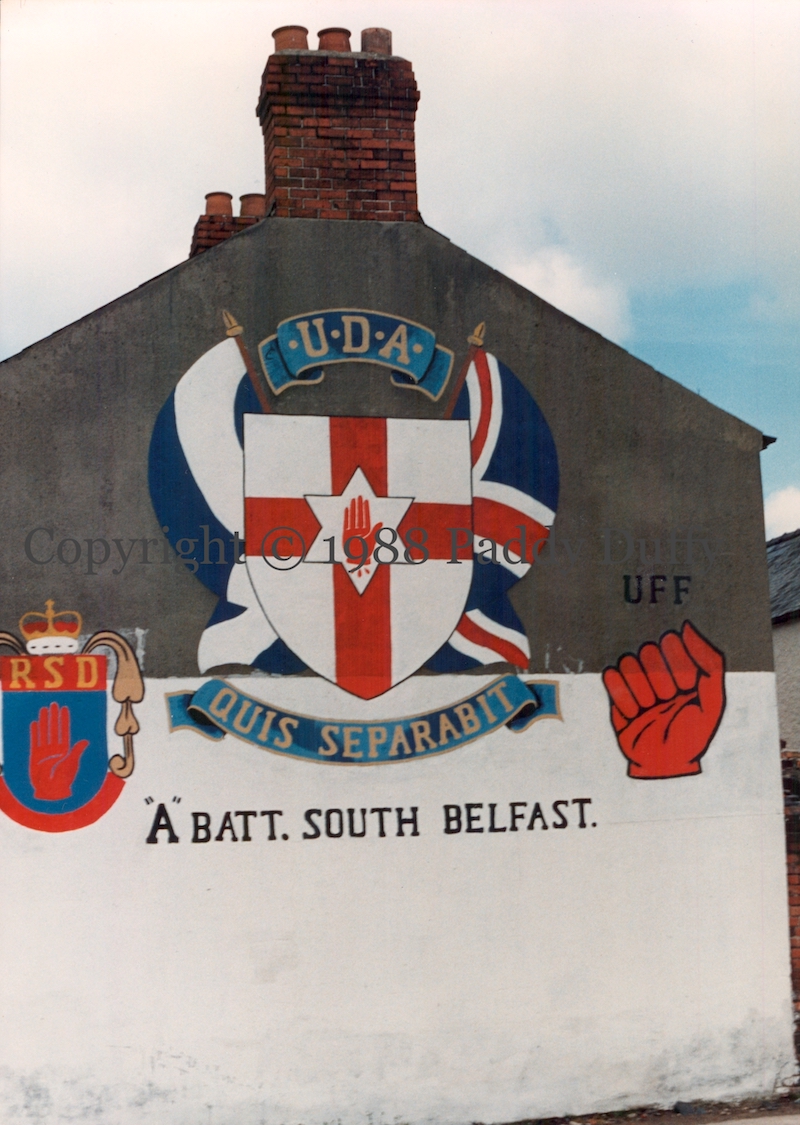
“UDA “A” batt. South Belfast. RSD [Roden Street Defenders (private Fb)] UFF”
This is the mural that greets travellers moving west along Donegall Road to the Village. The houses in Beit Street have been knocked down and their replacements, which face directly onto Roden Street, no longer reach all the way to Donegall Road, leaving this gable as a prime painting space.
These are murals from completing organisations, the UVF (above) represented by an Uzi above various flags and the emblem of the UVF, and the UDA (below) represented additionally by hooded volunteers on manoeuvres. They were together on the Crumlin Road, on waste-ground at the top of Queensland Street and at the top of Tasmania Street. On the gable next to the UVF flags large YCV and 36th Division emblems would be added – see the Peter Moloney Collection.
“”I have always believed we had a legitimate right to take up arms …” from an interview by IRA volunteer Maıréad Farrell, executed with her gallant comrades Seán Savage & Dan McCann.”
Yann Goulet’s Ballyseedy Memorial sculpture was rendered in paint for the funeral procession of the Gibraltar Three on March 16th, 1988. The sculpture is a reflection on the killing of eight anti-Treaty prisoners at Ballyseedy Cross (Baıle Ó Síoda), Kerry, during the Irish Civil War. From left to right, we see the dead victim, the grieving widow and orphaned child, and a person (in the painted version wearing the same clothes as the victim) defiantly striding off to take his place and seek revenge.
In the wake of the killings in Gibraltar, six more people were killed in one of the most tense weeks in Troubles history – the IRA’s Kevin McCracken on the 14th, Thomas McErlean, John Murray, and IRA-member Caoımhín Mac Brádaıgh by Michael Stone in the graveyard on the 16th, and British Army corporals Wood and Howes at Mac Brádaıgh’s funeral on the 19th.
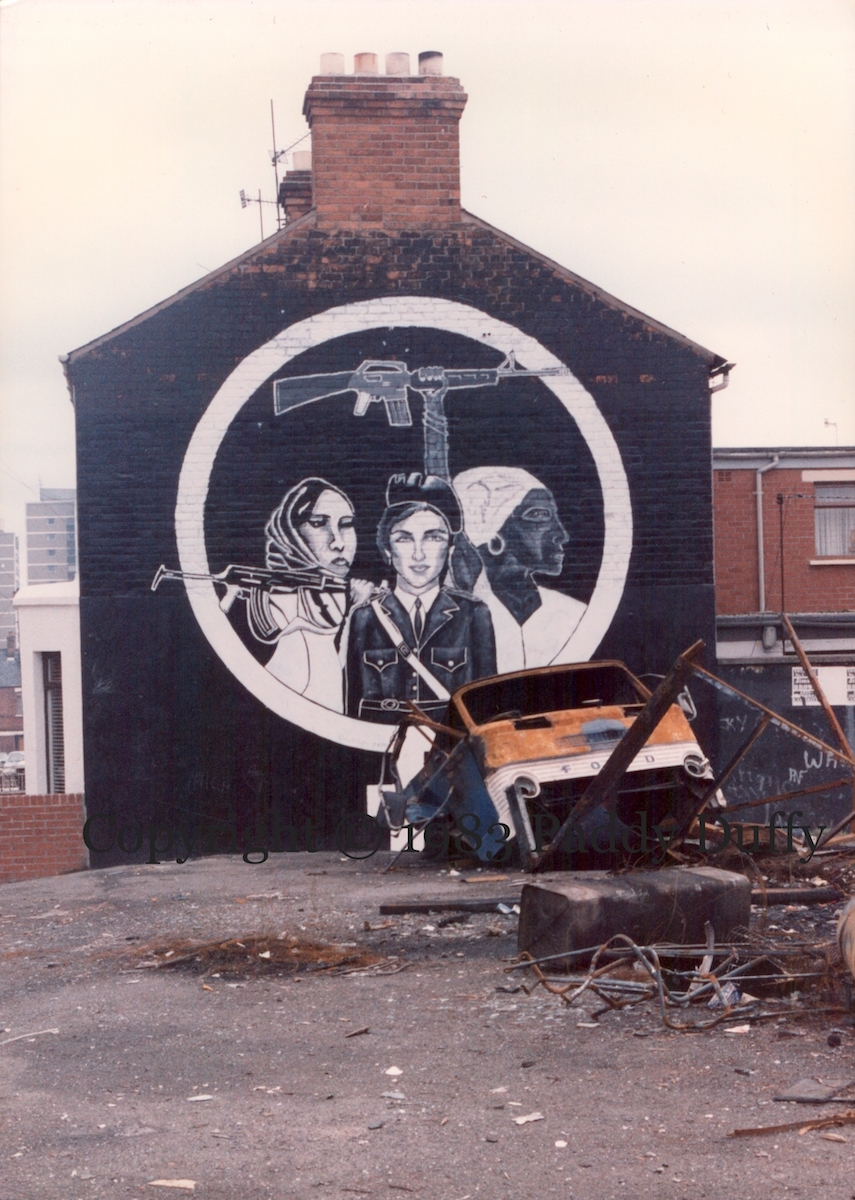
“Solidarity between women in armed struggle” would be added in the bottom right (or is perhaps obscured by the burnt-out lorry. The imagery shows female members of the Palestine Liberation Organisation (PLO), Cumann Na mBan, and the Southwest African People’s Organisation (from Namibia) drawn within the symbol for woman (also the planet Venus in astrology).
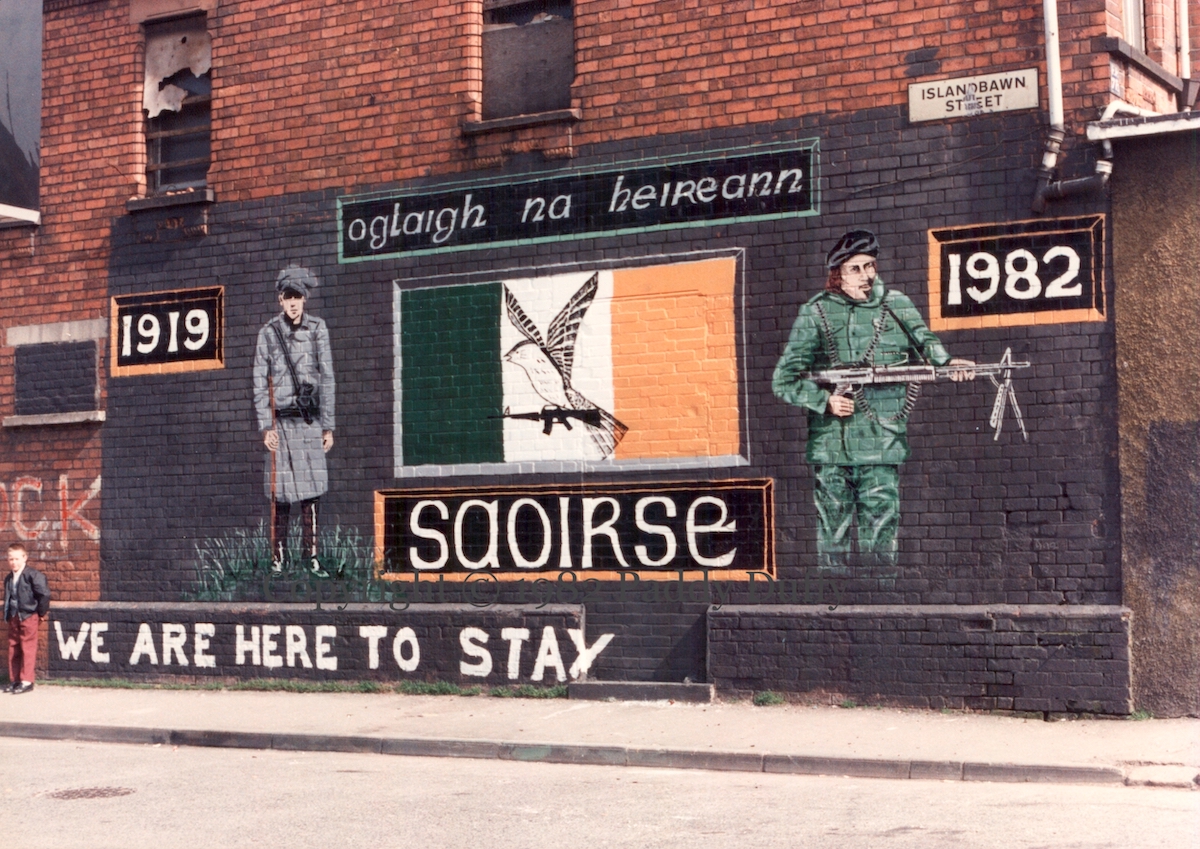
This mural celebrates the IRA (“Óglaigh Na hÉıreann” at the top) from 1919 (the army of the independent Dáıl Éıreann) to the “present” day of 1982. In the centre, a lark flies against a Tricolour, with the word “Saoırse” (“freedom”) beneath.
This is a repainted version of the original, which was one of several murals in Beechmount and the Rock streets that were paint-bombed by “marauding Coldstream Guards” (according to AP/RN of 1982-04-29) – for the damaged mural, see the Peter Moloney Collection. The “1919” date would be changed to “1916”.
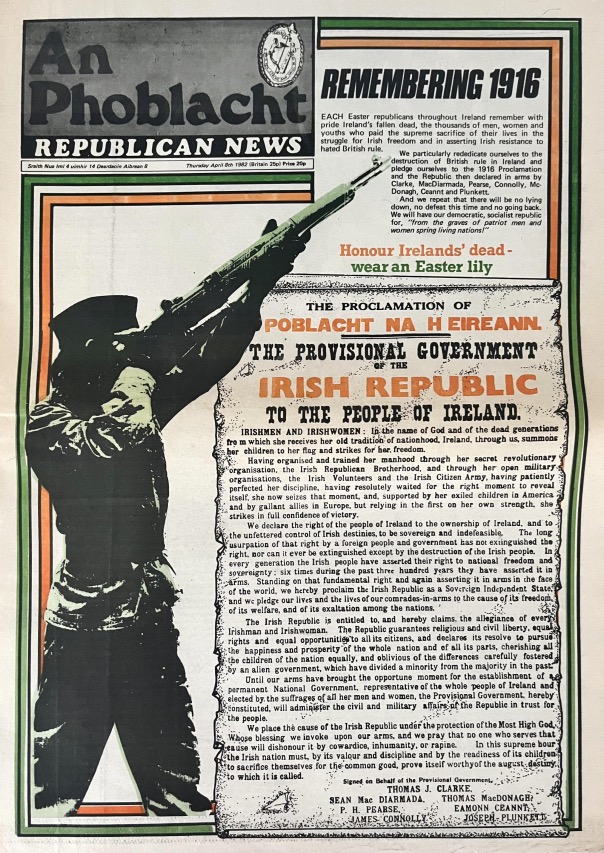
“An Phoblacht/Republican News – official organ of the republican movement. Contents include war news, features, IRA statements, prison news from Ireland & England, news from throughout the 32 counties, solidarity news from abroad.”
Workers read the 1982-04-08 edition of the paper, the cover of which is reproduced behind them (and included below): a masked volunteer fires a funeral volley next to the 1916 Proclamation.
The Maid Of Erin harp, with a “cap of liberty” rather than a crown (WP), together the slogan “It is new strung and it shall be heard” is the emblem of the Society of United Irishmen (WP).
Three female activists, one with a rifle, proclaim “Resistance” on the Falls Road, Belfast. The phrase is attributed to Che Guevara. The mural was commissioned by Sınn Féın’s Department Of Women’s Affairs for International Women’s Day, 1982 (March 6th). This is probably a work-in-progress image, as the words “We must grow tough, but without ever losing our tenderness” are missing from the top part of the wall and a signature – “painted by Sınn Féın Youth” – in the bottom left. Compare to the images in the Peter Moloney Collection.
This is the second mural on this wall – the first was a tribute to the first four hunger strikers to die in 1981 (see the Peter Moloney Collection). That mural was only head-high, whereas this one attempts to cover the entire wall, all the way up to the chimney – for the development of CNR muraling at this time, see Visual History 03.
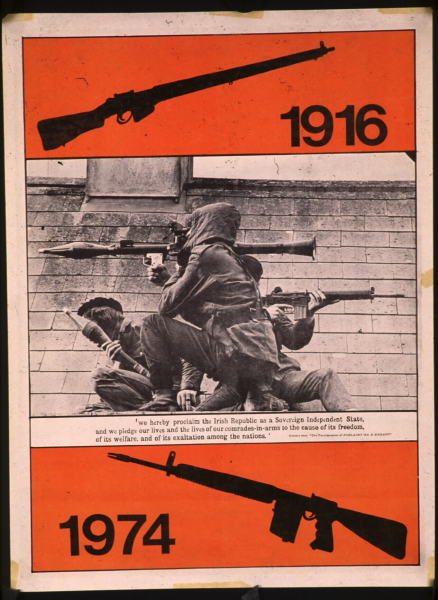
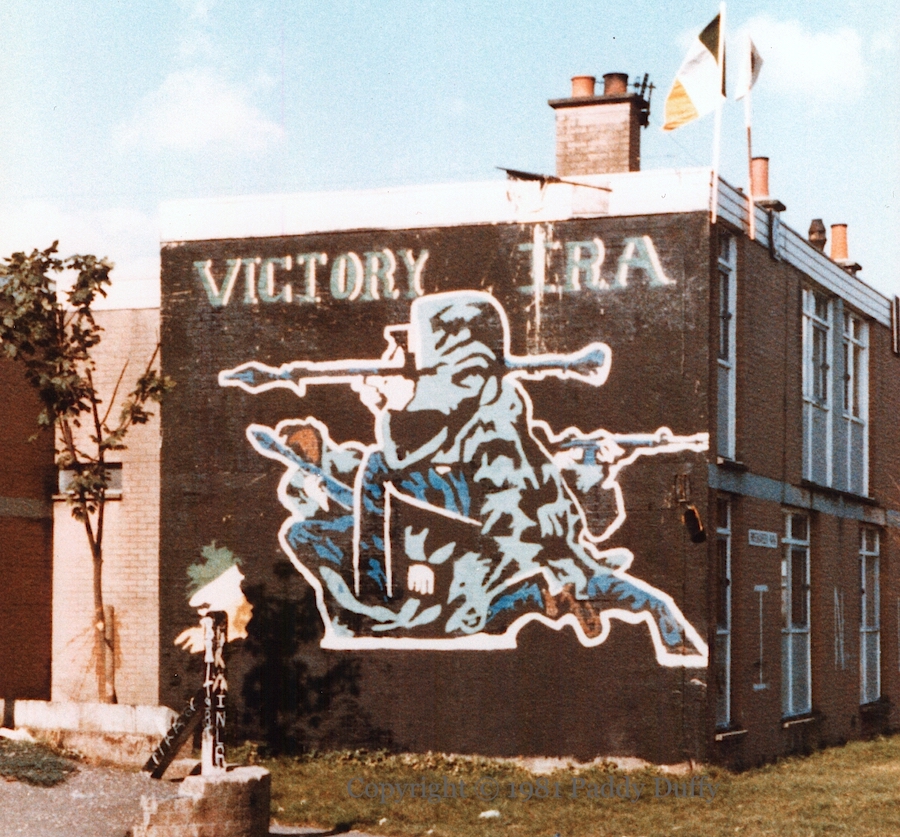
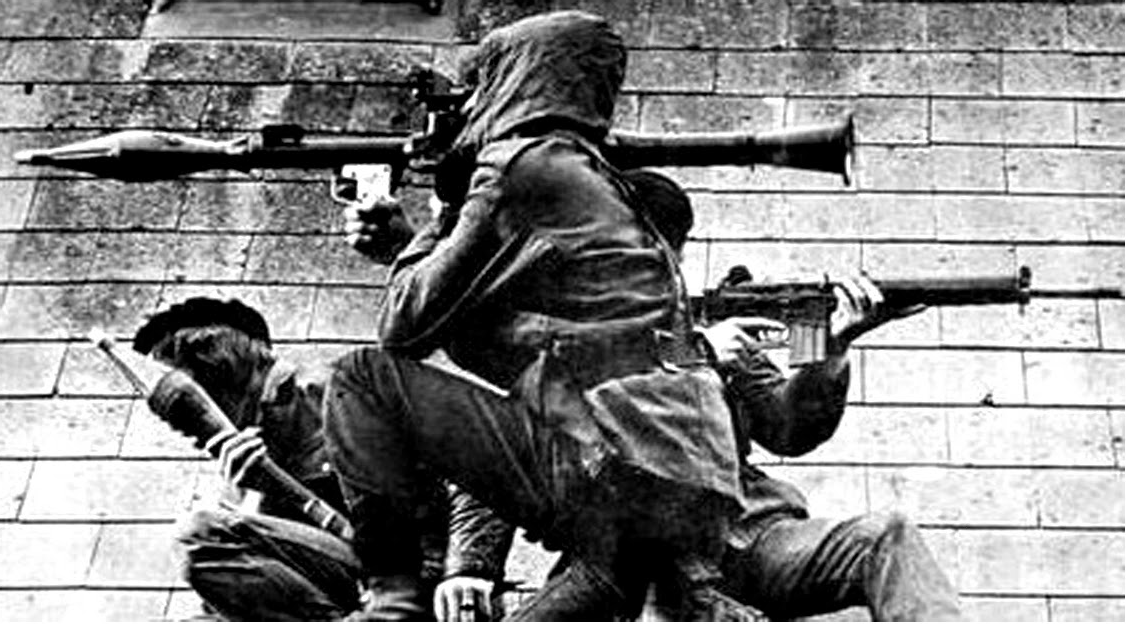
“Victory [to the] IRA”. Volunteers with RPGs and armalites in Rossnareen, kneeling over an outline of Ireland in green, white, and gold. The central trio comes from an IRA publicity photograph, included below.




 Paddy Duffy Collection