This board to Seán Mac Dıarmada in Ardoyne details his exploits leading up to and including the 1916 uprising and his earlier connection with the local area.
Painted by Rısteard ÓMurchú.
Previously: Mac Dıarmada also appears in the Bone Staır Na Gaeılge mural.
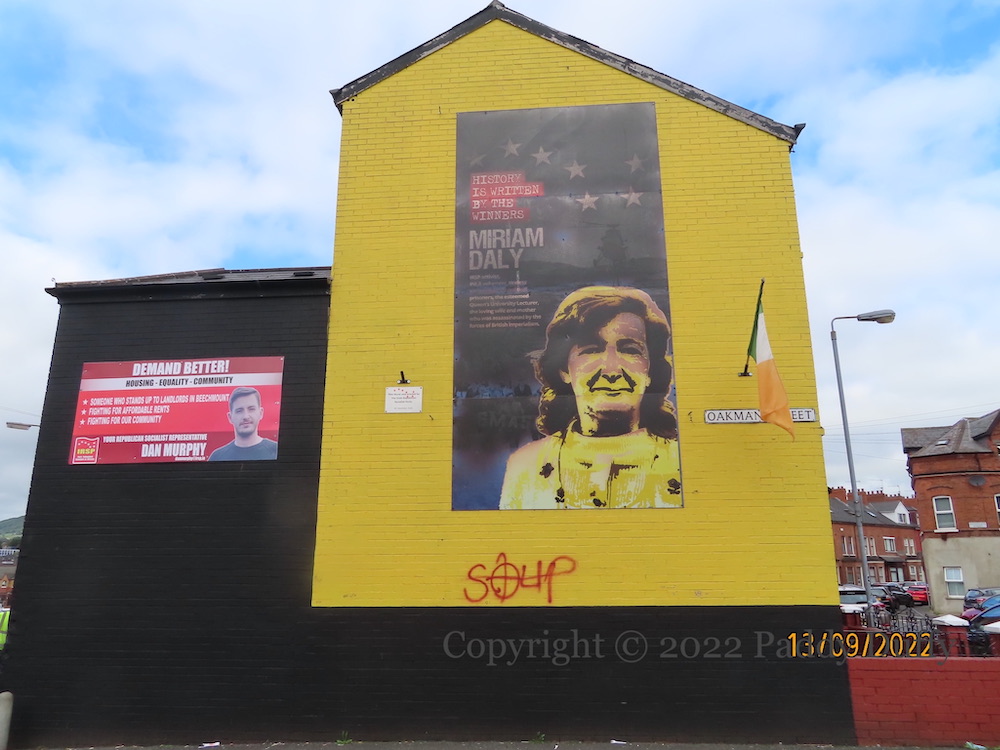
Queen’s University lecturer in economic history Miriam Daly took over as chairwoman of the IRSP (Irish Republican Socialist Party) after founder Seamus Costello was killed in a feud with the IRA. Daly was shot dead in 1980 by the UDA/UFF in her Andersonstown home in 1980. (Interview with husband Jim Daly.)
An IRSP (web) electoral board joins the Daly tribute, showing 2022 Assembly election (WP) candidate Dan Murphy campaigning on a platform focusing on housing: “Demand better! Housing – Equality – Community. Someone who stands up to landlords in Beechmount (e.g.), fighting for affordable rents, fighting for our community.”
The IRSP first painted on this Oakman Street gable in 1996, with the original Daly mural. (Before that, in 1986, there was an IRA anti-touting message – see M00413). The long-standing and much-graffitied mural, History Is Written By The Winner (painted by son Donal Daly among others) was replaced in 2014 by a Joey Ramone mural for a U2 video competition (Murals Of Innocence). The board shown in today’s images was launched on Sunday 2016-12-04 to a crowd of about 200.
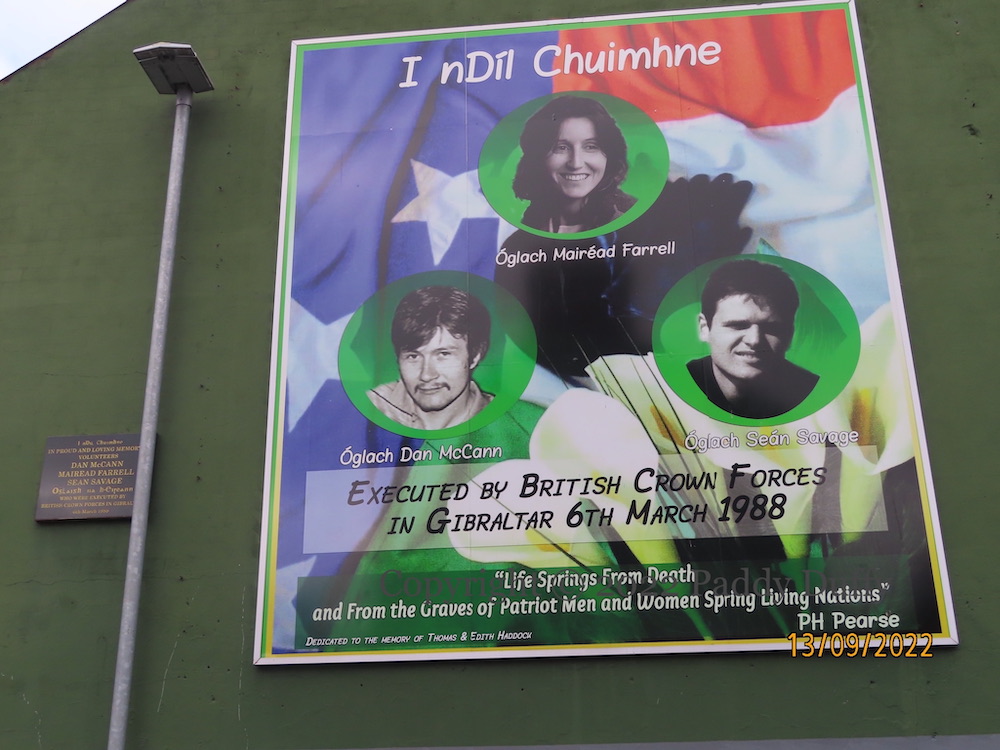
The new replacement board commemorating the Gibraltar 3 (Maıréad Farrell, Dan McCann, and Seán Savage “executed by British crown forces 6th March 1988) uses words from Pearse’s oration at the funeral of O’Donovan Rossa. Not the more common “the fools, the fools …” but “Life springs from death and from the graves of patriot men and women spring living nations” (used previously in Strabane in 1990 – M00860). The board is “dedicated to the memory of Thomas and Edith Haddock”.
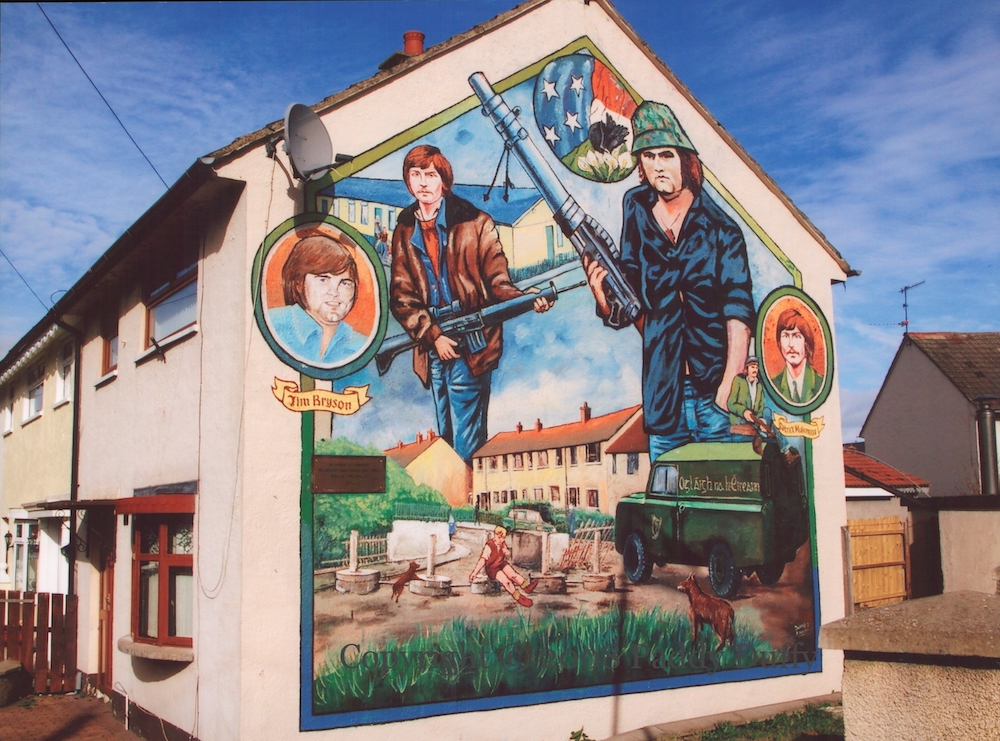
“In memory of [IRA] volunteers Jim Bryson and Patrick Mulvenna. Died on active service 1973.” The pair were killed by undercover British Army soldiers firing from above the Ballymurphy shops (Broken Elbow). Mulvenna died immediately (August 30th), Bryson three days later.
“Years from now they will ask you where you were when your comrades were dying on hungerstrike. Shall you say you were with us or shall you say that you were conforming to the very system that drove us to our deaths[?]” INLA (sign the light-pole as well as the flags and red star in the mural) volunteer Patsy O’Hara, from Derry, joined the hunger strike on the same day as Raymond McCreesh (March 22nd) and died, 61 days later, later in the same day (May 21st, 11:29 p.m.) as him (2:11 a.m.).
The Gibraltar Three are IRA volunteers Maıréad Farrell, Seán Savage, and Dan McCann, who were executed by British crown forces in Gibraltar on March 6th, 1988.
Along the top is written a variation on the second half of Terence MacSwiney’s famous phrase: “[It is not those who can inflict the most but] “Those that endure the most will conquer in the end”
“Freedom.” On the left, a Starry Plough (of the INLA) is attached a spear of ancient Ireland, next to two pikes (of the 1798 Rebellion), behind an ancient shield filled in with the Gal Gréıne of the Fıanna; on the right, a volunteer from the modern “Óglaıgh Na hÉıreann” aims an assault rifle, all against a large Irish Tricolour.
“In proud memory of those who gave their lives for Ireland’s freedom” (and out of sight to the left) “Also to all civilians murdered by the British crown forces” (and out of sight to the right) “Also to all civilians murdered by pro-British elements”. The Celtic cross bears three republican flags: Tricolour, Sunburst, and Starry Plough.
The volunteers (and one Sınn Féın member) listed are (on the left) “Martin Forsythe, Martin Skillen, Gerard Fennell, Terence O’Neill, John Dempsey” and (on the right) “Sean McDermott, Tom Magill, Sean Savage, Kevin McCracken, Paul Best”.
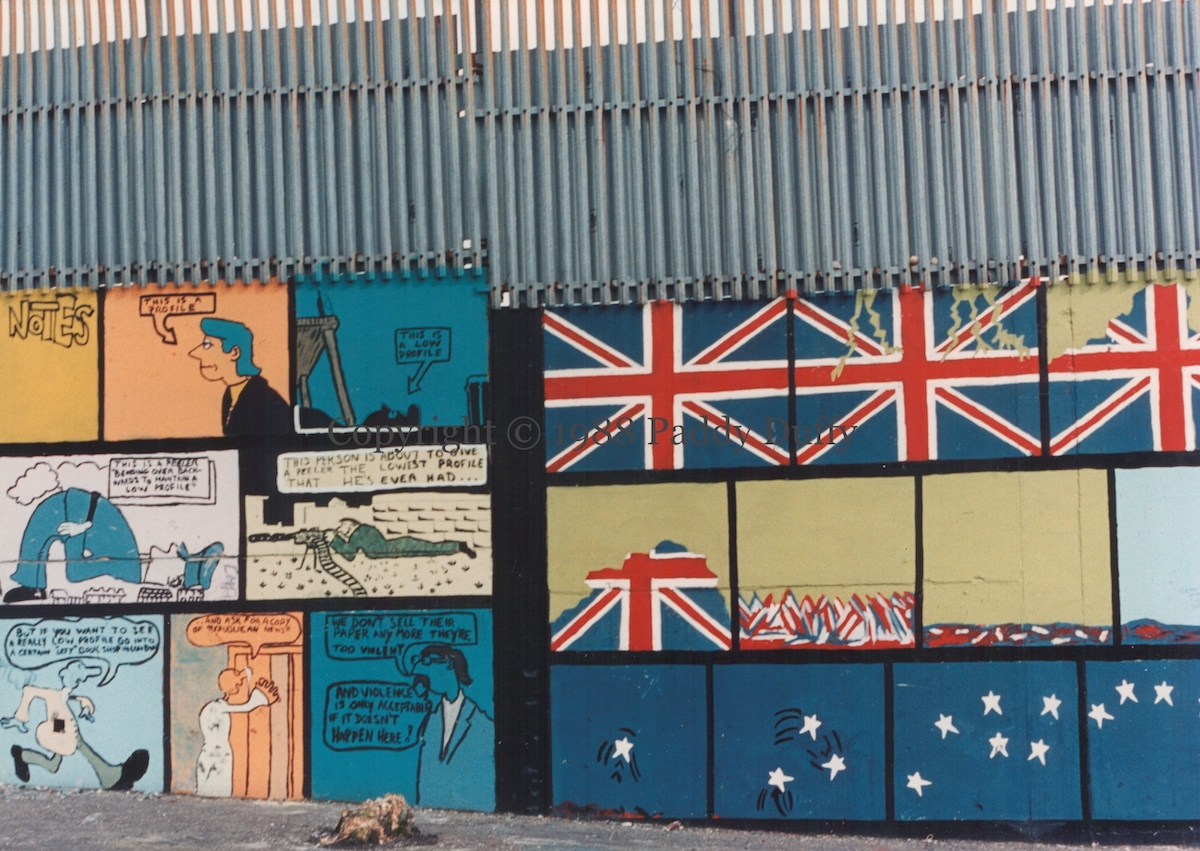
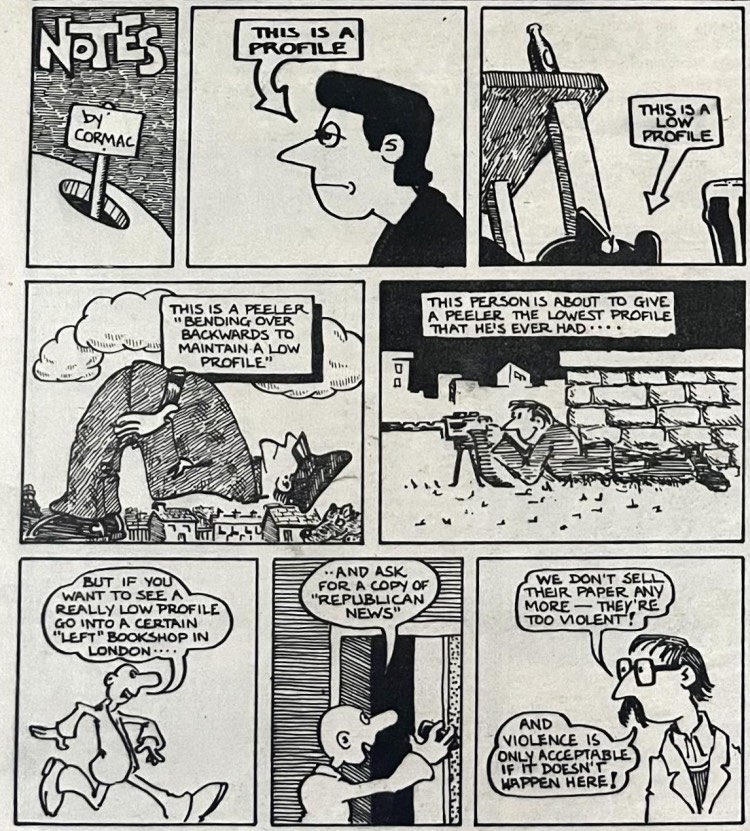
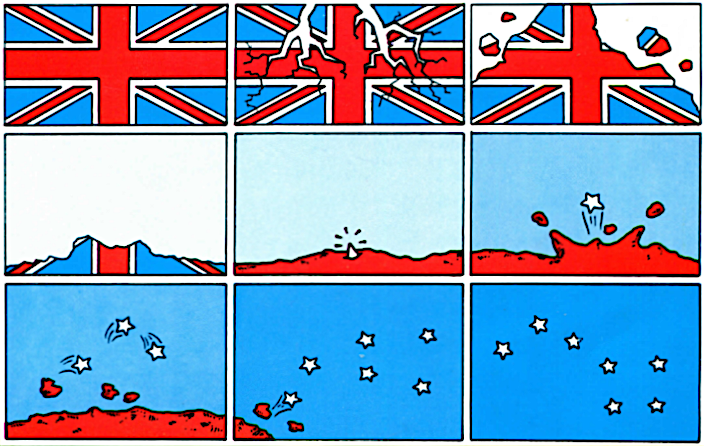
These two pieces are both by cartoonist “Cormac” (Brian Moore), as reproduced on the wall of Corry’s Timber at the top of Springhill Avenue, west Belfast, by Mo Chara Kelly.
Cormac produced cartoons for Resistance Comics, Republican News (and then An Phoblacht/Republican News), Socialist Challenge (and then Socialist Action), and Fortnight. His “Notes (For A History Of Ireland)” appeared in RN and AP/RN for about 30 years.
The mural on the left reproduces a cartoon from February 1979, combining hatred of the “Britz” and RUC with criticism of a left-leaning London bookshop that no longer stocks the paper because “violence is only acceptable if it doesn’t happen here”.
The other is an eleven-panel version of the nine-panel image that appeared on the cover of the 1982 collection Cormac Strikes Back, showing the Union Flag crumbling and the Starry Plough rising from its ashes.



 Paddy Duffy Collection