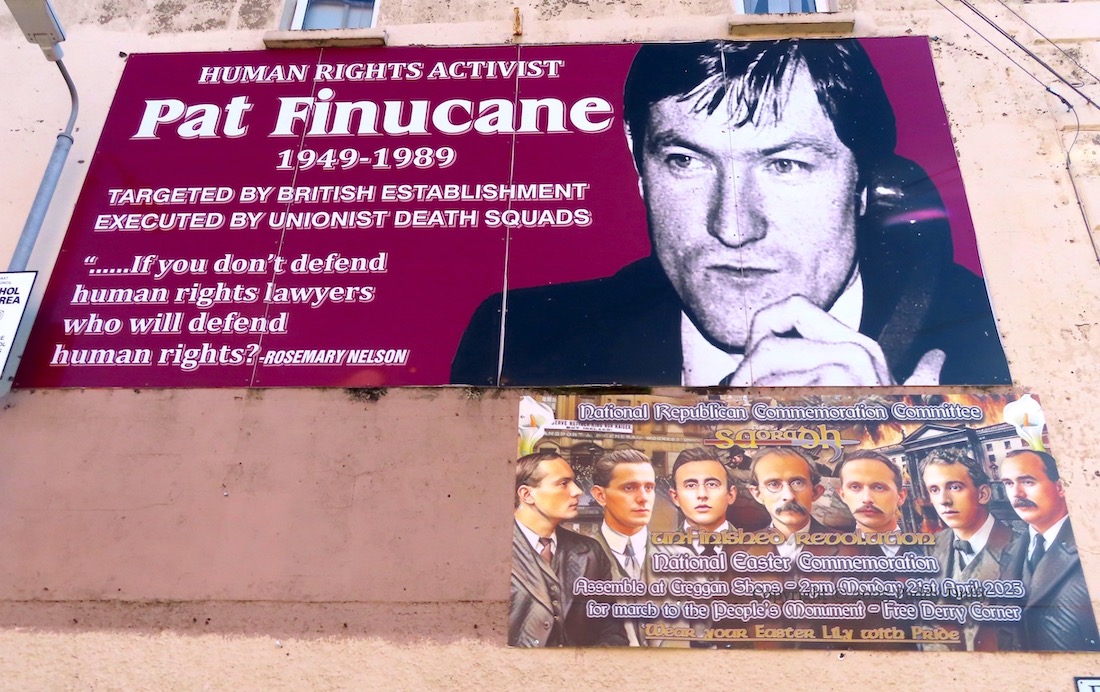
These Saoradh (web) boards calling for attendance at the national march from Creggan to the new (2022) “People’s Monument” in Rossville Street are in Hugo Street (above) and Beechmount Drive (below):
“National Republican Commemoration Committee national Easter commemoration: assemble at Creggan shops – 2pm Monday 21st April 2025 for march to the People’s Monument — Free Derry Corner. Wear your Easter lily with pride.”
For a full list of this year’s commemorative marches, see Republican News.
Easter Monday falls late this year – April 21st – though still not as late as it did in 1916, when it was on the 24th. The event is typically celebrated at Easter, regardless of its proximity to the 24th, though for the centenary in 2016, anti-Agreement republicans commemorated the Rising on April 24th, specifically, while others paraded at Easter (which was at the end of March).
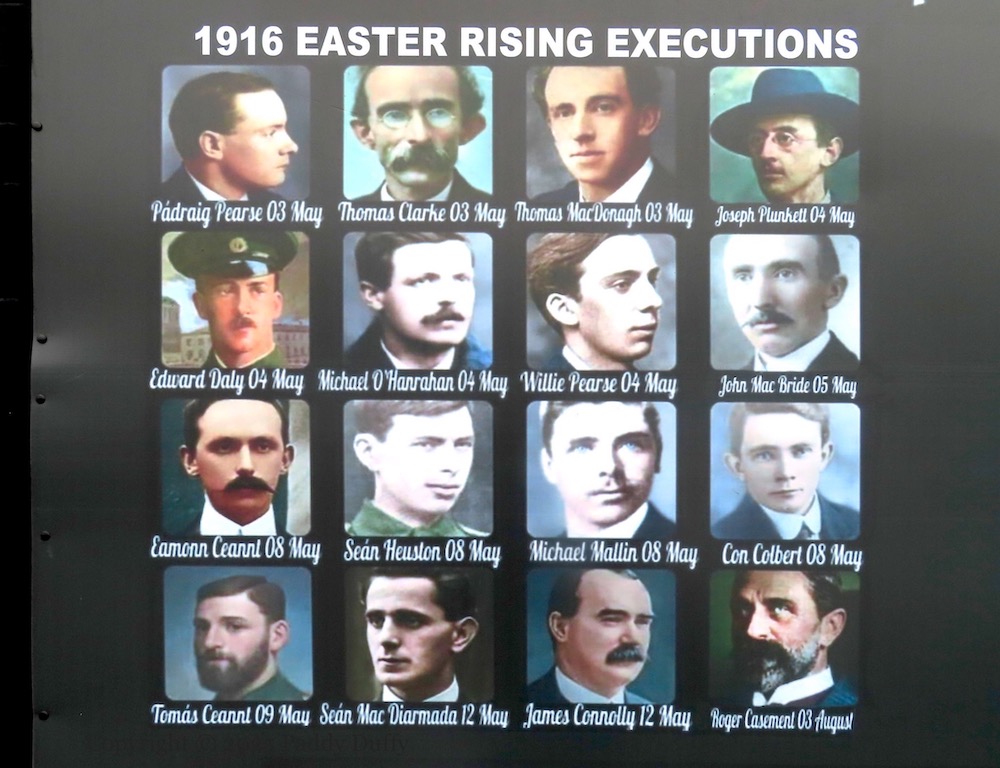
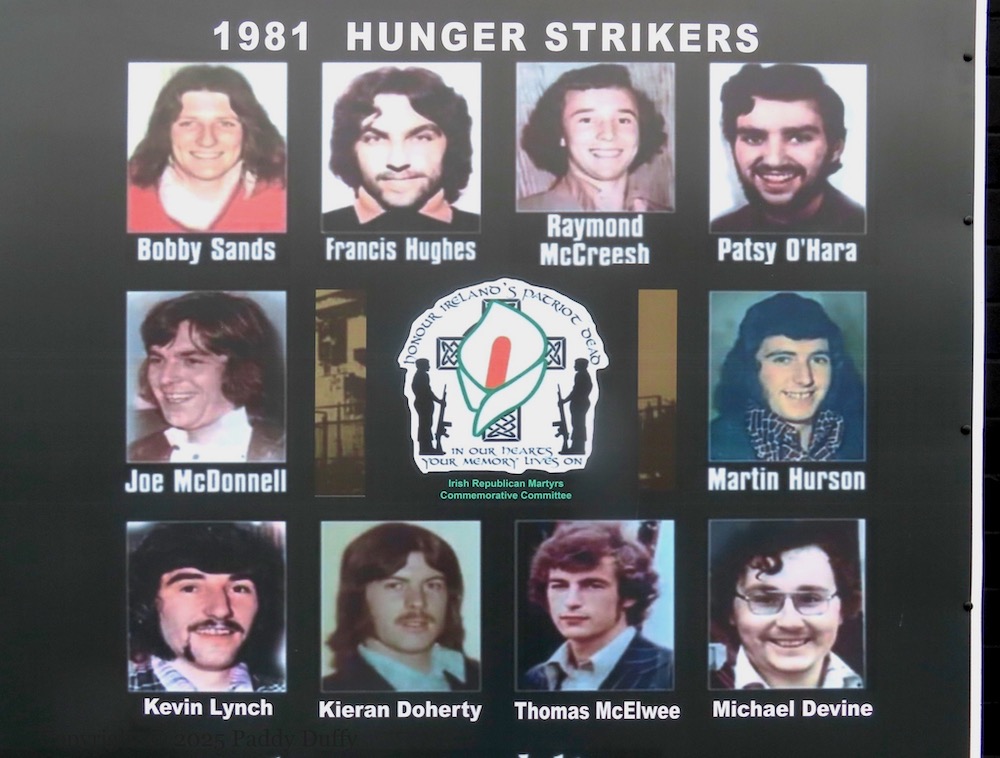
“In our hearts your memory lives on”: the sixteen republicans executed in connection with the Easter Rising (in 1916) and the ten hunger strikers who died in the second (1981) hunger strike are remembered in a new board on Northumberland Street, west Belfast (Visual History).
64 republicans died during the Rising (An Phoblacht) and 3,500 arrested. 187 people were tried by court martial and 90 were found guilty and sentenced to death. Of these, 14 were executed over a period of ten days in May, 1916, including all seven of the signatories to the Proclamation (WP). Tomás Ceannt did not take part in the Rising; he was executed in Cork for shooting dead one of the RIC officers who were sent to round up the brothers Ceannt (WP). Roger Casement was executed in August, convicted of treason for attempting to smuggle weapons from Germany for use in the Rising. (Irish Times)
The sixteen are: Pádraıg Pearse, Thomas Clarke, Thomas McDonagh, Joseph Plunkett, Edward Daly, Michael O’Hanrahan, Willie Pearse, John Mac Bride, Eamonn Ceannt, Seán Heuston, Michael Mallin, Con Colbert, Tomás Ceannt, Seán Mac Dıarmada, James Connolly, Roger Casement.
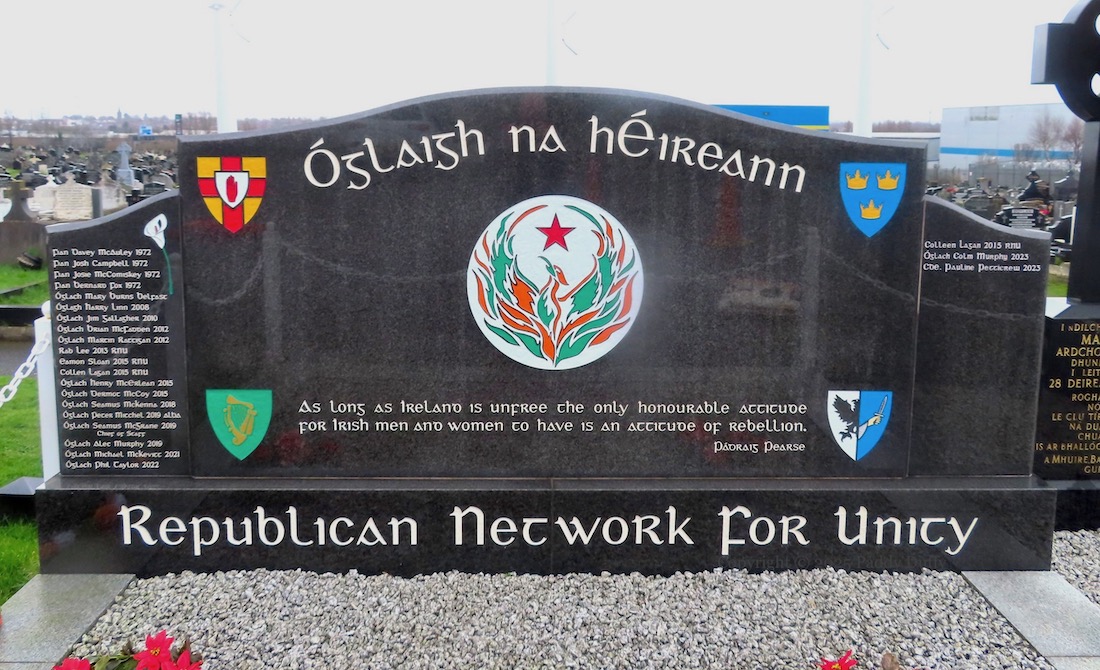
“”As long as Ireland is unfree the only honourable attitude for Irish men and women is an attitude of rebellion” – Pádraıg Pearse”. Pearse wrote the lines in July 1913, in an essay for Irish Freedom (Cartlann), though with “revolt” rather than “rebellion”.
The stone features the phoenix and the lily, and the crests of the four provinces of Ireland. It was unveiled in 2023 and an image of it was used in an RNU board on the Falls Road.
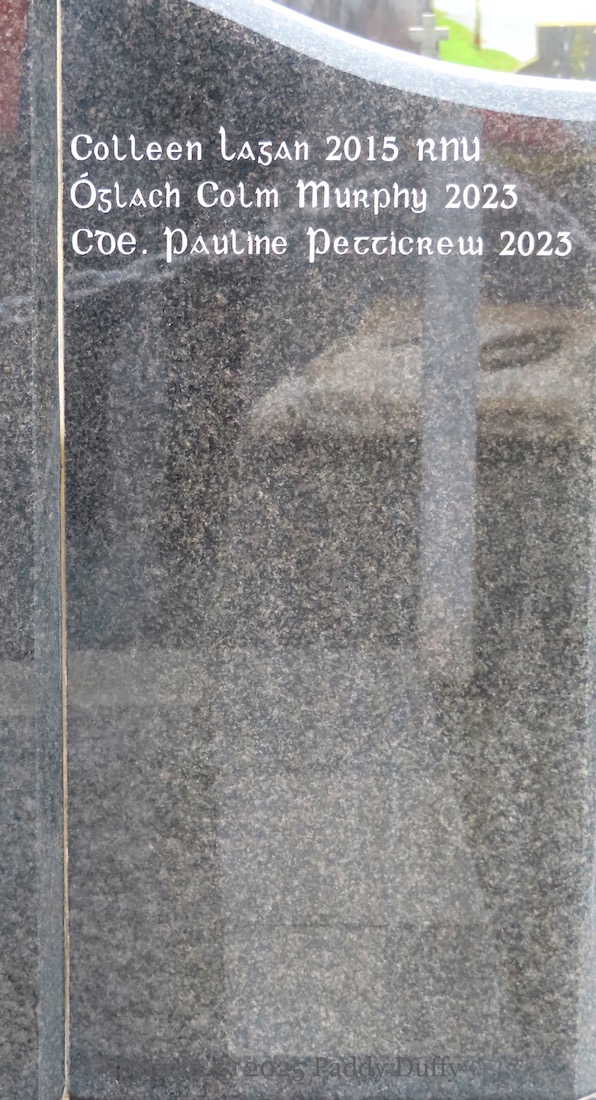
Among the volunteers listed are the four Ardoyne Fıanna who died in 1972 (commemorated in Ardoyne) and Michael McKevitt, founder and (alleged) chief of staff of the RIRA/Óglaıgh Na hÉıreann (WP) who died in 2021.
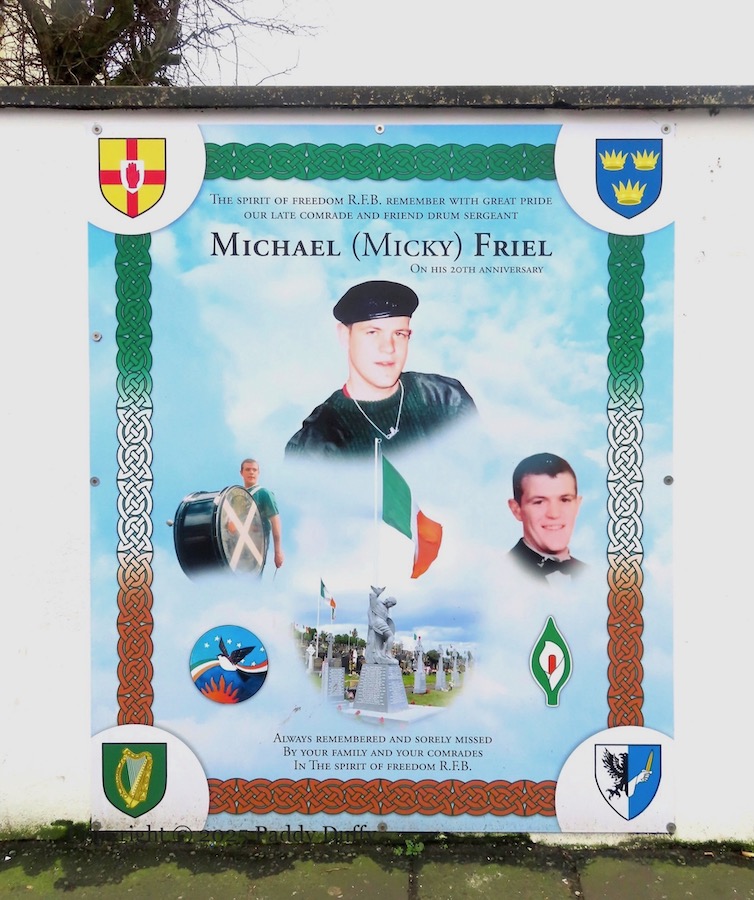
“The Spirit Of Freedom RFB remember with great pride our late comrade and friend drum sergeant Michael (Micky) Friel on his 20th anniversary. Always remembered and sorely missed by your family and your comrades in the Spirit Of Freedom RFB.” The band does not appear to have an on-line presence but there are references to the band going back to 1997 (An Phoblacht). Friel died in 2004 at age 24 (FindAGrave).
“In defence of the republic”, “Éıre aontaıthe, Gaelach, agus saor. Seasamh [“ag seasamh”? “seas”? “seasaıgí”?] le Poblacht Shóısıalach Dhaonlathach na hÉıreann 32 Contae.” “Nothing can alter the truth of it: Ireland belongs to the Irish” – Pádraıg Pearse. [from ‘To The Boys Of Ireland‘]”
[Ireland united, Gaelic, and free. Stand with a 32-county, democratic, socialist, Irish republic]
“Honour Ireland’s patriot dead – in our hearts your memory lives on. Irish Republican Martyrs Commemorative Committee [Fb]”
This board also serves to provide an end-of-life image of the piece behind it – Climate Change Affects Everyone But Not Equally – which is now 12 years old and has missing panels; since no one appears to be minding the space, the old board is simply being covered over.
North Armagh remembers both the centenary of the Easter Rising – in black and white in the background are (above) the seven signatories of the Proclamation, (bottom left) Cumann Na mBan (see the 2014 west Belfast mural) and (bottom right) the Irish Citizen Army (depicted by the painting The Birth Of The Irish Republic) – but also nineteen local volunteers and activists from the Troubles era: (anti-clockwise from left) Thomas Harte, Michael Crossey, Charles Agnew, Julie Dougan, John Francis Green, Terry Brady, David Kennedy, Peter Corrigan, Sheena Campbell, Sam Marshall, Eamonn McCann, Harry McCartney, JB O’Hagan, Sean McIlvenna, Eddie Dynes, Eugene Toman, Garvase McKerr, Sean Burns.
The emblems in the upper corners of those of Na Fıanna Éıreann and the Irish National Volunteers. The inclusion of the National Volunteers is unusual and perhaps a mistake: they were formed in 1914, when the Irish Volunteers split after Redmond urged Irishmen to join the British Army in the Great War; about 24,000 National Volunteers joined the 10th and 16th (alongside roughly 180,000 other Irishmen) (WP). The intended emblem might instead be that of the Irish Volunteers, which kept the name of the pre-WWI organisation but only a fraction of the volunteers, some of whom participated in the Easter Rising; their emblem is also a harp but with “IV” or “Irish Volunteers” or (for the Dublin brigade) the Fıanna Fáıl sunburst. (If you can clarify, please comment/get in touch.)
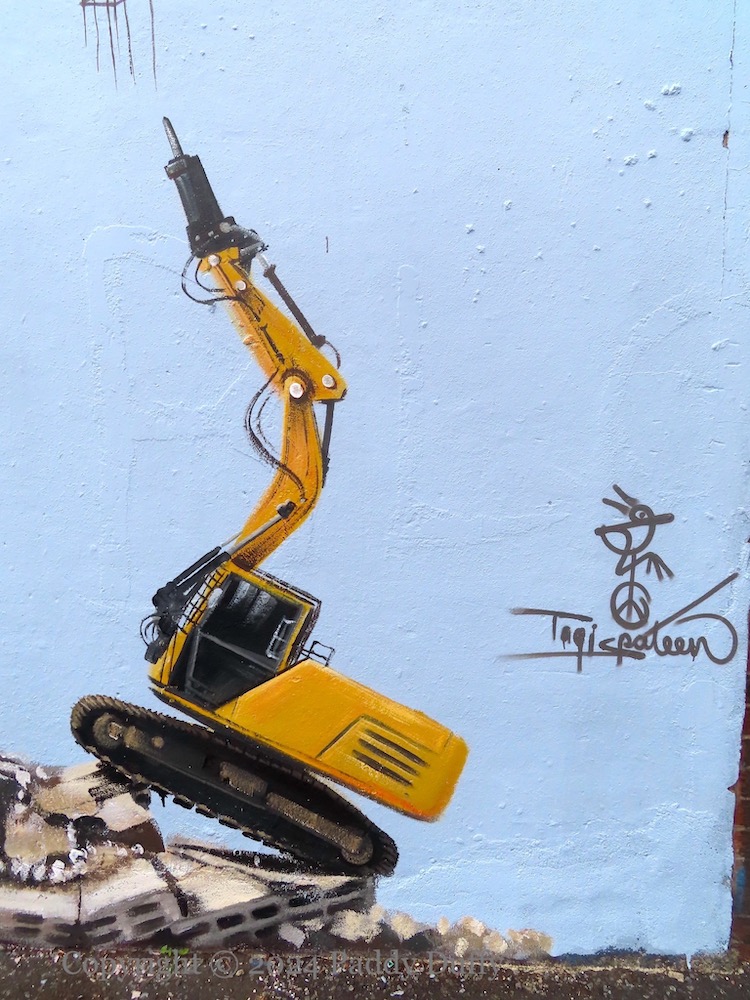
Palestinian artist Taqi Spateen’s (web | ig) third piece in Belfast is in Crocus Street, in Beechmount, west Belfast, in conjunction with the Beechmount Residents’ Collective, which has images of the launch on June 23rd (ig). It replaces the vandalised-and-repaired lower part of the pro-immigrant mural seen in In Search Of A Better Life. In the mural, both an olive tree and slender Easter lilies emerge from the rubble. On these a new society can be built.
For Spateen’s first piece, in Kent Street in the city centre, see Anatomy Of Oppression.
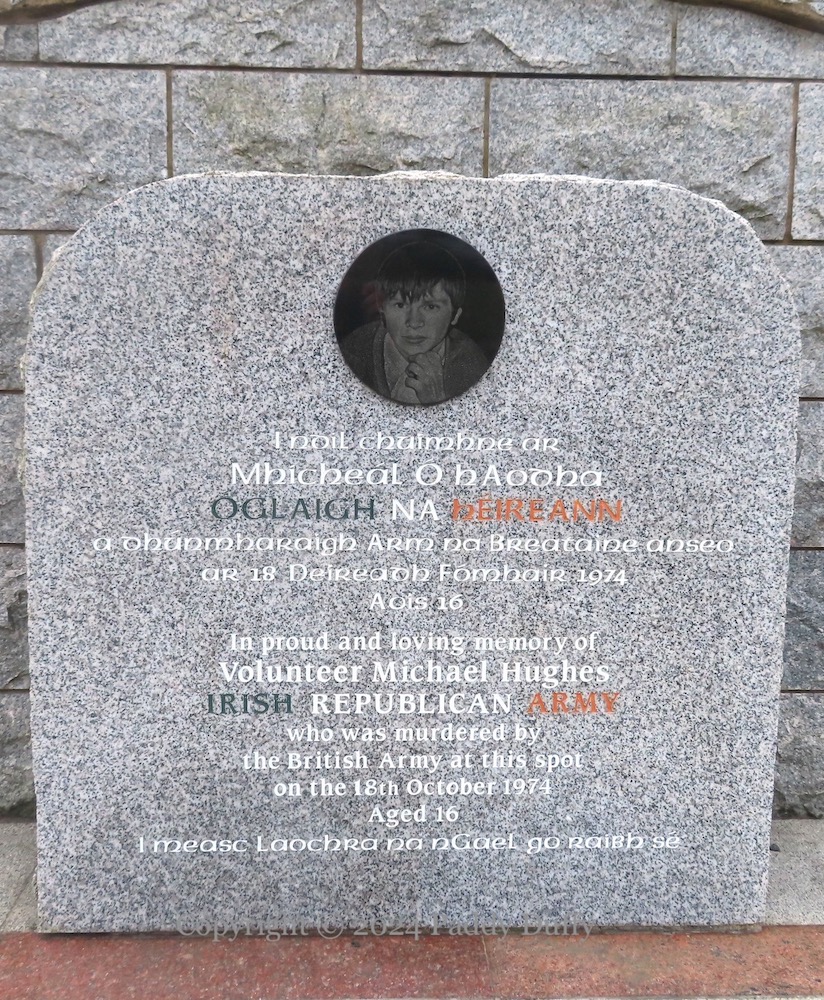
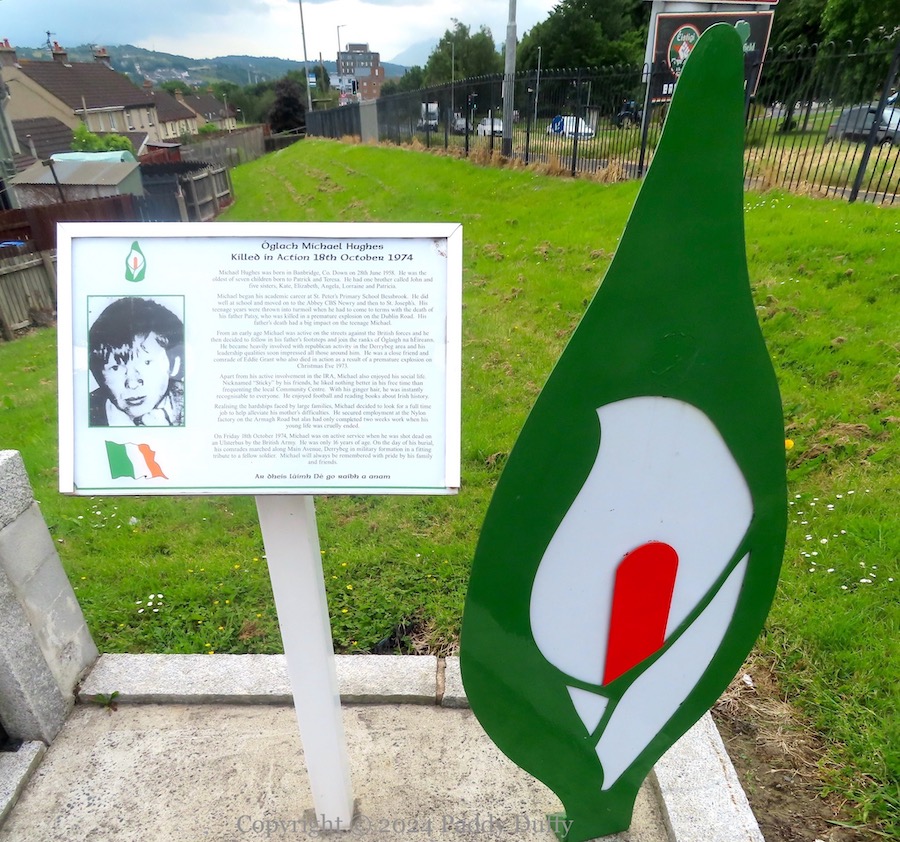
“I ndıl chuımhne ar Mhıcheál Ó hAodha, Óglaıgh na hÉıreann, a dhúnmharaıgh Arm na Breataıne anseo ar 18 Deıreadh Fómhaır 1974, aoıs 16. In proud and loving memory of Volunteer Michael Hughes, Irish Republican Army, who was murdered by the British Army at this spot on the 18th October 1974 aged 16. I measc laochra na nGael go raıbh sé.”
Hughes was shot when he and several other youths attempted to hijack a bus at the stop at the entrance to the area which was under observation by a Royal Marine unit; the soldier who fired the shot claimed that Hughes had pointed a pistol at him, but no weapon or forensic evidence was recovered (Lost Lives 1208).
This is an enlarged memorial to Hughes at the upper entrance to Derrybeg. For the previous memorial, see M08521); Peter also photographed the bus shelters (in 2002).
From the printed info board: “Michael Hughes was born in Banbridge, Co. Down on 28th June 1958. He was the oldest of seven children born to Patrick and Teresa. He had one brother called John and five sisters, Kate, Elizabeth, Angela, Lorraine and Patricia. Michael began his academic career at St. Peter’s Primary School Bessbrook. He did well at school and moved on to the Abbey CBS Newry and then to St. Joseph’s. His teenage years were thrown into turmoil when he had to come to terms with the death of his father Patsy, who was killed in a premature explosion on the Dublin Road. His father’s death had a big impact on the teenage Michael. From an early age Michael was active on the streets against the British forces and he then decided to follow in his father’s footsteps and join the ranks of Óglaıgh Na hÉıreann. He became heavily involved with republican activity in the Derrybeg area and his leadership qualities soon impressed all those around him. He was a close friend and comrade of Eddie Grant who also died in action as a result of a premature explosion on Christmas Eve 1973. Apart from his active involvement in the IRA, Michael also enjoyed his social life. Nicknamed “Sticky” by his friends, he liked nothing better in his free time than frequenting the local Community Centre. With his ginger hair, he was instantly recognisable to everyone. He enjoyed football and reading books about Irish history. Realising the hardships faced by large families, Michael decided to look for a full time job to help alleviate his mother’s difficulties. He secured employment at the Nylon factory on the Armagh Road but alas had only completed two weeks work when his young life was cruelly ended. On Friday 18th October 1974, Michael was on active service when he was shot dead on an Ulsterbus by the British Army. He was only 16 years of age. On the day of his burial, his comrades marched along Main Avenue, Derrybeg in military formation in a fitting tribute to a fellow soldier. Michael will always be remembered with pride by his family and friends. Ar dheıs láımh Dé go raıbh a anam.”
Nine people died in the 1972 blast that killed Patsy Hughes, at the customs station in Newry – two lorry-drivers, four customs officials, and three IRA volunteers (Lost Lives 551).
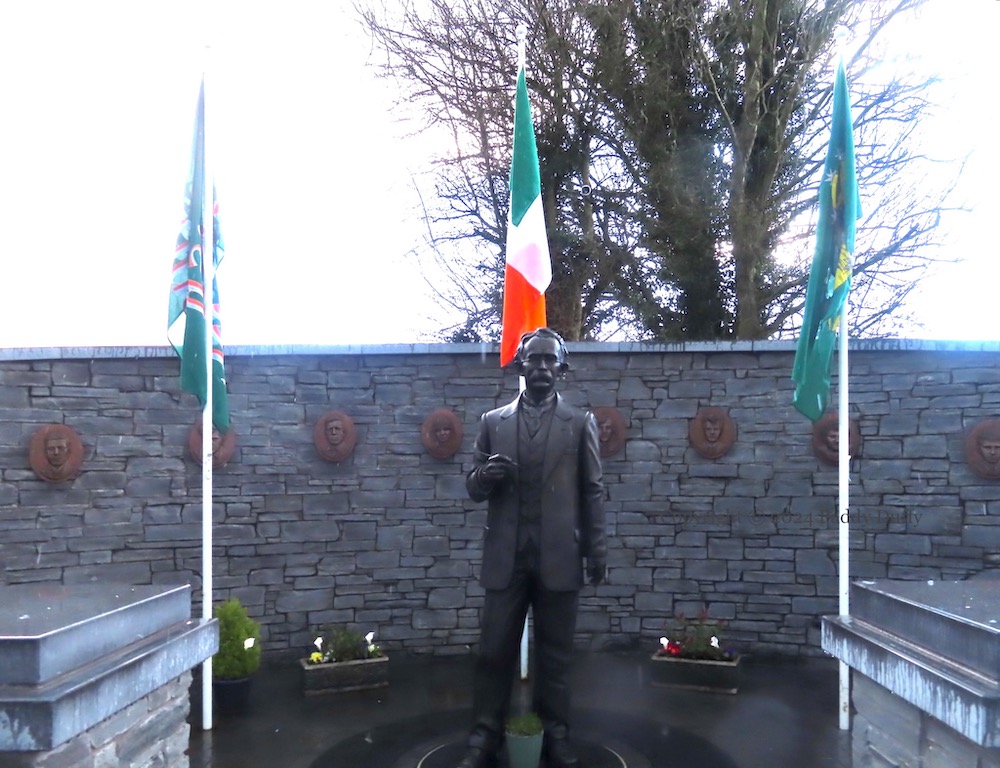
Thomas Clarke/Tomás Ó Cléırıgh (b. 1858) has a long career in Irish fenianism, including fleeing to America after firing at police (at age 20) and 15 years of hard labour for an attempted bombing in London, beginning in 1883 (DIB). He is best known for his role, along with Sean Mac Dıarmada (The Mainspring), as architect of the Easter Rising. He is particularly honoured in Dungannon, where he grew up from the age of nine onward, the last posting of his British-Army–sergeant father. This statue in the Lisnahull area was unveiled (in this location) in late November 2021 (We Are Tyrone | NI World).
The circular placard is on O’Neill Park, across the street from the Garden.
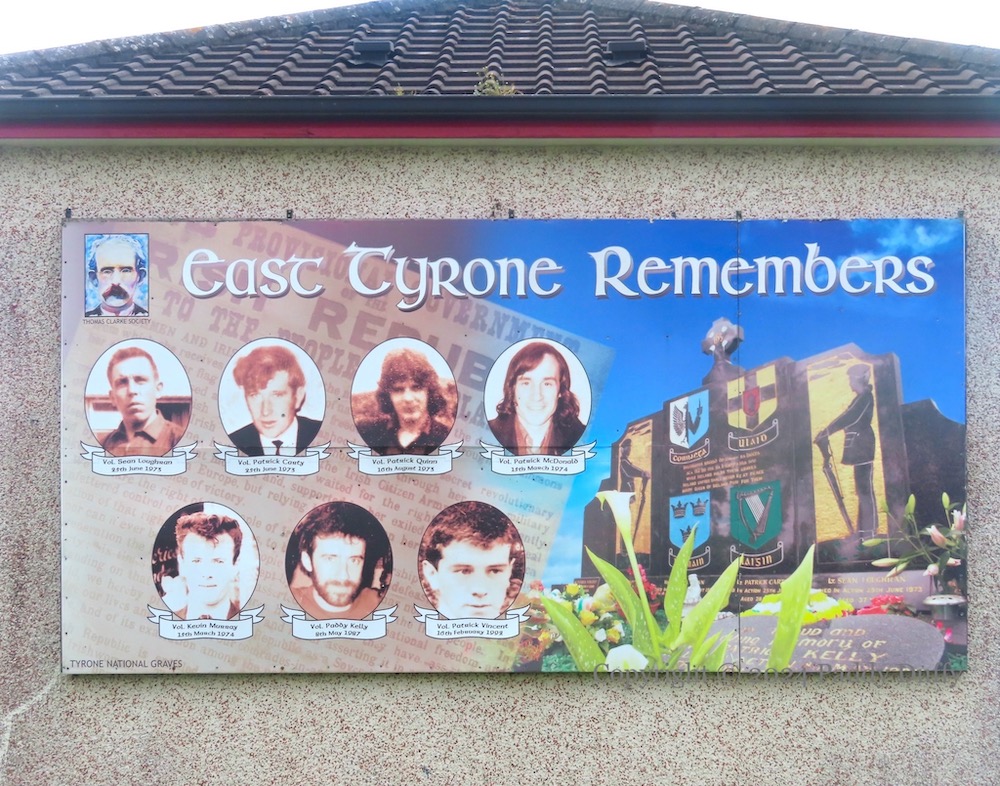
The ‘East Tyrone Remembers’ board to IRA volunteers Sean Loughran, Patrick Carty, Patrick Quinn, Patrick McDonald, Kevin Murray, Paddy Kelly, Patrick Vincent – either this one exactly or a re-print of it – is mounted periodically. It first appeared in 2010 to be replaced by the Clonoe Martyrs. It was back again in 2013 and has been in place since 2017.
This RNU (Fb) board calls for attendees at a gathering in Milltown cemetery to commemorate the Easter Rising of 1916. The signatories to the Proclamation can be seen above and behind the large Óglaıgh Na hÉıreann gravestone on the right.
















 Paddy Duffy Collection