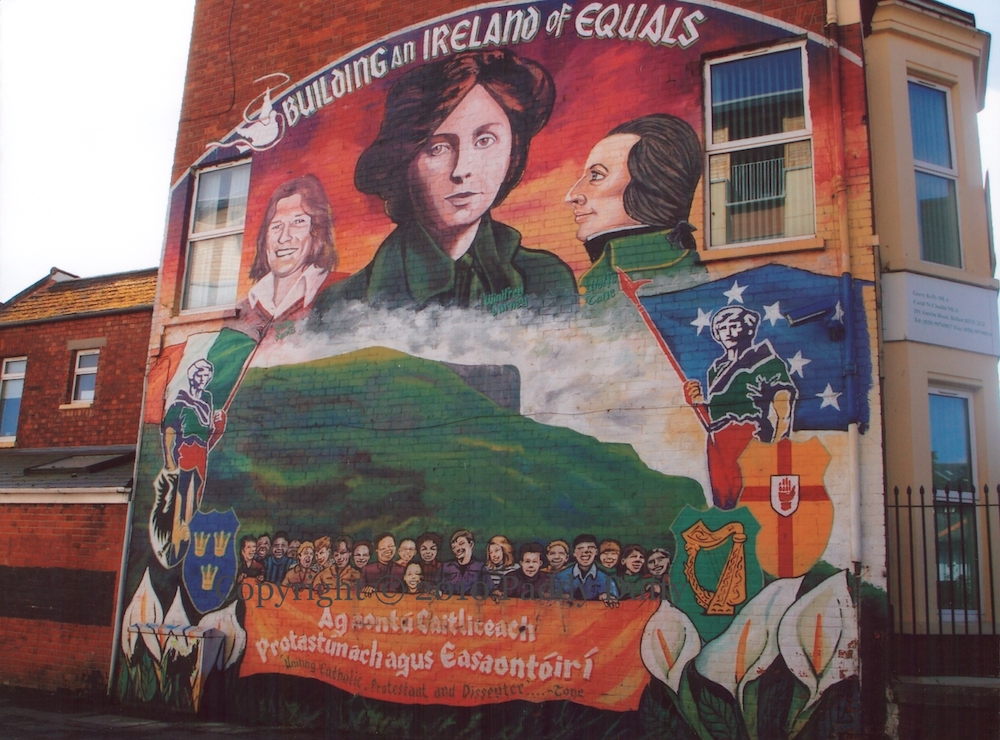
“Understand the past – and build a better future le chéıle Catholic, Protestant and Dissenter.” “The past” in this case is the Battle Of St Matthew’s (“Chath Naomh Máıtıú”), one of the formative events of the Provisional IRA (“Óglaıgh Na hÉıreann”) (WP).
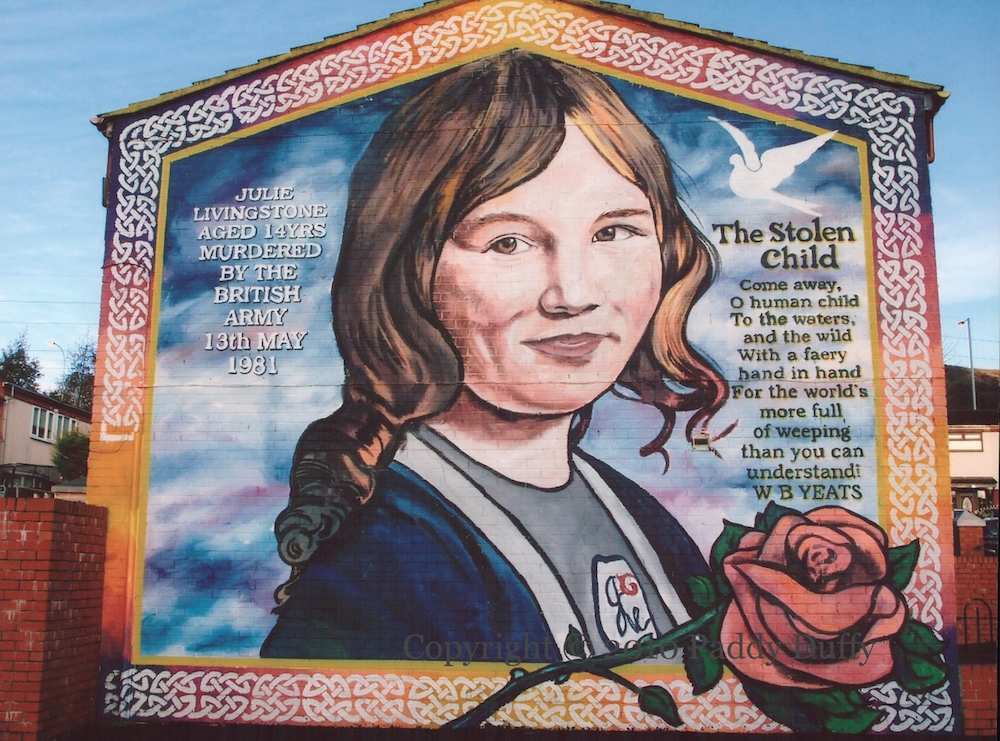
“Julie Livingstone aged 14 yrs. Murdered by the British Army 13th May 1981.” “The Stolen Child – Come away, O human child/To the waters and the wild/With a faery hand in hand/For the world’s more full of weeping/Than you can understand! – WB Yeats.” Livingstone was killed by a plastic bullet.
There is also a stone and plaque near the spot she was struck, on the Stewartstown Road.
The aspect of Cave Hill commonly known as Napoleon’s Nose is shown sheltering the people of Newington, surrounded by heroes and emblems of the past – Bobby Sands, Wolfe Tone, and in the centre, Winifred Carney. This republican mural is both internally directed (at Newington and the New Lodge) and externally, being on the main Antrim Road (Oceanic avenue, on the side of the Sinn Féin office) which is a main artery between the city and points north.
“Ag aontú Caıtlıceach, Protastúnach agus Easaontóırí.” – “Uniting Catholic, Protestant, and Dissenter.” In An Argument On Behalf Of The Catholics Of Ireland (1791), Wolfe Tone of the United Irishmen wrote, “To subvert the tyranny of our execrable government, to break the connection with England, the never-failing source of all our political evils, and to assert the independence of my country, these were my objects. To unite the whole people of Ireland, to abolish the memory of past dissensions, and to substitute the common name of Irishman, in place of the denominations of Protestant, Catholic and Dissenter, these were my means.”
A dove carries the keys that would unlock the chains that are already being rent asunder by their manacled captive in “Ceıs Fada” [Long Kesh]. Part of the “green ribbon” campaign to release republican POWs under the terms of any peace agreement.
An Orange Order marcher (with skeletal face, glowing eyes, and a ‘Give way’ sign) is about to step on a protestor from the lower Ormeau who holds a sign reading “Peace – Justice” and has just released a dove that is sitting on top of the road-sign on the corner.
The scene is the Ormeau Road at Farnham Street, and the mural is in Farnham Street at the Ormeau Road; the mural thus includes a depiction of itself: the edge of the mural (with blue sky and grey pavement) appears on the wall to the left of the pizza shop with painted shutters reading “What part of NO don’t you understand?” (An image of the actual shutters, from the squire93 collection, is included below.)
In the top left is a smaller piece painted on a board: the words “Will there ever be peace? No.” are super-imposed on a grave.
This is one of about nine murals painted in 1995 for the 150th anniversary mural of An Gorta Mór/the Great Hunger (Visual History).
There is a wall to the right that reads, “There was no famine; it was genocide.” (See the Peter Moloney Collection.)
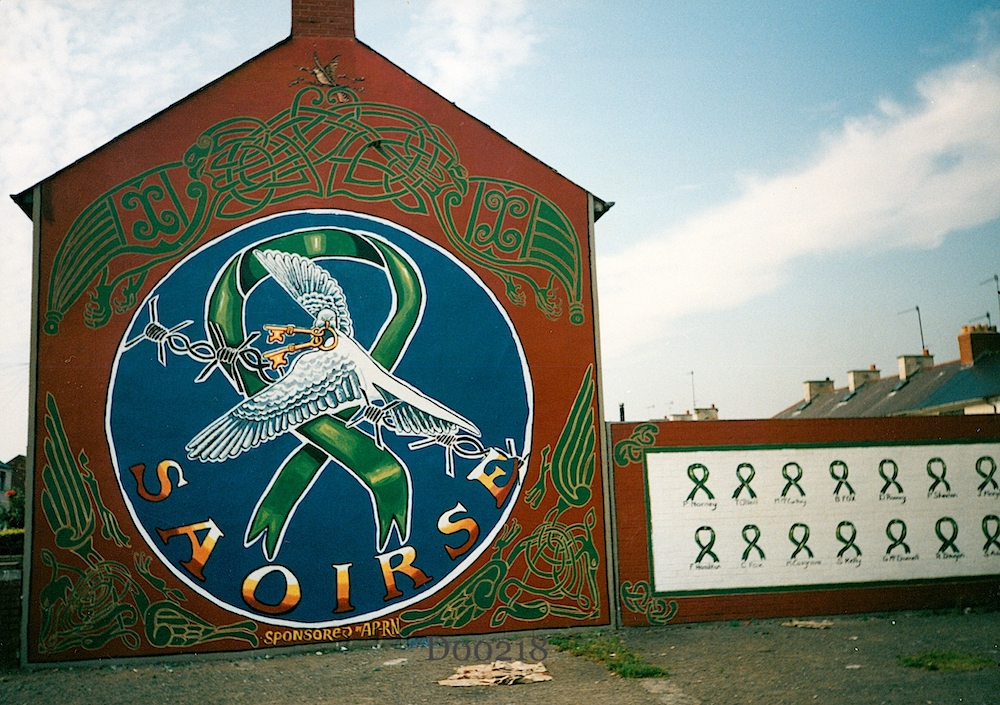
The dove on the chimney and the green ribbon below are a nod to the other main movement during this period, the release of political prisoners as a leading goal of the peace process.
“Ardoyne Fleadh Cheoıl – meon an phobaıl a thógáıl tríd an chultúr” = “building community spirit through culture”.
“Eıre [Éire] (Éıru [Érıu]), a queen of the Tuatha Dé Danann, slain at the battle of Taıltean [Taılteann] (Telltown [Teltown], Co. Meath) 1698 BC.” Érıu is placed in a neolithic setting and is releasing a dove which flies off in a trail of stars. (In the repainted version, the date given is 698.)
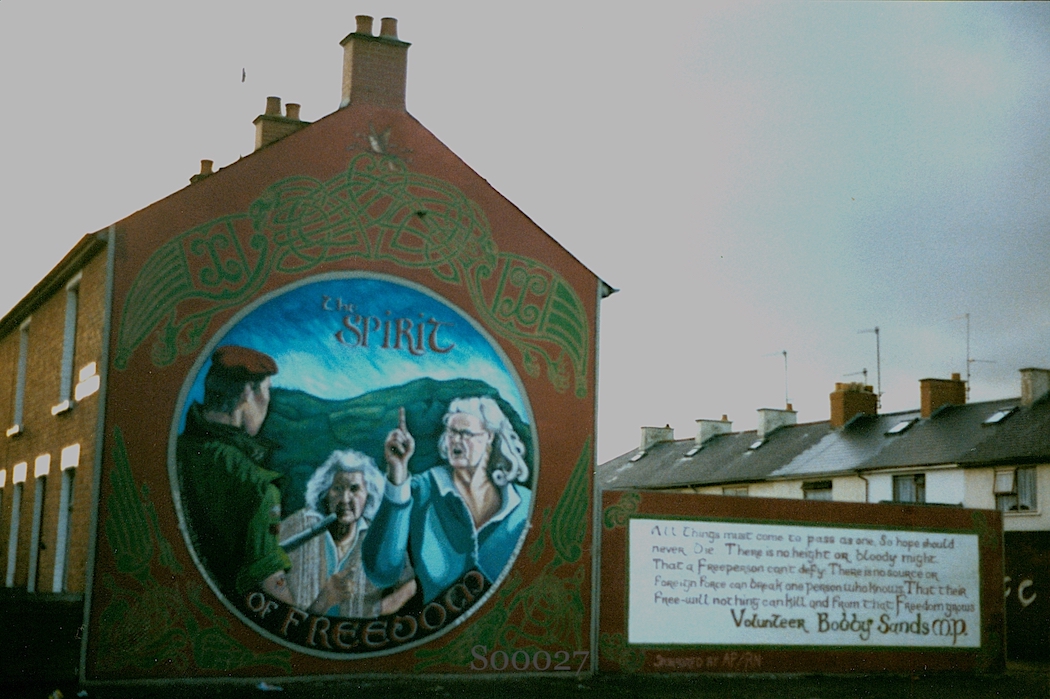
The frame of this mural in St James’s was originally painted by Andrea Redmond (Fb) in 1994 for a mural (included below) showing local pensioners remonstrating with a British Army soldier, under the title “The Spirit Of Freedom”, reproducing a photo that appeared in a French-language magazine (see below).
The central circle was repainted (again Redmond) for the 1995 “green ribbon” campaign: the dove holds the keys that will set free the republican prisoners, symbolised by the barbed wire and the lark in the apex. There was also a side-wall, showing two rows of green ribbons, each with the name of a POW (see immediately below).
“Sponsored by AP/RN” has been moved from the side-wall to the main wall.
In small letters on the part of the circle at the back of the soldier is written “This mural is dedicated to the memory of J[…] D[…] and M[…] Fitzsimons”.
On the side wall is a verse from the poem The Crime Of Castlereagh by “Volunteer Bobby Sands MP”: “All things must come to pass as one/So hope should never die/There is no height or bloody might/That a freeman can’t defy./There is no source or foreign force/Can break one man who knows,/That his free will no thing can kill/And from that freedom grows.”
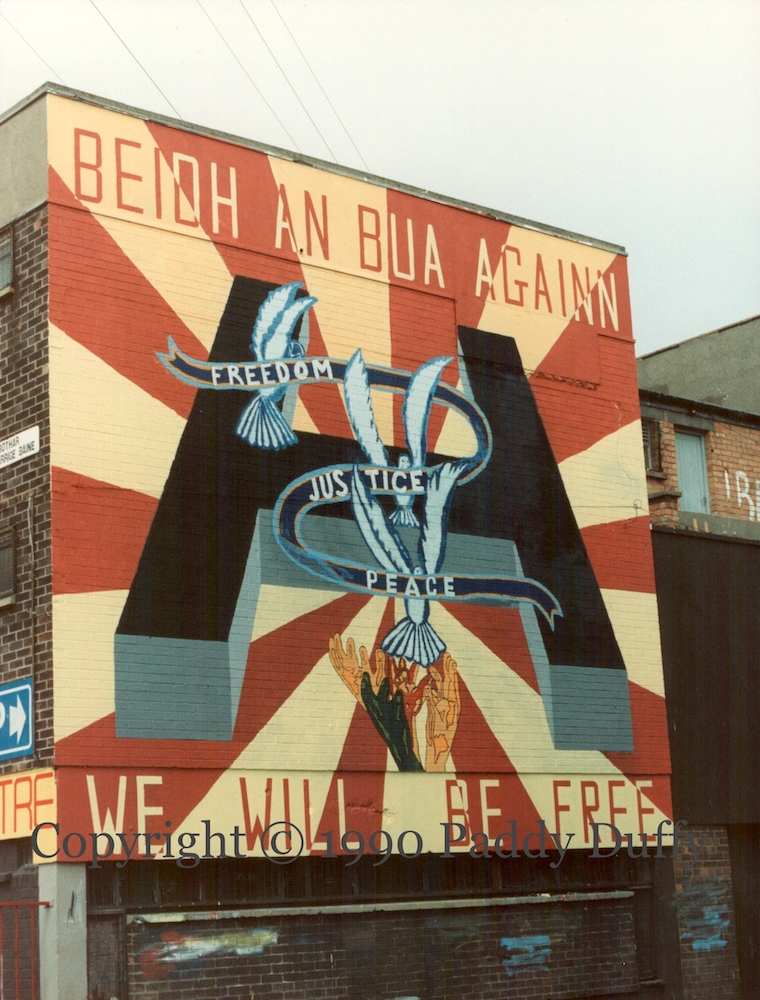
“Beıdh an bua agaınn” [victory will be ours] is a slogan that Mo Chara Kelly saw inside a cell in the H-Blocks. A circle of four hands – perhaps intended to be in the colours of humankind – releases three doves: “freedom, justice, peace”. “We will be free.”
Painted by Mo Chara Kelly at the top of the Whiterock Road, west Belfast.
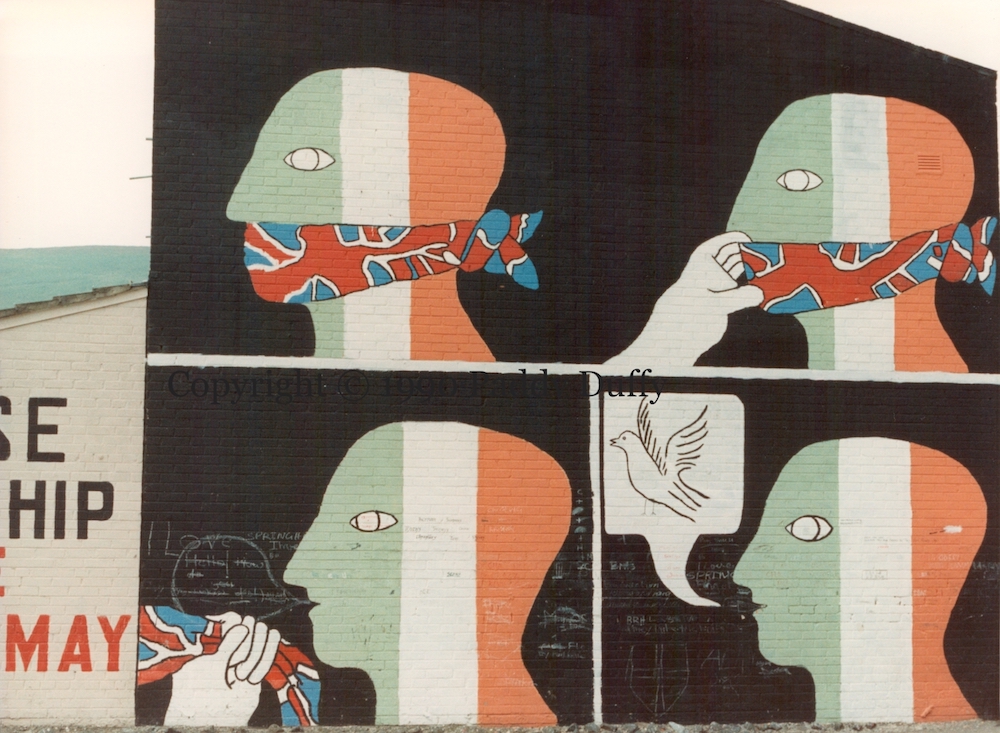
A Cormac cartoon protesting British censorship of Sınn Féın is rendered as a mural by Mo Chara Kelly. The broadcasting Ban was put in place in 1988, disallowing Sınn Féın representatives from speaking in their own voice on television and radio. But if the gag of British censorship were removed, the talk is of peace (in the form of a dove) – suggesting that there is some for negotiation on the violent removal of British forces and administration.
Out of frame to the left are written “Oppose censorship” and (in red) “Vote Richard May”. Richard May ran (unsuccessfully) for election to Belfast City Council in 1989.



 Paddy Duffy Collection