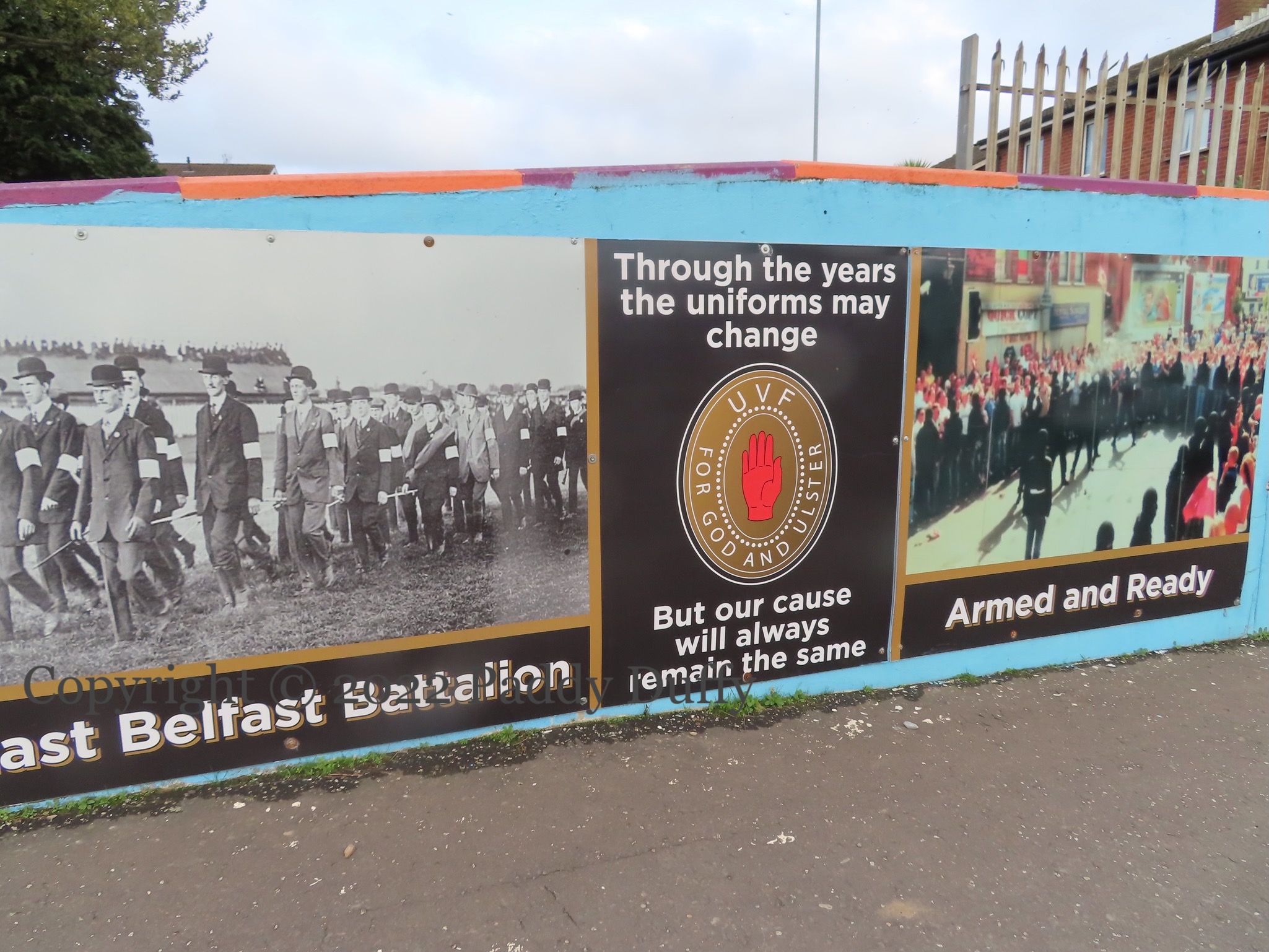
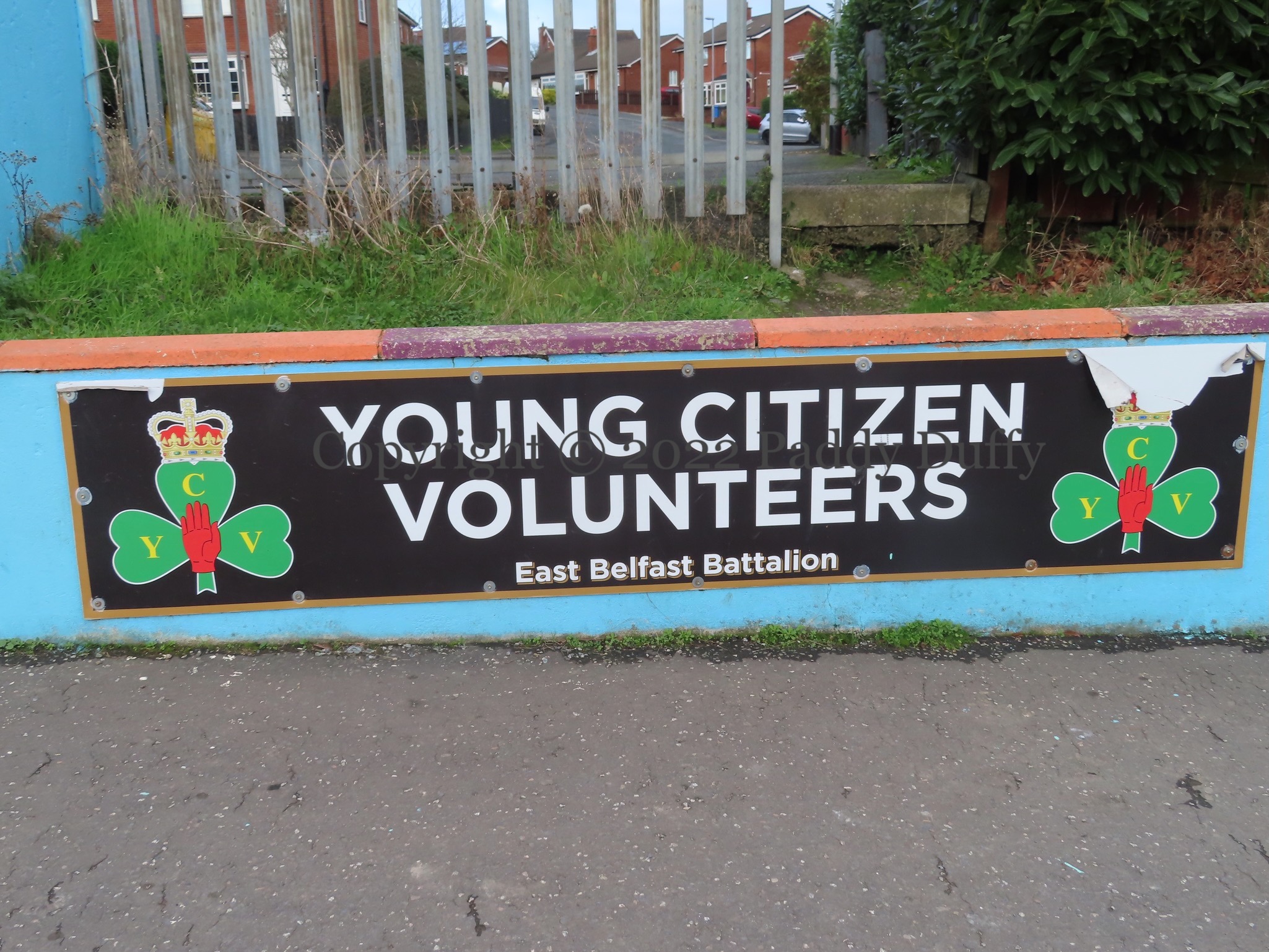
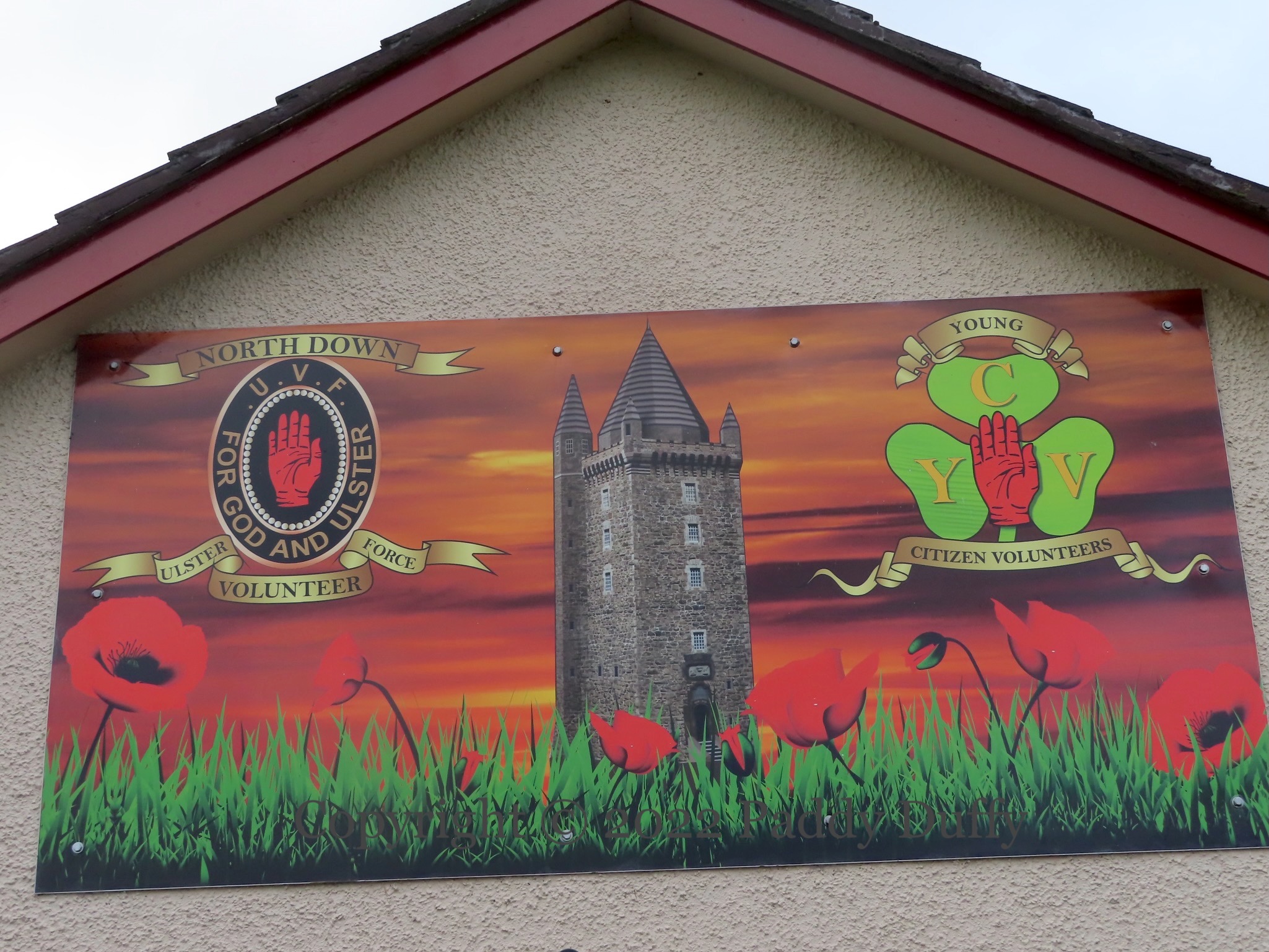
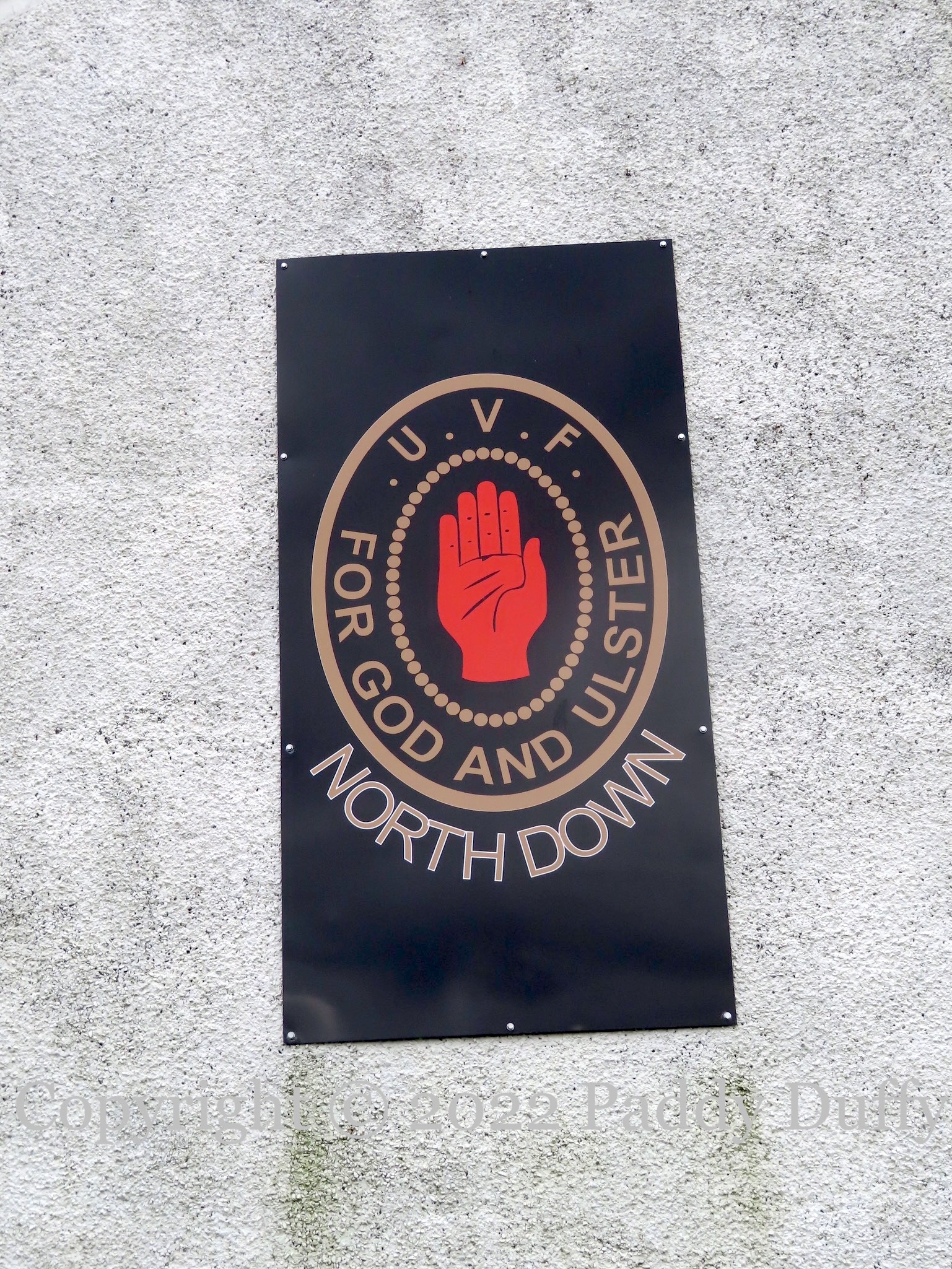
Here is a gallery of UVF boards along Abbot Drive, in Bowtown, Newtownards, mixing North Down with East Belfast brigades (see East East Belfast), and mixing UVF/PAF with the Ulster Volunteers and 36th Division – “Through the years the uniforms may change but our cause will always remain the same”. “The prevention of the erosion of our identity is now our priority.”
Here are the four boards on Lindsay Street, south Belfast, from east to west.
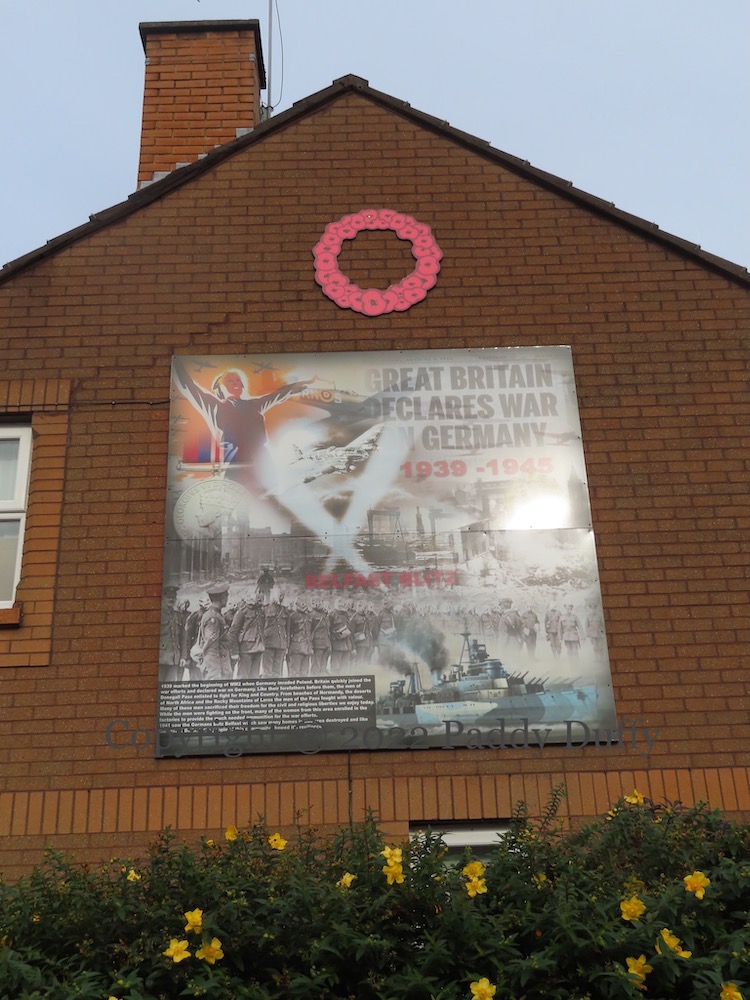
Above: “Great Britain declares war on Germany 1939-1945. 1939 marked the beginning of WW2 when Germany invaded Poland. Britain quickly joined the war efforts and declared war on Germany. Like their forefathers before them, the men of Donegall Pass enlisted to fight for King and Country. From beaches of Normandy, the deserts of North Africa and the Rocky Mountains of Leros the men of the Pass fought with valour. Many of these men sacrificed their freedom for the civil and religious liberties we enjoy today. While the men were fighting on the front, many of the women from this area enrolled in the factories to provide the much needed ammunition for the war efforts. 1941 saw the Germans Blitz Belfast which saw many homes in this area destroyed and like the rest of Belfast, the people of this community shows it’s [sic] resilience.”
“The war is over. Armistice Day 1918. 11th month, 11th day, 11th, hour.” “But in their eyes shall shine the holy glimmers of goodbyes … Their flower the tenderness of patient minds, and each slow dusk a drawing down of blinds.” Lines from Wilfred Owens’ (1893-1918) ‘Anthem For Doomed Youth‘ on a new board in Lindsay Street.
The text at the bottom reads: “The last three months of WWI became known as the hundred days. Realising they were defeated an armistice was signed by the Germans. Germany finally surrendered and WWI ended on November 11th 1918. The terms of the agreement called for the end of fighting along the entire Western Front to begin a precisely 11 am that morning. Records show that the last British soldier killed in WWI was Private George Edwin Allison of the 5th Royal Irish Lancers. He was killed at Mons at 09:30 am, just 90 minutes before the ceasefire.”
Computer-generated board in Lindsay Street showing a map of the northern end of the Western Front and images of soldiers marching, on horseback, and in the trenches: Donegall Pass remembers 1914-1918 – the great sacrifice. Lest we forget. Here are commemorated the many local men who during the Great War of 1914-1918 gave the most that man can give: life itself for God for King and Country.
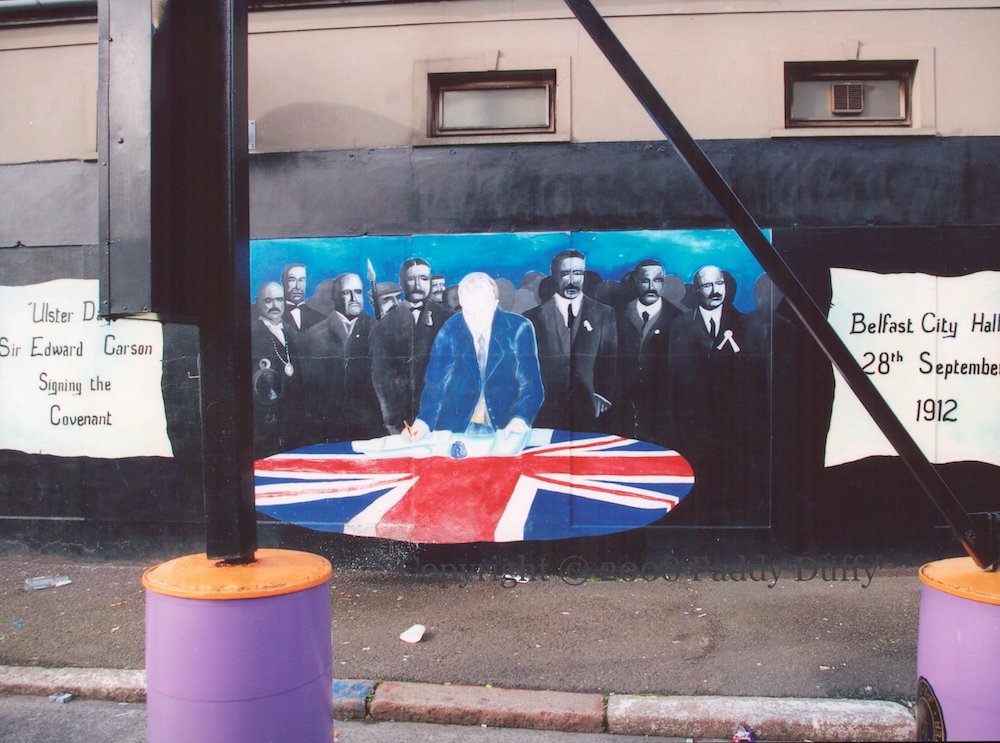
“It is needful that we knit together as one man, each strengthening the other, and not holding back of counting the cost” – Ulster [Unionist] Council Resolution 1912.” “Ulster’s solemn league and covenant. Ulster Day 28th September 1912.” The Council met on September 23rd and 471,000 people signed the covenant (figures here) on or around the 28th – Ulster Day – led by Sir Edward Carson.
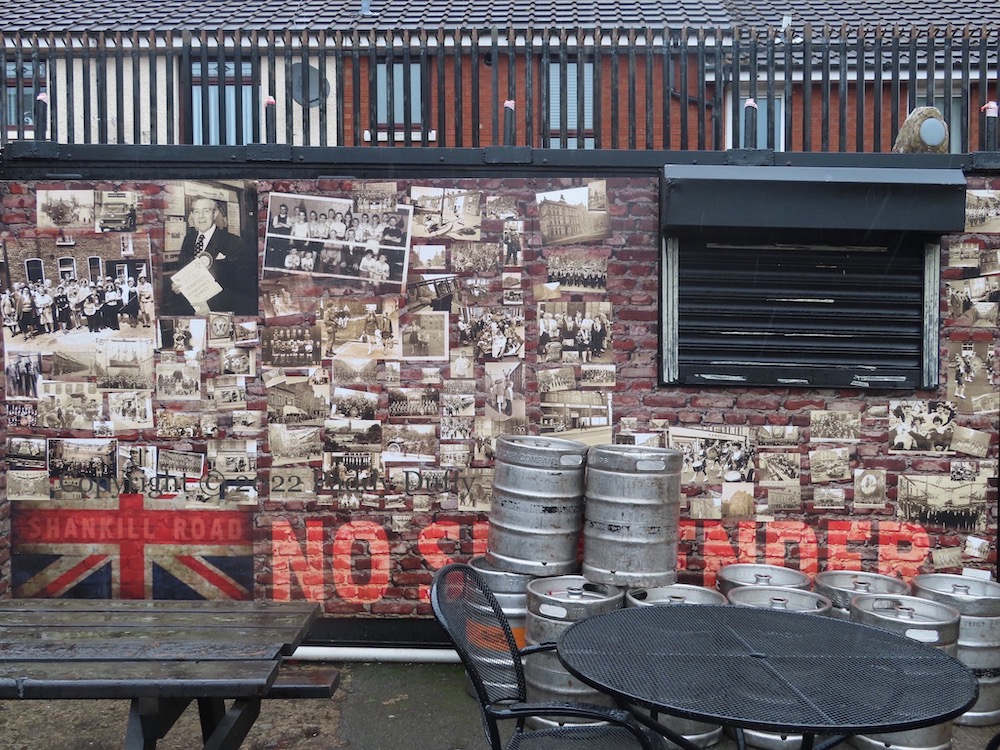
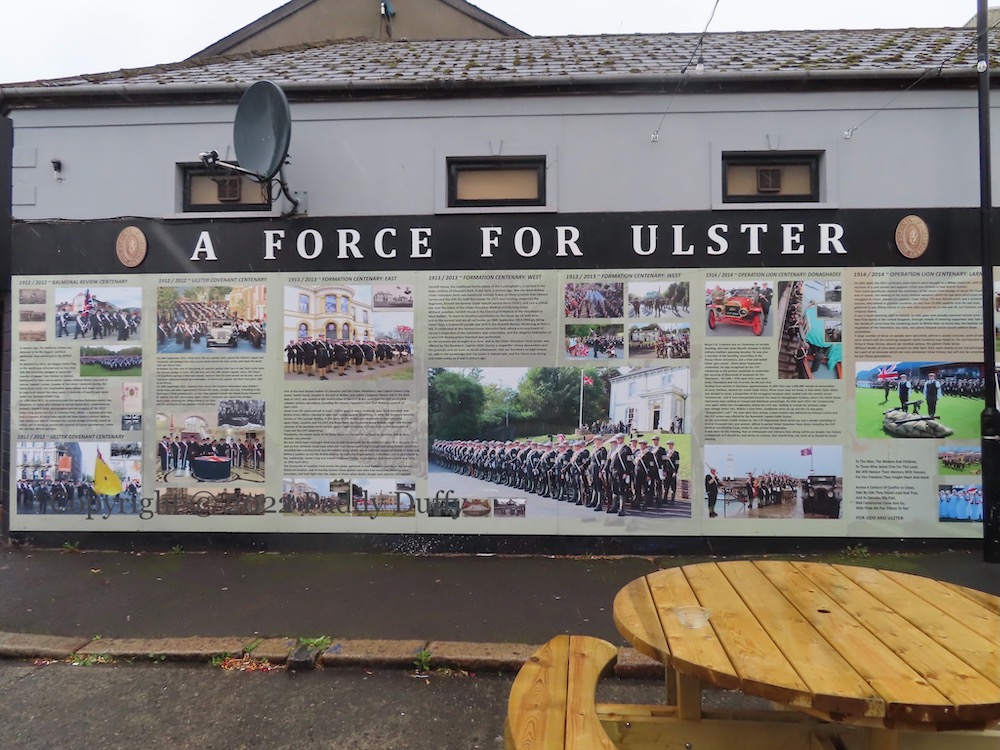
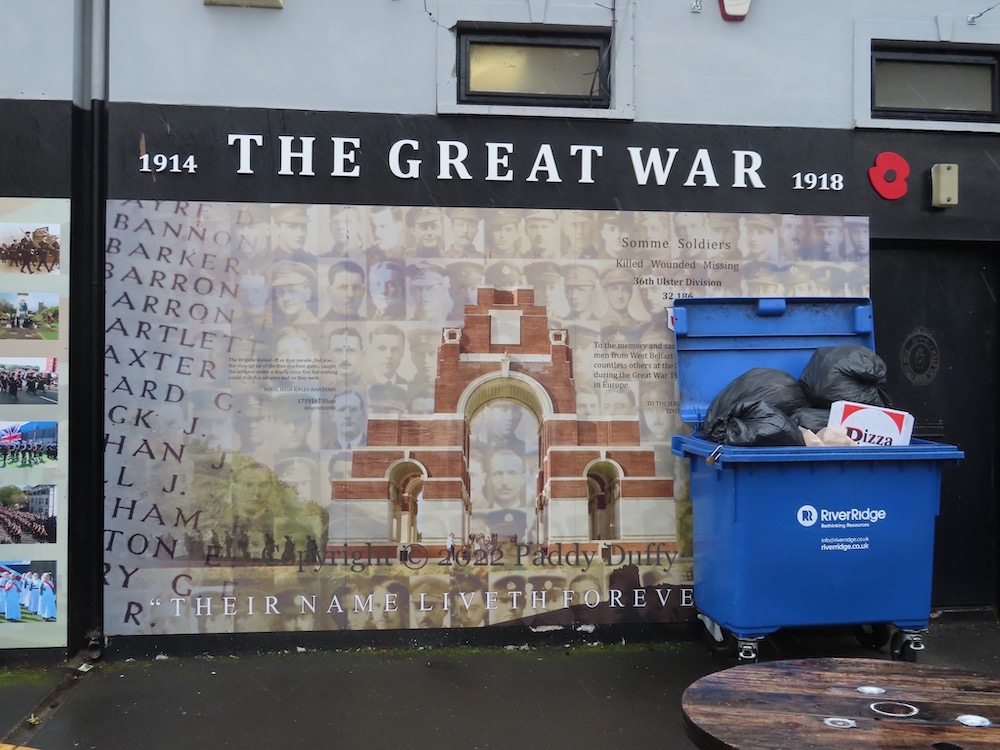
This is the scene at the Rex Bar at (the old) Moscow Street on the Shankill, including, below, three boards describing the formation of the Ulster Volunteers (‘A Force For Ulster’) and using the Thiepval Memorial To The Missing Of The Somme against a background of portraits to commemorate the losses suffered by the 36th (Ulster) Division of the British Army, which the Volunteers became, at the Somme and in other battles, mowed down by “the Hun machine guns” (‘The Great War’). 32,186 men from west Belfast were killed, wounded, or missing. “To them bravery was without limit, to us memory is without end”.
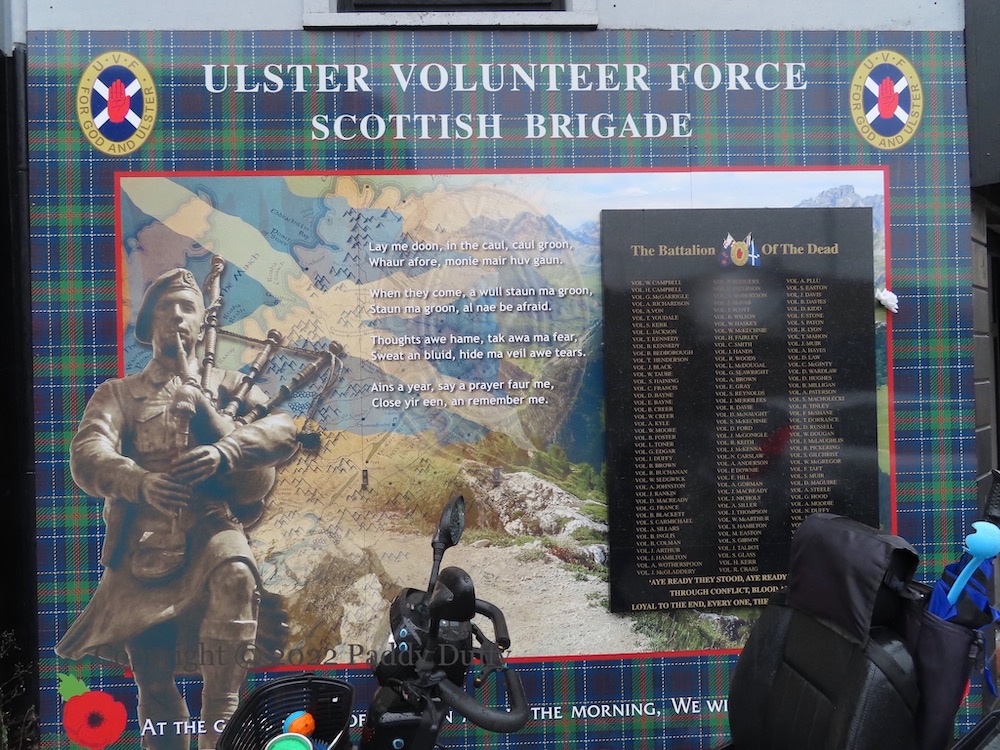
On the Shankill proper (at the newly-christened “Scots Corner”) is a board and plaque to the UVF’s “Scottish Brigade”: “Aye ready they stood, aye ready they fought, through conflict, blood and tears, loyal to the end, every one, the Scottish volunteers.” “Aye ready” was the motto of the 59th Scinde Rifles of the British Indian Army (and later of the Canadian Navy) but is best known from the label of Camp Coffee, in which a Highlander was served a cup of Camp by a Sikh servant (nowadays, they both have a cup of their own).
A Scottish soldier plays the pipes over a list of the “Battalion Of The Dead”, Scottish volunteers from the (modern) UVF. The list is led by William “Big Bill” Campbell, who has had a small plaque in his memory at this spot since (at least) 2014. Preacher and DUP politician George Seawright (see A Crown Of Life) is also included – he was born in Glasgow in 1951.
The 100th anniversary plaque and board shown in this entry are on the spot of Bloomfield House (web), where guns from Clyde Valley were held for the East Belfast battalion of the Ulster Volunteers in 1914.
See also: John Henry Patterson’s involvement in Operation Lion.
“In memory of the men and women from the Orangefield area, who have made the ultimate sacrifice in the defence of our freedom in all theatres of conflict, both foreign and at home.” These boards are memorials to the members of the 8th battalion 36th (Ulster) Division, formed from men from Avoniel and Strandtown.
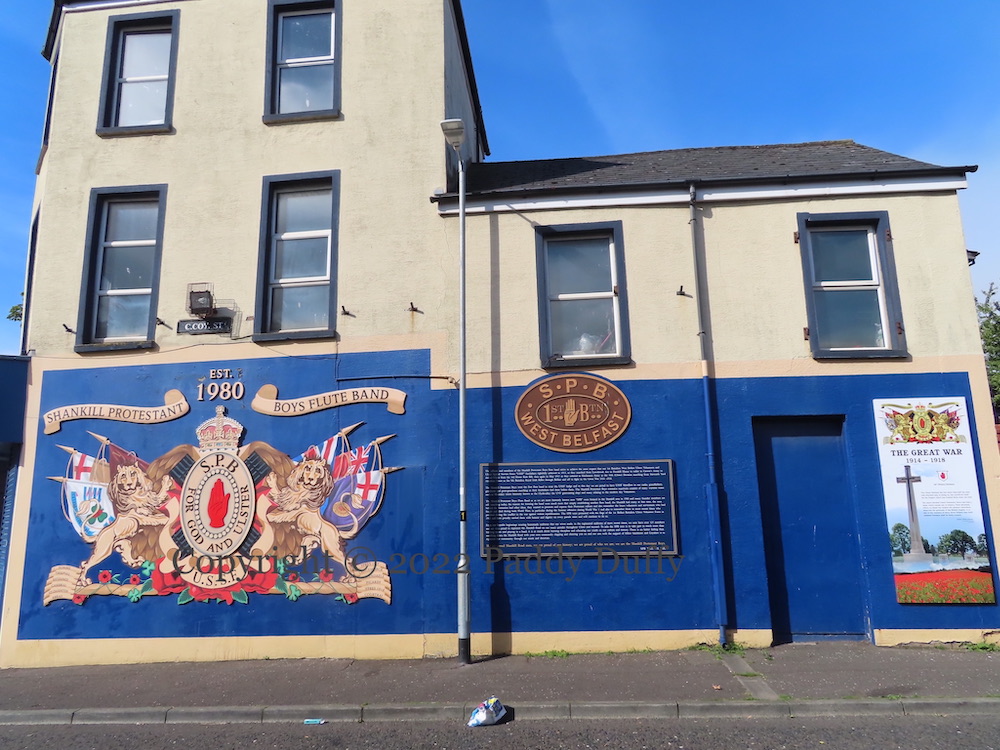
At first glance the piece above looks like a colourful mural but it is in fact a large painted carving of lions rampant on either side of the emblem of the Shankill Protestant Boys flute band, named for the Shankill Boys of the original Ulster Volunteers and the Ulster Special Service Force unit within it which was designed to be a unit of “first responders”, ready to react at short notice to action by republicans or British forces anywhere in northern Ireland (historyireland).
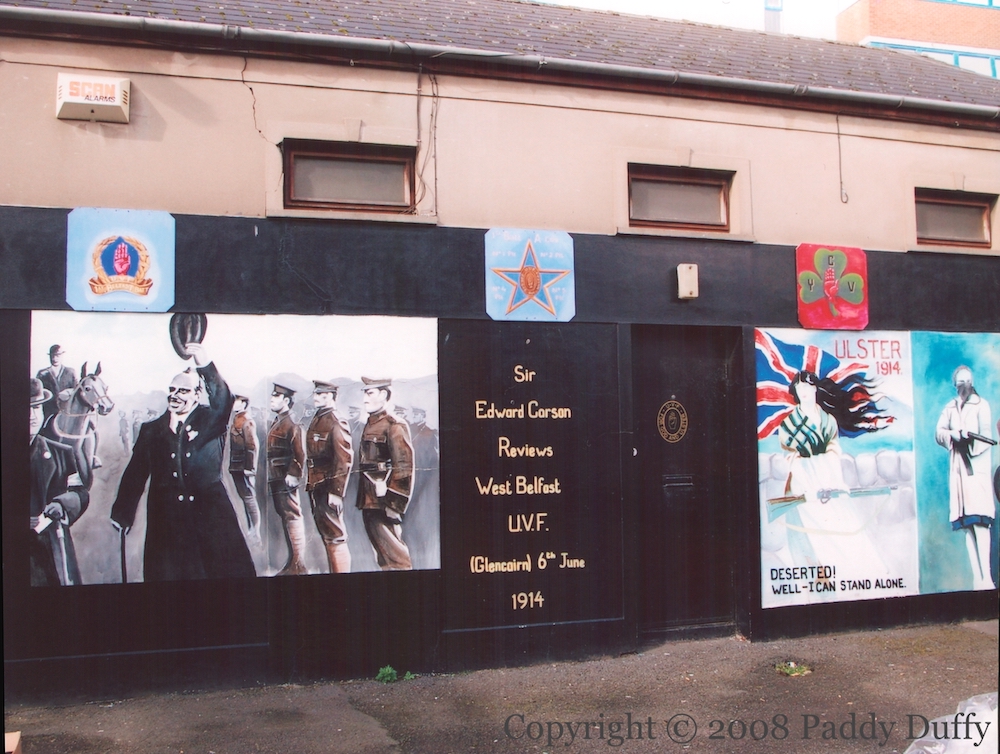
These three panels are in the courtyard of the Rex Bar in what used to be Moscow Street, celebrating resistance to Home Rule – Covenant Day September 28th 1912; the formation of the Ulster Volunteers, being reviewed at Fernhill House in Glencairn Park by Edward Carson; “Deserted! Well I can stand alone“; and (in post-partition Northern Ireland) “a Protestant farmer’s wife guards her husband against sectarian attack from across the border”.
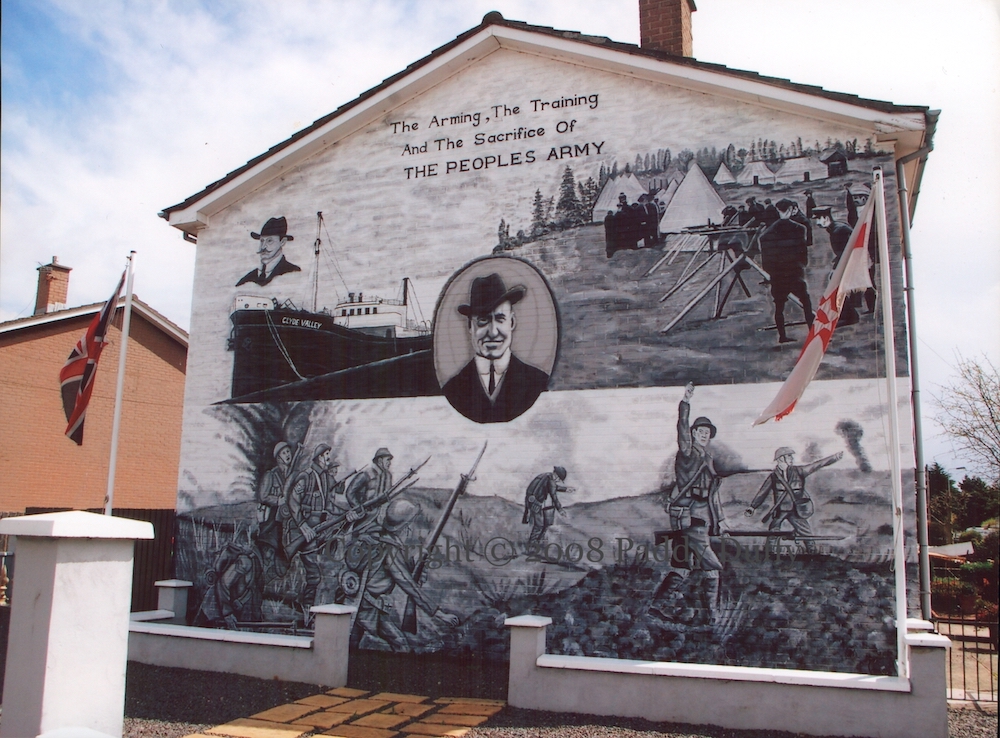
“The arming, the training, and the sacrifice of The People’s Army.” The arming of the Ulster Volunteers (top left) comes from the guns smuggled into Larne on the Clyde Valley. The training of the Ulster Volunteers shown (top right) is probably at Ballywalter. The sacrifice (bottom) is the 36th (Ulster) Division going over the top in James Beadle’s painting ‘Charge of the 36th (Ulster) Division, Somme, 1st July 1916’.
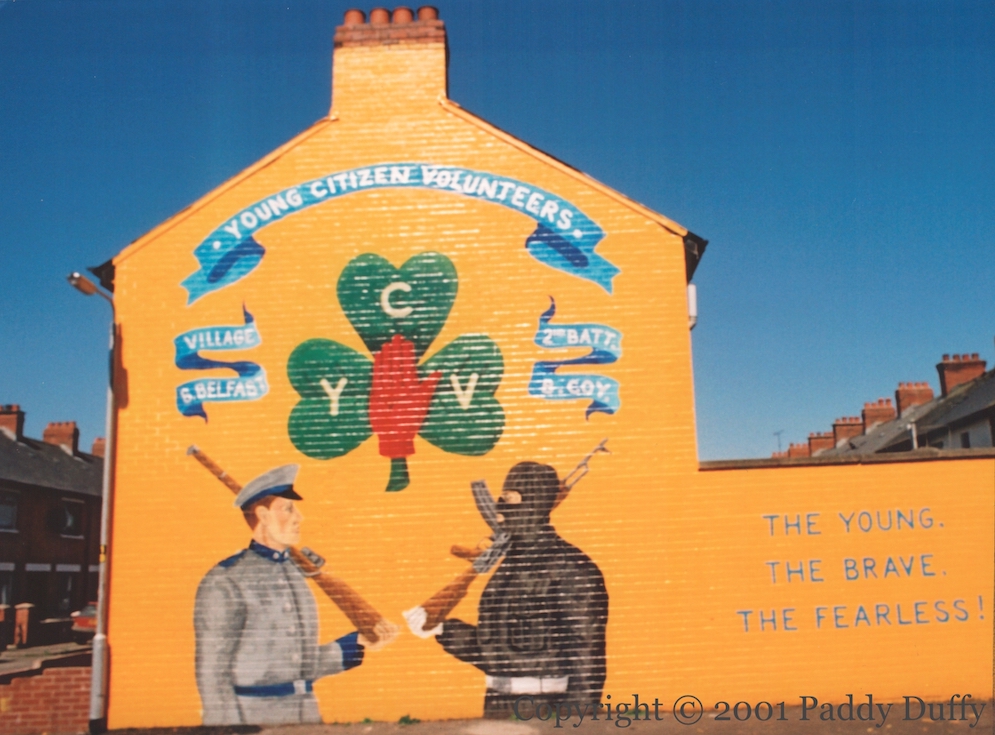
“Village, south Belfast, 2nd battalion, B company.” Young Citizen Volunteers of both the Home Rule (1912) and Troubles periods are shown shouldering rifles.








 Paddy Duffy Collection