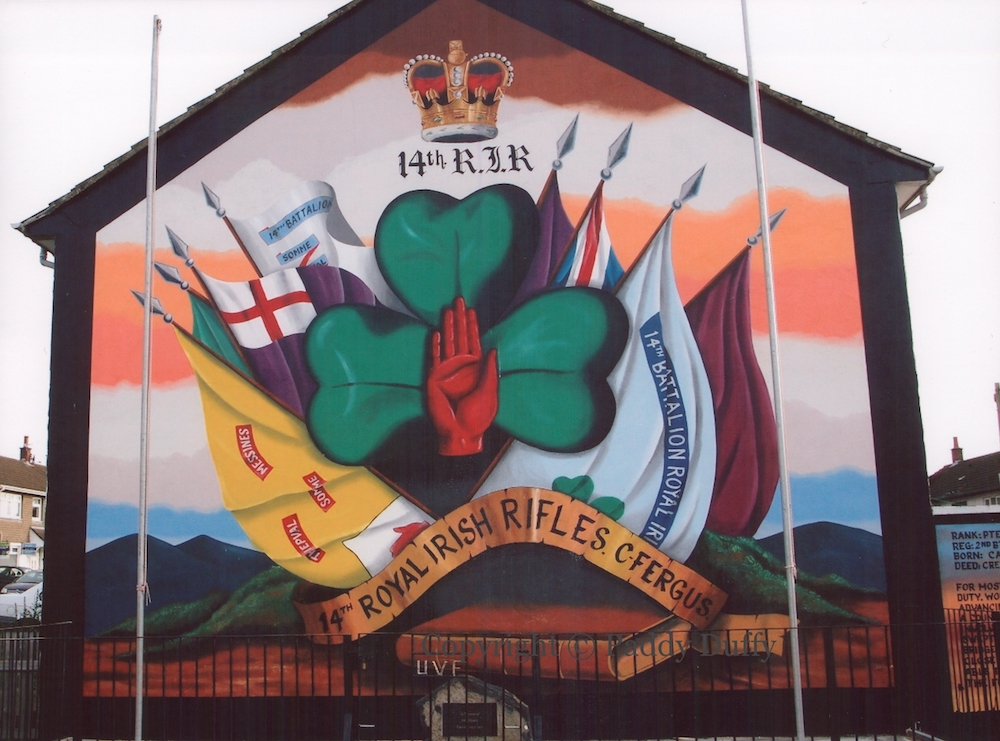
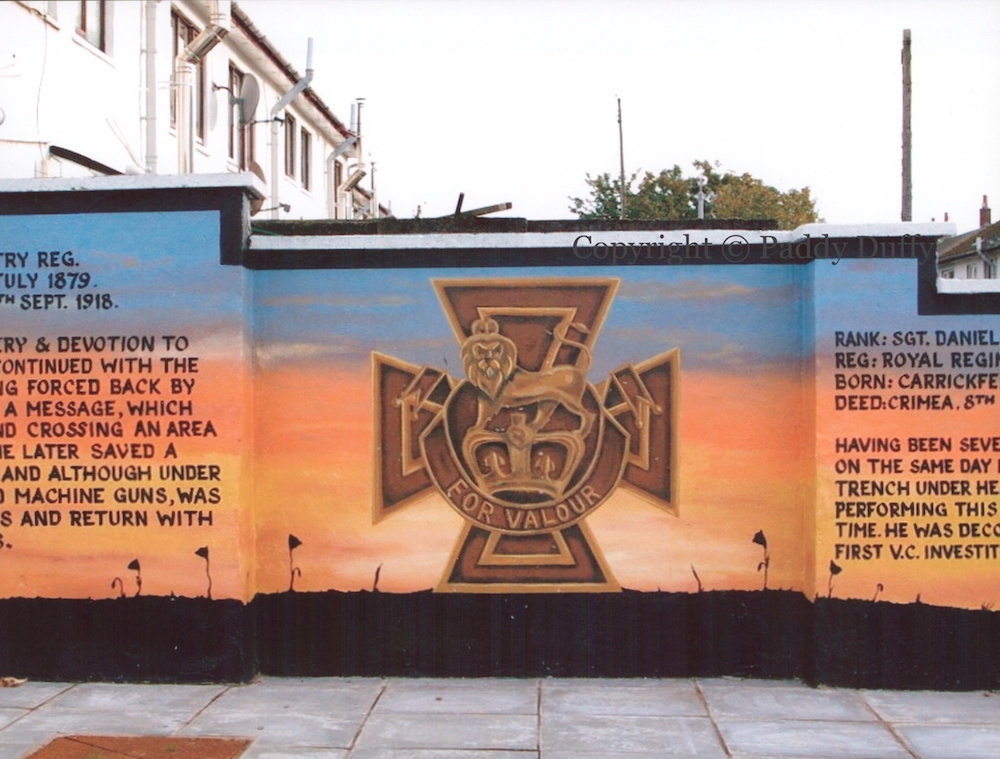
The bravery of two Carrickfergus natives, which won each of them the VC, is recounted on the side-wall to a larger 14th Royal Irish Rifles (YCV) mural. Pte. James Crichton served with New Zealand infantry in France (in WWI) and Sgt. Daniel Cambridge served in Crimea.
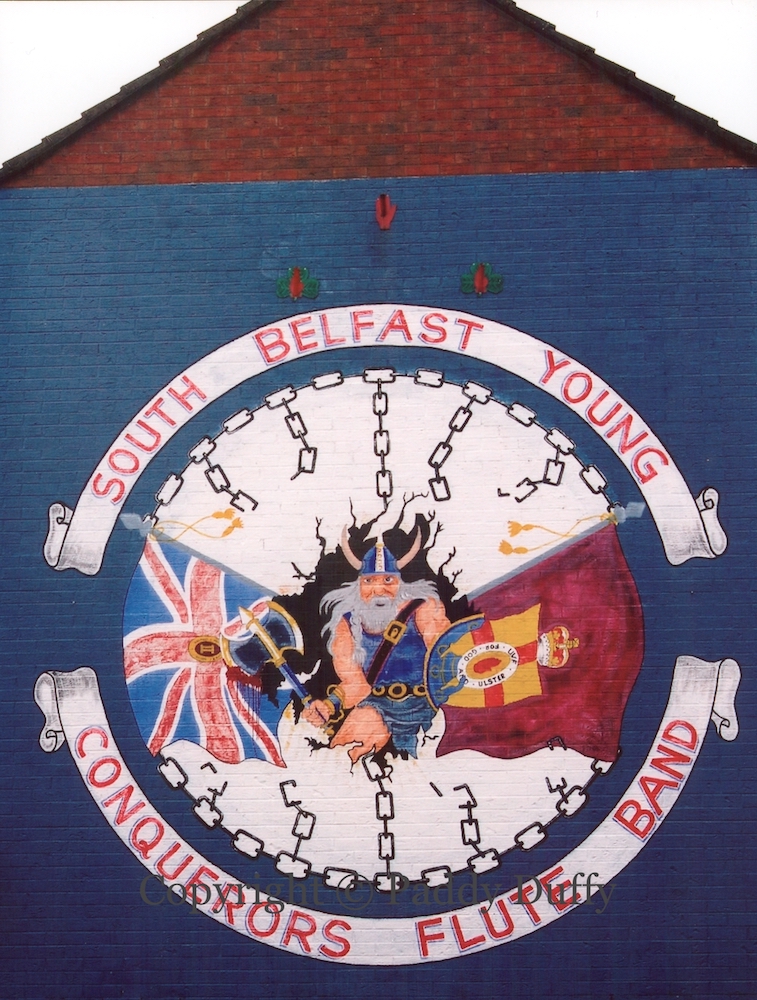
Young Conquerors flute band (Fb) mural in Donegall Pass. Flanking the central viking are (left) the flag of Ulster Volunteers south Belfast battalion and (right) the USSF flag.
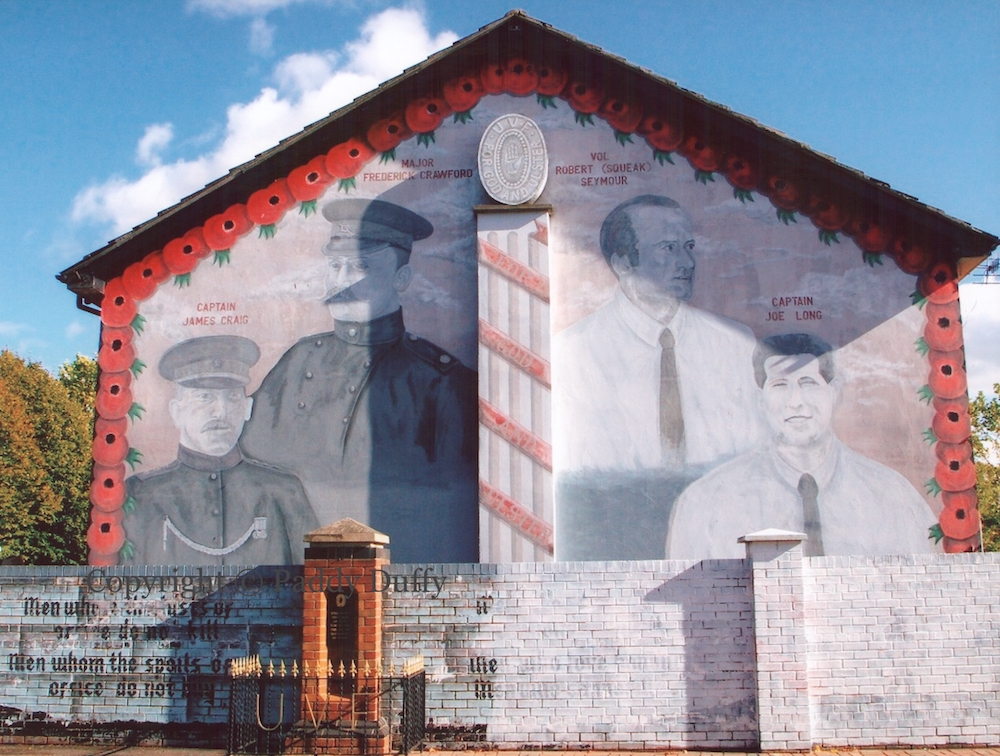
“Men whom the lusts of office do not kill/Men whom the spoils of office do not buy/Men who possess opinions and will/Men who love honour; men who cannot lie” – part of a poem by Josiah Gilbert Holland.
The men on the left of the mural are Captain James Craig (who fought in the Second Boer War before becoming a unionist leader, organiser of the the Ulster Volunteers, and first Prime Minister Of Northern Ireland) and Major Frederick Crawford, who fought in both Boer Wars and organised the Larne gunrunning.
The four others, listed both on the plaque in front of the mural and on the stone in the memorial garden (constructed in 2003) are UVF volunteers Robert Seymour, shot dead by the PIRA; James Cordner and Joseph Long, who were killed in a premature explosion, and Robert Bennett, killed by the British Army during a riot. (Seymour and Long are on the right of the mural.)
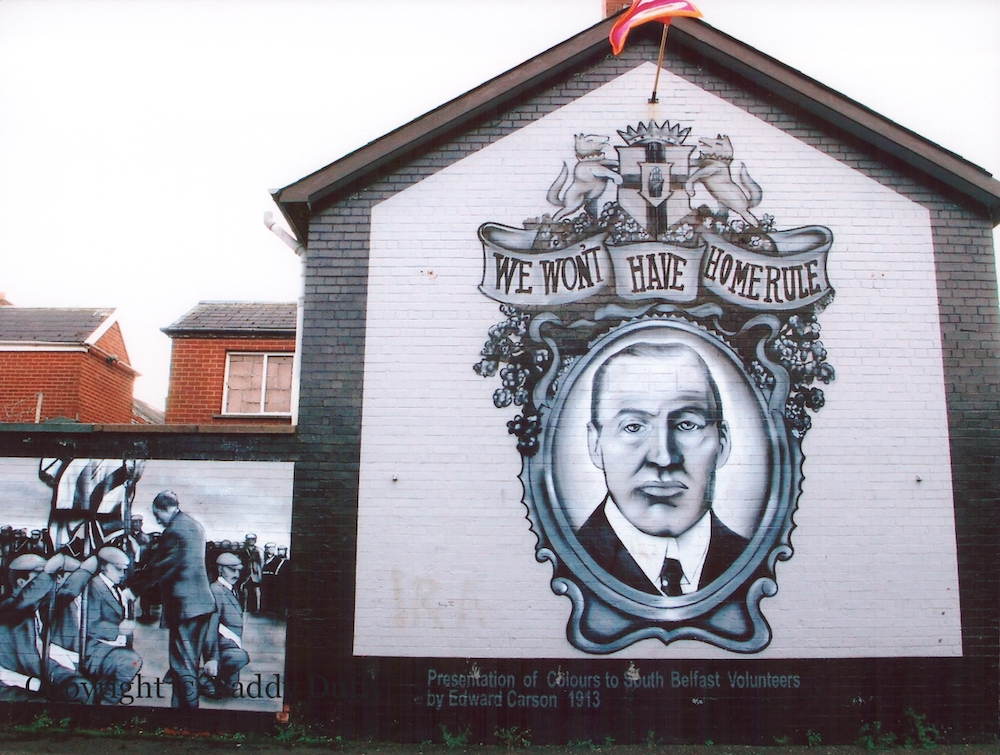
“Presentation of colours to South Belfast Volunteers by Edward Carson 1913.” According to the Digital Repository Of Ireland, however, the scene depicted is Carson and the Central Antrim Volunteers in 1914.
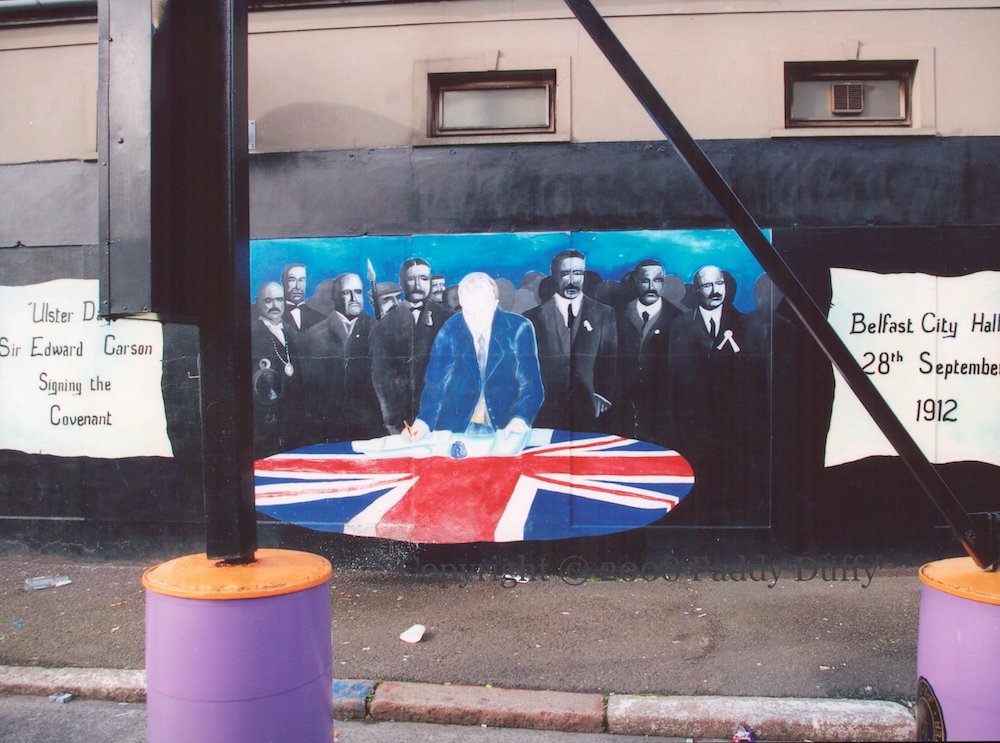
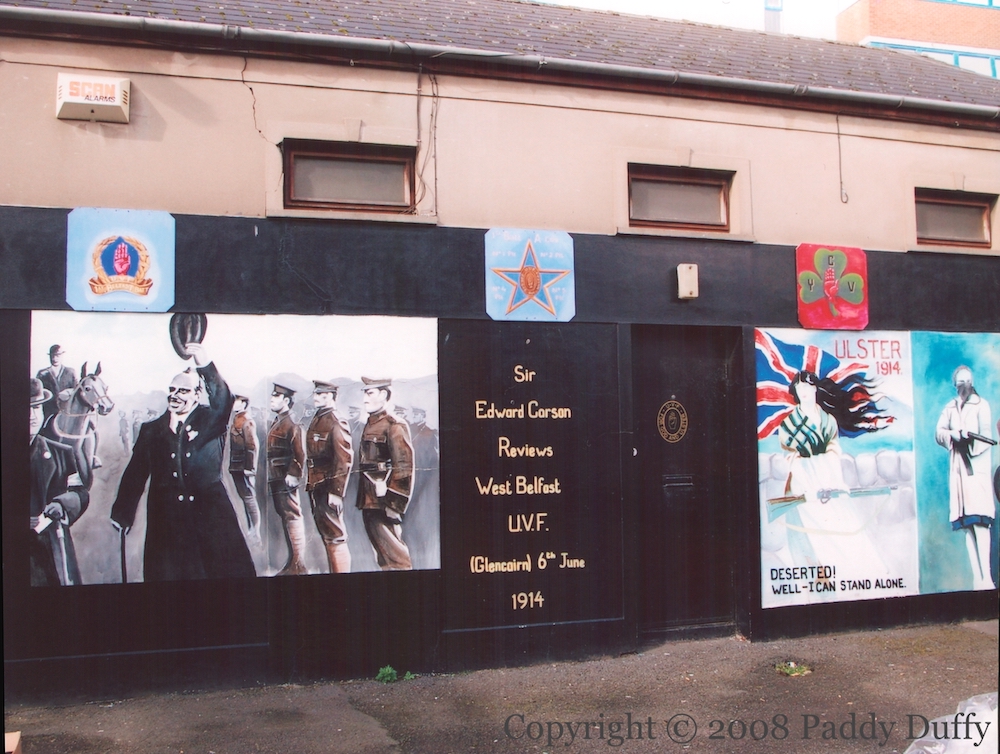
These three panels are in the courtyard of the Rex Bar in what used to be Moscow Street, celebrating resistance to Home Rule – Covenant Day September 28th 1912; the formation of the Ulster Volunteers, being reviewed at Fernhill House in Glencairn Park by Edward Carson; “Deserted! Well I can stand alone“; and (in post-partition Northern Ireland) “a Protestant farmer’s wife guards her husband against sectarian attack from across the border”.
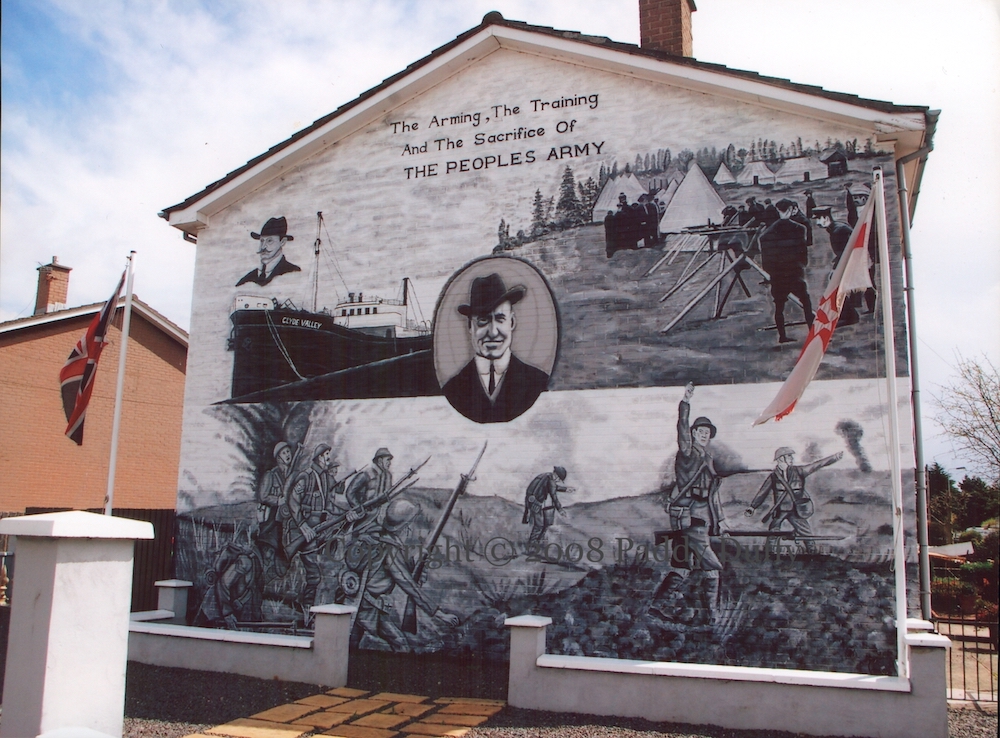
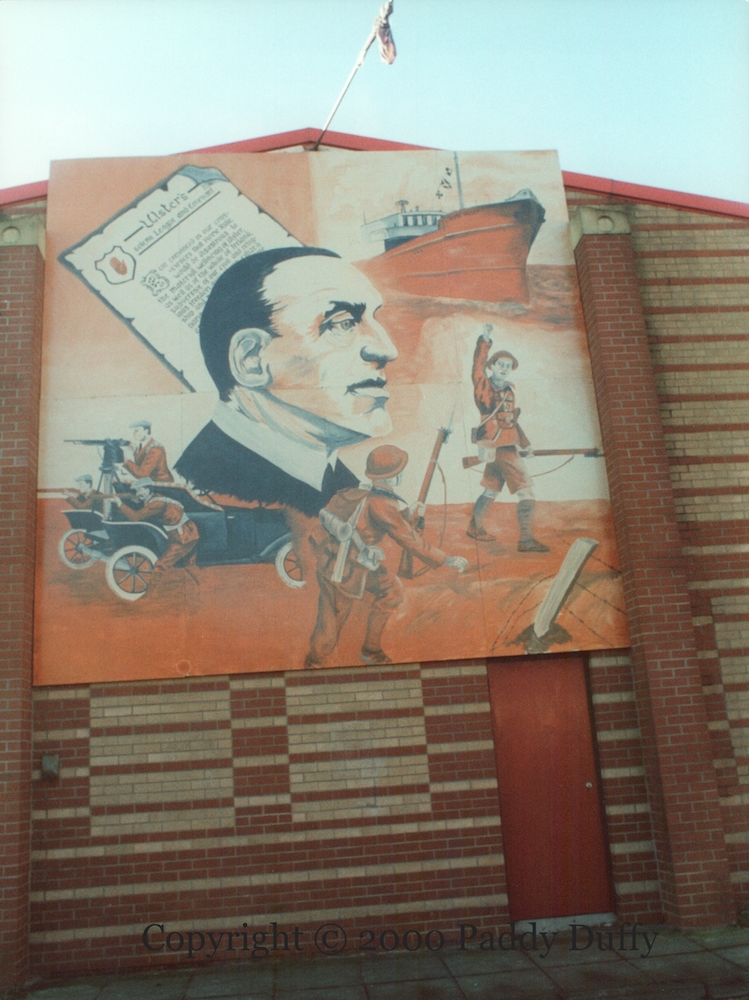
“The arming, the training, and the sacrifice of The People’s Army.” The arming of the Ulster Volunteers (top left) comes from the guns smuggled into Larne on the Clyde Valley. The training of the Ulster Volunteers shown (top right) is probably at Ballywalter. The sacrifice (bottom) is the 36th (Ulster) Division going over the top in James Beadle’s painting ‘Charge of the 36th (Ulster) Division, Somme, 1st July 1916’.
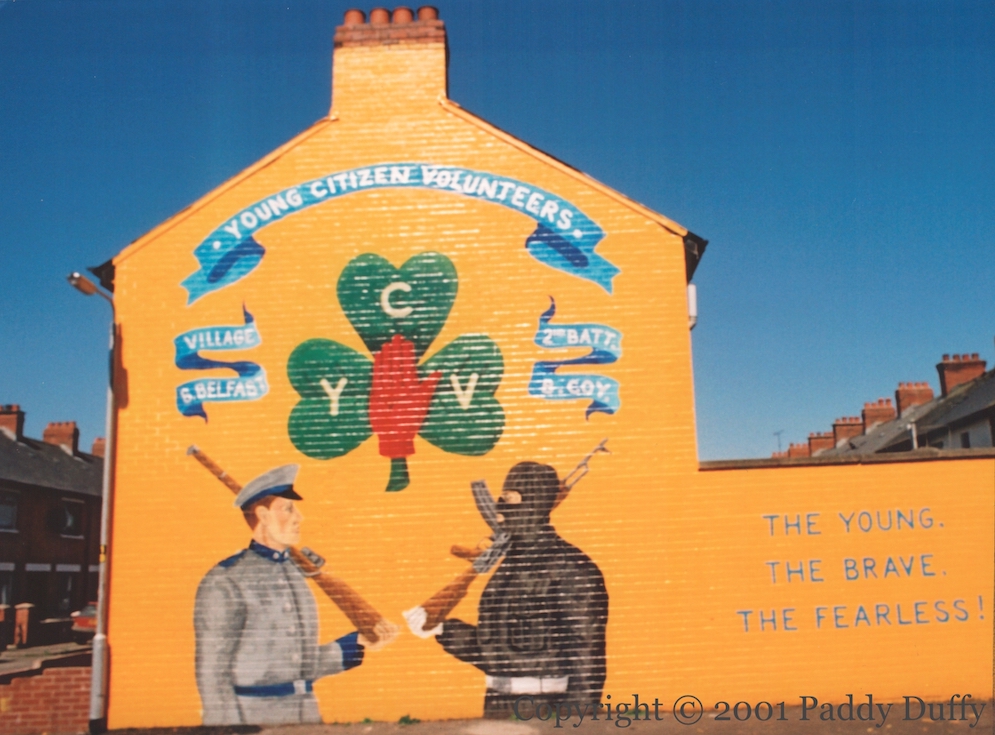
“Village, south Belfast, 2nd battalion, B company.” Young Citizen Volunteers of both the Home Rule (1912) and Troubles periods are shown shouldering rifles.
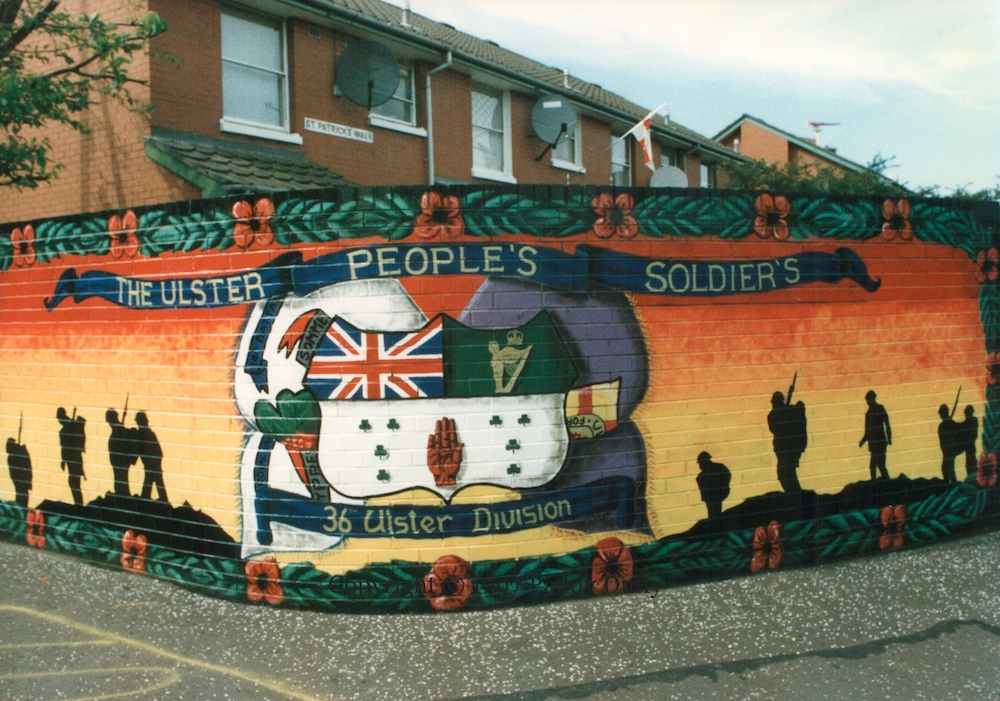
The Ulster Volunteers were formed in response to the Home Rule bill of April 1912 and the Covenant signed in September 1912, first by Edward Carson and then by almost half a million others. Guns were smuggled into Larne on the Clyde Valley in April 1914 but the advent of the World War saw the volunteers instead joining the British Army, specifically the 36th (Ulster) Division, and went over the top at the Somme.
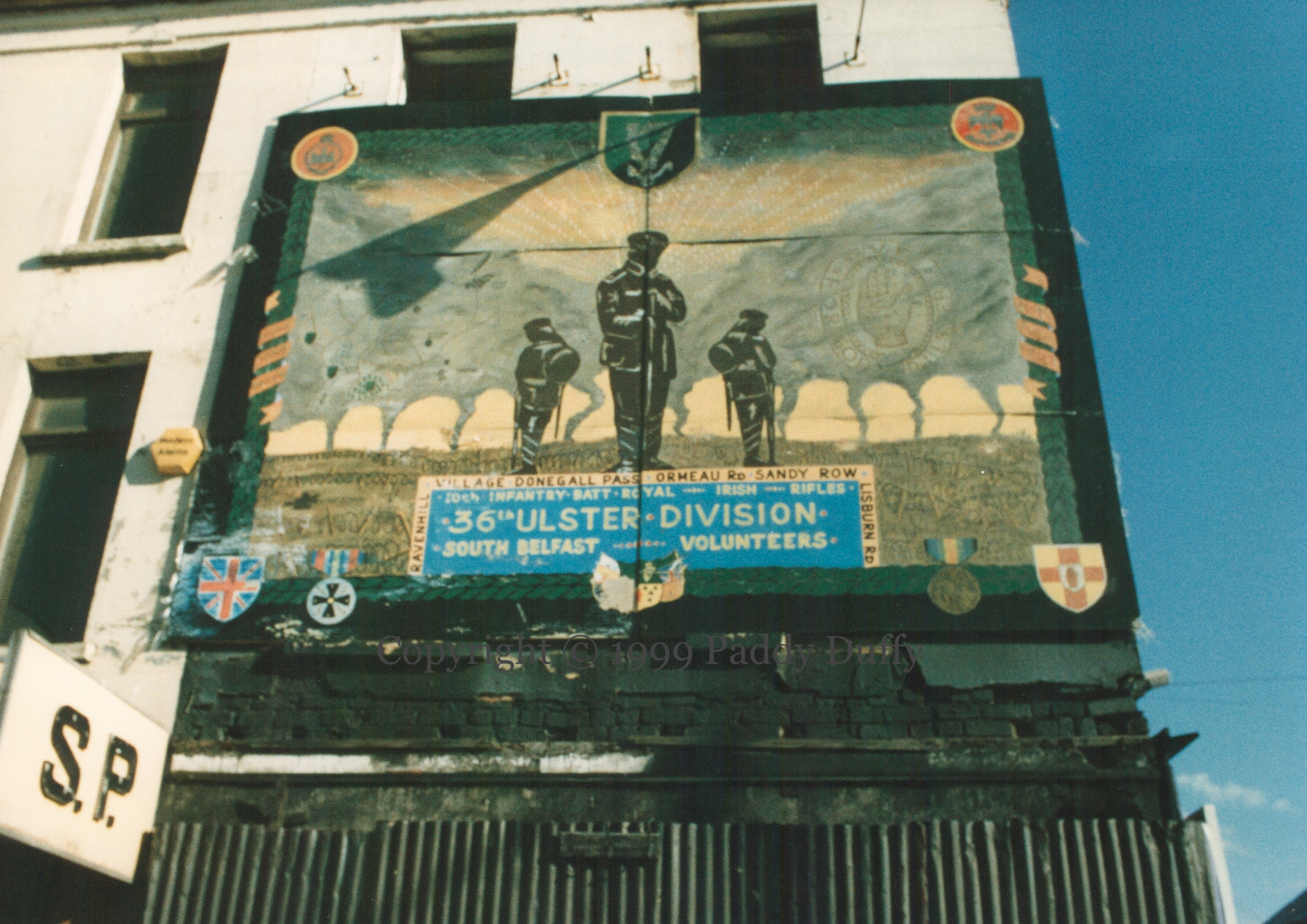
Along the top are the emblems of the Royal Inniskilling (27th) Fusiliers (featuring Crom castle), Royal Irish Rifles (featuring the Maid Of Erin harp), Royal Irish Fusiliers (featuring the barossa eagle).
Wrapped around the left column are “Ballykinler, Finner, Clandeboye” – three of the training camps of the 36th. Wrapped around the right column is “Lest we forget”.
The central text reads: “Ravenhill – Village – Donegall Pass – Ormeau Rd – Sandy Row – Lisburn Rd. 10th infantry battalion Royal Irish Rifles, 36th (Ulster) Division, South Belfast Volunteers”
The Union Flag appears in the lower left, next to an unidentified medal, while the flag of Ulster (rather than Northern Ireland, which did not yet exist) appears in the lower right, next to a Victory medal. (In a previous version of this painting, the Union Flag was a VC and the medal was a Distinguished Conduct Medal.) Between them is the emblem of the 36th Division.
The main image shows three graveside mourners standing in a field of barbed wire and in front of ?mis-shapen tombstones?, all against a background of sunrise over a mountain on which have been superimposed (left) a map of the Somme and (right) a large UVF emblem.
Painted by Ron McMurry on boards. Donegall Pass, south Belfast
 Paddy Duffy Collection