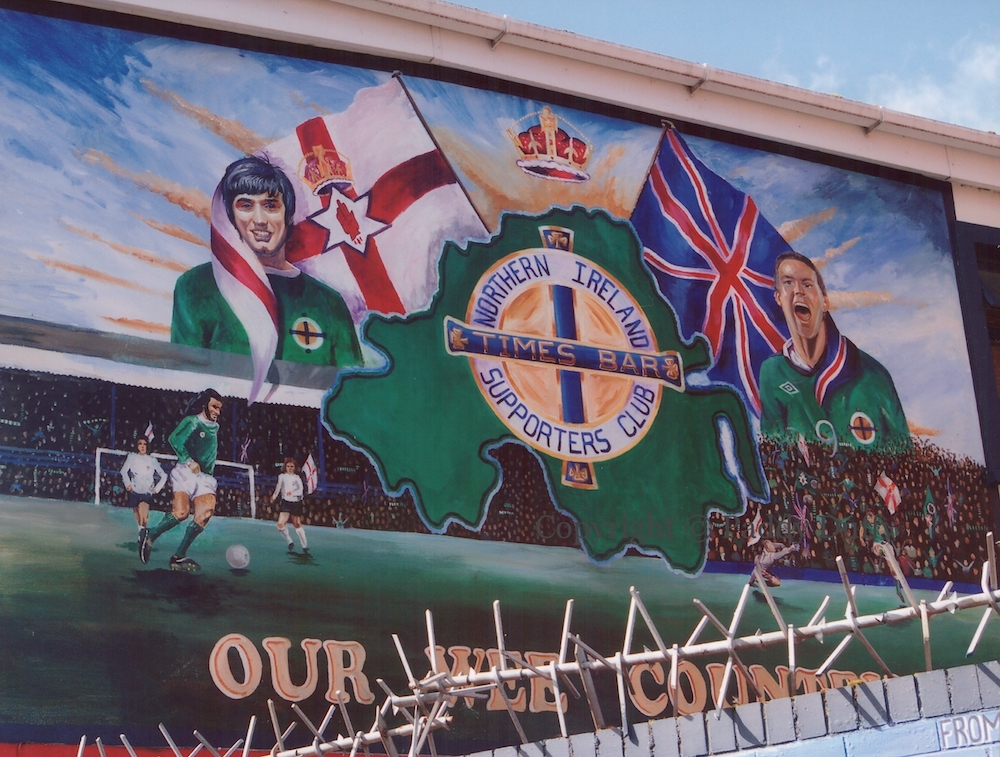
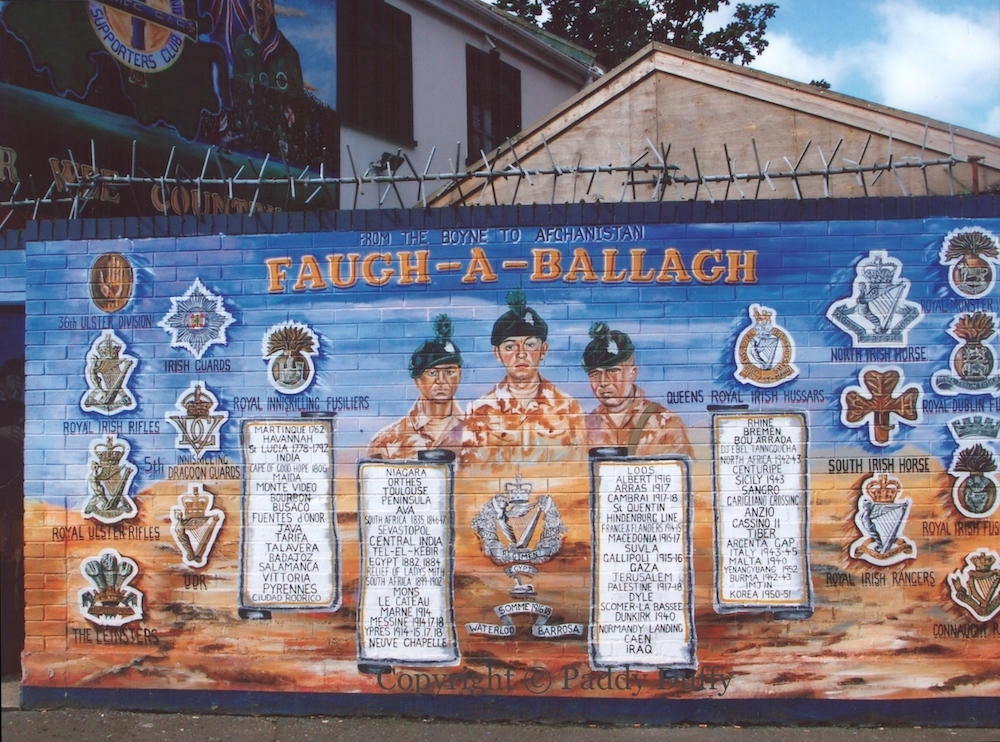
Here are two murals from the Times Bar in York Road, north Belfast.
First (above), a mural celebrating the Northern Ireland football team with the slogan “our wee country”. George Best is on the left and David Healy on the right.
Second, under the title “Faugh-A-Ballagh”, the motto of the Royal Irish Fusiliers (and more recently of the Royal Irish Regiment), a mural commemorating Irish and Northern Irish service in the British military. Robert Blair “Paddy” Mayne is featured on the left (WP). A plaque in the middle reads: In memory of Pte. F.G. Dolloghan, Parachute Regt. Killed at the Nijmegan Bridges, Holland, Sept. 1944. (WWII’s Operation Market Garden (WP))
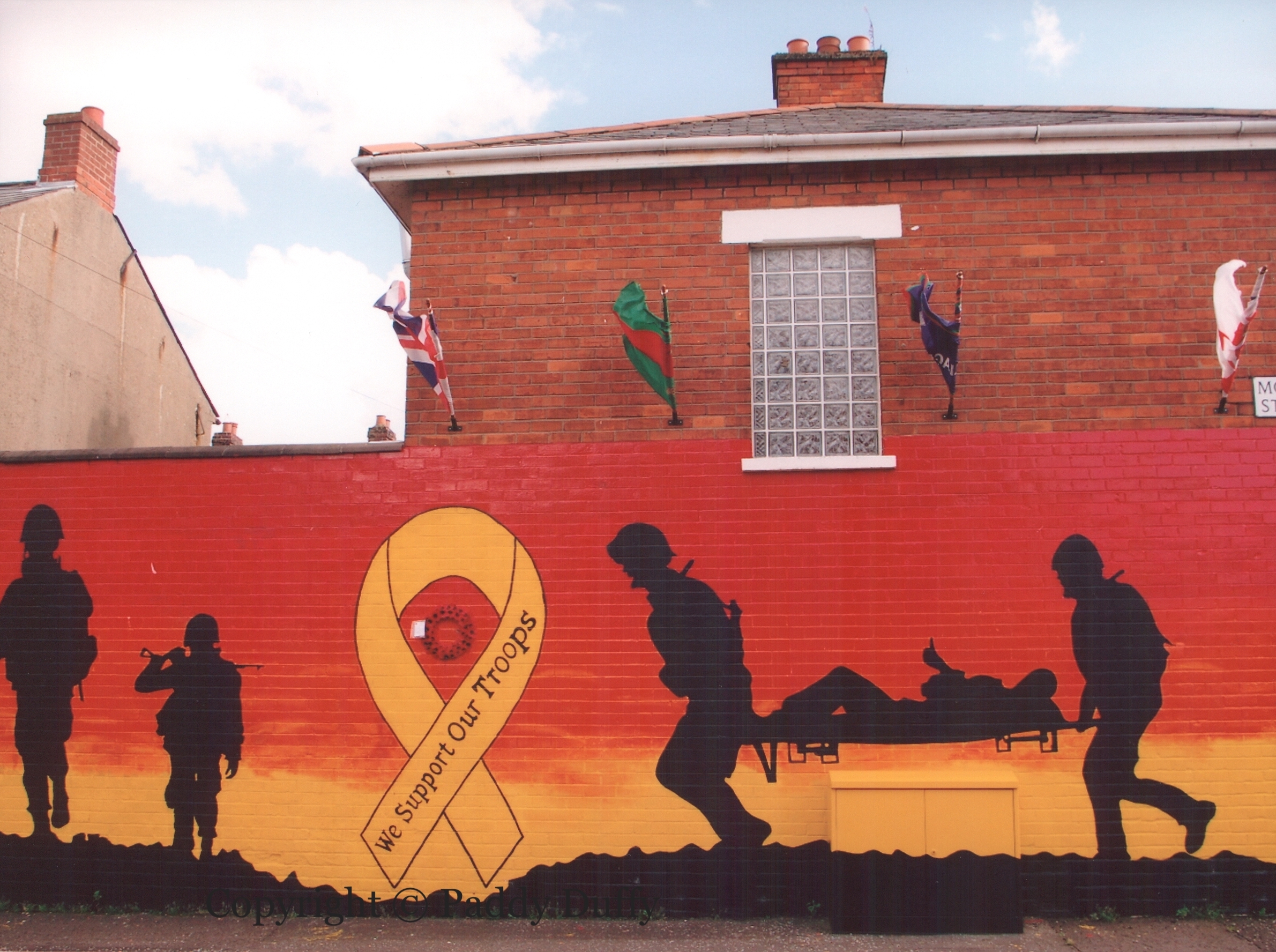
The photograph of a stretchered soldier giving a ‘thumbs up’ (shown below) was set up and photographed by Captain Ed Hodges of the King’s Royal Hussars in Basra, Iraq, in 2007 (Daily Mail). In silhouette (as shown here) it has become the icon of the Help For Heroes charity raising money for British forces.
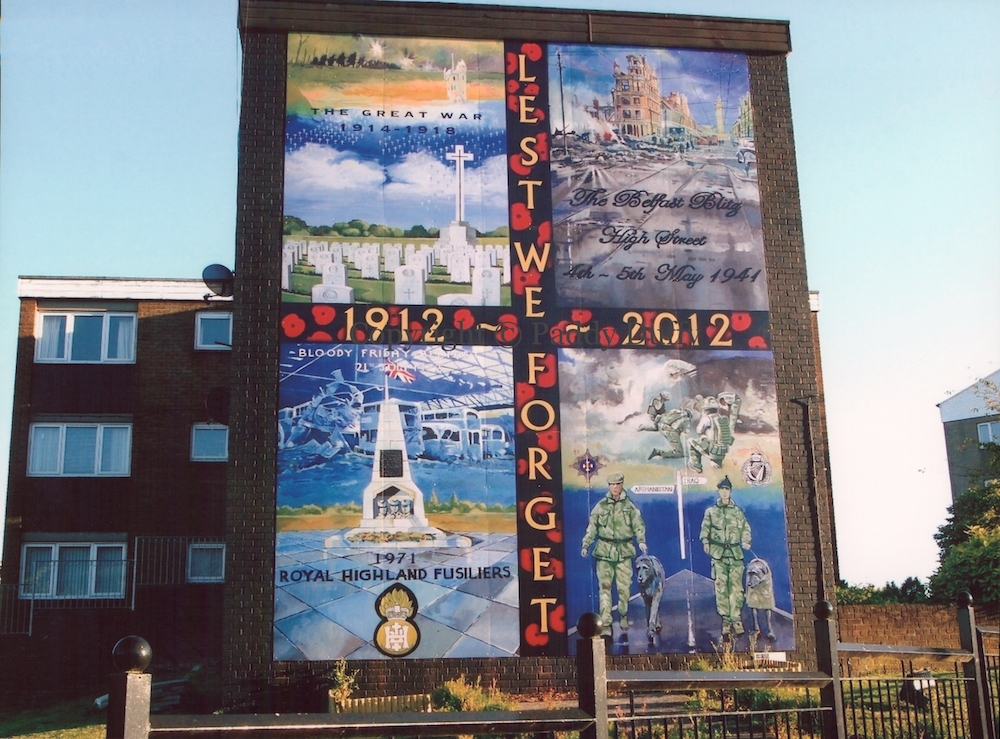
The three-storey mural above is in Ballysillan and replaced a UVF mural when it was added in 2011. The mural is the work of Jim Russell while artist-in-residence at Arts For All. The information below was provided by Arts For All.
The Great War: The first panel commemorates the Great War that ravaged Europe from 1914 to 1918 and shows troops advancing into battle, the Ulster Tower at Thiepval commemorating the sacrifice at the Somme and an image showing one of the war cemeteries and highlighting the true cost of war.
Second World War: The second panel features some of the devastation visited upon Belfast during a series of Luftwaffe raids during the early years of the Second World War. Belfast suffered greatly with over 1,000 people dying in four nights of bombing in April and May of 1941.
The Troubles: In the third panel highlight the dark history known as the Troubles. It features two events from the years of that time – the murder of the three young off-duty Scottish soldiers in 1971 [the monument depicted was featured in The Highland] and the Bloody Friday bombings of July 1972. In the midst of the horror that accompanied the early years of the Troubles these events still caused many to struggle to understand how people could carry out such atrocities.
Present Day Conflict: Panel four brings us up to the present day. Military service is a tradition for many in Northern Ireland and for many their first overseas trip came on the back of an overseas posting whilst serving in one of the Armed Forces. From times past, through the World Wars, the Korean War, to more recent conflicts in Iraq and Afghanistan soldiers and regiments drawn from Norther Ireland continue to play a role.
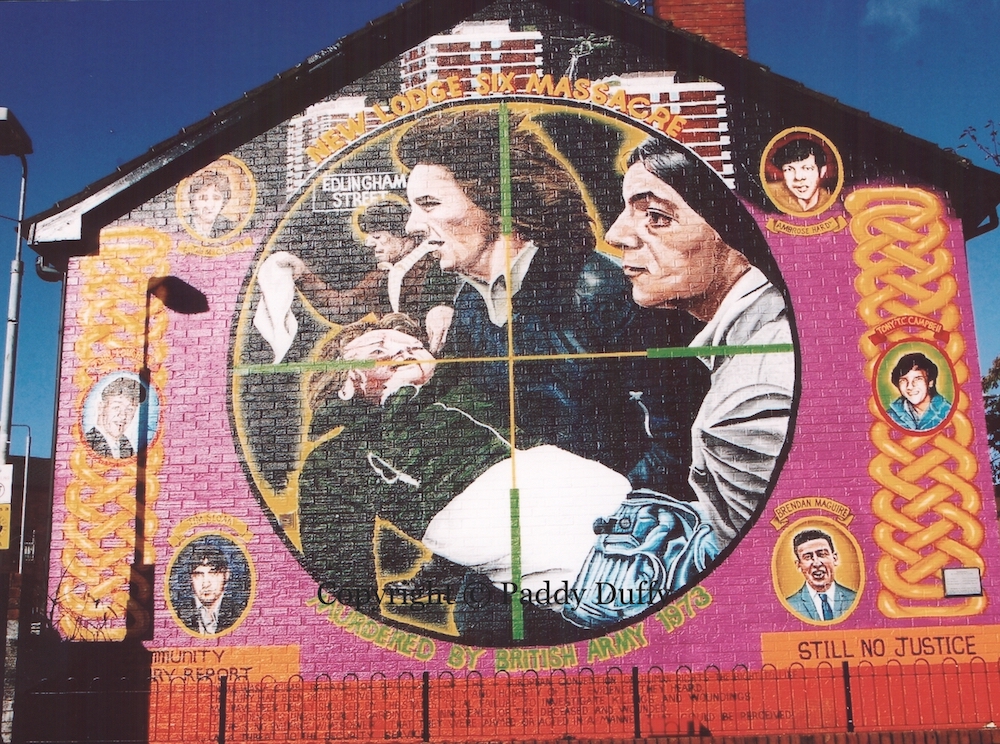
“Community Inquiry Report: There was a clear breach of Article 2 of the European Convention On Human Rights, the right to life. The jury was deeply moved by the integrity and honesty of the evidence they heard. We have been deeply shocked by the state’s total failure to investigate killings and woundings. The evidence is unequivocal regarding the innocence of the deceased and wounded. There is no evidence whatsoever that they were armed or acted in a manner that could be perceived as a threat to the security services.”
Two of the New Lodge Six (James Sloan, James McCann) were killed by the UDA outside a bar and four (Tony ‘TC’ Campbell, Ambrose Hardy, Brendan Maguire, John Loughran) were among the crowd that gathered, killed by British Army snipers from their positions on top of the flats, using night-vision sights, February 3rd-4th, 1973. Sınn Féın politician Gerry Kelly spoke at the launch.
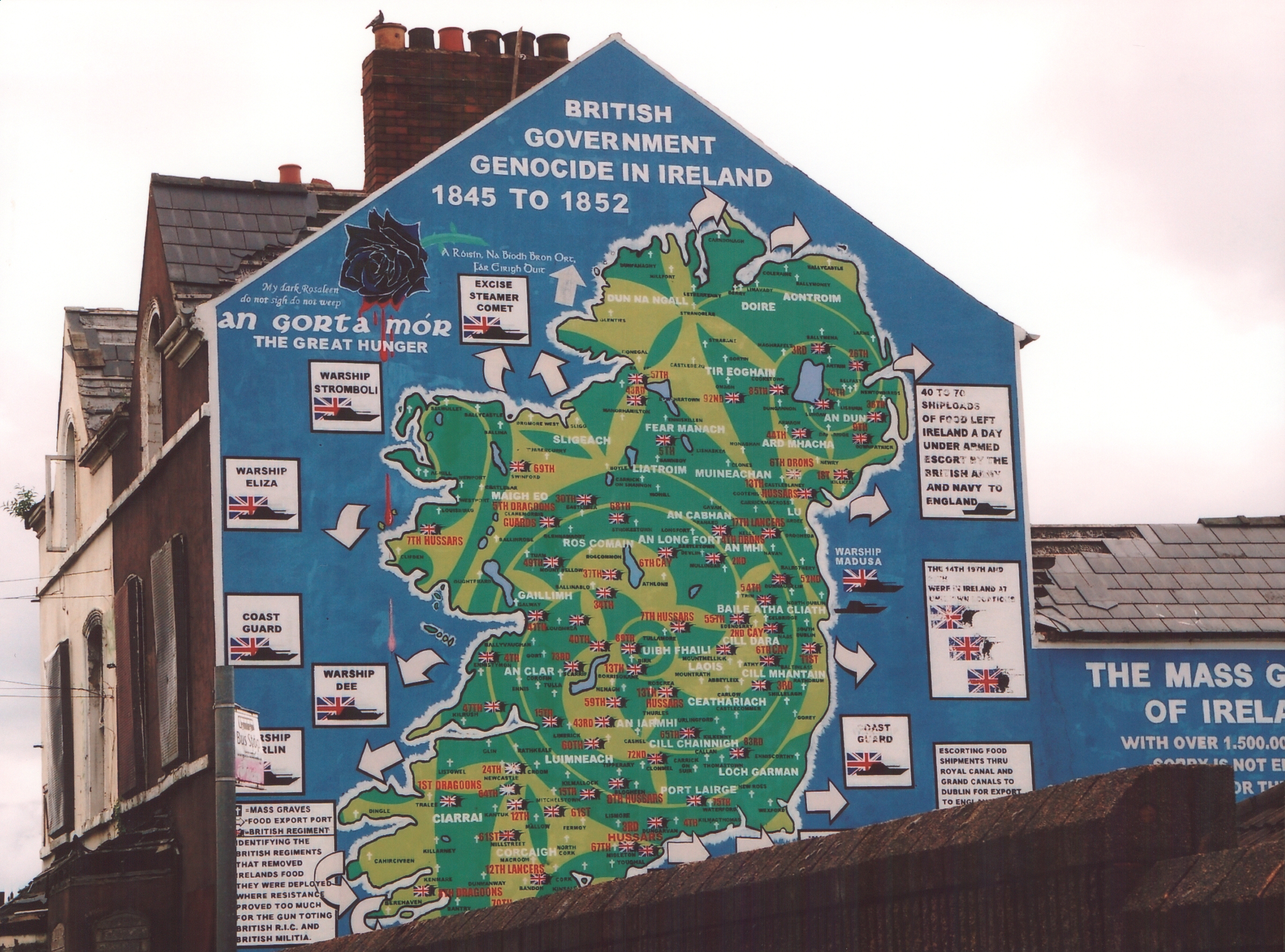
In 1997, the office of then-Prime Minister Tony Blair issued a statement acknowledging that the administration of the time of the Hunger failed to intervene (Guardian | Independent).
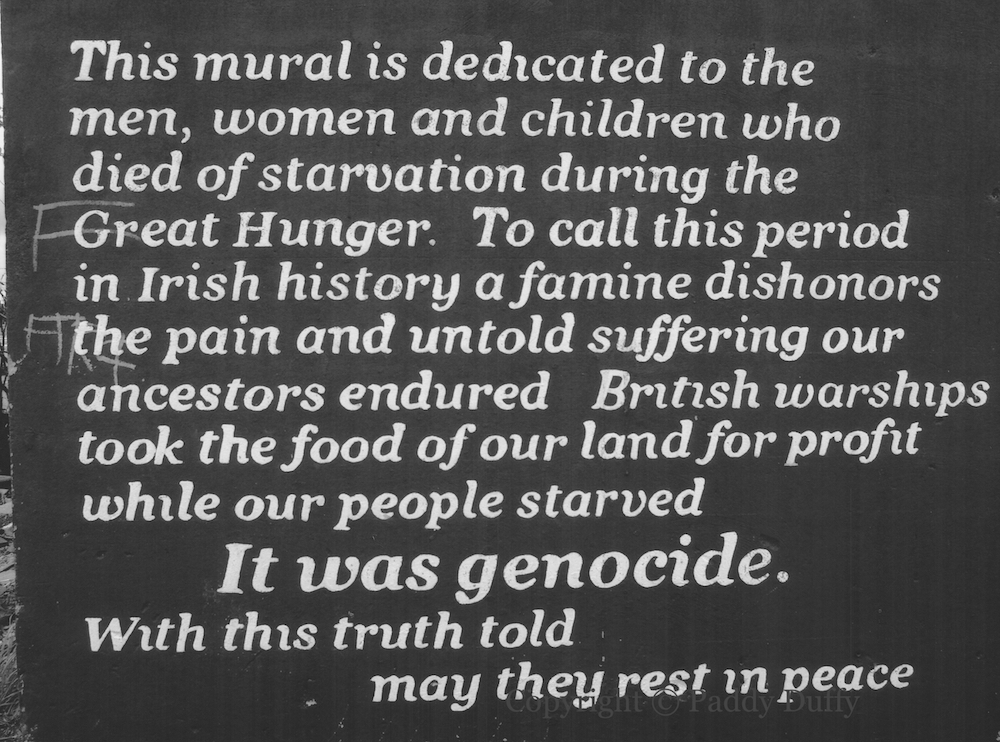
The mural above asserts that government’s inaction was not merely a matter of negligence but of will: “With over 1,500,000 deaths “sorry” is not enough. It is time the British government and its war machine to leave Ireland and her people in peace. During the genocide of 1845 to 1852 the British government seized from Ireland’s producers tens of millions of head of livestock, tens of millions of tons of flour, grain, meat, poultry and dairy products, enough food to sustain 18 million people. 200,000 British troops (100,000 at any given time) and 12,000 RIC removed Ireland’s food at gun point. This mural is dedicated to the men, women and children who died of starvation during the Great Hunger. To call this period in Irish history a famine dishonors the pain and untold suffering our ancestors endured. British warships took the food of our land for profit while our people starved. It was genocide. With this truth told may they rest in peace.”
“A Róısín, na bíodh brón ort, fár [fé’r] éırıgh duıt.” Each white cross on the map represents a mass grave. The map is originally from irishholocaust.org.
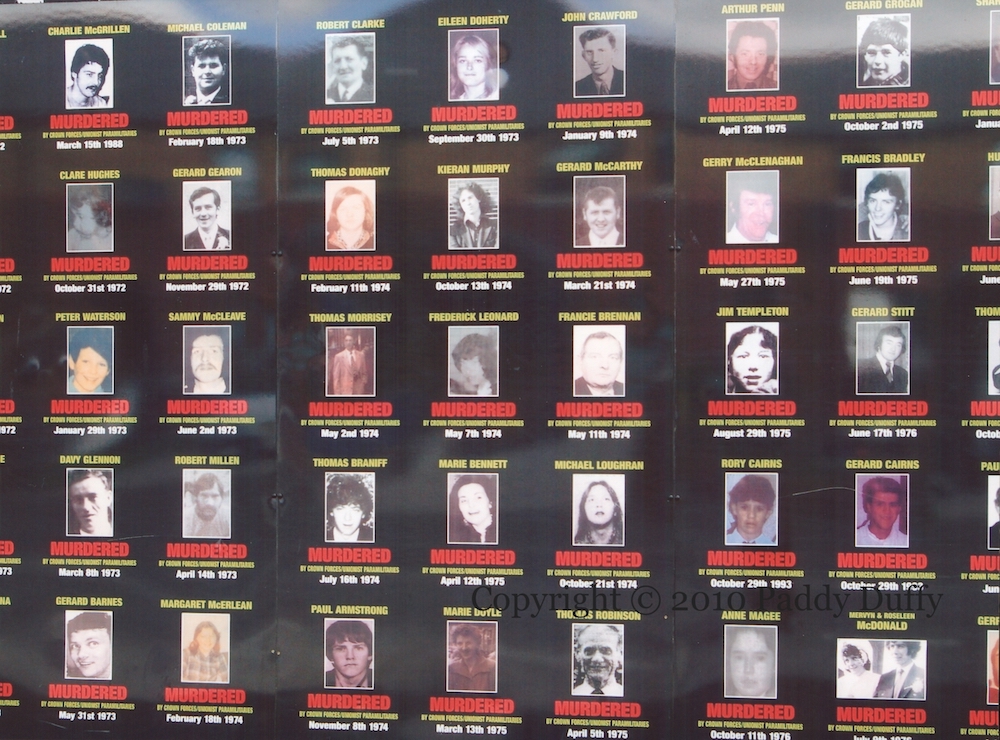
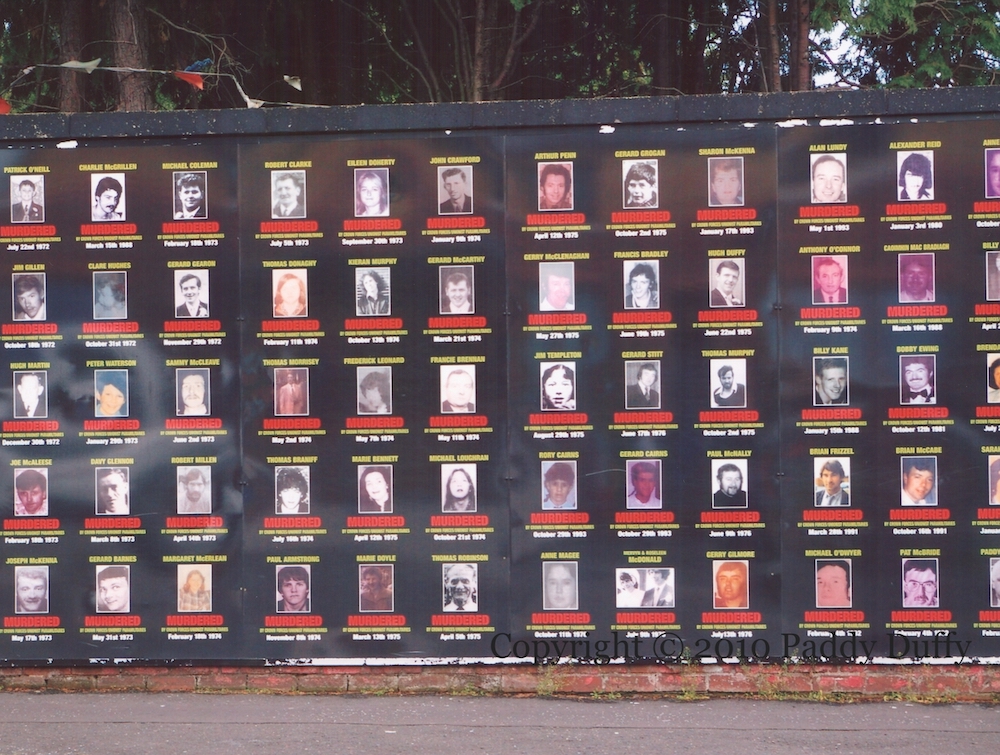
These are new boards on Beechmount Avenue, alongside the many portraits of victims.
McGurk’s Bar: “At 8:47 pm on Saturday 4th December 1971, a no-warning bomb, planted by British terrorists, exploded on the doorstep of family-run McGurk’s Bar. Fifteen innocent men, women and children perished. Those who were not crushed or slowly asphyxiated by masonry where horrifically burned to death when shattered gas mains burst into flames beneath the rubble. Nearly the same again were dragged from the debris alive. In the aftermath of the atrocity, the British and Unionist Governments, RUC police force and British military disseminated disinformation that the bomb was in-transit and that the civilians guilty by association, if not complicit in this act of terrorism. This is despite a mountain of forensic evidence including a witness statement that saw the bomb being planted and lit before the British terrorists escaped into the night. From the moment the bomb exploded and for 40 years since, the families and friends of those murdered have campaigned constitutionally and with great dignity to clear the names of their lived ones. It is a Campaign for Truth that continues to this day. Join us at themcgurksbarmassacre.com” “
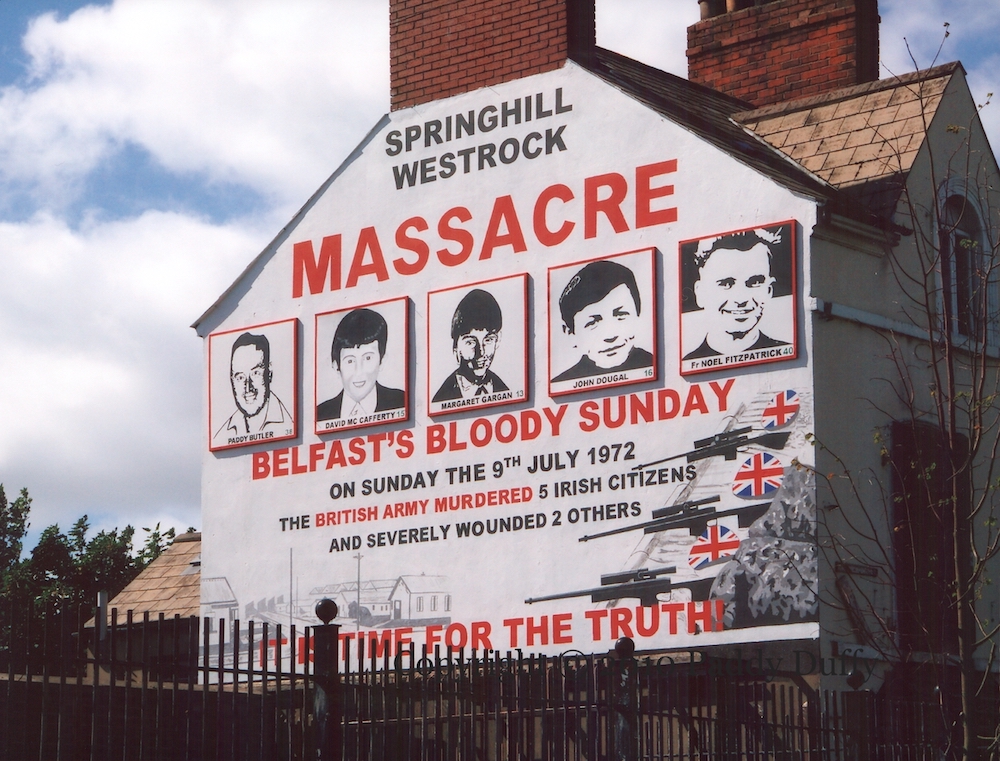
Springhill–Westrock Massacre: “Belfast’s Bloody Sunday. Time for truth! On the 9th July 1972 a team of British Army snipers took up firing positions in Corry’s timber yard overlooking the nationalist Springhill/Westrock estates. Within less than an hour five civilians lay dead and two critically wounded. Among the dead were three teenagers, a father of six and a priest on his way to administer the last rites to the dead and injured. There has never been a proper police investigation, and not one solider has spent a single day in prison in connection with their deaths. The families deserve, and demand the comprehensive facts be told by the British establishment. The truth costs nothing.”
Collusion: “Crime is crime is crime” said UK Prime Minister Margaret Thatcher in a 1981 news conference in Saudi Arabia. Her words are used against her and the UK government and armed forces: “We want you to tell us the truth [about collusion]”.
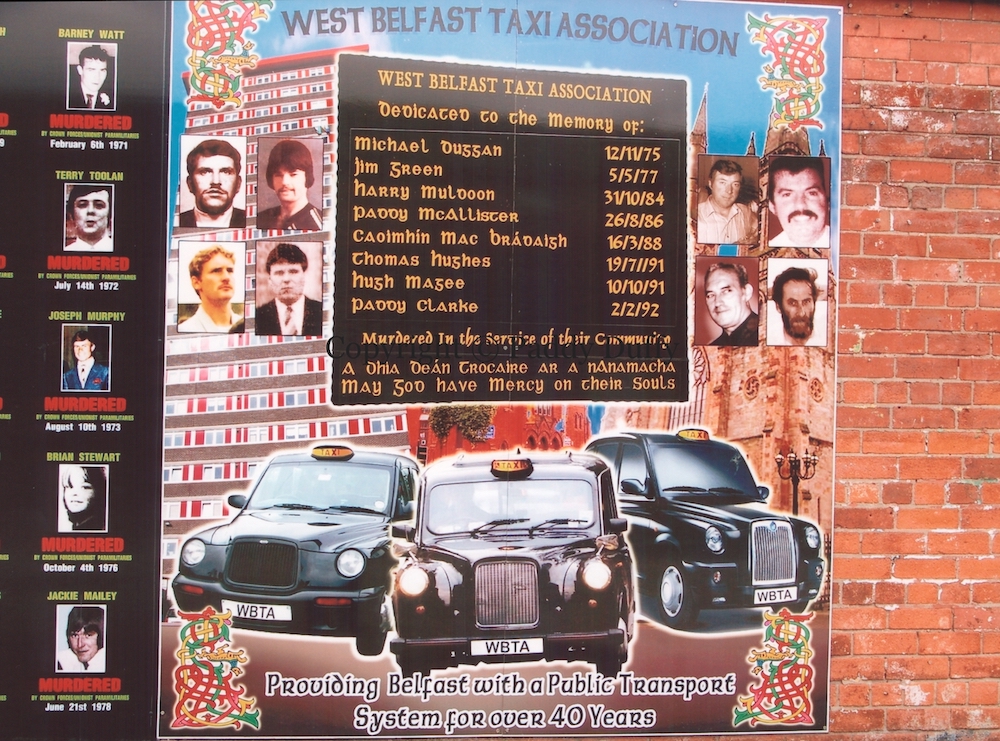
WBTA: Black taxis were first brought from England to Belfast in 1970 by locals who wanted to provide an alternative, and locally-based, transport system to augment the Citybuses which were sometimes cancelled and sometimes burned out. “West Belfast Taxi Association. Providing Belfast with a public transport system for over 40 years.”
The board commemorates eight drivers who were killed during the troubles: “Dedicated to the memory of Michael Duggan 12/11/75, Jim Green 5/5/77, Harry Muldoon 31/10/84, Paddy McAllister 26/8/86, Caoımhín Mac Brádaıgh 16/3/88, Thomas Hughes 19/7/91, Hugh Magee 10/10/91, Paddy Clarke 2/2/92. Murdered in the service of their community. A Dhıa deán trocaıre ar a nanamacha.” French documentary about black taxi drivers.
Beechmount Avenue/Ascaıll Ard Na bhFeá, west Belfast
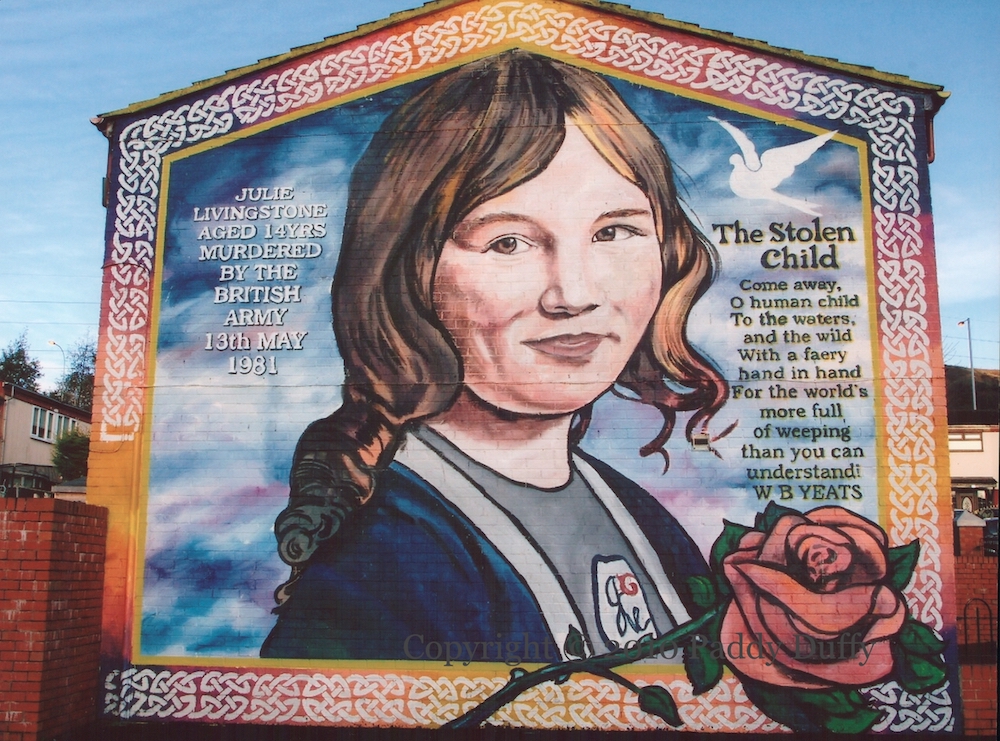
“Julie Livingstone aged 14 yrs. Murdered by the British Army 13th May 1981.” “The Stolen Child – Come away, O human child/To the waters and the wild/With a faery hand in hand/For the world’s more full of weeping/Than you can understand! – WB Yeats.” Livingstone was killed by a plastic bullet.
There is also a stone and plaque near the spot she was struck, on the Stewartstown Road.
This is a mural by Mo Chara Kelly (with DD Walker, Michael Kelly, and Ta Heath) commemorating the deaths of five people shot by British Army snipers in 1972: Paddy Butler (39), David McCafferty (15), Margaret Gargan (13), John Dougal (16), Fr Noel Fitzpatrick (40). The snipers fired from JP Corry’s timber yard (shown on the right) and at the time the Westrock bungalows were still standing (shown lower left).
“Belfast’s Bloody Sunday. On the 9th July 1972 the British Army murdered 5 Irish citizens and severely wounded 2 others. It’s time for the truth.”
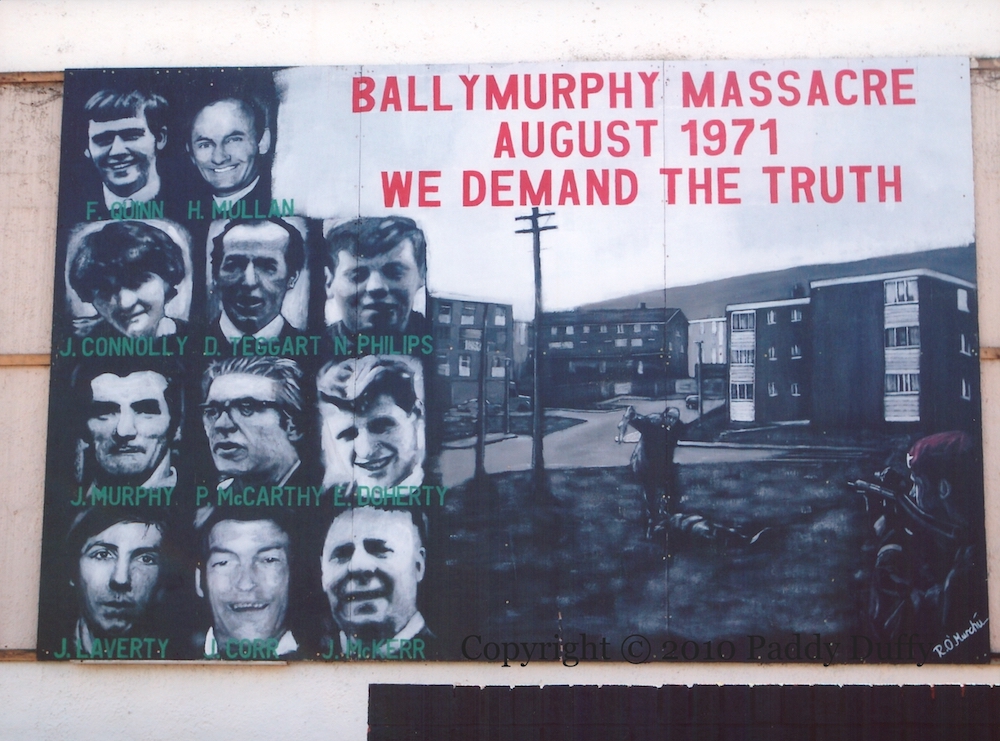
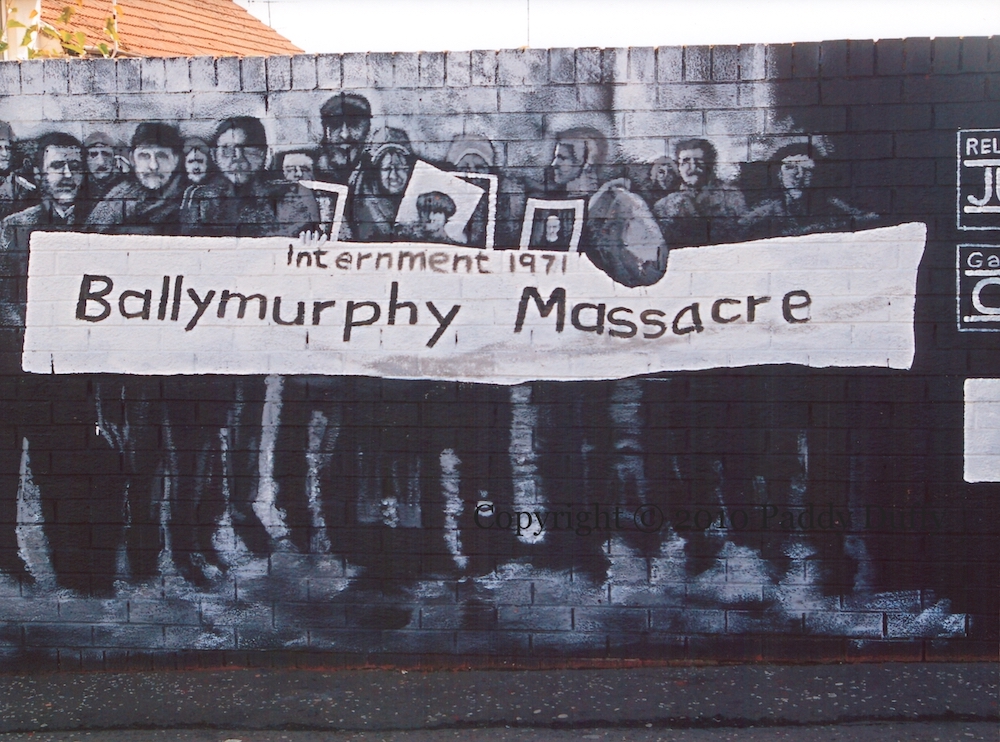
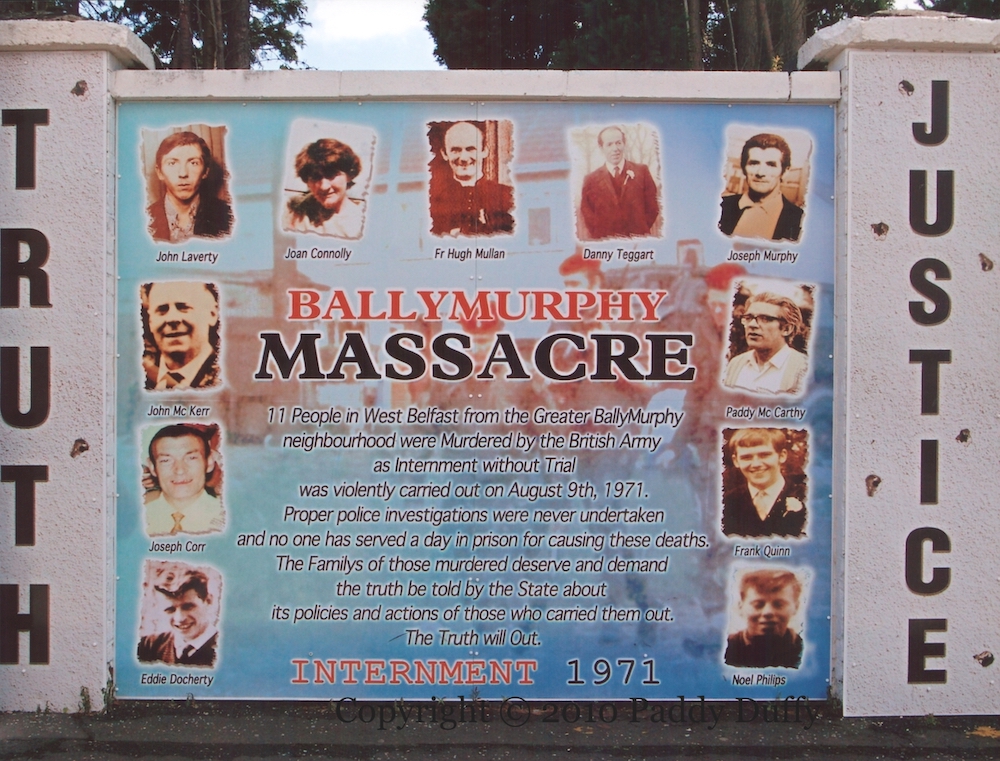
“Ballymurphy Massacre – August 1971 – We demand the truth” with portraits of the 11 dead – Quinn, Mullan, Connolly, Teggart, Philips, Murphy, McCarthy, Doherty, Laverty, Corr, McKerr.
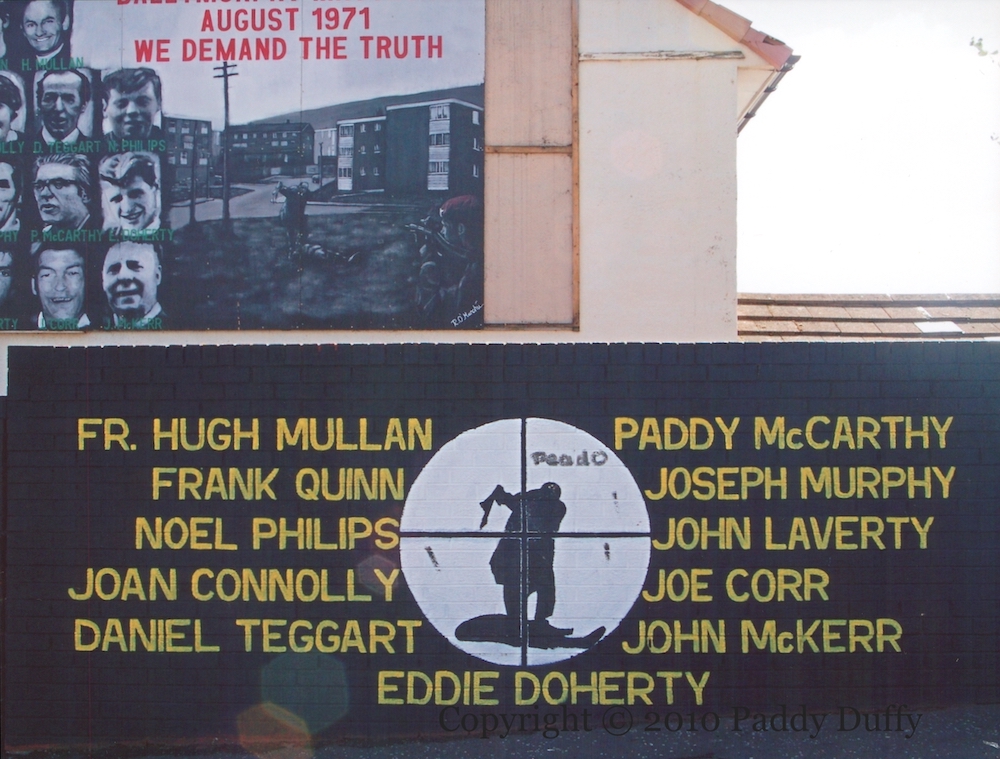
The painting (by Rıstead Ó Murchú) on the board shows the killing (from the direction of Springmartin) of Father Hugh Mullan in waste ground near Springfield Park. It was previously on the Whiterock Road but has now been moved onto the Springfield Road to join the murals on the low wall calling for justice. Two of the panels are also included. More can be seen in in Peter Moloney’s collection.
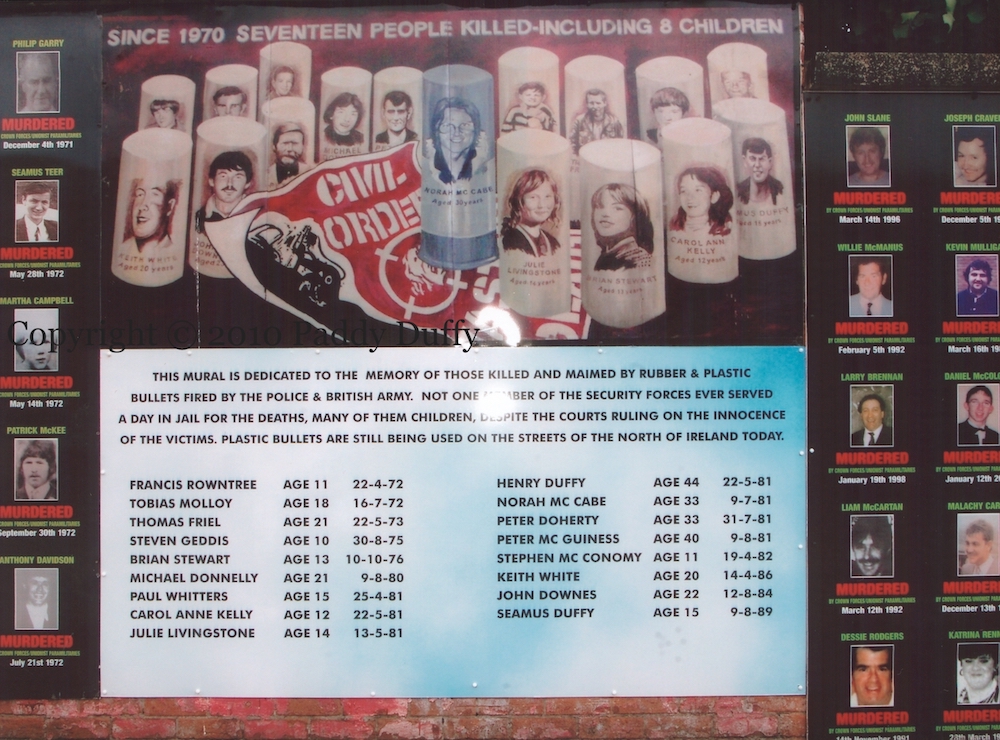
The victims of the Ballymurphy Massacre in 1971 and of plastic and rubber bullets throughout the troubles receive particular attention among galleries of “murdered” people.
“11 people in west Belfast from the Greater Ballymurphy neighbourhood were murdered by the British Army as internment without trial was violently carried out on August 9th, 1971. Proper police investigations were never undertaken and no one has served a day in prison for causing these deaths. The familys [sic] of those murdered deserve and demand the truth be told by the state about its policies and actions of those who carried them out.” The 11 are (clockwise) Eddie Docherty, Joseph Corr, John McKerr, John Laverty, Joan Connolly, Fr Hugh Mullan, Danny Teggart, Joseph Murphy, Paddy McCarthy, Frank Quinn, Noel Philips.
“This mural is dedicated to the memory of those killed and maimed by rubber & plastic bullets fired by the police & British Army. Not one member of the security forces ever served a day in jail for the deaths, many of them children, despite the courts ruling on the innocence of the victims. Plastic bullets are still being used on the streets of the north of Ireland today.”