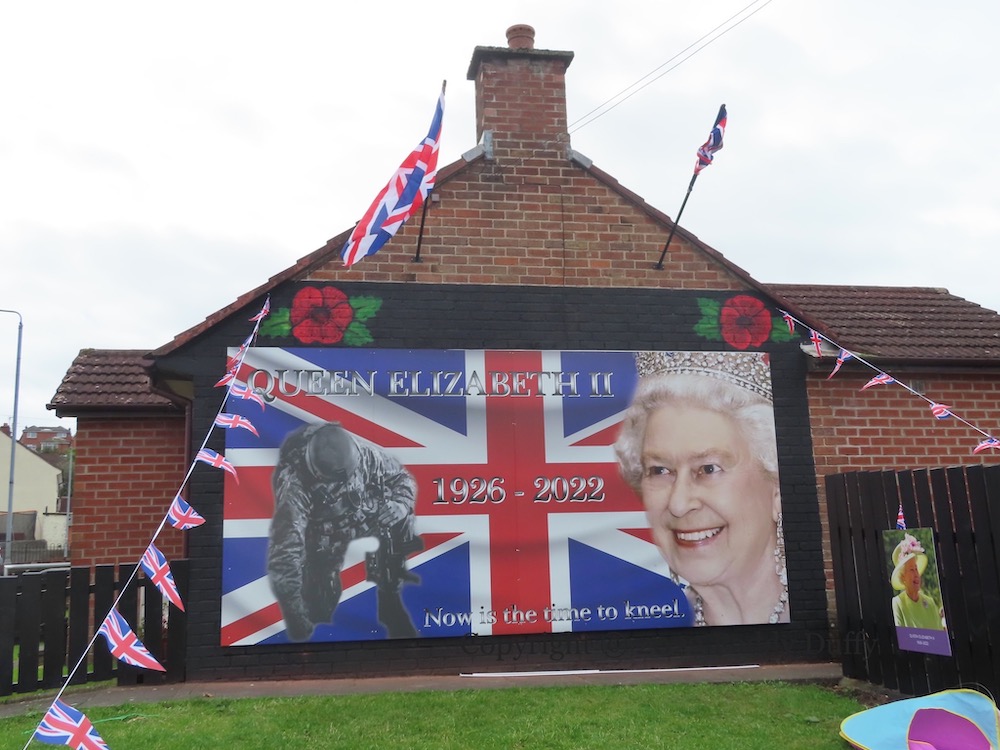
The “now” in “now is the time to kneel” would seem to suggest that there is some inappropriate kneeling going on at some other time, besides as a mark of respect to the patriotic dead (in this case, Queen Elizabeth II, who died on September 8th, 2022) – perhaps the kneeling prior to Premier League soccer matches as a protest against racism (World Soccer Talk).
Replaces Clonduff Youth on Clonduff Drive in Castlereagh.
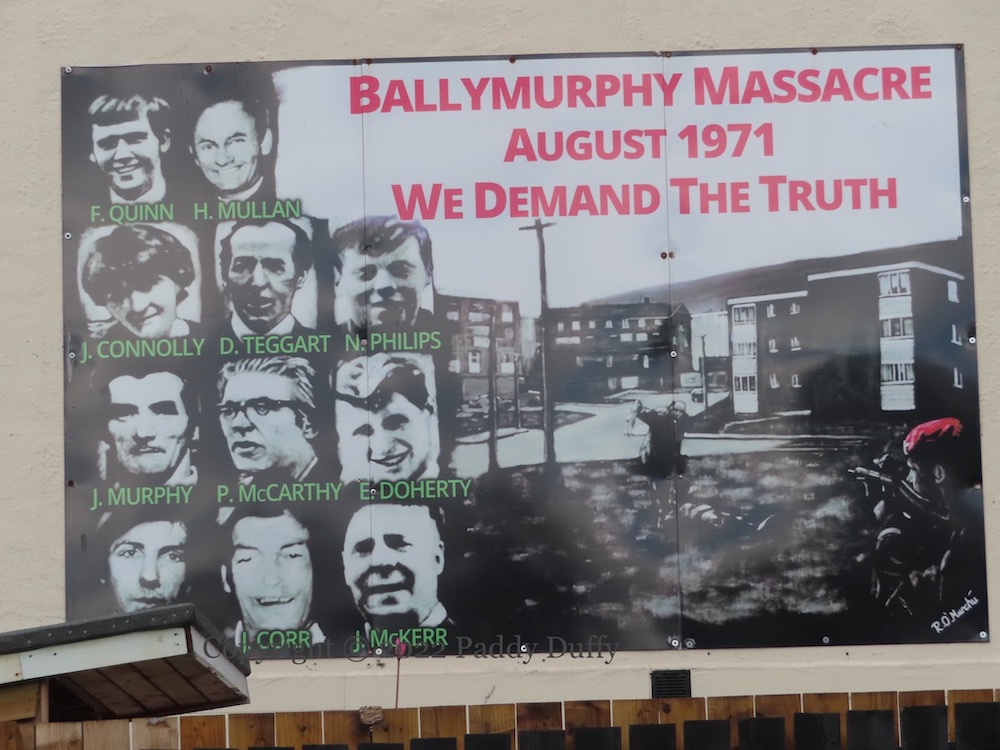
The inquest into the Ballymurphy Massacre – the killings of 11 people from August 9th to 11th, continues, with testimony this past week from former Paratrooper Henry Gow (Irish News | BBC-NI). The image above shows Hugh Mullan being shot from Springmartin while going to the aid of a neigbour, Bobby Clarke; he is waving a white Babygro (BallymurphyMassacre.com). The Paratrooper is distinguished by his red beret.
The mural was originally painted by Rısteard Ó Murchú in 2008 and displayed first on the Whiterock Road then around the corner on the Springfield Road; the location of the repainted board is at the Glenalina Road entrance to the area, in the spot of the former 1916 GPO mural (which had lasted seventeen years before the wall was re-plastered and whitewashed in 2017).
The plaque on the fence reads, “This plaque is dedicated to the 11 innocent civilians murdered by members of the British Parachute regiment in August 1971. Fr Hugh Mullan, Frank Quinn, Noel Phillips, Joan Connolly,
Danny Teggart, Joseph Murphy, Eddie Doherty, John Laverty, Joseph Corr, Paddy McCarthy, John McKerr. Donated by the Frank McCann Cumann, Hamilton [Scotland] (Fb).”
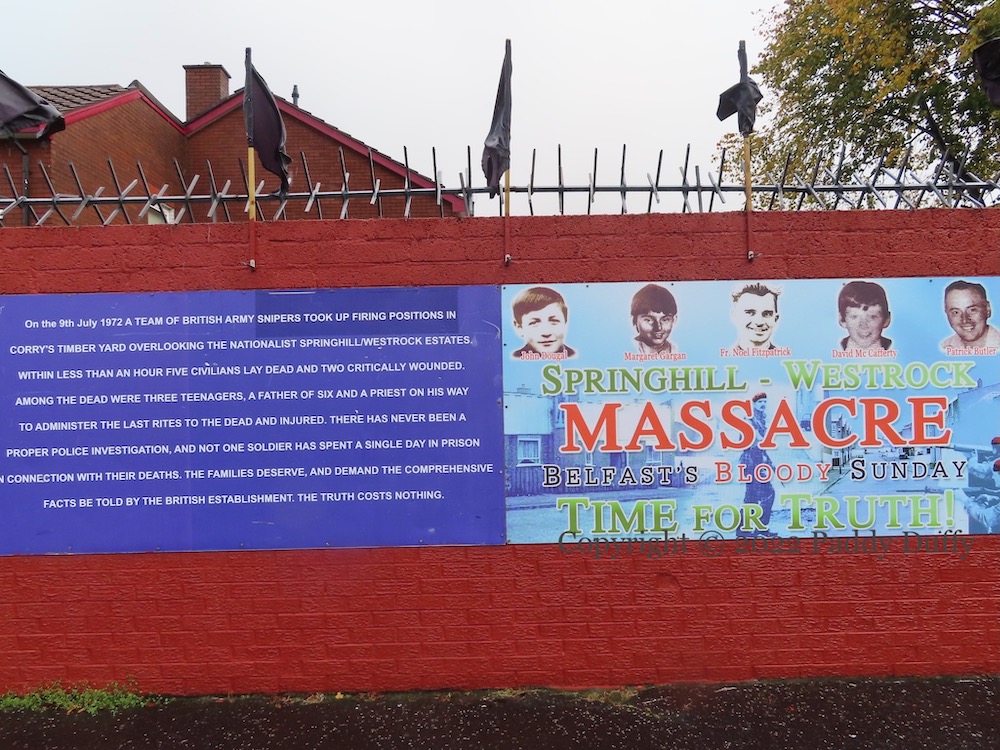
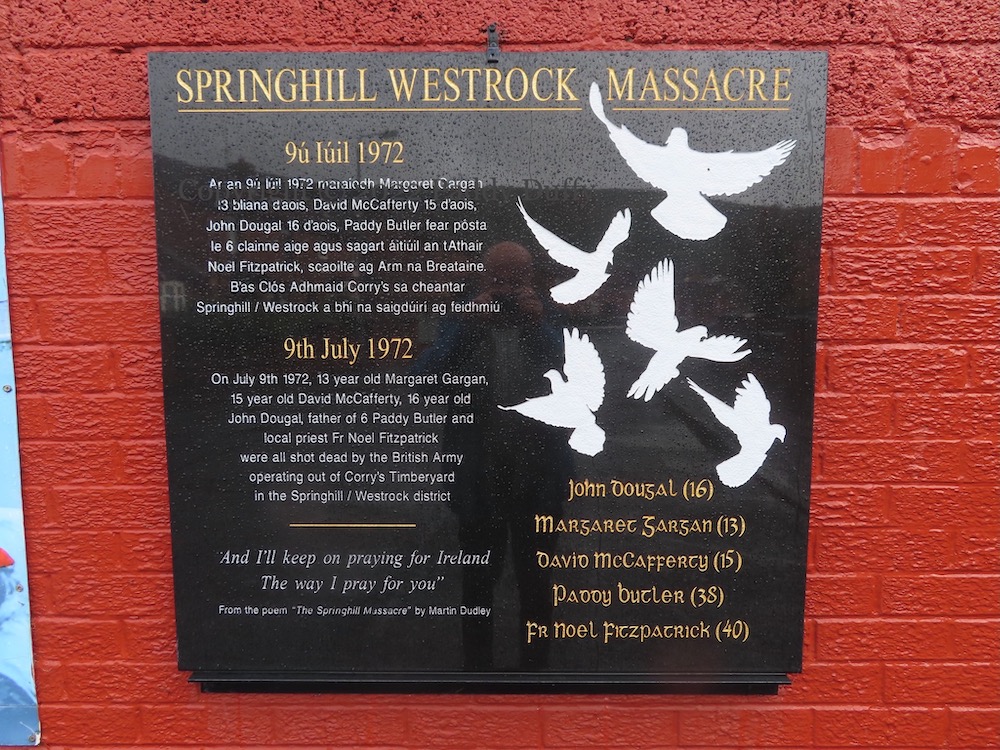
“Springhill-Westock Massacre: Ar an 9ú Iúıl 1972 maraíodh Margaret Gargan 13 blıana d’aoıs, David McCafferty 15 d’aoıs, John Dougal 16 d’aoıs, Paddy Butler fear pósta le 6 claınne aıge agus sagaırt áıtiúıl an tAthaır Noel Fitzpatrick, scaoılt ag Arm na Breataıne. B’as Clós Adhmaıd Corry’s sa cheantar Springhill/Westrock a bhí na saıghdıúrí ag feıdhmıú.”
“‘And I’ll keep on praying for Ireland/The way I pray for you’ – from the poem “The Springhill Massacre” by Martin Dudley”. The new plaque was launched on July 9th, 2019 by Dudley and Brian Pettigrew, both of whom were wounded in the attack. Here is a gallery of images from the launch from Relatives For Justice.
The board, above, was originally in Beechmount Avenue/Ascaıll Ard Na bhFeá, but had to be moved due to the “re-imaging” of the brick wall at the back of St Mary’s University College into a fence by the Department For Communities (web).
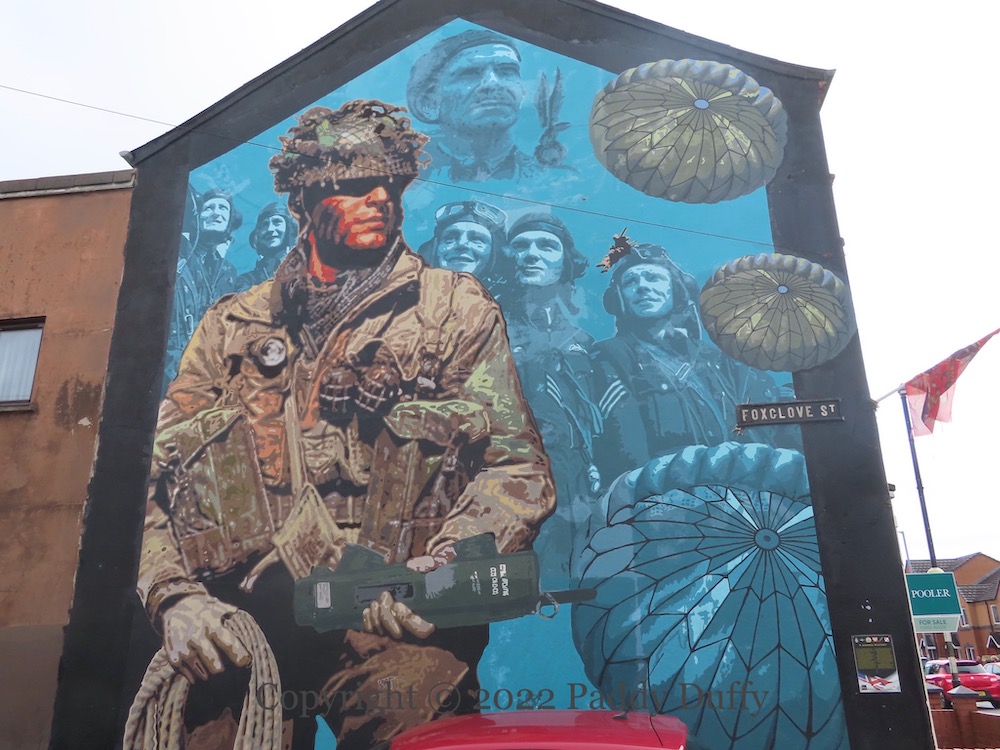
Stanislaw Sosabowski — who appears in the apex of this mural in east Belfast — survived the first World War (fighting for Austria-Hungary), the occupation of Poland in 1939, and escaped from a prisoner-of-war camp before crossing Europe and taking command, in Britain, of the 1st Polish Paras. The unit fought in Operation Market Garden at the Battle Of Arnhem. (WP | Polish Heritage Society for a booklet of text and images)
His memoirs have been published as Freely I Servedand interviews about his service were collected for a film called A Debt Of Dishonour (youtube) – the title comes from the fact that Sosabowski was blamed for the failure of the Operation, perhaps as a bargaining tactic in negotiations between Britain, Russia, and Poland.
Across the middle of the mural are airmen from the 303 Polish Squadron, which was celebrated in a Shankill mural: Love Demands Sacrifice. In the foreground is a modern British paratrooper in field gear.
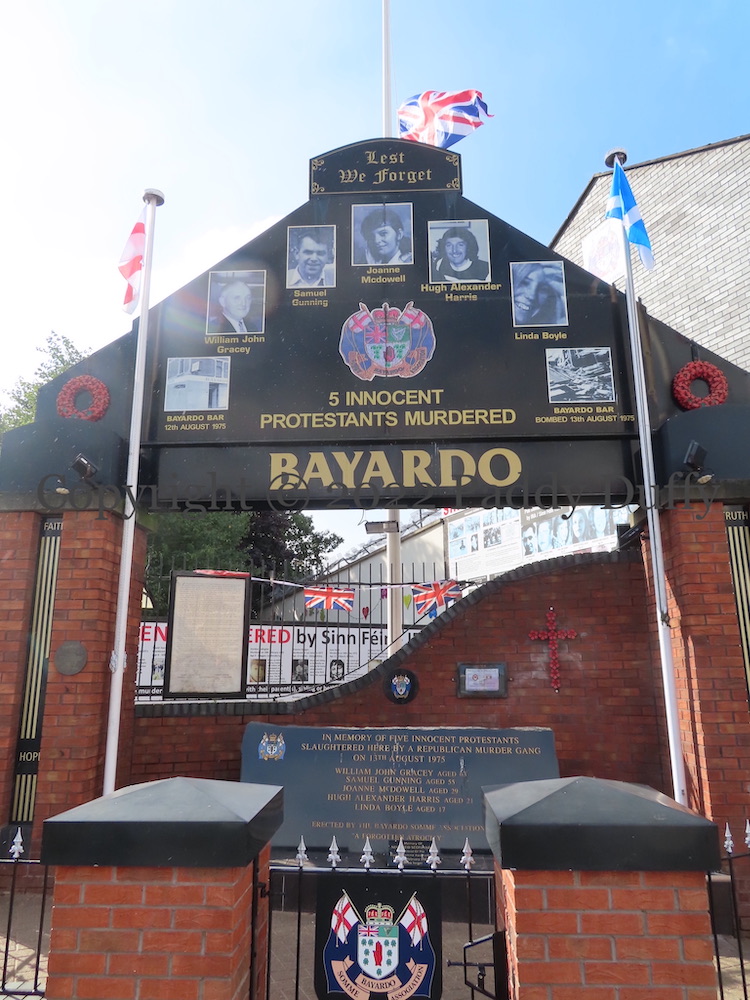
A gallery of scenes from IRA bombings surrounds the Bayardo memorial arch, the centre-piece of which are two images from the 2015 paris bombings (shown above). “IRA – Sinn Fein – ISIS no difference”. In an interview for the USA’s PBS (Public Broadcasting Service) the DUP’s Sammie Wilson said he agreed with the equivalence.
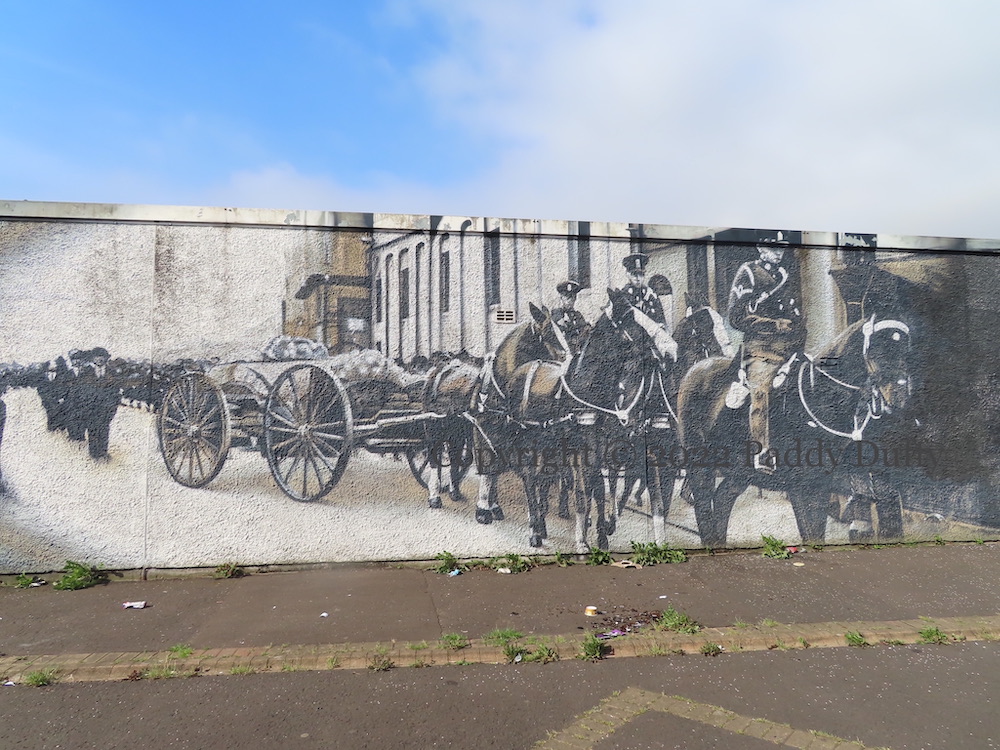
“Richard Mussen joined the Royal Inniskilling Fusiliers (27th foot) at the age of 15. At the outbreak of the Zulu wars he volunteered for active service and was transferred to the Second Battalion The South Wales Borderers (24th foot). At the outbreak of the Great War he joined the 9th Battalion Royal Ulster Rifles and with him went his 4 sons and 2 sons-in-law. His son Richard (junior) was killed at the Somme on Thursday 21st March, 1918 and is remembered at Pozieres Memorial. Richard Mussen was buried from 22 Dundee Street [which was just above Agnes Street] on 29/12/1936 and was accorded full Military Honours. He was laid to rest in Belfast City Cemetery.” (From the companion plaque.)
Here is a short NVTv documentary about Mussen, including (at 12m25s) the image on which the mural shown here is based. The mural was done with spray paint by artist Sam Bates a.k.a. SMUG. It was unveiled on June 24th, 2011.
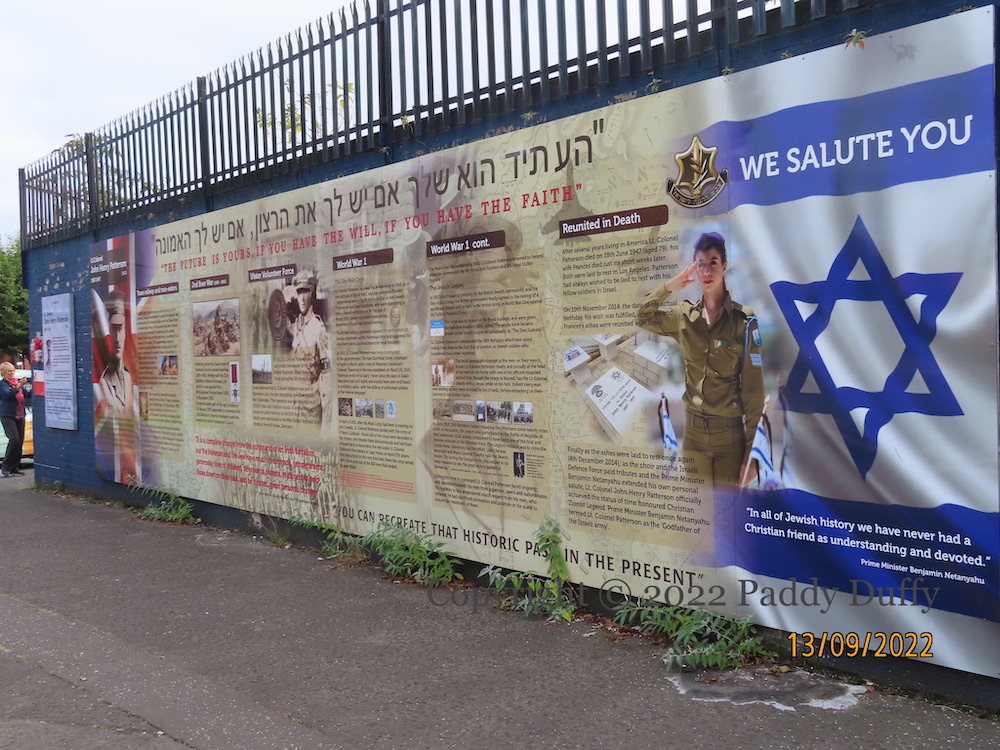
John Henry Patterson went from Ireland to Kenya, where he killed several lions after months of hunting. He wrote an account of the hunt entitled The Man-Eaters of Tsavo which has inspired three movies; the lions, named The Ghost and The Darkness, were both over nine feet in length. Back in Ireland he commanded a battalion of the UVF and was involved in the Larne gun-running of 1914: Operation Lion.
The final panel (on the right) shows the star of David and a quote from Prime Minister Benjamin Netanyahu: “In all of Jewish history we have never had a Christian friend as understanding and devoted.” The interim panels described Patterson’s raising and leading of the Jewish battalions of the Royal Fusiliers in WWI. After dying in obscurity in Los Angeles in 1947, his remains were transported to Israel in December 2014 and reinterred (video). For more, including a recording of Patterson’s voice, see this BBC Magazine article.
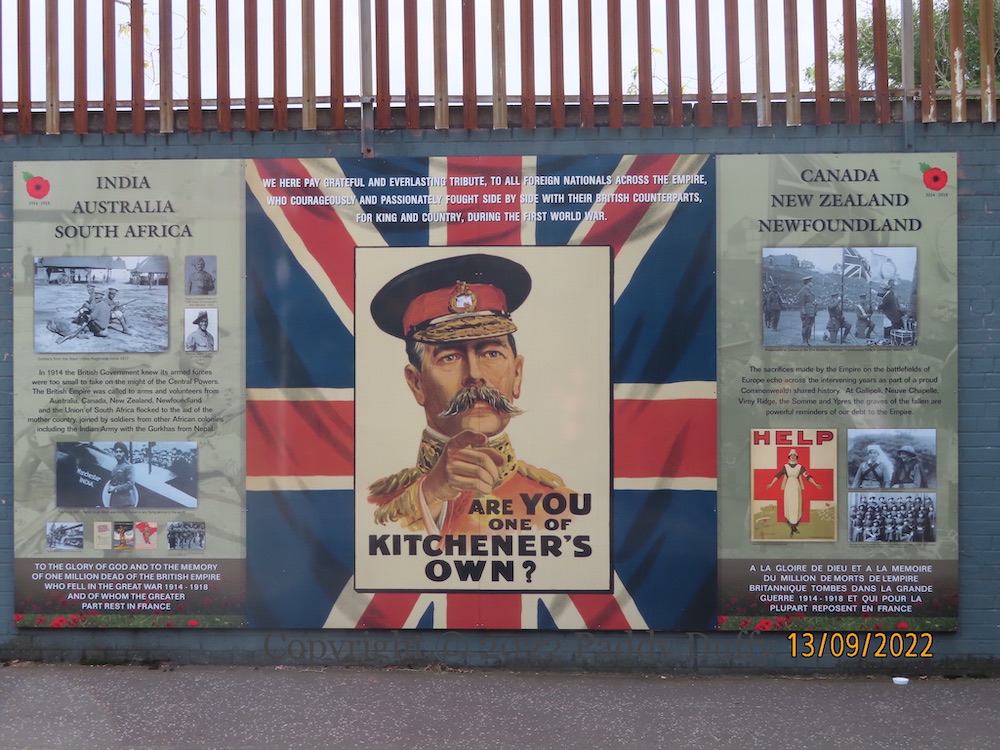
“Are you one of Kitchener’s own?” asks this mural in Northumberland Street: “We here pay grateful and everlasting tribute, to all foreign nationals across the empire, who courageously and passionately fought side by side with their British counterparts, for King and country, during the First World War.” The left-hand side (second image) features images of soldiers from the West Indies and India, including “The Flying Sikh”, Hardit Singh Malik and a French lady as she “pins flowers on a regiment containing Muslims, Sikhs, and Hindus.” On the right, images of the “presentation of Colours to the 51st Battalion Canadian expeditionary force” and of Canadian “bluebird” nurses in the Canadian Army Medical Corps.
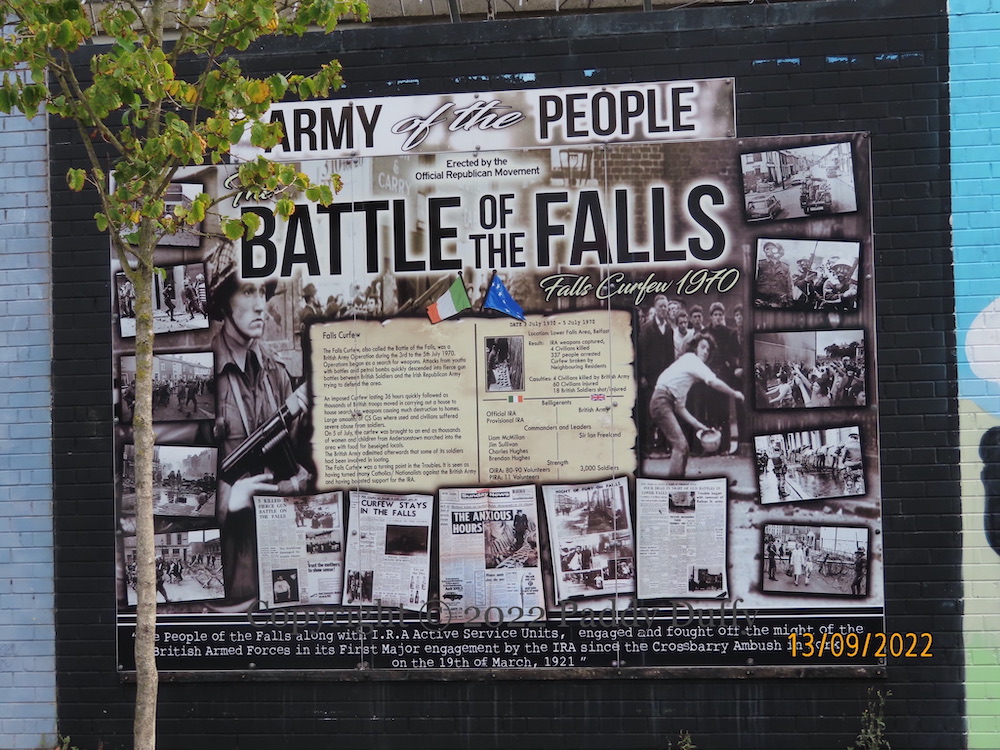
Four people were killed in the course of The Falls Curfew, the 36 hours from July 3rd to 5th in 1970 during which 3,000 houses on the lower Falls were cordoned off after a weapons search of the area devolved into a riot. The curfew ended with a march of women and children from Andersonstown bearing relief (represented in Falls Curfew 1970).
Left: Lawyers for the PSNI defended the request for a Public Interest Immunity certificate regarding evidence in the case of Noah Donohoe (PA). This stencil on Divis Street says “not in our name” and asserts that “the public want full disclosure”.
Right: This is the third mural (see 2014 The Maze Ablaze and 2018 The Battle Of Long Kesh) on the International Wall on Divis Street about the ‘Battle Of Long Kesh’, when republican prisoners tried to burn down the cages in protest at living conditions in the camp. CR gas had recently been developed by the British MoD at a lab in Porton Down and is alleged to have been “used against Irish POWs”.
Brady & Faul wrote an 80-page report on the conditions at the camp following the event, entitled The Flames Of Long Kesh. “Telegram to International Red Cross: ‘ … Visited Long Kesh today with others … request immediate investigation into use of “CR gas” … sub-human conditions … SOS … come immed[i]ately’ – 20 Oct 1974, Brian Brady & Fr. Denis Faul”.



 Paddy Duffy Collection