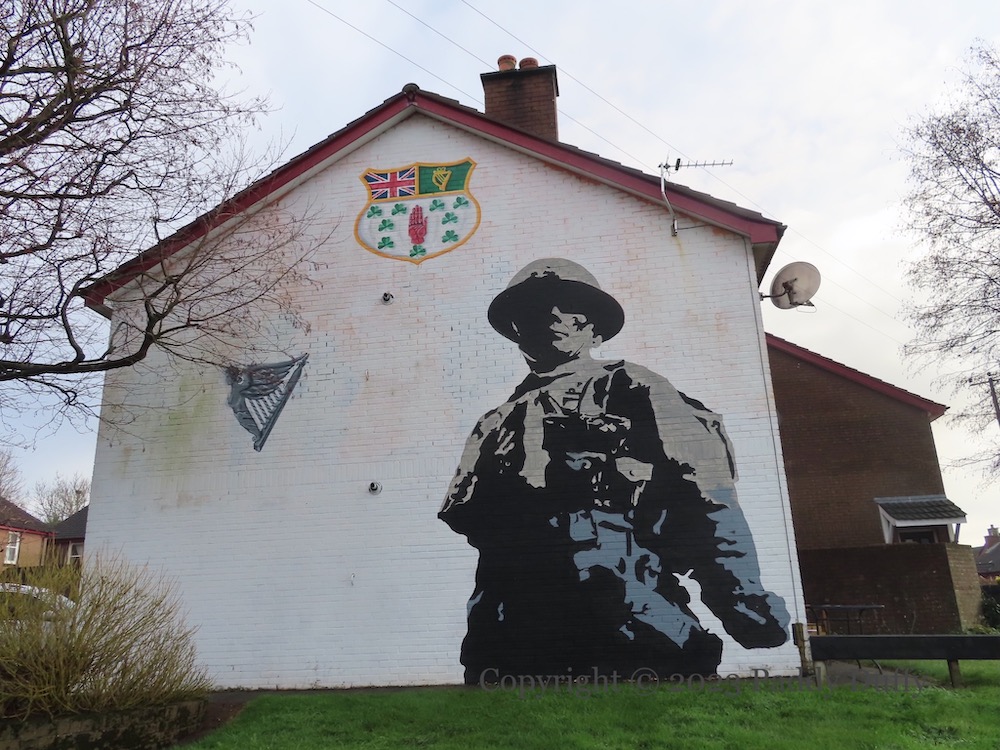
This is a UVF/YCV mural in Grange Drive, Ballyclare, celebrating and commemorating soldiers from the Ulster Volunteers who went on to serve in the 36th (Ulster) Division in WWI and in particular at the Somme. The central panel shows soldiers bearing the Division’s standard (painted in colour in an otherwise black-and-white mural and in the style of the (US) Marines ‘Iwo Jima’ Memorial (WP)) which comprises the Union flag, harp insignia of the Royal Irish Rifles, and the red hand of Ulster on a field of shamrocks.
The other panels show uniforms of the Ulster Volunteers, a Protestant woman defending the fields, soldiers going over the top, and soldiers bowed at a UVF memorial.
Also included, below, is an ‘over the top’ image from a substation at the very top of the estate.
In the Great War, the men from Ballyclare generally joined the 12th (Central Antrim) battalion of the Royal Irish Rifles (the emblem of which is on the left), and were assigned to the 108th brigade along with others from south Antrim and County Down.
The wear on this mural suggests that it might have been painted (by Dee Craig – Fb) at the same time as Ballyclare Remembers, for the centenary of the Somme; there is no record of it in any of the usual sources or Dee’s page.
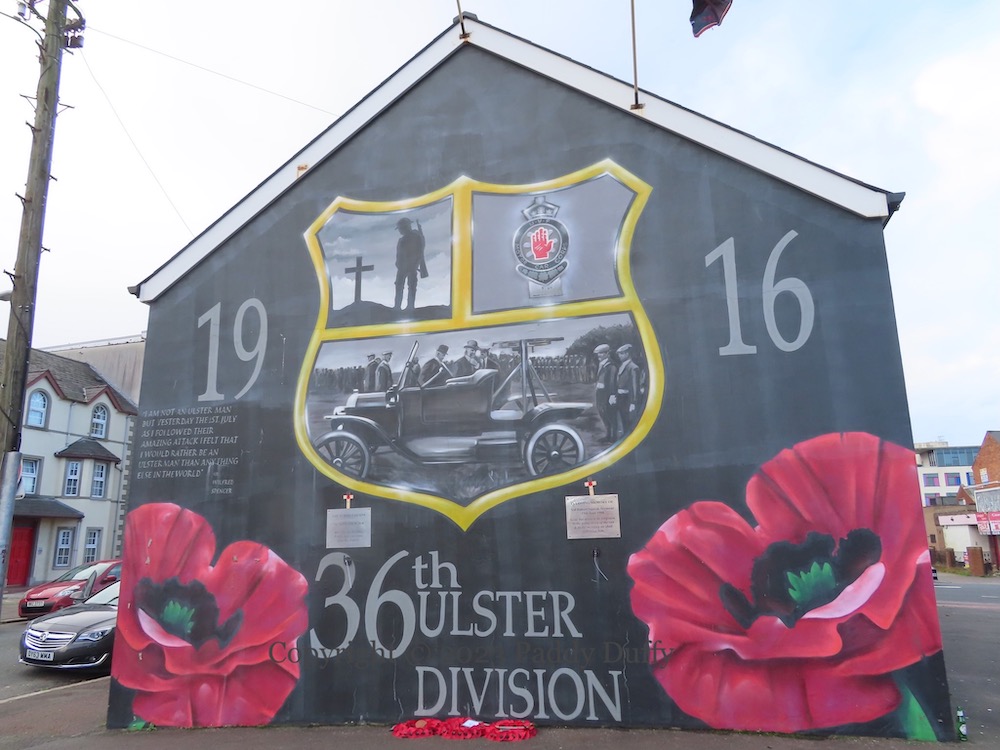
The first time that the horseless carriage was used in a military operation was the Ulster Volunteers’ “Larne Gunrunning” of April 1914. By this time, there are thought to have been 350 vehicles in the Corps (Angelsey). It’s not clear whether the cars were later used by the 36th (Ulster) Division – please comment/get in touch if you can shed light on this. (For Spencer’s quote on the left, see I am not an Ulsterman.) The plaque is to (modern) UVF volunteer ‘Squeak’ Seymour.
“Time changes! But the sacrifice remains the same.” The board shows, in black and white, a WWI soldier, who is comforting another solider, in modern gear and in colour. The emblems of the 36th (Ulster) division and Royal Irish Rifles are also shown. Sponsored by the EU and the Cosy Somme Association. This is a repainted version of the original (late 2013) board which had faded badly.
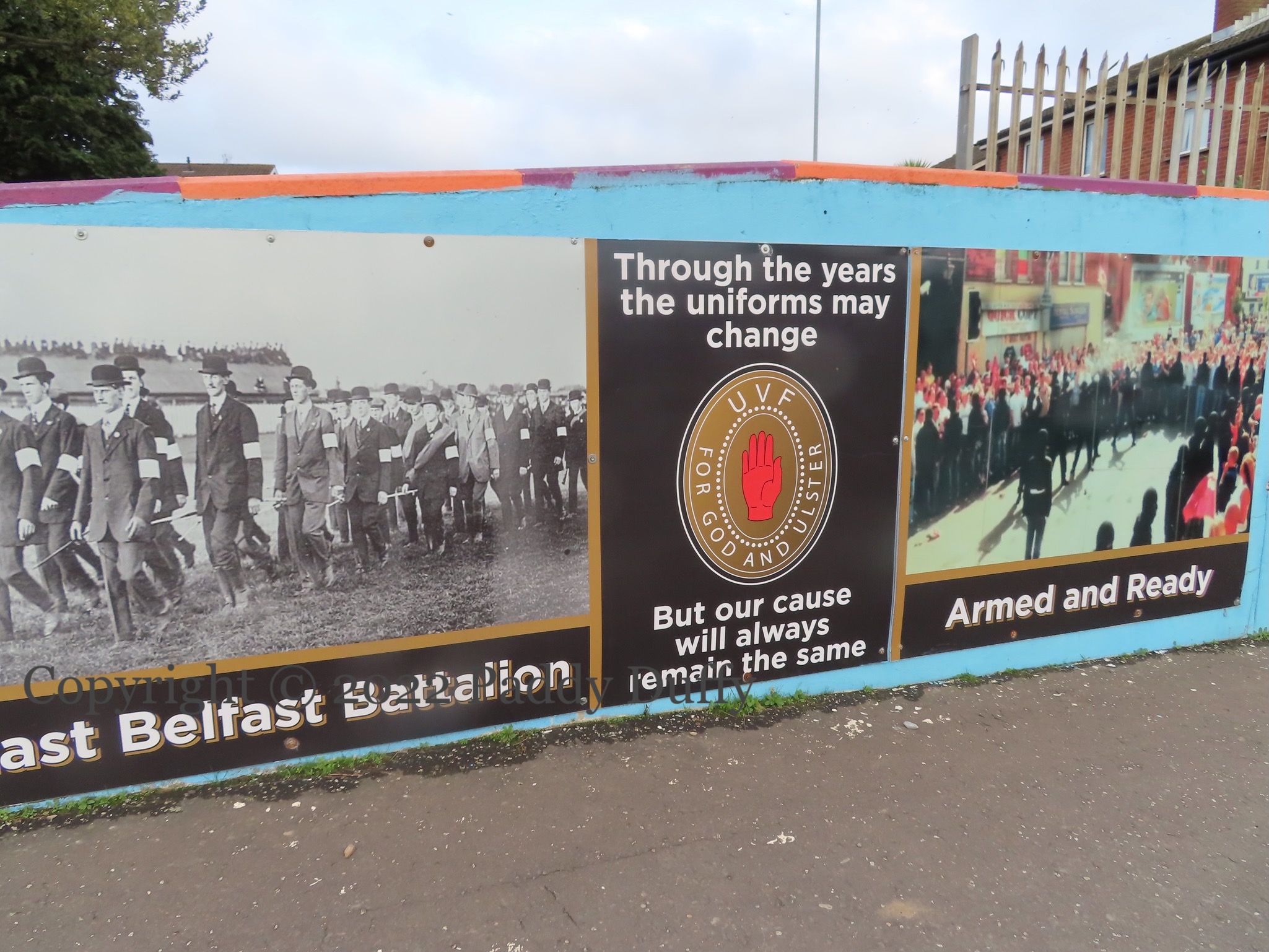
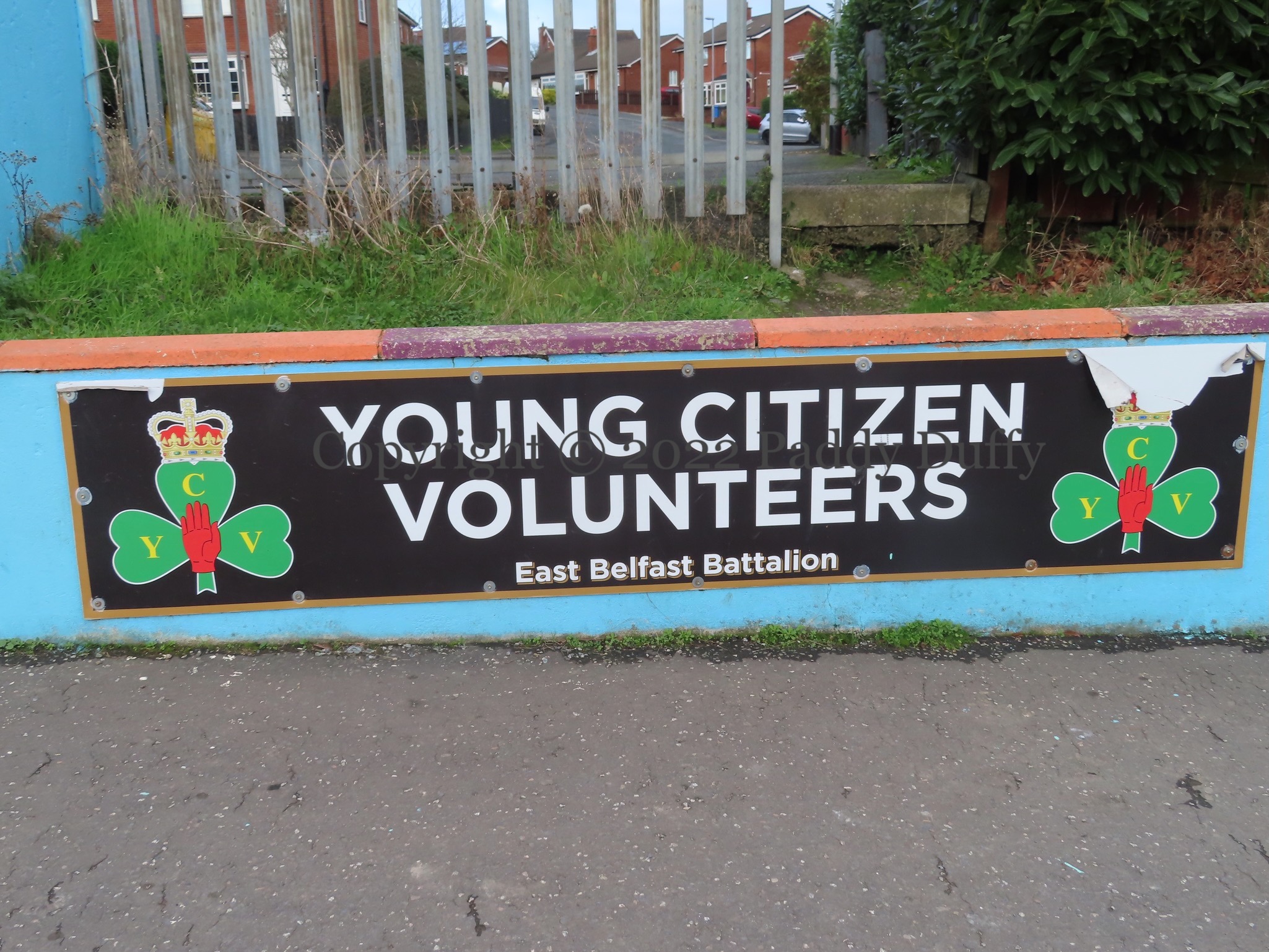
Here is a gallery of UVF boards along Abbot Drive, in Bowtown, Newtownards, mixing North Down with East Belfast brigades (see East East Belfast), and mixing UVF/PAF with the Ulster Volunteers and 36th Division – “Through the years the uniforms may change but our cause will always remain the same”. “The prevention of the erosion of our identity is now our priority.”
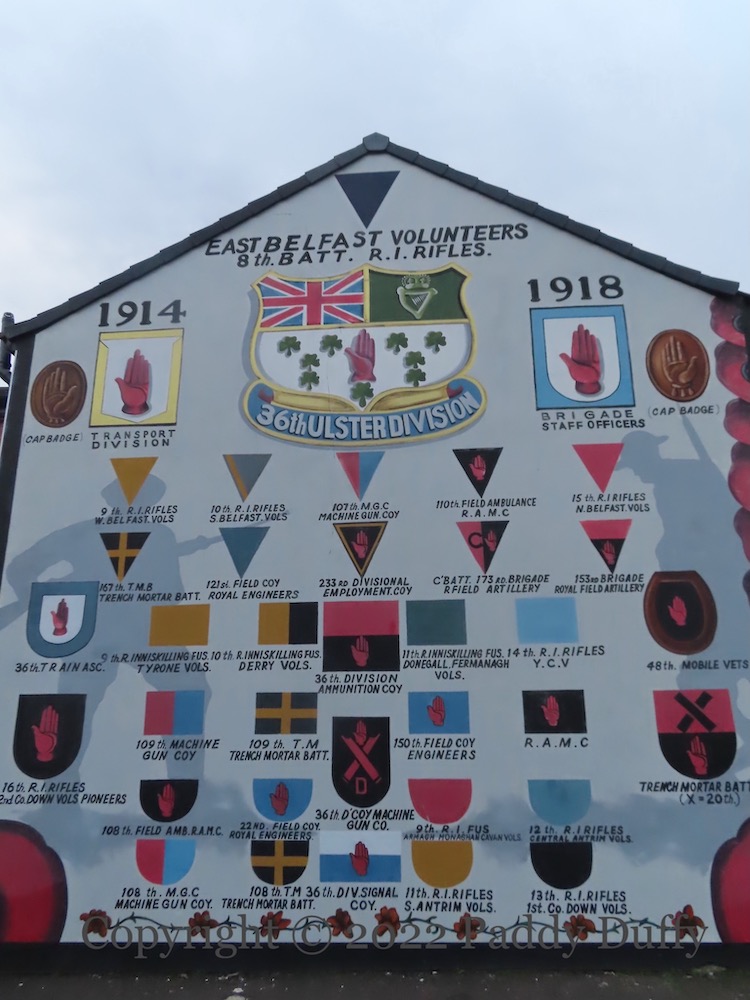
In this board the Rising Sons Flute Band (“RSFB”) portrays itself as following in the footsteps of the Ulster Volunteers who joined the British Army and specifically the 8th battalion of the Royal Irish Rifles in the 36th (Ulster) Division, which was drawn from east Belfast’s Ulster Volunteers in 1914.
This mural and its accompanying plaques, at the mouth of Canada Street, commemorate WWI and celebrate the Victoria Crosses won by members of the 36th (Ulster) Division “For valour”: Cather, McFadzean, Bell, Quigg, Emerson, De Wind, Seaman, Knox, and Harvey. The main mural features insignia of more than thirty units of types ranging from machine gunners to vets.
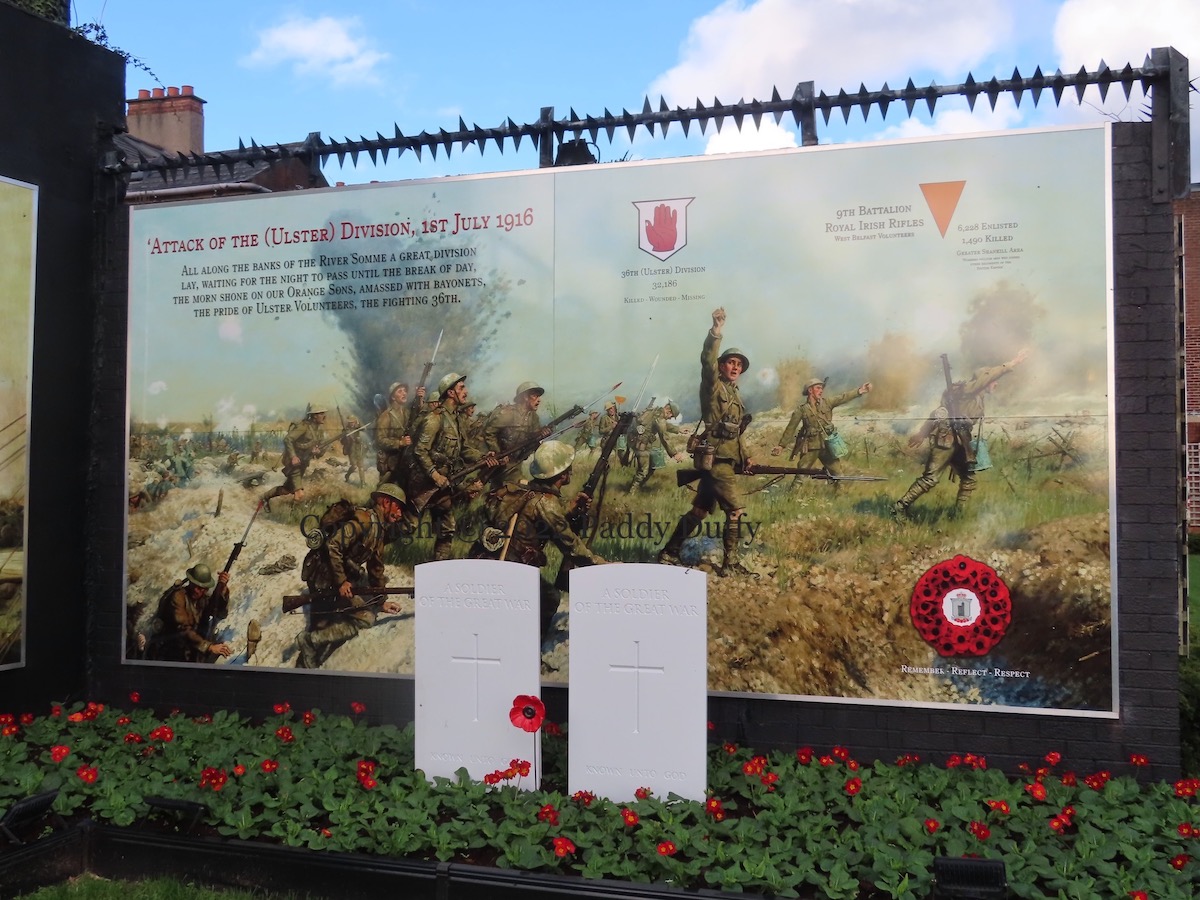
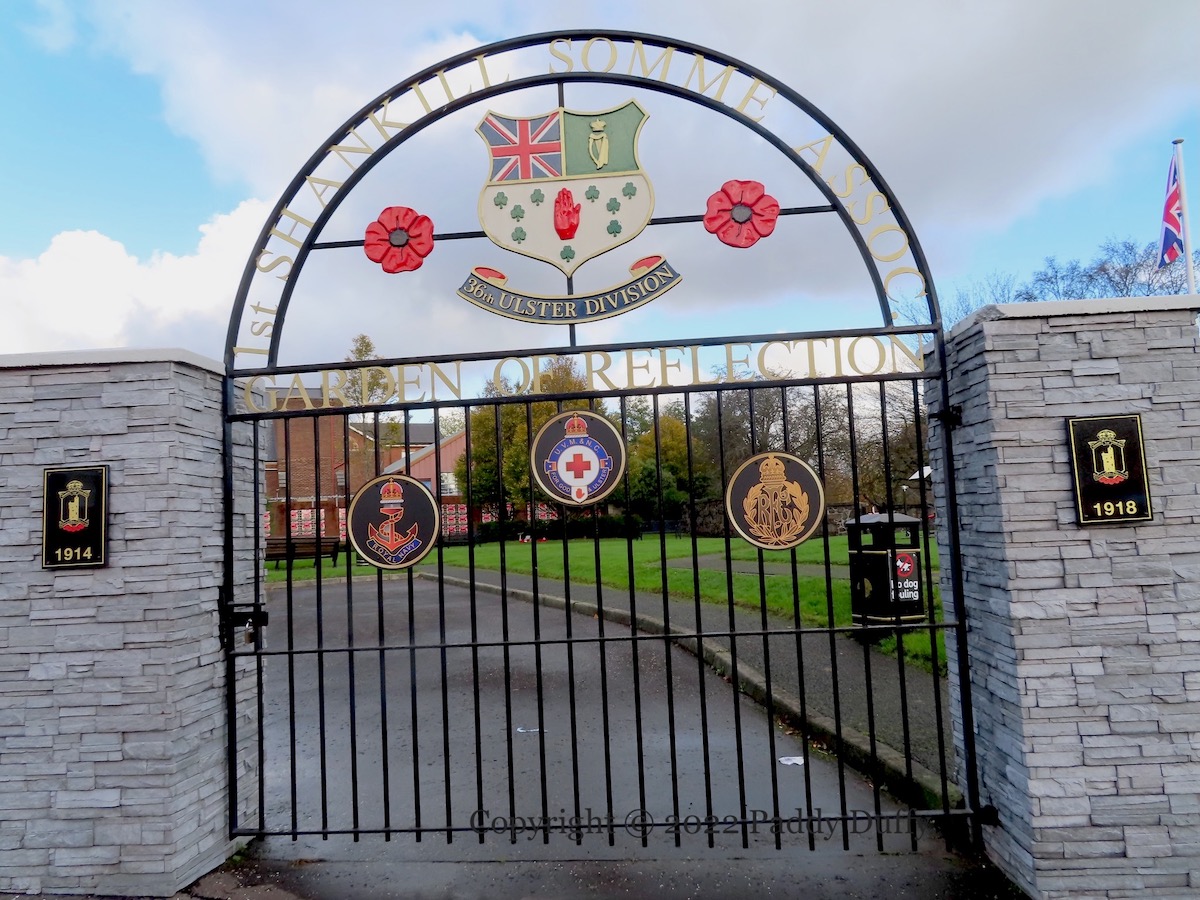
The Shankill Somme Association’s garden of reflection has added a number of new boards.
The board shown above is JP Beadle’s painting “Battle of the Somme: Attack of the Ulster Division”, which hangs in Belfast City Hall (militaryprints.com). It replaces a painting of a soldier in a field of poppies, seen in The Great War.
To its left is John Singer Sargent’s painting “Gassed”, showing the “aftermath of an indiscriminate mustard gas attack on British forces during the Battle of Arras 21st August 1918” (which also forms a part of a memorial in east Belfast) with the GK Chesterton quote “The true soldier fights not because he hates what is front of him, but because he loves what is behind him”.
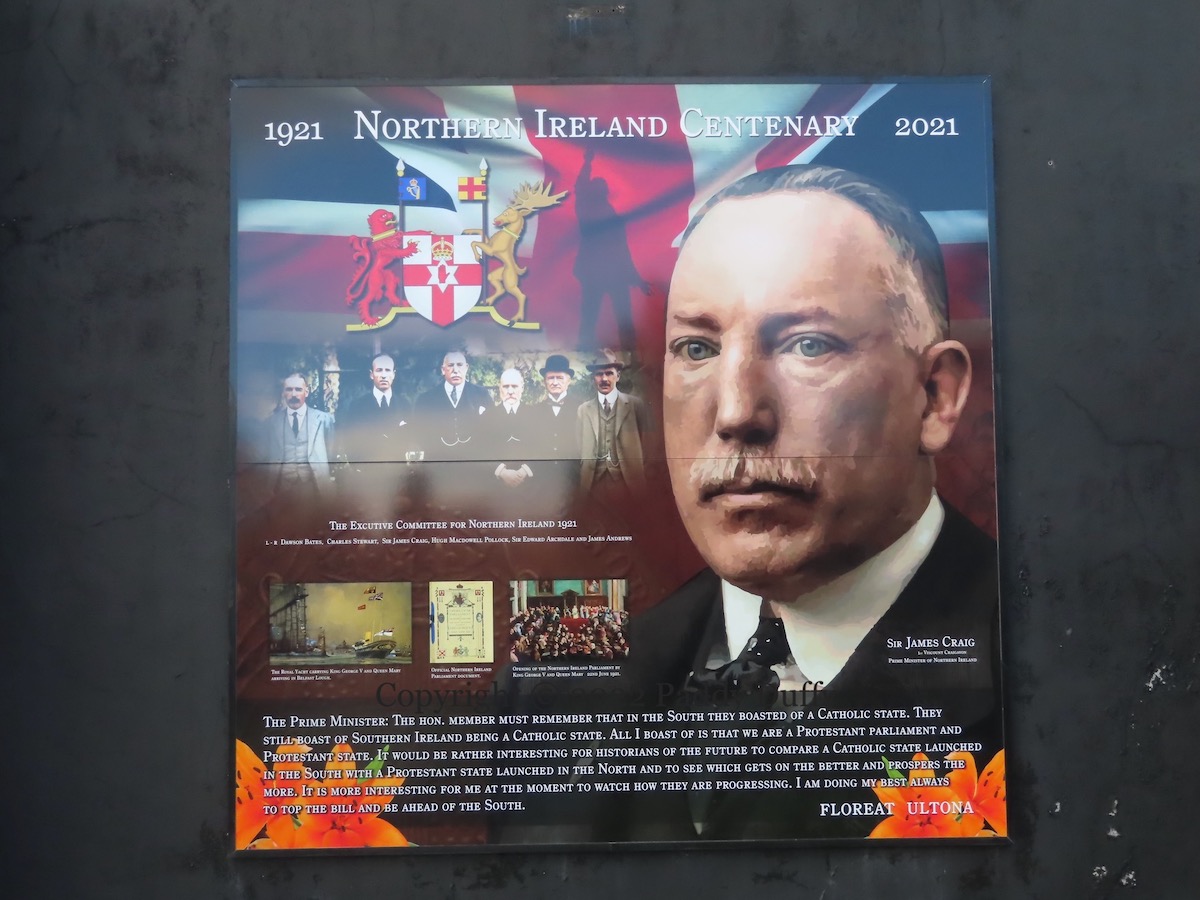
Also new – and somewhat out of place – is the Northern Ireland Centenary board featuring James Craig: “It would be rather interesting for historians of the future to compare a Catholic state launched in the south with a Protestant state launched in the north and to see which gets on the better and prospers the more”. There are other “floreat Ultona” boards/murals in the Village (focusing on the B Specials and UDR) and in Rathcoole (where “Ulster welcomes her King and Queen”).
There are also three insignia on the gates (compare with M05717), to the Royal Navy, the Ulster Volunteer Medical & Nursing Corps, and the Royal Flying Corp.
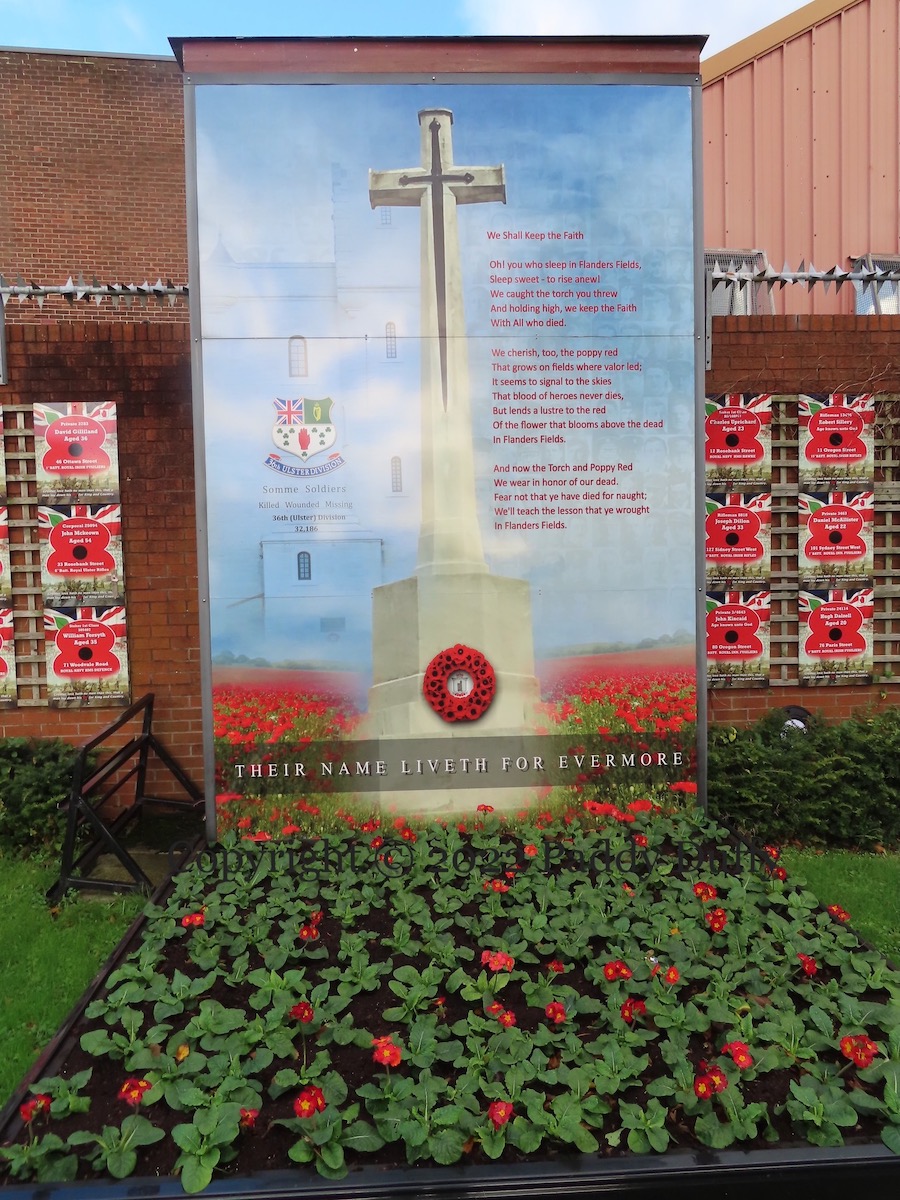
Previously (c. 2017), the undead soldiers of We Shall Not Sleep were replaced with an image of the Cross Of Sacrifice memorial – the original is in Ypres, Belgium but there is also one in the City Cemetery – see One In Design And Intention. At the same time, the poppy plaques for individual local soldiers and the image of the Menin Gate were also added.
The Flanders Field board appears to have survived since 2012 – see Somme Memorial.
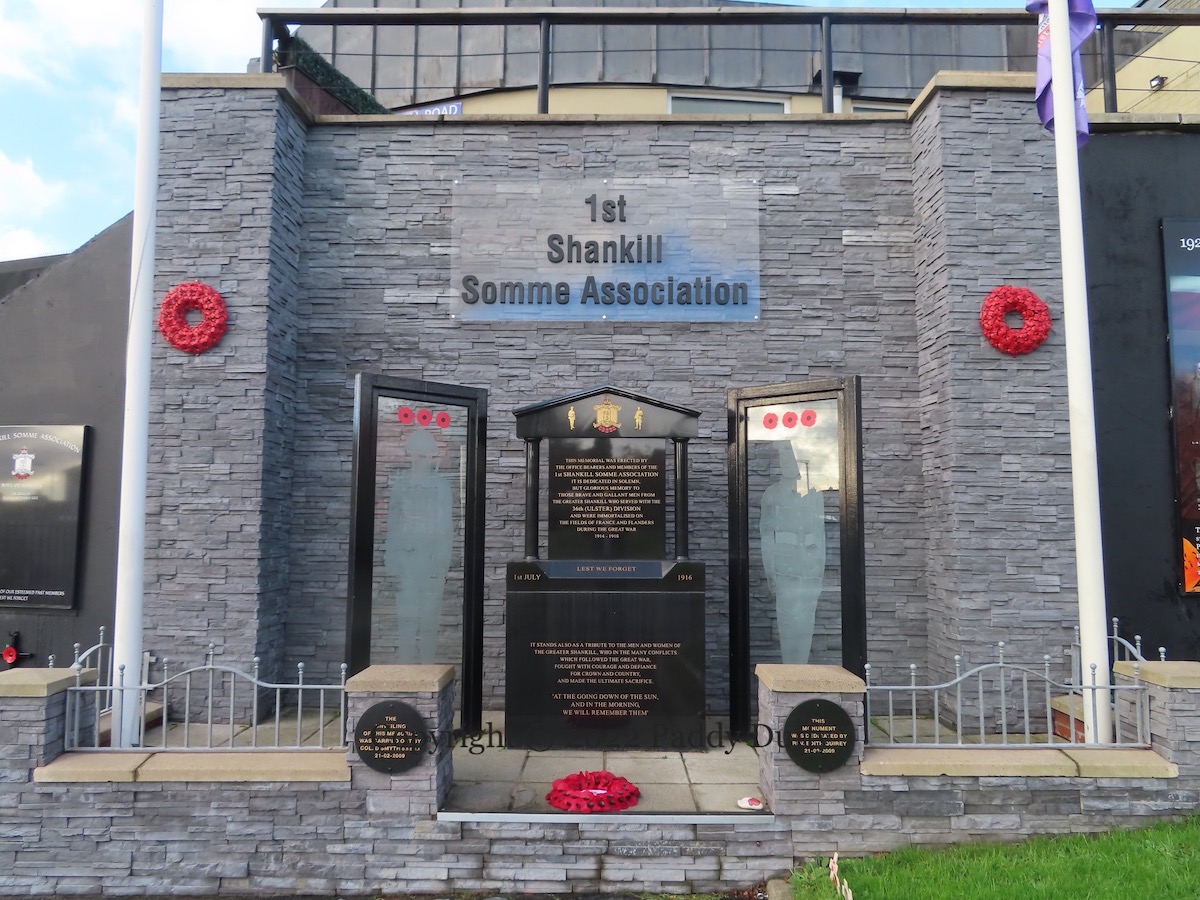
The final image below shows the new stone surround for the main memorial. See (again) Somme Memorial.
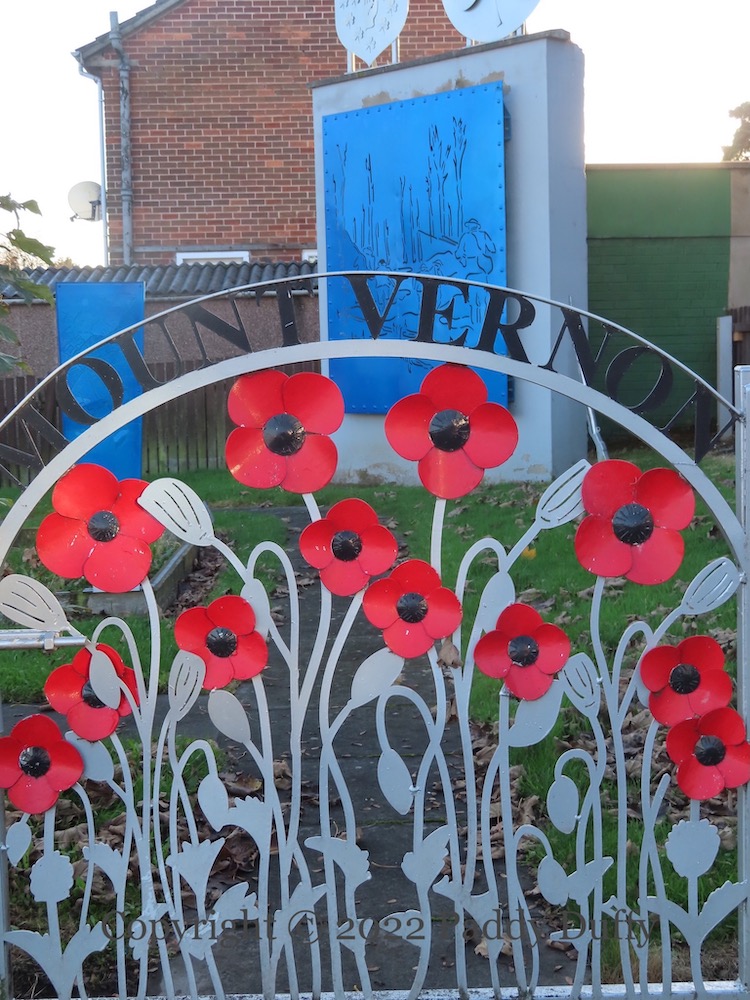
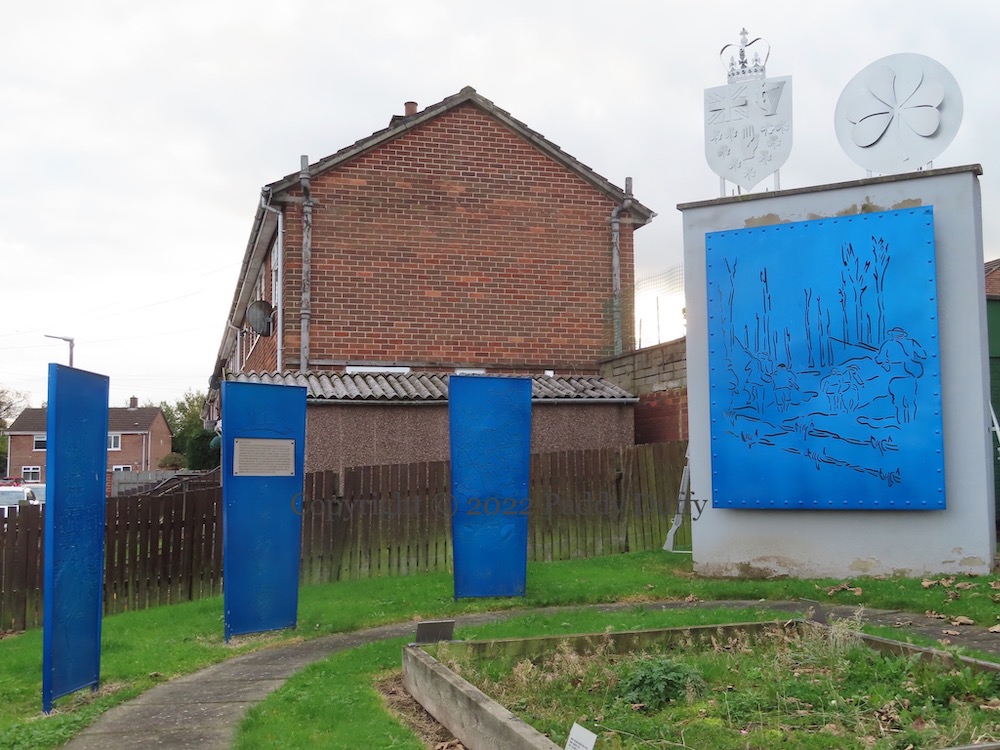
This metal gate of poppies opens onto a cluster of blue metalworks showing scenes from WWI and a map of the area around Messines. The silver emblems are of the 36th and 16th divisions.
For more, including the panels to John Cordon and William McFadzean, see M07770.
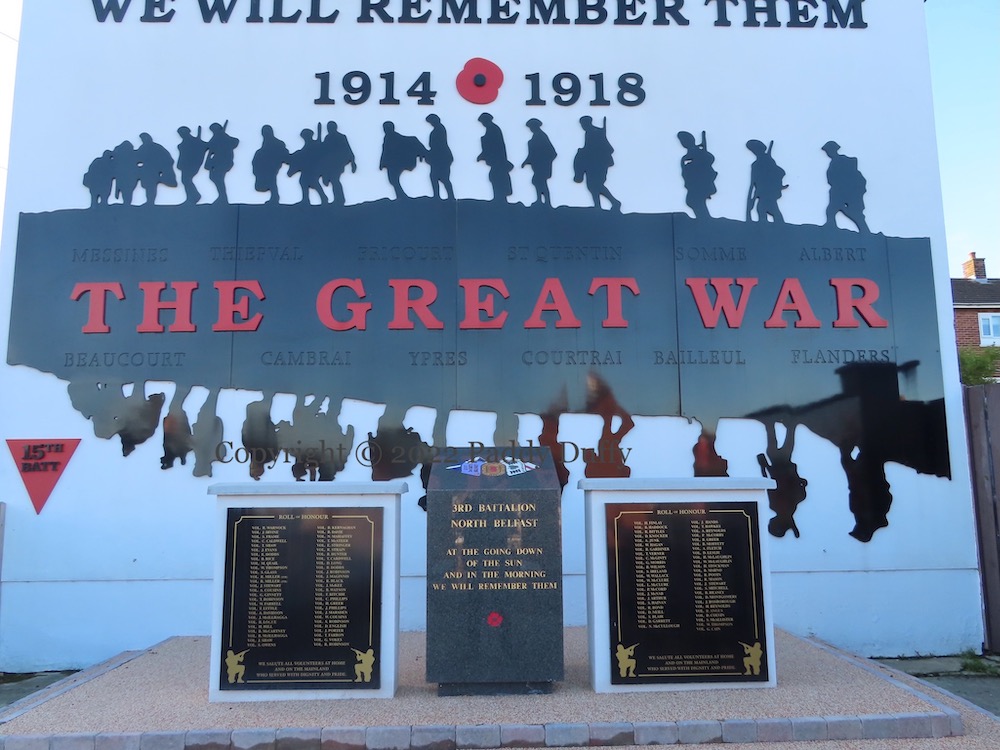
The memorial garden in Mount Vernon, has a “cut-out” mural to the 36th (Ulster) Division and memorial plaques to six UVF members who died between 1974 and 2000, including (lhs of the final image) Joe Shaw, who was shot by the UDA during the 1974-1975 feud. (For details of the killings and its aftermath, see this Balaclava Street article.) The stone in the centre is dedicated to the “3rd battalion North Belfast” Ulster Volunteer Force.



















 Paddy Duffy Collection