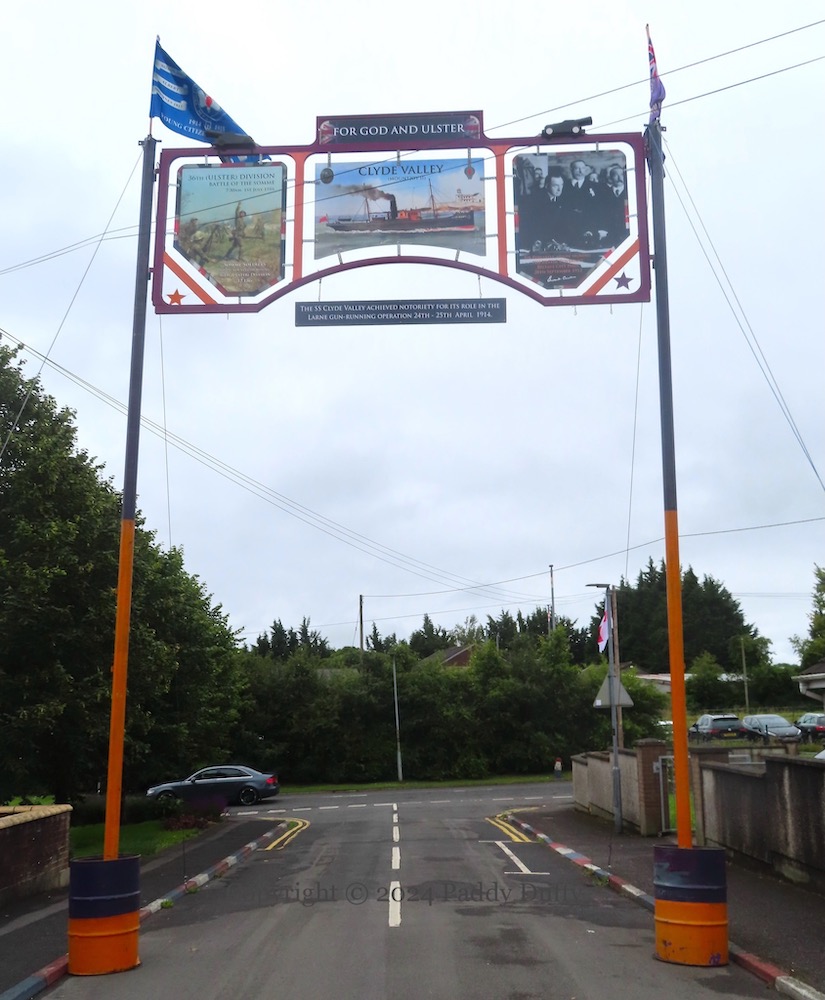
The Millbrook arch has three panels: “36th (Ulster) Division, Battle Of The Somme, 7:30 am 1st July 1916”; the Clyde Valley (Mountjoy II) “The SS Clyde Valley achieved notoriety for its role in the Larne gun-running operation 24th-25th April 1914”; “Sir Edward Carson signing the Ulster Covenant, Belfast City Hall 28th September 1912”.
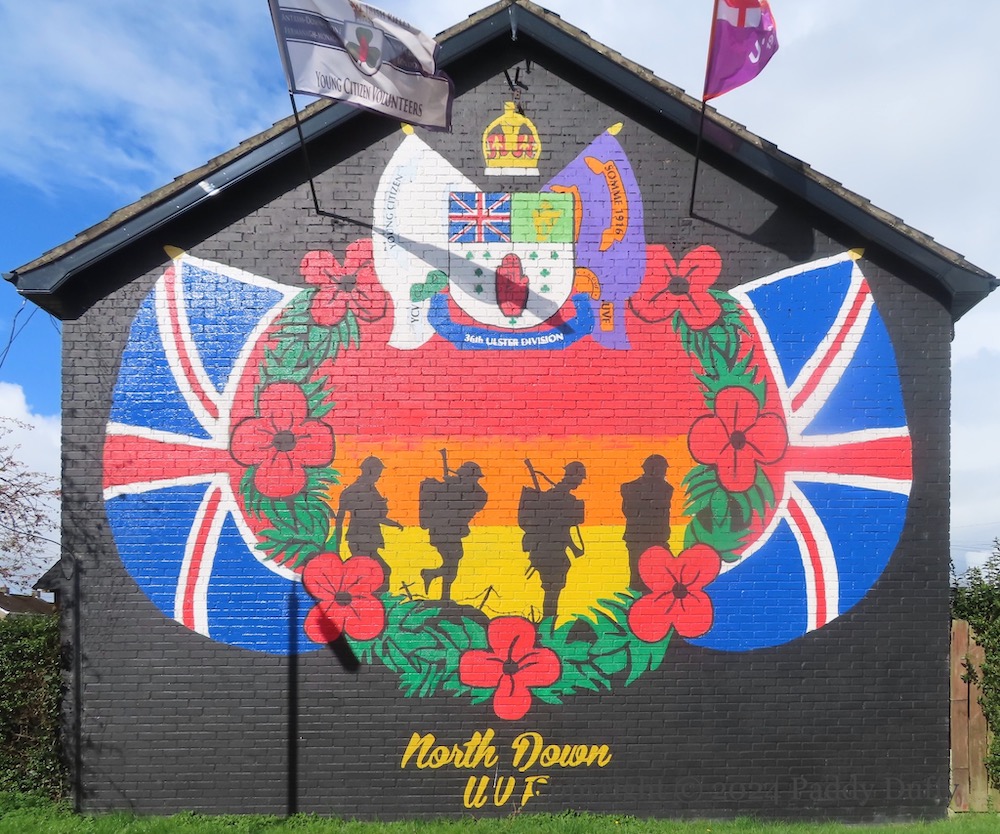
Each quadrant of Down (north, south, east, west) gave rise to a battalion of Ulster Volunteers, and North Down comprised 15 companies, almost doubling the typical British-Army size of eight companies (History Ireland; see also another History Ireland article on the initially sporadic development of the Volunteers out of Unionist Clubs).
Upon the outbreak of the Great War, the Down volunteers joined the 13th battalion of the Royal Irish Rifles, which were assigned to the 108th brigade of the 36th Division of the British Army.
The mural shown in this entry is a recent repainting; the previous version was painted in 2017 (and originally c. 2007 – see M03697).
See also: Only A Few Minutes – a memorial mural to Bangor native James Samuel Davidson, of the 108th and a North Down volunteer.
Clandeboye Road, at the bottom of the Kilcooley estate.
Remembrance Day, formerly known as Armistice Day, commemorates and celebrates the end of hostilities in the first World War on November 11th, 1918. Many ceremonies in the UK take place on the second Sunday of the month, regardless of the date. This practice began in 1945, changing the WWII practice of marking the occasion on the preceding Sunday, to ensure that the holiday did not fall on a work-day (WP).
This large tarp (above) is at the Shore Road memorial garden to the 10th, 36th, and 16th divisions, shown below, along with the nearby Fifes & Drums/Fairhill flute band (Fb)/Pride Of The Shore (Fb) tribute to QEII. The tarp was also seen last year: Remembrance Day.
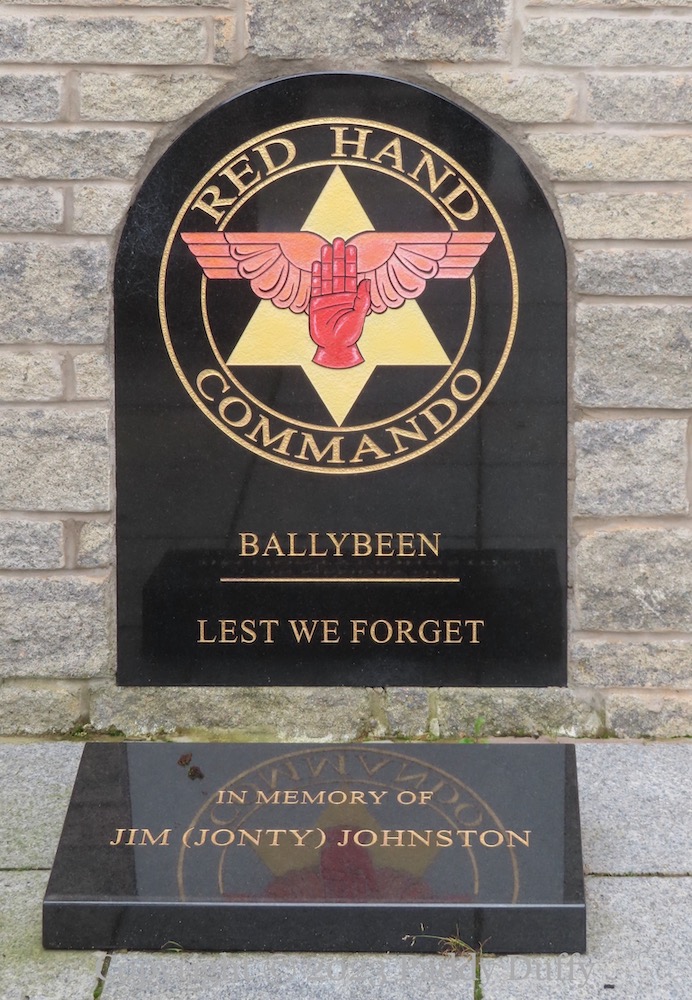
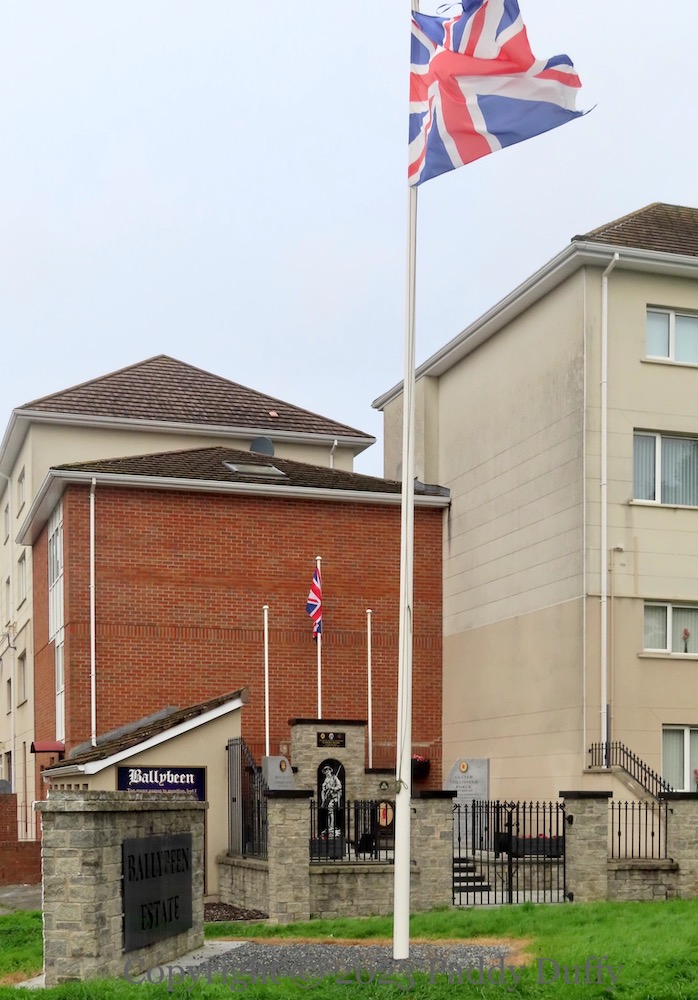
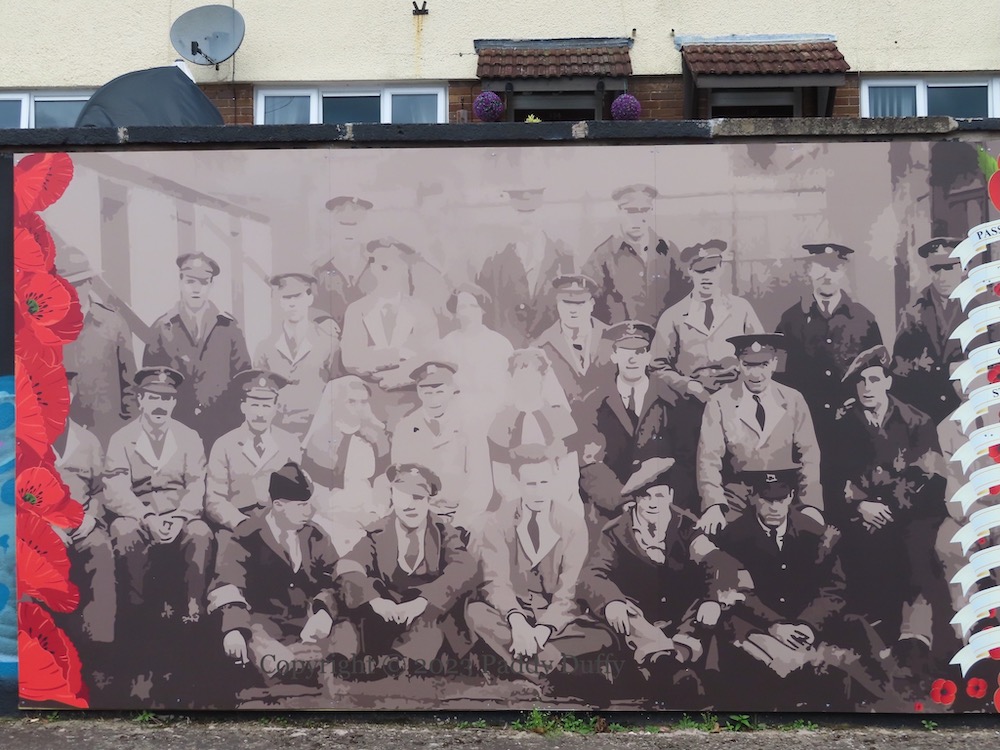
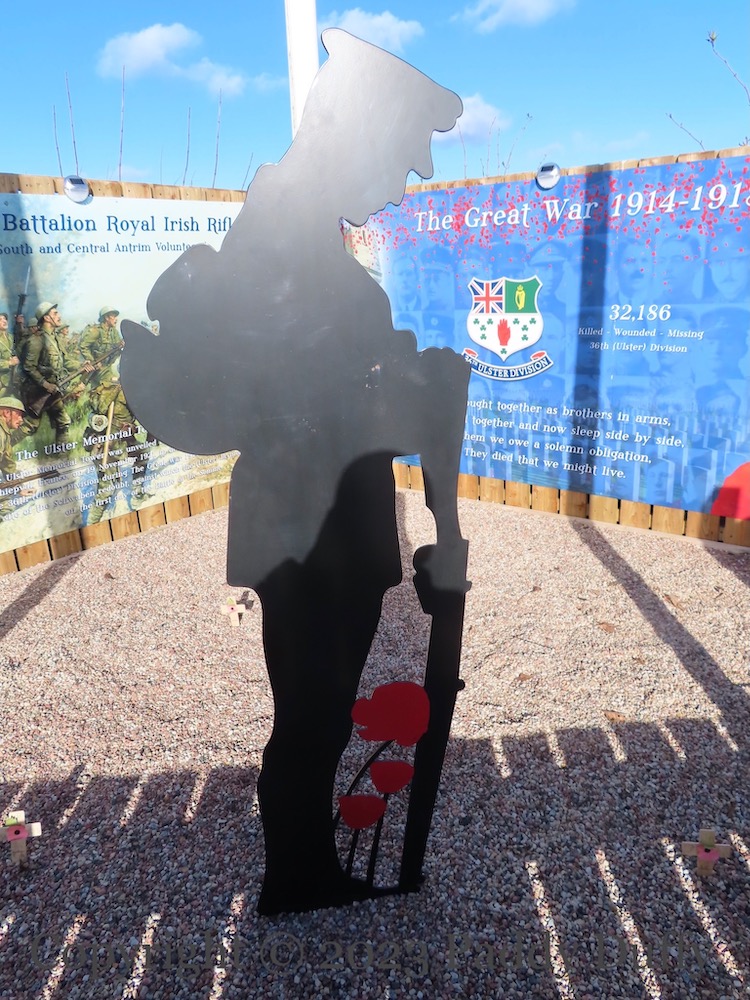
This is the UVF/RHC memorial garden in Ballybeen, with individual plaques to “East Belfast battalion commander” RJ ‘Mickey’ Wilson (died 2022), Jim ‘Jonty’ Johnston (killed in 2003 BelTel), M. Walker, G. McCartney, David Brown. While most of the plaques and stones are to the modern UVF, there are three pieces to the 36th (Ulster) Division.
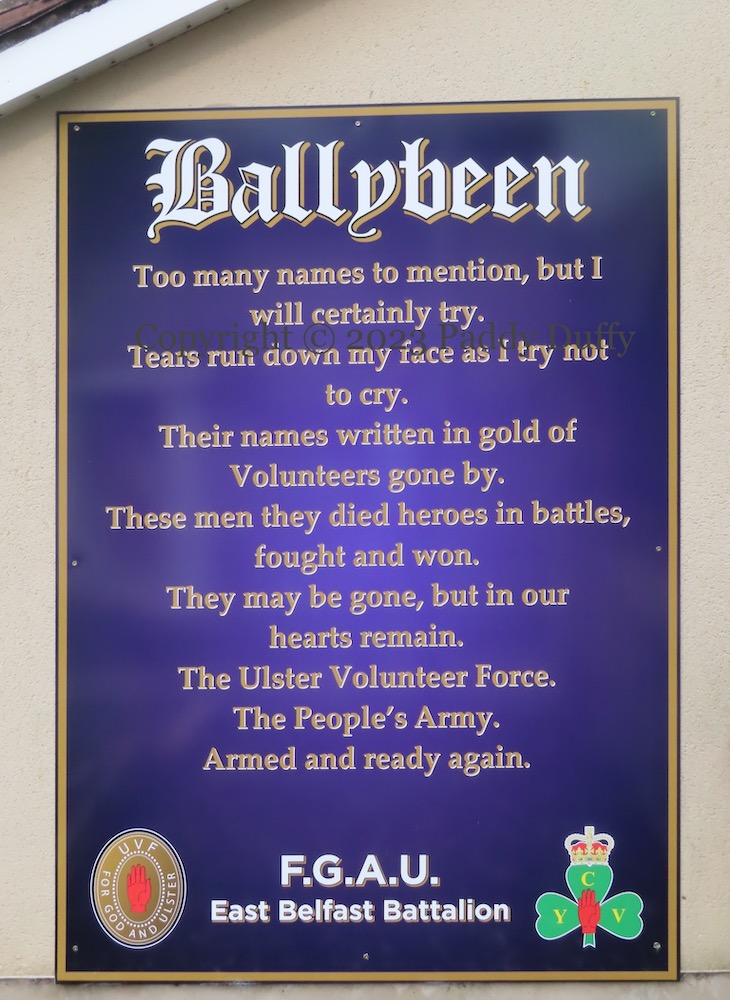
“Too many names to mention, but I will certainly try./Tears run down my face as I try not to cry./Their names written in gold of Volunteers gone by./These men they died heroes in battles, fought and won./They may be gone, but in our hearts remain./The Ulster Volunteer Force. The People’s Army./Armed and ready again.”
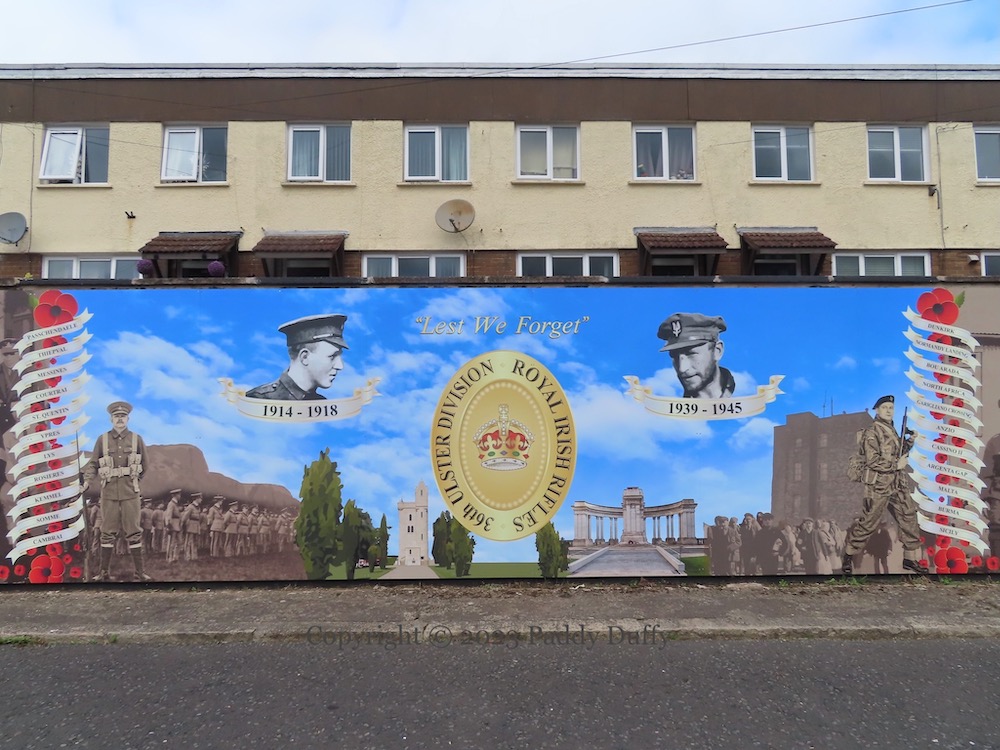
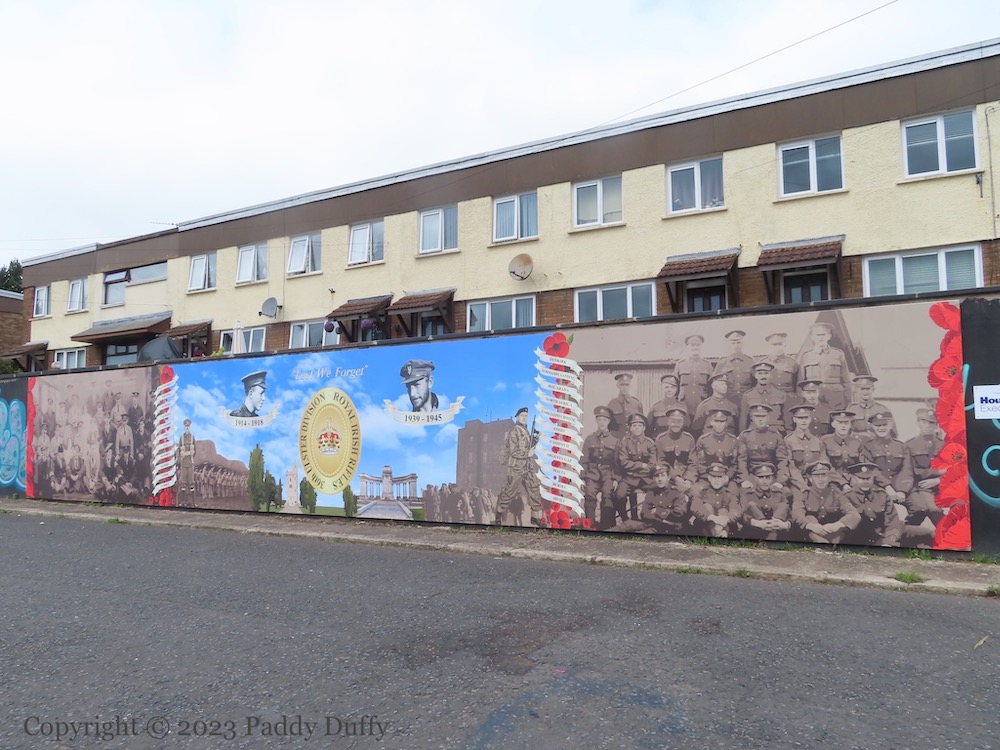
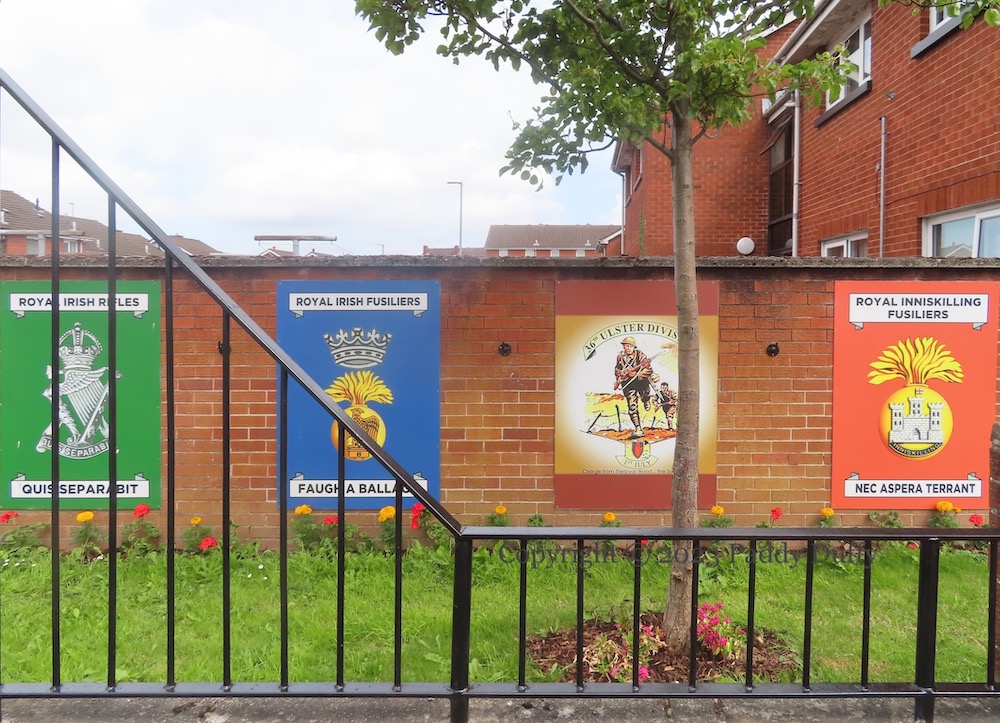
After WWI, the Royal Irish Rifles became the Royal Ulster Rifles (and later became part of the Royal Irish Rangers). This board prioritises WWI as the Rifles were part of the 36th Division. The hero of WWI portrayed in the central panel is William McFadzean, awarded the VC for falling on two live grenades in the trenches on July 1st, 1916. McFadzean is familiar from many previous murals both individually and in the company of other VC winners; for his family home in Cregagh, see Rubicon.
Alongside McFadzean, the hero of WWII is Blair “Paddy” Mayne, who was only briefly in the Ulster Rifles before making his name in the Parachute Unit (later, and better, known as the SAS). His many medals of honour are shown in an old Newtownards mural, though he was denied the VC.
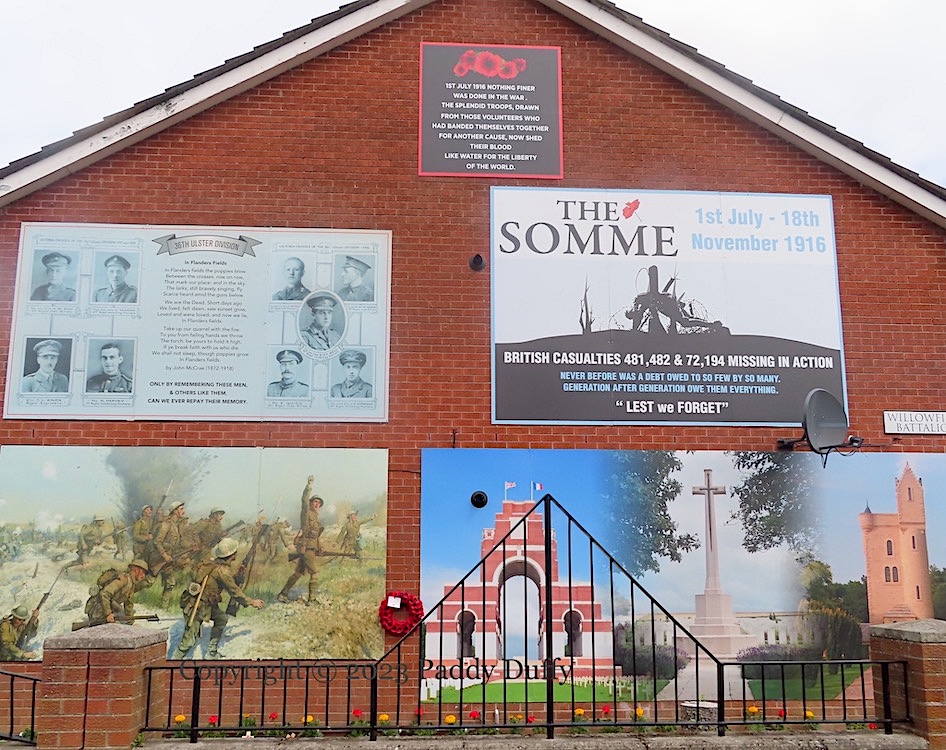
“Willowfield Battalion.” The building on the corner of Willowfield Street and the Woodstock Road was demolished and rebuilt with a building whose gable wall is full of windows. As a result, the display of Somme-related boards (see 2017’s Faugh-A-Ballagh in the Seosamh Mac Coılle collection) has moved a short distance down the street to a gable that has been revealed by taking down two large trees. The panels remain as before, though a new version of the Somme board renders the information horizontally rather than vertically (above).
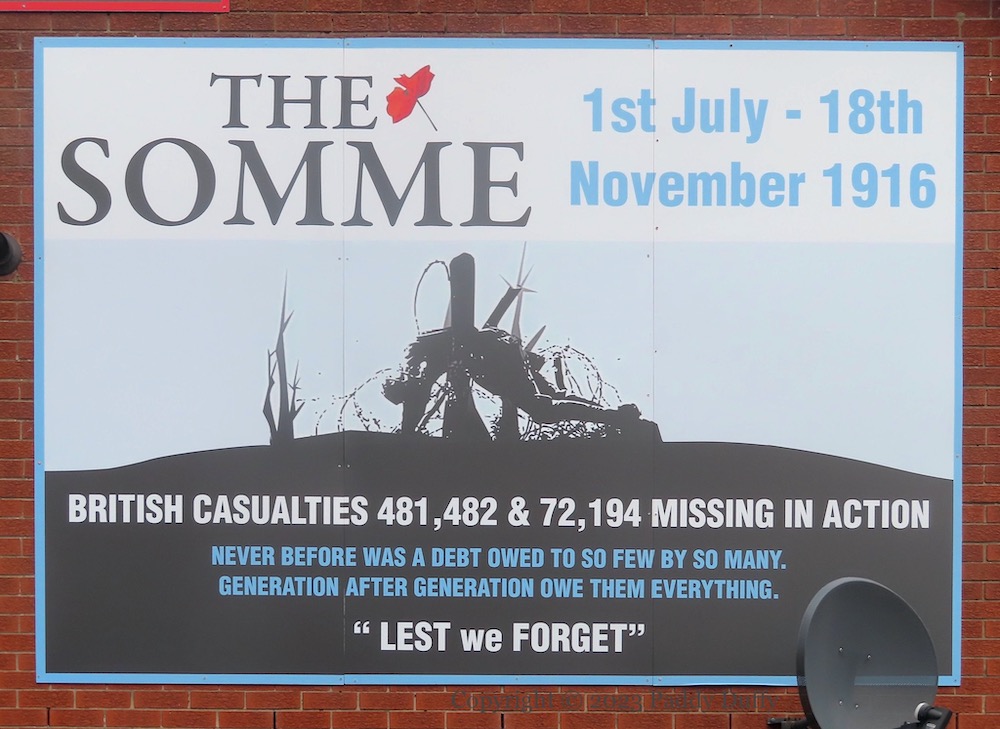
Above: “Never before was a debt owed to so few by so many. Generation after generation owe them everything. Lest we forget.” Winston Churchill’s line about the British Air Force in WWII, that “Never in the field of human conflict was so much owed by so many to so few (youtube)“, is echoed in a board about the battles at the Somme between July 1st and November 18th, 1916. “The few” in this case, however, number nearly half a million dead and more than 72,000 missing.
Apex: “1st July 1916 nothing finer was done in the war. The splendid troops, drawn from those volunteers who had banded themselves together for another cause, now shed their blood like water for the liberty of the world.”
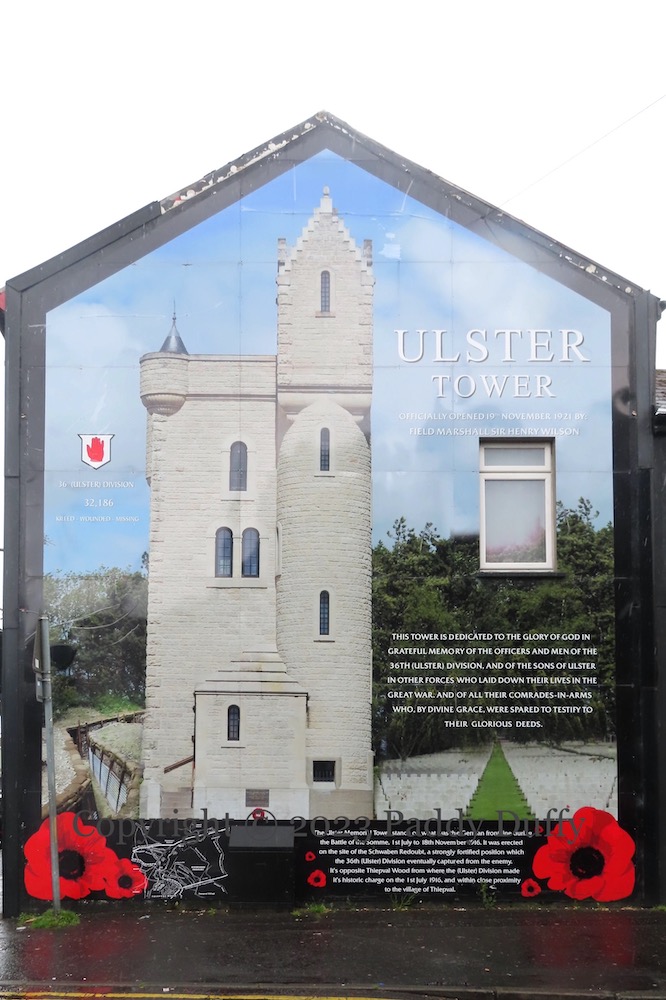
The map in the lower left corner of this WWI commemorative mural shows the defensive lines of both the Allies and the Central Powers. As the inscription on the mural describes, the Ulster Tower is situated close to the Schwaben Redoubt, the primary objective of the 36th Division on the first day of battle.
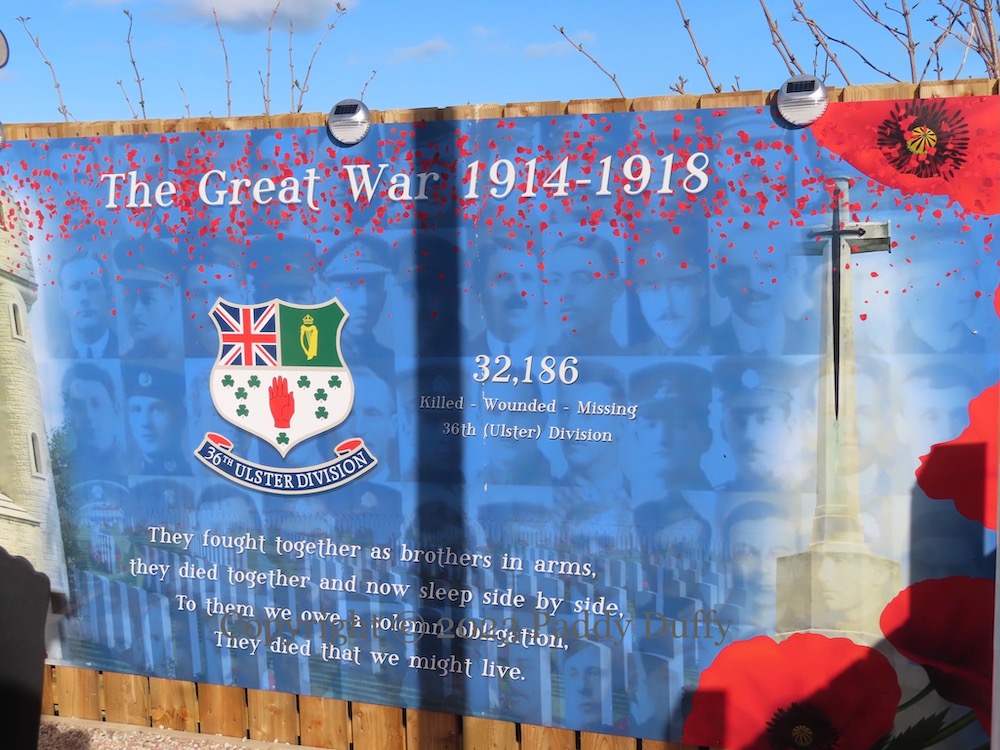
“Ulster Tower, officially opened 19th November, 1921, by Field Marshall Sir Henry Wilson.” “This Tower is dedicated to the glory of God in grateful memory of the officers and men of the 36th (Ulster) division, and of the sons of Ulster in other forces who laid down their lives in the Great War, and of all their comrades-in-arms who, by divine grace, were spared to testify to their glorious deeds.” “The Ulster Tower stands on what was the German front line during the Battle Of The Somme, 1st July to 18th November 1916. It was erected on the site of the Schwaben Redoubt, a strongly fortified position which the 36th (Ulster) Division eventually captured. It’s opposite Thiepval Wood from where the (Ulster) Division made it’s [sic] historic charge on 1st July 1916, and within close proximity to the village of Thiepval.” “32,186 killed, wounded, missing.” “Greater love hath no man than this that a man lay down his life for his friends.”
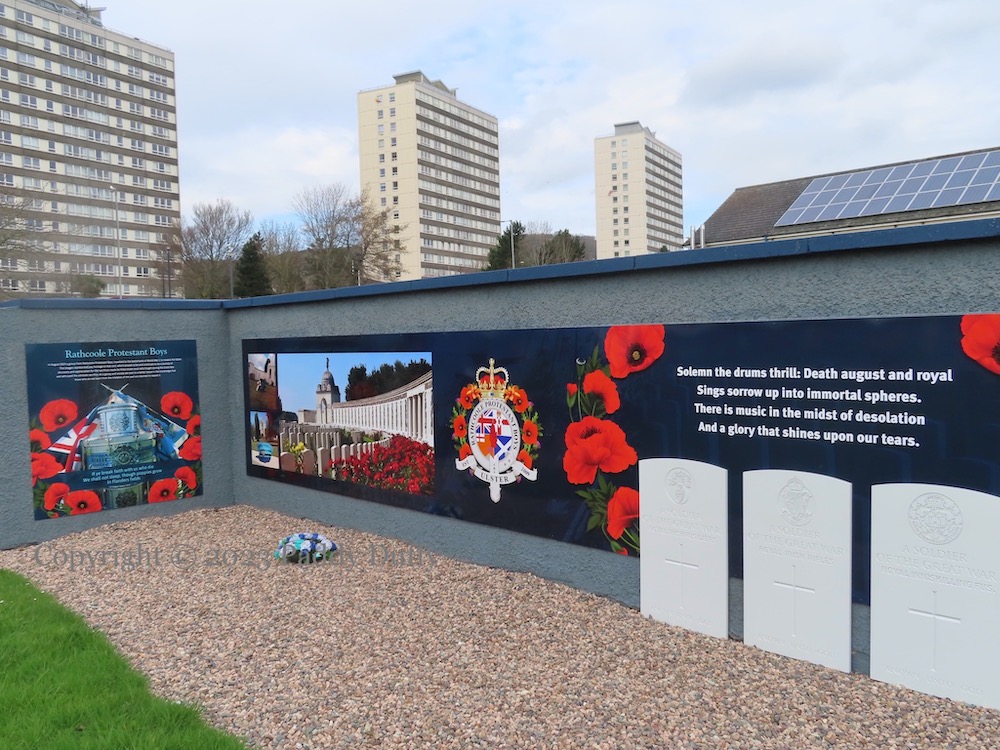
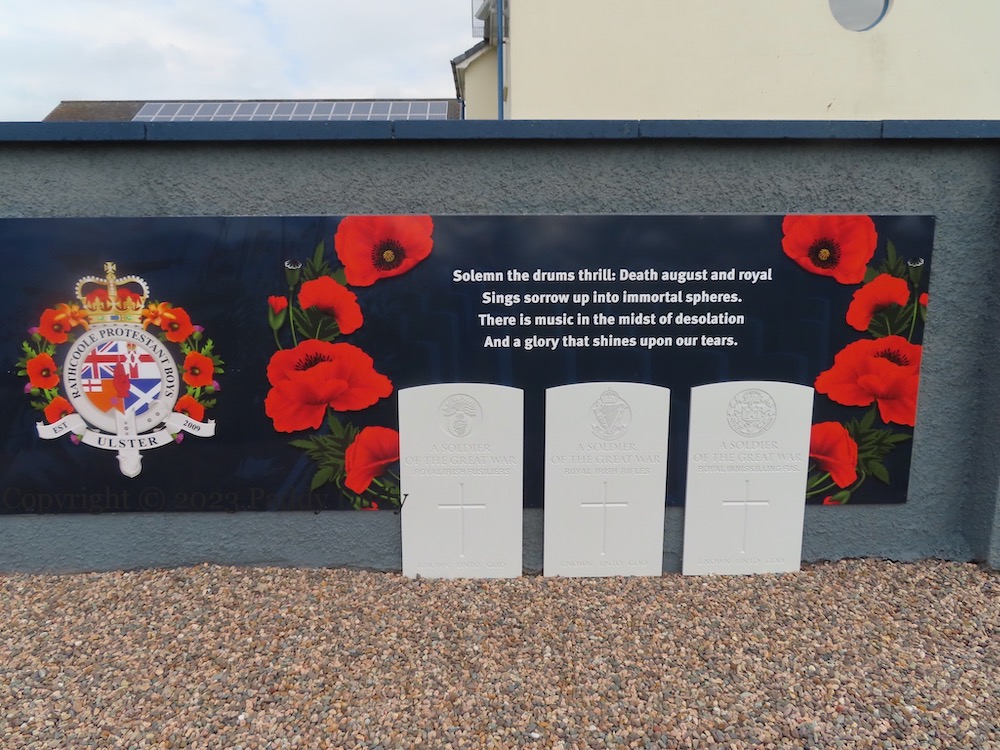
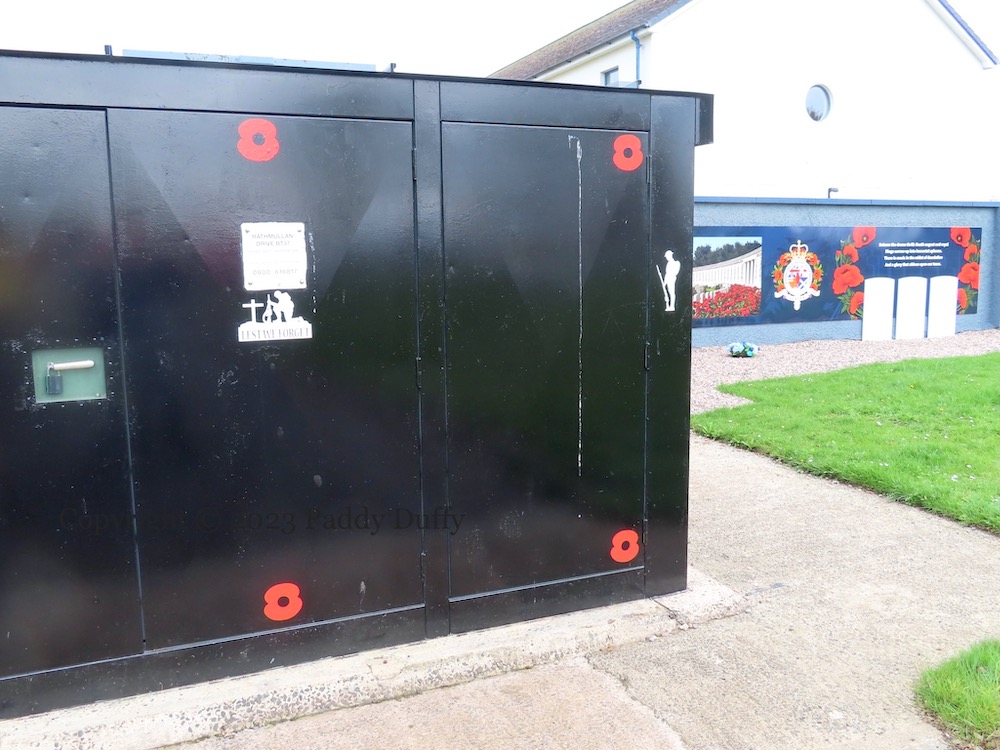
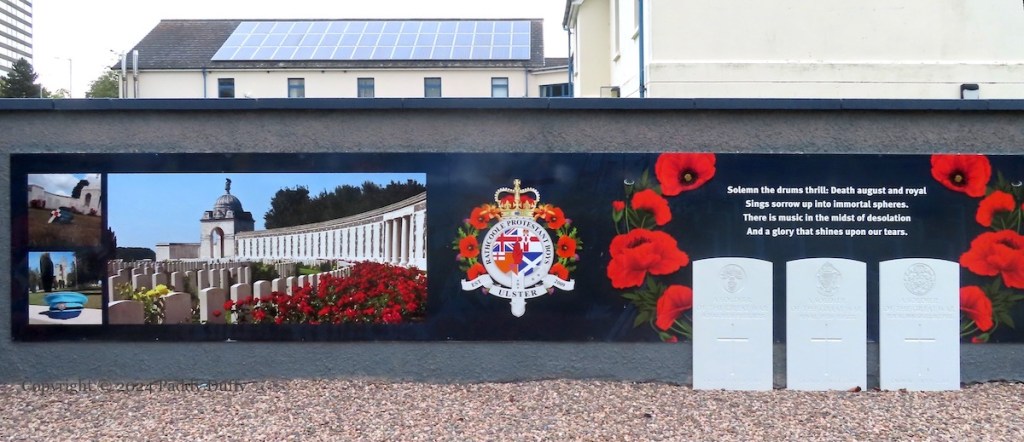
JP Beadle’s painting “Battle of the Somme: Attack of the Ulster Division” hangs in Belfast City Hall (Royal Irish has a history of its purchase) but is reproduced here in a new Rathcoole memorial to the dead of the Great War. (A list of “Ulster’s VC Heroes” can be found at the bottom of The Dead We Honour Here, from the east Belfast memorial garden. For the King George V quote, see How Nobly They Fight And Die.)
“Solemn the drums thrill: Death august and royal/Sings sorrow up into immortal spheres./There is music in the midst of desolation/And a glory that shines upon our tears.” This is the second verse of Binyon’s For The Fallen, a poem whose fourth verse – “They shall not grow old …” – is used in dozens of murals and memorials. (And in one case, the fifth verse: They Sleep Beyond England’s Foam.)
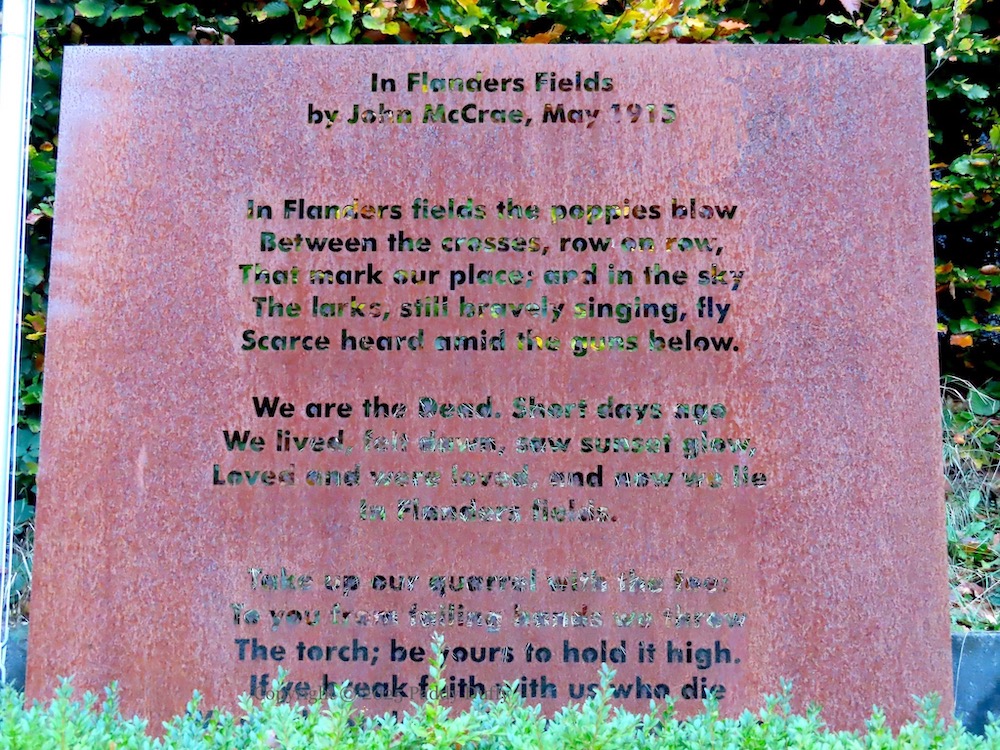
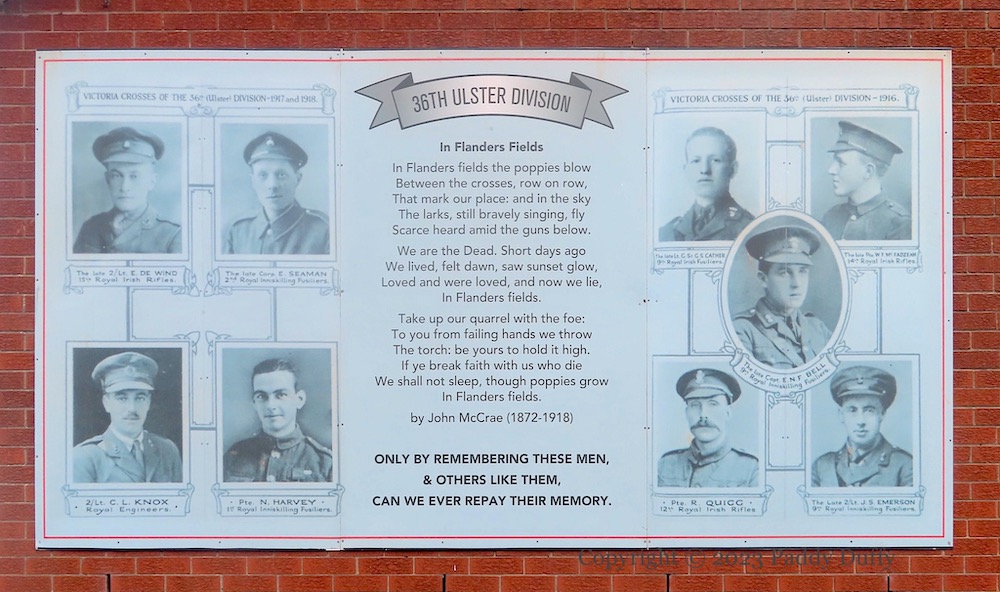
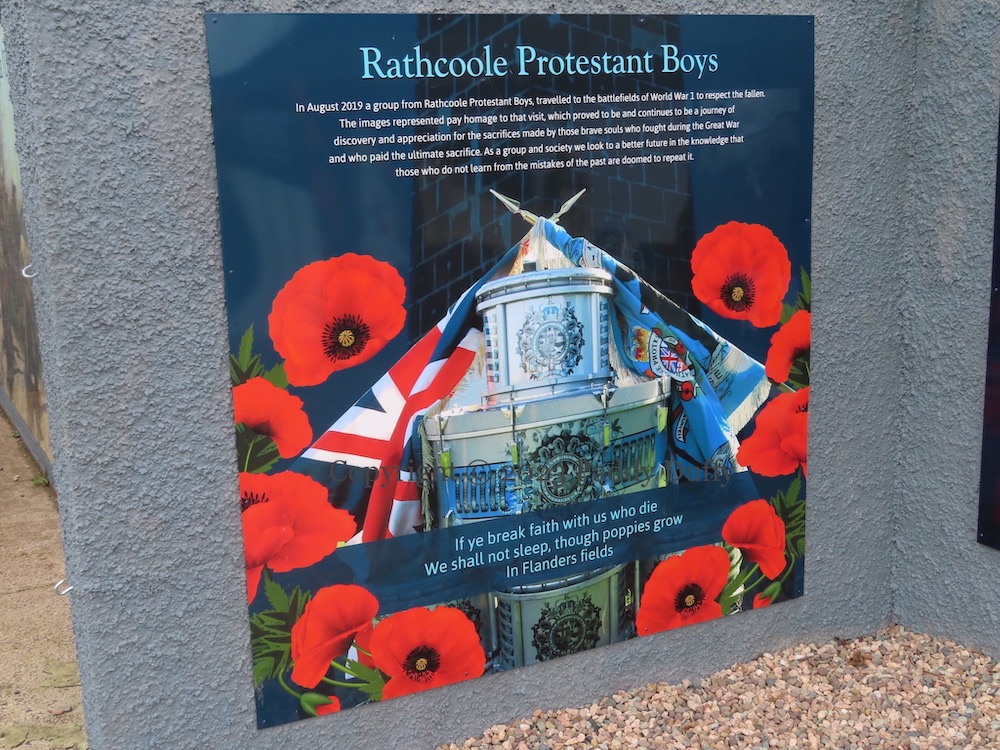
John McCrae’s poem concludes the board to the left: “In August 2019 a group from Rathcoole Protestant Boys [Fb] travelled to the battlefields of World War 1 to respect the fallen. The images represented pay homage to that visit, which prved to be and continues to be a journey of discovery and appreciation for the sacrifices made by those brave souls who fought during the Great War and who paid the ultimate sacrifice. As a group and society we look to a better future in the knowledge that those who do not learn from the mistakes of the past are doomed to repeat it. ‘If ye break faith with us who die/We shall not sleep, though poppies grow in Flanders fields.'”
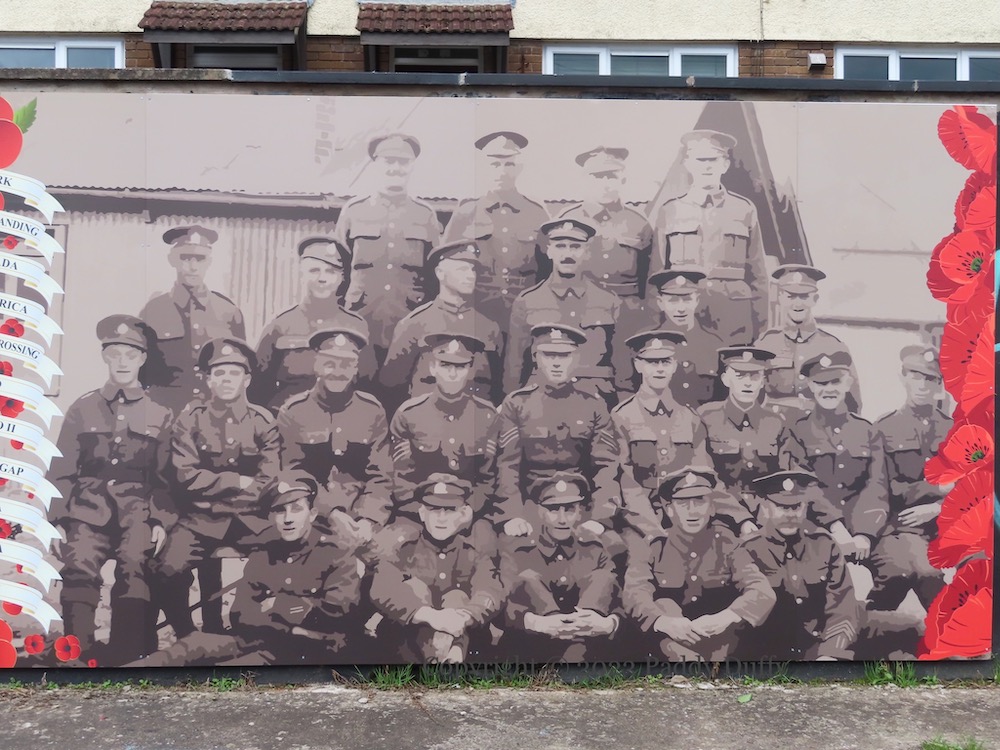
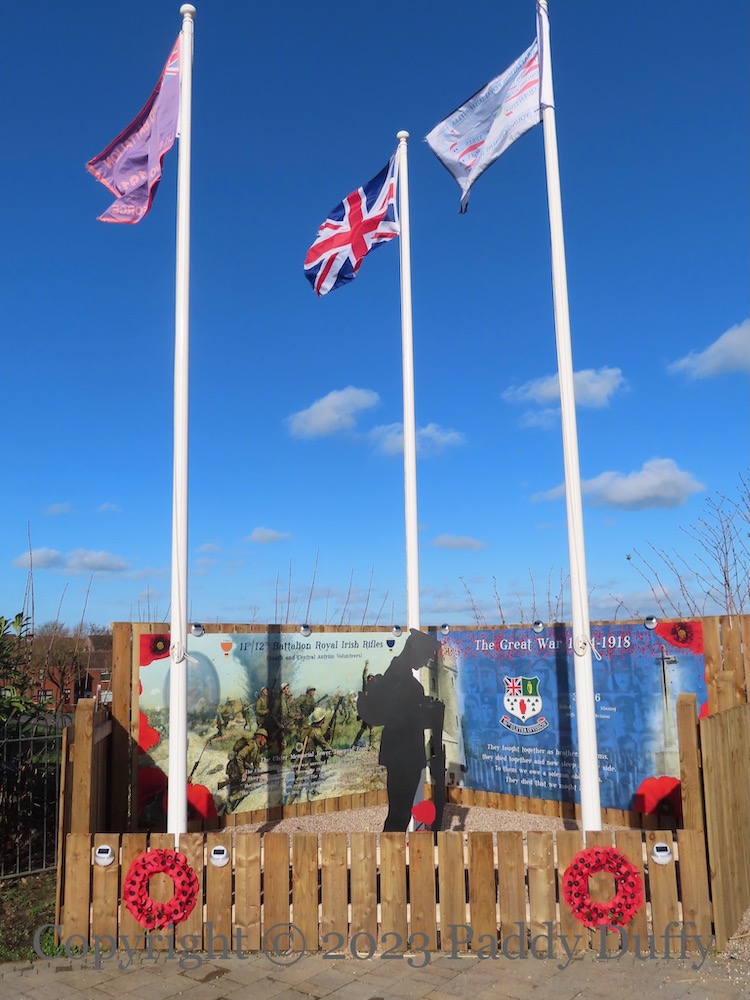
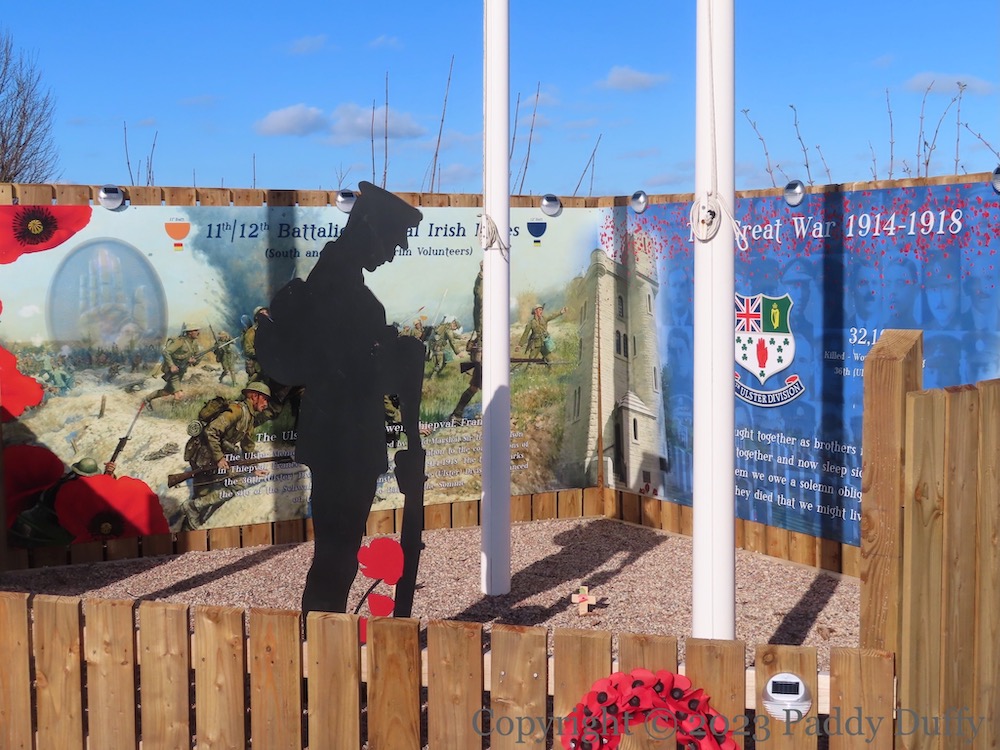
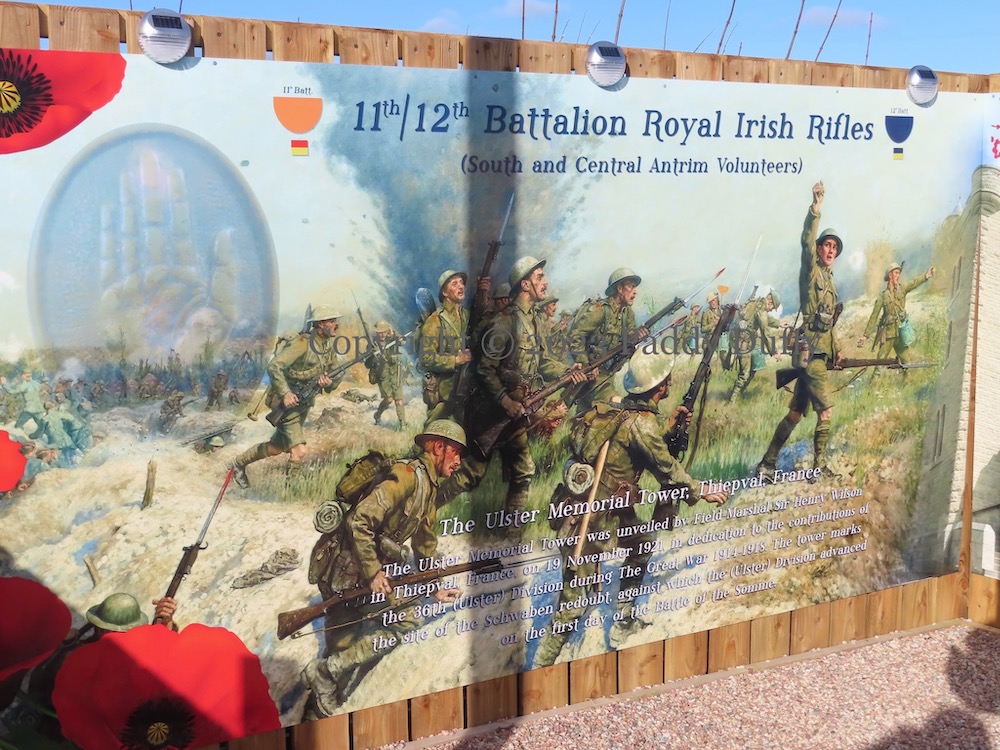
The 11th and 12th battalions of the Royal Irish Rifles were part of the 108th brigade and the 36th (Ulster) Division in WWI.
On July 1st, 1916, the 12th battalion’s objective was to reach the German trenches beyond Beaucourt railway station with the 9th battalion Royal Irish Fusiliers (Armagh, Monaghan & Cavan Volunteers); they were cut down by machine-gun fire and unable to achieve their goal. Robert Quigg of the 12th Rifles and Geoffrey Cather of the 9th Fusiliers were awarded the VC (see previously VCs Of The 36th). The 11th was part of the attack on the Schwaben Redoubt and reached the German second line before being pushed back in the evening. (Royal Irish | Web Matters)
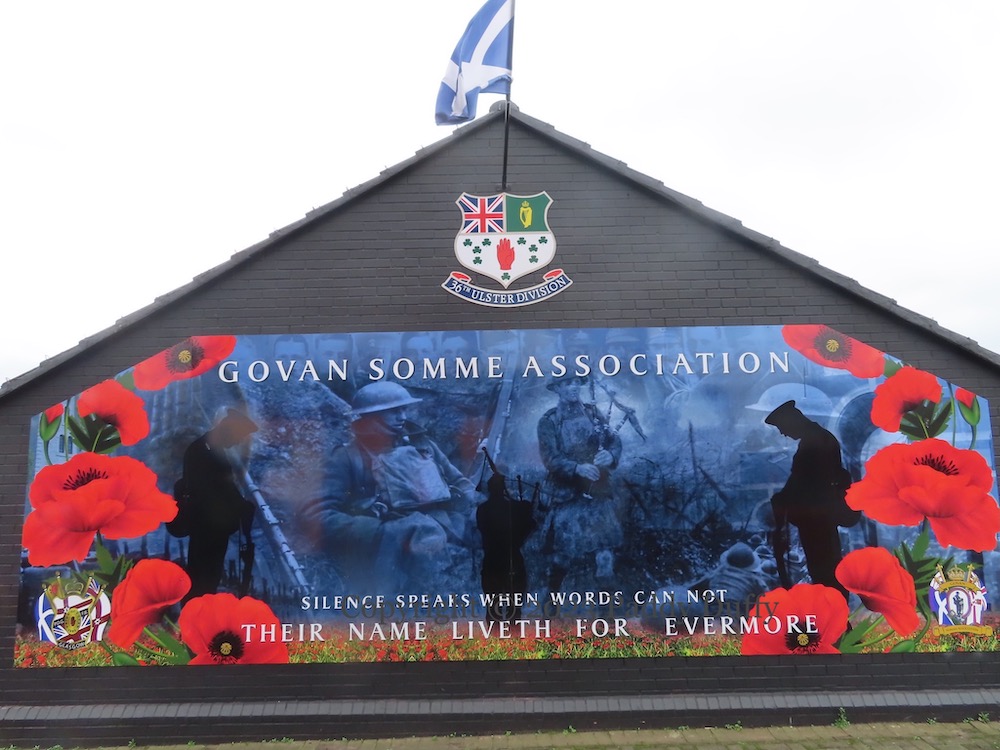
There was previously a (painted) mural on this wall – see Passchendaele Court – but this latest display is a large printed board, with photographs blended together and framed by graveside mourners, poppies, and the emblems of the Pride Of Govan flute band and the Govan Somme Association (Fb), which also supported the previous mural.
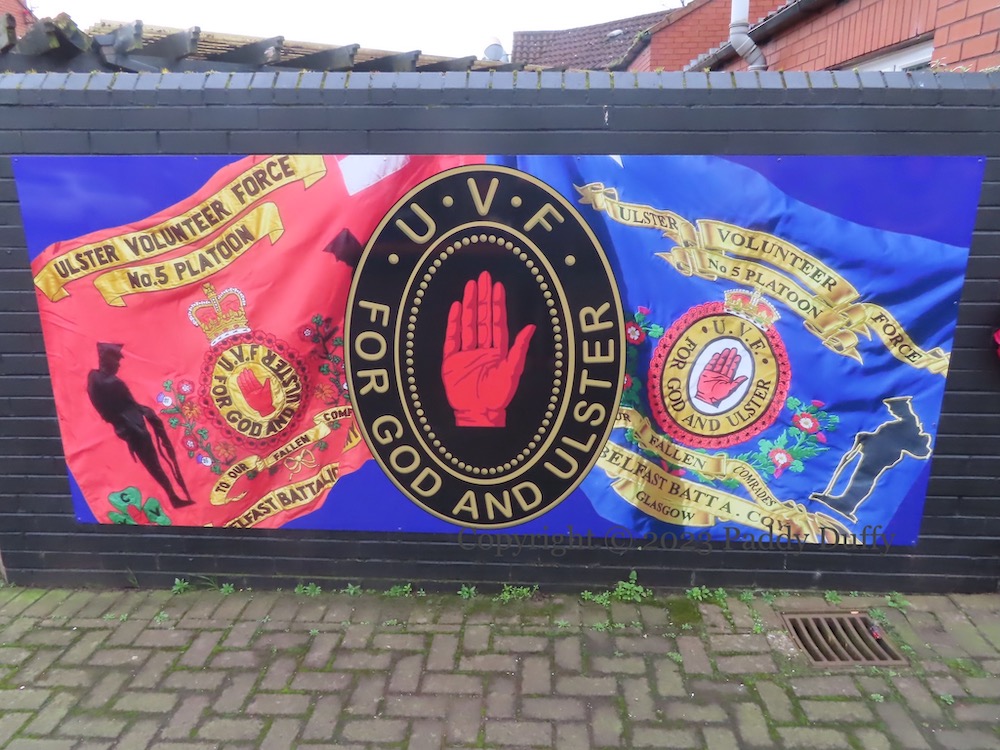
To the left, as seen in the final images, is a smaller UVF (1st Battalion) A Company 5th Platoon board – like the other new board in the street We Will Always Be Ready (and on the other side of Conway Street – see When Needed We Shall Rise Again).