York Road Civil Defence Hall

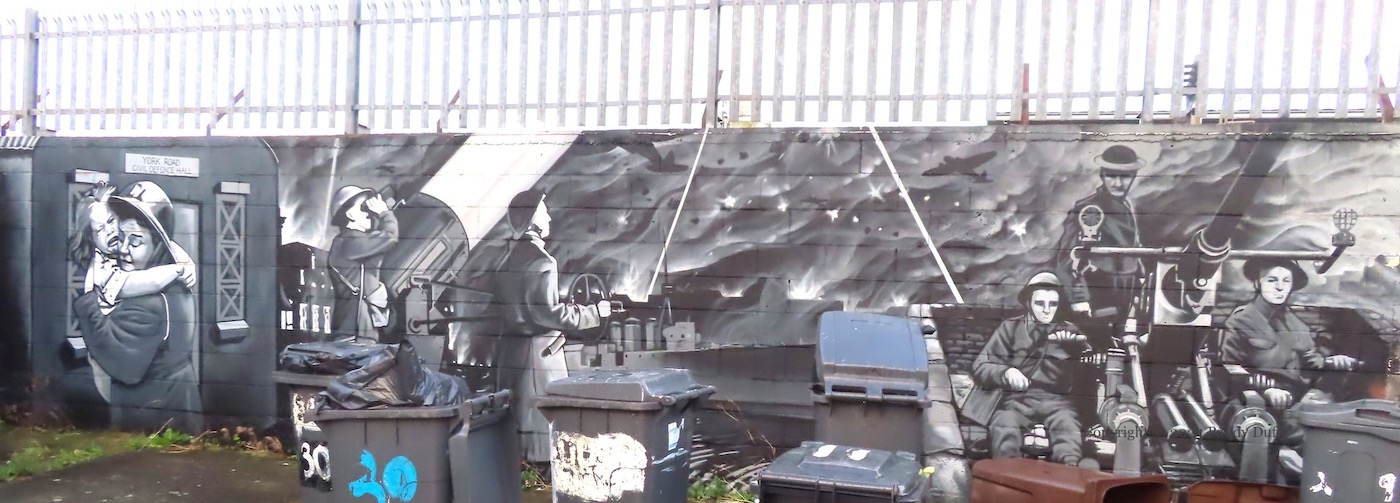
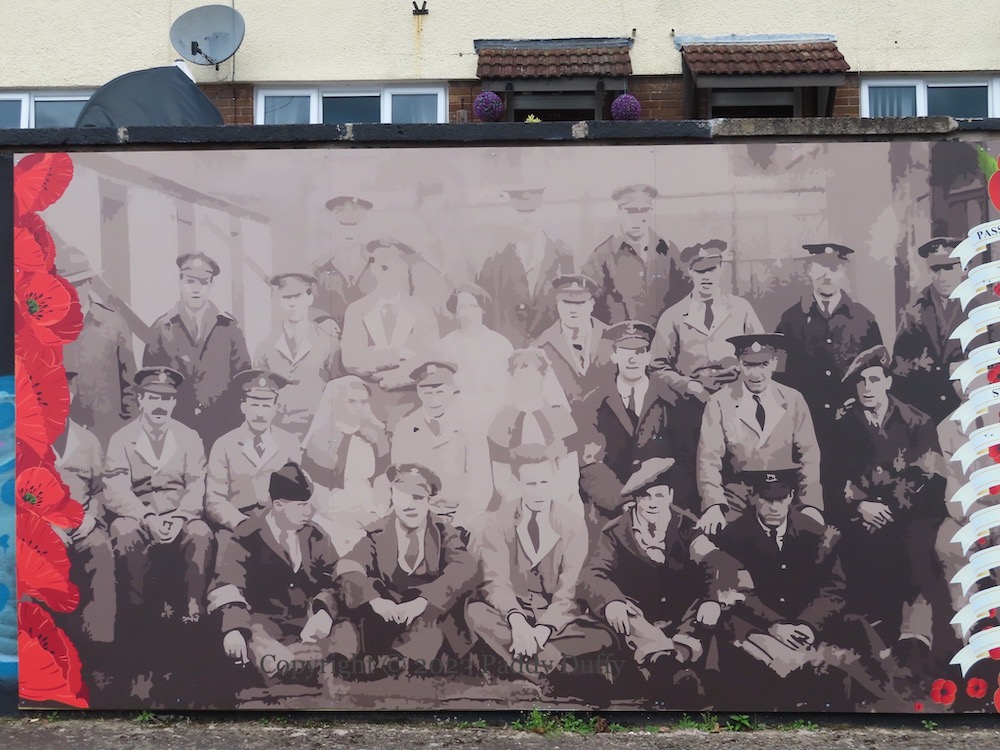
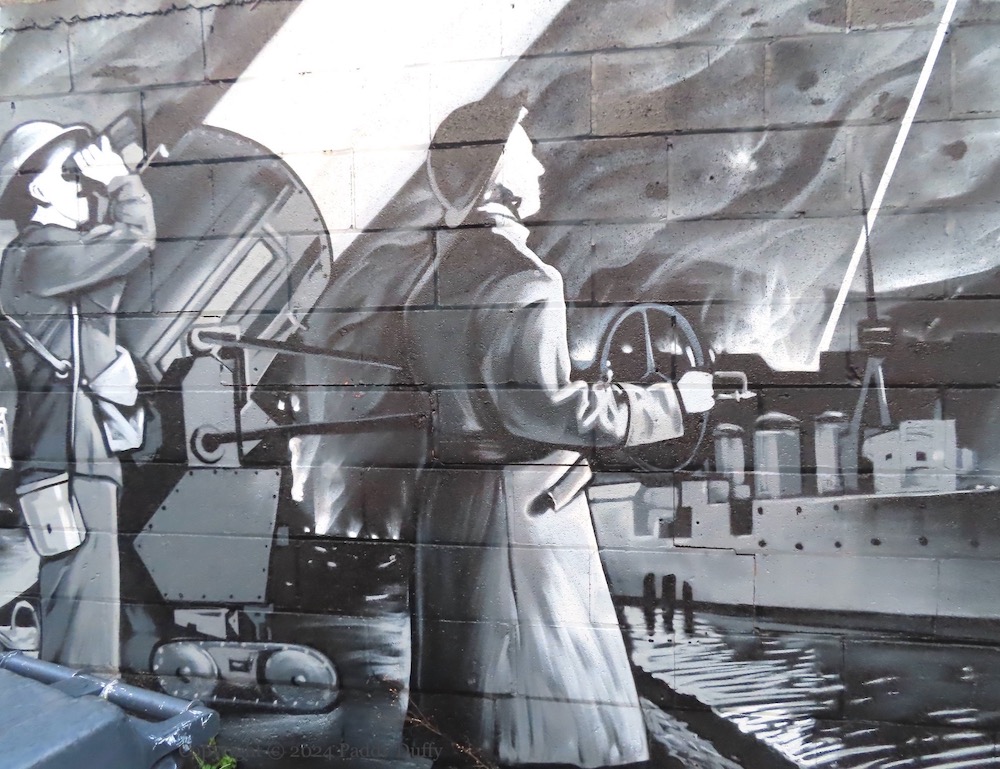
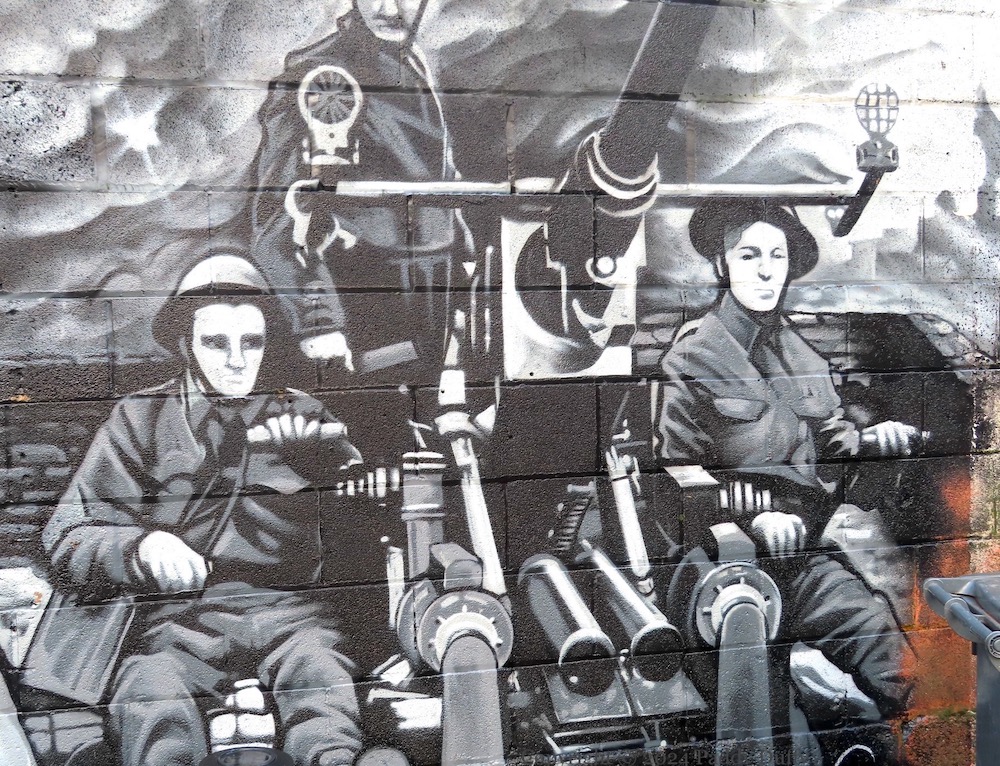
The HUBB community centre (Fb) in north Belfast has, since 2010, been based in what used to be a World War II Civil Defence air-raid shelter, which it cleaned and renovated (Tele). The original hall is depicted in this mural on the side of the HUBB.

In 1940, Belfast was protected by thirty-eight anti-aircraft guns. The German Luftwaffe flew a reconnaissance flight over Belfast on November 30th, 1940 and a test mission of eight planes on April 7th, 1941 concluded that Belfast’s defences were, “inferior in quality, scanty and insufficient” (Hogg). 150 bombers would blitz Belfast the following week, on Easter Tuesday, April 15th, and the seven guns that had been in operation ceased firing, believing, falsely, that RAF planes were also in the sky (WP).

Belfast was bombed by the Germans four times in April and May of 1941. In the blitz of Easter Tuesday, 1941, more than 900 people died, 1,500 were injured, and half the houses in Belfast were damaged (WP). According to Elaine Hogg’s research in the ‘Darker Side Of Belfast’ series, 100,000 people left the city in the remainder of the month, due to shock, fear, and the squalid conditions and unruly behaviour that followed the bombing.
Click image to enlarge
Copyright © 2024 Paddy Duffy
T05962 T05963 T05964 T05965
T05966 T05967
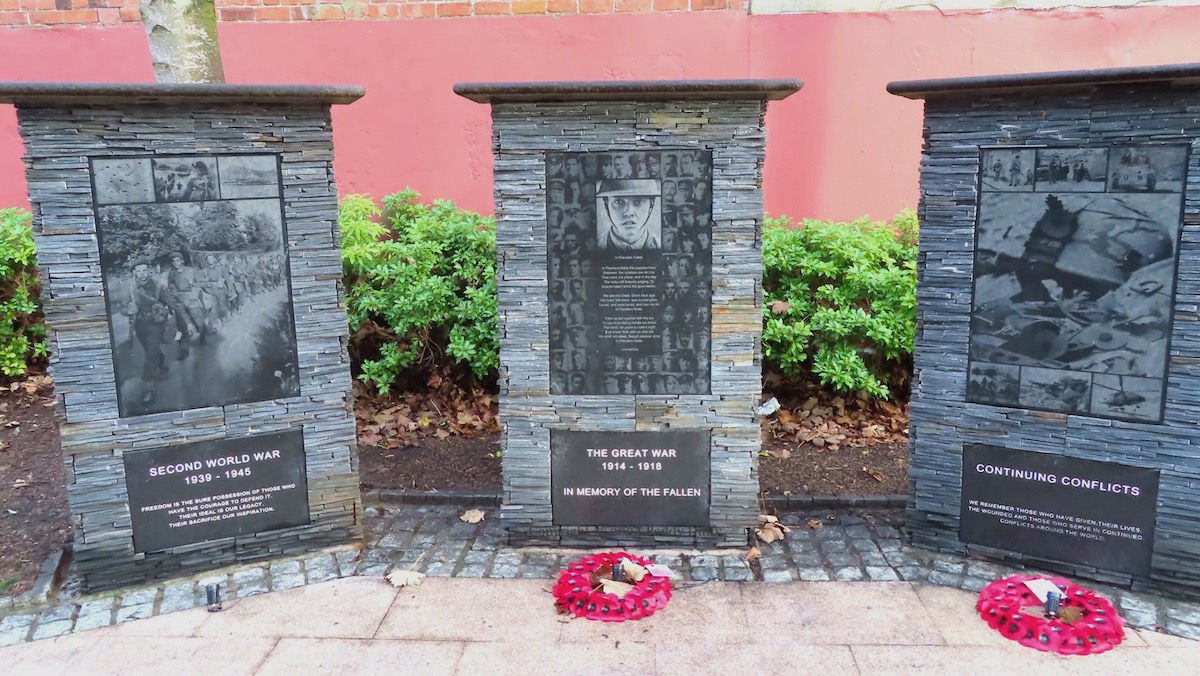
Continuing Conflicts

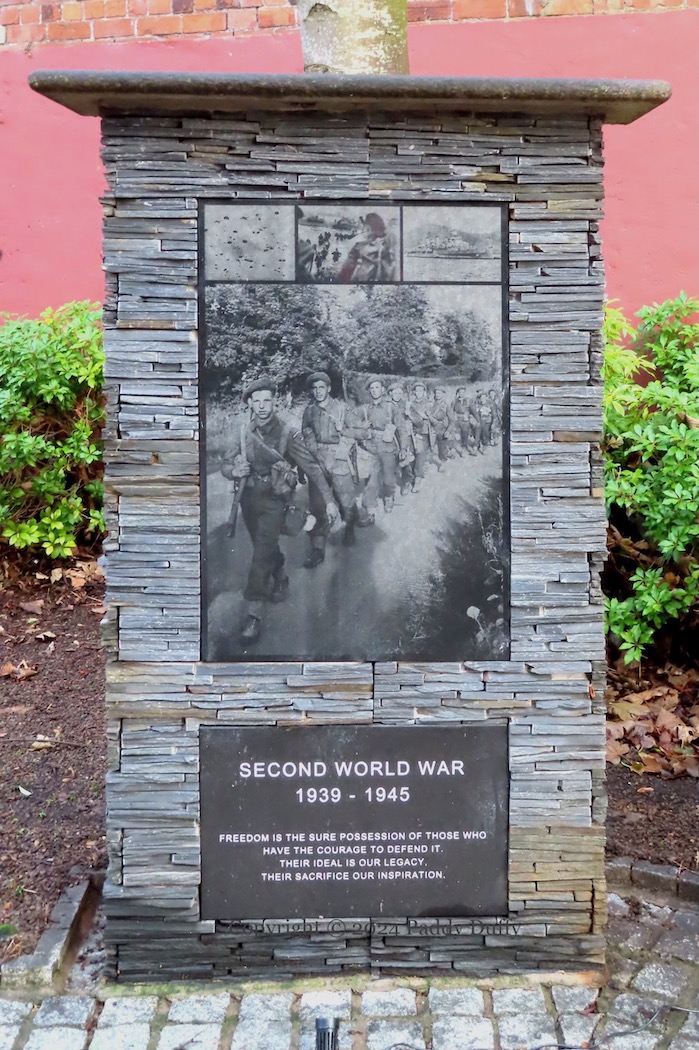
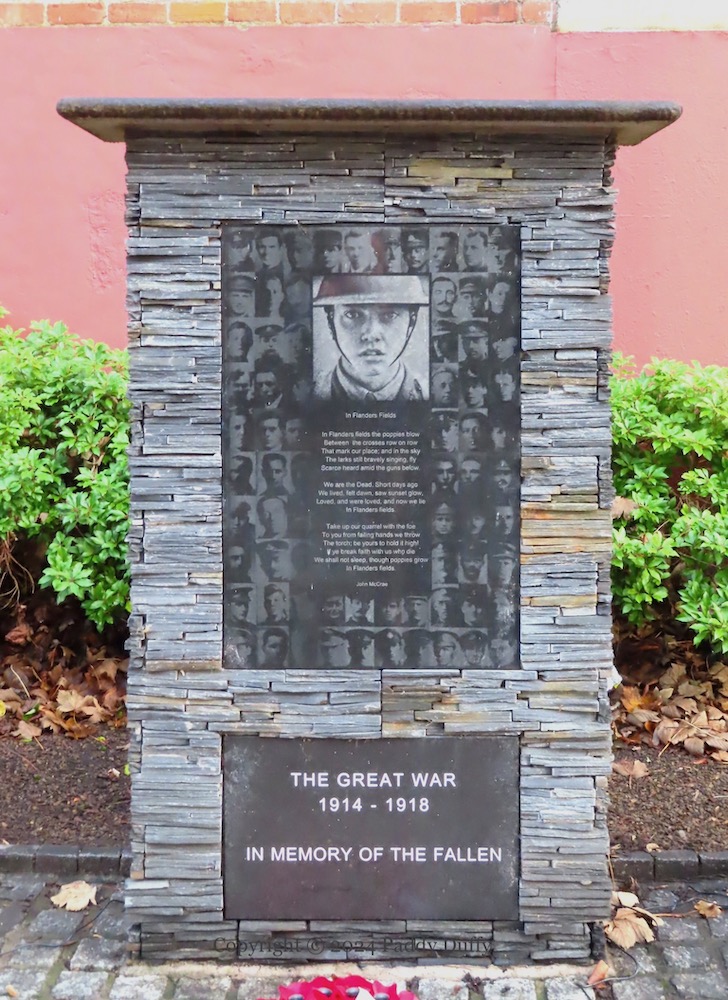
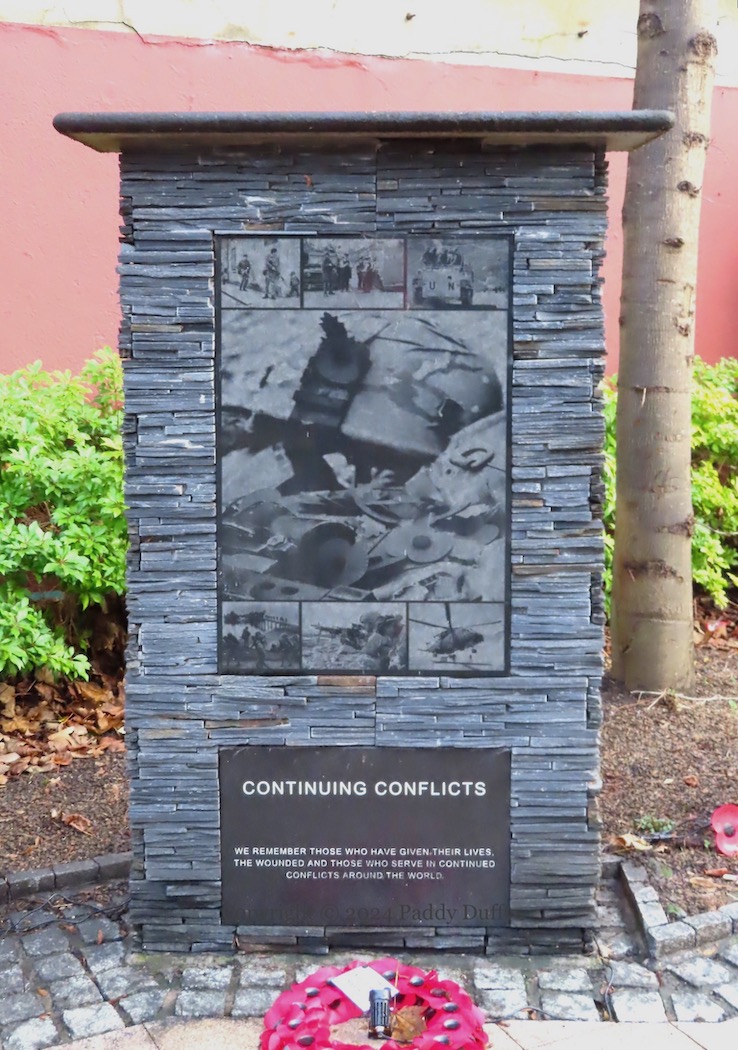
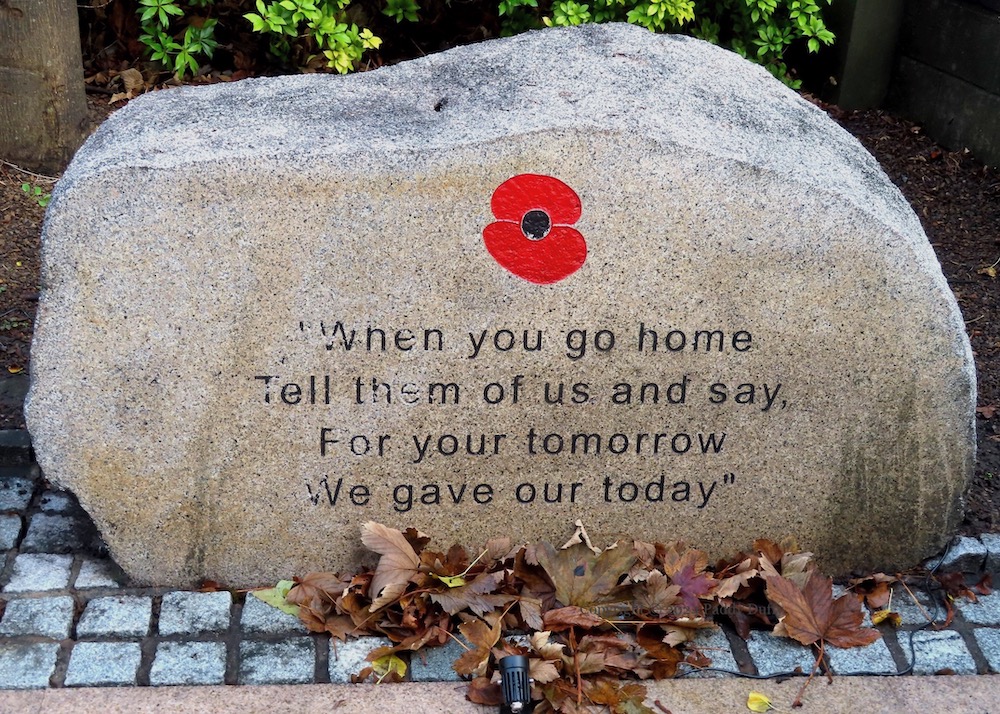
The war memorial garden in City Way (Sandy Row) commemorates those from the Great War, World War II, and “Continuing Conflicts” which includes the “Troubles”. There is also a fourth, smaller, stone, with John Maxwell Edmonds’s memorial epitaph.

“The Great War 1914-1918: In memory of the fallen”, with John McCrae’s poem ‘In Flanders Fields‘.
“Second World War 1939-1945: Freedom is the sure possession of those have the courage to defend it. Their ideal is our legacy. Their sacrifice is our inspiration.”
“Continuing Conflicts: We remember those who have given their lives. The wounded and those who serve in continued conflicts around the world.”

Click image to enlarge
Copyright © 2024 Paddy Duffy
T05933 T05934 T05935 T05936 T05937
The Battles Of Britain

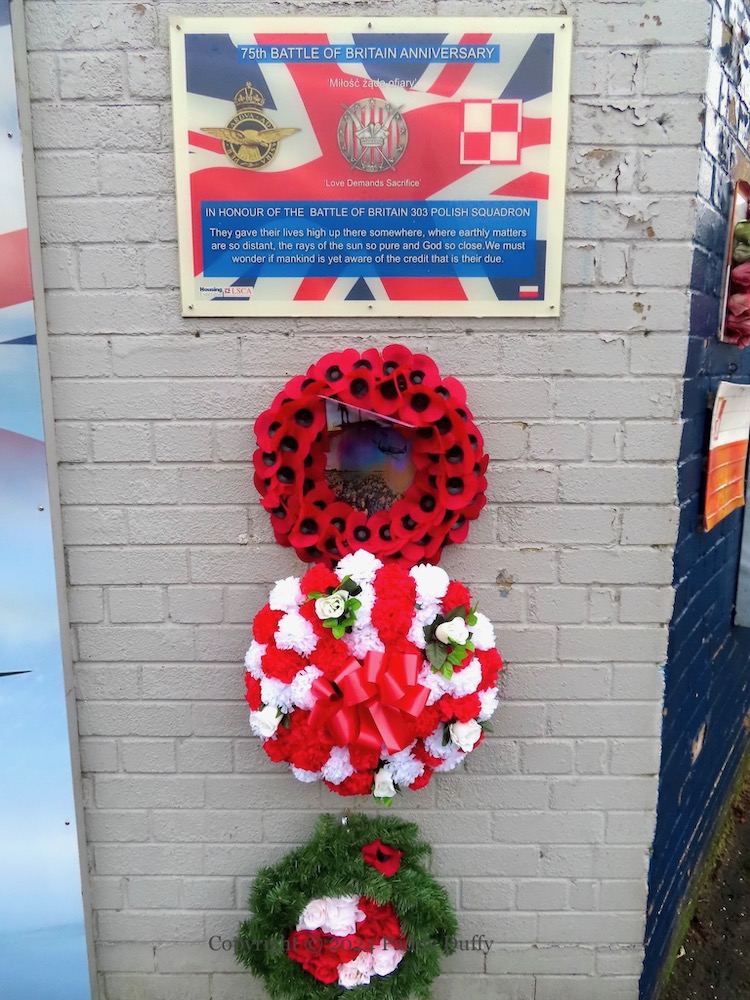
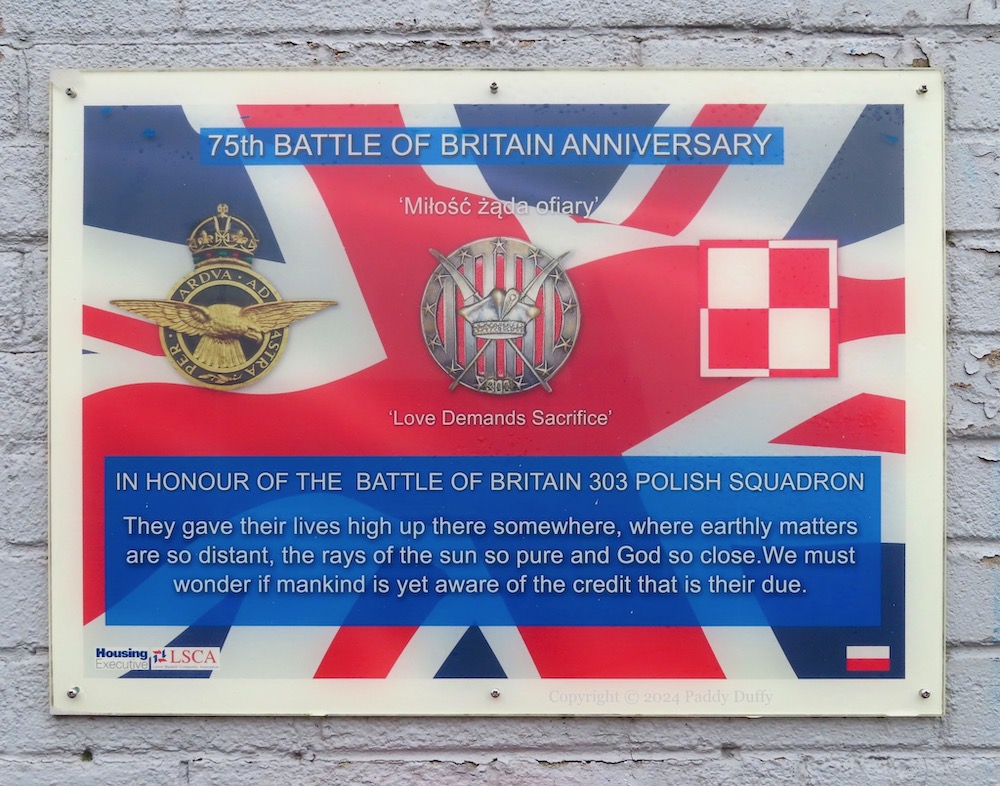
These wreaths are mounted next to the Battle Of Britain board on Beverley Street (Band Of Brothers) which celebrates and commemorates the Polish pilots in the RAF’s 303 Squadron during WWII.

The first and third of these three wreaths – which were new at the end of 2024 – combine WWI and WWII. In the first, we see poppies and the familiar image of a WWI soldier standing by a graveside, along with an image of a WWII fighter-plane (probably a Spitfire or Hurricane) flying over a crowd of soldiers. The third combines the red-and-white of Poland with a poppy. (See also the wreath from 2018, which placed Polish writing and imagery within a wreath of poppies.)

Click image to enlarge
Copyright © 2024 Paddy Duffy
T05920 T05921

Dead, Dissected, And Buried

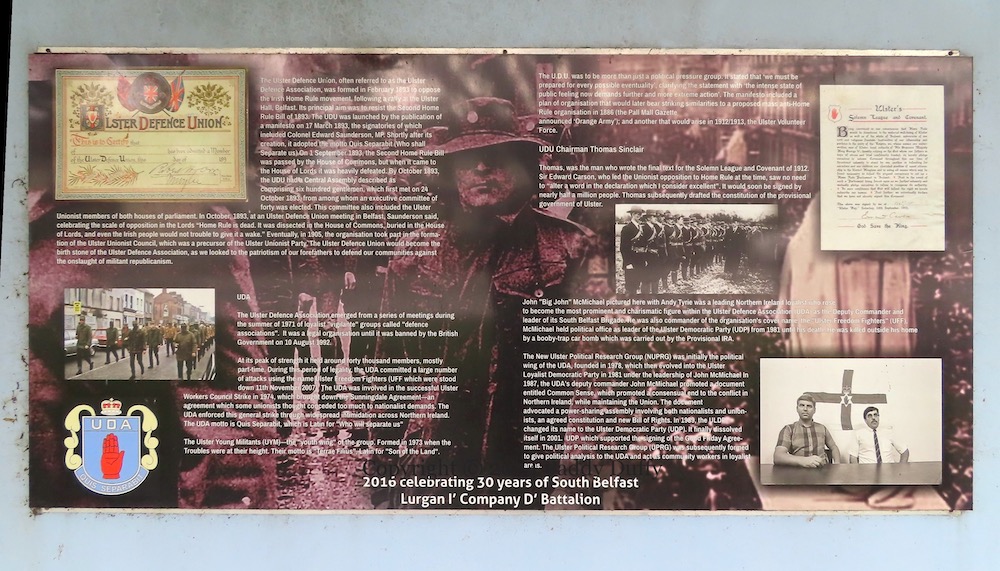
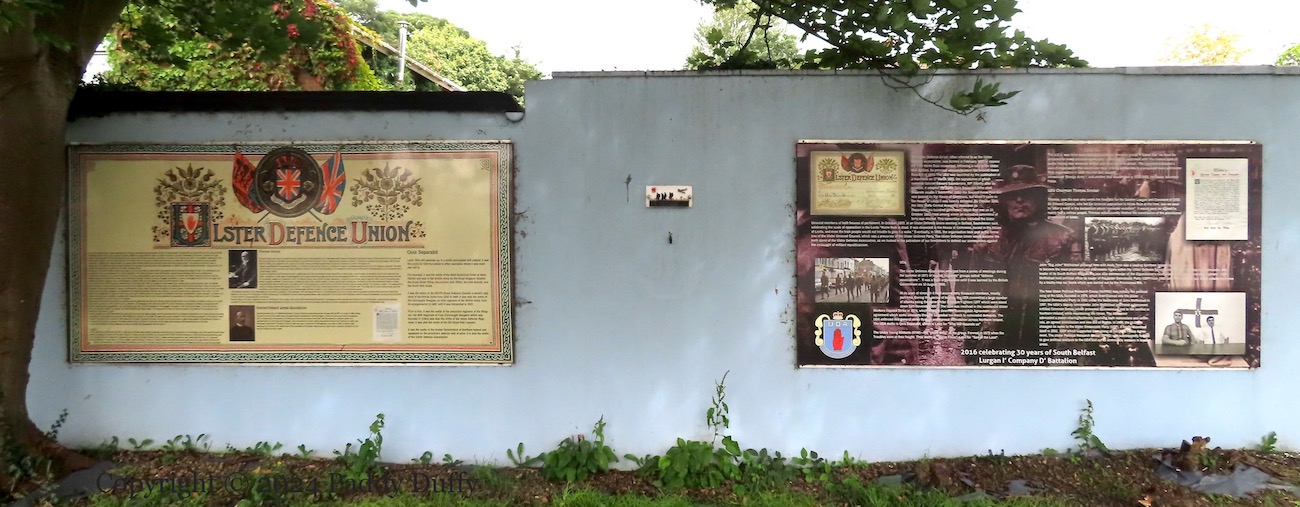
These are the UDA boards on Avenue Road, near Lurgan Park, which proved controversial when they were erected (in 2016), mainly because the second piece (below) “celebrat[es] 30 years of South Belfast/Lurgan 1 company D battalion” UDA and shows Troubles-era shows-of-strength (News Letter) and because it turned out the wall was owned by the Housing Executive (NIWorld).

The piece above describes the creation of the UDU in 1893, as a response to the second Home Rule bill, which was passed by the Commons but rejected in the Lords, and which Edward Saunderson celebrated by saying, “Home Rule is dead. It was dissected in the House of Commons, buried in the House of Lords, and even the Irish people would not trouble to give it a wake”. The UDU is as used an origin-story for the UDA, though often in vague terms, such as the verbiage here which reads “[the UDU] would become the birth stone of the Ulster Defence Association, as we looked to the patriotism of our forefathers to defend our communities”. (For more, see UDU-UFF-UDA. For Saunderson, see Union Is Strength.)

This year (2024), UVF lettering a stone’s throw away, on the other side of the entrance to the park, likewise drew criticism (BelTel | ArmaghI), but it has now been removed.

Avenue Road, Lurgan.

Click image to enlarge
Copyright © 2024 Paddy Duffy
T05406 T05405 T05407 T05408 John McMichael Andy Tyrie

Footsteps Through Our History

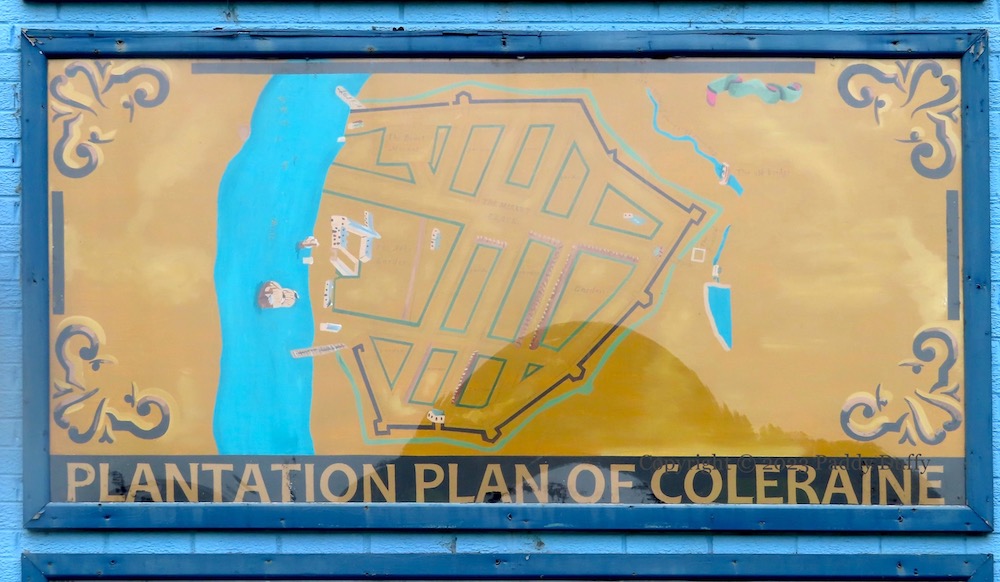
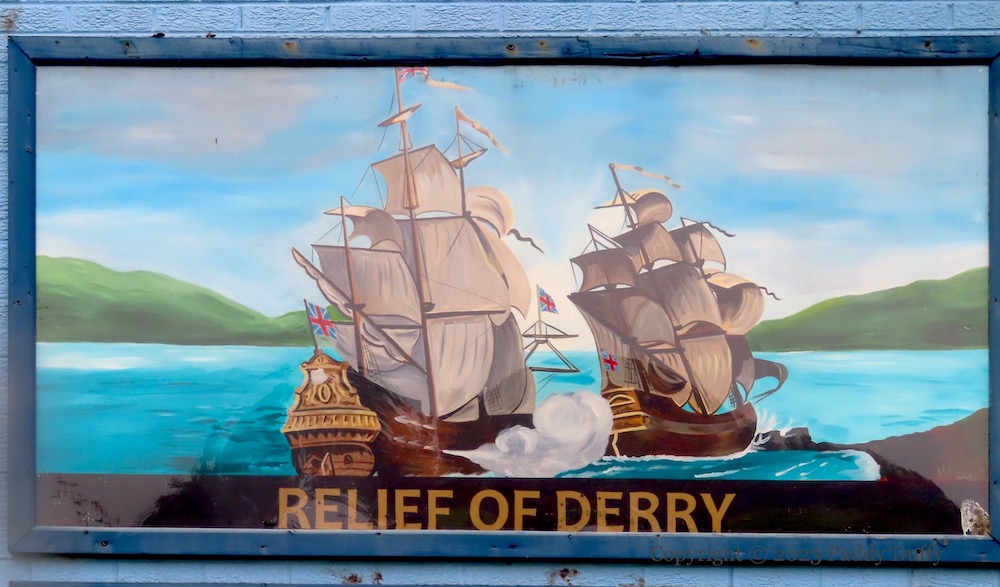
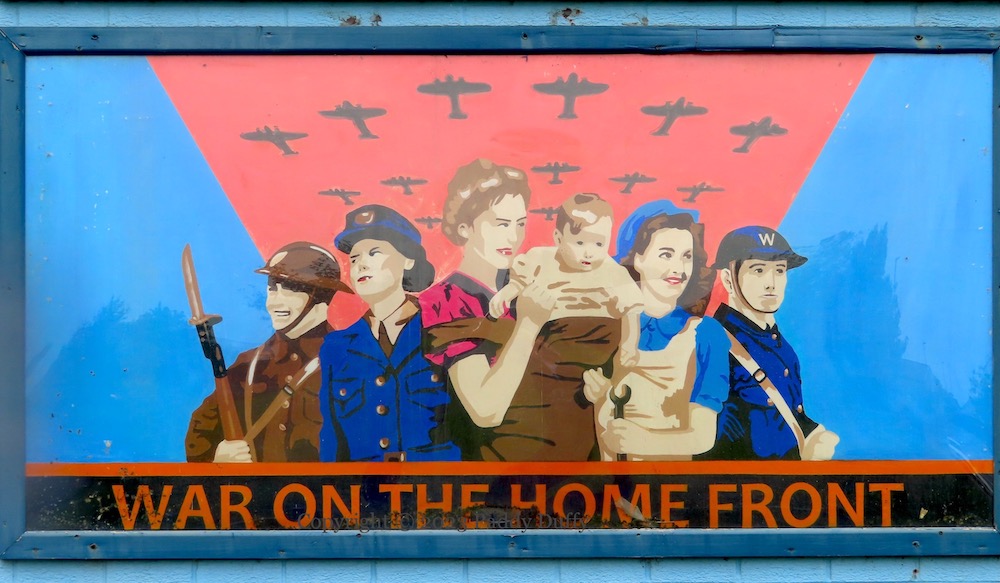
Footsteps through the history of Coleraine, from top to bottom: Martin Luther (c. 1521); John Knox, who led the reformation in Scotland (c. 1560); the plan of Coleraine (c. 1611); the relief of Derry (1689); the Williamite campaign (1690); (and then a jump to) WWI (“Christmas truce, western front”); WWII (“War on the home front”).

These boards replaced a UDA mural in March, 2014 (see Loyalist Ballysally).

Daneshill Road, Coleraine.

Click to enlarge
Copyright © 2023 Paddy Duffy
T03273 T03274
T03275 T03277 T03280
T03276 T03278 T03279

Royal Irish Rifles

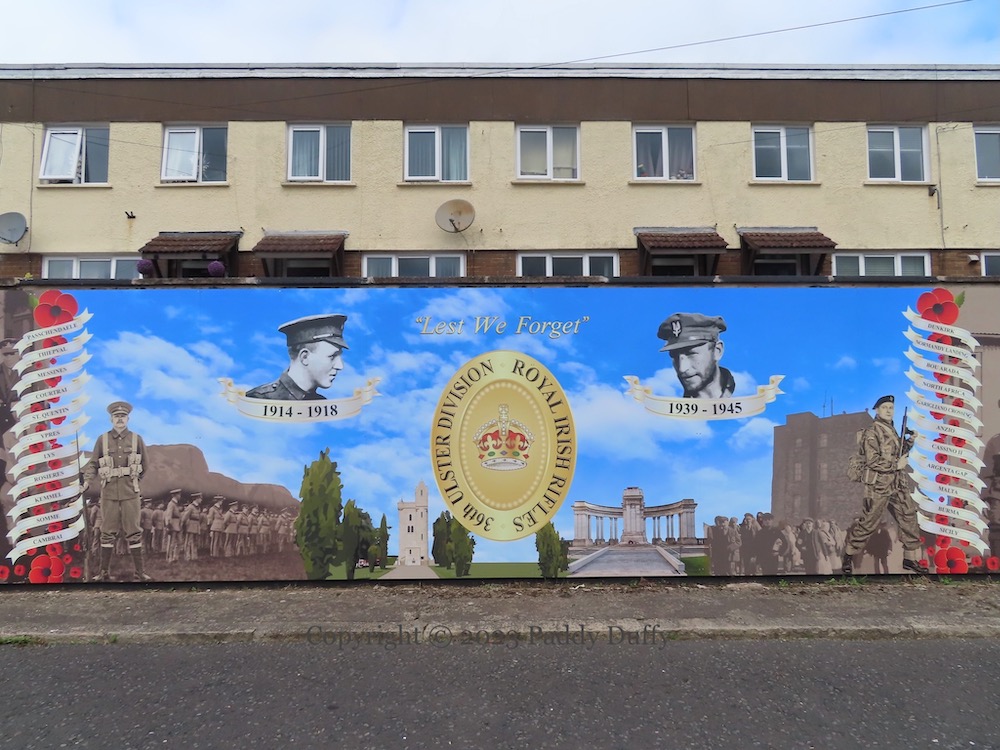
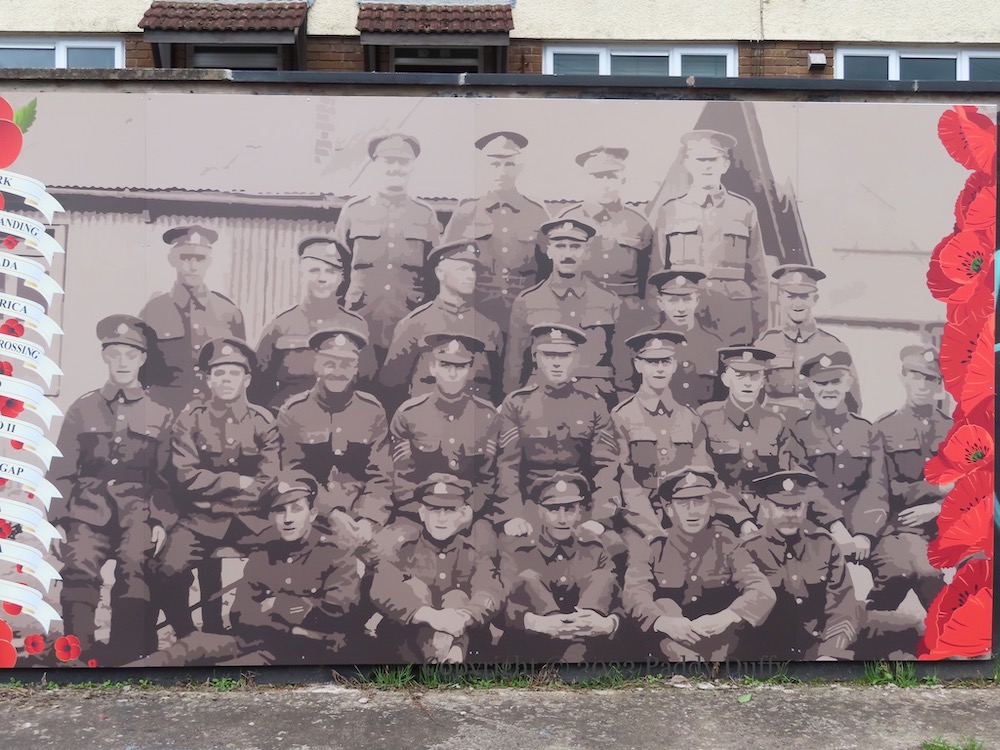
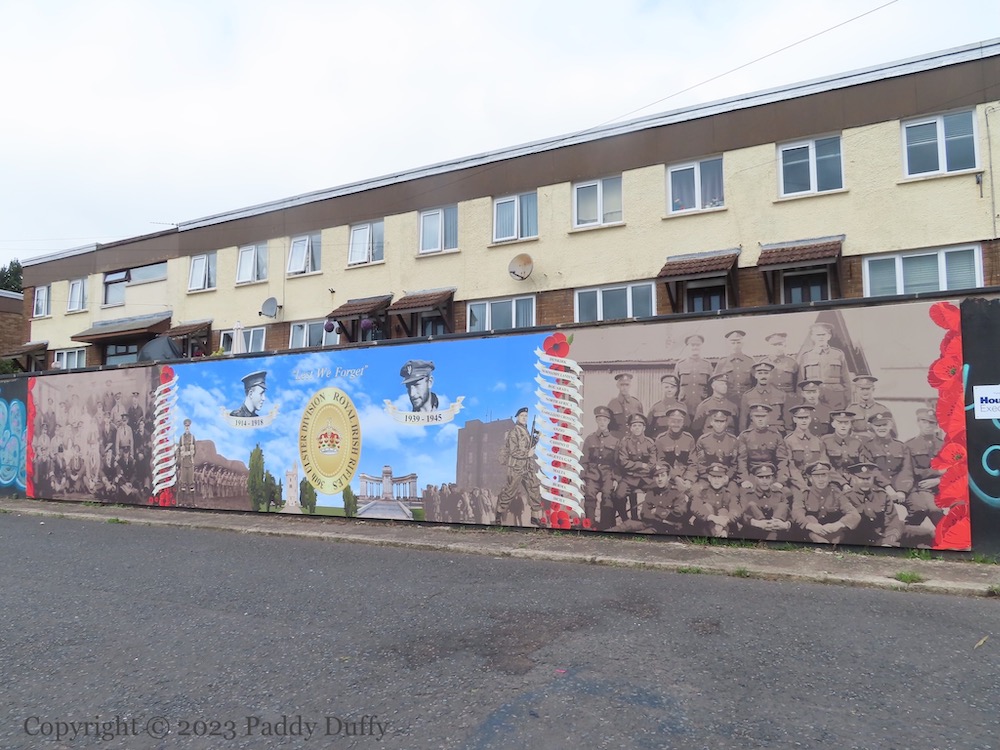
After WWI, the Royal Irish Rifles became the Royal Ulster Rifles (and later became part of the Royal Irish Rangers). This board prioritises WWI as the Rifles were part of the 36th Division. The hero of WWI portrayed in the central panel is William McFadzean, awarded the VC for falling on two live grenades in the trenches on July 1st, 1916. McFadzean is familiar from many previous murals both individually and in the company of other VC winners; for his family home in Cregagh, see Rubicon.

Alongside McFadzean, the hero of WWII is Blair “Paddy” Mayne, who was only briefly in the Ulster Rifles before making his name in the Parachute Unit (later, and better, known as the SAS). His many medals of honour are shown in an old Newtownards mural, though he was denied the VC.

Click image to enlarge
Copyright © 2023 Paddy Duffy
T03128 T03129 T03130 T03127

Kindness Is Free

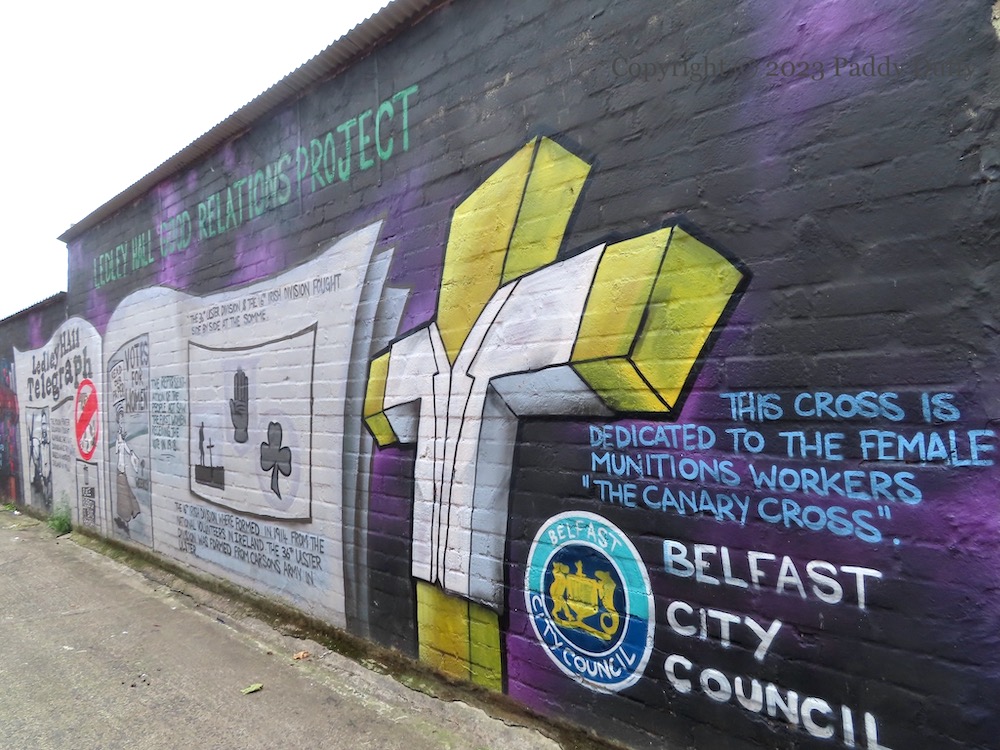
An imaginary newspaper called the “Ledley Hall Telegraph” includes stories on the 303 (Polish) RAF Squadron (which was stationed in Northern Ireland from 1943 to 1944), “Votes for women” (“the Representation Of The People Act saw the first women receiving the vote in 1918”), and the 16th and 36th Divisions (the mural says they “fought side by side at the Somme” – but the 36th was withdrawn on July 2nd after the Battle Of Albert and the 16th arrived in September and fought in the battles of Guillemont and Ginchy; both were withdrawn to Messines and both would take part in the Battle Of Messines in June 1917).

The “newspaper” is bookended by two painted crosses (for Row On Row), one for Guardsman Connor Lilley, a member of the Gertrude Star flute band, who was serving with the 1st battalion Royal Irish Guards when he was killed in an accident in Canada (Fb), and the other for WWI female munitions workers who, because of their work with TNT, risked yellowing skin both from direct exposure and from liver damage (“toxic jaundice”) (WP).

Also included is “The Kindness Hut”: “Be the reason someone smiles today”, “Kindness is free – please share”, “In a world where you can be anything, be kind”, “Take only what you need! If everyone shares there’s enough to go around”.

Click image to enlarge
Copyright © 2023 Paddy Duffy
T03135 T03136 T03137 T03138 T03139 T03140 Ledley Hall Good Relations Project Ledley Hall established 1942

Full Spectrum

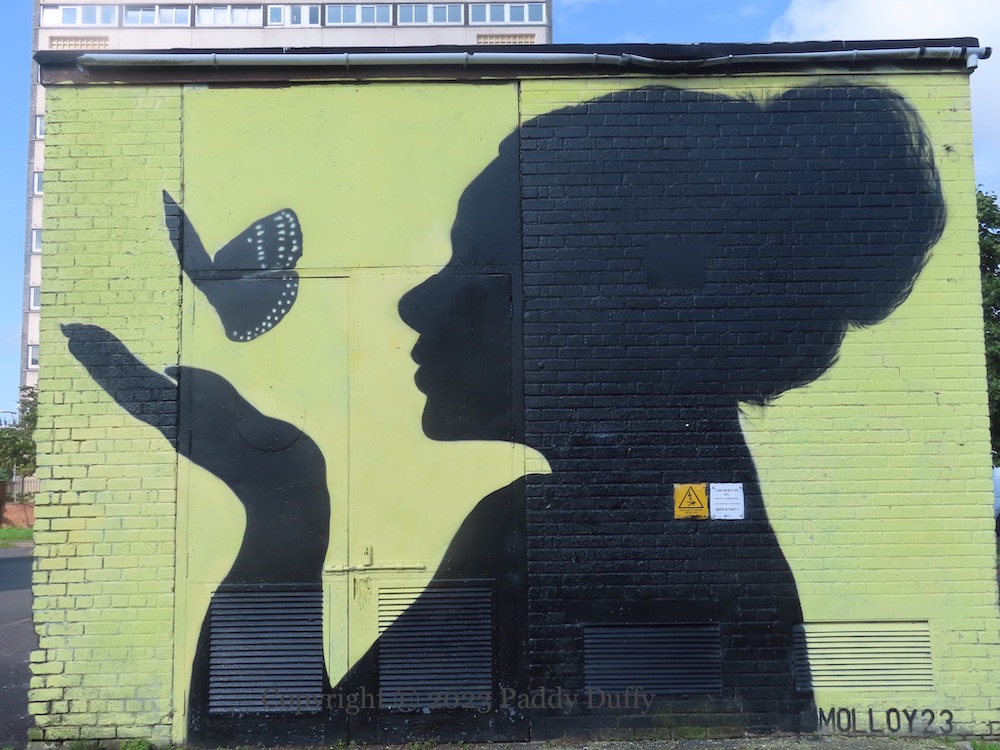
Here are five pieces of street art by Glen Molloy (ig) at Clarawood flats. The first three are new; the pair following is from earlier this year (Jan and Feb). The artist of the sixth piece is unknown. The seventh piece is by “The Spermer” (web) from 2020 and already in some disrepair – it was painted at the same time as Glen’s spitfire, shown last.

Demolition of the two blocks of flats was approved by the Housing Executive in May 2021 (Belfast Live) and by the Department Of Communities in September 2021 (Belfast Live). Demolition of Kilbroney is scheduled for the autumn and Clarawood (the tower block) for 2024 (Irish News).

(See also the Housing Executive’s ‘Action Plan’ for all tower blocks (pdf).)

Click image to enlarge
Copyright © 2023 Paddy Duffy
T02988 [T02987] T02989 [T02990] T02991
T02984 T02986 T02992 [T02993]
T02985 T02983

A Fighter For Our Freedom

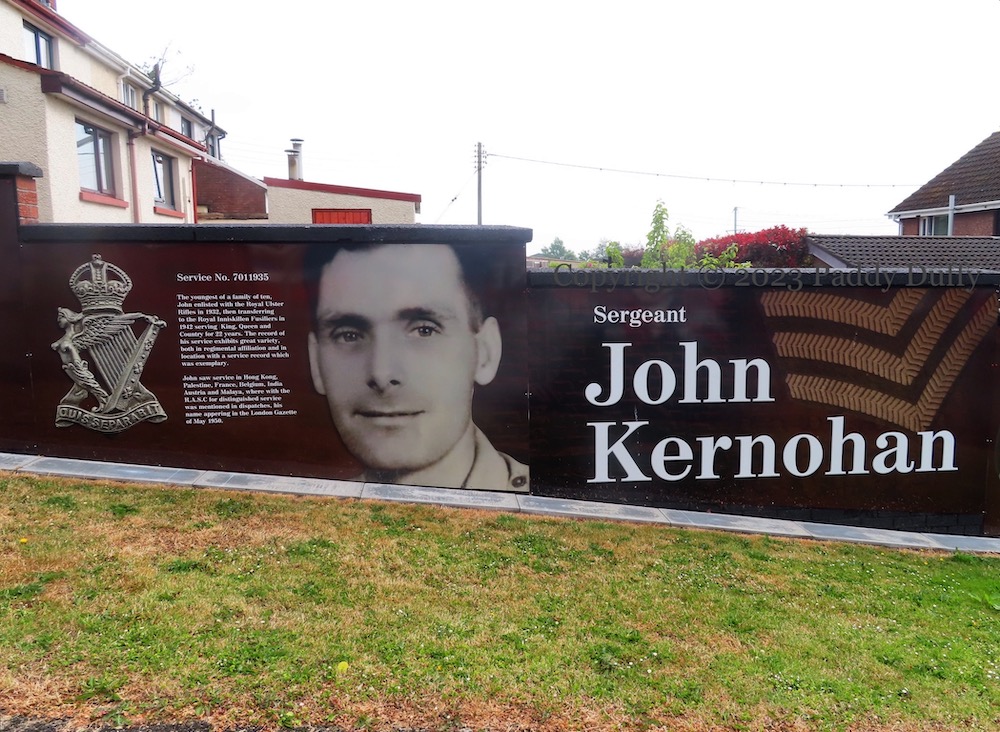
“Sergeant John Kernohan. Service No. 7011935. The youngest of a family of ten, John enlisted with the Royal Ulster Rifles in 1932, then transferring to the Royal Inniskillen Fusiliers in 1942 serving King, Queen and Country for 22 years. The record of his service exhibits great variety, both in regimental affiliation and in location with a service record which was exemplary. John saw service in Hong Kong, Palestine, France, Belgium, India[,] Austria and Malaya, where with the R.A.S.C. for distinguished service was mentioned in dispatches, his name appe[a]ring in the London Gazette of May 1950 [May 19th, 1950, page 2489, “in recognition of gallant and distinguished services in Malaya during the period 1st July 1949 to 31st December 1949″; Royal Army Service Corps, Corporal Kerohan].”

The medals from left to right are: General Service – Palestine ribbon, 1939-1945 Star, War Medal, Burma Star, Defence Medal

Drumahoe Gardens, Millbrook, Larne.

Click image to enlarge
Copyright © 2023 Paddy Duffy
T02798 T02799 [T02800] T02801 sign-link.ni

Moving In Marches Upon The Heavenly Plain

The stencil is in Mount Vernon, which is also home to a series of metalworks – see They Sleep Beyond Ulster’s Foam. That title, as well as the title of this entry, comes from Binyon’s poem For The Fallen, the fourth stanza of which is often cited in memorial for the dead of the Great War: “They shall grow not old, as we that are left grow old; / Age shall not weary them, nor the years condemn. / At the going down of the sun and in the morning / We will remember them.”

The stencil is perhaps not only a memorial to the dead of WWI – the planes appear to be WWII models such as the Hurricane or Spitfire (as on the box below, and in A Miracle of Deliverance); most WWI planes were biplanes.

Click image to enlarge
Copyright © 2022 Paddy Duffy
T04423 T04424