St James’s Support The Hunger Strikers

St James’s supports the hunger strikes – in Long Kesh and Armagh and (on the right) in Turkey.

Various images and posters from 1980 and 1981 are reproduced. Along the top, we see (l-r) a soldier is confronted at the top of Springhill (image at Irish Times), “Wanted for murder [and torture of Irish prisoners]” (image at MSU), “Mothers hunger”, “Blessed are those who hunger for justice“, “Where there is oppression there is resistance”, Armagh hunger-striker Mary Doyle.

Along the bottom: “Stop strip searches“, “Save our children from plastic death”, “Support the hunger strike demands”, and portraits of 1981 hunger-strikers Bernard Fox and Pat Sheehan, both from the Falls Road.

For Turkish hunger-strikers, see F-Block Martyrs | Zehra Kulaksiz | Support The Turkish Hunger Strikers

Hugo Street, west Belfast

Click image to enlarge
Copyright © 2008 Paddy Duffy
T00385

Hunger Strikers Memorial

The hunger strikers memorial in Rossville Street, Derry, was launched in 2000. Compared to the entries from 2001 and 2004, this version has a new centre-piece – the metal lark has been replaced by a combination lark and hand cast in stone.

The central “H” carries the names of the ten deceased 1981 strikers, while the stones to either side carry the names of other republicans to have died on hunger strike: Thomas Ashe 1917, Michael Fitzgerald 1920, Joseph Murphy 1920, Terence McSwiney 1920, Joseph Whitty 1923, Denis Barry 1923, Andrew Sullivan 1923, Tony D’Aroy 1940, Jack McNeela 1940, Sean McCaughey 1946, Michael Gaughan 1974, Frank Stagg 1976.

In the background of the image below are (left) Free Derry Corner and (centre-right) The Petrol Bomber.

Rossville Street, Derry

Click image to enlarge
Copyright © 2007 Paddy Duffy
T00378 T00411

Patsy O’Hara

“Years from now they will ask you where you were when your comrades were dying on hungerstrike. Shall you say you were with us or shall you say that you were conforming to the very system that drove us to our deaths[?]” INLA (sign the light-pole as well as the flags and red star in the mural) volunteer Patsy O’Hara, from Derry, joined the hunger strike on the same day as Raymond McCreesh (March 22nd) and died, 61 days later, later in the same day (May 21st, 11:29 p.m.) as him (2:11 a.m.).

Lecky Rd, Derry

Click image to enlarge
Copyright © 2007 Paddy Duffy
T00420

The Hunger Strike Era

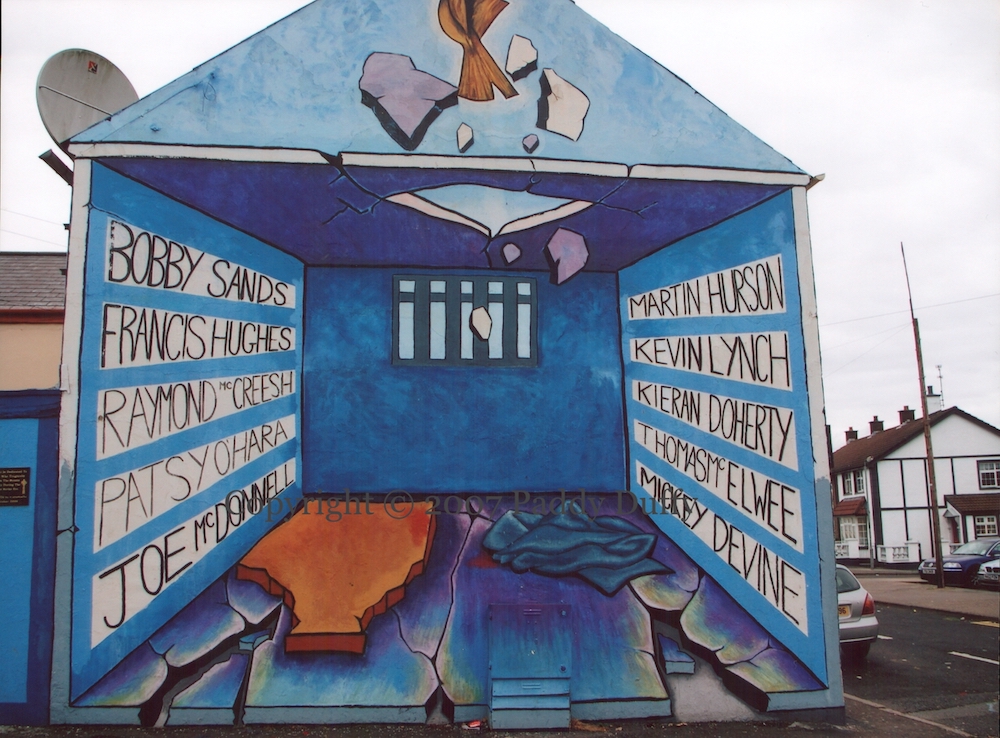
A lark (rather than a dove) bursts through the ceiling of a H-Block cell lined with the names of the ten deceased 1981 hunger strikers. “This mural is dedicated to all those who tragically died on the streets of Derry during the hunger strike era. Suımhneas Dé dá nanamacha. 3rd October 2006.”

Westland St, Derry

Click image to enlarge
Copyright © 2007 Paddy Duffy
T00404

Kieran Doherty

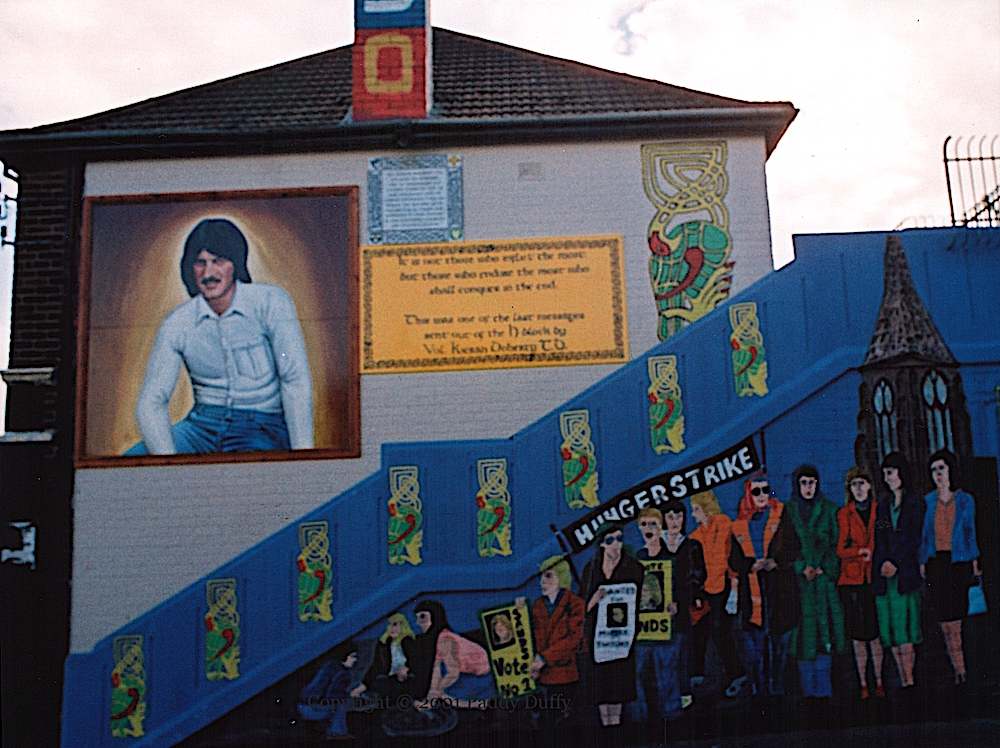
Kieran Doherty was elected TD (Teachta Dála) for Cavan-Monaghan three weeks into his 1981 hunger strike. He held the position for two months, until he died on August 2nd. The portraits, plaques, and mural of marchers are in his home area of Andersonstown. The words “It is not those who inflict the most, but those that can endure who shall conquer in the end” is an echo of Terence MacSwiney, whose hunger strike in 1920 lasted 74 days, one more than Doherty’s.

The chimney retains the “150” from the previous mural about the Great Hunger.

Painted by Lucas Quigley in Slemish Way, Andersonstown, west Belfast

Click image to enlarge
Copyright © 2001 Paddy Duffy
T00491

H-Block/Armagh

The sixth mural from the Bogside Artists commemorates the 1980 hunger strikes, first in Long Kesh and subsequently in Armagh Women’s Prison. The main figure is Raymond McCartney; the female figure is perhaps Mary Doyle (the other two female strikers were Maıréad Farrell and Maıréad Nugent).

Rossville St, Derry

Click image to enlarge
Copyright © 2001 Paddy Duffy
T00356

Claiming Equality!

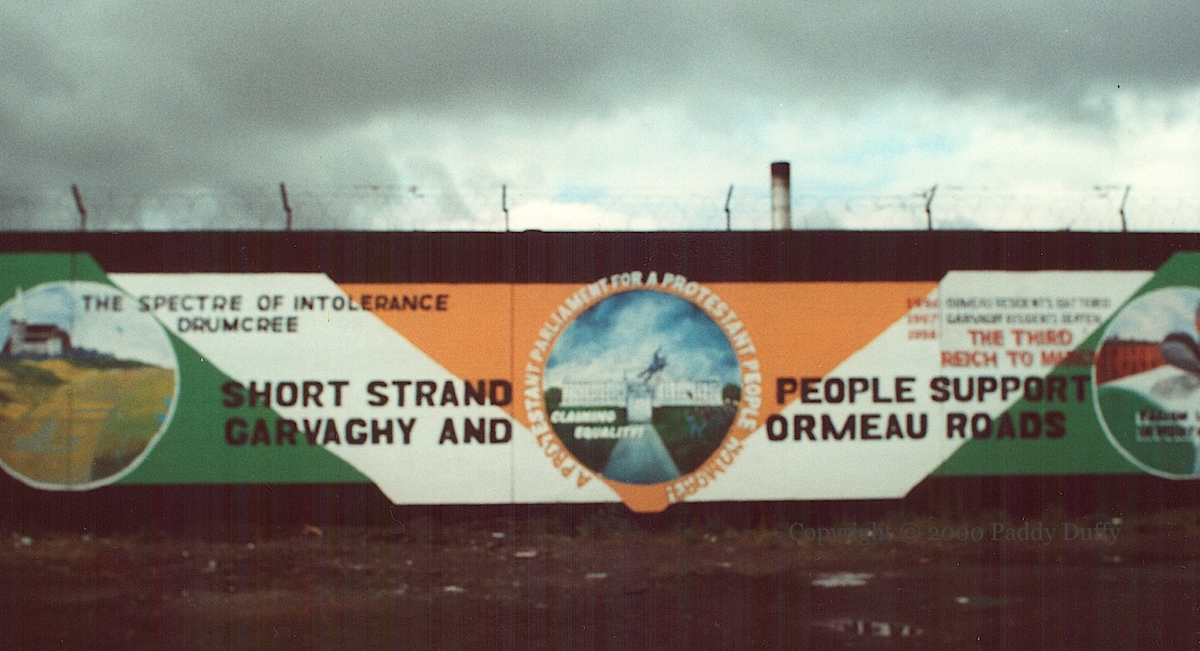
Northern Ireland’s first Prime Minister, James Craig, said in 1934, that Stormont was “carrying on a Protestant Government for a Protestant People” (NI Parliamentary Debates), though the phrase has now been transformed into the doubly alliterative “A Protestant parliament for a Protestant people”. In the centre of a long mural at the waste-ground at the top of Mountpottinger Road, people carrying Irish Tricolours tear down the statue to Northern Ireland’s most prominent leader, Sir Edward Carson, that stands outside Stormont, “claiming equality”.

The main issue that has tested the resolve of governments both local and national to the equality declared in the 1998 Belfast (Good Friday) Agreement is Orange Order parading through nationalist areas, such as the Garvaghy Road below Drumcree church in Portadown, and the Ormeau Road in south Belfast.

“Short Strand people support Garvaghy and Ormeau Roads.” On the left: The spectre of intolerance – Drumcree.” Centre: “A Protestant parliament for a Protestant people no more!” On the right “1996: Ormeau residents battered; 1997: Garvaghy residents beaten; 1998: The third reich to march.” and “Fascism lives! in Portadown”.

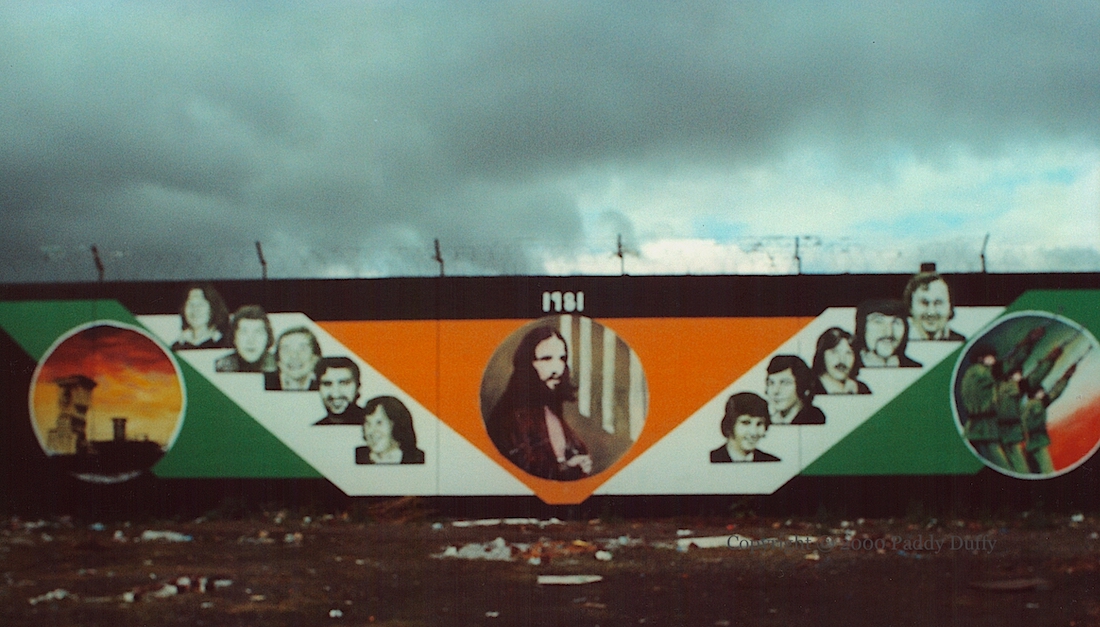
The piece is next to a hunger-strikers commemoration piece with ten portraits on shaped wooden boards against a painted background with blanket-man Hugh Rooney in the center. Between the two is a “spirit of freedom” lark and the names of the ten deceased 1981 strikers.

Mountpottinger Road, Short Strand, east Belfast

Click image to enlarge
Copyright © 2000 Paddy Duffy
T00426 T00427 T00417 T00416 T00418

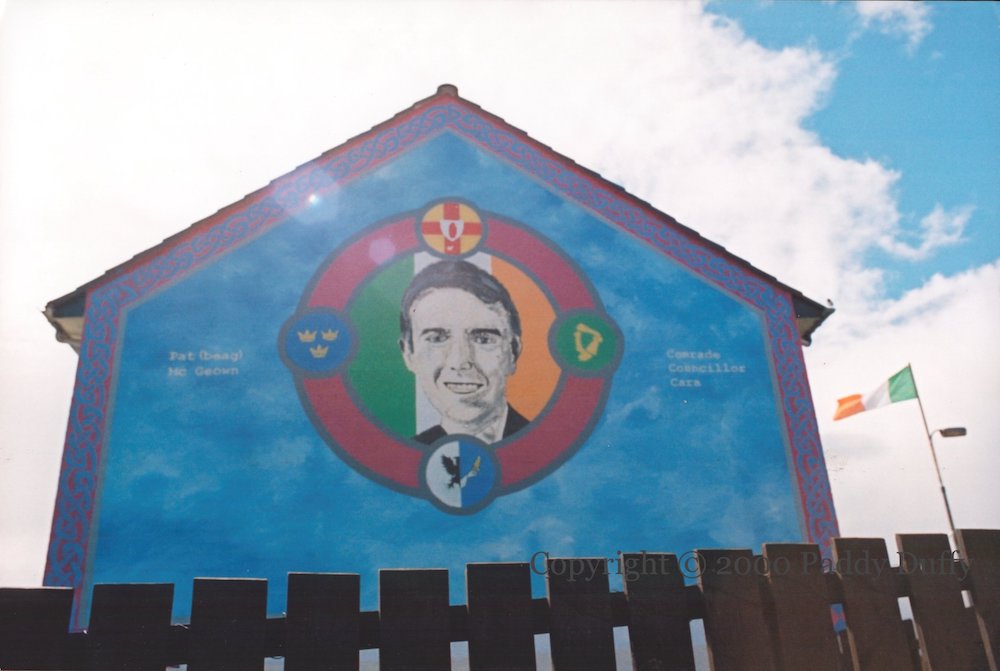
Pat ‘Beag’ McGeown

“Comrade, councillor, cara [friend].” Pat McGeown was a 1981 IRA hunger striker whose family intervened when he lapsed into a coma. After his release in 1985 he also worked for Sınn Féın and was elected to Belfast City Council in 1993. He died in 1996 of a heart attack. He is also remembered by a plaque on the Sınn Féın office on Falls Road.

Ballymurphy Road, west Belfast

Click image to enlarge
Copyright © 2000 Paddy Duffy
T00786