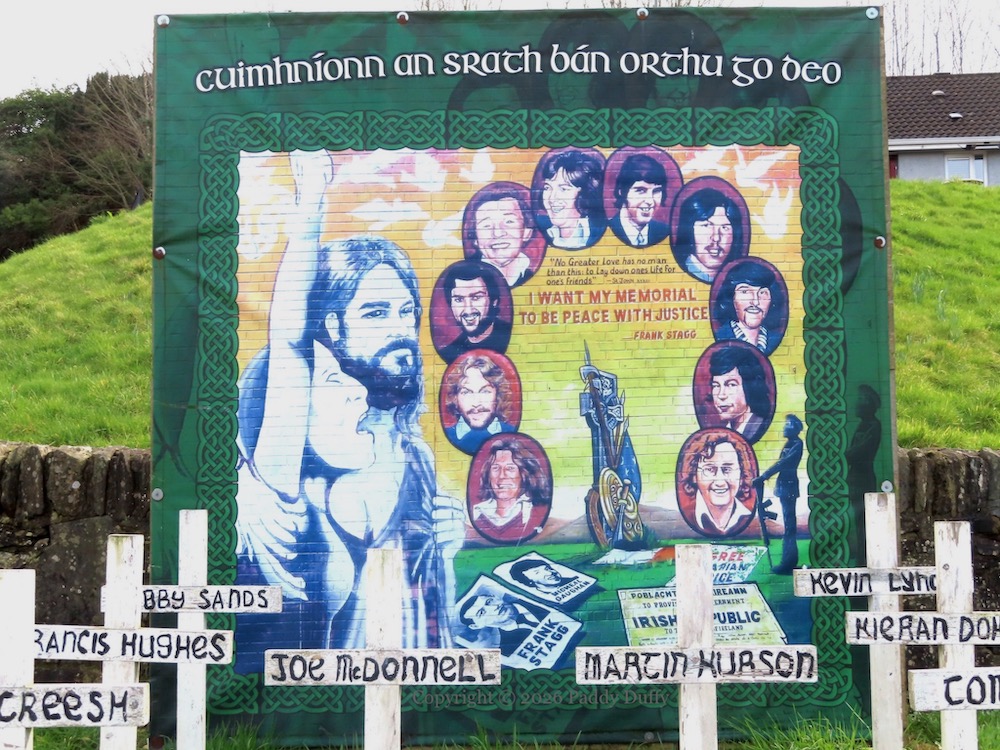
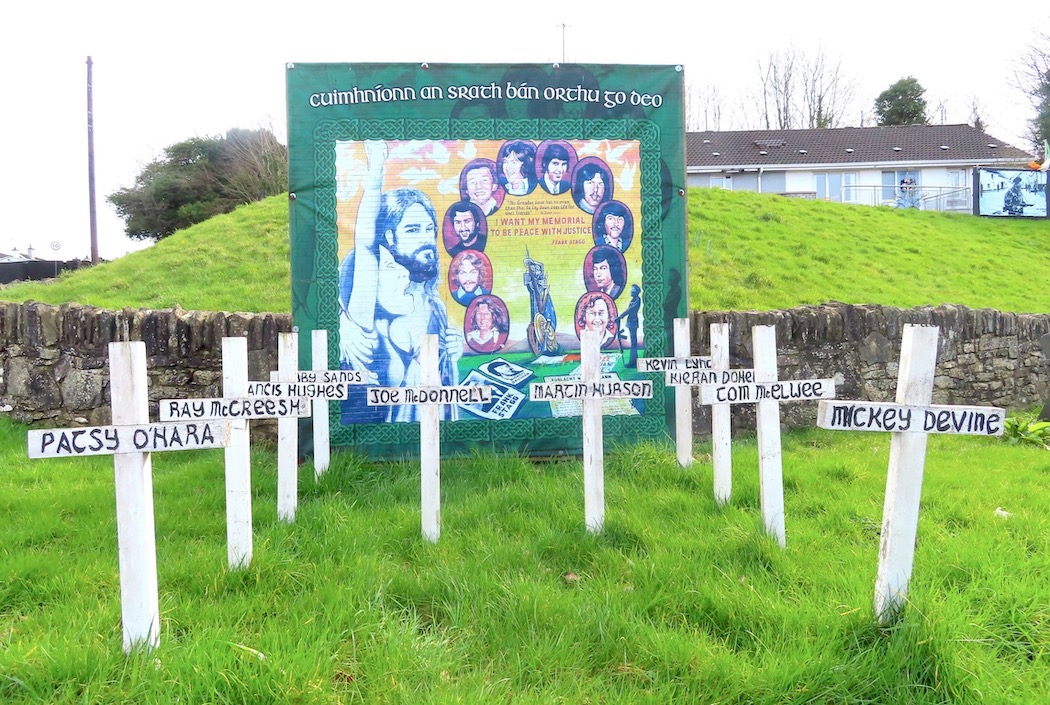
“Cuımhníonn an Srath Bán orthu go deo [Strabane remembers them forever]”. The names of the ten deceased 1981 hunger strikers appear on ten white crosses that are set in a “H” formation in front of a tarp bearing their portraits.
Anti-Agreement armed group Óglaıgh Na hÉıreann split in 2024 (BelTel) with the larger faction following Tony McDonnell (BelTel). Death threats against seven members from the smaller faction (under Sean O’Reilly) were issued and attacks were made in February (BBC), March (Irish News/reddit), and July (Irish News).
The signage seen here is in the New Lodge in north Belfast. On the left are the names of the ten deceased 1981 hunger-strikers, on the right, armed and masked volunteers pose against a background of a vintage picture of the flats (from Getty Images – BBC).
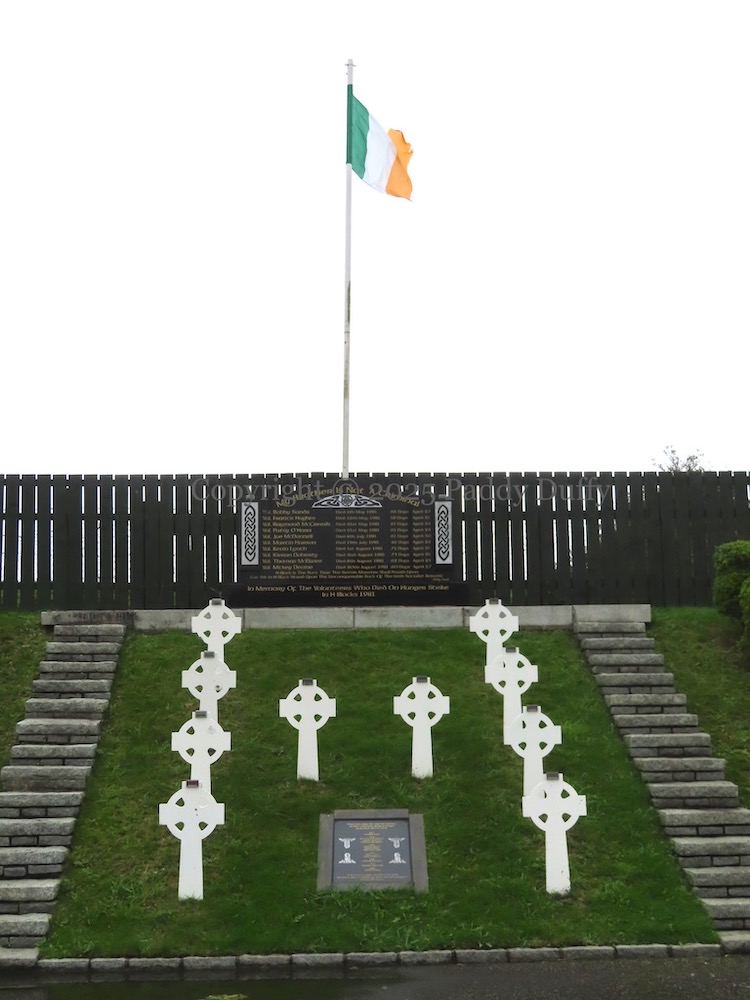
The brothers in question are Raymond and Brian McCreesh, from Camlough, Co Armagh. Raymond is third in the list of the ten deceased 1981 hunger strikers on the large stone at the top of the slope: “In memory of the volunteers who died on hunger strike in H-Blocks 1981.” The quote along the bottom reads, “H-Block is rock that the British monster shall perish upon for we in H-Block stand upon the unconquerable rock of the Irish socialist republic – Bobby Sands”; the source of the quote in unknown.
The lower stone reads “These men made the supreme sacrifice for their country by dying on hunger strike from 1917 to 1976: 1917 Thomas Ashe; 1920 Michael Fitzgerald, Joseph Murphy, Terence McSwiney; 1923 Joseph Whitty, Denis Barry, Andy Sullivan; 1940 Tony Darcy, Sean McNeela; 1946 Sean McCaughey; 1974 Michael Gaughan; 1976 Frank Stagg. “It is not those who can inflict the most but those that can suffer the most who will conquer” – Terence McSwiney.”
The final image is a call from “Independent Republicans Armagh [Fb]” to commemorate Dessie Grew and Martin McCaughey, who were riddled with bullets fired by the SAS as they moved weapons near Moy, Co Tyrone, in 1990 (RN | youtube).
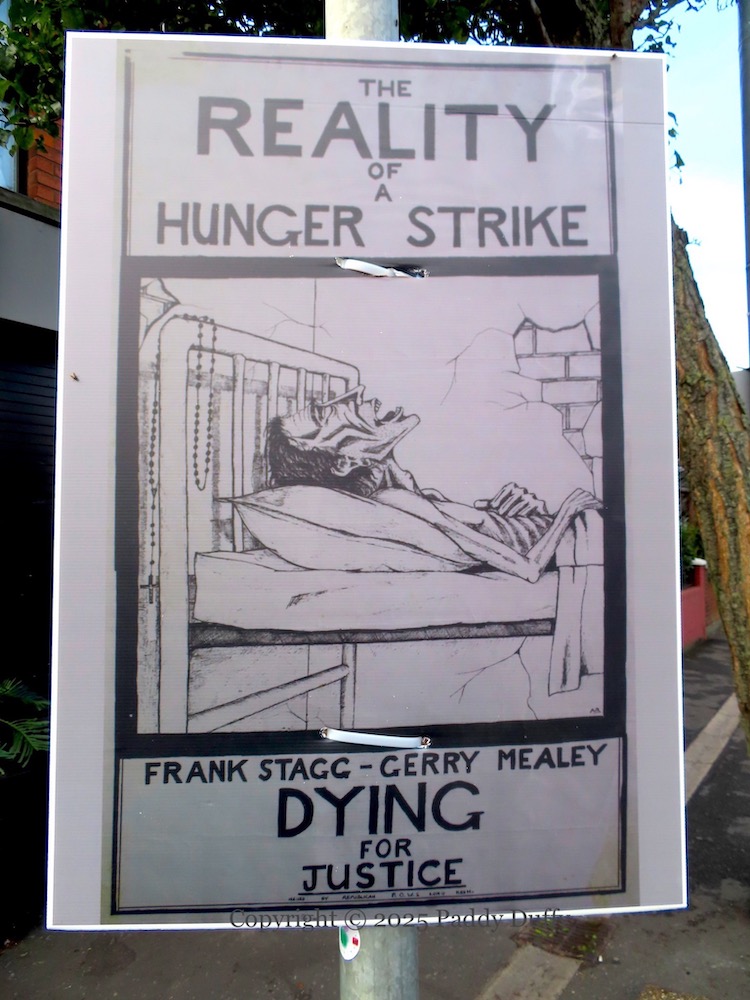
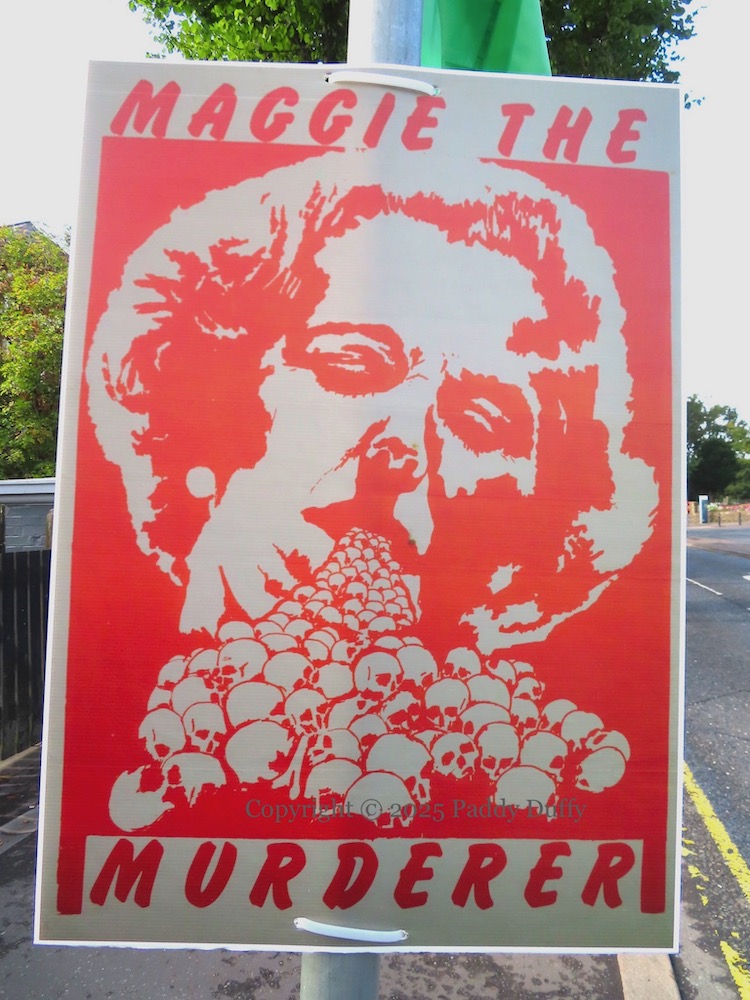
These are just four out of the scores of placards that lined the Falls Road on August 24th for the National Hunger-Strike Commemoration march to Milltown Cemetery, where Sınn Féın president Mary Lou McDonald gave the address (available at Belfast Media | video of the march is available on youtube).
Many of the placards show front pages from Republican News and An Phoblacht/Republican News, perhaps thanks to the Irish Republican Digital Archive (web), which has lately added scans of the newspapers from 1970 to 1984.
Michael Gaughan and Frank Stagg are presented along with the ten deceased 1981 hunger strikers on the cross-beam of a large wooden “H” at the top of Turf Lodge.
IRA volunteer Michael Gaughan died in Parkhurst prison in 1974 after 64 days on hunger strike. Gaughan’s coffin was draped with the Tricolour used to bury Terence McSwiney in 1920. He was force-fed seventeen times during the strike and his family alleged that he died from food stuck in a punctured lung. The practice was ended after Gaughan’s death.
Frank Stagg was on the Parkhurst hunger strike with Gaughan, and another in Long Lartin prison, and a third in Wakefield in December 1975. He died after 62 days on February 12th, 1976.
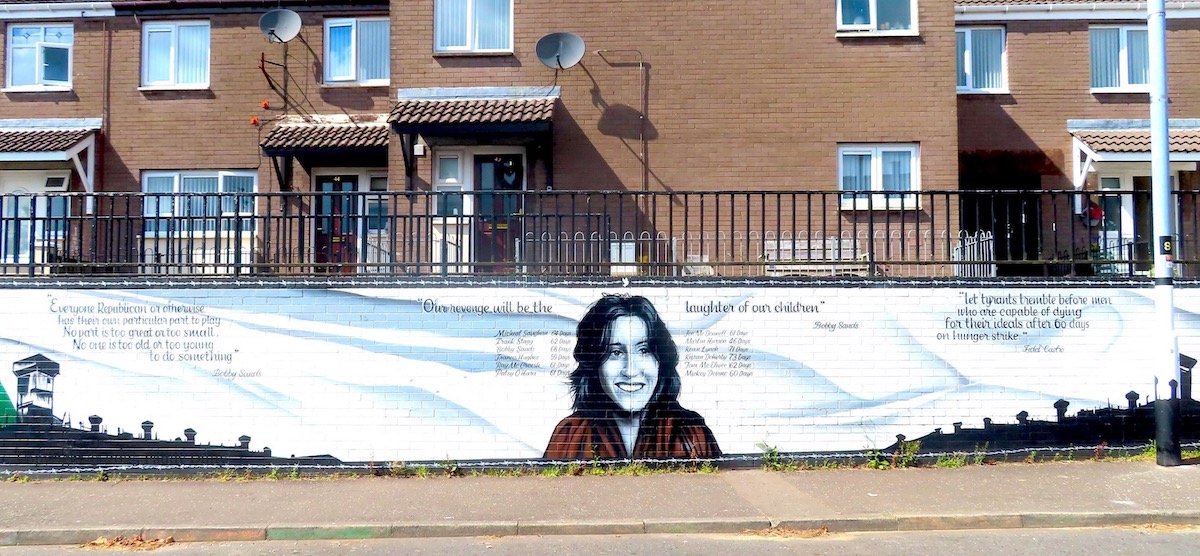
This entry updates Cuımhníonn Doıre from August 2024, in which the central part of the mural, showing Maıréad Farrell (above), was incomplete. In addition to a completed portrait of Farrell there are two quotations from Bobby Sands and one from Fidel Castro (along with a list of the twelve dead hunger-strikers of the Troubles era):
“‘Everyone, Republican or otherwise, has their own particular part to play. No part is too great or too small, no one is too old or too young to do something’ – Bobby Sands” [Diary, March 14th, 1981]
“‘Our revenge will be the laughter of our children’ – Bobby Sands”
“‘Let tyrants tremble before men who are capable of dying for their ideals after 60 days on hunger strike’ – Fidel Castro” [The line comes from Castro’s opening address on September 15th, 1981, to the Inter-Parliamentary Conference (pdf)]
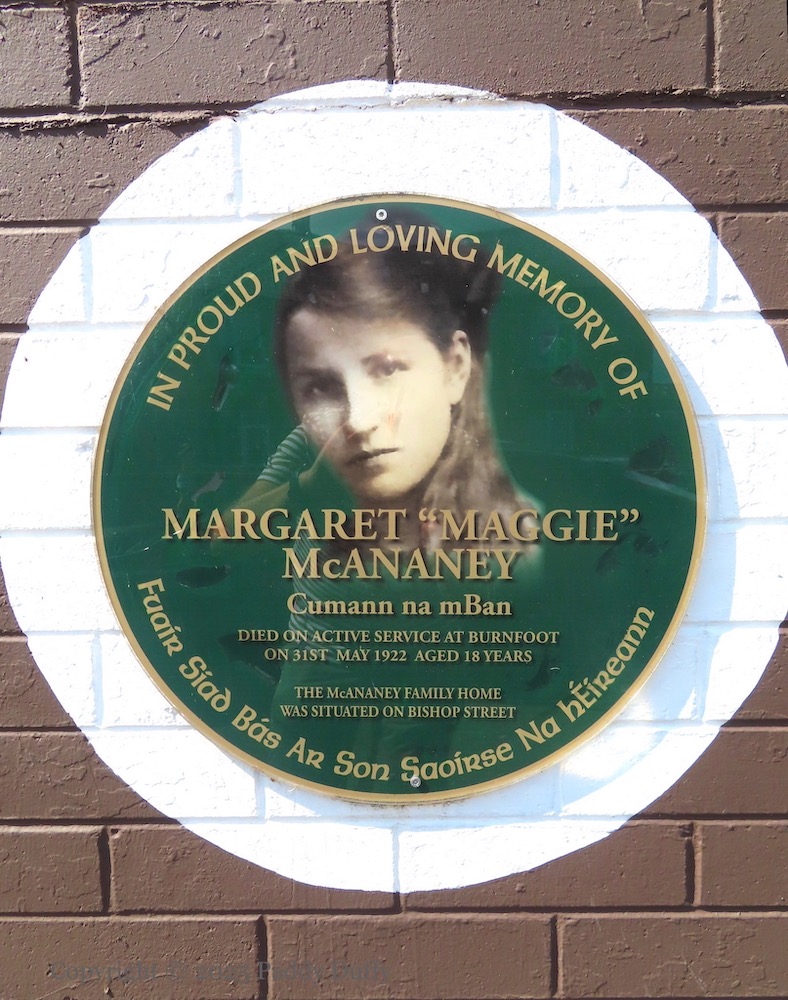
Also included below are an adjacent IRA Derry Brigade roll of honour and a plaque to Maggie McAnaney.
McAnaney died when a gun went off at an IRA checkpoint near Burnfoot, Co. Donegal, a month before the Civil War began (Derry Journal). This is an unusual use of the phrase “active service”, as McAnaney was travelling to a picnic at the time, rather than on exercises or preparing munitions; the phrase would later come to be associated primarily with a premature bomb explosion.
“In proud and loving memory of Margaret “Maggie” McAnaney, Cumann na mBan, died on active service at Burnfoot on 31st May 1922, aged 18 years. The McAnaney family home was situated on Bishop Street. Fuaır sıad bás ar son saoırse na hÉıreann.”
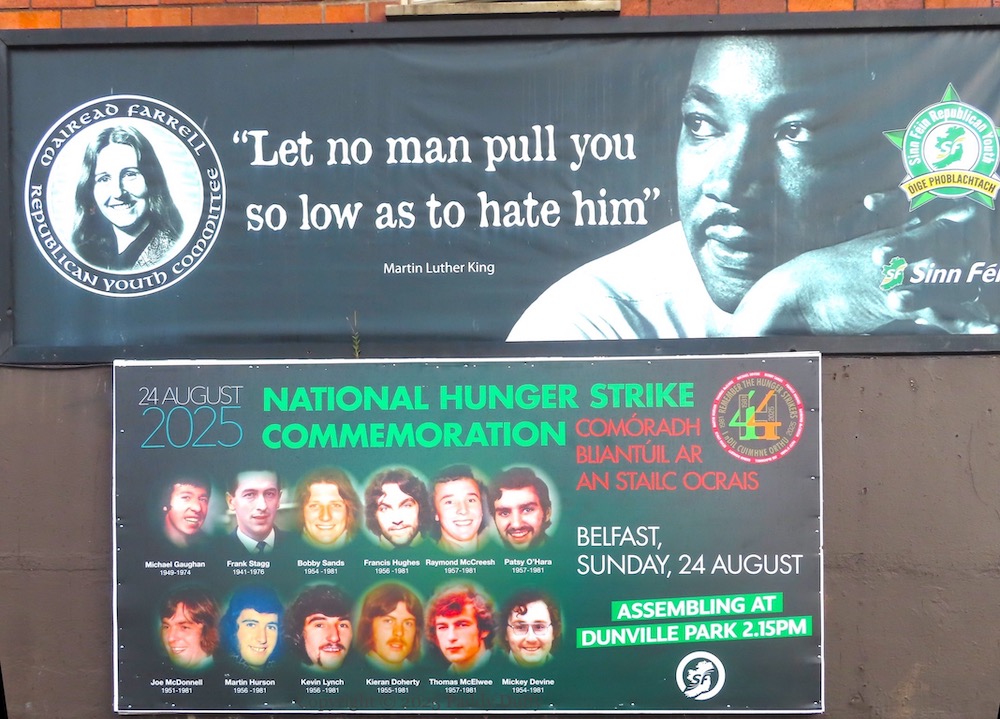
Michael Devine was the last of the 1981 hunger-strikers to die, on August 20th, 1981, and although the strike was not called off until October 3rd, his death now marks the end of the strike for commemorative purposes. The 44th annual national commemoration of the strike will take place this year on the 24th, “assembling at Dunville Park” in west Belfast.
Beechmount Street, west Belfast. The MLK tarp goes back to 2014.
Féıle An Phobaıl (web) is now headquartered in the renovated (BCC) St Comgall’s on Divis Street in Ionad Eileen Howell, and during this year’s (2025) festival is home to an exhibition called “Vibrant Colours, Violent Past”, the centrepiece of which is a 20-foot-long panoramic history of republicanism, with Wolfe Tone, James Connolly, and Martin McGuinness as pivotal figures.
A leaflet distributed at the launch (on August 1st) explained the genesis of the project, as follows:
“A few years ago I met a great friend of Ireland and art collector Darius Anderson from California who was here on a trip with his wife Wendy and hoping to see some new work by Irish artists, not only work destined for gallery walls but having been fortunate to be included on one of local guide Dee Morgan’s tours he developed a love for and focus on our world-recognised mural art tradition.
“Then last year on another trip here I was able to introduce Darius to my life-long friends and probably the most prolific contributors to our local landscape.
“From a casual meeting alongside Marty and Micky at work repainting the Vol. Kieran Doherty mural in Andersonstown came an inspired suggestion that we accept a challenge from him to tell our story graphically on a canvas rather than the usual brick wall, not just on canvas to hang on a wall in his gallery in L.A. but a canvas to cover the entire wall 20ft x 7ft!
“Excited by our positive response Darius wondered could we invite some loyalist artist/activist to contribute a similar large canvas celebrating the history of the British, Unionist, Loyalist community here.
“That was last July. This exhibition is a result of that meeting but also a chance for the public to remind themselves of our often colourful and unfortunately violent past. – Danny D, Muralist/Activist”
“History is like a rearview mirror! You must always check back but you must keep focused on the road ahead, otherwise you are going to crash!” (Similar wording was used in a piece – Painting From The Same Palette – painted by Danny D and Mark Ervine in 2008.)
The exhibition was launched on August 1st and also included four display boards featuring murals by Danny D (CNR) and Dee Craig (PUL) (Fb).
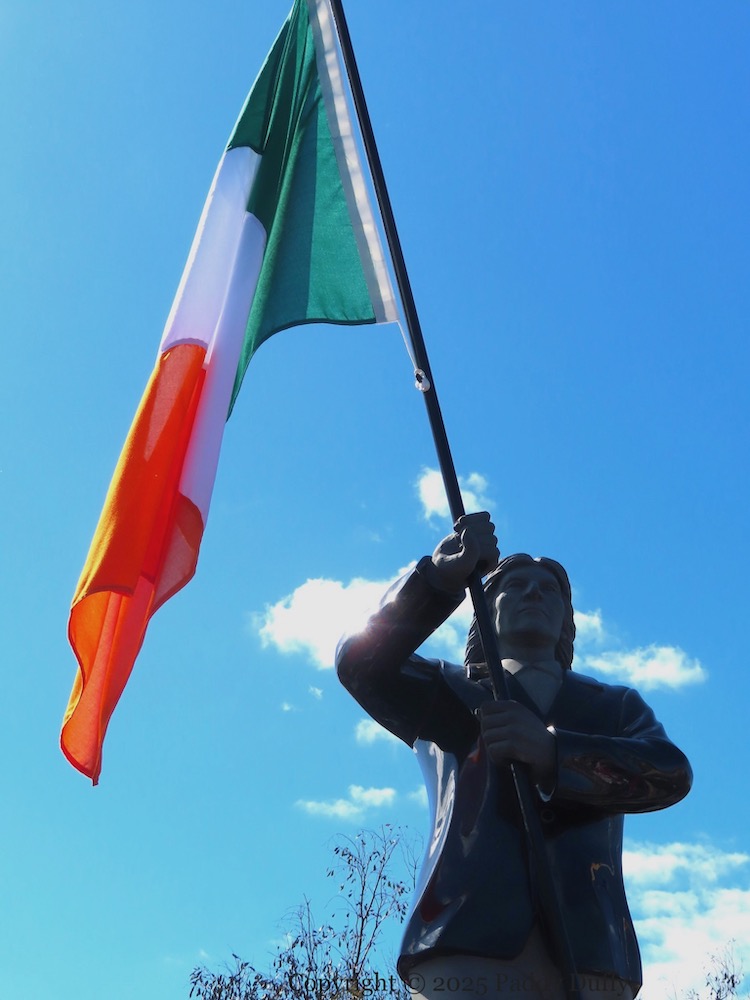
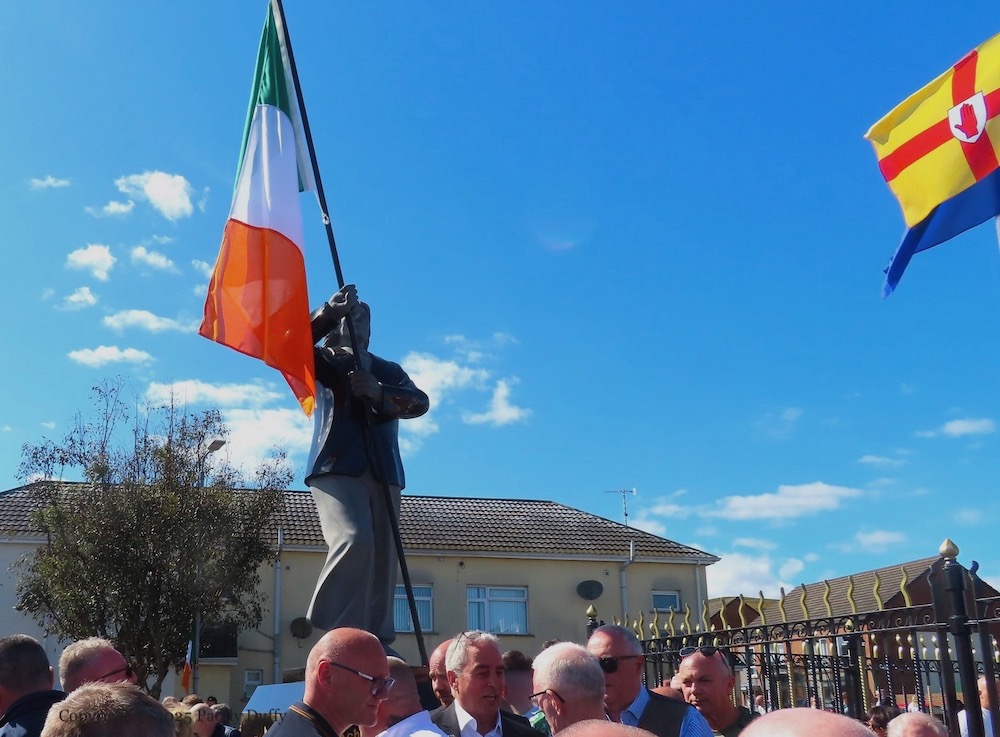
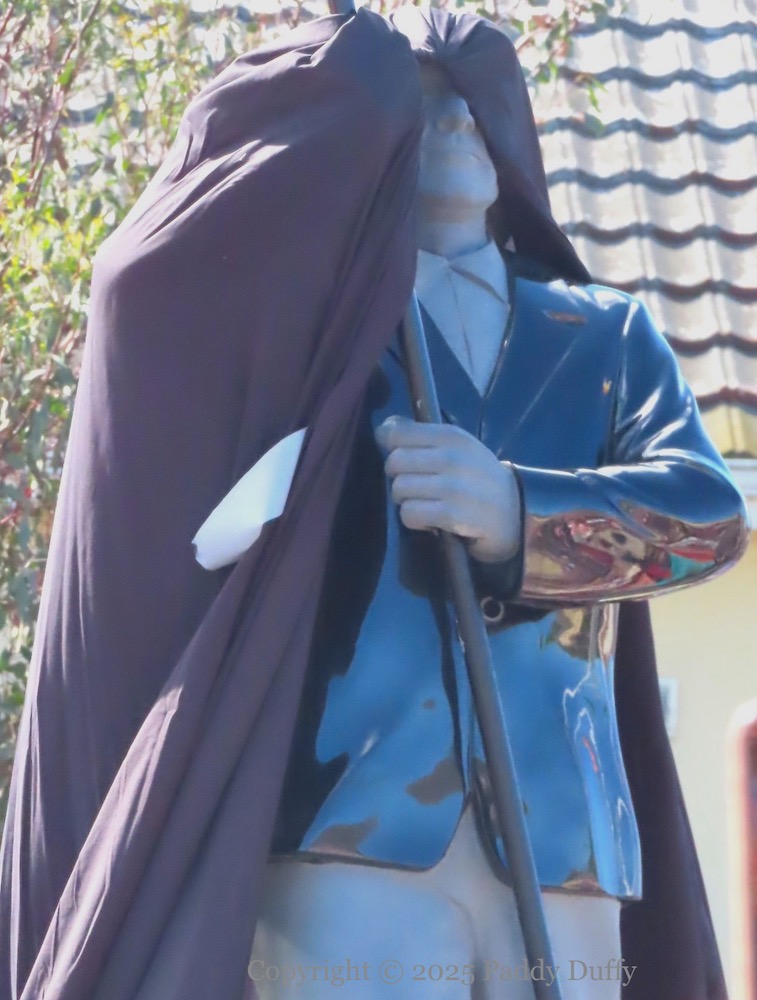
“Óglach Bobby Sands 9th March 1954 – 5th May 1981”. Sands was the first of the ten IRA and INLA prisoners to die in the second hunger strike. For the 44th anniversary of his death, a statue was unveiled in Twinbrook, near the Sands family home and next to the memorial garden in Gardenmore Road (Peter Moloney Collection).
The statue was created by Packy Adams (Belfast Media | Irish News) and appears to be based on the photographs by Gérard Harlay – discovered in 2019 – of Sands carrying a United Irishmen flag in a march that took place a few months before his (final) arrest in 1976 (Bobby Sands Trust). The new statue (which does not have planning permission) has a built-in flag-pole, to which an Irish Tricolour was added for the launch on May 4th.
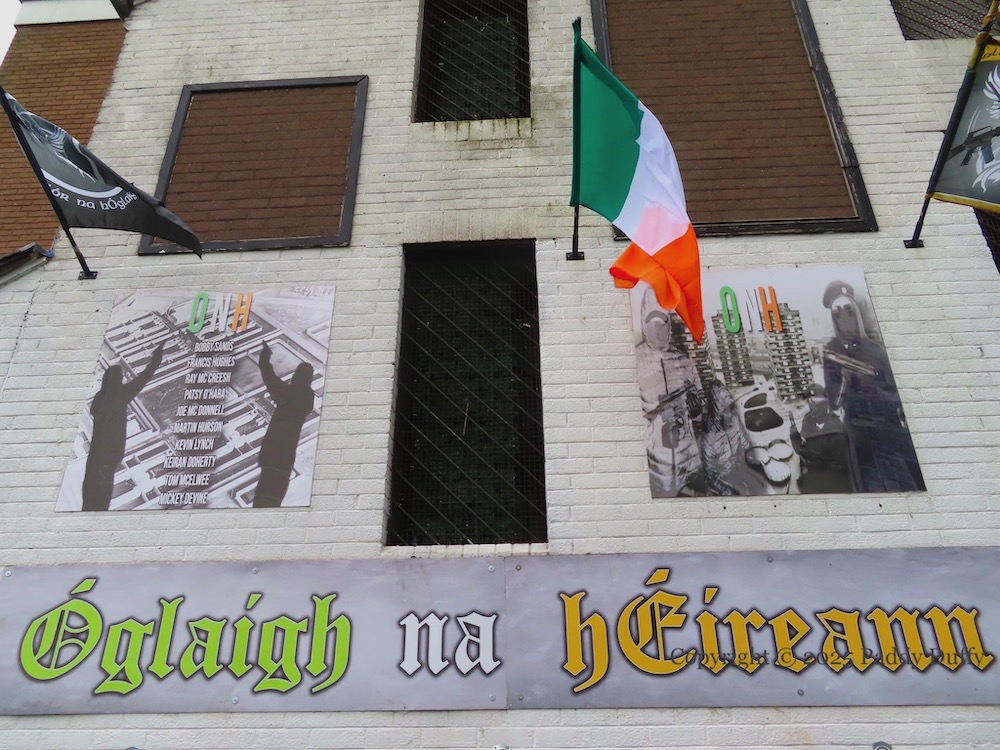
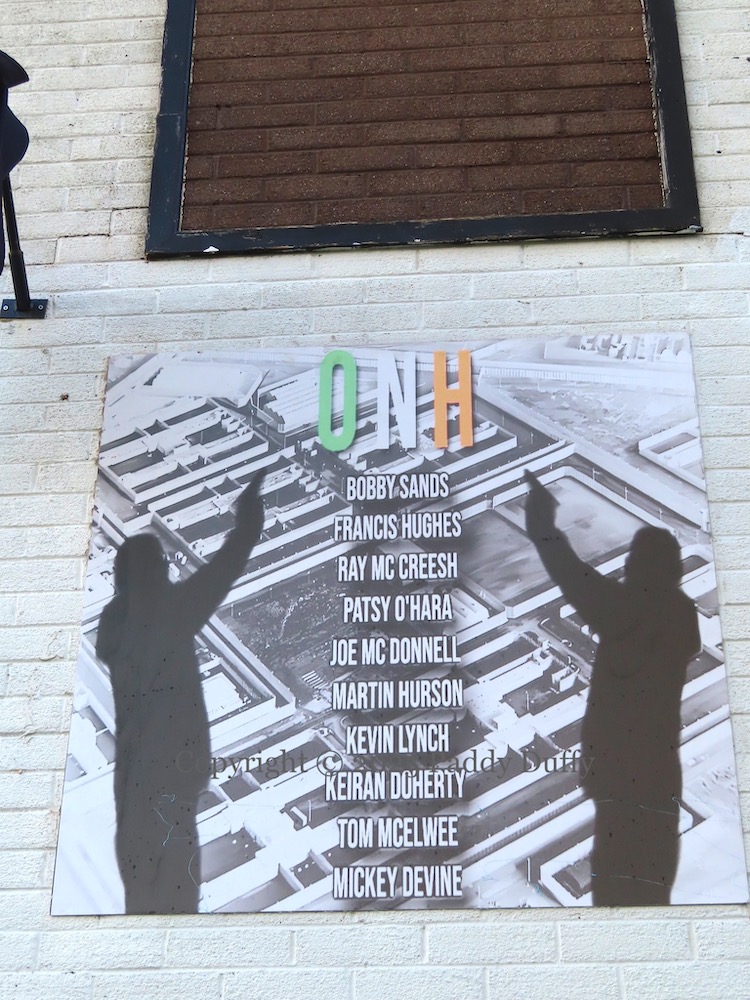
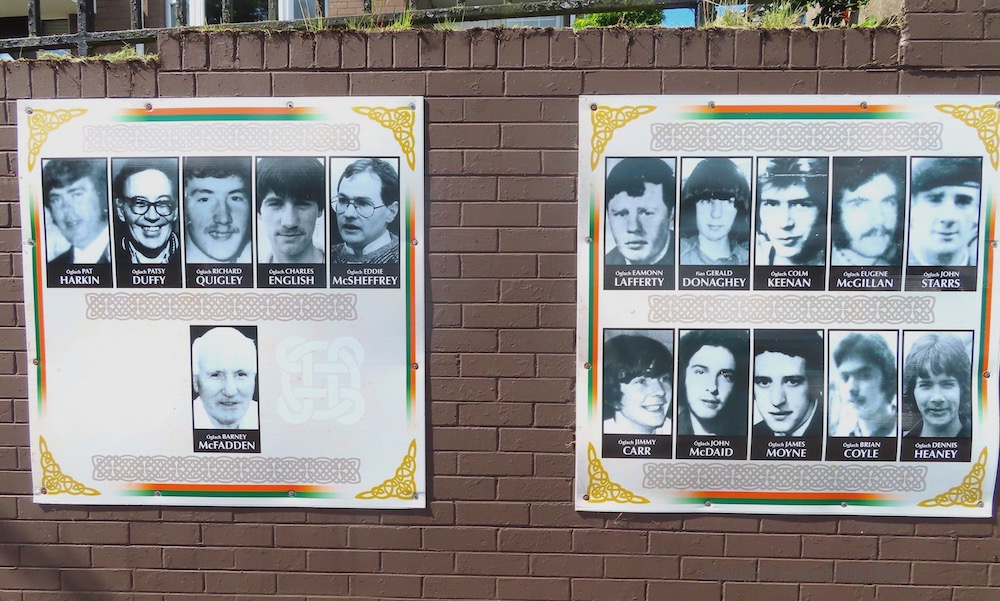
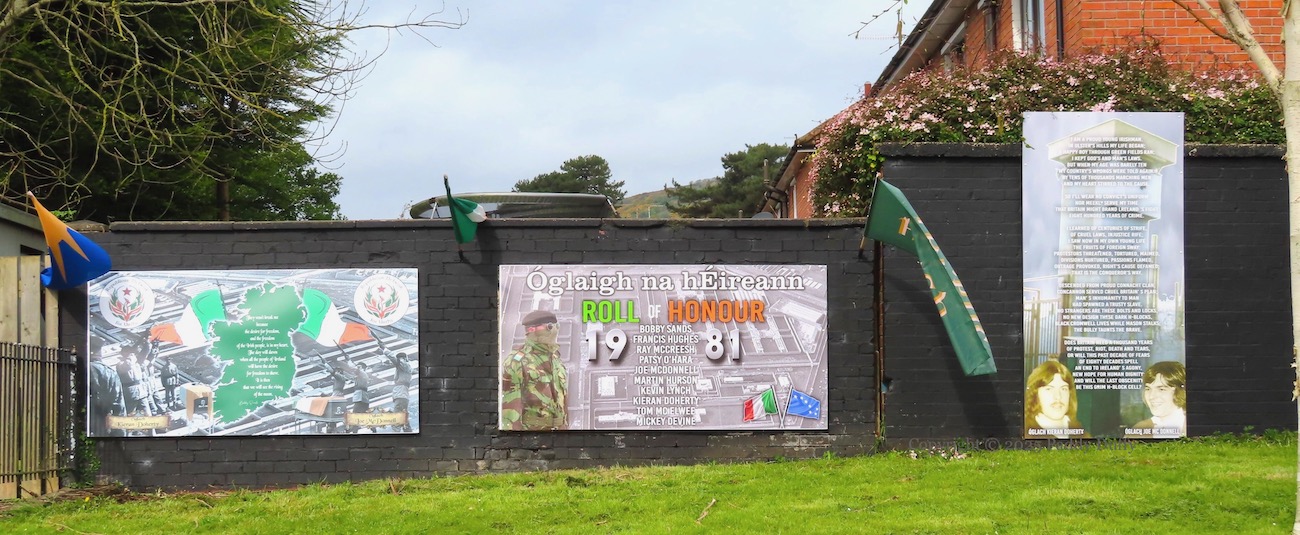
For Easter 2025, an “Óglaıgh Na hÉıreann roll of honour 1981” board was added to the wall at the top of Bingnian Drive in Andersonstown, with the names of the ten who died in the second hunger strike. “Óglaıgh Na hÉıreann” here obscures the difference between the IRA and the INLA (O’Hara, Lynch, Devine), and between the Provisional IRA and the anti-Agreement IRA factions. It’s not clear to what extent the (2009 onward) ONH is currently operating, after a split in 2024 (BelTel 2024 | BelTel 2025).
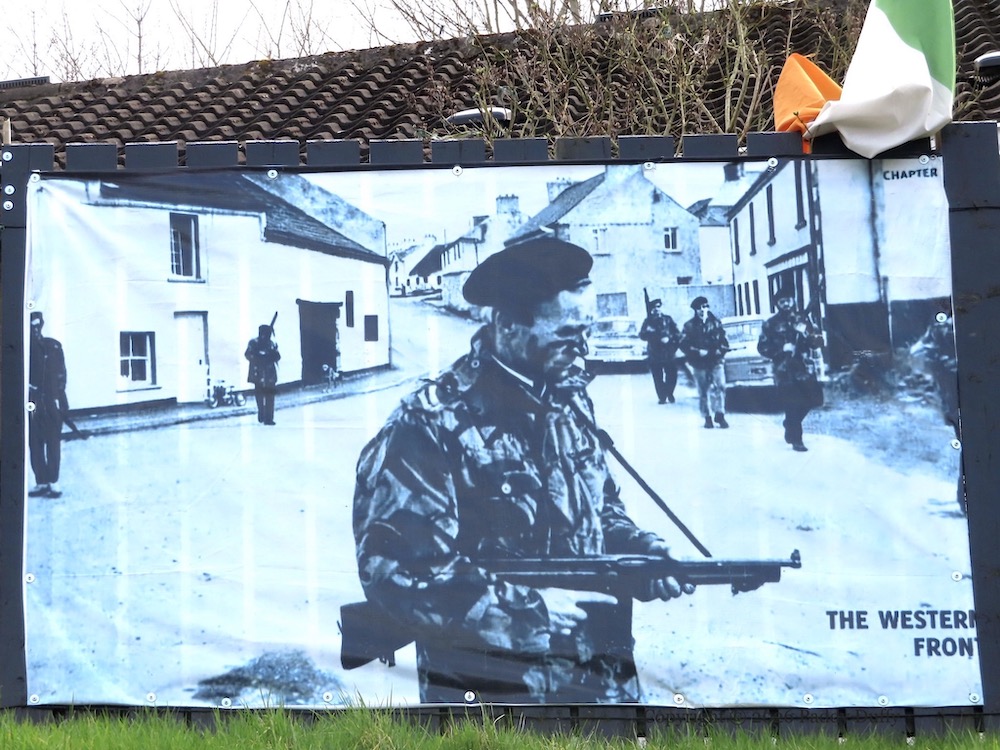
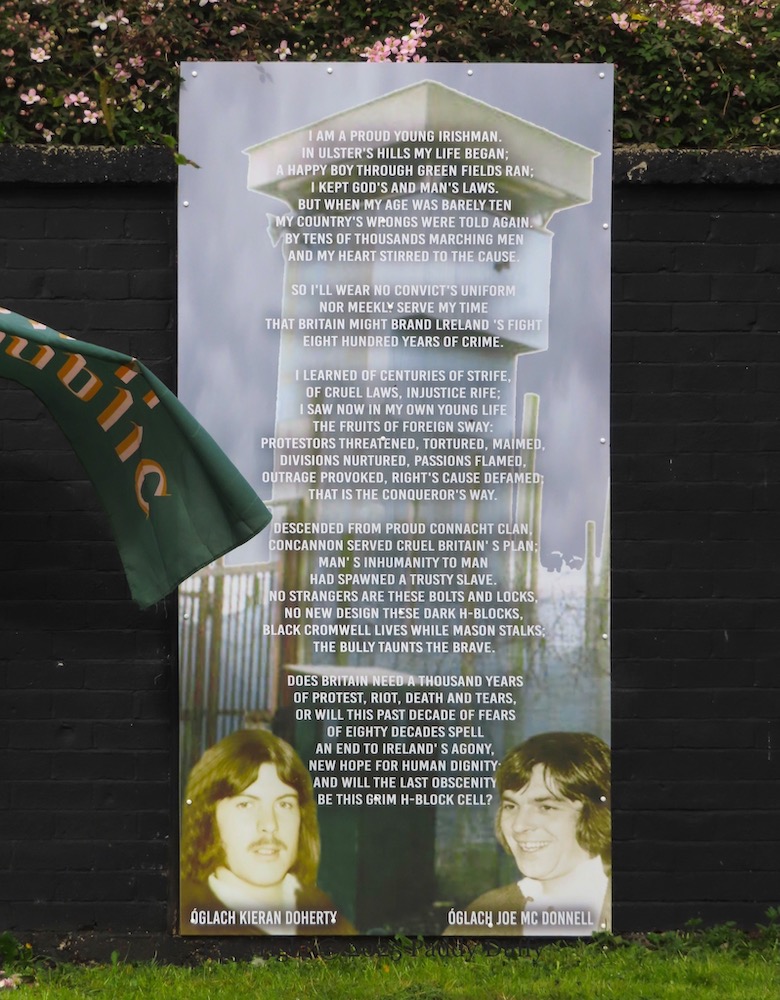
For the RNU piece on the left (in the wide shot) see The Rising Of The Moon. Like the piece on the right, it features Kieran Doherty and Joe McDonnell, two of hunger strikers who were local to the area. For background information, see the board formerly on the wall: To Whom Do We Owe Our Allegiance Today?













 Paddy Duffy Collection